

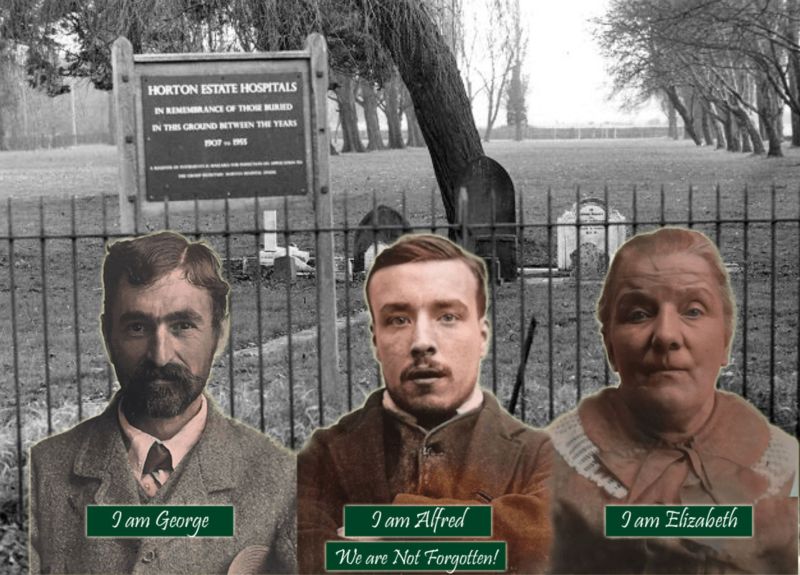
“Us and Them” visualises connections with former Epsom patients


A ground-breaking heritage project exploring the lives of disabled people detained in Surrey’s former mental hospitals is turning fresh attention on Horton Cemetery in Epsom – the burial ground of some 9,000 men, women and children whose resting place remains locked, overgrown and inaccessible under the control of a property speculator who has neglected the site since the 1980s.
Freewheelers Theatre and Media, a creative company of disabled artists based in Leatherhead, is leading Us and Them, a National Lottery Heritage Fund-supported initiative using original medical portrait photographs and case records from Surrey’s long-closed asylums. Working with photographer Emma Brown, community history group On the Record and researchers at King’s College London, they are uncovering the stories of patients whose voices were seldom heard in their lifetimes. The project includes new wet-collodion portraits of Freewheelers members made using the same Victorian techniques once used in institutions such as The Manor Hospital and West Park. These contemporary portraits will be shown alongside the originals in a touring exhibition, with the first major display due to take place at The Horton, Epsom, in 2026.
For Epsom, the work resonates particularly with Horton Cemetery – the former burial ground for patients from the Epsom Cluster hospitals, including The Manor, Horton, Long Grove, West Park and St Ebba’s. Despite its national historic significance as the largest asylum cemetery in the UK, the cemetery has been left to decay for decades and remains closed to relatives, historians and the wider community. The Friends of Horton Cemetery continue to campaign for its return to public or charitable ownership so that the site can be restored, documented and respected as the resting place it once was.
The Freewheelers project highlights the human stories behind those buried there. One participant, Alice Scott, chose to pair herself with Rose Harris, a woman confined to The Manor Hospital in 1910 and buried in a pauper plot at Horton Cemetery in 1917. Another member, Pete Messer, recreated the photograph of workhouse survivor Frederick Tarrant, who spent 15 years in various institutions, part of the same system that funnelled thousands of patients to unmarked graves in Epsom.
Historians involved in Us and Them emphasise how the original photographs were created without consent for purposes of classification and diagnosis, often contributing to stigma. Today, the Freewheelers portraits aim to prompt public reflection on how disability is perceived and represented, and how society remembers – or forgets – those who lived and died within institutional care. The project’s December creative sessions coincide with a Christie’s auction of similar historical images, underlining renewed public interest in the stories of institutionalised people.
The Friends of Horton Cemetery say the renewed national attention generated by projects like Us and Them strengthens the argument that the burial ground must be brought back into community hands. Volunteers have long argued that the cemetery is a unique and irreplaceable heritage site, containing the life histories of people from across Britain and the world, many of whom have living descendants still searching for answers.
Recent BBC reporting has highlighted the scale of the neglect, the site’s condition and the growing calls for public ownership. For many families, the cemetery is the last physical link to relatives whose lives were shaped by the former Epsom institutions. Campaigners say that without intervention, the stories now being rediscovered risk remaining disconnected from the very place where so many of those patients were laid to rest.
More information about the Friends’ campaign and the history of the site and some 500 personal stories of the patients buried in the Epsom Hospital Cluster cemetery in Hook Road/Horton Lane, Epsom can be found at www.hortoncemetery.org

See BBC coverage here:
Disability group recreates Victorian hospital images
‘Grandad is one of 9,000 buried in derelict site’
Call for public ownership of asylum cemetery
Related reports in Epsom and Ewell Times:
Portraits of pauper patients in Epsom’s Horton Cemetery, inspires artist
Petition to reclaim Horton Cemetery from property speculator
Local community gathered at Horton Cemetery
Another Horton Cemetery Life Story
Image: Background Horton Cemetery: photographed on 28 February 1971 by L R James. Epsom & Ewell Local & Family History Centre. Foreground: Courtesy Friends of Horton Cemetery