

Epsom and Ewell countryside volunteers face uncertain times


Epsom and Ewell’s army of countryside volunteers faces uncertain times as responsibility for protecting the borough’s wildlife habitats shifts next year to a new East Surrey council. The fear is that nature conservation will slide down the priority list during the upheaval of local government reform.
Dozens of local people turn out in all weathers to help nature thrive in places such as Epsom Common, Horton Country Park and on the Hogsmill, an internationally rare chalk stream where water voles were reintroduced last year. More than 40 percent of the borough is open space for the public and visitors to enjoy, or other green belt land. Their work varies widely from opening up woodland glades and removing invasive plants to tending orchards and laying woodchip footpaths. Caring for juniper bushes, which are critically declining in Britain, is an important task on the Epsom Downs.
Epsom and Ewell Borough Council leads much of this conservation work, supervising the volunteers and organising contractors to carry out bigger jobs. However, it is due for abolition under a major shakeup of local government when East Surrey takes over in April 2027. Little is known about how the countryside, which provided residents with uncrowded space to exercise and enjoy nature during the Covid pandemic, will be managed in future. Work on the transfer of powers has only just begun, and where the new council will be based has yet to be decided.
Local people caring for local nature
Amid the uncertainty, volunteers are anxious to ensure that local people keep caring for local nature, and that residents retain ready access to their woods, wildflower meadows and riverbanks. “To preserve what we’ve got takes a lot of work, and in Epsom and Ewell it’s largely done by volunteers. My concern is it continues to get done,” said David Dixon, a volunteer for the past 10 years. “Volunteers are not going to travel 20 miles to do it, they want to do it locally. The worry is that it’ll be subsumed into some sort of central authority who won’t know the local areas, who won’t really know the tasks that are needed,” said Dixon, one of a roughly 10-strong group led by the Council’s Countryside Team that meets every Thursday.
Volunteers in various countryside groups collectively work about 8,800 hours a year in the borough. Their task is to maintain and improve the biodiversity of local sites which are home to the likes of kingfishers, endangered great crested newts and a rare population of all five UK species of hairstreak butterfly. Native roe deer also roam, peregrine falcons visit from a nearby nest and cuckoos are once again heard, all within a stone’s throw of the town centre.
Risks and opportunities
The aggregate hours figure has been collated by Dave King, who chairs the Epsom Common Association (ECA), and Geoff Delamere, a countryside volunteer since 2018. In a briefing paper they detail the risks and opportunities raised by the reform which will replace Surrey’s two levels of local government with a single tier. https://bit.ly/4bvgZnR
At a time when council budgets are under heavy strain those 8,800 hours equate notionally to almost £112,000 worth of voluntary labour a year, based on the National Living Wage rate. Volunteer work keeps down the cost of managing the borough’s two Sites of Special Scientific Interest (SSSIs), five Local Nature Reserves and six ancient woodlands. “We’re pretty good value for money,” said King. The ECA’s EcoVols group works on the Common two days a month for much of the year, with 10–15 volunteers typically turning out.
Epsom and Ewell’s professional countryside officers are paid from the Council budget but they amount to just three full time equivalent staff. Most of the work they lead is funded externally, largely from UK government countryside stewardship schemes. When they aren’t working outdoors, Council officers may be at a computer applying for such funding or environmental grants from other sources.
A vision for nature
The modest cost of countryside management means it risks being overshadowed by much bigger budget items that East Surrey will take over. “I fear that wildlife and nature reserves may be well down the priority list,” said King. “We need people who understand the site, have a vision for the site.” ECA volunteers also make charcoal for sale and check the welfare of cattle that graze the Common in the summer.
A new body, East Surrey Joint Committee, is overseeing the transition and aims to ensure all services move smoothly into the new arrangement. It met for the first time only in January and will work until voters elect East Surrey councillors on May 7. East Surrey will then act as a shadow authority until April 1 next year when it takes over, with the borough continuing to run services in the meantime. Ultimately, decisions about how countryside management, including volunteering, are funded and run will be made by the East Surrey Council.
Countryside management is not the only thing surrounded by uncertainty. Arrangements have to be made for the wide range of services currently provided by Surrey’s 11 borough and district councils, all of which will be subsumed into either West or East Surrey.
Knowledge and expertise
Epsom and Ewell has a large body of other volunteers working in everything from litterpicking to helping run Bourne Hall Museum. Council leader Hannah Dalton, who sits on the East Surrey Joint Committee, did not respond to a request for comment. However, Residents’ Association councillor Liz Frost, chair of the borough’s Environment Committee, expressed gratitude for countryside volunteers. “Their essential work, local knowledge and expertise help ensure that our residents and visitors can enjoy easy access to nature and open spaces across the borough,” she said in a statement.
Such work relies on council leadership and support. The Thursday group attended by Dixon and Delamere is run directly by the Epsom and Ewell Countryside Team, which draws up a work programme, provides equipment and supervises the volunteers. The group typically cuts back undergrowth to allow veteran trees – some more than 300 years old – space to flourish. In the spring they erect electric fencing so that cattle, including the gentle “Belties” – Belted Galloways marked by broad white stripes around their bellies – can graze and help maintain habitats.
Feargal Sharkey support
At other times volunteers uproot Himalayan balsam, a colourful but highly invasive Victorian import which chokes native vegetation along many of Britain’s rivers, including the Hogsmill. Volunteers also control ragwort in Nonsuch Park, allowing grassland to be mown for hay, which must be free of the plant as it is harmful to horses. The park has its own volunteer team, the Nonsuch Voles.
Such work is hard but rewarding. “It’s the most enjoyable ‘job’ I’ve had,” said Delamere. “It’s outdoors and good exercise, as well as being useful for the environment and biodiversity.” He added that companionship and learning new skills are key benefits, along with positive comments from passers-by. “Long may this mix of professionals and volunteers continue.”
On Epsom Common, the Council Countryside Team agrees a conservation programme for the independently-run EcoVols to carry out. “They do a lot for us,” said King, noting work such as scrub clearance and chainsaw operations. “We cost about a pound per volunteer hour,” he added.
Skylarks and kestrels
Other groups operate across wider areas including Epsom and Ewell. The Lower Mole Partnership works throughout northeast Surrey and neighbouring Kingston, while the Surrey Wildlife Trust manages Priest Hill where skylarks and kestrels are commonly seen. The Woodland Trust owns Langley Vale Wood, and the South East Rivers Trust is active on the Hogsmill. Local volunteer groups also include the Epsom and Ewell Tree Advisory Board and the Friends of Horton Country Park.
Much of this work is not discretionary. Environmental legislation requires biodiversity to be enhanced, so these efforts must continue into the future. “Volunteers are going to have to work locally,” said Dixon. “And the people who decide what has to be done are going to have to have a good local knowledge.”
David Stamp is a member of the Epsom and Ewell Borough Council countryside volunteers group.
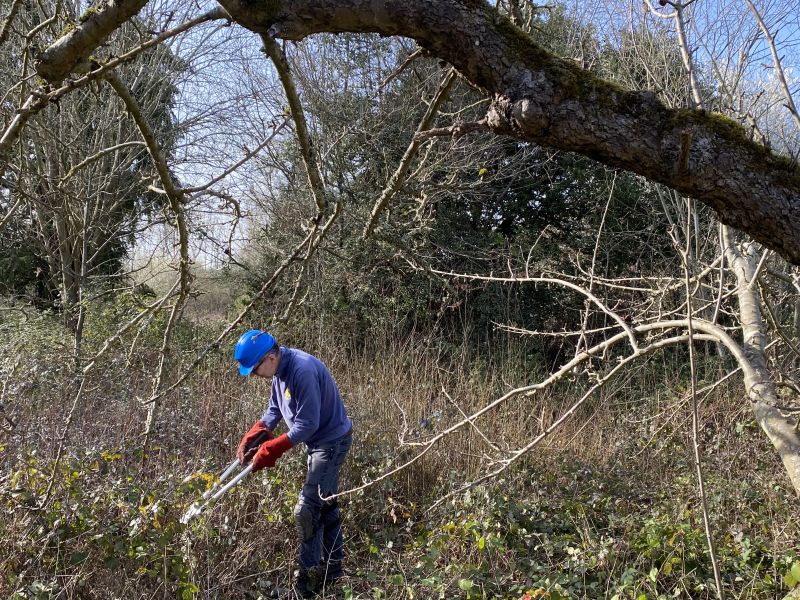
Photo: A volunteer clears undergrowth in Horton Country Park
Related reports:
Epsom Common 19th Green Flag Award
Epsom Common Association: A History of Conservation and Biodiversity