


A newly built railway footbridge has been delivered to Epsom Common but cannot be installed after a late dispute emerged between Surrey County Council and Network Rail over its width.
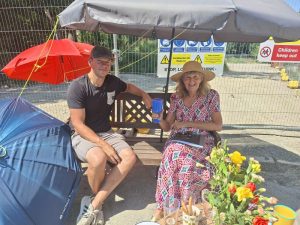
Residents of Castle Road, Epsom, who have endured nearly three years without the former crossing to Evelyn Way, briefly blocked access to the Network Rail compound when the replacement structure arrived to be stored beside their homes.
The previous bridge was closed and demolished almost three years ago. Work to strengthen and rebuild its supports began earlier this year, and residents had expected the new bridge to be installed over the weekend of 4 July.
Instead, the structure is now lying within the building site while Network Rail and Surrey County Council attempt to resolve whether it can legally be installed.
The bridge has been designed with a width of 1.5 metres. However, SCC says the public footpath crossing the railway has a legally recorded width of 3.6 metres.
The council maintains that allowing a narrower bridge would obstruct part of the public right of way and breach its statutory duty to protect its full width.
What has particularly angered residents is that the conflict appears not to have surfaced until April 2026, despite the bridge having been absent for almost three years and construction work beginning in February.
SCC says it was neither consulted about the replacement design nor asked to approve the works before construction began.
‘No choice but to object’
Cllr Matt Furniss, SCC Cabinet Member for Highways, Transport and Economic Growth, told the Epsom and Ewell Times:
“We appreciate and share residents’ frustration at the situation. Unfortunately, Network Rail failed to consult us on the installation of the bridge prior to starting construction works in February, nor did they apply under the Highways Act for an S118 or technical approval to undertake works to a structure on a public highway.
“This meant when we found out about the bridge work in April, we had no choice but to object in line with our statutory duty to assert and protect public rights of way.
“The bridge being proposed by Network Rail also fails to meet minimum width national design standards, with it being less than half the width of the public footpath. To provide a narrower bridge is an obstruction under the Highways Act.”
Cllr Furniss added that SCC understood Network Rail had placed a structure on the site but said the rail infrastructure body had not confirmed its intentions.
“We will continue to work with Network Rail to resolve this situation as soon as possible while achieving the best possible long-term outcome for the community and ensuring that the public footpath is protected,” he said.
Residents halt delivery
Residents learned that, rather than pay for storage elsewhere, the completed bridge was to be delivered to the site and left there pending a resolution.
When the delivery day arrived, a group gathered at the entrance and initially prevented the vehicle from entering.
“We were ready for it; the whole thing was set up for it,” said Castle Road resident Linda Barry. “But if it’s now just dumped here, we have no idea when the bridge will be installed. What has been the three-year hold-up at Surrey County Council?”
The project manager was called to the scene and attempted to reassure residents that the delay would be temporary. With the bridge already in transit and no alternative place immediately available for it, residents eventually allowed it to be unloaded.
“We were in an impossible position,” said Ms Barry. “The bridge was here, and there was nowhere else for it to go. But now we have no guarantee that it will be installed, so it could be here by the side of the road for a long time.”
Residents say they have already endured years of disruption, dust and temporary sewage-pumping arrangements associated with the works.
Council learned of bridge through social media
In a separate response to Ms Barry, a member of the SCC Countryside Capital Programme said the authority became aware of the proposed replacement bridge only in late April — and did so through social media.
She wrote: “Unfortunately, we had not been consulted on the design and therefore had no opportunity to provide input during its development.”
She explained that Section 130 of the Highways Act 1980 requires the council, as highway authority, to assert and protect the rights of people using public rights of way.
“This includes protecting the full recorded width of the public footpath,” she said. “As a result of the legislation, we are not legally able to permit the installation of a bridge that would reduce the available width of the public footpath to below the recorded legal width.”
Ms Barry questioned why consultation had apparently not taken place during the years between the closure of the old bridge and construction of its replacement.
She also pointed out that, during her 43 years living in Castle Road, she had known the crossing as a footbridge used by pedestrians and people with pushchairs rather than as a route requiring a 3.6-metre-wide structure.
Potential year-long delay
Residents have been told that resolving the dispute could delay installation by as much as another 12 months, although no revised completion date has yet been formally confirmed.
The controversy raises questions over how a replacement bridge could be designed, manufactured and brought to the point of installation without the highway authority responsible for the public right of way being consulted.
For Castle Road residents, the immediate result is that a bridge built to restore a long-closed route has reached Epsom — but remains firmly on the ground.
Photo caption: Castle Road residents Linda Barry and Rob block access to the Network Rail site before the replacement footbridge was unloaded.
Network Rail was been invited to comment.

.
Photo caption: Castle Road residents Linda Barry and Rob block access to the Network Rail site before the replacement footbridge was unloaded.
Related reports: