


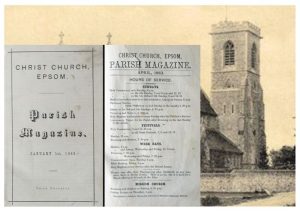
Out of the blue, Christ Church Epsom Common was recently approached by a Worcestershire-based bookseller and gratefully accepted her kind gift of a bound volume (about the size of a modern paperback) of parish magazines from 1883. The volume, too battered and niche for resale, nonetheless provides a fascinating glimpse into the life of the parish just seven years after the church’s consecration in 1876.
There were Christ Church parish magazines before this: the January 1883 edition refers to an item in the now-lost December 1882 magazine. As with many such publications, they were seen as ephemeral at the time. Although issued monthly, the next surviving edition in the Christ Church archive dates from 1900, with records then remaining patchy until the late 1940s, when systematic retention began.
Both the gold-stamped spine and the frontispiece give the contents simply as Parish Magazine 1883, with no mention of the parish name. The editor is listed as J Erskine Clarke MA, an Anglican clergyman who, in January 1859, launched what is regarded as the world’s first commercial parish magazine inset, prosaically titled Parish Magazine. Each monthly edition ran to around 24 pages and combined religious material with a surprisingly wide range of secular content.
Alongside sermons and Bible studies were items of fiction (often moralising), practical advice, articles on British wildlife, and descriptions of churches and places at home and abroad. The 1883 editions included pieces such as First Aid to the Sick, Making a Will, an account of a visit to Malta, an unexpectedly open-minded article on Islam and the Prophet Mohammed, and the intriguingly titled Worms and their Habits. Each issue carried at least two engraved illustrations, particularly to accompany the travel articles.
The inset was published by Wells Gardner, Darton & Company of Paternoster Buildings, London, specialists in ecclesiastical publishing, and printed by Strangeways & Sons. It was always intended to be surrounded by locally produced parish material. At Christ Church this usually amounted to a further eight pages, printed and bound with the inset by local firm L W Andrews & Son. In some months, when local material ran to only four pages, the usual plain cover was altered to make better use of the available space.
Parishioners paid 2d per issue – roughly £1 in today’s money.
Much of the local content was routine but revealing. Each issue set out the full schedule of services for the coming month, listing not only Sunday services but weekday Mattins and Evensong, along with the hymns to be sung. Lists of baptisms, marriages and funerals followed, together with a standard notice inviting women to offer Thanksgiving after Childbirth, “there being no fee, but it being usual for a Thank-offering to be made at the Altar”. Details of the previous month’s collections were also carefully recorded.
Christ Church did not acquire its own church hall until 1899, so meetings and events were held in a variety of venues. The January 1883 magazine lists the Vicarage, the Working Men’s Club, the Infant School and the Guild Room. The then-new Working Men’s Club, opened in 1881 and later renamed the Epsom Common Club, stood just across Stamford Green.
The Infant School, now lost, stood on West Hill (then known as Clay Hill). Founded through an 1844 endowment by Miss Elizabeth Trotter of Horton Manor, O’Kelly’s former racing stables were converted for the education of children from families on Epsom Common. The school closed in 1925 and was later demolished.
Another regular feature was the “Penny Bank”, encouraging thrift among parishioners. Deposits could be made weekly at the Vicarage, with interest paid at 2½ per cent – or 5 per cent for children attending Christ Church Sunday School.
The January issue opened with a letter from the Vicar, the Revd Archer Hunter, then barely a year into what would become a 30-year incumbency. After setting out his vision for the developing parish, he appealed for more Sunday School teachers and closed by wishing all a Happy New Year – though only, he cautioned, for those “determined to spend it in the constant Presence of their God and Saviour”.
Later editions offer vivid glimpses of parish life. February records a recitation of Dickens’ Christmas Carol in the Infant School room, delivered by Mr Mechelen Rogers before a large audience. While not all were amused, those “qualified to give an opinion” spoke in the highest terms of his performance, promising him an “enthusiastic and noiseless” reception should he return.
March saw the founding of a parish branch of the Church of England Temperance Society, with 37 parishioners unanimously adopting a strongly worded resolution identifying intemperance as a source of poverty, crime and irreligion. Members signed pledges ranging from total abstinence to more qualified commitments, and the movement quickly attracted both adult and juvenile members.
The same edition listed the parish’s current “Wants”, including Sunday School teachers, a parish bier, a bookcase and books for a parochial library, and a new organ stop. It is a pleasing historical coincidence that this very volume survives bearing a library label inside its front cover, suggesting it was once item number 436 in that collection and heavily used.
For parishes that bound their magazines into annual volumes, the national publishers supplied a frontispiece and index, with the binding undertaken locally. A small label inside the rear cover of this book shows it was bound by John Snashall of Epsom High Street. Though now in poor condition, the quality of the leather spine and gold-blocked title speak of careful craftsmanship.
More than a century on, this battered volume offers a remarkably intimate picture of parish life in Victorian Epsom Common – practical, moral, communal and often surprisingly vivid.
This article is reproduced with permission from the Epsom and Ewell History Explorer (www.eehe.org.uk). The original article, written by Roger Morgan, forms part of EEHE’s extensive and richly illustrated archive of local history. EET readers are warmly encouraged to explore the many other fascinating histories available on the site.
Image: Christ Church from postcard 1900 and the front pages of the January and April 1883 editions by Roger Morgan © 2022