


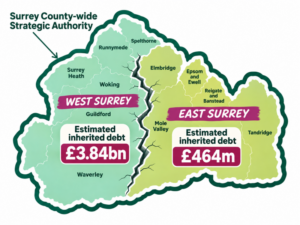
When Charles Dickens wrote A Tale of Two Cities, he contrasted the fortunes of London and Paris. Surrey’s approaching local government revolution offers a rather different tale: two new councils, born on the same day, inheriting vastly unequal financial fortunes.
On 1 April 2027, East Surrey Council and West Surrey Council will replace Surrey County Council and the county’s eleven borough and district authorities. Both will assume responsibility for everything from rubbish collections and planning to adult social care, education and highways. But while East Surrey will inherit comparatively modest debts and a generally stronger audit position, its western neighbour faces a financial inheritance dominated by billions of pounds of borrowing and serious doubts about the reliability of several predecessor councils’ accounts.
The contrast has been thrown into sharp relief by revelations at Woking Borough Council’s November Audit and Governance Committee, where external auditors Grant Thornton warned that the council was unlikely ever to obtain an unqualified audit opinion before it disappears next March.
The problem extends beyond Woking. The auditors indicated that almost all the councils joining West Surrey were expected to enter the new authority with disclaimed audit opinions, presenting an exceptional challenge in establishing reliable opening financial balances.
Councillor Stephen Oades (Independent: Goldsworth Park) asked whether this was really the best start for West Surrey. The answer, judging by the auditors’ evidence, was clearly not.
What does a disclaimed audit mean?
A disclaimed audit opinion does not necessarily mean that money has gone missing or that accounts are fraudulent. It means the auditor cannot obtain sufficient reliable evidence to express an opinion on whether the financial statements present a true and fair picture.
Across England, a backlog of local authority audits has resulted in numerous disclaimed opinions, sometimes because statutory deadlines prevented auditors from completing their work rather than because of financial misconduct.
Woking, however, has particularly serious difficulties. The council’s financial collapse, its complicated commercial investments and gaps in supporting records have created problems extending back to its last satisfactory audit in 2018/19.
The November meeting heard of missing bank statement evidence and inadequate information concerning debtors, creditors, leases and collection fund reliefs.
The difficulty for West Surrey is that the new council must establish opening balances for all the assets and liabilities it inherits, despite auditors being unable to verify some of the historical figures. Grant Thornton described the scale of this challenge as exceptional.
There is nevertheless some reassurance. Surrey County Council, which represents the great majority of the new authorities’ service expenditure, has an unqualified audit record. This provides a substantial foundation for both successors, even if it cannot eliminate problems inherited from the districts.
East Surrey starts from firmer ground
East Surrey, bringing together Elmbridge, Epsom & Ewell, Mole Valley, Reigate & Banstead and Tandridge, faces a significantly more favourable position.
At an East Surrey shadow authority committee meeting, the Interim Chief Finance Officer confirmed that Surrey County Council and three of East Surrey’s five borough and district councils had obtained unqualified audit opinions for 2024/25. The other two had received modified or disclaimed opinions.
Those two are Reigate & Banstead and Tandridge, both affected by the national audit backlog and difficulties establishing assurance over opening balances. By contrast, Elmbridge and Epsom & Ewell received unqualified opinions, while Mole Valley completes the eastern group of three.
This does not mean that East Surrey can simply combine five clean sets of accounts. Its finance officers are working with the two affected councils on improvement plans, recognising that unresolved audit qualifications could carry forward into the new authority’s opening balance sheet.
Epsom & Ewell Borough Council offers a particularly relevant local comparison. Its external auditors Grant Thornton gave its 2024/25 accounts an unqualified opinion, subsequently acknowledged at the borough’s Audit and Scrutiny Committee in March 2026. Its 2025/26 financial statements were also brought before the committee in November, well ahead of the transition to East Surrey.
The distinction is significant. While West Surrey must address severe financial difficulties alongside unreliable historical audit evidence, East Surrey’s problems appear more contained and potentially easier to resolve.
The billions separating East and West
The real gulf between the two new authorities emerges from their borrowing.
Financial information presented to the East Surrey Joint Committee in March 2026, using government borrowing and investment data from December 2025, calculated the following indicative positions:
East Surrey net borrowing £464m. West Surrey net borrowing £3.84bn
West Surrey’s net borrowing was therefore estimated at more than eight times East Surrey’s.
These figures include indicative allocations of Surrey County Council borrowing and investments and an assumed £500 million reduction in Woking’s debt. They are planning estimates, not final opening balances. The ultimate division of county liabilities and the mechanism for addressing Woking’s debt remain important matters to resolve.
The underlying difference is unmistakable. Woking, Spelthorne and Runnymede have accumulated borrowing on a scale unmatched anywhere in East Surrey, largely associated with commercial property investment strategies and their financing.
East Surrey’s constituent councils have certainly borrowed money, but none approaches the exceptional levels found in the west.
The debt inheritance of all eleven districts
Figures previously reported by the Epsom & Ewell Times for 2024/25 illustrate the scale of the disparity.
| Future council | Existing borough or district | Borrowing |
|---|---|---|
| West | Woking | £2,155.6m |
| West | Spelthorne | £1,065.8m |
| West | Runnymede | £597.7m |
| West | Guildford | £311.5m |
| West | Surrey Heath | £183.4m |
| West | Waverley | £140.3m |
| East | Tandridge | £92.8m |
| East | Mole Valley | £73.9m |
| East | Epsom & Ewell | £64.4m |
| East | Elmbridge | £48.6m |
| East | Reigate & Banstead | £5.0m |
Source: Epsom & Ewell Times, previously published 2024/25 district debt comparison. Figures rounded. This historical gross-debt comparison uses a different basis and reporting date from the March 2026 net-borrowing projections above.
Collectively, the six western districts accounted for approximately £4.45 billion of borrowing in that comparison, against just £285 million across the five eastern districts.
The western total was more than fifteen times the eastern total, even before taking account of the county council debt that will be divided between them.
Epsom & Ewell’s borrowing of approximately £64.4 million amounted to around £786 per resident, whereas Woking’s exceeded £20,600 per resident. Reigate & Banstead was at the other end of the spectrum, with just £5 million, approximately £32 per resident.
These debts are not all equivalent financial risks. Some borrowing is supported by income-generating assets or capital investments, while other debt may be associated with assets that have lost value or generate insufficient returns. The value, income and future disposal prospects of those assets are therefore as important as the headline amounts.
The cost of borrowing is the real test
Borrowing itself is not necessarily a problem for local government. Councils routinely borrow to finance buildings, infrastructure and other long-term assets. The question is whether they can afford the interest and capital repayment costs without jeopardising essential services.
Here the difference between the two Surreys becomes even more pronounced.
According to the March 2026 financial planning report, the estimated annual gross financing costs for the new councils, including their share of county council obligations, were £51.9 million in East Surrey and £319.5 million in West Surrey.
The report calculated that borrowing costs would consume approximately 7.6 per cent of East Surrey’s indicative net revenue budget, compared with 39.9 per cent in West Surrey.
For Woking Borough Council alone, gross financing costs of £155.7 million were equivalent to more than seven times its 2026/27 net revenue budget before the effects of exceptional government support.
Spelthorne’s equivalent figure was 269 per cent and Runnymede’s 157 per cent. In other words, those councils’ financing commitments substantially exceeded the budgets available for ordinary services.
East Surrey’s individual districts are not without pressures. Epsom & Ewell’s £3.5 million annual financing costs represent approximately 29.6 per cent of its borough net revenue budget, while Mole Valley’s equivalent proportion is 24.3 per cent. Tandridge stands at 16.6 per cent, Elmbridge at 8.5 per cent and Reigate & Banstead at just 4.4 per cent.
These comparisons do not account for all investment income and other financing adjustments, but demonstrate why the inheritance of existing debts matters so much to the councils about to replace them. mycouncil.surreycc.gov.uk+1
Even the fortunate East faces difficult choices
East Surrey’s comparative advantage should not be mistaken for financial security.
The same council papers warn that all twelve existing Surrey authorities face medium-term budget gaps. Falling government support, increasing demand for social care, inflation and the cost of reorganising services will affect both new councils.
The proposed reallocation of Surrey County Council’s functions and finances adds another layer of complexity. Decisions remain necessary about how its assets, borrowing, liabilities and investment obligations will be divided between East and West.
There is also the question of council tax harmonisation. The five eastern districts currently charge different amounts, with the borough element of Band D council tax ranging from £217.60 in Mole Valley to £265.88 in Elmbridge in 2026/27. The new authority must decide how quickly to bring those rates together.
Finance officers have recommended harmonisation in the first year, but the political and financial consequences will require careful consideration.
East Surrey’s comparatively favourable balance sheet gives it greater room for manoeuvre. It does not exempt its councillors from difficult decisions about spending, taxation, reserves and services.
Can West Surrey escape its inheritance?
West Surrey’s financial prospects depend heavily on continuing recovery measures in Woking and Spelthorne, including the sale of commercial assets and government assistance.
Woking’s auditors have recognised considerable progress in restoring financial management and governance. Government debt support of £500 million began being implemented in September 2026, although its eventual effectiveness depends partly on the success of the council’s asset disposal programme.
Nevertheless, a recent Grant Thornton report identified liabilities exceeding assets by almost £1 billion at 31 March 2026, illustrating how far the authority still has to travel before achieving sustainable finances.
The creation of West Surrey does not itself make historic debt disappear. Unless liabilities can be reduced through government intervention, asset sales or other financial measures, they will continue to consume resources that might otherwise be available for local services.
Nor does the name change solve the auditors’ problems. The new authority must establish credible financial records while confronting the unresolved difficulties inherited from its predecessors. Woking Online+1
Two councils, one county, very different futures
Surrey’s reorganisation was promoted as an opportunity to simplify local government, eliminate duplication and create more efficient public services.
The two new authorities will share the same statutory responsibilities and operate within the same national funding framework. But they will begin their lives on remarkably unequal financial terms.
For East Surrey’s residents, including those in Epsom & Ewell, the challenge will be to ensure that the opportunity presented by a more manageable debt inheritance is not squandered through weak financial controls, unnecessary expenditure or failures of transparency.
For West Surrey, the challenge is more fundamental: establishing a financially sustainable authority despite a legacy of debt that has already overwhelmed some of its predecessors.
The fundamental question for the Government is whether it can expect the two councils to deliver comparable services when the financial burdens they inherit are so dramatically different.
Surrey’s new unitaries will be born equal in law. They will be anything but equal in financial circumstances.
And unlike Dickens’ two cities, neither can escape the consequences of the past simply by changing its name.
.
Related reports
- The Surrey Unitary Councils agree to go two-tier again – 24 November 2026
- West Surrey’s financial mess – 14 November 2026
- Will Middlesex get in Surrey West’s title after all? – 10 November 2026
- East Surrey Council – Not Quite What We Were Promised? – 27 October 2026
- Government to pay a chunk of Woking’s record debt – October 2026