


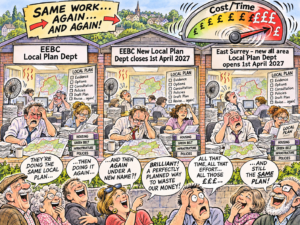
Epsom and Ewell Borough Council has voted to start preparing another Local Plan, even though its existing plan remains unfinished and the Council itself will cease to exist in just over four months.
At a meeting of the Licensing and Planning Policy Committee on Tuesday 24 November, councillors questioned the logic of the Government’s demand that the authority begin a new planning process before it hands over responsibility to East Surrey Council on 1 April 2027.
The decision comes after years of controversy surrounding Epsom and Ewell’s existing Local Plan, including disputes over Green Belt housing allocations, public consultations, planning inspectors’ requirements and the extent of democratic oversight.
The Government nevertheless insists that a new process must begin, despite the Borough Council having already missed two statutory deadlines.
Councillors ultimately agreed to publish a formal notice of intention to commence a new Local Plan and a timetable before the end of December. Much of the actual work will fall to the new East Surrey authority, which has already expressed a preference for preparing a single Local Plan covering all five existing boroughs and districts.
“It’s a nonsense”
Cllr Clive Woodbridge (RA Ewell Village) challenged the proposal, questioning why a council approaching abolition should begin a process that its successor would almost certainly wish to undertake itself.
“I am struggling to agree to this because it’s a nonsense,” he told the committee. “We’re not going to exist in four months’ time. A new local authority is going to come in, and they’re going to want to start this process.”
He suggested that the sensible course would be for East Surrey Council to take responsibility from the outset. Reflecting on the prolonged controversy surrounding the current Local Plan, he added: “We’ve just gone through this very lengthy, very politically charged exercise, which we haven’t finished yet.”
He feared that announcing another process so soon would damage public confidence. “It makes us look stupid, and just because the government wants something stupid, do we agree with it?”
Cllr Phil Neale (RA Cuddington) expressed similar reservations and referred to a letter sent to ministers by East Surrey Council’s Cabinet Member for Strategic Planning and Growth, Cllr Bradley Nelson.
The letter, dated 25 September, explains that five existing authorities are being required to progress plans they cannot complete before their abolition, while East Surrey cannot formally commence its own plan until April.
Cllr Neale asked whether the committee could defer its decision until the Government responded. Head of Planning Policy and Economic Development Ian Mawer confirmed that no response to Cllr Nelson’s letter had been received.
However, he explained that the Ministry of Housing, Communities and Local Government had already rejected local government reorganisation as sufficient reason for Epsom and Ewell to delay its own new plan.
Government intervention threatened
The committee heard that national regulations introduced in March 2026 required Epsom and Ewell to publish a notice commencing a new Local Plan by 30 June and complete an initial readiness assessment, known as Gateway 1, by 31 October. Both deadlines had passed without compliance.
Cllr Kieran Persand (Conservative Horton) asked what difference another short delay would make, given that both deadlines had already been missed. Mr Mawer acknowledged the missed deadlines but explained that the Council had spent the intervening period corresponding with ministers and seeking clarification of its obligations.
Cllr Neil Dallen (RA Town) asked what powers the Government possessed if the committee refused to proceed. Mr Mawer referred to section 15HA of the Planning and Compulsory Purchase Act 2004, explaining that the Secretary of State could intervene where an authority was failing to take necessary steps in preparing or revising a Local Plan.
“The Secretary of State can take over the preparation of a plan,” he explained, although he could not say whether ministers would actually exercise those powers.
Cllr Dallen suggested that refusing to comply might ultimately generate more work for council officers than taking the limited steps requested. “We can either lay back and say, ‘Okay, you told us to do it, we’ll do it.’ It’s not much work, or we can be obstinate and say no, we’re not going to, and probably cause a lot of trouble, which would be more officer time than just doing what we’re asked to do.”
Cllr James Lawrence (Independent College) agreed that the Government’s approach was difficult to justify but favoured taking the minimum necessary steps. “I do agree with Councillor Woodbridge that this is a somewhat bizarre decision by the government to do this,” he said.
However, he warned that refusal could attract unwanted ministerial attention and additional demands on officers. “I think the less effort option might actually be to agree to this, do the minimum that’s required to make sure that we’re legally compliant.”
Cllr Lawrence said he would support the recommendations reluctantly, believing compliance would involve less work than confrontation.
How much will another plan cost?
Questions were also raised about the financial implications of beginning another planning process. Cllr Lawrence asked whether approving the report would authorise additional expenditure and what costs might arise. Mr Mawer explained that the immediate work involved publishing a notice, preparing a timetable and updating the Council’s website, using existing officer resources.
No separate budget has been allocated for the new Local Plan Review.
However, he acknowledged that the cost of preparing a complete Local Plan could be substantial. “One million pounds is not unusual, or thereabouts. Sometimes a bit less, sometimes more,” he told councillors.
The officer report notes that any additional expenditure from the Council’s corporate projects reserve, which has an uncommitted balance of approximately £1.5 million, could significantly reduce funds available for other priorities.
Mr Mawer stressed that the committee was not being asked to authorise major evidence-gathering, external consultancy work or other substantial expenditure. Such decisions would fall to East Surrey after April.
Councillors restrict officers’ powers
There was a further discussion about exactly what the committee was authorising. Cllr Woodbridge initially questioned whether the matter required approval by Full Council. Mr Mawer clarified that the committee itself had authority to make the decision.
Cllr Persand then questioned a recommendation allowing the Head of Planning Policy and Economic Development to “finalize and publish” the new documents. He expressed concern that this wording might permit officers to make substantive changes without returning to elected members. “The word ‘finalize’ is quite vague,” he said, explaining that the documents could potentially be altered after the committee’s approval.
Mr Mawer replied that the changes envisaged were principally the insertion of publication dates and other missing administrative details.
Following discussion, Cllr Persand proposed an amendment restricting the finalisation authority to the highlighted text in Appendices 2 and 3 of the report. The amendment was seconded by Cllr Lawrence and approved.
The committee then passed the amended recommendation, alongside the decision to commence the preliminary planning process.
Another round of housing targets and Green Belt disputes?
The decision comes while the existing Epsom and Ewell Local Plan 2022–2040 remains under examination by a Government-appointed Planning Inspector.
Its history has been particularly troubled.
Preparation was paused by councillors in March 2023 before resuming in October that year. The plan was eventually submitted for examination on 10 March 2025.
Following hearings in autumn 2025, the Inspector sought additional evidence concerning the Council’s approach to Green Belt land and potential housing sites.
The resulting changes have generated further disputes over the inclusion of land previously protected from development.
At an extraordinary Full Council meeting on 26 October 2026, councillors divided 13–13 over whether to consult on the Inspector’s proposed Main Modifications. Mayor Cllr Lucie McIntyre used her casting vote in favour.
The resulting consultation, which includes additional housing allocations on Green Belt sites such as Downs Farm and Priest Hill, remains open until 14 December.
The new Local Plan Review would therefore begin before the Inspector has completed consideration of the existing one.
The Council’s report emphasises that starting the new process will not affect the ongoing examination of the current Local Plan.
CPRE: “Not another Local Plan – unbelievable!”
Tim Murphy of CPRE Surrey, the countryside protection organisation, has criticised both the requirement to begin again and the Government’s escalating housing targets.
In an opinion piece entitled “Not Another Local Plan – Unbelievable!“, Mr Murphy observes that several versions of the draft plan have already been produced, with at least four rounds of public consultation and considerable expenditure.
He estimates that the current draft plan, incorporating the Inspector’s proposed modifications, would provide for slightly fewer than 350 additional homes annually, compared with approximately 200 approved annually in recent years.
The housing target against which the existing plan is being examined is just under 600 annually.
But the Government’s subsequently revised methodology produces an even higher figure for the next plan, approaching 900 homes a year.
Mr Murphy warns that this presents an enormous challenge in a borough where much of the undeveloped land is Green Belt.
“Just about all this new housing would have to be built on the Borough’s Green Belt, unless we are to lose our local parks and school playing fields,” he argues.
He is particularly critical of the Government’s standard method for calculating housing need, which uses existing housing stock and an adjustment based on the relationship between local house prices and earnings.
Mr Murphy argues that this fails to reflect Epsom and Ewell’s position in the London commuter belt, where many residents earn considerably more than the borough’s locally recorded wages.
He also questions the assumption that increasing housing supply will necessarily reduce prices, arguing that developers may instead delay construction to protect their returns.
These are CPRE’s assessments of the housing market and the consequences of national planning policy, rather than findings reached by the Borough Council or Planning Inspector.
Mr Murphy also raises the fundamental question of how East Surrey will handle housing requirements inherited from its five predecessor authorities.
“Will the new Unitary Authority challenge the figures? Will it take a more strategic approach to accommodating more people in East Surrey? At this juncture, we simply do not know.”
What happens after April?
The timetable approved for publication provides for a new Local Plan Review covering 2027–2040.
Its provisional stages include a scoping consultation from 26 April to 7 June 2027, an initial Gateway 1 assessment in June 2027, further consultations during 2028, examination in 2029 and adoption scheduled for October 2029.
However, those dates are expressly subject to decisions by East Surrey Council after it assumes statutory planning responsibilities on 1 April.
East Surrey’s stated intention is to begin work on a single Local Plan for its whole area as soon as possible, rather than produce five separate successor plans for Elmbridge, Epsom and Ewell, Mole Valley, Reigate and Banstead, and Tandridge.
If that happens, Epsom and Ewell’s newly published notice and timetable may be superseded by a single East Surrey planning programme.
For residents already following the lengthy and contentious history of the existing Local Plan, the immediate consequence is therefore another formal planning exercise, but with important decisions about housing distribution, Green Belt protection, infrastructure and future development still to be taken by a different council.
The Borough Council will initiate the process. East Surrey will determine what ultimately becomes of it.
Related reports
- Mayor’s casting vote sends Epsom and Ewell Local Plan changes to consultation – 27 October 2026
- East Surrey seeks planning head start as Epsom faces two Local Plans at once – 30 September 2026
- Epsom and Ewell’s New Local Plan sites advance amid clash over scrutiny and cost – 25 September 2026
- Bitter exchanges in Epsom and Ewell Council Chamber on Local Plan oversight – 22 July 2026
- Next phase in the journey of the Epsom and Ewell Local Plan announced – May 2026
- Persand parses the Local Plan process in Epsom – 18 May 2026