Epsom and Ewell Times

Current

ISSN, LDRS and IMPRESS logos

On the Hunt for pothole repairs

Jeremy Hunt and a pothole

The Government will give an additional £3.7m for pothole repairs in Surrey. But one Surrey councillor is calling for ministers to “go further” and change the way road funding is allocated from Westminster.

Tuesday’s budget, delivered by South West Surrey MP Jeremy Hunt, announced an additional £200million for 2023/24 across the country for pothole repair.

Surrey County Council’s deputy cabinet member for levelling up, Councillor Rebecca Paul (Conservative, Tadworth, Walton & Kingswood) said she was “delighted” the Government had recognised more funding was needed in Surrey for road repairs. She told the LDRS: “The recent spate of potholes across our county affects every single one of us, so this additional money is much welcomed.” She called on the Government to “go further and give serious consideration” to changing how highways maintenance funding is allocated to take into account traffic volume.

Cllr Paul delivered a petition to Downing Street in June 2022 calling for funding for road repairs to be allocated by usage rather than the current formula which looks at the length of roads. She said: “This would result in a fairer allocation of funds so that Surrey Highways is better able to address the backlog.”

Roads minister Richard Holden said the cash could mean another 75,000 potholes repaired. He also praised Surrey’s lane rental scheme, which he said the county had been “at the forefront” of rolling out. The scheme, rolled out in 2021, charges companies for works which cause delay at peak times on the county’s busiest roads.
Mr Holden said the scheme minimised delays from roadworks taking place because they were more often carried out at the same time, and this also reduced damage to roads. He told the LDRS he wanted to see that rolled out more across the country.

On Cllr Paul’s calls for “fairer funding” from central government, Mr Holden said it was “swings and roundabouts” because a lot of the strategic road network, paid for out of national taxation, was in Surrey. He added: “I’m always willing to listen to local concerns about these issues. I think it’s vitally important that we do get the balance right when it comes to road funding.”

A motion will be brought to a meeting of Surrey County Council on Tuesday, calling for the adoption of a “Vision Zero Safe System” and setting a target date for zero fatalities and severe injuries on Surrey’s roads. Will Forster (Lib Dem, Woking South) will bring forward a motion saying: “Road collision statistics in Surrey have hardly changed over the last ten years. In 2021 24 people were killed and 647 were seriously injured. The effects of a road traffic collision can have a physical, emotional, social and economic impact on everyone involved. In financial terms the cost of road collisions in Surrey was approximately £250 million in 2021.”

A Surrey County Council spokesperson said: “While any additional funding for potholes is welcomed, as highlighted by the Annual Local Authority Roads Maintenance survey in 2022, the condition of roads across the UK would require a one-time catch up cost (over and above what authorities already receive) of £12.64bn. The current commitment from government for English roads funding prior to the announcement in this week’s budget was £2.7bn in total between 2022 and 2025, therefore the funding allocations from government still fall far short of the needs of the UK roads.

“However Surrey County Council recognises the need to invest in our roads and so is investing additional funds beyond government grants and will be spending £188m on improving and maintaining our roads and pavements over the next five years.”


From custody to caring – new plans for Epsom’s old nick.

Epsom Police station and new plan

Epsom Police Station has been closed since 2012 along with its several cells for detainees. The Surrey Police are situated in offices in The Town Hall, The Parade, Epsom, where there are no custody facilities for arrested suspects. LDRS reports on the latest plans for the old building.


A former Surrey police station and the neighbouring ambulance station could be turned into a 96-bed care home.
Plans for the Church Street site, in Epsom, include a basement car park, croquet lawns and specialist care for people with dementia.

But the The Epsom Civic Society has raised concerns about “the proliferation of specialist elderly accommodation within the borough” while there is an “outstanding need” for housing, especially affordable homes. A letter to the council regarding the application also highlighted the “importance of supporting the vitality and viability of Epsom town centre”.

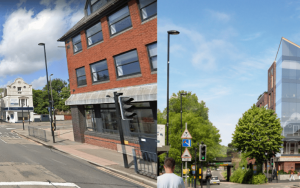
Image. Left: Old station – Google street view. Right: Plans for former Epsom Police Station in Church Street. Credit: Hunters

The society also raised concerns about protecting trees on the site, necessary measures being put in place for demolition works which may involve asbestos removal, and a possible flooding risk associated with the basement car park.

The police station part of the site was granted planning permission in 2020 for a residential development with 29 apartments located in two blocks, but this excluded the ambulance station. While a since withdrawn application was also made in 2019 for a 60 apartment extra care scheme, which saw some local opposition but no objections from the statutory or council consultees, according to documents submitted by the applicant.

The 1960s police station building has been empty since 2012, and could now be replaced with the three to five-storey blocks of a CQC registered residential care home which would offer 24-hour care.

According to planning documents, the 96 bedrooms would provide nursing, residential and dedicated dementia care, and would have an ensuite wet room.

The applicant said: “The care home will be capable of caring for residents of all dependency levels, including those who require dementia care within a specialist unit.”

The Church Street Conservation Area, which contains contains 20 listed buildings including the grade II St Martin’s Church, The Cedars and Ebbisham House, wraps around the south and west ends of the site.

Plans show the home would include gardens with trees planted and “activity lawns” for residents to include bowling, croquet, gardening.


Why planning matters at Hobbledown

Hobbledown Epsom

A parent fought back tears as he told a Epsom and Ewell Borough Council’s planning committee he thought someone was going “to be injured or killed” as councillors approved a series of applications for a family attraction. Hobbledown Farm in Epsom made five planning applications to its local council, some for works that had already been carried out.

Councillors called the attraction “a great asset” to the borough but also voiced frustrations that applications were coming to them for things that had already been done.

When the applications were last brought to Epsom and Ewell Borough Council’s planning committee in October, councillors deferred their decision and asked Hobbledown representatives to come back with a flood assessment for the site.

The meeting heard council officers were “content” with answers that had come back on the flooding risk after two rounds of consultation with the Environment Agency and with the lead local flood flood authority. But as well as concerns around an increased risk of flooding for neighbours, the vice chair of Clarendon Park Residents’ Association spoke at the meeting on behalf of residents in the estate next to the farm.

Alex Duval had been told he could not speak on all five applications at once, and was not able to stay for the whole meeting because he needed to get his nine-year-old child home for bed. But speaking as part of the consideration on a new overflow car park, and before an item on lorry deliveries on McKenzie Way, which he said residents were “most worried about”, Mr Duval set out the issues.

He claimed his car had been nearly hit by a reversing lorry there recently and that a two metre high fence that had just been approved by councillors retrospectively meant lorries coming out could not see as they exited. Clearly emotional, he said: “I’ll just say it as it is: completely unacceptable. My son has had to go out into the road, I’m going to try not to be really upset about it, to go round lorries coming out from that site into oncoming traffic and it’s not acceptable. It is not acceptable for anyone living on Clarendon Park.”

He paused, saying he could not even read his prepared notes any more. Again having to cut short his speech and close to tears, the father said: “Some resident, or a resident’s child, is going to be injured or killed, when [deliveries] could have been controlled on the other side [of the site].”

Cllr Jan Mason (Residents’ Association, Ruxley) said she had been talking to residents who had raised concerns about lorries using the McKenzie way entrance. She had also previously said an application for a gas tank holder on the site was “an accident waiting to happen” though councillors were reminded that this would be a matter for the Health and Safety Executive and not for planning.

The planning applications put in for the site, which is in the green belt and next to Horton Country Park, were:

  • A retrospective application for timber and netting outdoor play structures, three bounce pillows and a lorikeet enclosure.
  • Putting in a new “shepherd’s hut” toilet block.
  • A retrospective application for timber fencing around the farm, the relocation of entrance gates and the installation of a gas tank holder.
  • A variation of a condition on previously granted planning permission to allow part of the site to be used for over-flow car parking at the busiest times.
  • A variation of a condition to let deliveries to the farm shop and cafe enter the site via McKenzie Way.

All the applications were approved, with the chair using a casting vote on a second attempt to approve the gas tank holder.

Councillors were told by officers that the fact applications were retrospective was not material consideration, despite many expressing their frustrations on them.

A representative for Hobbledown said management changes at the attraction had been made and they were working to “resolve any planning breaches at the site”. Bob Neville said meetings had been held between the applicant and senior planning officers at the council to try and respond to concerns.

He told the meeting: “We hold our hands up. There have been planning breaches that have occurred on the site. What we’re doing now is working pro-actively to resolve those issues going forward.”

After the overflow car park was approved, Cllr Mason was heard to say: “They’ve won again.”

Speaking on that item she had previously said: “We’re not Chessington World of Adventures. This is on a local nature reserve and I think we should remember that.”


New hospital programme called “HS2 of hospitals”

Epsom hospital

The government’s hospitals programme has been called the “HS2 of hospitals” as “quite intense” discussions continue about how to take it forward.

Epsom and St Helier had its plan for a new site agreed by the NHS in 2020, with an original date for opening set at 2025, now pushed back to 2027 “at the earliest”. A health liaison panel at Epsom and Ewell Borough Council heard from James Blythe, managing director at the trust, who said adapting the current buildings to modern healthcare standards was becoming “increasingly difficult year on year”.

The national programme was announced as delivering 40 hospitals by 2030, with Epsom and St Helier one of eight “pathfinder” hospitals due to be at the top of the list, Mr Blythe told the meeting. But he said there were “quite intense discussions” going on at government level about the programme and how to take it forward.
Mr Blythe said: “What the government, the Treasury and the Department [of Health], are working through is basically how do you go about building 40 hospitals? Clearly what don’t you do is say to 40 schemes: ‘Go and design something completely different, go out to the construction market and try and procure it.’

“This has sort of now become the HS2 of hospitals. Let’s think about how we do this as a single scheme. Let’s think about how we do this consistently, how we procure consistently, how we design consistently.”

With St Helier hospital “very evidently crumbling” and problems with buildings at the Epsom site too, the trust plans to build a new specialist emergency care hospital on the old Sutton Hospital site, next to the Royal Marsden Hospital. Mr Blythe said: “We know that if we build a modern hospital to modern standards, we can do better for our patients, including local Epsom residents.”

But he said with the move from one financial year into the next, there were questions about where future works might sit in relation to other capital projects. He added: “Clearly what the construction market can’t take is 40 new hospital schemes trying to do the same thing at the same time.”

The meeting also heard that the trust was expecting feedback on its plans “very soon”, hoping it would then be able to get on with the planning process. Mr Blythe said: “As you can imagine, planning for a hospital which is going on to the land adjacent to Royal Marsden in Belmont in a mature and developed residential area, that planning process will not be insignificant. So we know that that will take some time”

Epsom and Ewell Borough Councillor Liz Frost (Residents’  Association, Woodcote Ward) asked about plans for the new multi-storey car park due to be built at the Epsom site, which was granted planning permission on appeal in December. She said she received a lot of complaints about roads surrounding the hospital being clogged up as people queued for spaces.

Cllr Frost said: “I have in the past spent quite a lot of time at Epsom Hospital when car parking has been horrendous and everybody was turning up late for clinics because they couldn’t actually get in.”

Mr Blythe said work should start in the autumn to build the new car park, and that options being looked at to minimise disruption during the nine-month build included possible park and ride schemes and using town centre car parks.

Saying he would bring back a plan later in the year for how the project would be handled, Mr Blythe also said the “flip side” was parking should be “substantially better once it’s built”.

He added: “We’re hoping that by [building the new car park] we will prevent some of the build-up of traffic from backing up into the town centre, which has sadly been a feature of the hospital for the last few years.”

Related reports:

Pay black hole takes £2.2M Epsom Hospital funds

Epsom Hospital multi-storey car park rises

Epsom Hospital’s multi storey carpark wrong on many levels?

Epsom Hospital car park appeal

Local hospital’s building woes


Pay black hole takes £2.2M Epsom Hospital funds

Epsom hospital

Epsom and St Helier Trust has set out how it is working to claw back £2.2million in salary overpayments. A board meeting of the trust heard that people continuing to be paid after they had left a role was one issue that had led to the outstanding money.

The Epsom and St Helier Trust board met on Friday (March 3) heard that there was “angst” against the trust when it was accused of “pushing people into hardship” when reclaiming money.

Meeting documents show that as of November 30, the trust had £2.2m of salary overpayments of which £798,000 had been invoiced for, and £382,000 was being repaid via agreed plans.

There was work being done with a payroll overpayments team and the HR department to look at £823,000 of outstanding overpayment money to make sure it could be recovered from people who were not responding or where the trust did not have a forwarding address.

Andrew Grimshaw, group chief finance officer, told the meeting that where the the trust was seeking contact or had had no contact with people who owed money was invariably people who had left and not been “terminated” on the system. He said the trust did agree an extended repayment plan with a lot of people to get overpayments back.

The “single most effective action” in stopping overpayments was terminating people on the system when they resigned from a role, he told the meeting. But he added: “A lot of the angst we see  is when we are accused of pushing people into hardship.”

An active review had been carried out to find out how many people were being paid who shouldn’t be, meaning a lot of new cases had been found. The meeting chair, Gillian Norton, said she knew the board was “sensitive” to the issue, and in the past had given “a very clear steer” on it.

She added: “It’s public money so we have a duty to recover it but we have to do it in a way that is compassionate.”
Derek Macallan, a non-executive director on the board, he was conscious of how hard it was to employ people and how many steps there were to new starters. He asked: “At the end of employment is there a black hole people go into and keep being paid?”

The chair of the Audit Committee, Peter Kane, responded that there had been improvements made but there was “still some way to go. We will be keeping our eyes on it, we’e not letting go of it despite the fact that improvements have been made.”


Patient nut complaint to protect others

St Helier Hospital Epsom

The Epsom and St Helier Trust board heard the complaint of a patient allergic to nuts given nut oil. LDRS reports:

A hospital patient with a peanut allergy and an epipen was given medication for a nosebleed which contained nut oil. The patient at St Helier hospital was told before going home that the A&E doctor “didn’t think” the cream contained nut oil, a hospital trust board meeting heard. But on returning home and reading the leaflet, the unnamed patient learned there was in fact arachis oil, or peanut oil, in the medication. The patient had gone to the emergency department after a nosebleed, having started on a medication to help reduce blood clots. The patient had told the nursing team on arrival at the hospital and the doctor who prescribed the cream for the nosebleed about their allergy.

On contacting the emergency department, the patient was told there was not an alternative medicine that could be prescribed.

Members of the Epsom and St Helier Trust board heard at a meeting on Friday (March 3) that the patient then contacted their GP for an alternative before making a complaint to the trust so the issue would not affect other patients.

The board meeting, held at Epsom hospital, heard from a registrar and a consultant in the emergency department what steps had since been taken to learn lessons from the incident. These included a safety alert being sent within the team and the individual doctor being spoken to, while board members also asked what more could be done at trust level to help in what was a “very, very busy” department.

Ruth Charlton, the site chief medical officer, said the emergency department was of the only in the trust to use a paper prescription method rather than electronic. She also said that because the emergency department was operating 24/7, and doing things very quickly, patients were not sent to pharmacy for medications, which would be “an extra checking mechanism in place”. She said an electronic system would flag allergens, such as cows’ milk, in a medication and then allow something else to be prescribed instead.

She added: “We need to take away this case and look at what more we could do to address the systems issues.”
The meeting also heard it was not clear what checks were made by the doctor about what was in the medication, or who the patient had spoken to when calling the hospital to ask about alternative medications.

Board chair, Gillian Norton, said the board was impressed with the “rigorous approach to learning” shown by the department and thanked the doctors for sharing the experience. She said: “Keep up the great work. “We are very conscious that you have done all this learning and thought about this while you have got this incredibly busy day job.”


Plodcast problem leads to PC sacking

A Surrey Police officer was dismissed without notice after he made a podcast in which his wording suggested he “condoned committing criminal acts of domestic abuse”. The officer, who cannot be named due to reporting restrictions and is referred to as Officer A, uploaded an episode of his podcast in January 2022 in which he discussed a non-crime domestic incident with his ex-partner that took place on Christmas Day 2021, following an argument over child contact that day.

A Surrey Police misconduct hearing on 8 February 2023 found his behaviour was a breach of discreditable conduct and dismissed him without notice. During the podcast uploaded to Spotify on 10 January 2022, but since deleted, Officer A discussed the Christmas Day 2021 incident, and “made a number of inappropriate comments referring to his ex-partner”, according to the hearing outcome.

The report into the hearing said: “During the podcast he also used discussion and wording which suggested that he condones committing criminal acts of domestic abuse.” Surrey Police said the officer accepted the allegations made against him, but that he had experienced a “difficult break-up with his former partner”. He said this as well as “frustrations regarding his access to their child” were the context in which he recorded the podcast.

Surrey Police said: “The panel accepted the officer’s explanation that by the words he used he was not condoning domestic abuse but the impact on the public view may well be different given the ongoing national concern regarding violence against women and girls and the level of mistrust some have with the police in such matters.”

The officer, who cannot legally be named because of restrictions put in place at the hearing, identified himself as a police officer in the podcast on April 23, 2020 and as a Surrey officer in the introduction of a previous podcast.
The panel found him to have breached the professional standard of duties and responsibilities (being diligent in the exercise of their duties and responsibilities) in this regard.

A member of the public alerted Surrey Police to “inappropriate content on social media” on April 23, 2020, which was dealt with by the officer’s senior management team and the content was removed.


Surrey Police add: “The officer is not being named to protect the welfare of his former partner and child, who played no part in the officer’s alleged misconduct. This will ensure the correct balance is maintained between the open process as envisaged by the Regulations and Home Office Guidance and the welfare of either the officer or others”.


Surrey’s longest sitting MP to stand-down

Sir Paul Beresford MP

Sir Paul Beresford will not stand again as an MP in Surrey, citing “midnight sittings” in Parliament and “a diary built around the whims of the whips’ office” as reasons for retiring. The Conservative Mole Valley MP, who has been in Parliament since 1992, told constituents in an email he would not stand again in the newly-formed parliamentary constituency of Dorking and Horley.

The next general election is due to take place by January 2025 and changes to constituency boundaries will come in before then, meaning the current Mole Valley constituency will no longer exist.

Sir Paul, 76, who is also a practising dentist, has been the area’s MP since 1997. The Mole Valley parliamentary constituency will be split up under current plans, with just over 60 per cent of it forming most of the new “‘Dorking and Horley” seat.

His 25,453 vote majority in 2015, and similar in 2017, was reduced to 12,041 in the 2019 general election, with the Lib Dem candidate, and Mole Valley Councillor, Paul Kennedy in second place each time.

In an email to constituents, Sir Paul said: “I cannot express how grateful I am to the voters in Mole Valley who have consistently supported me for so long and trusted me to be their representative in the House of Commons – it has been a great honour. ” He said he had given “serious thought” to standing in the next election and that the decision to step back had “not been easy”.

Sir Paul added: “I am very much of the view that anyone elected as an MP owes it to their constituents to throw themselves entirely into the role – and when you find yourself beginning to wonder what life without midnight sittings of the House and a diary built around the whims of the whips’ office might look like – it is probably time to step back.”

[E&ET adds: Sir Paul represented Croydon Central 1992-1997]


2023/2024: average of £50 more to pay Surrey County Council

Council tax pie chart for Epsom

Surrey residents will pay nearly £50 a year more to the county council for its share of council tax from April.
The 2.99 per cent increase was confirmed at a full meeting of the authority on Tuesday (February 7) though opposition parties did not vote for the budget.

The raise, which is less than the 4.99 per cent councils can increase bills by without a referendum, is made up of 0.99 per cent on the core bill, and two per cent which will go towards adult social care. It will mean the average band D property will pay 94p per week, or £48.69 per year, more from April.

Surrey’s district and borough councils are still to confirm their increases.

The council’s Conservative leader, Tim Oliver (Weybridge) told the meeting the rise came in the context of the cost of living crisis, inflation and interest rates all impacting the council as well as Surrey residents. He added: “Everything we do has simply become more expensive to deliver. That can be seen in our budget papers, showing increased spending in almost every area.” Cllr Oliver said it was a “challenge” each year to deliver a balanced budget which nonetheless “prioritised those most in need of help and support but equally recognising that residents don’t always see or access many of our services“.

He said a “caring and democratic society” expected that people who needed to could turn to their local council for support, and pointed to nearly half of the council’s budget going on adult social care “looking after people with disabilities or extra needs as they get older”. The rise, he said, was less than inflation and less than in many other parts of the country.

But opposition group leaders on the council pointed to problems with the council’s home to school transport arrangements, families going to tribunals for SEND support and cuts to budgets.

Cllr Will Forster (Lib Dem, Woking South) highlighted £30m of cuts to adults and children’s social care, where “efficiencies” had been found in the budget. He said: “This budget has the wrong priorities. Rather than protecting services that vulnerable people rely on, they are targeted for cuts.”

The Lib Dem group also called on the council to spend some of its £150m of reserves, or savings, on highway repairs, saying residents wouldn’t understand why the council was “squirrelling” away money it could spend on improving the roads.

Residents’ group leader, Cllr Nick Darby (Dittons and Weston Green Residents, The Dittons), said £11m spent on an IT project that was still not operational, anger from residents over a proposed Guildford road closure and the “shambles” of school transport issues were signs of poor communication and consultation at the council. He said there was a need to “acknowledge problems, recognise them and then deal with them” adding that “not everything” in the budget was wrong.

Cllr Darby told the meeting: “On the one hand, we can and do provide figures which balance. It’s more difficult to fulfil our duty to residents by spending their money well, putting them first, especially the vulnerable.” He also repeated his call for a rethink of council tax bands, which would need to be done at central government level.

See below for a full breakdown of how much council tax money will be going to Surrey County Council from April:

Band A – £1,116.72 per year
Band B – £1,302.84 per year
Band C – £1,488.96 per year
Band D  – £1,675.08 per year
Band E – £2,047.32 per year
Band F – £2,419.56 per year
Band G – £2,791.80 per year
Band H – £3,350.16 per year

Related reports:

Surrey County Council sets 23/24 budget

Surrey County Council proposes 2023/24 budget


Surrey County Council sets 23/24 budget

Indian road compared to Epsom road

A councillor who visited rural India paused his tour to take photos of the roads because they were “in better condition than Surrey’s”. The Labour group leader on Surrey County Council said he visited the state of Karnataka last month and on a visit to a village school, stopped to take a photo of the road.

Councillor Robert Evans (Labour, Stanwell and Stanwell Moor) told a meeting of the council on Tuesday (February 7) that his host had asked him what was wrong with the roads there. He told the meeting he had replied: “Nothing, to the contrary. I just wanted photographic evidence that the road surfaces here in rural India are better than in many parts of Surrey.”

Cllr Evans also said his Stanwell residents asked him why roads in what he called the “forgotten part of Surrey” were worse than in other parts of the county. He told the meeting: “I actually tell them they’re not, they are pretty bad everywhere.”

In the meeting, councillors voted through the authority’s budget for 2023/24, though without the support of the opposition. The county council’s share of council tax will increase by 2.99 per cent from April, which means an increase of 94p per week, or £48.69 per year on the average band D property.

This is less than the 4.99 per cent which the government says councils can increase council tax by without a referendum, though Slough, Thurrock and Croydon councils were this week given permission to raise council tax by 10 and 15 per cent to help pay off huge borrowing costs.

The district and borough councils in Surrey, as well as the Police and Crime Commissioner, will also add their shares to the bills that will be paid by residents. Surrey’s £1.1billion budget, which includes spending of more than £400m on adult social care and £249m on children, families and lifelong learning was described as a “good and fair” budget by the council’s leader.

Cllr Oliver (Conservative, Weybridge) pointed to the council’s “ambitious” capital programme which included highways maintenance as well as low emission buses, flood alleviation measures, independent living facilities for the elderly and more accommodation in the county for looked after children.

A cabinet meeting last week heard that more government funding was needed in Surrey for repairs on the county’s 3,000 miles of roads. The Liberal Democrat group leader called on the council to spend money the council had in reserves rather than “cutting spending on roads and services for vulnerable people”. Cllr Will Forster (Woking South) said Surrey’s roads were “completely falling apart”. He pointed to a highways budget that he claimed would be less than £30m by 2024/25, compared to nearly £70m in the 2023/24 budget. He said: “That is not acceptable. Our residents would find that appalling.”

But another councillor said it would be “bonkers” to spend the council’s savings on road repairs or other projects.
Cllr Edward Hawkins (Conservative, Heatherside and Parkside) said he supported the budget and looking to the situation in the Ukraine, Turkey and Syria, that it was important not to spend money that had been put aside.
He told the meeting: “It’s bonkers to spend the money that you put aside for a rainy day, when we really don’t know what’s coming around the corner.”

The meeting opened with a minute’s silence for the dog walker who was killed in Caterham in January, the Epsom College head and her family who were found dead on Sunday (February 5) as well as those affected by earthquakes in Turkey and Syria.

Related Reports:

Don’t blame us for potholes say Surrey’s highway authority.

Surrey County Council proposes 2023/24 budget

Going potty about pot-holes?


Don’t blame us for potholes say Surrey’s highway authority.

Pothole in Woodcote Road Epsom

The state of Surrey’s roads is “no fault of the county council” its cabinet has heard, as councillors vowed to put more pressure on central government for highways funding. In what the council’s leader called “pothole season”, the problems facing the repair of the county’s roads were set out at a meeting of the authority’s cabinet on Tuesday (January 31).

Approving the budget for the next year, ahead of full council voting on it, cabinet agreed a 2.99 per cent increase to the authority’s council tax share, or 94p per week for residents. This will be alongside any increases to come from Surrey’s 11 districts and boroughs and a proposed £15 increase per year for the Police and Crime Commissioner.

Cabinet members agreed a final budget for the council in 2023/24 of £1.1billion, an increase of £61.4m from 2022/23. The council tax increase will be made up of a 0.99 per cent increase in the core council tax and a 2 per cent increase in portion that is spend on adult social care.

In terms of the budget for roads in Surrey in 2023/24, the meeting heard that the budget was being set in the context of “hyper-inflation”, seeing an increase in the cost of bitumen of nearly 30 per cent over the past year.
Councillor John O’Reilly (Conservative, Hersham), chairman of the communities, environment and highways select committee, pointed to three central government cabinet ministers being Conservative MPs, including the chancellor Jeremy Hunt, the MP for South West Surrey.

He said he hoped a central government review into highways funding was carried out earlier than next year, adding: “The state of our roads, through no fault of this council, do require not just pothole filling but resurfacing.” Cllr O’Reilly told the meeting: “I’m sure we’ll put as much of our influence as we possibly can on central government to address these issues of funding for highways, particularly potholes.”

Speaking before the meeting, Cllr Tim Oliver (Conservative, Weybridge), the council’s leader, said despite seeing more traffic than other areas, the county council got the same level of funding from central government. He said the potholes were a national problem, made worse at this time of year by the freezing weather in what he called “pothole season”. But he added that additional investment from the council had paid off and led to fewer potholes, with 32,000 being filled last year compared to 75,000 the year before.

He told the LDRS: “We need the government to give us some one-off money for potholes.”

Council will meet to approve the budget in full on Tuesday (February 7).

Related Reports:

Going potty about pot-holes?

Surrey County Council proposes 2023/24 budget

Senior local Councillor slams Surrey’s budget consultation


No Crawleys for Surrey’s Downton Abbeys

Headley Court

A lack of “Downton Abbey” type families to occupy abandoned mansions led to 112 homes at Headley Court (near Epsom) get the green light last night. The Mole Valley green belt site has previously been used by the Ministry of Defence,  Help for Heroes and as a covid testing centre. It could now be turned  into 12 two-bed homes within the converted mansion, with further 97 two-bed homes and three one-bed residents on the grounds.

Image: Headley Court mansion: Graham Harrison MoD

They were approved by a vote of 12 in favour and zero against. with three abstentions, by Mole Valley’s Development Management Committee on Wednesday, February 1. Attached to the approval was a list of conditions, including that homes should only go to people aged over 60 and assessed as requiring a care package, to make a publicly accessible restaurant and library available on site, as well as to agree to a travel plan.
The travel plan would include an on-call bus service and car club. 

The green belt site does not require special circumstances as it is considered to be previously developed land, the committee heard. There is currently an ongoing appeal of a previously rejected planning application on the site, due to be heard in May, and a decision on whether to pursue that matter will be taken in due course by developers Audley Group.

Questions raised during the meeting surrounded public access, environmental protection matters and parking, with Councillor Tim Hall, who abstained in the vote, saying the plans were “not quite there” particularly as the current bus to the site only ran once every two hours.

The meeting began with chair Cllr David Preedy announcing an interest in the matter and leaving the chamber. As a ward member, a letter was read on his behalf where he highlighted issues of parking while deputy Rosemary Hobbs oversaw the discussion.

The site was formerly part of a larger parcel of land that had used by the Ministry of Defence (MoD) from the 1950s to 2018 and since subdivided and sold to different owners. The  mansion house has been vacant since the departure of the MoD with the Jubilee Complex gardens used by the NHS and Surrey County Council during the pandemic.

Cllr Helyn Clack said: “We’ve been through a lot of papers for Headley Court  and a lot of changes.
“It’s a very historic site not just in its past but the very recent past. Its held very dearly in the heart of residents across the whole of mv and wider still because of the work that it did for Help for Heroes, the Afghanistan war and also what it has done more recently supporting the NHS throughout the pandemic. Across the whole of Mole Valley there are lots, particularly in rural areas, of large country houses originally built in the late 19th century or 18th century,  and then become completely unable to be used for their original purpose. You see them everywhere.

“We’ve had them here to discuss being converted into something where they can maintain their facial value but also be of use to the community going forward. We certainly wouldn’t want to see Headley Court left unoccupied or abandoned and people who want to go visit it are going to be able to do so in this plan.  The fact that hundreds, maybe thousands of people will visit this site when it’s finished – it will be a memorial site, not just to the veterans who were mended here but also to the pandemic.”

She added that she was banking on the new residents demanding and setting up their own residents association
Cllr Clack said: “We don’t still have the sort of Downton Abbey type families anymore who can run these huge estates. It’s a shame the MOD pulled out, it was a wonderfully loved site.”

She had trust in the planning regulations to deliver on what they were asking for and to not let that not fall by the wayside because it’s ‘too difficult to do’.

A further item on the agenda, to grant listed building consent to develop the site, was approved unanimously.


A sign of no signs to come on ULEZ?

Traffic jam

Surrey councillors say they could stop TfL (Transport for London) putting signs on the county’s roads ahead of the planned ULEZ (Ultra Low Emissions Zone) expansion. Surrey County Council’s leader said the authority would “stand its corner” on the expansion “blindly going ahead” as he called for more conversation between the London Mayor’s office and the authority.

The ULEZ sees drivers of certain cars charged £12.50 per day to enter it, and is currently in place in central London where Transport for London (TfL) claims there has been a reduction in nitrogen dioxide pollution by nearly half.
The zone is set to cover all of greater London from August, meaning it will border Surrey in council areas such as Elmbridge, Epsom and Ewell, and Spelthorne.

But Councillor Matt Furniss (Conservative, Shalford), the county council’s cabinet member for transport, infrastructure and growth, told a cabinet meeting on Tuesday (January 31) that TfL would need a legal agreement with the council to put anything on the county’s roads.

Cllr Furniss said he had written to the Mayor of London and TfL, setting out the council’s “absolute disappointment” that the plan would go ahead without “meaningful conversation” on how Surrey residents would be affected. He said he had told officers to stop any discussions on the location of signs on the county’s roads until “a grown up conversation has happened between the two authorities on mitigating the disruption and the financial cost to Surrey residents.”

The council’s leader, Cllr Tim Oliver (Conservative, Weybridge), said “any conversation would be a good start” claiming there had been “no dialogue at all”. He told the meeting: “We do have the legal opportunity to prevent the Mayor of London putting signage on our highways and we will forcefully make that point to them. We will stand our corner on this.”

Surrey’s councils were given the chance to respond to a consultation on the ULEZ expansion in 2022, with Elmbridge, Tandridge and Spelthorne, among others, submitting responses. They called variously for a delay to the expansion, an expansion of the scrappage scheme offered to London residents to include Surrey car owners and the expansion of the zone 6 Oyster card zone.

Cllr Furniss said the county council had put forward ten points to TfL that should be considered if the scheme were to go ahead. These included exemptions for taxis and key workers, corridors to NHS facilities near the border and extensions to public transport into Surrey, among others.

The expansion is due to come into place from August 29 this year.

Related reports:

ULEZ will come to Epsom and Ewell borders

Yet more on ULEZ….

More on Epsom and Ewell and Surrey and ULEZ

Council’s last minute opposition to ULEZ extension.


Gladiator light-man on demand bus

TimHall drives a bus

It’s not every day you meet an Emmy award winner on a bus in rural Surrey. And it’s not every day the said Emmy award winner would be driving that bus either. But that’s what passengers in the north of Mole Valley may find if they book one of the on-demand, electric buses that have been running in the area since last year.

Tim Hall worked in TV for 40 years, including on the iconic Gladiators early in his career, and told the LDRS he took home Emmys for his work as a lighting director on Olympic ceremonies in Russia and Rio. Having done his last job in early 2022, he found himself in retirement, at the end of his working life and thinking: “Is this it?” He came out of retirement to drive the buses, which launched in June last year.

The LDRS* took a trip on the bus, where passengers, both regular and new, praised the service for being reliable and good value, and for the care and attention shown by the drivers as well.

*(Epsom and Ewell Times news partner the BBC Local Democracy Reporting Service)

As well as more than £600,000 of central government funding for better rural transport links in Surrey, the county council has put in more than £200,000 to the Mole Valley service, and hopes to expand the scheme further. Tim admitted there is often a lot of chat to be had on the buses. “You can start a conversation off and before you know it you have been excluded from it,” he said.

The buses can be booked on an app, via a website or on the phone, and have no fixed route. Would-be passengers can check the availability at the time they want to travel, and can book in advance or on the day, a minimum of half an hour ahead. The service is also part of the capped bus fares scheme, meaning that until the end of March all journeys will cost £2, though those over five miles would normally cost £3.

Mother and daughter Beryl and Alison Wood had booked the bus from Cobham Sainsbury’s, one of the extra places passengers can travel to outside of the designated area, back to Beryl’s Bookham home with their shopping. It was Beryl’s first time using the service, which she described as “wonderful” but Alison said she uses the bus a few times a month, whether for visiting her mum or for other reasons.

Alison said the drivers always made sure passengers got on and off safely, including helping with their shopping, which was particularly important for elderly people or those who are less mobile. She added: “You feel like you’re being taken care of. [The drivers make] sure that you’re out of the bus safely.”

Other out-of-area stops that passengers can travel to include Effingham Junction station and the Dorking stations, as well as Cobham’s Waitrose and Epsom hospital. Tim said the bus was very important to the people who use it, especially for those with reduced mobility as well as those using wheelchairs or other aids to get around. He added: “[Walking] more than 100 yards is too much for them. This is great. We pull up right outside their front door.”

[Ed: Do you think Epsom and Ewell needs these on-demand bus services? Let us know at admin@epsomandewelltimes.com.]


Surrey doctors to go on strike?

Hospital doctors

Royal Surrey hospital trust bosses are beginning to plan for three days of junior doctor strikes which could have a “significant impact” on services. A national ballot is currently taking place of members of the BMA Junior Doctors union, which closes on February 20.

If members vote for action, it could mean a possible 72-hour strike taking place in March, a board meeting heard on Thursday (January 26). As yet the trust, which runs Guildford’s Royal Surrey County Hospital as well as the Haslemere hospital, has not been directly impacted by its staff striking, though ambulance strikes in December saw the hospital put measures in place.

Meeting documents said the junior doctors’ strike was more likely than others to meet the 50 per cent threshold needed for members to strike because a national ballot was being held. According to the BMA website, junior doctors have seen their pay cut by more than 25% to their salaries since 2008/09.

Bill Jewsbury, the trust’s medical director, said the three-day strike, which he thought “probably would” go ahead, would have a “significant impact” on various parts of running the trust. The meeting heard that other, more senior doctors, would need to “step down” into the roles, along with non-union members.

Dr Jewsbury added: “That then has an impact beyond that 72 hours because we then have to rest those people.
“What you’re looking at is a much longer period of disruption than just your three days’ of strike.”

According to the documents, a review carried out of the day of ambulance workers’ striking in December had identified one incident that was being investigated of the strike having an impact on patient care. The meeting also heard that the possible junior doctors’ strike would impact on its target to clear the backlog of people waiting more than 78 weeks, a year and a half, for treatment by the end of March, in line with national guidance.

Getting rid of all the people on the waiting list was described in documents as “the biggest operational challenge affecting the trust”, with a peak of 207 patients in the category at the beginning of October, falling to 161 at the end of November and to 155 in the first week in December.

Matt Jarratt, chief operating officer, told the meeting: “That is going to be a major challenge was going forward.”


‘It felt like mum was a prisoner’ in Surrey Hospital

Royal Surrey County Hospital

A woman said she felt like her mum was “a prisoner” when she couldn’t take her home from a Surrey hospital.
The daughter, who we are choosing not to name, said it felt like the family was caught in a “never-concluding circle” when trying to communicate between NHS trusts to get her mum discharged.

Her mum was in hospital for five months, having been admitted to Guildford’s Royal Surrey County Hospital with pain following breast cancer, but the family living in West Sussex meant a lot of communication about release was across different NHS trusts.

By Colin Smith, CC BY-SA 2.0, https://commons.wikimedia.org/w/index.php?curid=9266476

She told a meeting of the Royal Surrey trust board on Thursday (January 26) that conversations about getting her mum discharged were “awkward” and “difficult” as she tried to negotiate her mum’s release from hospital and whether or not she needed a care plan in place.

Board members apologised for the patient and her daughter’s experience, which included time at Haslemere Hospital, and said the trust would address issues such as communication between themselves and neighbouring trusts. Alexandra Ankrah, NExT director at the trust, sympathised with the woman’s experience, saying she had been through similar with her own mother, though not at Royal Surrey.

Addressing concerns that her mother had felt like a “bed-blocker”, where people who are medically well enough to leave hospital cannot be discharged because there may not be the appropriate social care measures in place at home, she and others in the meeting agreed they did not like the term. Ms Ankrah said: “No one should ever be made to feel that they don’t have a right to our care and services.”

The daughter, who chose not to make a complaint against the trust, said: “I felt like my mum was a prisoner.”
The meeting heard that many patients were in similar situations regarding communication across county borders, and a meeting would be organised using the patient story as a basis to make changes.

The chief executive, Louise Stead, said it came up “every single week” with people caught in “an impossible little maze”. The trust’s medical director, Bill Jewsbury, said getting people home when they were well enough was “really important” because most people wanted to be at home and improved once there. He added: “If we are really honest with ourselves, we are incredibly risk averse around discharge planning.”

Dr Jewsbury said the story was “a classic example” of saying somebody needed a care package in place before they could be discharged but said it would be “quite a powerful driver” for the family to be able to take their relatives home. He said the trust should ask itself: “Have we had that conversation with yourselves as the broader family? [Have we] phrased and pitched it in such a way as: ‘There are going to be some risks involved in perhaps getting your mother home. ‘It isn’t without risk but we can get your mother home.’”

He said it would be “worth trying” and that the hospital could do more to work with families as well as outside groups such as charities and churches in supporting patients.

The hospital’s own virtual wards, where patients can continue to be treated at home and which started late last year, were also raised as one way of helping to tackle the issue.

The daughter told the meeting: “If somebody had presented me with a disclaimer for signing mum out of the hospital, I would have done that.”