Epsom and Ewell Times
26th November 2026

ISSN, LDRS and IMPRESS logos

Check your Epsom and Ewell train journeys January weekends.

A SWT train.

Residents of Epsom and Ewell are advised to prepare for disruptions to South Western Railway (SWR) services due to essential engineering works in the Wimbledon area. Bus replacement services will operate on key routes over two consecutive weekends: January 18-19 and January 25-26.

While services on the London Waterloo line from Epsom will be affected, passengers can still reach Waterloo by using Southern Railway services via the Victoria line and changing at Clapham Junction. However, there will be no SWR services between Epsom and Guildford, and SWR trains to Dorking will also be unavailable.

The works will involve renewing 800 meters of track, ballast, and sleepers between Wimbledon and Earlsfield, alongside replacing points and installing 100 meters of conductor rail. These upgrades aim to improve track reliability and reduce faults, providing smoother journeys for passengers.

Key Impacts for Epsom and Ewell Residents

  • No SWR trains from Epsom to Guildford.
  • Southern Railway services to Dorking via the Victoria line remain available.
  • Rail replacement buses will operate between Clapham Junction and Worcester Park, affecting onward connections.

Additional Service Changes

  • SWR services between London Waterloo and Chessington South, Hampton Court, Dorking, and Woking (stopping services) will not run.
  • Longer-distance services to Portsmouth Harbour, Exeter St Davids, and Weymouth will be revised, taking up to 30 minutes longer.
  • Berrylands station will be closed during the works.

Plan Ahead

SWR advises passengers to check travel options in advance via the SWR website (southwesternrailway.com/plan-my-journey) or National Rail (nationalrail.co.uk) and to allow extra time for their journeys.

Apologies from Network Rail and SWR

Peter Williams, SWR’s Customer and Commercial Director, acknowledged the inconvenience:
“Customers should plan ahead if they intend to travel on these weekends, as engineers carry out vital maintenance at one of the busiest parts of our network. We’re grateful for our customers’ patience.”

Mark Goodall, Network Rail’s Wessex Route Director, added:
“We’re sorry for the disruption but completing these upgrades back-to-back is the most efficient option. We encourage passengers to check their journeys and plan ahead.”

Further closures in the Wimbledon area are also planned for Sunday, February 2, and Sunday, February 9. Updates will be available on the SWR website.

For Epsom and Ewell residents, alternative travel routes and extra planning will help navigate the disruptions while these essential upgrades take place.


Heritage at Risk: Epsom Town Centre Conservation Area Faces Challenges

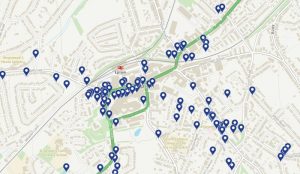
Listed buildings map of Epsom Town Centre

The latest Heritage at Risk Register, published by Historic England in November 2024, has cast a shadow over the state of heritage conservation in Epsom and Ewell. Two conservation areas—Epsom Town Centre Conservation Area and the Horton Conservation Area—have been flagged as being in poor condition, with a concerning trend of deterioration. While both areas are deemed to have “low vulnerability,” this designation should not obscure the urgency of their plight.

The condition of these heritage assets is not only a reflection of their physical state but also an indicator of broader systemic issues. Without proactive measures, Epsom risks losing significant elements of its historical character.

Decoding the Heritage Assessment

Historic England evaluates heritage assets based on three criteria: Condition, Vulnerability, and Trend:

  • Condition: The physical state of the asset, ranging from “very good” to “very bad.” For both Epsom Town Centre and Horton Conservation Areas, the classification of “poor” signals pressing maintenance and repair needs.
  • Vulnerability: The extent to which external factors, such as funding shortages or development pressures, threaten the asset.
  • Trend: Whether the asset’s condition is improving, stable, or deteriorating. Both conservation areas are assessed as experiencing a deteriorating trend.

While “low vulnerability” suggests no immediate threats, the deteriorating condition of these areas calls for decisive intervention to reverse the decline.

Epsom Town Centre Conservation Area: A Historic Hub in Decline

Epsom Town Centre is more than a commercial centre; it is the beating heart of the borough’s identity. Its 39 listed buildings include the Spread Eagle Hotel and historic structures on Wheelers Lane. Each of these buildings tells a story of Epsom’s rich past, from its heyday as a 17th-century spa town to its enduring role as the home of the Epsom Derby.

The “poor” condition and “deteriorating” trend of the conservation area suggest neglect and insufficient maintenance. While some buildings remain privately owned, the broader conservation area’s status is a public concern that requires collective action.

Horton Conservation Area: A Legacy of Victorian Innovation

The Horton Conservation Area, part of Epsom’s celebrated “hospital cluster,” was established to protect the architectural and historical significance of the Victorian psychiatric asylum buildings. One notable structure, the Horton Chapel, was recently restored and reopened as the Horton Arts Centre. While this transformation is a success story, Historic England’s continued classification of the area as “poor” indicates unresolved challenges.

Epsom and Ewell Borough Council: Highlighting Achievements

Councillor Peter O’Donovan, (RA Ewell Court) Chair of Licensing & Planning Policy, defended the Council’s track record in heritage conservation. He highlighted the Council’s restoration of the Epsom Clocktower in 2019 and its role in transforming Horton Chapel.

Regarding the Town Centre Conservation Area, O’Donovan noted that the Council has implemented policies to guide development, enforce planning regulations, and enhance the appearance of shopfronts and buildings. The recently published Town Centre Masterplan prioritises a “context-led design approach,” aiming to balance new development with the conservation of historic features.

“Our local heritage is integral to our unique character,” said O’Donovan. “The Council works in a range of ways to protect the borough’s heritage and conservation areas.”

You can read Cllr O’Donovan’s full response HERE.

Councillor Kieran Persand: A Call for Stronger Action

Conservative Councillor Kieran Persand, representing Horton Ward, painted a more critical picture. He expressed concerns about the lack of a robust repair and maintenance programme for heritage sites, particularly in the Horton area.

Persand also raised alarm over the Council’s draft Local Plan, which proposes development on Horton Farm, a high-performing Green Belt site. “The vulnerability of these conservation areas is increasing significantly,” Persand warned. “Epsom is at risk of losing its identity as a beautiful and historic location through inappropriate development and poor maintenance.”

The Bigger Picture: Heritage and Development

Epsom’s heritage is inextricably linked to its future development. While the Council has emphasised its commitment to protecting conservation areas, critics argue that its actions often fall short of its rhetoric. The inclusion of Horton Farm in the draft Local Plan has drawn widespread opposition, with residents and conservation advocates fearing irreversible harm to the borough’s historic character.

Historic England’s findings underscore the importance of balancing development pressures with heritage conservation. The “poor” condition of Epsom’s conservation areas should serve as a wake-up call to prioritise long-term preservation efforts.

Community and Stakeholder Engagement

Preserving Epsom’s heritage requires a collaborative approach involving local authorities, property owners, and the community. Practical steps could include:

  • Increased Funding: Securing additional resources for maintenance and restoration.
  • Community Initiatives: Encouraging residents to take pride in and advocate for their local heritage.
  • Education and Awareness: Promoting understanding of the value of conservation areas.
  • Stronger Enforcement: Ensuring compliance with planning regulations and conservation policies.

The Path Forward

Historic England’s report is both a challenge and an opportunity. While the condition of Epsom’s conservation areas is concerning, it is not too late to act. Proactive measures, guided by a shared commitment to preserving the borough’s heritage, can reverse the trend of deterioration and secure Epsom’s identity for future generations.

As the debate continues, the question remains: will Epsom rise to the challenge, or will it allow its treasures to fade into obscurity?

Map of many of the listed buildings in Epsom Town Conservation Area: © Crown copyright [and database rights] 2025. OS AC0000815036. | © Historic England | © Crown Copyright 2024. Released under OGL. | © Crown Copyright 2024. Contains Ordnance Survey data © Crown copyright and database right 2024. Released under OGL.


Epsom Green Belt Debate Intensifies

Horton Farm Epsom

The ongoing debate surrounding Epsom & Ewell Borough Council’s Proposed Submission Local Plan has escalated as the Epsom and Ewell Times publishes two sharply contrasting letters – one from the Epsom Green Belt Group (EGBG) and the other a formal response from the Council itself. At the heart of the dispute lies the proposed development of Green Belt land, the availability of affordable housing, and the transparency of the consultation process.

Epsom Green Belt Group: A Call for Change

The Epsom Green Belt Group’s letter criticises the Council for failing to heed public sentiment and expert advice during the Regulation 18 consultation earlier this year. Despite overwhelming opposition to the proposed release of over 175 hectares (around 12%) of the borough’s Green Belt, the Council has pressed ahead with plans that include development on high-performing sites such as Horton Farm and Hook Road Arena.

The EGBG highlights a key inconsistency: while the Council advised neighbouring Sutton Borough in September 2024 that they were under no obligation to review Green Belt boundaries, they have not followed this guidance themselves. Furthermore, the EGBG argues that prioritising brownfield and ‘grey belt’ land, as outlined in the updated National Planning Policy Framework (NPPF) of December 2024, has been neglected.

The group also casts doubt on the Council’s promises of ‘affordable housing,’ pointing out that discounts on market prices still place homes out of reach for many. Flats on brownfield sites, they argue, offer a more viable path to genuinely affordable housing.

A looming concern raised by the EGBG is the likelihood of the Local Plan being deemed unsound by the Planning Inspectorate. They warn that if the plan proceeds in its current form, it could pave the way for further Green Belt loss.

Read the full Epsom Green Belt Group letter here.

Council’s Response: Balancing Competing Priorities

In their formal response, Epsom & Ewell Borough Council defends the Proposed Submission Local Plan, arguing that it strikes a necessary balance between meeting housing needs and protecting the borough’s environment.

The Council acknowledges the high demand for affordable housing, with over 1,350 households on the housing register. They stress that their policies reflect both national guidelines and financial viability assessments.

Regarding the consultation process, the Council points out that Regulation 19 is a statutory stage primarily focused on assessing the plan’s legal compliance and soundness. They also address concerns over the timing of the consultation—spanning the Christmas and New Year period—explaining that it was essential to meet the submission deadline of 12 March 2025 under the current NPPF.

On the contentious Green Belt issue, the Council offers specific figures: 52.6 hectares of greenfield Green Belt land (3.36% of the total) and 85 hectares of previously developed Green Belt land (5.44%) are earmarked for development. They maintain that these changes are necessary to meet housing targets while acknowledging the flexibility offered by the NPPF.

The Council concludes by noting that while changes can still be proposed following the consultation, the Planning Inspectorate ultimately determines their validity.

Read the full Epsom & Ewell Borough Council letter here.

Diverging Priorities, Uncertain Outcomes

Both letters reveal deep divisions not only in policy direction but also in trust between the Council and sections of the local community. While the Council presents its plan as a pragmatic response to national housing targets and local affordability issues, the EGBG sees it as a short-sighted and flawed approach.

Key questions remain unanswered:

  • Why hasn’t brownfield land been prioritised more explicitly?
  • Will the Local Plan survive scrutiny by the Planning Inspectorate?
  • Are the proposed ‘affordable homes’ truly affordable for local residents?

The coming weeks will be crucial as the consultation progresses and residents have their final opportunity to submit their views. One thing is clear: the future of Epsom’s Green Belt hangs in the balance, and both sides are prepared to stand their ground.

Residents can participate in the consultation process until 5 February 2025 via the Council’s consultation portal.

Related reports:

Can the green light to Epsom’s Green Belt housing turn red?

Council minority vote Local Plan to next stage with Green Belt in

Conflict on Epsom’s Green Belt plans of another kind?

Epsom and Ewell Green Belt battle lines drawing near

and many more. Search “local plan” in search bar.


Prime Minister and Health Secretary Visit Epsom Hospital to Unveil NHS Recovery Blueprint

Epsom Hospital

Epsom Hospital played host to Prime Minister Sir Keir Starmer and Health Secretary Wes Streeting today as they unveiled a significant national plan aimed at tackling the extensive backlog of NHS tests, checks, and treatments. The visit highlighted the government’s strategy to expand healthcare capacity, streamline services, and reduce waiting times for millions of patients across the UK.

The blueprint includes a major partnership between the NHS and the private healthcare sector, intended to make additional hospital facilities, equipment, and staffing resources available. Prime Minister Starmer emphasized that healthcare reform must be “totally unburdened by dogma” and that prioritising patient outcomes over ideological constraints was essential.

The government announced plans for an extra 450,000 appointments for diagnostic tests and health checks, with local diagnostic centres operating 12 hours a day, seven days a week. GPs will have increased power to make direct referrals to these centres, reducing delays caused by administrative hurdles. Furthermore, 14 new surgical hubs will be established to handle less complex procedures, easing the strain on general hospital facilities.

Health Secretary Wes Streeting highlighted the urgency of these measures, pointing out that the current NHS backlog stands at 7.6 million patients awaiting elective treatments. He stressed that these reforms aim to address not only the backlog but also improve efficiency and convenience for patients.

Amanda Pritchard, Chief Executive of NHS England, expressed confidence in the proposed measures, stating that they would enable the NHS to deliver millions more tests, checks, and treatments annually, while also empowering patients and local healthcare providers.

While the national focus was clear, local concerns were also raised. Liberal Democrat MP for Epsom & Ewell, Helen Maguire, issued a statement welcoming the measures but stressing the ongoing need for infrastructure improvements at Epsom and St Helier Hospitals. She reiterated her campaign for the long-awaited Specialist Emergency Care Hospital in Sutton to be prioritised.

Cllr Kate Chinn, (Court Ward) Labour group leader on Epsom and Ewell Borough Council said: “It was great to see Keir in Epsom today, highlighting the great work done at SWLEOC and setting out Labour’s plans to cut NHS waiting lists. People in Epsom and Ewell know how the NHS is struggling after 14 years of Tory neglect and false promises of a badly-needed new hospital by 2030. Labour, which created the NHS, is determined to rebuild it, but it will not be an easy job.”

As the government pushes forward with its ambitious NHS recovery plan, the people of Epsom will be watching closely to see how these national promises translate into real-world improvements at their local hospital.

Related reports:

Planning buses not missing them says Epsom’s MP

Epsom and St Helier Hospitals in Desperate Need of Repairs

Public meeting about Epsom Hospital future


Epsom & Ewell Faces Tight Constraints in 25/26 Government settlement

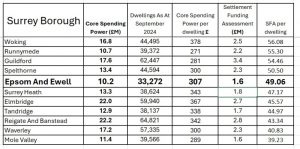
11 Surrey boroughs table of HMG funding

Epsom & Ewell Borough Council has received its provisional financial settlement for 2025/26, and while the figures align with expectations, they highlight ongoing financial pressures on local services. The settlement forms part of the UK Government’s wider local authority funding announcement, which has delivered mixed outcomes across Surrey’s district and borough councils.

Epsom & Ewell’s Settlement Overview

According to the latest figures, Epsom & Ewell’s Core Spending Power for 2025/26 is projected at £10.23 million, equating to £307 per dwelling. This places Epsom & Ewell below several neighbouring boroughs, including Woking (£378 per dwelling) and Elmbridge (£367 per dwelling), but slightly above Waverley (£300 per dwelling).

The Settlement Funding Assessment (SFA), which includes central government grants and retained business rates, stands at £1.63 million. This figure underscores the limited financial flexibility available to the council, particularly given rising costs and increasing service demands.

The Funding Context

The settlement includes a modest contribution from the New Homes Bonus, with Epsom & Ewell receiving only £6,160. This pales in comparison to Runnymede (£774,587) and Guildford (£614,903), reflecting the borough’s slower rate of housing growth.

A Challenging Year Ahead

The provisional settlement aligns with broader trends across Surrey, where councils have been advised to continue delivering “high levels of efficiency” to maintain balanced budgets. Surrey County Council, facing similar pressures, acknowledged the settlement as expected but warned of the continued uncertainty surrounding medium-term funding.

Councillor David Lewis, Surrey County Council’s cabinet member for finance and resources, noted: “Councils across the country continue to face a very challenging financial future. Uncertainty on funding into the medium term, coupled with high prices and increased demand, means high levels of efficiencies continue to be required in order to balance budgets.”

Limited Relief from Government

While councils such as Mole Valley have benefitted from additional Government grants targeting homelessness and recycling services, Epsom & Ewell has not been as fortunate. With no significant uplift in funding and reliance on reserves to bridge financial gaps, the council faces tough decisions in the coming financial year.

Furthermore, the funding floor mechanism has provided limited relief, ensuring that Epsom & Ewell does not see a drastic year-on-year funding drop. However, without long-term certainty or multi-year settlements, financial planning remains a significant challenge.

Looking Forward

As the Government promises to ‘fix the foundations of local government’ from 2026-27 onwards, Epsom & Ewell will need to rely on prudent financial management and creative revenue generation strategies to maintain essential services.

Residents can expect continued fiscal caution from the council as it navigates rising costs, growing demand for services, and ongoing funding uncertainty. The final settlement figures are expected to be confirmed early in the new year, and until then, the council’s budget planners remain in a holding pattern.

Related reports:

Tiers to be shed if Epsom and Ewell loses its Borough Council?

Examination of a Surrey Borough’s 2nd highest UK debt

What cuts to Surrey County Council services are you prepared for?


Epsom celebrates a new Ukrainian Christmas Day

Ukraine Choir and other performers

The vibrant Ukrainian community in Epsom and Ewell and surrounding areas will celebrate Christmas Day for the second year on 25th December. This change was formalized when President Volodymyr Zelenskyy signed a law on July 28, 2023, moving the official Christmas holiday from January 7 to December 25.

This decision aligned with earlier moves by major Ukrainian churches. The Ukrainian Greek Catholic Church in February 2023 announced its plan to switch to the Revised Julian calendar followed by The Orthodox Church of Ukraine on May 24, 2023.

The shift to December 25 reflects Ukraine’s efforts to distance itself from Russian traditions and strengthen its integration with Western practices. Previously, Ukraine observed Christmas on January 7, following the Julian calendar, a tradition shared with the Russian Orthodox Church. The move to December 25 aligns Ukraine’s Christmas celebrations with those of most Western countries, symbolizing a step toward greater cultural independence.

The public are welcome to join Ukrainians, their hosts and supporters at Epsom Methodist Church on Ashley Road on Saturday 21st December for a special evening of music from wonderful Ukrainian musicians and singers. Entry is free and no reservations required.

A social event starts at 5pm and the music commences at 6pm concluding about 7.15. Entry is free and a leaving collection is devoted to the musicians whose livelihoods in Ukraine have been cut by Putin’s war.

You will enjoy a pianist, a violinist, a soprano, poetry, a brass ensemble, a bandura player (a traditional Ukrainian instrument) and a local Ukraine refugee choir in a packed and varied programme.

The event is organised by the charity behind The Epsom Jazz Club and supported by Epsom based Surrey Stands With Ukraine and the Epsom and Ewell Refugee Network.

Lionel Blackman, the organiser said “In one way it is a sad event as it is the tenth Ukrainian Music evening held in Epsom since the Russian invasion in February 2022, which reminds us how long this horrible war has been going on. The music can help take minds away from the tragedies in their homeland.”

All are welcome. If you do come you may if you wish bring and share a plate of some finger buffet food. There is no parking at the Church and you should leave plenty of time for travel as roads and rail will be busy.

There will also be time for you to get to Epsom Choral Society’s Christmas Concert at St Martin’s Church, Church Street, Epsom that starts at 7.30pm.

Full details of the Epsom Choral Society concert HERE


Going South from Epsom for Xmas? Check your trains

SWR train

Epsom residents are being urged to check before travelling as South Western Railway (SWR) services to Guildford face significant disruption due to emergency engineering works. The works will take place from Saturday 21 December to Tuesday 24 December, affecting trains running via Cobham & Stoke D’Abernon and Epsom.

The disruption comes as Network Rail works to stabilise an embankment near Clandon following the detection of ground movement. Trains in the area have been operating at reduced speeds, and urgent repairs are required to ensure passenger safety.

Impact on Services

During the works, limited train services will operate between London Waterloo and Effingham Junction via both Cobham & Stoke D’Abernon and Epsom. To help passengers, replacement buses will run on the following routes:

  • Surbiton to Guildford, every 30 to 60 minutes depending on the day.
  • Effingham Junction to Guildford, every 30 minutes, with some extending to Epsom.

Passengers travelling between Epsom and Guildford will be served by either a train or replacement bus. Normal services are expected to resume from Friday 27 December, but journey planners will be updated daily, and travellers are advised to check before setting out.

A Safety Priority

Explaining the need for the emergency works, Tom McNamee, Network Rail’s Wessex Route Infrastructure Director, said:
“We detected ground movement at an embankment in the Clandon area, which has made it necessary to operate trains at slower speeds. Stabilising the embankment is critical to ensure the safety of passengers and staff. While we recognise this will be disruptive, it’s essential to carry out these repairs to prevent further movement and restore full services as quickly as possible.”

Passenger Advice

SWR is apologising to passengers for the inconvenience. Steve Tyler, Planning and Performance Director at SWR, added:
“We are sorry for the disruption and are working hard to provide as many train services as possible during the works. Buses will operate to ensure passengers can still reach their destinations, and we encourage everyone to check journey planners before travelling. We appreciate your patience as these essential repairs are completed.”

Key Information

  • Trains will not stop at Horsley, Clandon, or London Road Guildford stations during the works. These will instead be served by replacement buses.
  • No SWR services will operate on Christmas Day or Boxing Day, and an amended timetable will be in place from Friday 27 December.

For the latest updates, visit southwesternrailway.com or use journey planners to confirm service availability. Passengers are encouraged to allow extra time for their journeys during this period.


An Epsom and Ewell education in water shortage

Dripping tap

The residents of Epsom, Ewell, Stoneleigh, and surrounding areas have been grappling with a significant water supply crisis over the past 48 hours, following a major failure in the infrastructure of SES Water. The disruption, which began on Monday afternoon, has left families struggling with basic necessities, businesses hampered, and schools forced to close early for the Christmas break.

What Happened?

SES Water has attributed the disruption to the failure of a critical valve in their network. Ian Cain, Chief Executive of SES Water, stated that the issue is being addressed by teams working around the clock. While efforts are being made to restore supplies, the company has warned that normal service may take another 24 hours as water quality tests are conducted to ensure safety.

Despite these reassurances, the community has expressed frustration with what many perceive as vague and inconsistent updates from the water provider. Bottled water stations have been set up at four locations, but long queues and limited access have left some residents resorting to supermarket purchases to meet their needs.

Impact on Residents

For many, the water outage has caused significant upheaval in their daily lives. Basic tasks such as showering, cooking, and cleaning have become a challenge.

Rebecca Johnson, a mother of two from Epsom, shared her experience:
“It’s been incredibly difficult. We’ve had to rely on bottled water for everything, even brushing our teeth. My youngest has eczema, and not being able to bathe him properly has made it worse. This isn’t just an inconvenience; it’s affecting our health.”

Local businesses have also been hit hard. A café owner in Sutton lamented the loss of customers:
“Without water, we can’t wash dishes, cook, or even make coffee. We’ve had to shut our doors during what should be a busy pre-Christmas period.”

School Closures

One of the most striking consequences of the outage has been the early closure of Nonsuch High School for Girls. Headteacher Mrs. Williamson-Jones described the decision as unavoidable:
“With no water for toilets, heating, or cooking, it was impossible to maintain a safe environment for our students and staff. This disruption will have a lasting impact on the education of 1,500 girls.”

Parents have expressed concern about the loss of learning days and the difficulties of last-minute childcare arrangements.

Political Response

Local MP Helen Maguire has taken a firm stance, labelling the situation “completely unacceptable.” In her press release, she detailed her ongoing communication with SES Water, including discussions with Ian Cain, and criticised the company’s lack of transparency.

“Families deserve clear and timely updates, and this has been sorely lacking,” she stated. Maguire has also raised broader concerns about the resilience of the local water infrastructure and called for an investigation to prevent future crises.

A Global Perspective

While the situation in Epsom has highlighted the vulnerabilities of local water infrastructure, it also serves as a stark reminder of the global water crisis. According to the United Nations, 26% of the world’s population—around 2 billion people—lack access to safe drinking water in their homes.

In countries such as Yemen, Ethiopia, and India, millions face daily struggles to secure clean water for drinking, cooking, and washing. Prolonged droughts, overextraction of groundwater, and pollution exacerbate these challenges. The World Health Organization estimates that 829,000 people die annually from diseases caused by unsafe water, sanitation, and hygiene.

The water shortage in Epsom and Ewell, while temporary, offers a glimpse into the hardships endured by billions worldwide. It underscores the importance of robust infrastructure and efficient resource management to ensure equitable water access.

Calls for Accountability

For Epsom and Ewell residents, the immediate concern is the restoration of their water supply. However, the crisis has also raised questions about SES Water’s preparedness and reliability. Recent increases in water bills have further fuelled dissatisfaction, with many questioning whether they are getting value for money.

Local resident Mark Stevens voiced the concerns of many:
“We’re paying more, but the service keeps getting worse. This outage has shown just how fragile our water system is. SES Water needs to be held accountable.”

Helen Maguire MP has pledged to continue pressing the company for answers and solutions. She has also urged SES Water to prioritise vulnerable residents and ensure that support reaches those most in need.

Moving Forward

As the community waits for normal service to resume, there is a growing demand for action. Residents and businesses alike are calling for a thorough review of SES Water’s operations, improved communication during emergencies, and long-term investments in infrastructure.

The local water crisis has been a sobering experience for many, highlighting both local vulnerabilities and global inequalities in water access. While the immediate challenge is to restore supply, it is clear that the lessons learned must inform future planning and policy to prevent similar disruptions and ensure water security for all.


The Local Plan plot thickens after revised NPPF

The Government’s revised National Planning Policy Framework (NPPF), published on 12 December, has set ambitious new housing targets, requiring local councils to accelerate their housebuilding efforts. This move coincides with Epsom & Ewell Borough Council (EEBC) updating its Local Development Scheme, which outlines the timetable for the borough’s Local Plan.

Under the updated scheme, EEBC’s Regulation 19 Consultation will take place from 20 December 2024 to 5 February 2025, before the Local Plan is submitted for examination in March 2025. The council aims to complete the public examination by July 2025. The Proposed Submission Local Plan (2022–2040), which Councillors approved on 10 December, is intended to shield the borough from ad hoc developments and ensure sustainable planning decisions.

Councillor Peter O’Donovan, Chair of the Licensing and Planning Policy Committee, emphasised the importance of meeting these deadlines:

“We are determined to meet the Government’s deadlines and will do everything within our power to achieve them. I strongly urge residents and businesses to read and follow the consultation guidance so that their feedback can be sent to the Planning Inspectorate.”

Government Targets: “Builders Not Blockers”

The Government has set a bold target of building 1.5 million homes by 2029, with councils expected to contribute to a new annual quota of 370,000 homes. Prime Minister Keir Starmer highlighted the urgent need for reform, stating:

“For far too long, working people graft hard but are denied the security of owning their own home… Our Plan for Change will overhaul the broken planning system and deliver the homes and growth this country desperately needs.”

Deputy Prime Minister Angela Rayner added:

“We must all do our bit to tackle the housing crisis. Local councils must adopt plans to meet housing needs, ensuring homes are built alongside the necessary public services and green spaces.”

Key measures in the updated NPPF include:

  • Mandatory housing targets for all councils, with increased expectations in high-growth areas.
  • A “brownfield-first” approach to prioritise development on previously used land, followed by “grey belt” areas of lower-quality greenbelt land.
  • Developers required to meet strict “golden rules” for infrastructure, including affordable housing, GP surgeries, and transport.

Boosting Council Resources

To support these changes, councils will receive an additional £100 million in funding and 300 more planning officers to expedite decisions. The Government is also exploring “brownfield passports” to fast-track urban developments and offering local authorities the option to increase planning fees.

Local Impact and Next Steps

The Regulation 19 Consultation represents the final chance for residents to provide input before the plan is examined by an independent inspector.

To participate in the consultation or register for updates, visit epsom-ewell.inconsult.uk.

With the new planning framework demanding rapid progress, councils across the country face the challenge of balancing ambitious housing targets with preserving the character of their communities. Epsom & Ewell’s ability to meet these demands will serve as a critical test of the Government’s commitment to delivering for “hardworking families” while addressing the nation’s housing crisis.

Related reports and letters:

Can the green light to Epsom’s Green Belt housing turn red?

Council minority vote Local Plan to next stage with Green Belt in

Epsom and Ewell’s Draft Local Plan goes to Full Council


Epsom and Ewell’s MP leads debate on support for Explosive Ordnance Disposers

EOD suit

Helen Maguire, Epsom and Ewell’s MP and former British Army Military Police Officer, led a Westminster Hall debate 11th December on government support for the Explosive Ordnance Disposal (EOD) community. Drawing on her military experience and recent meetings with EOD specialists, Ms Maguire highlighted the critical importance of supporting this sector, both domestically and globally.

The motion read: “That this House believes that the United Kingdom’s capacity in explosive weapons disposal and victim assistance requires utmost government support, particularly at a time of extreme geopolitical unrest.”

Ms Maguire emphasised the UK’s “enviable global reputation” for expertise in EOD, victim assistance, and the production of demining equipment. She also underscored the extensive humanitarian work supported by the UK, citing the Foreign, Commonwealth and Development Office’s (FCDO) Global Mine Action Programme, which has a budget of £14.8 million for 2023-24. This programme tackles landmines, cluster munitions, and explosive remnants of war in countries such as Ukraine, Angola, and Cambodia.

Ms Maguire remarked, “Explosive weapons are being used in modern conflicts to an extent we haven’t seen for generations. The number of civilian casualties has increased by 70% in three years, with Ukraine and the Middle East being major contributors.” She also noted the challenges faced in Ukraine, where over 150,000 square kilometres of land is contaminated with unexploded ordnance, requiring decades of work to make safe.

Domestic Challenges and Veterans’ Welfare

Highlighting domestic issues, Ms Maguire praised the UK’s EOD teams, who handle around 2,300 incidents annually, ranging from unexploded World War II bombs to improvised explosive devices. She also paid tribute to the bravery of EOD personnel, describing their work as a testament to “courage as a decision.”

The debate touched on the impact of explosive weapons on civilians and veterans alike. Ms Maguire called for sustained government support for injured veterans, including those with prosthetic limbs. Referring to pioneering research at institutions like Imperial College London, she advocated for better resources and protective equipment, particularly for female deminers.

She stated, “For those of us who have served, many of us will know people who were killed or injured by explosive ordnance. Supporting veterans and civilians is not just a duty; it is a moral imperative.”

The Global Context

Ms Maguire provided an alarming overview of global challenges, noting that “aggressors throughout history have never let the rules of war or international prohibition interrupt a good night’s sleep.” She stressed the UK’s unique position to lead in international donor coordination and post-conflict reconstruction.

Ms Maguire also underscored the economic benefits of mine clearance, which unlocks agricultural land and restores livelihoods. She cited Lebanon as an example, where demining has enabled safer farming and improved access to water.

The MP called for innovation in demining technologies, such as drone-mounted ground-penetrating radar and chemical signature analysis. She also highlighted the need for better coordination in Ukraine, where demining equipment often sits unused due to licensing and training gaps.

Building Awareness and Collaboration

Ms Maguire announced plans to form an All-Party Parliamentary Group (APPG) on explosive weapons, aiming to enhance support for EOD and victim assistance. She extended an invitation to colleagues and stakeholders to join the initiative. Referencing the TV series Trigger Point, she suggested its star, Vicky McClure, could help raise awareness about the vital work of EOD teams.

Government Minister’s response:

The Minister expressed gratitude to the EOD community, stating: “Our EOD operators are highly trained, and they’re world-renowned, equipped to deal with a full range of explosive threats… They deserve our absolute appreciation and thanks from the government, from Parliament, and indeed, the entire country.”

The Minister highlighted the scale of the UK’s EOD operations, mentioning that: “700 service personnel from the Army, Royal Navy, and RAF deal with 2,300 EOD incidents across the UK annually.”

The economic and diplomatic significance of EOD was underlined: “EOD capabilities also have an important economic legacy. They feed our scientific and industrial base, sustain cutting-edge design in robotics and detection technologies, and contribute to international diplomacy and reconstruction.”

The Minister emphasised evolving threats, such as drone-deployed munitions and advanced IEDs, and committed to ensuring the UK remains prepared: “We must invest in EOD capabilities to ensure we stay ahead of emerging threats and technologies.”

He noted that the UK is aiding Ukraine by training personnel and sharing lessons learned. Regarding mine contamination in Ukraine, he stated: “This is not a problem that will go away today; it will last a generation.”

The Minister reaffirmed the government’s commitment to veterans: “You have my word that I will support veterans, both legally and with welfare support, particularly those from Northern Ireland.”

Related report (Westminster Debate)

Grayling’s fishy business

Image  Creative Commons Attribution 2.0 Generic license. Bundeswehr-Fotos


Council minority vote Local Plan to next stage with Green Belt in

Town Hall and Local Plan

On 10th December 2024, the Full Council of Epsom and Ewell Borough Council convened to debate the proposed Local Plan, a pivotal document that will shape the borough’s future planning, housing, and Green Belt policies until 2040 and beyond. Central to the debate were contentious issues regarding housing targets, the timetable for the Local Plan submission, and the potential release of Green Belt land for development. The controversial Local Plan, including some Green Belt development, was voted through by 16 votes from a Council that consists of 35 Councillors.


Presentation of the Petition

The meeting began with the presentation of a petition organized by Yvonne Grunwald, titled “Remove Green Belt from the Epsom and Ewell Borough Council Local Plan.” Mrs. Greenwald argued the case against developing on Green Belt land:

“Over the last few years, residents have repeatedly told the Council that they do not want building on the Green Belt. They have held rallies, protests, they have spoken at council meetings. This includes secondary school children. They’ve sent emails to councillors and their MP… The results showed that 87% of respondents were opposed to building on the Green Belt.”

She criticized the council’s perceived disregard for public opinion:

“Why consult with the residents if you are going to ignore the result and actively undermine them?”

Mrs. Greenwald also pointed to an alternative plan that relied solely on brownfield sites:

“In November, opposition parties and the Green Party, together with residents, submitted an alternative plan, which showed that enough houses can be built on brownfield sites already identified by the Council.”

Concluding her speech, she urged the Council to act quickly to amend the plan:

“You must make sure that the Local Plan doesn’t include Green Belt… This should happen as quickly as possible so that it can be submitted to examination before the new NPPF rules come into force.”


Council Debate

Councilor Peter O’Donovan, (RA Ewell Court) Chair of the Licensing and Planning Policy Committee, responded to the petition. He acknowledged the concerns raised but defended the inclusion of Green Belt land in the Local Plan as a necessary compromise:

“The proposed submission plan… aims to strike the right balance of meeting development needs, including much-needed affordable housing, against protecting the borough’s Green Belt and character of the urban area, both of which are important to our residents.”

He warned of the risks of removing Green Belt sites from the plan:

“Officers consider that removing sites from the Local Plan would significantly increase the risk of the plan being found unsound at the examination stage. If our Local Plan is found to be unsound, we will have to restart the process again, meaning we will be without an up-to-date Local Plan for longer.”

Councillor Julie Morris (Lib Dem College) expressed her sympathy for the petition’s intentions but highlighted the challenges of late-stage changes:

“The problem with this petition is that it’s quite late in the day. Whilst I have every sympathy with its intentions and what it says, it’s actually quite difficult to implement that right now. You know, 12 months, 18 months ago, it would have been a different scenario.”

Councilor Bernie Muir (Conservative Horton) strongly opposed the inclusion of Green Belt land in the Local Plan, emphasizing the importance of protecting such spaces:

“Releasing high-quality Green Belt should be avoided at any time… Without this housing, our homeless levels will grow, not reduce. Releasing high-quality Green Belt without achieving a very significant benefit by doing so would be contrary to the NPPF and totally unacceptable.”

Councilor Clive Woodbridge (RA Ewell Village) cautioned against removing Green Belt sites, citing the experience of Elmbridge Council:

“Elmbridge… submitted a Local Plan with no Green Belt and a multiplicity of smaller brownfield sites. They are now faced with the option of either withdrawing it or having it found unsound. The inspector argued that the brownfield-only approach adopted would fail to deliver anything near the level of need for the planned period.”


Final Debate on the Draft Local Plan

When the draft Local Plan was introduced, Councillor Neil Dallen (RA Town) summarized the difficult position faced by the Council:

“Nobody wants to build on Green Belt, but there is not enough brownfield land. The risk is that this won’t be accepted, and we’ll be in even bigger trouble.”

Councillor Jan Mason (RA Ruxley) criticized the concentration of development in certain areas:

“You’re talking about the most densely populated part of this borough. This isn’t well thought out… There will only be harm.”

Councillor Chris Ames, (Labour Court) condemned the lack of affordable housing:

“This plan… will only deliver just over 1,000 affordable homes… fewer than 400 social rented homes by 2040. This is not sound.”

Clive Woodbridge defended the plan as a balanced approach:

“It delivers badly needed homes while protecting most of the Green Belt and maintaining the character of our borough.”


Outcome of the Vote

The Council ultimately voted on the draft Local Plan without amendments. The majority supported the plan, although several councillors abstained or voted against it. Councillor Peter O’Donovan’s remarks highlighted the Council’s predicament:

“This is the plan we have in front of us, and this is what we need to vote on today.”

Those opposing the plan, like Councillor Jan Mason, stood firm in their dissent:

“I’m personally against this plan… This isn’t something that will suit Ruxley and West Ewell.”


Conclusion

The Full Council’s debate underscored deep divisions over the Local Plan. While the plan’s supporters argued it represented a necessary compromise to meet government targets and protect the borough’s future, its critics condemned the perceived sacrifice of Green Belt land and insufficient affordable housing. The council’s approval of the draft plan marked a critical step forward, but the contention surrounding it suggests continued challenges as the plan progresses to examination.

The Voting: 16 FOR, 8 Against and 7 Abstentions.

Councillors Who Voted FOR:

  • Arthur Abdulin, Residents’ Association, Town Ward
  • Steve Bridger, Residents’ Association, Stamford Ward
  • Neil Dallen, Residents’ Association, Town Ward
  • Liz Frost, Residents’ Association, Woodcote and Langley Vale Ward
  • Shanice Goldman, Residents’ Association, Nonsuch Ward
  • Rachel King, Residents’ Association, Town Ward
  • Robert Leach, Residents’ Association, Nonsuch Ward
  • Steven McCormick, Residents’ Association, Woodcote and Langley Vale Ward
  • Phil Neale, Residents’ Association, Cuddington Ward
  • Peter O’Donovan, Residents’ Association, Ewell Court Ward
  • Humphrey Reynolds, Residents’ Association, West Ewell Ward
  • Alan Williamson, Residents’ Association, West Ewell Ward
  • Clive Woodbridge, Residents’ Association, Ewell Village Ward
  • John Beckett, Residents’ Association, Auriol Ward
  • Hannah Dalton, Residents’ Association, Stoneleigh Ward
  • Chris Watson, Residents’ Association, Ewell Court Ward

Councillors Who Voted AGAINST:

  • Rob Geleit, Labour, Court Ward
  • Christine Howells, Residents’ Association, Nonsuch Ward
  • Alison Kelly, Liberal Democrat, Stamford Ward
  • James Lawrence, Liberal Democrat, College Ward
  • Bernie Muir, Conservative, Horton Ward
  • Kieran Persand, Conservative, Horton Ward
  • Julie Morris, Liberal Democrat, College Ward
  • Jan Mason, Residents Association, Ruxley Ward

Councillors Who ABSTAINED:

  • Chris Ames, Labour, Court Ward
  • Kate Chinn, Labour, Court Ward
  • Christine Cleveland, Residents’ Association, Ewell Village Ward
  • Bernice Froud, Residents’ Association, Woodcote and Langley Vale Ward
  • Tony Froud, Residents’ Association, Stoneleigh Ward
  • Darren Talbot, Residents’ Association, Auriol Ward
  • Graham Jones, Residents’ Association, Cuddington Ward

Procedural criticisms and more:

The Epsom Green Belt Group has raised significant concerns regarding the procedural handling of the Local Plan by the Residents Association-led council. They argue that the process lacked transparency and adequate opportunities for scrutiny.

In their press release, the Group stated:

“For almost two years, since the regulation 18 consultation in early 2023, the public has been waiting to see what would be included in the Local Plan, whilst lobbying for the protection of the Green Belt, submitting a 10,000-member petition, holding rallies and writing to councillors. Requests were made to discuss the Local Plan and the treatment of Green Belt in the fourth quarter of 2023, in July 2024, and in September 2024. Nothing was shared, and nothing debated until November 2024.”

This lack of earlier discussion and public involvement was also echoed during the Full Council meeting. Councillor James Lawrence (LibDem College) highlighted the limited opportunities for councillors to engage in substantive discussions:

“There have been cases where we could have been involved, such as after the briefings. There’s nothing wrong with having briefings, but those were never brought into the public domain until a few weeks ago.”

The Group also pointed to restrictions on questioning during the December 2024 Full Council meeting, which they argued severely limited proper scrutiny of the Local Plan. They noted that only five questions were permitted in total, with some councillors, such as Councillor Mason, restricted from raising further queries, and others, like Councillor Lawrence, unable to pose any additional questions. Councillor Mason’s frustration was evident:

“I had more to ask about the Green Belt allocations and the housing numbers, but I was told I had used up my chance. How is this adequate scrutiny for a plan that decides the future of this borough for 16 years?”

Additionally, the Group criticized the Residents Association for missing the opportunity to submit the Local Plan under the existing National Planning Policy Framework (NPPF) guidelines, which would have allowed for greater flexibility in protecting the Green Belt. They claim that the refusal to expedite the Local Plan’s preparation has exposed the borough to heightened housing targets under new rules.

Councillor Hannah Dalton (RA Stoneleigh) expressed the challenge of navigating a rapidly changing regulatory landscape but stopped short of endorsing the Group’s criticism of delays:

“We’ve got numbers that have changed. We’ve got new government ambitions. We want to build affordable and social housing. Whatever we do, it’s not going to satisfy everybody. That is the nature of Local Plans.”

The Group also accused the council of opening the floodgates for further Green Belt development by including high-quality Green Belt sites in the Local Plan. Councilor O’Donovan, however, defended the approach as a necessary trade-off:

“By including a small portion of Green Belt in the plan, we ensure protections for the rest. Without a Local Plan in place, developers will have greater freedom to target any Green Belt site.”



Small Business is my business says Epsom’s MP

All Things Nice in Ewell Village

Helen Maguire, MP for Epsom and Ewell, has announced a new survey for local businesses and will spend time working alongside staff at three local establishments in the lead-up to Small Business Saturday on 7th December.

Small Business Saturday is an annual campaign aimed at encouraging the public to support local businesses and raise awareness of their contributions to the community and the economy.

Ms Maguire is set to visit Fatima’s Hair Boutique in Epsom, All Things Nice Café in Ewell, and Lavender Flowers in Ashtead, where she plans to engage directly with staff and customers. According to her office, these visits are intended to provide her with a better understanding of the challenges faced by small businesses in the constituency.

The MP, who has previously run a charity fundraising consultancy and a fitness business, has highlighted her personal experience as a former small business owner. She says this gives her an insight into the pressures and demands local entrepreneurs encounter.

Ms Maguire’s survey, available on her website, invites business owners to share their experiences and concerns. She says the results will help her advocate for better support for small businesses in Parliament.

Speaking about her initiative, Ms Maguire said:

“Local businesses like All Things Nice and Lavender Flowers are integral to our community, providing not just services but also fostering a sense of connection and vibrancy. I look forward to working alongside them and learning more about how I can help.”

The MP also criticised the government’s proposed National Insurance hike, stating:

“Small businesses here in Epsom and Ewell have faced rising costs and reduced support in recent years. The planned National Insurance increase will place even more strain on them, and I’ll continue to press for this to be reconsidered.”

The Liberal Democrats have stated that they oppose the National Insurance rise, which they claim will adversely affect small businesses nationwide.

Ms Maguire’s visits will take place tomorrow and Friday.


What is Small Business Saturday?

Small Business Saturday, now a well-established event in the UK, promotes awareness and support for independent businesses. In 2022, shoppers were estimated to have spent £1 billion at small businesses on the day. The campaign encourages consumers to shop locally and highlights the broader contributions of small enterprises to communities and economies.

Small Business Saturday is an independent initiative that runs across the UK, with more details available on its official website.

Helen Maguire’s Small Business Survey can be accessed here.


Epsom and Ewell to be served by publicly owned trains

SWR train

The government has announced that South Western Railway (SWR), which serves commuters from Epsom, Ewell West, Stoneleigh and Worcester Park to London Waterloo, will be the first train operator to transition back into public ownership. The move comes following the passage of the Passenger Railway Services (Public Ownership) Act 2024, signalling a historic shift for Britain’s railways.

Starting next year, SWR services, including the Epsom to London routes, will come under the direct management of DfT Operator Limited, a publicly owned body. This change aims to address long-standing issues of delays, cancellations, and high costs that have plagued privatized rail services for decades.

What This Means for Epsom Commuters

Epsom’s SWR services connect thousands of local residents daily to key destinations such as London Waterloo, Wimbledon, and Clapham Junction and south to Dorking and Guildford. These routes are lifelines for commuters and leisure travellers alike, and reliability issues have often sparked frustration among passengers. Under public ownership, improvements in punctuality, affordability, and customer satisfaction are hoped for.

Local resident and commuter Sarah James commented: “I’ve been using the Epsom to Waterloo service for over ten years, and while it’s convenient, the delays and rising ticket prices have been hard to justify. If public ownership can bring real improvements, it’ll be a welcome change.”

Government’s Vision for the Railways

Transport Secretary Heidi Alexander said: “We’re putting passengers back at the heart of our railways. For too long, privatization has failed to deliver for the British public. South Western Railway is the first step in our plan to rebuild a rail system that works for everyone.”

The move forms part of a broader government commitment to overhaul the rail network, with c2c and Greater Anglia services also set to follow suit by 2025. The goal is to save up to £150 million annually by eliminating franchise fees, redirecting those funds into service improvements instead of shareholder profits.

How Will the Transition Work?

The Department for Transport (DfT) is prioritizing a seamless handover, ensuring minimal disruption for passengers. Ticketing systems and staffing will remain unchanged during the transition period, with SWR’s current workforce continuing to support commuters.

Publicly managed services will eventually integrate into Great British Railways (GBR), the government’s new overseeing body for track and train operations. GBR promises a more unified and efficient approach to rail management, focusing on reliability, accessibility, and value for money.

Local Impacts Beyond the Commute

Epsom is known for its vibrant community and attractions like Epsom Downs Racecourse and Epsom shopping centre, which rely on reliable rail links to draw visitors. Public ownership of SWR could boost local tourism by ensuring smoother travel to and from Epsom.

Additionally, the promise of greater transparency and accountability could restore faith in public transport, encouraging more residents to opt for trains over cars, which aligns with Surrey County Council’s environmental goals.

What’s Next?

The first publicly run trains will start operating in 2025, and residents can expect regular updates on planned improvements, including timetable adjustments and station enhancements. The Epsom and Ewell Times will continue to monitor the situation closely, bringing you the latest developments as they happen.

For now, commuters and local businesses will be watching closely to see if public ownership delivers the transformative results promised by the government.

Image: CA850 (with cropping and exposure alterations by XAM2175) – CC BY-SA 2.0


Lucy Porter Returns to Her Roots with “No Regrets” at Epsom Playhouse

Lucy Porter outside Epsom Playhouse

Epsom Playhouse is set to welcome one of comedy’s most beloved figures, Lucy Porter, on 18th January 2025, as part of her nationwide tour with the brand-new show No Regrets. For Lucy, this performance will be more than just a stop on her tour—it’s a nostalgic homecoming.

Lucy, who grew up in nearby Croydon and Wallington, has fond memories of Epsom. “Epsom was the place we went for a fancy day out—it seemed so much posher than anywhere else nearby,” she reminisces. “I used to hang out at the Ashley Centre, which is right next to the theatre. I’ll relive my youth by putting on some baggy jeans and Kickers, hanging around and terrorising the locals!”

Reflecting on her formative years, Lucy recalls special occasions at the Berni Inn at Tattenham Corner, where she developed her love of prawn cocktails, and visits to the Playhouse itself as a young fan. “I never dreamed that one day I’d get to perform there myself,” she says.

A Hilarious Exploration of Regret

In No Regrets, Lucy takes audiences on a journey through her most embarrassing mistakes and missteps, from disastrous dates and professional mishaps to parenting fails and ruined friendships. With her trademark wit, she examines the nature of regret, guilt, and shame—topics she knows all too well as a self-confessed middle-class, middle-aged ex-Catholic.

“It’s not all doom and gloom,” Lucy promises. “Regrets can also be inspiring. You can use them to change your ways. This show is about learning to laugh at the past and maybe using it to build a better future.”

Lucy’s comedic reflections are infused with sharp social commentary. In the show, she explores collective regrets, such as not maintaining the work-life balance we rediscovered during lockdown or failing to realise clapping for the NHS wasn’t enough to sustain it.

From Epsom to Stardom

Lucy Porter’s career spans acting, writing, and comedy. A familiar face on television, she has appeared on QI, Mock the Week, Have I Got News for You, and Would I Lie to You. Her stage credits include One Flew Over the Cuckoo’s Nest and even a stint on Eastenders. A passionate quizzer, Lucy co-hosts the hit podcast Fingers on Buzzers with Jenny Ryan (The Vixen from The Chase), and she’s a former Celebrity Mastermind Champion of Champions.

Her dulcet tones are regularly heard on BBC Radio 4, where she contributes to shows like The News Quiz and Just a Minute.

Don’t Miss Out

For those eager to catch Lucy’s laugh-out-loud performance and hear her candid confessions, tickets are available now at www.boundandgaggedcomedy.com.

Lucy’s final word on her return to Epsom? “I’m so excited to come back and share this show with a place that meant so much to me growing up. I hope everyone brings their prawn cocktails!”


Broad Gauges New Train Set to Serve Epsom

Stuart Broad and new SWR train to serve Epsom

Residents of Epsom will soon benefit from South Western Railway’s (SWR) latest investment in modern rail travel as the new Arterio trains, officially launched this week, are set to roll onto local lines in March 2025. The £1 billion fleet of state-of-the-art trains promises greater capacity, enhanced comfort, and cutting-edge features for commuters and leisure travellers alike.

The launch event at London Waterloo was marked by cricketing great Stuart Broad CBE naming one of the trains the Nighthawk, in a nod to his storied cricket career. Speaking at the ceremony, Broad reflected on the role trains play in bringing communities together:

“Trains are a lifeline for fans travelling to iconic venues. It’s exciting to think of the Nighthawk connecting people across London and the South East, including my beloved Oval cricket ground.”

The Arterio fleet is a major upgrade for SWR’s suburban network. By June 2025, these sleek trains will serve routes to Dorking, Epsom, Guildford, Hampton Court, and Reading, with some of the first services to Epsom and Guildford scheduled for March.

What’s New for Epsom Commuters?

Local residents can look forward to a host of improvements:

  • More Space: Each 10-car Arterio train offers over 50% more capacity than the outgoing Class 455 models.
  • Modern Comforts: Passengers will enjoy Wi-Fi, charging points at every seat, air conditioning, and accessible toilets.
  • Real-Time Information: Advanced technology will provide live updates, helping commuters stay informed.

These upgrades are set to make travel smoother for Epsom residents, whether commuting to London or exploring nearby destinations like Guildford and Hampton Court.

A Train Network Honouring Sporting Heritage

SWR’s nod to sporting excellence was evident at the event, where trains were also named the Jockey, Red Rose, Ace, and Thames Racer, celebrating key destinations such as Ascot, Twickenham, Wimbledon, and the Boat Race course. The Nighthawk is expected to carry cricket fans heading to the Oval via nearby stations, including Vauxhall.

Stuart Meek, Interim Managing Director of SWR, highlighted the significance of the new fleet:
“The Arterio trains are more than just a means of travel – they symbolise connection and community. Epsom passengers, among others, will soon benefit from the extra capacity, reliability, and comfort these trains bring.”

A Boost for Epsom and the Local Area

The introduction of these trains is part of a broader commitment to enhancing rail services across Surrey. With more than 80 peak services planned each weekday, residents can expect reliable, comfortable journeys into London and beyond.

As Epsom prepares to welcome the Arterio trains, the town’s position as a well-connected suburban hub is set to be further cemented, offering improved travel options for work, leisure, and everything in between.

For further updates on Arterio services to Epsom, keep an eye on the Epsom and Ewell Times.