Epsom and Ewell Times
26th November 2026

ISSN, LDRS and IMPRESS logos

Ewell “no new oil” pensioner punished

Lords protestor and Ewell pensioner punished for no new oil protest at court

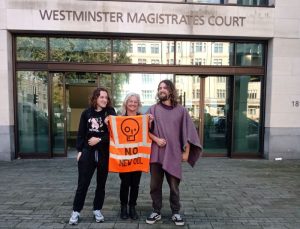
Judit Murray, a 69 year old resident of Ewell, was today sentenced to a 12 month community order with 60 hours of community service at Westminster Magistrates Court.

Ms Murray and her co-defendants, Sol Bourne and Daniel Knorr, who received the same sentence, were found guilty of aggravated trespass at a previous hearing for their memorable protest at Lord’s cricket ground on 28/6/23.

The Just Stop Oil stopped play during the match between England and Australia on June 28, as security and ground staff cleaned up orange powder that was thrown on the pitch and ensured the ground was not damaged.

The three were found guilty after a trial and appeared on 24th October to be sentenced.

Ms Murray said after the hearing “I have seven beautiful grandchildren who deserve the best possible life, so when the country’s top professional, Dr Camilla Kingdon, President, Royal College of Paediatrics and Child Health ’the climate crisis poses an existential threat to the health and well-being of all children’ I am morally and duty-bound to act.”

“Climate change is no longer tomorrow’s problem, it is today’s. The travesty of justice is that I was forced to defend my actions whilst the real criminals; the prevaricating politicians and fossil fuel profiteers, remain unaccountable.”

“My protest interrupted a cricket game for four minutes, a sport you simply wont be able to play in storms, floods or fifty degree heat.”

I am no ‘dangerous radical’, those who are, to quote the UN Secretary General, are ‘the countries that are increasing the production of fossil fuels’. Like our own. They should have been in the dock today,
not me.’


Local Plan (2022-2040) Un-Pause Recommended

Planning documents

Ahead of tonight’s Extraordinary Council Meeting to be held at The Town Hall, The Parade, Epsom at 7.30pm the Epsom and Ewell Times summarises the Report submitted to Councillors by the Head of the Council’s Development Department.


In an effort to ensure the future development and planning of their locality aligns with contemporary standards and requirements, Epsom and Ewell Borough Council initiated a public consultation on the Draft Local Plan (2022-2040) from February 1, 2023, to March 19, 2023. This process aimed to gather input from the community, enabling the council to make informed decisions regarding their local development strategy.

Following the conclusion of the consultation, the council convened an extraordinary meeting on March 22, 2023. During this meeting, the council opted to halt the Local Plan temporarily to undertake specific tasks.

Fast forward to September 24, 2023, and the Licencing and Planning Policy Committee has recommended to the Full Council that it is time to revive the Local Plan. The suggestion to un-pause the Local Plan underscores the importance of keeping the plan up to date and conforming to national planning policy.

An officer’s report to Epsom and Ewell Borough Council puts forward the following recommendations:

  1. Un-pause the Local Plan immediately.
  2. Acknowledge the work done since the pause decision in March 2023.

The rationale behind this proposal is multifaceted. The primary reason is a legal obligation to review the Local Plan every five years. The current development plan in Epsom and Ewell includes documents that date back more than five years, such as the Epsom and Ewell Core Strategy (2007) and Plan E (2011). These documents predate significant national policy changes in the form of the National Planning Policy Framework and National Planning Practice Guidance. The absence of an updated Local Plan poses risks to the council, including the potential loss of a 5-year housing land supply and implications related to the Housing Delivery Test and sustainable development.

Delays to the Local Plan timetable could also jeopardize the transitional arrangements that may be introduced through a revised National Planning Policy Framework. Furthermore, the government has reiterated the need for Local Plans prepared under the current system to be submitted for examination by June 30, 2025, and adopted by December 31, 2026. The actualization of these dates hinges on the Royal Assent of the Levelling Up and Regeneration Bill, as well as parliamentary approval of related regulations. Thus, it is prudent to continue Local Plan development to meet these timeframes.

The existing Epsom and Ewell Development Plan consists of three documents that were locally produced. Two of these documents were adopted before the introduction of the National Planning Policy Framework and Planning Practice Guidance, which have been subject to revisions since their inception. Local Plans must adhere to national planning policy, necessitating an update to bring them into conformity.

The council initiated a consultation on the Draft Epsom and Ewell Local Plan (2022-2040) between February 1 and March 19, 2023. This Draft Local Plan outlined a growth strategy for the borough, intending to provide a minimum of 5,400 homes over the plan period. The strategy had to balance housing provision with environmental and policy constraints such as land designated for special purposes, nature reserves, and the Green Belt.

During this consultation, the council received feedback from 1,736 individuals and organizations, including residents, statutory consultees, and other stakeholders. It’s essential to note that all responses have been made available for public viewing, with any inappropriate comments appropriately redacted.

A Consultation Statement will be released alongside the next version of the Proposed Submission Local Plan (Regulation 19) to summarize the main issues raised and how they’ve been considered.

The Council Motion, passed on March 22, 2023, mandated the Local Plan’s pause for specific tasks, including further work on brownfield sites, consideration of alternatives that exclude green belt sites, analysis of future housing needs based on 2018 data, and a clearer understanding of the government’s intentions regarding green belt protections and housing targets.

The selected workstreams under the Council Motion have been completed, including the call for sites process and the publication of responses to the Draft Local Plan. Thirteen new sites were submitted during this process. However, the decision to un-pause the Local Plan is crucial for further progress, such as revising the Local Plan timetable and site selection, taking into account the latest information.

The Council Motion imposed restrictions on what work could be undertaken in preparing the Local Plan, making it necessary to formally un-pause the plan for further progression. Un-pausing the Local Plan will lead to the production of a revised timetable and the advancement of other critical pieces of evidence. Work on site selection will also commence, considering the latest information on land availability.

“It’s important to understand that un-pausing the Local Plan doesn’t mean the Proposed Submission version of the plan will remain unchanged. Additional sites have been proposed through the call for sites process, and the Proposed Submission Local Plan will undergo public consultation.”

However, it has also been reported to Councillors that there are limited actively promoted sites for development within the Longmead and Kiln Lane areas. The existing employment sites are well-occupied and support various businesses, indicating a need for additional land to accommodate more employment space, including uses suitable for an industrial estate. The council has already invested significant resources in exploring opportunities for industrial estate redevelopment.

Further investigation is deemed reasonable only if a substantial portion of land becomes available through the call for sites process. It is suggested that the council be formally approached to consider making its land available for redevelopment. Obtaining a formal response through the call for sites process would provide essential evidence to inform future decisions regarding the location of development in the Local Plan.

The Levelling Up and Regeneration Bill is in progress, and if implemented, it will significantly alter how Local Plans are produced. This shift may lead to more streamlined Local Plans and a focus on spatial aspects over detailed development management policies. Transitional arrangements will apply, and the government has set a deadline of June 30, 2025, for the submission of Local Plans prepared under the current system.

In conclusion, this report recommends un-pausing the Local Plan to ensure it aligns with national planning policy and complies with legal requirements. Reviving the Local Plan is essential to the future development and planning of Epsom and Ewell Borough.

Drafting of Epsom and Ewell Local Plan “unpausing”?

Motion to pause Local Plan process

Cllr McCormick’s own answers on Local Plan

Public meeting on Local Plan dominated by greenbelters.

Housing need or desire?

Can Epsom and Ewell get more dense?


A bridge closed too far?

Castle Road Bridge closure Epsom

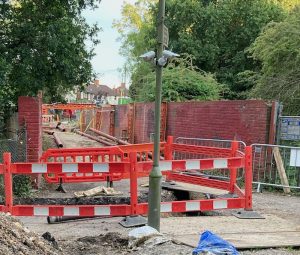
In a saga that has left many residents scratching their heads, a seemingly routine footbridge closure in Epsom has morphed into an unexpected and prolonged headache. The bridge, over the railway line connecting Castle Road to Epsom Common, which was initially shut down at the end of February, has confounded locals with its persistent downtime, offering more questions than answers.

Initially, the bridge’s closure seemed to be prompted by some mysterious “movement,” which had caught the attention of passersby and authorities alike. However, the reasons behind this decision were left shrouded in mystery.

Castle Road bridge to Epsom Common – Google Earth

A brief flurry of activity was seen shortly after the initial closure, with residents hopeful that the issue would be resolved. But this optimism was short-lived. Fast forward to late July, and the mystery deepened as news surfaced that the bridge had been closed due to the discovery of an electricity cable. Many were left puzzled as to why such a discovery had not been anticipated in the first place, leaving the community without their bridge connection.

Since August, the situation appeared to be inching towards a resolution, as services crossing the railway were reportedly lifted and temporarily attached to the bridge’s parapet. Work was ongoing, although without any obvious sense of urgency. In late September, Surrey County Council dropped a bombshell, renewing the closure order for an additional six months, prolonging the ordeal for beleaguered locals.

Chris Grayling MP, brought some semblance of hope when he announced that Network Rail expected the bridge to finally reopen in November. However, skepticism lingered, and residents continued to endure the inconvenience of the ongoing closure.

The closure’s ramifications have rippled through the community, prompting discussions between the Epsom Common Association and Epsom and Ewell Borough Council, although the influence of both parties on the situation remains in doubt. Notably, the footpath diversions on the bridge’s north side have proven problematic, especially as they traverse areas that traditionally transform into quagmires during the winter months.

In an effort to mitigate these challenges, the community proposed an extension of rubber mats to cover all unpaved sections of the diversion route. Though the Council has been in contact with contractors to address this issue, it offers little comfort to those who rely on the bridge for daily crossings.

Adding a twist to this already puzzling tale, Cllr Steven McCormick (RA Woodcote and Langley Vale) has stated “Following excavations on site, the understanding of how dire the condition of the bridge has started to come to light. Due to the extent of the movement of the bridge and the size of the cracks visible only beneath the surface, it was deemed not safe to excavate further with machinery.”

Engineers were brought to the site to investigate the matter further, and their conclusion was nothing short of alarming – the bridge, it appears, is in such a precarious state that it must be demolished and replaced. This revelation has shaken the community, as further ground investigations are planned to determine suitable foundations for the new bridge.

In light of this troubling development, it seems that the footbridge will remain inaccessible until further notice, casting a shadow of uncertainty over the community’s daily routines.

Image courtesy Epsom Common Association


LibDem PPC awarded Medal by the King

Maguire with medal

Epsom & Ewell Liberal Democrat Parliamentary Candidate Helen Maguire received a British Empire Medal (BEM) in The King’s Birthday Honours list announced in June.

The honour was given for the contribution Helen has made for services to the community of Claygate, Surrey, where she lives with her family.

Helen, a former Captain in the Royal Military Police who served in Bosnia and Iraq said, “I am absolutely delighted to have had the work that I and others in my local community have undertaken in recent years recognised.

 “Our efforts to establish wider facilities for the community to support all ages and particularly young people and sport in the immediate area, while providing new options for others came to fruition with the opening of the Claygate Pavilion. It’s therefore humbling to have received such recognition for what was a team effort, so I therefore congratulate those who supported me in establishing our community centre in Claygate.

 “My ambition in standing as Liberal Democrat Parliamentary Candidate for Epsom & Ewell, Ashtead and Leatherhead, is to extend the sort of work that we have been engaged in in Claygate to this constituency so that all can benefit from the sort of improvements that are needed in the area”.

Helen served in Bosnia on a NATO multinational peacekeeping mission and Iraq, to help rebuild the Iraqi Police Service while providing on-the-ground counter- insurgency policing support to front line infantry.

She is a nationally recognised fundraiser having secured over £1 million for UK charities since leaving the Army.


Satellite comms. pass Surrey Uni test

LEO satellites

A satellite company called Eutelsat OneWeb recently made a big advancement. They successfully connected their low Earth orbit (LEO) satellites to a 5G mobile network for the first time. This achievement is a big step towards bringing super-fast internet to people in remote and rural areas.

They were able to do this with the help of a partnership called the Sunrise Programme, which is supported by the European Space Agency. In a test, researchers from the University of Surrey used these satellites to connect to a 5G network. These satellites are orbiting the Earth and make up the second-largest satellite constellation in the world.

During the test, they checked things like video calls, streaming videos, online gaming, virtual and augmented reality, and web browsing. With the LEO satellites, they were able to provide fast internet with very little delay, or “low latency.” They also made sure that users could smoothly switch between the satellite network and regular mobile networks, providing a seamless 5G experience.

Barry Evans, Professor of Satellite Communications at the 6G/5G Innovation Centre (6G/5GIC) at the University of Surrey, said:  “It was thrilling to see no degradation when using the 5G connection made possible by the LEO constellation. This is a step closer to increasing internet access for more people around the world – a privilege that many of us take for granted. The work performed in the 5G pilot tests has demonstrated the feasibility of 5G backhaul over LEO satellites.”

Eutelsat OneWeb’s technology is similar to what we have with 4G, and they matched the quality of 5G in the mobile network with 4G quality in the satellite network. This allowed them to support all the applications they tested.

Eutelsat OneWeb has also made a deal with Telstra in Australia to support their 4G and 5G networks.

Overall, this is a significant achievement in bridging the gap in internet access and improving connectivity for people in remote areas. It’s also a testament to the Surrey’s leadership in space and telecommunications technology.

Image: Attribution-ShareAlike 3.0 Unported CC BY-SA 3.0 DEED


No reservations to put reserves in “Thames to Downs”

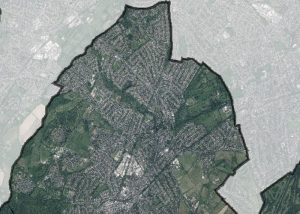
Part of Epsom and Ewell aerial view

Epsom & Ewell Council Eyes Inclusion of Local Natural reserves in the ‘Thames To Downs’ National Nature Reserve.

The Council’s Environment Committee 17th October debated an ambitious move to preserve its natural heritage and enhance biodiversity. The Council is considering the inclusion of several of its green spaces within the proposed ‘Thames To Downs National Nature Reserve’ (NNR). The council plans to report back to the committee if Natural England deems them suitable for this scheme.

The recommendation comes as a bid to consolidate and expand upon the Council’s ongoing efforts in managing biodiversity and public access within its open spaces. The move also carries the potential for national recognition, designating the council as an ‘Approved Body’ known for maintaining its land to the highest environmental standards on a permanent basis.

The NNR management criteria align with the council’s strategy of balancing biodiversity conservation with ensuring public access to these natural sanctuaries. Collaborating as part of the NNR partnership with neighboring landowners is anticipated to attract substantial external funding to aid in long-term land preservation and management.

Furthermore, inclusion in the NNR not only fulfills key service priorities but also demonstrates the council’s commitment to its statutory responsibilities. It aligns seamlessly with the ‘Biodiversity Duty’ and other environmental requirements, such as upcoming Local Nature Recovery Strategies.

The NNR status will not only showcase the borough as an exceptional place to live and work but also contribute significantly to preserving and expanding local biodiversity.

Epsom Common Local Nature Reserve (LNR), a site of national importance for nature, gained recognition as a Site of Special Scientific Interest (SSSI) alongside Ashtead Common back in 1955. In the 2005-2015 Epsom Common Management Plan, the council committed to achieving a ‘Favorable’ SSSI condition assessment for Epsom Common. Subsequently, the goal was to apply for National Nature Reserve status, encompassing the entirety of the Epsom & Ashtead Commons SSSI as part of a National Nature Reserve.

The endeavor to secure NNR status for Epsom Common LNR is well-documented in the council’s current Epsom Common LNR Management Plan 2016-2116 and the Climate Change Action Plan.

An officer explained to the committee: “We are really keen that Epsom Common joins Ashtead Common in being declared a National Nature Reserve. We’ve all been set up for that for over a decade. It’s in the management plan; it’s Council policy to do that. But Natural England has changed its approach to National Nature Reserves in the last two or three years. They have put forward the offer to work with us and other partners to form a much larger, what they would term a super-national Nature Reserve, going from the Thames at Kingston to the North Downs.”

Cllr Julie Morris (LibDem College) raised the question what legal status such a NNR would have? Could landowners within them nevertheless develop their land? The officer answered: “Epsom Common, for example, is a Site of Special Scientific Interest, and that’s the strongest legal protection that you can afford a site like that. The other sites that are being put forward are in the Green Belt. They are sites of nature conservation importance. They have ancient woodlands. All of those are material considerations for a planning application. Alistair Helwell, who is the lead person at Natural England for National Nature Reserves, does make a point of saying it is a declaration, not a designation. So it doesn’t afford greater protection, but it does afford a greater level of kudos, obviously”

National Nature Reserves (NNRs) are vital for preserving significant habitats, species, and geology while serving as invaluable ‘outdoor laboratories’ for research. These reserves offer opportunities for schools, special interest groups, and the general public to directly experience wildlife and learn more about nature conservation.

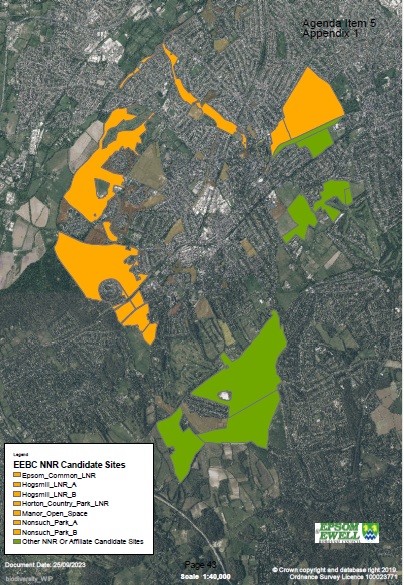
Currently, England boasts 221 NNRs covering over 105,000 hectares of land, approximately 0.7% of the country’s surface. The largest among them is The Wash, sprawling over almost 8,800 hectares, while Dorset’s Horn Park Quarry is the smallest at 0.32 hectares. The five proposed sites in Epsom & Ewell together span an impressive 455 hectares, equivalent to 13.4% of the borough’s land.

A ‘Favorable’ SSSI condition assessment was successfully attained in 2010, prompting the council to commence the NNR application process. Unfortunately, due to funding cuts at Natural England, the application was postponed for nearly a decade. It was only in 2021 that the council was approached once again by Natural England, offering renewed prospects for an NNR application. In 2022, Natural England’s approach evolved, emphasizing the creation of more extensive landscape-scale NNRs in line with the government’s ‘Making Space For Nature’ initiative.

The council has been invited to put forward other sites under its ownership/management for possible inclusion in a landscape-scale NNR stretching from the Thames at Kingston to Box Hill on the North Downs.

Five potential sites in Epsom & Ewell, including Epsom Common Local Nature Reserve (LNR), Manor Open Space, Horton Country Park LNR, Hogsmill LNR, and Nonsuch Park, have been identified. Natural England has suggested an affiliate status for sites primarily designated for purposes other than nature conservation, such as Epsom Downs. It’s important to note that the inclusion of Nonsuch Park will require separate permission from the Nonsuch Park Joint Management Committee.

A comprehensive partnership with a variety of landowners is envisioned, including local authorities, Surrey Wildlife Trust, National Trust, Woodland Trust, Crown Estates, Merton College (Oxford), and City of London (Ashtead Common).

The unanimous decision of the committee to include the named sites within Epsom & Ewell for consideration will be followed by assessments of their suitability and the council’s capability as an ‘Approved Body’ for managing an NNR.


Chalk Pit debate deferred by late abatement

Chalk Pit waste site. Epsom

The Environment Committee of Epsom and Ewell Borough Council 17th October was to discuss a motion proposed at a Full Council meeting on July 25, 2023, regarding a noise nuisance issue at the Chalk Pit site in College Road, Epsom. The motion had suggested that the Council should install professional noise measurement equipment at the site for a minimum of three months and respond to any noise regulation breaches with noise abatement orders. Councillor Bernie Muir (Conservative Horton) had introduced the motion at Full Council.

However, the Chair of the Committee, Cllr John Beckett (RA Auriol) announced: “”Members, as you are aware, I made the decision to withdraw this item from the agenda this evening in light of the recent enforcement activity last week. This activity resulted in an abatement notice being served to an operator at the Chalk Pit. I am very conscious of the members’ and the public’s interests in this matter. I am keen to ensure that the proposed motion is debated with full consideration of the circumstances, including the impact of the recently served abatement notice. Therefore, I propose that this item is deferred and considered at the next meeting of this committee in January.”

There were no objections and Cllr Beckett added that there will be “No further debate, questions, or statements will take place regarding the Chalk Pit until the meeting on the 9th (January).

The Councillors had received an officer’s report written before the abatement notice was served and that report is summarised here:

The report provided background information about the Chalk Pit, explaining its historical use and current industrial activities. It highlighted the various sources of noise on the site, such as equipment, machinery, road vehicle arrivals and departures, and more. The site was in close proximity to residential properties, and complaints about noise had increased since 2021.

Surrey County Council has jurisdiction over waste processing at the site, while other activities are regulated by the Borough Council. A planning application was submitted by Skip It, including changes and enclosure construction to control noise emissions. The Environment Agency and local authorities regulate noise and dust issues, depending on the source.

The report described the council’s actions in response to noise complaints, including extensive monitoring and investigation. Despite clear evidence of audible noise, the council’s officers believed they lacked sufficient evidence to issue an abatement notice, citing the complexity of the issue and the need for unequivocal evidence.

The report noted that residents had the option to pursue their own civil legal action under the Environmental Protection Act 1990 if they wished to explore this further.

The council had taken some enforcement actions, including Community Protection Warning Notices, but no abatement notices had been issued due to the lack of evidence.

The report presented three options for the committee to consider:

1. Close the investigation with no further action due to insufficient evidence.

2. Keep the issue under review and seek funding for enforcement action if sufficient evidence emerges.

3. Recommend allocating funding to hire external noise consultants to conduct a fresh investigation based on recent complaints and site changes.

Option 3 would require additional funding from sources like reserves and would only be pursued in the event of substantial and substantiated complaints about noise nuisance. Officers asked Councillors “In deciding whether to support renewed investigations on top of those that have already taken place, Members are asked to consider the likelihood of whether renewed investigation would ultimately lead to successful enforcement action and, by extension, whether it would be an effective use of limited Council resources.”

Related reports:

Will the dust ever settle on Chalk Pit conflict?


Noble housing intentions?

Noble Park housing plan

Crest Nicholson and the Vistry Group have partnered for a “sustainable development” initiative near Noble Park in Epsom. They plan to submit a comprehensive planning application to Epsom and Ewell Borough Council this Autumn. The proposal aims to construct around 90 new homes, with 40% allocated as affordable housing.

The project includes the creation of communal open spaces and green areas, featuring a community orchard and a children’s play area. Noble Park allotments will remain untouched, highlighting a “commitment to preserving community assets”. Additionally, plans include dedicated private parking facilities for allotment holders.

The developers have invited the local community to participate in shaping this initiative by providing input and ideas. Residents can offer feedback or seek more information through the ‘Feedback and Contact’ tab on the following unattributed website. http://nobleparkconsultation.com/

The project is located on 5.67 hectares of land to the east of the existing Noble Park development, at the intersection of West Park Road and Horton Lane, with vehicular access from West Park Road. While specific timelines depend on the planning process, construction may begin in 2025, contributing to family housing and affordable homes in the area. This initiative “aims to address housing shortages and bring positive change to the community”.

Epsom and Ewell Times can confirm that Epsom and Ewell Borough Council will meet at 7.30pm on 24th October, to decide whether to “un-pause” progress on the Local Plan. The Plan that will establish the planning policy framework for where and how many houses may be built in the Borough in the future.

Related reports:

Drafting of Epsom and Ewell Local Plan “unpausing”?

Motion to pause Local Plan process


Council Grapples with Rising Cost of Homelessness

Geograph Britain and Ireland | Licence details Creator: Evelyn Simak | Credit: Evelyn Simak Copyright: © Evelyn Simak and licenced for reuse under cc-by-sa/2.0

In an ongoing challenge to manage rising homelessness-related costs, Epsom & Ewell Borough Council (EEBC) finds itself confronted with an impending financial strain exceeding their 2023/24 budget. This report sheds light on the concerted efforts made to mitigate the budgetary overruns and identifies available funding avenues to cover these increased expenditures.

The Community and Wellbeing Committee 10th October accepted the following recommendations:

  1. Acknowledge the measures taken over the past 6-12 months to address homelessness.
  2. Approve the utilization of the Homelessness Prevention Grant (HPG) and homelessness grant reserves to meet the projected increase in expenses, thereby ensuring EEBC complies with its obligations under the Housing Act 1996 and Homelessness Reduction Act 2017.
  3. Note that a comprehensive update will be presented at the Community & Wellbeing Committee in March 2024.

EEBC is bound by statutory duties outlined in the Housing Act 1996 and the Homelessness Reduction Act 2017. Non-compliance could expose the council to legal challenges.

The Committee were advised of escalating expenditure: EEBC’s budget is stretched thin due to mounting expenses for temporary accommodation in fulfilling their homelessness obligations. Costs for 2023/24 are poised to surpass £1.5 million, primarily owing to an increasing number of homelessness cases, a 15% surge in rental rates from accommodation providers, and a shortage of alternative housing options.

Officers have been operating in an increasingly demanding climate, with the cost-of-living crisis amplifying the complexity of issues presented by households in need of assistance.

The cost-of-living crisis, accompanied by rent hikes, has exacerbated housing supply issues, with heightened competition from other local authorities further straining the available housing stock.

The Homelessness Strategy & Action Plan 2022-27 was adopted in November 2022, outlining key objectives and actions. Progress has been made in early intervention and prevention.

Competition and energy cost increases have pushed up the cost of accommodating households in temporary arrangements, despite the team’s adaptive procurement approach.

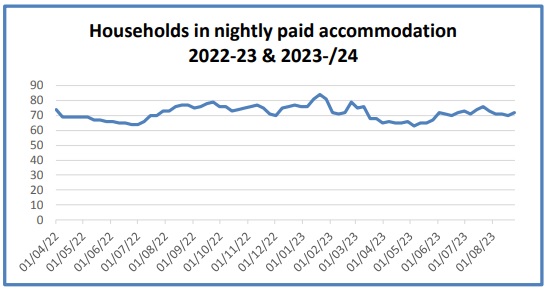
Officers occasionally resort to using Travelodge as accommodation due to a lack of alternatives, incurring a substantial cost of around £140 per night. The average net cost of nightly paid accommodation for small families has surged by over 18% compared to 2022/23, reaching approximately £23,500 annually.

EEBC introduced a Private Sector Leasing (PSL) scheme to lease properties from private landlords for temporary accommodation, offering significant cost savings compared to expensive options like Travelodge.

The challenges faced by the housing services teams are likely to persist in the coming year, and high numbers of households in temporary accommodation are expected to persist.

Economic uncertainties and factors such as reduced housing development and the closure of bridging accommodation for refugees will continue to exert pressure on housing services.

Monthly reporting to the Committee Chair and Vice Chair will provide ongoing updates on the situation, with a commitment to implement actions as per the Homelessness Strategy.

Promotion of the PSL scheme to landlords will be pursued, and collaboration with housing associations and partners to boost the supply of affordable housing will remain a priority.

In sum, EEBC is grappling with the burden of homelessness-related expenses, which, despite diligent efforts, continue to rise. The council faces the critical task of managing these costs to fulfill its legal obligations while seeking innovative solutions to address housing supply challenges in the community. The situation will be closely monitored, with continued engagement with stakeholders to identify viable solutions.

The recommendations were agreed by the committee.

Image: Evelyn Simak cc-by-sa/2.0


Housing Allocation Policy Undergoes Updates

Town Hall

In a bid to modernize the housing allocation process and enhance the efficiency of social housing distribution, the Council adopted a series of amendments to the Housing Allocation Policy and Choice Based Letting Scheme. These changes aim to align the policy with recent legislative updates, reinforce penalties for fraudulent activity, and refine financial thresholds for eligibility.

Cllr Clive Woodbridge, Chair of the Community and Wellbeing Committee (RA Ewell Village) introduced the item at its meeting on 10th October: “It’s over six years since this was last reviewed significantly, and the changes proposed to the policy are intended to introduce considerable more flexibility so that we can widen the range of people that we can assist through the scheme. So, the committee has been asked to review it and say whether they agree with the various changes that are being made”.

During the discussion Cllr Woodbridge asked: “How has the Domestic Abuse Act changed the way we have to implement our policy, and how is that reflected in the document before us tonight?” The Council Officer explained: “Our previous policy was compliant anyway, it just didn’t make a particular reference to The Domestic Abuse Act. We have exceptions within the allocation policy which allow us to look at each case on a case-by-case basis. However, the housing needs register is a waiting list and often it can’t address people who have an urgent need for rehousing, so often the more appropriate route for people who are at immediate risk of domestic abuse is to go through the housing options process. However, the policy is designed so we don’t put barriers up for those that do want to be on our housing needs register, so it doesn’t have a requirement to have lived in our borough and is flexible to take those needs into account.”

Cllr Alison Kelly (LibDem Stamford Ward) expressed her concern about the position of “care leavers” (persons who have been in care between the ages of 16 and 25 who lived in care for at least 13 weeks since their 14th birsthday) and asked that each such applicant for housing was considered flexibly and treated on a “case by case” basis. The officer responded that “At a practical level we would always treat each case on a “case by case basis””. She added that the care leaver policy was being looked at on a Surrey wide basis.

In December 2014, a joint Social and Strategy and Resources committee approved fundamental changes to the existing Housing Allocation Policy. The policy governs how housing needs are prioritized, Housing Needs Register applications are assessed, and social housing is allocated. Following extensive consultations with key stakeholders, the revised Housing Allocation Policy was formally endorsed and implemented in June 2015.

While the policy has effectively met its intended goals, certain aspects are now due for review to ensure its continued relevance and responsiveness to current challenges. Consequently, several adjustments to qualifying and non-qualifying criteria, along with administrative procedures, have been proposed to keep the policy up-to-date. The key changes include:

  1. Fraud & False Information:
    Revisions to the qualifying criteria and penalties for applicants involved in fraudulent applications or false information. These changes will align with the ongoing efforts of Reigate and Banstead’s Fraud Investigation team.
  2. Legislative Compliance:
    Ensuring the Housing Allocation Policy complies with evolving legislation, statutory guidance, and case law.
  3. Alignment with Surrey-Wide Protocols:
    Adapting the policy to any adjustments in joint protocols implemented across Surrey.
  4. Financial Qualifying Criteria:
    Reviewing the financial criteria for inclusion on the Housing Needs Register. The current thresholds, set in 2015, restrict single people or couples without dependent children with gross annual earnings of £25,000 or more and couples or single parents with dependent children with gross annual earnings of £50,000 or more.

Proposed Changes:

  • Fraud & False Information: Strengthened criteria and penalties for applicants making fraudulent applications. Disqualification from the Housing Needs Register for two years for fraudulent applicants and five years for those convicted of fraud or deception.
  • Legislative Compliance: Updates to reflect changes in legislation and statutory guidance affecting the Housing Allocation Policy.
  • Alignment with Surrey-Wide Protocols: Incorporating changes introduced in the Surrey Joint Housing Protocol for Care Leavers and the Homelessness Reduction Act 2017.
  • Financial Qualifying Criteria: Adjusting the income thresholds, increasing the current £25,000 gross annual earnings for single people/couples without dependent children to £40,000, and the £50,000 threshold for couples/single parents with dependent children to £65,000.

These adjustments are backed by a recent benchmarking exercise across Surrey, which highlights the need to ensure a balanced mix of households reliant on welfare benefits and those employed, especially for one-bedroom properties. Additionally, the proposed income thresholds align with the income levels at which applicants would no longer qualify for welfare benefits or universal credit.

Furthermore, the changes aim to address the challenges faced by low-income households in private rental accommodation, who are often limited by the Local Housing Allowance (LHA) rates, causing a substantial shortfall between LHA rates and median private sector rents.

The proposed adjustments are a comprehensive attempt to modernize the Housing Allocation Policy, making it more equitable, responsive, and reflective of the current housing landscape. The committee unanimously adopted the revised policy.


Improving housing improvements for the vulnerable

Chair lift

10th October Epsom and Ewell Council’s Community and Wellbeing Committee agreed a Revised Private Sector Housing Grants Assistance Policy to Expand Support for Vulnerable Residents.

The item was introduced by committee Chair Cllr. Clive Woodbridge (RA Ewell Village). In response to updated central government guidelines, the local Council is poised to adopt a more flexible and proactive approach to assist a broader range of households through its revised Private Sector Housing Grants Assistance Policy. The move comes as a result of increased funding for the Disabled Facilities Grant (DFG) program via the Better Care Fund. This additional funding has enabled the Council to harness the powers under the Regulatory Reform Order 2002 (RRO) to introduce a Discretionary Private Sector Housing Grants Assistance Policy, aiming to provide support for vulnerable residents.

The existing policy has proven effective in the past but is now undergoing revision as the Council finds itself with a significant surplus of DFG funds, providing an opportunity to extend its assistance further. Notably, central government’s guidance, released in March 2022, has directed the Council to utilize the discretionary powers within the RRO to meet the needs of disabled and vulnerable individuals in the community more comprehensively. This flexibility includes adaptations to means test requirements and grant caps, while also offering discretionary financial aid for purposes such as home safety and hospital discharge support.

The Council’s objective is to ensure equitable and accessible financial support reaches a wide array of residents. To achieve this, a revised policy is being proposed to accommodate an increased number of vulnerable residents.

Background:

  • The Council’s responsibilities concerning financial assistance for repair and adaptations are regulated by the Housing Grants, Construction, and Regeneration Act 1996 and the Regulatory Reform (Housing Assistance) (England and Wales) Order 2002 (RRO).
  • The Private Sector Housing Grants Assistance Policy was first introduced in 2018.
  • The Council annually receives ringfenced central government funding for DFGs, totaling £785,282 in the last three years. Local authorities are encouraged to maximize the use of their discretionary powers under the RRO to respond to local needs, necessitating the formulation of a published policy.
  • In the fiscal year 2022/23, the Home Improvement Agency collaborated with various organizations to enhance the promotion of their services and grants, leading to the completion of 43 DFGs worth £616,000 for a wide range of adaptations, including level access showers, stairlifts, ramps, and wheelchair accessible extensions. The handyperson service completed 241 jobs, addressing needs such as grab rails, minor repairs, and garden clearances.
  • The integration of services between Housing, Social & Adult Care, and the National Health Service aims to support vulnerable households in remaining in their homes whenever possible.
  • Poor housing can be a significant barrier for vulnerable, elderly, and disabled individuals, contributing to immobility, social exclusion, ill health, and depression. Housing assistance policies can mitigate these challenges by enabling people to live independently in secure, well-maintained, and suitable housing.

Proposed Policy Changes:
The Council’s revised policy includes several notable changes to better support residents:

  • Broadened eligibility criteria, including the removal of means test requirements for prevention grants and the inclusion of council tax support as a passporting benefit to streamline access.
  • A more flexible application process and forms.
  • A new exceptions clause for individualized case handling.
  • An increased maximum grant level to account for rising construction costs and complex needs.
  • Assistance extended to those with terminal illnesses and dementia.
  • Introduction of loans from the Parity Trust for cases requiring additional funds or where grant requirements aren’t met.
  • Accessible housing grants to meet the growing demand in the housing market for disabled individuals who are either homeless or in need of more suitable properties.
  • Addition of a prevention grant to enhance health and safety in homes in alignment with the NHS and Social and Adult Care.

The Council’s commitment to expanding its support through this revised policy reflects its dedication to fostering safer, more accessible housing options for vulnerable residents.

The revised policy was unanimously agreed by the committee.


Local community gathered at Horton Cemetery

Banner at Horton Cemetery

On World Mental Health Day 10th October on a working and un-seasonally hot day, young and old gathered in commemoration of the 9000 patients buried in Epsom’s abandoned Cemetery.

The events were the climax to a year long project of The Friends of Horton Cemetery, supported by Kings College and Dr Alana Harris, local resident and Reader in History at the University. Entitled “Out of Sight, Out of Mind”, the project raised awareness throughout the Borough of the lives of 9000 patients buried between 1899 and 1955. In their memory nearly 1600 ceramic flowers were uniquely painted by hundreds of concerned citizens as they contemplated the stories and photographs of individual patients.

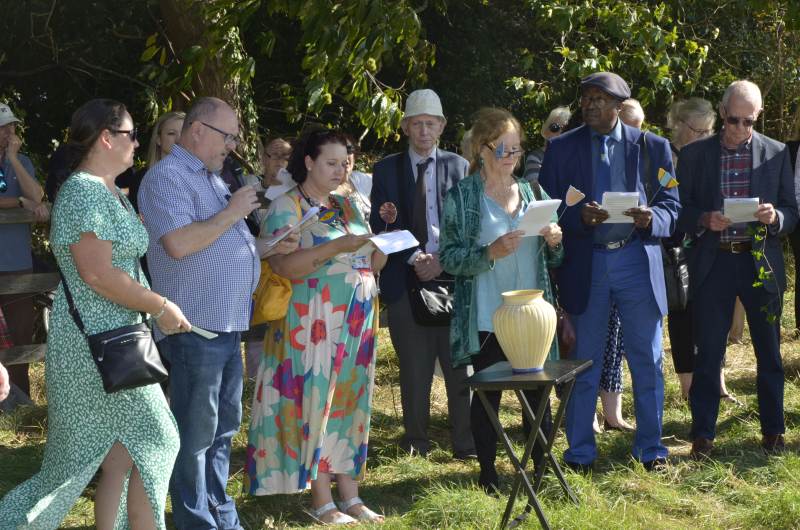
Hardy poem reading

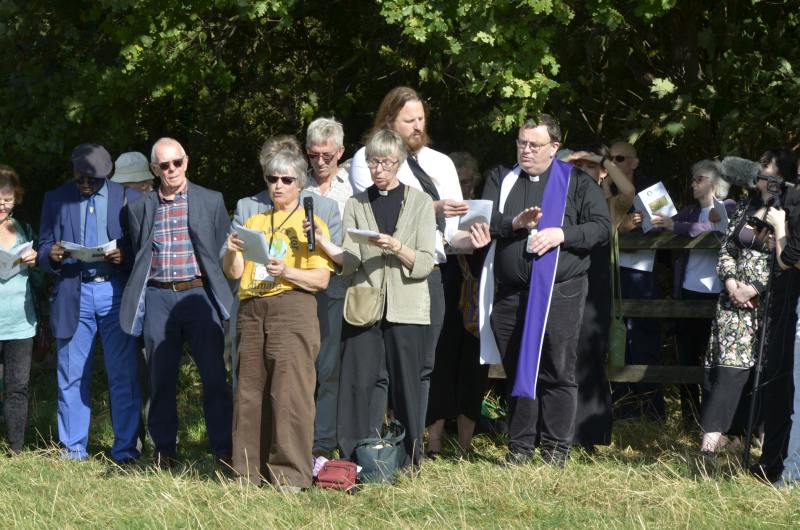
Faith leaders read a committal together

The celebration started in a private field provided for the day by local farmer Mr Seymour Bourne and located right next to the five acre Cemetery. The largest asylum cemetery in Europe. Under a blazing Autumn sun the gathering was addressed by the charity’s secretary Mr Lionel Blackman, who called for a rejection of a local council categorisation of the Cemetery as “amenity woodland”. The Mayor of Epsom and Ewell, Cllr Robert Geleit (Labour Court Ward) spoke of Epsom’s historic connection to the five psychiatric hospitals in the Borough.

Patron of the charity, Chris Grayling MP sent a message, read by Horton Ward Cllr Kieran Persand: “It’s easy not to realise, as you drive past, the piece of history that lies behind the fence. Thousands of people lived in the old hospitals, lived and died mostly anonymously. They have no gravestones to mark their final resting place. And disgracefully the cemetery has been allowed to rot by its current owners. It is a credit to the work of the Friends, and of people like Alan Carlson who raised the money for a memorial, that their memory has not been lost. I hope one day that the cemetery can be taken back, and turned into a real garden of remembrance for those who passed so much of their lives here.“

Theresa Keneflick, a trustee of the charity and head of St Josephs Primary School spoke and brought a school choir who sang “True Colours” by Cindy Lauper.

The following each read a verse from Thomas Hardy’s ‘Voices from Things Growing in a Churchyard’:

Rosie Spence, relative, on behalf of her great, great, great grandfather. Allen Price from Love Me Love My Mind. Carmen Nel, NHS Clinical Practitioner. Audrey Ardern-Jones, local poet and project volunteer. Charles Wood, former Nurse at Manor Hospital and Horton Hospital. Kevin McDonnell, Friends of Horton Cemetery Trustee and lead researcher of the lives. Timothy Folkard, project volunteer.

Then voices from the Cemetery were spoken by Epsom Players representing the lives of Enid Barnet and Richard Waterer.

Dr Alana Harris explained the symbolism of the ribbons everyone had tied for the day to the fence near the Cemetery.

Rev Nick Parish and Judith Mitchell (St Martin’s Church of England); Fr Stephen O’Brien (St Joseph’s Catholic Church); Pastor Josh Selfe (Epsom Methodist Church); Clerk Frances Touch (Epsom Quakers) said in unison:

“We are gathered to remember these 9000 souls who lived and died in Epsom – to
remember them and to make representations that they might have dignity and rest in their death.

To everything there is a season and a time for every purpose on earth. A time to be born and a time to die; a time to plant and a time to pluck up that which is planted. A time to heal, a time to break down and a time to build up.

We affirm our mutual commitment to honour the residents of Horton Cemetery and to work for their memorialisation. Amen.”

Finally a trumpet solo ‘Marking the Unmarked’ – was performed by its composer Erin Symonds.

The gathering then followed Scots Piper Bob Ash to the former Horton Chapel where a Memorial Garden of the ceramic flowers was unveiled. The audience was addressed by Patron of The Friends of Horton Cemetery, Baroness Sheila Hollins, who once worked in the St Ebbas Hospital in Hook Road, Epsom. Dr Harris concluded speeches with an overview of the project and its significance and meaning.

‘In Memoriam’ a film created by Cameron Cook, Jack Daly and Mica Schlosser of Kings College simply rolled the 9000 names to suitable music. The audience was spellbound.

Company Concentric performed a dance ‘Garden Unlocked’ and led the audience to the Memorial Garden unveiling. This involved the planting of final flowers within the Forget Me Not installation by Sue Littleboy planting for James Poppelwell (great grandad, 1867-1914, d.Long Grove, grave b977); Nari Fairbanks (by proxy as resident in NT, Australia) – planting for Charles Holdgate (great, great, great uncle, 1854-1932, d. Long Grove, grave 1105a); Iveta Goddard – creator of the ceramic flowers used in the memorial garden and Lauren of St Joseph’s Catholic Primary School.

Joining the 200-odd strong audience beside Horton Cemetery were Liberal Democrat PPC Helen Maguire, Chair of Epsom and Ewell Labour Party Mark Todd and Gina Miller the True and Fair Party PPC for the constituency. And as ever on her push-bike, Cllr. Alison Kelly (LibDem Stamford) and Janice Baker a leader of the local Green Party. Two Residents Association Councillors appeared including Cllr Phil Neale (Cuddington Ward) and another.


Lease reprieve for Langley Village Hall

Langley Vale Village Hall lease signing

Langley Vale Village Hall was under the threat of closure but due to the hard work of the Langley Vale Village Hall Association and local residents a new 10 year lease has been negotiated.

The Hall, situated at 47 Rosebery Rd, Epsom, is the heart of community life in the somewhat otherwise isolated housing estate over the Downs. The freeholder of the hall is THE GUILDFORD DIOCESAN BOARD OF FINANCE, a company limited by guarantee and not-for-profit.

Nevertheless, it is reported to have been been a trying and difficult year dealing with the lease renewal.

Sharon Watkinson, a long standing resident of Langley Vale, witnessed the signatures of the trustees of the Association on the new lease.

The new lease includes a guaranteed option to add a further 5 years to take the Hall safely through to 2038.

The renewal allows the Association to apply for grants for the Village Hall for some much-needed maintenance works and possible eco friendly upgrades to the heating and also the windows.

The Hall was the venue for a highly successful Kings Coronation Street Party, “the best party the Village has seen” said Sean Porter, Chairman of the Langley Vale Village Hall Association.


Pollution around Epsom and Ewell Schools

Cars on the school run

Epsom and Ewell Extinction Rebellion embark on a public education drive on Sunday 9th October in Epsom High Street. The climate action group has tabulated the pollution statistics for schools in and around the Borough.

The table below is based on statistics provided by addresspollution.org a United Nations accredited initiative of the Central Office of Public Interest.

Between 10am and 1pm the XR group will have a Doctor’s surgery (with an Intensive Care Unit Doctor) giving real world advice on the health impact of Air Pollution. A Citizens Polling Board so passersby can vote for their favourite Pollution Solutions and an information desk so you can find out the Air Pollution levels at your home and local schools.

In 2020 in a study published by the journal Science of the Total Environment, experts from the University of Surrey’s world-renowned Global Centre for Clean Air Research (GCARE) partnered with a local school and the local community in Guildford to investigate the impact cars have on air quality in and around schools during drop-off and pick-up times.

Children face a worrying threefold increase in air pollution during the daily school runs, causing air quality experts to call for restrictions on the use of cars during those periods.

These are the statistics provided by addresspollution.org for local school postcodes year long average figures assessed on 4th October 2023:

School A i r
Pollution Level
UK Ranking Higher is worse PM2.5
Level
mcg/m3
WHO Safe Limit 5 .
PM10 Level mcg/m3
WHO Safe Limit 15 .
NO2
Level mcg/m3 WHO Safe
Limit 1 0 .
Auriol School Very High 8 2 % 12.22 18 .8 9 2 0 .1 7
Beacon School Significant 5 1 % 1 0 .4 0 1 6 .8 4 1 5 .1 6
Blenheim High High 7 8 % 1 1 .9 0 1 8 .6 4 1 9 .0 6
Che a m Common Very High 8 4 % 1 2 .2 8 1 9 .0 7 2 1 .5 0
Cuddington Croft High 7 0 % 1 1 .1 7 1 7 .8 0 1 8 .8 2
Cuddington School Very High 8 2 % 1 2 .1 9 1 8 .8 4 2 0 .8 4
Danetree Very High 8 0 % 1 2 .0 5 1 8 .7 1 1 9 .5 9
Downsend High 7 2 % 1 1 .4 6 1 8 .0 5 1 8 .3 1
Epsom & Ewell High Very High 8 3 % 1 2 .1 6 1 8 .8 4 2 1 .2 2
Epsom College High 6 4 % 1 0 .9 6 1 7 .5 2 1 7 .0 5
Epsom Downs Primary Significant 5 2 % 1 0 .3 8 1 6 .9 2 1 5 .3 8
Epsom Primary High 7 8 % 1 1 .7 7 1 8 .4 1 1 9 .8 2
Ewell Castle High 7 8 % 1 1 .7 9 1 8 .4 9 1 9 .8 7
Ewell Grove Very High 8 2 % 1 2 .0 1 1 9 .0 2 2 1 .0 2
Glyn High 7 4 % 1 1 .6 9 1 8 .2 5 1 8 .1 2
Ki ngswoo d House High 7 3 % 1 1 .4 8 1 8 .0 5 1 8 .6 7
Knollmead Primary Very High 8 2 % 1 2 .0 2 1 8 .6 6 2 1 .3 4
Linden Bridge Very High 8 3 % 1 2 .1 5 1 8 .8 2 2 1 .6 0
Malden Parochial Very High 8 8 % 1 2 .2 1 1 9 .1 1 2 4 .9 6
Mead Infant Very High 8 2 % 1 2 .2 3 1 8 .8 9 2 0 .1 8
Meadow Primary Very High 8 0 % 1 2 .0 6 1 8 .7 3 1 9 .8 1
Nescot High 7 2 % 1 1 .4 2 1 8 .0 2 1 8 .4 0
Nonsuch Primary Very High 8 1 % 1 2 .0 5 1 8 .7 7 2 0 .4 0
Riverview Primary Very High 8 1 % 1 2 .1 7 1 8 .7 9 2 0 .2 9
Rosebery High 6 7 % 1 1 .2 9 1 7 .7 6 1 6 .7 5
Shawley Community Significant 5 0 % 1 0 .3 8 1 6 .7 9 1 4 .9 8
Southfield Park High 7 2 % 1 1 .5 4 1 8 .0 7 1 8 .1 0
St Christophers High 7 0 % 1 1 .4 2 1 7 .9 7 1 7 .6 6
St Clements High 7 9 % 1 1 .9 4 1 8 .5 9 1 9 .7 0
St Josephs High 6 8 % 1 1 .3 8 1 7 .8 6 1 6 .9 1
St Martins High 6 8 % 1 1 .3 1 1 7 .8 2 1 7 .0 6
Stamford Green High 6 8 % 1 1 .3 3 1 7 .8 0 1 7 .1 4
Wallace Fields High 6 7 % 1 1 .2 4 1 7 .7 5 1 7 .2 2
West Ewell Very High 8 1 % 1 2 .1 5 1 8 .7 8 2 0 .1 8

Image: The school run © Robert Ashby cc-by-sa/2.0 Geograph Ireland


Quis custodiet ipsos custodes?

Magnifying glass over paper with word "silence"

A 9 month delay in presenting a critical report about Epsom and Ewell Borough Council‘s handling of complaints was the subject of testy exchanges at a meeting of the Council’s Audit and Scrutiny Committee on Thursday 28th September.


“Who will watch the watchmen?” When the Audit and Scrutiny Committee of the Council is itself under scrutiny – who takes responsibility for that?


The Local Government and Social Care Ombudsman (LGO) had written to the Chief Executive of the Council in July 2022. The letter stated: “during the year your council failed to respond in time to our correspondence during three investigations. On each occasion, we had to escalate the matter internally and were forced to consider issuing a witness summons and a public report for non-compliance. Such delays in our investigation undermine our role and can result in further distress to complainants.”

Though the letter was available to the public on the Ombudsman’s website the question asked at the 28th September meeting was why the committee, responsible for the scrutiny and review of the decisions and performance of the council, was not presented with the letter at either of its subsequent meetings of November 2022 and February 2023. It was finally presented at the meeting of April 2023.

The Chair of the 28th September 2023 meeting of the Audit and Scrutiny Committee was Councillor Steve Bridger (RA Stamford). He repeated a written answer to the question which referred to a “work plan” that provided for the Ombudsman’s communication to be presented at the April meeting.

The questioner was former Residents Association Councillor Previn Jagutpal, exercising his right to ask a question as a member of the public. He responded to the Chair’s answer and stated that there was no such direction in any “work plan”, copies of which he held on the desk in front of him.

Mr Jagutpal went on to heavily criticise the conduct of the matter and said “Why should residents of Epsom and Ewell have confidence in the transparency and effectiveness of the Audit and Scrutiny Committee when pivotal information, such as the 2022 LGO annual review, and perhaps other information over the last four years, is not being shared in a timely manner with the committee?”

He went on to label the committee “The bodge-it and secrecy committee”.

In another procedural controversy, though permitted a supplementary question to his first one, Mr Jagutpal was denied a second question, even though, as Mr Jagutpal pointed out, there was plenty of time for the committee to deal with it. Exploiting a bizarre anomaly in the procedures he was permitted to make a statement during which he told the committee what his denied second question was! Namely, a question concerning a meeting between the Chief Executive of the Council and the LGO of April 2022. Thus, as Mr Jagutpal argued, the matter pre-dated the subject of his first question about the July 2022 LGO letter.

A lawyer for the Council advised the Chair that Mr Jagutpal was not permitted a second question. According to Epsom and Ewell Times research of the standing orders the rule appears to be:

“If a member of the public asks or wishes to ask more than one question, their second question (written or oral) shall be taken after all other individuals who wish to ask a question have been given the opportunity to do so.”

There were no other members of the public lining up to ask questions at this meeting.

Councillor Chris Ames (Labour Court Ward) raised a point of order and accused the Chair of plucking rules out of the air to silence a member of the public and protect the Council from scrutiny. He said “I just do not believe that that rule exists. However, more to the point I’ve noticed that every time Mr Jagutpal tries to ask a question that risks embarrassment for officers, or for yourself chair, some arcane rule is plucked out of the air to shut him down. It absolutely reeks of cover up and pettiness. What must residents think of a Residents Association Council using every trick in the book to keep residents in their place?”

The legal adviser intervened once more: “I’ve previously advised this committee as to my interpretation as monitoring officer that the current Constitution and the relevant Annex is to be read that way so my advice has been quite clear that’s how we’re operating.”

Later in the meeting Cllr Ames weighed in again about the 9 month delay in disclosing the LGO’s July 2022 critical letter. He said “”I think my question for you, chair, is when you received this letter, you must have looked at this letter. You must have thought things are going very badly wrong. I must put this before the audit and scrutiny committee at the next meeting rather than sit on it until April. I mean, surely, as a competent chair, you would look at that letter. It was expressly said in the letter to have been addressed to yourself, chair, and yet you sat on this report for something like nine months.”

Cllr Bridger responded “We can assure you that nothing has been hidden or anything else. Yes I appreciate it should have been dealt with. However, the letter also goes to the chief executive and myself and other members. ……… the report is available for everybody to see. Nothing’s hidden at all and from what I hear it’s almost as if everybody’s waiting for us to bring the report but everybody can see it.”

The committee was informed that the LGO has stated that the situation of communications between its office and the Council had much improved.

Related reports:

Local Audit meet: unexpectedly interesting…