

Epsom and Ewell Times
22nd October 2026

ISSN, LDRS and IMPRESS logos

Watch out! Tanks about!

In 1939, following the declaration of the Second World War, thought was given to the real possibility of a German invasion of our shores. When The Channel Islands were invaded on 30th June 1940, thoughts were swiftly turned into actions. Mt Hitler wasn’t kidding!

The German Luftwaffe had begun its bombardment of our cities, softening us up for a land invasion. This caused our boffins at the MOD to come up with some radical defensive ideas. Altering the landscape was one such thought; so that aerial navigators were unable to find points of reference. So, things like the partially filling in, or splitting into two, lakes were intended to sow confusion. Also, particularly on our East Coast, fake villages were hastily erected, a mile or two away from the originals. However, a lot of thought was also given to inland defences, things that would disrupt and delay any concerted attempts of the enemy to take over the country once a landing had been made. Suddenly, in 1940, all across the UK and still recognisable to this day in many places, Pill Boxes were built of varying designs and sizes.

Another form of defence was also devised, one that was designed to slow down and hopefully stop a mechanised land force from racing across the landscape. These came in the form of ‘Tank Traps’, slabs of cast concrete of
varying sizes, from quite small to rather large and weighing several tons, being randomly placed in what were deemed strategic locations and routes.
Tank Traps in Epsom

Epsom, it seems, had these ‘Tank Traps’ in several locations and, in a
fairly close proximity to each other. It would appear that two ‘large’ ‘Tank Traps’ were built between two houses on West Hill, also, nearby at the start of Hookfield, over twenty were strewn across a front lawn it would seem. Just over West Hill itself, at Stamford Green, there were deep and wide ‘Tank Traps’ dug between Stamford Green pond and the Scout Hut in the grounds of the church. These landmarks have long been removed or covered over, leaving no signs of what was ‘the last resort for our defence’.

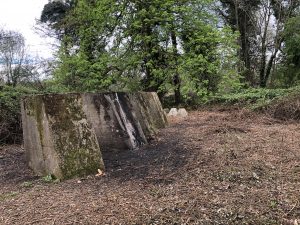
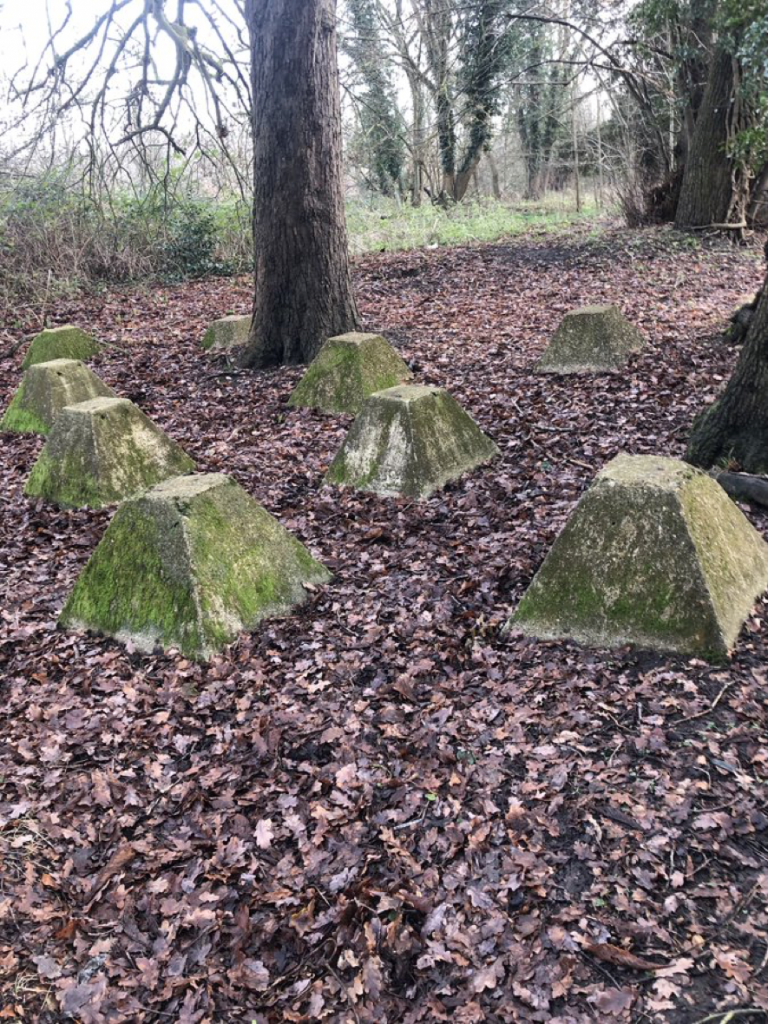
However, the tale isn’t quite done just yet as, for when I was out exploring on my bicycle, I came across, what I found out to be, the old cricket pitch on the grounds of what was The Manor Hospital, part of the Epsom Cluster. The perimeter of what was the oval is still very obvious and, there is something of a path following it around and it has a couple of benches in one corner. In this corner, I alighted on what I believe to be, the only remaining ‘Tank Traps’ in the Borough. Though when I first came across them they were covered by brambles which, have now been removed, showing them off in their aged glory but, still intact. With four large ones, six feet tall in a line and, set out behind them, around fifteen to twenty much smaller ones they look like a gaggle of goslings following four parents, quite comical, though humour was never the intention. I was astonished when I first found them as, at that time I hadn’t heard of ‘Tank Traps’ being set up in the Borough at all and, people that I spoke to of
them, lifelong E&E residents, had about as much idea as I did, to their existence. They are there if you wish to view them and may they stay among us, but hopefully never need to be used for their original intention.

Horton Light Railway – A Potted History

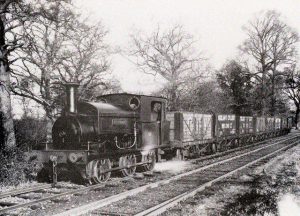
Having been closed down and dismantled just four years before my birth, the Horton Light Railway always held a certain fascination, for me when growing up in the area, and I often wondered what it would have been like to see the old steam engines going back and forth.

Hollymoor

Up to its demise, there had been five engines running on the line, Hollymoor (1905-1908), Engine No 947 (1905-1909), Crossness (1913-1935), Hendon (1935-1947) and Sherwood (1947-1950). Parts of the latter, Sherwood, were still scattered around the area known as ‘Central Station’ (now David Lloyd Sports Centre), and the ‘Powerhouse’ where the Epsom Cluster hospitals generated their own electricity (before the National Grid) and steam for heating and hot water for the hospitals. Hollymoor, of course, lives on, in name at least, in the road Hollymoor Lane.

The railway was originally built to supply the materials needed for the building of what became the ‘Epsom Cluster’ of five mental health institutions in the early 1900s. It made sense for the railway to remain in use post-construction to deliver supplies to the Cluster.

I grew up close to the shunting yard by Ewell West Station where the area was once shared with an orchard. This became the County Highways Depot, and later Highway House, which eventually gave way to a housing development.

Following the line

The original track bed, shunting branch, ran alongside the existing railway line away from the station, nearly reaching the stile at the end of West Street, replaced by the footbridge which remains today in the early 1960s. From there it swept round to follow a parallel course with Chessington Road, almost immediately finding its first obstacle, a feeder stream for the River Hogsmill, where a concrete bridge was built to accommodate. The bridge was removed in more recent years, though I could never understand why.

Once over the stream, the route followed between what is now, Hollymoor Lane, named after one of the locomotives used on the line, and a few houses built on Chessington Road and then reaching Baker’s Field running along its outer, sewage farm, edge and through a short avenue of mature elm trees, sadly long gone.

From there it crossed into what is now Hook Road Arena, passing the ends of Oakdale Road and then Richards Field, where a footbridge on the original route of the ‘Bridle Path’ crossed over the line, and then carried on behind the shops and what is now West Ewell Social Club, still running parallel with Chessington Road until it met its next obstacle, Hook Road (known as Kingston Lane at that time), where a tunnel was formed as, the road by then was becoming a busy thoroughfare.

Crossing bridges

The original bridge is still there and intact, left in position after Hook Road was re-routed. Though filled in, done when the track was removed, it can be viewed in the Horton Golf Club car park.

From Hook Road, the line carried on, into what is now Horton Country Park, unhindered and into Butcher’s Wood, where a branch line took it right into Long Grove Hospital. Then onto Four Acre Wood where, another branch took the line off to feed what was called ‘Central Station’, before it finally went on to West Park Hospital.

As the railway passed through Horton Country Park there were three footbridges, originally level crossings but, due to an accident in its infancy, a local woman Mary Tobin was killed owing to, what was deemed, neglect. The first between Butcher’s Wood and Four Acre Wood, one on the branch to Central Station and the last just before the line entered West Park. They had been erected on Rights of Way footpaths cutting through farmland that was attached to the hospitals. Here they were able to access fresh dairy, vegetables, and fruit from the orchards when in season.

There can be few people remaining in the borough that can remember seeing the railway and its engines in all their working glory, but if any readers have any memories or indeed pictures, we would love to hear from you.

Tony Collis, March 2022


Borough History: Elizabeth Whitrod

Courtesy of the Friends of Horton Cemetery we republish researched stories of the 9000 patients of the cluster of psychiatric hospitals formerly located in the Borough who were buried in the neglected Horton Cemetery off Hook Road. The charity seeks to persuade Epsom and Ewell Borough Council to reclaim the five acre site from a property speculator to whom it was miss-sold by the NHS in 1983. This is the story of Elizabeth Whitrod.

Elizabeth was born in the March quarter of 1857 to William and Mary Vaughan (née Bratton/Brattan, in Wrotham, Kent. (Malling registration district).

William and Mary had married on 24th February 1846, at the Parish Church of St Marylebone. William’s father was John, a Gardener and Mary’s Father was George a labourer. On their marriage certificate, William was recorded as a servant.

By the 1861 Census, the family was living in Wrotham. William was a groom. Mary, his wife, was entered as a groom’s wife. They had seven children, Elizabeth being the fifth child of the seven and is listed as a scholar. Her eldest brother Edgar is 14 years old and working as a gardener.

By the time of the 1871 Census, Mary Ann, Elizabeth’s mother had died (in February 1870). A search on the GRO reveals the following sad story; Elizabeth’s brother Edward had died on the 31st of January from a malignant sore throat of 6 days duration. Next, her mother Mary died on the 5th of February from typhus fever. Then, the youngest brother to Elizabeth, Ernest, died on the 20th March, aged 14 months from thrush and diarrhoea. Mary Ann, Elizabeth’s older sister died on 29th March in the Union Workhouse at West Malling from typhoid. Finally, her younger brother, Albert aged 5, died on 7th April from diphtheria. It is hard to contemplate the family coping with such losses within the space of three months and one wonders what effect those deaths had on the remaining family.

The census of 1871, shows Elizabeth is acting as housekeeper for her father and her younger siblings Bertha, Clara and Frank, who were still at school. William, her father died in 1872 and on the 1881 census, Elizabeth is 27 years old, working as a housemaid to Hancilia E. Ionides, an Annuitant. On the 1891 Census, there is an Elizabeth Vaughan with a given age of 30, living as a housemaid / domestic servant. The head of the household is absent. The address is 2, High Street, West Malling. With her, is a Kate Vaughan some five years her junior and born in Malling, whilst Elizabeth is recorded as being born in Stratford upon Avon. I wonder if that was the birthplace of the absent head of the house. Perhaps Kate is what Clara, born in 1860, was known as.

In 1893, Elizabeth marries William John Whitrod, a 32-year-old labourer. His father, Roper, was a bootmaker but was deceased by the time of the marriage. William John Whitrod was born in 1861, in the Guiltcross registration district of Norfolk, the fourth of nine children. His parents, according to a family tree on Ancestry, were said to be married in 1852, but I can find no proof of this. The children were all born between 1855 and 1873. On the 1901 Census, William and Elizabeth are living at 7 Lansdowne Crescent, Kensington. William’s occupation is that of a scavenger and Elizabeth is a caretaker. A scavenger would be what today we call a dustman, a refuse collector or street cleaner. There is no indication of Elizabeth’s epilepsy.

Elizabeth was first admitted to Horton on 10th July 1906 and she stayed there for five years. On October 23rd 1911, she moved to the Epsom Colony. She was there for a further seven years or more and died on 12th January 1918. Elizabeth’s death certificate shows that she suffered from epilepsy for many years. She is not described as a widow. I cannot locate her husband, William. A search in the GRO index shows the death of William John Whitrod, aged 45, in the March quarter of the Chelsea registration district. Could this be him? It is hoped that Elizabeth’s medical notes will have survived and more information will become available.


Notable Residents of Epsom & Ewell – Robert Honey Fabian

From 1972 until his death in 1978 Robert Fabian lived out a quiet retirement at 40 Fairfax Avenue in East Ewell. Twenty years earlier he had been the most famous policeman in the country known to the television watching public as Fabian of the Yard. He was TV’s first celebrity policeman and the aforementioned programme, based around his real-life cases and where he was played by actor Bruce Seton, preceded even the long-running Dixon of Dock Green.

Robert Honey Fabian was born at 25a Malyons Road in Ladywell, Lewisham in 1901. He joined the police force in 1922 and worked his way through the ranks, eventually joining the fabled Murder Squad. Not only did Fabian and his colleagues investigate killings in the capital but they were often, famously, called in to baffling cases up and down the country. One such murder was that of Charles Walton who was found slaughtered with a pitchfork through his neck in the village of Lower Quinton in Warwickshire in 1945. Fabian was unable to apprehend the murderer, but the case has fascinated ever since due to rumours of ritual killing, witchcraft and Satanism.

Fabian enjoyed his second career in the new media of television and appeared at the end of each episode of Fabian of the Yard as himself, explaining what happened to the criminal that had just been featured. Many were hanged. He became a household name and face and in 1956 guested on radio’s Desert Island Discs. One current older resident of Fairfax Avenue remembers Robert Fabian well and told me how the residents all felt reassured that Scotland Yard’s most famous detective lived in their street.