‘I don’t believe I am a political person’: Surrey leader reflects
20 December 2025
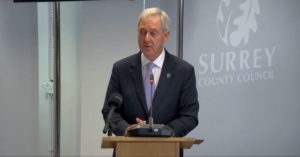
As Surrey heads into the new year, the mood at Woodhatch Place, the county council’s head quarters, is one of reflection and quiet apprehension for the year ahead. For Tim Oliver, leader of Surrey County Council, the festive period comes at the end of what he described as a “busy” year. One that began with the announcement of the biggest shake up in local government for decades and will end with the council preparing for even more change in 2026.
“It’s been quite a journey,” he said, reflecting on the year since local government reorganisation was announced. “But we’ve ended it in a pretty good place in terms of setting ourselves up for the heavy lifting over the next 12 months.”
While Christmas brings a lull in council business and many work places, Cllr Oliver joked that residents “with a bit of time on their hands” are still keen to get in touch about local issues. But there is no resentment in his voice, just a familiar sense of public service never stops.
Sat in an office of some description, a blurred bookshelf marked a hazy backdrop, the council leader seemed slightly weary but ready for a half-hour interview. Reflecting back on his time at the local authority, at the last full year in power, he said: “I just marked seven years as the leader of this council. I feel proud of what the council has done over that period in terms of financial stability, we’ve invested a lot into communities like ‘Your Fund Surrey’.”
“I don’t believe that I am a political person,” said Mr Oliver, the Conservative leader of the council, speaking to the local democracy reporting service. “Or that I run this council in an overtly political way.”
It is a claim some of his colleagues and opponents may find laughable. Particularly when the councillors might claim the council is concerned about financial resilience despite all the criticism over its SEND service, asset-based funding and ambitions to empower communities and charities with funding rather than expand the council’s services. But Mr Oliver confirmed the council should not be swayed by ideology and national movements. “There shouldn’t be party politics in local government,” he said. “We have one job here and we are elected to improve the lives of our residents.”
Yet the past year has shown how difficult that principle can be to maintain. Debates over reorganisation, he said, have exposed what he described as a rise in “tribal politics” within the council’s HQ. “One of the things that has been slightly disappointing over this last year is that there has been a bit of tribal politics around the reorganisation,” he said. Mr Oliver added: “
However, this criticism has been robustly rejected by opposition councillors. Paul Follows, leader of the Liberal Democrats, said that while the Conservative leader was “disappointed” by the tone of the debate, the response from other parties reflected what they described as the reality that only the Conservatives supported pursuing local government reorganisation in its current form.
He said Lib Dems across Surrey had supported reform only where it was rooted in “genuine localism” and underpinned a proper assessment of the county’s financial challenges. Cllr Follows said: “It is difficult to see what, if any, benefit this rushed process of local government reorganisation brings to Surrey – particularly to boroughs that are largely self-sufficient and solvent, such as Waverley, Guildford, and Reigate & Banstead.”
Cllr Oliver acknowledged that local election results often reflect national sentiment, regardless of how councils perform. “You could be the most outstanding council,” he said, “but if you’re standing through a political party, it reflects the national position.”
While he said he was proud of the council’s record on financial stability and service improvement, he admitted he did not know how voters would respond in an election likely to be shaped by national politics, council tax pressures and public frustration. “I genuinely don’t know what will happen here locally,” he said. Mr Oliver said he saw no evidence that Reform-run councils were doing anything fundamentally different from authorities already under financial pressure.
Despite his concerns, Mr Oliver said residents ultimately judge councils on outcomes rather than ideology, on results rather than rhetoric. As he prepares to take a step away from leadership, Mr Oliver said whoever takes over must remain true to acting in the best interest of residents.
Surrey will get a mayor despite months of uncertainty and a lack of solid confirmation from the government, the county council leader has insisted. Tim Oliver said he is “confident” a mayor of Surrey would go ahead, even though the central government has yet to formally sign off and has delayed mayoral elections in other parts of the country.
“I can assure you, it will happen,” Cllr Oliver said, speaking to the local democracy reporting service (LDRS), on December 17. Surrey was placed on the government’s first wave of local government reorganisation specifically to unlock devolution and create a mayor. The leader added that ministers were fully aware of the county’s position.
The delay, he suggested, was more about shifting national priorities and new ministers rather than any change of heart over Surrey itself. “It’s slightly frustrating,” he said. “We didn’t get a confirmation date of the mayoral election when we thought we would.”
Since reorganisation was announced last year, there has been a change of secretary of state and a rethink over how quickly devolution should roll out. Mayoral elections have already been pushed back to 2028, something Cllr Oliver believes Surrey is now being caught up in. “They haven’t said no,” he said. “But equally they didn’t say yes at the same time as the announcement, which is what we had expected.”
The county leader said he has already met with the minister responsible and is due to have another meeting in early January, saying discussions with the government were “active”. Despite the uncertainty surrounding a mayor, Cllr Oliver said Surrey’s positioning has remained strong and that the county would likely follow whatever timetable the government agrees with other mayoral areas: potentially bringing elections forward to 2027 rather than waiting until 2028.
While residents may find the process confusing, he said the end goal was clearer leadership and more powers devolved from Westminster. The LDRS reported in October there was “no promise” that Surrey could have a directly-elected mayor as part of the government’s devolution despite this being described locally by councillors as the entire main purpose of reorganisation.
The Ministry of Housing, Communities and Local Government has previously said that the references to Surrey getting a directly elected mayor were “not quite accurate” as the decision “has not been confirmed” and that they were only “committed to working with partners to establish a strategic authority for the area”.
Public of Epsom and Ewell to be asked if they want two new Councils
20 December 2025
Epsom and Ewell Borough Council has voted to continue exploring the creation of two new community councils—one for Epsom and one for Ewell—following an often heated debate at the Full Council meeting on Tuesday 9 December. The decision means the proposals will now go to a second phase of public consultation before a final vote in March 2026.
The meeting also saw Cllr Hannah Dalton (RA Stoneleigh) elected—by 17 votes to 11—over Cllr Alex Coley (Independent Ruxley) as the Borough’s representative on a Local Government Association forum related to Local Government Reorganisation (LGR).
The main item of the night, however, was whether to progress the Community Governance Review (CGR) and consult residents further on the proposed new parish-style councils.
What was decided
Two recommendations were voted on separately, both by recorded vote:
• Recommendation 1: Proceed to a second-stage consultation • Recommendation 2: Confirm the amended Terms of Reference and delegated arrangements for running that consultation
Both recommendations were carried by 17 votes to 6 (or 7) with 6 (or 5) abstentions, depending on the motion.
Supporters: “Residents must have a voice before the borough is abolished”
Cllr John Beckett (RA Auriol), who proposed the motion, framed the issue as a democratic response to the looming abolition of the borough council under Surrey’s move to two unitary authorities. He warned of a 75% reduction in elected representation once Epsom and Ewell’s 35 borough councillors and 5 county councillors are replaced with just 10 unitary councillors.
Beckett said: “These changes are about the centralisation of power and money all at the expense of local democracy.” He added that the first consultation—352 responses, with 67% supporting further investigation—was “the second highest response to a borough-wide consultation outside the Local Plan”.
He argued that parish-style councils could preserve local identity and provide continuity: “For our residents… this gives our residents a choice, and it gives our residents a voice.”
Cllr Hannah Dalton told councillors that other areas undergoing unitary transitions, including Northamptonshire, Wiltshire and Somerset, saw unparished areas “left behind”. She said that if Epsom and Ewell did not act now, it risked becoming “the only unparished area in East Surrey”.
She added: “Tonight we are only asking you to support further consultation… with a precept that has no transfer of assets, whatever our colleagues are saying.”
Cllr Neil Dallen (RA Town) said the proposal was modest: “We go out to the residents and we ask them… whether they want us to continue.”
Cllr Rachel King (RA Town) emphasised that the public had only given feedback on principles so far: “We now need to give them a proper opportunity to respond to a fleshed out proposal… We owe it to our residents to give them a voice.”
Opponents: “A flawed consultation, a financial burden, and a political stitch-up”
Opposition councillors delivered some of the sharpest criticism heard in the chamber for years.
Claims of a flawed consultation
Cllr Julian Freeman (Lib Dem College) said the consultation process was “flawed” because respondents were forced to select an option rather than reject the idea outright. He argued: “This is the wrong issue at the wrong time… The only reason this is being raised now is to create a role for the people in this room.”
Cllr Rob Geleit (Labour Court), speaking also on behalf of absent Cllr Kate Chinn, said the proposals lacked community backing: “A flawed and skewed consultation, a lack of engagement… giving no mandate… and poor financial analysis.” He added: “I see no point in removing a layer of democracy only to add it back again on a lesser level.”
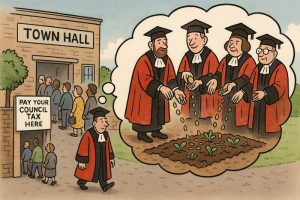
Cllr Alison Kelly (Lib Dem Stamford) said residents were mostly concerned about planning, but that the parish proposals did not address this: “Most people… give the issue of allotments very little thought. We are showing a cost of a parish council around £45 for an allotment you don’t need in a flat.” She noted that only around 230 respondents had expressed a desire for a parish council.
Financial warnings: 98.7% admin, 1.3% allotments
Cllr James Lawrence (Lib Dem College)highlighted the ratio in the report: approximately £1.5m in administrative overheads versus £20,000 for allotment running costs. “You will be telling [residents] you’re creating a parish council that is just for allotments… the allotments cost is 1.3% of the tax you’re going to charge.” He added that consultation documents risked misleading residents by listing admin and allotments side-by-side “as if they were roughly equal”.
“An uncapped tax burden on struggling households”
Cllr Alex Coley warned that the real precept could be much higher—up to £180 for Band D properties—if the community councils later took on community buildings with significant maintenance liabilities such as Bourne Hall: “It would be disingenuous to go to residents with £40-something pounds when it could be £180… We should not seek a view from residents with a lower figure and then quadruple it.” He said many residents were “struggling financially” and called the proposals “an astonishing waste of time, energy and money.”
Cllr Bernie Muir (Conservative Horton) urged councillors to wait until the new unitary structure and Surrey’s pilot Neighbourhood Area Committees (NACs) bedded in: “I think this is a premature discussion… we should see how the unitaries and NACs pan out and then move forward if we need to.”
Cllr Chris Ames (Labour Court) was highly critical of the RA leadership: “This wasn’t a review. This was one option chosen by the Residents’ Association to meet its own purposes… It’s all about providing a jumping-off point for the clique that runs this council.”
Admin cost vs allotment cost: the core numerical controversy
Using the figures in the Report to Council:
• Admin and support costs for new community councils: approx. £1.5 million • Cost of allotment management: approx. £20,000
That means roughly:
• 98.7% of the expenditure is administration • 1.3% is allotment provision
This ratio became a central argument for opponents, particularly Cllr Lawrence, who said allotments would be a “rounding error” in the parish budget.
Supporters responded that these were not final budgets, merely illustrative maxima, and that Phase 2 consultation would use the true starting point—around £43–£46 Band D—with no asset transfers.
Conclusion
The council has opted to continue exploring parish councils despite sharp divisions. The second public consultation will now seek residents’ views on more detailed proposals before a final decision in March 2026—months before the borough is abolished and replaced by the new East Surrey unitary authority.
Do Epsom and Ewell Borough’s allotments need their own elected Councils?
20 December 2025
Epsom and Ewell Borough Councillors will meet on Tuesday 9 December to decide whether to progress the next stage of creating two new parish councils for the borough before the authority itself is abolished in 2027. The proposal comes amid the Government’s reorganisation of Surrey, which will see all boroughs, districts and Surrey County Council replaced by two large unitary authorities.
Parliament’s direction of travel is clear: to simplify local government by replacing the current two-tier structure with single, consolidated authorities. East Surrey Council, which will take over responsibility for all local services from 1 April 2027, is intended to achieve economies of scale and reduce duplication between bodies. The question now before councillors is whether introducing new parish councils beneath the new unitary structure would support or undermine that objective.
Earlier this year the Borough Council launched a Community Governance Review seeking resident views on the creation of parish councils. Of a borough population of around 80,000, the consultation received 352 responses. The most favoured option was the creation of two parishes—one for Epsom and one for Ewell—each with its own parish council and councillors. Whether this level of public engagement constitutes a sufficient mandate for a constitutional change that introduces a new local taxation and governance layer is one of the issues councillors must now weigh.
The proposal is also set against the backdrop of Surrey County Council’s own recent approach to local engagement. In other parts of Surrey the County Council has piloted “Neighbourhood Area Committees” aimed at bringing councillors, residents and partners together to shape local priorities without creating new bodies with precept-raising powers. These committees are designed to provide an alternative route for local consultation and influence that stops short of formal parish governance. Whether such models should be adopted more widely under a single-tier system—and whether they might re-emerge under the new East Surrey Council—adds a further dimension to the discussion about the need for, and value of, parish councils.
Supporters of parishing argue that the disappearance of the borough council leaves a significant democratic gap. Once abolished, the entire former borough area will be represented by just ten East Surrey councillors instead of the 40 elected representatives residents currently have across county and borough levels. Parish councils would help preserve local identity, provide a community voice on issues close to home, and maintain civic traditions, including the mayoralty, which would otherwise require Charter Trustees.
However, the financial implications remain uncertain. Initially, the proposed parish councils would take on only the minimum legal duty of managing allotments, with no parks, community buildings or other assets transferred. On that basis, it is estimated by Epsom Council officers, a Band D property would pay a parish precept of about £43–£46 per year. But if parish councils later seek wider responsibilities—whether by local choice or because East Surrey Council wishes to devolve services—the cost to residents could increase. In time, this could reintroduce something resembling a two-tier model from below, even as the new unitary seeks to simplify structures from above.
Proponents of the unitary approach argue that genuine savings depend on consolidating services, not recreating local administration. Advocates of parish governance counter that representation and community influence have a value that cannot be measured solely in financial terms. Councillors, meanwhile, must judge whether the balance of risks and benefits favours moving to the next stage of consultation or pausing the process entirely.
If the Borough Council votes to proceed on Tuesday, a second consultation will run from mid-December to early February, with a final decision required before March 2026, when powers transfer to the East Surrey Shadow Authority. If the proposal is halted, decisions about any future local governance arrangements—whether parish councils, neighbourhood committees or other models—will fall to the new unitary authority.
The choice before councillors therefore becomes one of the last major decisions the Borough Council will make about the shape of local democracy in Epsom and Ewell. Residents can follow the meeting live via the council’s YouTube channel.
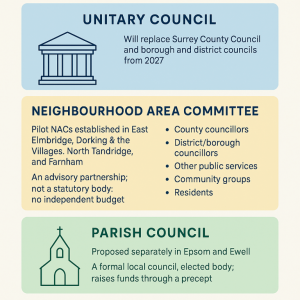
As Surrey prepares for major local government reorganisation, the County Council has been trialling a new model of community involvement known as Neighbourhood Area Committees (NACs). These committees, currently operating in four pilot areas, are designed to give residents and partners a stronger voice in shaping local priorities without creating new councils or adding an extra layer of taxation. With Epsom and Ewell facing the abolition of its borough council in 2027 and debating whether two parish councils should be established, attention is turning to whether NACs offer an alternative blueprint for local influence in the new unitary era.
The first three pilot NACs were launched in summer 2025 in East Elmbridge, Dorking and the Villages, and North Tandridge. A fourth area, Farnham, joined the initiative in September. These areas were selected to test the model across different geographies and community types, including both parished and unparished areas. Epsom and Ewell is not currently included in the pilot scheme, but the County Council has indicated that NACs could eventually be rolled out county-wide if the pilots prove successful.
Unlike parish or town councils, NACs are not statutory bodies. They do not have legal powers, budgets or the ability to raise a precept through council tax. Surrey County Council describes them as advisory partnerships that bring together elected representatives, public services, voluntary and community organisations and local residents to identify shared priorities and shape decision-making at a neighbourhood level. Typical membership includes county councillors, district or borough councillors (where applicable), representatives from health, police, education and the voluntary sector, alongside community groups and residents. Subject specialists from County Hall provide officer support.
The aim is to encourage more collaborative working between public services and communities, promote preventative approaches, and ensure that future unitary authorities have access to local intelligence when planning services. NACs sit outside the formal structures of governance and do not replace any existing body. Where parish councils exist, they may participate in a NAC, but the NAC itself has no authority over them.
NAC boundaries are formed using existing county electoral divisions as building blocks, refined to ensure the populations are of manageable size, roughly around 50,000 residents. The pilots are running until the end of 2025, after which Surrey County Council will assess their effectiveness and consider whether to expand them across the county. The evaluation will look at levels of participation, the quality of partnership working, community impact and how well NACs might support the new East and West Surrey unitary councils from 2027.
The emergence of NACs adds an additional dimension to the ongoing debate within Epsom and Ewell about whether to create parish councils. Parish councils are formal, elected bodies with defined legal powers and the ability to raise funds through a precept. NACs, by contrast, are informal community partnerships with no statutory authority. Supporters of the parish council model argue that a legally constituted local body is necessary to preserve democratic representation once the borough disappears. Others believe NACs might offer a lighter-touch mechanism to maintain local influence without recreating a second tier of government or introducing new local taxes.
Whether NACs become a central feature of local engagement under East Surrey Council will depend on the outcome of the pilot phase and the design decisions made by the incoming Shadow Authority after May 2026. For now, Surrey’s NAC pilots provide an insight into one possible direction for neighbourhood-level involvement in the years after reorganisation.
Epsom and Ewell Council transparency disputes revisited
20 December 2025
The Audit and Scrutiny Committee of Epsom and Ewell Borough Council met on 13th November, with long-running disputes about transparency once again overshadowing its agenda. Questions from the public and exchanges between councillors highlighted continuing disagreements over how openly the Council has handled its governance issues and its dealings with external auditors.
Public challenge over unrecorded meetings with auditors
Resident Previn Jagutpal opened the meeting by questioning the Council’s claim to have established “a very open dialogue” with its external auditors, Grant Thornton. He noted that a Freedom of Information response confirmed that no minutes were taken of the Chief Executive’s first meeting with the auditors. He suggested that unrecorded, closed-door discussions were difficult to square with recent criticisms of the Council’s transparency.
Committee Chair Cllr Steven McCormick (RA Woodcote and Langley) replied that not all internal meetings were minuted and that the quality of discussions with auditors did not depend on the existence of formal notes. He maintained that the sessions were appropriate and did not represent secrecy.
Jagutpal pressed further, but the Chair repeated that such meetings were professional exchanges and were not inconsistent with openness.
“Culture of secrecy” dispute resurfaces
Jagutpal’s second question revisited an earlier controversy over whether the Local Government Association peer review team had used the phrase “culture of secrecy” when assessing the Council’s decision-making. In September, Chief Executive Jackie King told the Committee she had an email from the peer-review lead saying they did not recall using that wording.
Jagutpal said that a fuller email chain disclosed under FOI showed that the LGA lead was “not present at every discussion”, leaving open whether the phrase had surfaced elsewhere. He accused the Council of selectively presenting the peer review comments. Cllr McCormick rejected any suggestion of misrepresentation and said the full email would be circulated to members and attached to the minutes of the meeting.
Clash over what may be discussed in public
Labour councillor Chris Ames (Court) then raised a formal point of order. He said councillors had been told they could not discuss certain matters in public that related to the 2023 changes to the Scheme of Delegation — the very subject that led auditors to conclude there was a “significant weakness” in governance. He argued that restricting discussion created the impression that matters were being “stitched up behind the scenes”.
The Chair and the Monitoring Officer both insisted that exempt-information rules applied and that certain details could only be taken in a private session. Ames protested that this prevented transparent scrutiny, but the Chair declined to widen public discussion further.
Disputed minutes and calls for further scrutiny
During approval of the September minutes, councillors and officers agreed to make a minor correction to a sentence summarising the Chief Executive’s comments. The amendment was adopted without dissent.
The meeting’s most heated exchange followed when Ames asked the Committee to add a future agenda item examining why the external auditors had not been informed earlier about changes to the Scheme of Delegation. Cllr McCormick initially resisted, saying the matter had already been covered by previous meetings.
Ames said that earlier discussions had been “stage-managed” and that the Committee had not been allowed to probe key issues. Liberal Democrat councillor James Lawrence (College) supported bringing the item back, saying members simply wanted clarity on when and how auditors were informed.
After a prolonged exchange, the Chair agreed that the subject could be added to a future agenda. Officers, not councillors, will prepare a report to support that discussion.
Wider business proceeds quietly
Following these debates, the Committee turned to counter-fraud matters, financial monitoring, and internal-audit progress reports. These items attracted few comments and passed without controversy — in contrast to the extended disputes over transparency that continue to dominate the Committee’s work.
Transparency remains the unresolved issue
Once again, the meeting demonstrated that the central challenge facing the Council is not simply the content of audit recommendations, but the competing interpretations of what “transparency” requires in practice. With further reports now expected, the question of how openly Epsom and Ewell Borough Council takes and explains its decisions seems set to return to the Committee table in the months ahead.
Image: Audit and Scrutiny Committee get ready for the meeting. Epsom and Ewell Borough Council YouTube.
Epsom and Ewell Times timeline on Council transparency tussle
How the Council’s transparency dispute unfolded
The debate over transparency at Epsom and Ewell Borough Council has stretched across several meetings of the Audit and Scrutiny Committee. What follows is a clear timeline of how concerns first surfaced, how councillors reacted, and how the Council’s leadership has responded.
March 2024 – Peer review flags concerns
An LGA Peer Review identifies weaknesses in decision-making processes, warning of confusion among councillors and raising concerns about the Council’s use of confidential sessions. It calls for clearer, more transparent explanations of how decisions are made under the committee system.
February 2025 – External auditors find a “significant weakness”
Grant Thornton reports a “significant weakness” in the Council’s governance arrangements, citing both the peer review and the lack of transparency over 2023 changes to the constitution and Scheme of Delegation. The Council disputes the auditors’ interpretation, arguing that it is already operating transparently.
March 2025 – Committee requests Chief Executive attendance
Audit and Scrutiny calls for Chief Executive Jackie King to attend its July meeting to explain management responses to the auditors’ findings. Concerns centre on whether officers properly informed auditors about the delegation changes.
May 2025 – Governance statement controversy
A draft Annual Governance Statement presented to the committee is criticised for downplaying the auditors’ “significant weakness” finding. Members send it back for redrafting, saying it fails to give an honest account of the issues raised.
17 July 2025 – CEO absence sparks anger
At the July meeting, members express frustration that the Chief Executive is absent despite earlier requests. Labour councillor Chris Ames repeatedly raises objections, accusing the Council of stalling accountability. The Chair says the CEO will instead attend the September meeting.
30 September 2025 – CEO gives evidence and defends actions
Chief Executive Jackie King attends and answers questions for the first time. She denies that the peer review described the Council as having a “culture of secrecy”, saying the LGA peer-review lead did not recall using the phrase. She outlines changes to reporting practices, including splitting public and confidential papers and providing plain-English explanations for exemptions.
Councillors, including Liberal Democrat James Lawrence, challenge the Council’s transparency record, citing confusing urgent-decision processes, late information at the May AGM, and the need for clearer oversight of how auditors are kept informed.
The Committee receives the officers’ report but signals that further scrutiny will be needed.
Early November 2025 – FOI reveals fuller peer-review email chain
A resident obtains an email chain via Freedom of Information showing that the LGA lead was “not present at every discussion” during the peer review, raising questions about whether the term “culture of secrecy” may have arisen elsewhere. This adds fuel to concerns about whether the Council has selectively interpreted criticism.
13 November 2025 – Transparency dispute dominates meeting
Two public questions challenge the lack of minutes for meetings between the CEO and auditors and question whether the Council has “fileted” peer-review comments. The Chair defends the Chief Executive’s position, saying not all professional meetings require minutes, and promises to append the full email to the minutes of the meeting.
A tense exchange follows when Cllr Chris Ames raises a point of order, arguing councillors are being prevented from openly discussing matters central to the auditors’ “significant weakness” finding. The Chair and Monitoring Officer insist some discussions must remain exempt.
Ames calls for a future agenda item explaining when and how auditors were told about the delegation changes. With support from Cllr James Lawrence, the Chair eventually agrees that officers will prepare a report for future consideration.
Routine business proceeds quietly, but the transparency issue clearly remains unresolved.
Looking ahead
With further reports pending and the Committee determined to revisit key questions, the transparency debate shows no sign of easing. How openly Epsom and Ewell Borough Council explains its actions, documents its decisions, and engages with auditors is likely to remain at the heart of future Audit and Scrutiny meetings.
Surrey resident’s views on County split ignored?
20 December 2025
The Government has been accused of ignoring Surrey residents’ views on how to dissolve and merge the county’s councils after it emerged there was a clear preference for three unitaries rather than the two mega authorities that have been imposed.
A consultation ran from June 17 to August 5 to help the Government understand what residents, businesses, and other stakeholders thought about the changes in Surrey. The results, we were told, would be used to “inform the final decision on which option is best for Surrey, with a decision expected in October.”
On Tuesday, October 28, it was announced that Surrey County Council and its 11 boroughs and districts would be abolished and replaced with West Surrey Council and East Surrey Council. The decision flies in the face of the 51 per cent of the 5,617 respondents who backed three unitary proposals versus the 19 per cent that favoured East/West.
This, despite a costly PR drive from Surrey County Council that sent leaflets to every household pushing for the two unitaries. The results were published by the Ministry of Housing, Communities and Local Government as part of its decision – and found that, in addition to the strong resident support for three councils, 56 per cent were also strongly opposed to what has been delivered.
The Ministry said: “Support for the three unitary proposal was based on the view that a three unitary council model resulted in authorities that were a good size and that the groupings of current authority areas made sense. Residents generally believed that the proposal would achieve good economies and efficiencies and be good for local identity, accountability, community engagement and service improvement.
“Negative responses relating to the three unitary proposal highlighted concern that it would not generate significant efficiencies, as well as concerns about how debt would be addressed. Those who supported the two unitary proposal typically did so on the basis of the greater efficiencies presented in the proposal, with the belief that it would create authorities of a good size.
“It added: “There was no single factor as to why residents did not support the two unitary proposal, though the most common theme in responses was that the two unitaries were too large and secondly, that the proposals would be bad for local identity.”
Councillor Paul Follows, leader of the Liberal Democrats on Surrey County Council, was one of the drivers behind the three unitary model in his role as leader of Waverley Borough Council. He said: “They cancelled elections, asked for views, and then did the opposite.”
The Ministry said its decision process carefully considered responses to the consultation as well as all other relevant information. It said the proposals were assessed against set criteria and that, of the choices, the two-council proposal better met that – particularly as it is seen as more likely to be financially sustainable.
A spokesperson said: “Putting Surrey’s local authorities on a more sustainable footing is vital to safeguarding the services its residents rely on, as well as investing in their futures. The government consultation for both proposals, held between July 17 and August 5, treated the proposals equally.”
On the cancelled elections, the ministry said they were postponed for a year to provide additional capacity for speeding up reorganisation – given the urgency of creating sustainable unitary local government for Surrey.
Many more…. search local government reorganisation
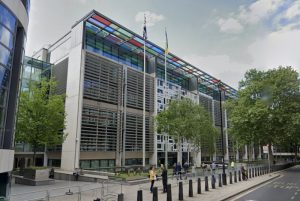
Image: Ministry of Housing, Communities, and Local Government (image Google)
Government Casts Doubt on Surrey’s Mayoral Devolution Promise
20 December 2025
No promises have been made that Surrey will get full devolution and a directly elected mayor – despite it being the “entire purpose” of the lengthy and arduous process of splitting the historic county and its 11 boroughs and districts into two mega councils.
It had been understood that Surrey’s councils would be abolished and reformed into either two or three unitary authorities, with two sets of elections – first for the new bodies, and then for an overarching mayor in 2027. Surrey County Council’s website outlining the devolution and Local Government Reorganisation (LGR) process mentions the word “Mayor” seven times, and even lists May 2027 as when residents would go to the polls to decide who would be responsible for strategic services such as education, policing, fire and rescue.
However, the Government’s own timetable for Surrey only lists a May 2026 election for the two shadow councils, followed by the next round of balloting in May 2031 – and then every four years after that. Furthermore, the Ministry of Housing, Communities and Local Government has said that the references to Surrey getting a directly elected mayor were “not quite accurate” as the decision “has not been confirmed” and that they were only “committed to working with partners to establish a strategic authority for the area”. They clarified that the announcement that Surrey would be dissolved and reformed into East and West Surrey was “not promising a mayor”.
Areas with strategic mayors, such as London and Manchester, are given extra devolved powers from Government, with the argument being it gives local people a greater say in the running of their areas. Writing to the leaders of Surrey’s councils, the ministry would only say that simplifying local government ensures “a strong foundation for devolution”. It said it was committed to working with partners across Surrey, including the new unitary authorities, to establish a strategic authority to ensure relevant functions held at the county level can continue on that geographic footprint where possible, such as transport and adult skills.
It added that the establishment of a strategic authority would be subject to the relevant statutory tests being met and local consent – but makes no mention of a directly elected mayor. This is important because strategic authorities are different from Mayoral Strategic Authorities. According to the ministry, Foundation Strategic Authorities include non-mayoral combined authorities and combined county authorities, and any local authority designated as a strategic authority without a mayor.
Mayoral Strategic Authorities, such as the Greater London Authority, all Mayoral Combined Authorities and all Mayoral Combined County Authorities, “automatically begin as Mayoral Strategic Authorities” – and only those that meet specified eligibility criteria may be designated as Established Mayoral Strategic Authorities to unlock further devolution.
It has left the county council saying devolution is now an “ambition” rather than a formality. Others have called out the council for rushing into such a seismic shift, and cancelling elections to get devolution done – without any guarantees over whether the county would get a mayor.
Councillor Paul Follows, leader of the Liberal Democrat group at Surrey County Council, said having a mayor “was the entire purpose of the reorganisation”. He added: “The county council has gone in on this nonsense without any guarantee over the reason they have it, despite that being the principal reason the county has initiated this process – but they have yet to receive any guarantees. I’m sure the county will reflect their reasons for going for this in the light that the ministry said we may not be getting devolution.”
Many more…. search local government reorganisation
Epsom and Ewell to Go East in Surrey shake-up
20 December 2025
The Government has confirmed plans to abolish Surrey’s two-tier system of local government and replace it with two single-tier unitary councils — East Surrey and West Surrey — in what is being described as the biggest reform of local administration in the county for half a century.
A letter from the Secretary of State for Levelling Up, Housing and Communities, Steve Reed MP, sent to Surrey’s council leaders on 28 October 2025, confirmed the decision to proceed with the two-unitary model, subject to Parliamentary approval. The change will dissolve Surrey County Council and its eleven borough and district councils, creating two large authorities responsible for all local services.
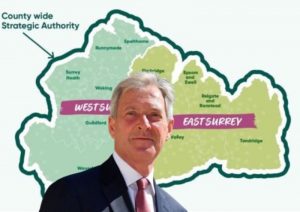
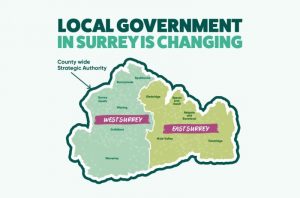
Under the plan, Epsom & Ewell will join Elmbridge, Mole Valley, Reigate and Banstead, and Tandridge to form the new East Surrey Unitary Authority. The remainder of the county — Guildford, Runnymede, Spelthorne, Surrey Heath, Waverley and Woking — will form West Surrey. Each authority will be responsible for everything from waste and planning to adult social care, highways and schools.
Elections for the new shadow councils are expected in May 2026, with the new authorities assuming full powers from 1 April 2027, once the required Structural Changes Order has been approved by Parliament.
In a statement issued Tuesday, Epsom & Ewell Borough Council (EEBC) said it “acknowledges the decision of Government to proceed with the creation of two new unitary councils” and pledged to work constructively to secure the best outcomes for residents.
Council Leader Hannah Dalton (RA Stoneleigh) said: “Although this is not the decision we had hoped for, our focus now is on supporting the transition in a way that protects our residents’ interests and maintains the quality of local services. Epsom & Ewell has always prided itself on being a well-run, community-focused council, and that commitment remains unchanged.”
EEBC said it would continue working closely with neighbouring councils and government officials and would “keep residents fully informed every step of the way” as plans for the new East Surrey authority take shape.
Three local Liberal Democrat MPs — Helen Maguire (Epsom & Ewell), Chris Coghlan (Dorking & Horley) and Monica Harding (Esher & Walton) — issued a joint statement describing the reorganisation as “an important moment of clarity for Surrey after years of uncertainty and financial mismanagement under the Conservatives”.
Helen Maguire MP said she welcomed the new chapter for Surrey, particularly the confirmation that local elections will now proceed: “I am pleased that Surrey is entering a new chapter with the introduction of these unitary authorities, and it is right that the local elections will now go ahead, especially after the delays. The Liberal Democrats have always championed decisions being made closer to the people they affect. We will continue to press the Government to give East Surrey Council the funding and freedom it needs to do its job effectively.”
Her colleague Chris Coghlan MP said he welcomed “the end to Tory mismanagement of Surrey County Council” and added that it was “entirely inappropriate that [the County Council] has such influence over the new structure,” citing its record on special educational needs and disabilities.
Monica Harding MP said Elmbridge residents should not be “expected to shoulder the debt of the failing Tory-run councils elsewhere in Surrey,” adding: “It’s high time residents get the chance to vote out failed Surrey leadership and replace them with those who will deliver for our transport systems, our adult social care, and our schools.”
The MPs said that while they support the simplification of Surrey’s structures, there remain serious concerns about how much control Surrey County Council will retain during the transition process. They called for full public consultation and financial transparency throughout.
In his letter to Surrey leaders, Secretary of State Steve Reed MP said the decision to proceed with two new unitary councils was driven by the need for financial sustainability. Across Surrey’s existing councils, total debt is estimated at £5 billion, led by the bankruptcy of Woking Borough Council.
He wrote: “In particular, I believe [two unitaries] performs better against the criterion of whether the councils are the right size to achieve efficiencies, improve capacity and withstand financial shocks. My view is that the two-unitary proposal is more likely to be financially sustainable.”
He confirmed a Government commitment to repay £500 million of Woking’s debt in 2026–27 — calling it a “significant and unprecedented commitment” necessary to give the new system a clean start.
Surrey County Council Leader Tim Oliver (Conservative) welcomed the decision, calling it “good news for Surrey residents and businesses. We welcome the Government’s direction to create two new unitary councils for Surrey from April 2027 – East Surrey and West Surrey,” he said. “Reorganisation and devolution are huge opportunities, and this is good news for Surrey residents and businesses. As expected, there will be elections to the new unitary councils in May 2026. This reform will unlock huge benefits for Surrey, with more powers held closer to communities, stronger local decision-making and turbo-charged economic growth for the region.”
Oliver added that he was “absolutely clear that, throughout this process, our vital work supporting residents will continue – services will be delivered and we will still be here for those who need us most.”
Currently, Surrey County Council runs roads, social care and education, while borough and district councils handle bins, planning, housing and leisure. Under the new model, residents will deal with one council instead of two, which ministers say will make services more efficient and reduce duplication.
Officials have confirmed that council tax rates across the new areas are likely to be “harmonised” over time, though details are yet to be finalised. The Government says the reorganisation will save money and improve accountability, but critics warn that merging larger and indebted authorities could make councils more remote and financially fragile.
For Epsom & Ewell — which has existed as an independent borough since 1937 — the coming eighteen months will bring detailed negotiations over staffing, budgets and boundaries as the East Surrey authority takes shape.
If Parliament approves the necessary legislation early next year, the new structure will come into force on 1 April 2027, marking the end of Surrey’s 12 existing councils and the beginning of a new era in local government.
Image: Map illustrating proposed East and West Surrey unitary boundaries. Epsom & Ewell joins Elmbridge, Mole Valley, Reigate and Banstead and Tandridge in East Surrey. Source: Surrey County Council. Credit SCC
Many more…. search local government reorganisation
Surrey County Council LGR leaflet misleading claim
20 December 2025
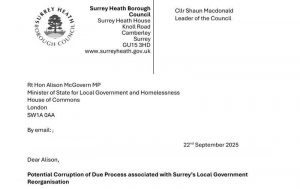
Claims of potential corruptions of due process have been levelled at key figures linked to Surrey County Council’s local government reorganisation (LGR) plans. The charges were put in a letter to the Minister of State for Local Government and Homelessness by the borough council leader at Surrey Heath. It surrounds a publicity leaflet issued by the county council and sent to householders across Surrey. The advert featured the signatures and logos of leading public bodies and figures in the county including Surrey Police, the fire and rescue service and the police and crime commissioner – and publicly backs Surrey County Council plans to merge with its 11 boroughs and districts to form two mega councils.
They did so, he said, before a final alternative position for three new councils had been finalised – meaning it was impossible to know all the options. Councillor Shaun Macdonald has since asked the ministry whether there were reasonable grounds to test whether public bodies, civil servants and elected officials broke impartiality guidelines and due process. He says senior figures, whose roles should be politically neutral, worked together, and spent public money, to push for Surrey’s two mega councils plan.
The Ministry of Housing, Communities and Local Government said the statutory consultation set out information about both proposals, and was available on gov.uk. It added that councils are required to have regard to the publicity code and any concerns should be raised with the council concerned. Surrey County Council leader Tim Oliver said they engaged with their Surrey partners about Local Government Reorganisation (LGR) throughout the process of compiling their recommendation “as government, stakeholders and residents would rightly expect”. He added that many felt the proposal for two unitary councils was the best possible outcome for the county, “which will simplify the system, save money and strengthen community engagement” and that their partners “followed their own governance processes in formally acknowledging their support for the two unitary proposal.” He said: “Importantly, all councils across Surrey have communicated with residents throughout LGR, and will continue to do so, using various channels to ensure people have access to information and given every opportunity to engage with the process.”
A decision on whether to create two or three new councils was expected earlier this month but the Local Democracy Reporting Service understands this has been delayed to give further consideration to the three-council model. A formal decision is expected at the end of this month. Delays to the announcement create a tighter window on the opposite side ahead of next May’s shadow elections.
Surrey Police said it was consulted by the county council over the two unitary councils and that it backed the move as it reflected structures the force already had in mind “before, and independently of, any plans for LGR within Surrey”. A spokesperson for the force said: “Since the proposals reflected the existing ideas of the force as to our likely future structure, it was natural for us to support them. Surrey Police will continue to work closely with our partners to understand how this proposal and any subsequent decisions might affect our own operating model now or in the future.”
Police and Crime Commissioner Lisa Townsend said she set out her support for a proposed two-unitary model of local government in a letter to the leader of Surrey County Council in May. She added: “This was subsequently included as part of the submission to Government who are currently considering what option will be implemented here in Surrey. I believe a two unitary model will not only be a simpler and more cost-effective structure for local residents but it would also be better placed to support the efficient policing of Surrey in the future. Nothing outlined in the three-unitary proposal has caused me to change my mind. The two unitary model fits well with Surrey Police’s emerging plans for a revised policing operating model – work on which had begun long before the white paper for local government reform was even on the table. My office were not consulted directly by Surrey Heath Borough Council during this process. My Chief Executive was approached by another council Chief Executive who requested feedback to help inform the development of the three-unitary proposal and we were very happy to engage in this discussion. I do not consider my support for the two unitary model to be a political decision. My views on this topic are informed by what aligns best with the future plans for Surrey Police and what I believe is right for the Force and the people it serves.”
Part of Cllr Macdonald’s letter read: “Objectivity requires ‘holders of public office must act and take decisions impartially, fairly and on merit, using the best evidence and without discrimination or bias’. It is my view that a reasonable person would not accept that writing a letter of support prior to the publication of final proposals and the start of the statutory consultation process meets the Nolan Principle of Objectivity, as due diligence in the assessment of ‘best evidence’ had not been completed. A safer position for a public body would be strictly balanced, factual information about impacts across all final options as part of the statutory consultation. Police officers, in serving the Crown, are prohibited from engaging in political activity and must remain impartial. Publicly endorsing a specific governance option (e.g. an SCC-led ‘two unitary’ model) or allowing the force’s crest to be used in a marketing campaign risks breaching those duties, even if the issue is ‘cross-party’. He added: “I do request that in assessing all statutory responses due note is taken of the potentially corrupted process and biased publicity resulting from the undue influence of Surrey County Council over these public officials and bodies, and their inputs disregarded to avoid the potential risk of judicial review.”
Where do we stand on local government reorganisation in Epsom and Ewell and the County?
20 December 2025
The future shape of local government in Surrey is moving into its final stage, with national and local plans converging on the abolition of all borough, district and county councils in April 2027 and their replacement by new, directly elected unitary authorities. Epsom and Ewell Borough Council (EEBC) has already taken steps to ensure residents’ voices are not lost in the process, while Surrey County Council (SCC) continues to pilot new neighbourhood structures that could form part of the post-reorganisation landscape.
Financial pressures driving reform
A new report from the UNISON trade union warns that councils across the UK are facing a combined funding gap of £4.1 billion in 2026/27. Demand for adult and children’s social care, inflation, energy costs and homelessness are all identified as key pressures. UNISON’s General Secretary Christina McAnea said local authorities “are still billions short of the money they need to provide essential services” and that cuts “often hit the vulnerable hardest”. The figures provide the wider context for the government’s push towards larger, self-financing unitary councils and new devolved mayoral regions.
Epsom and Ewell Borough Council’s position
Epsom and Ewell Borough Council voted in May 2025 to support a “three unitaries” model for Surrey, submitting its preferred plan to government. Under that proposal, Epsom and Ewell would join an East Surrey unitary alongside Mole Valley, Reigate and Banstead, and Tandridge. Surrey County Council has argued instead for two unitaries – East and West – while others have urged a single Surrey authority. The final decision now rests with ministers.
EEBC has meanwhile carried out a Community Governance Review to explore creating parish or community councils for the borough once the borough council itself is dissolved. The consultation, which asked residents how local representation should continue under a unitary structure, closed at 11.59pm on Thursday 9 October 2025. Results will be analysed and reported to the council later this year.
Chair of the Standards and Constitution Committee, Councillor John Beckett (RA Auriol), said earlier this year that parish councils would provide “an essential link between Epsom and Ewell residents and a new unitary council responsible for a much larger area in Surrey”. He said the borough’s aim was to ensure “that the interests of our residents and local communities have a platform, and that our vital local voice is not lost for future generations”.
All the political parties on Epsom and Ewell Borough Council were asked by Epsom and Ewell Times for their current views. Cllr Kate Chinn (Labour – Court) said: “The Labour group believes LGR benefits all of us. It reduces bureaucracy and increases transparency so reducing the huge administrative back room costs of the 12 authorities which currently deliver services. As devolution develops we will have mayors with strong new powers serving and delivering services for their local communities. It would be best to have 3 unitary authorities in the county which will enable strong local representation without the additional costs of a rather meaningless additional layer with very limited powers.”
Meanwhile, Cllr James Lawrence (LibDem College) said: “Local government reorganisation is diverting significant attention and resources away from the day-to-day work of councils, all for the promise of future efficiencies and savings from creating larger unitary authorities. Yet those savings may take many years to materialise—if they ever do—given that the government failed to carry out its own cost analysis of what is the biggest council shake-up in decades.
We welcome reforms that genuinely deliver cost savings, greater efficiency and clearer accountability to residents. But as Liberal Democrats, we believe local government should remain as close as possible to the people it serves. Councils must be representative, accessible, and structured so that people from all walks of life can realistically stand for election. We hope the Labour government upholds these principles in shaping a local government system that truly works in the public interest.”
Leader of the ruling Residents Associations, Cllr Hannah Dalton (Stoneleigh) stated to Epsom and Ewell Times “Our proposal submitted in May demonstrated how three unitary councils formed around existing local economies would set the stage for future economic growth in the county, and provide a strong foundation for governance that keeps decision-making closer to residents. We are waiting to hear from government on whether the decision will be to implement two or three unitary councils in Surrey. Following the announcement and what ever the decision is, our task will be to work together with all our partners across the county to ensure that the new councils are set up for future success.
She added: “Throughout this process, our unwavering commitment is to our residents by ensuring that we continue to deliver high-quality services in Epsom & Ewell without interruption, and that we keep residents informed every step of the way. The local elections for the new shadow authority which will take place next spring will be pivotal; I urge residents to have their say to ensure that the new councils truly represent everyone in our local communities.”
Surrey County Council pilots new neighbourhood model
Surrey County Council is testing new “Neighbourhood Area Committees” to bring together partners from local government, health, police, business, education and community sectors. Farnham became the fourth pilot area in early October, joining Cobham and Esher, Dorking and Villages, and Caterham and Warlingham. SCC Leader Tim Oliver said the pilots are part of a “test, learn and grow” approach to “giving residents a stronger voice and more opportunities to influence decisions that matter to them”.
The first committees in the earlier pilot areas are meeting this autumn, and an evaluation is due in December 2025. SCC says the pilots will help shape how local engagement operates within the new unitary councils and the expected county-wide Mayoral Strategic Authority.
Are elected councils being replaced by appointed bodies?
No. The plan remains for directly elected unitary councils to replace the existing county and district authorities. A Mayoral Strategic Authority for Surrey is also proposed, headed by an elected Mayor and a cabinet of members drawn from the unitary councils. The Neighbourhood Area Committees are advisory forums rather than statutory councils. Their future form will depend on the December evaluation.
Does reorganisation bring government closer to people?
Advocates say the structure will reduce the number of principal authorities while increasing neighbourhood-level involvement through parish councils or local area committees. Critics argue that layering a Mayoral Authority above the new unitaries could have the opposite effect. EEBC’s Community Governance Review is intended to ensure that neighbourhood representation remains genuine once the borough tier disappears.
National context: the LGIU’s October 2025 findings
The Local Government Information Unit’s latest overview, published in early October, confirms that Surrey has been placed among the final “Devolution Priority Programme” areas, alongside Essex and Kent. The LGIU says the government aims to settle new boundaries by early 2026, with the most likely outcome being two unitaries under a directly elected Surrey Mayor by 2027. The report highlights that Epsom and Ewell’s Community Governance Review is being viewed nationally as a model for how parish and community councils can preserve neighbourhood representation after borough abolition.
The LGIU notes that Whitehall intends to restrict transition funding to self-financing proposals, requiring counties and districts to reach consensus by December 2025 or face a structure imposed from above. Across England, 14 regions are now engaged in similar reorganisation or devolution talks, with most combining larger authorities at the top with expanded local partnership boards and parish councils beneath.
What happens next
Ministerial decisions on the Surrey map and devolution deal are expected by late 2025.
Shadow elections for the new unitary councils could take place in May 2026.
The new authorities are scheduled to begin operations on 1 April 2027.
EEBC’s Community Governance Review results will be published before the end of 2025.
Surrey County Council will review its Neighbourhood Area Committee pilots in December.
The combined effect of these changes will mark the biggest shift in local government in Surrey for half a century. Whether the result brings decision-making closer to residents, or simply reorganises power at a greater distance, remains to be seen.
Epsom and Ewell Council CEO contests ‘culture of secrecy’ claim and outlines fixes
20 December 2025
Audit & Scrutiny grills council on transparency
Epsom & Ewell Borough Council’s Audit & Scrutiny Committee on 30 September 2025, chaired by Cllr Steven McCormick (RA Woodcote and Langley), devoted a lengthy section of its meeting to the thorny question of transparency in council decision-making. Crucially, members heard directly from Chief Executive Jackie King after councillors had pressed for her attendance over the summer.
Why transparency was on the agenda
The committee had asked for a management paper expanding on the Council’s response to Grant Thornton’s value-for-money recommendation that the authority “develop a clear approach towards transparency” and be “mindful of requirements to be open and accountable”. Officers’ paper recapped the auditors’ reference to the LGA peer team’s concerns about decision-making and the handling of a constitution and delegations update that was “not fully discussed in public meetings”.
Senior management defended the lawful use of exempt items, promised clearer public rationales for any confidentiality, and said regular catch-ups with the external auditor were being instituted to ensure that key matters are raised and addressed appropriately.
The CEO’s evidence and key claims
Appearing for questions, Ms King told members she had already contacted the LGA peer review lead to verify what was actually said about EEBC’s culture.
“They don’t recall making the comment to say that there’s a culture of secrecy… they were more concerned with transparency from the aspect of clarity… being transparent in a way that everybody understood the processes around decision-making,” she said, adding that she would pursue written clarification for members.
On practical changes to reports and meetings, Ms King said officers are splitting reports so that only the genuinely confidential elements are in Part 2 and adding plain-English explanations for why any exemption applies.
“We’re going to continue to look at every paper… We’ve experimented with putting part of the paper in the public section and part in the exempt section… we can also add a section to say, in layman’s terms, what that actually means and why we’re doing it.”
She confirmed that external auditors will review a year’s worth of restricted items to provide assurance on whether exemption was appropriate.
Ms King also described the new audit dialogue: “We have… scheduled in catch-ups with myself… there’ll be a shared part where the Section 151 Officer is in there and possibly the Monitoring Officer… and then I’ll get some time on my own… We’re promoting that very open dialogue, and I believe I’ve got my first one… this week.”
On training and process controls, she said a decision-making flow-chart is on the staff hub and has been used in training. Controls have been tightened so that decisions are published promptly and responsibility for posting is explicit. “Everybody received training… We clarified… the timing of the publishing of a decision… we put in a step to make it very clear that it’s the initiating officer that has to publish it immediately.”
Members’ challenge
Vice-Chair Cllr Phil Neale (RA Cuddington) asked what concrete actions were being taken to address the peer review’s concerns and how their effectiveness would be monitored. Ms King responded that improvements would be visible in the content and structure of future public reports, with more part-public and part-exempt handling, and through the fact of regular auditor meetings, which auditors would consider in their conclusions. She also reminded members that actions from the Annual Governance Statement improvement plan had been acknowledged in a peer follow-up and are being tracked via the new performance hub.
When Cllr Neale pressed specifically on the “culture of secrecy” formulation, Ms King reiterated that the LGA lead, checking notes and recollections, did not recognise that phrase as the peer team’s finding, recalling instead a specific discussion where a few members “weren’t very clear on how we’d come to some decisions” on a major project. She undertook to write to the committee with any further detail.
Cllr Steve Bridger (RA Stamford) quizzed officers on how staff and members would be kept up-to-date with transparency expectations and what metrics would demonstrate progress. Ms King pointed to the ongoing training and process updates, but cautioned that some aspects are not easily reduced to KPIs: “You can’t really put metrics in for meetings or restricted paper measures.”
Cllr James Lawrence (LibDem College), who had pressed for the CEO’s attendance earlier in the year, set out why he felt the matter had to come back. He cited the auditors’ “significant weakness” conclusion and offered recent examples he felt illustrated shortcomings, including late tabling at the May AGM and confusion over an “urgent” fleet paper. Ms King accepted there had been human-error-type confusion, stressed that officers were learning and clarifying procedures, and distinguished between an “urgent matter” and an “urgent decision”.
What the Council’s written position says
The officers’ background paper to the committee set out a fuller management view. Headline points included:
Lawful confidentiality is limited and reviewed: reasons for exemption are set out publicly and checked by Legal. Where possible reports are prepared part public and part exempt so debate can remain in open session.
Clearer public explanations: officers acknowledged that rationales have not always been obvious and pledged clearer lay explanations in future.
Urgent decisions: management said they try to timetable items for committees or hold extraordinary meetings. If urgency rules must be used, decisions are taken with the chair, published to Members’ News, reported to the next committee, and an annual public log comes to Audit & Scrutiny.
Regular auditor check-ins are now in place after recognising an issue “should have been flagged sooner”.
The chair’s take and decision
After questioning, Chair Cllr McCormick noted that Audit & Scrutiny had, in effect, put officers “on the stand” and said the improvements on transparency were welcome, with the committee to continue monitoring. Members then received the report unanimously.
What changes residents should expect next
More public-facing content: reports split so only sensitive details are redacted, alongside plain-English explanations for any exemption.
Audit follow-through: external auditors to sample the past 12 months of restricted items and give an independent view.
Structured liaison: routine, documented meetings between the CEO and statutory officers and auditors throughout the year.
Internal training and controls: a live decision-making flow-chart, refreshed training and clarified responsibilities for immediate publication of decisions.
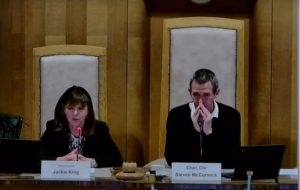
Jackie King CEO EEBC and Cllr S McCormick at Audit and Scrutiny Committee – Epsom and Ewell Borough Council YouTube channel