Epsom and Ewell Times
21st May 2026

ISSN, LDRS and IMPRESS logos

Local LibDem view on Epsom and Ewell Council’s future

Cllr Julie Morris and EEBC in background with ?

Local Government Reorganisation (LGR) is a recurring theme in British politics.  Government which is fit-for-purpose contributes to overall efficiency.  Proportional Representation would be by far the best change central government could make toward this.  However, the removal of two tier authorities is what we have to deal with and there are undoubtedly economies of scale to be had from the edict that Surrey should become two or possibly three unitary bodies, instead of one county council and eleven districts/boroughs.

It is really important to create new unitaries using current boundaries as far as possible.  The logistics and costs of any other scenario are complex and could lengthen the process by years.   Debt needs to be spread so that no new authority is immediately bankrupt (as some existing councils are heavily in debt) and, ideally, areas of wealth and deprivation should also be fairly distributed so that each new unitary begins life as both fair and financially viable.  Amalgamating services such as refusal collection, recycling and disposal makes sense as for small boroughs the costs of energy-efficient collection vehicles are prohibitive and it’s worth remembering that some councils already share staff such as legal, chief executive, IT, etc.  Working in partnership is not an entirely new thing, so amalgamation might be relatively straightforward in some areas.  Redistributing services covered entirely by the existing county council could be the key to success in the eyes of local residents, and there are some sensitive areas here e.g. social services and education, to say nothing of potholes.

We do not as yet know the preference of Epsom & Ewell Borough Council, and the Liberal Democrats in Surrey as far as I am aware have not yet come out in favour of any particular scenario.  I personally favour three new unitaries over two, but I’m sure there is room for manoeuvre once the fuller picture is known.  For Epsom, a new Town Council would probably find favour with local people.  Even though it has limited power particularly when it comes to planning applications, it can do a good job of keeping residents informed and, most importantly, involved.  This does nicely lead onto the tricky bit which is how to make sure residents themselves are not further disengaged from local politics (and politicians) and feel they have no say or contribution to make.  Decisions taken many miles away and a local councillor who represents a much wider area could impact voter turnout (and apathy) even more.  Only around 40% of the electorate currently vote in local elections anyway. 

Cllr Julie Morris

Leader of the Liberal Democrat group

Epsom & Ewell Borough Council 

Related reports:

Local Labour view on Epsom and Ewell Council’s future


Local Labour view on Epsom and Ewell Council’s future

Cllr Chinn with Epsom Town Hall in background

The government has directed a total reorganisation for two-tier local authority areas across the whole country. This was planned by the previous government and outlined in the Labour manifesto. Surrey County Council will cease to exist and will be divided up into, what Surrey Labour Party hopes, will be three unitary authorities.

Labour in Surrey has long argued that twelve councils, twelve civic centres or town halls, with twelve chief executives and a top-heavy administration is not the most economical way to deliver essential services. Small boroughs all with their own legal teams, revenue teams, housing teams, procurement staff—all duplicating roles unnecessarily. On completing the process, unitary authorities will soon start making efficiency savings.

Surrey Labour has been discussing for years how unitary authorities could be most effectively organised to best serve the residents of Surrey. Unlike the Liberal Democrats, who are hardly engaging, or the independents, burying their heads in the sand and calling for elections to be held in 2025, as did some council ruling groups. How they can claim good financial management whilst wanting an unnecessary election to go ahead makes no sense. Wasting taxpayers’ money on a soon-to-be irrelevance would be unforgivable.

Surrey Labour has embraced the process, made a case for three unitary authorities, and carefully examined how they could be organised, taking into account the guidance from the white paper:

  • Sensible economic geographies
  • Travel to work areas
  • The ability for local residents to engage and hold their devolved institutions to account

The Case for Three Unitary Authorities

We believe that there is an overwhelming case for three councils based on existing geography, taking into account expected population growth and recognising the political, economic, and social challenges faced by the county.

Surrey is to be divided into unitary authorities (UAs), with the government suggesting a population of 500,000 or more as ideal but recognising that there may be exceptions to ensure new structures make sense for an area. The population of Surrey is 1.25 million, which implies two or three authorities.

Dividing Surrey into two UAs would mean both would be oversized and geographically challenged in an area of anticipated population growth, whereas three would be initially undersized. The likely divisions would be:

  • Two UAs – (East/West) – as proposed by the Conservatives
  • Three UAs – (North/South-West/South-East) – as proposed by Labour and supported by all the boroughs and districts

Proposed Unitary Authorities

With service delivery to residents being the most important issue, we suggest the following councils:

Middlesex-Surrey Borders

  • Elmbridge, Spelthorne & Runnymede
  • Population: 334,000

Surrey Hills

  • Guildford, Surrey Heath, Woking & Waverley
  • Population: 478,000

North Downs

  • Epsom & Ewell, Mole Valley, Reigate & Banstead, and Tandridge
  • Population: 416,000

These names and details are provisional and will be decided later. However, they best fit geographically and population-wise.

All these areas would have much stronger geographical links and community ties than the larger, two-unitary authority model. While all three are under the government’s ideal 500,000 population threshold, Surrey Hills is closer to that figure, and all are areas of population growth.

These three UAs could provide a more local and focused delivery of key services, ensuring better support for adult social care and SEND needs, both priorities for Surrey. It would give greater clarity for residents, with one authority being responsible for all local services. Service delivery would be more efficient, more accountable, and free from disputes over which council has responsibility in an area.

Local Voices Must Be Heard

It is essential to establish a close relationship between Surrey County and district councillors in shaping their new unitary authorities as they are formulated. The reorganisation process must not descend into factional disagreements but remain focused on communities and democratic engagement at a local level.

Other unitary councils, such as London boroughs, often have local committees to represent community views. Boroughs and districts in Surrey should now begin engaging residents, examining the options, and organising forums to ensure local voices are represented in the new UAs.

Conclusion

The devolution offer in the white paper suggests a Surrey Mayor, offering priorities for funding that suit their areas and providing strategic leadership. This could positively impact key Surrey priorities, including:

  • Skills and employment
  • More housing
  • Increased local investment
  • Making Britain a clean energy superpower

Surrey’s approaches to neighbouring areas for a joint strategic mayor have not been successful.

A Surrey Mayor would automatically represent an area that aligns with the current police and crime commissioner and the Surrey Fire and Rescue Service boundaries, as envisaged by the white paper’s goal of “reforming and joining up public services”.

Overall, we believe that our three-unitary authority model will best serve the needs of Surrey residents going forward.

Much of this is based on previous contributions by Robert Evans & Arran Neathey (2019), Cllr Catherine Powell (2025), Tony Rooth & Michael Moriarty, with additional input from Cllr Robert King, but it does not necessarily represent all of their individual views.

Cllr Kate Chinn
Leader of the Labour Group
February 2025


 Mega Surrey council ruled out as leader says it would ‘lack accountability’

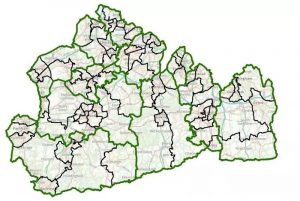
Proposed Surrey County boundaries (Credit contains Ordnance Survey data Crown copyright and database rights 2024)

Council leaders across Surrey have ruled out making the county a single mega authority. The agreement was reached during a meeting on February 7, attended by leaders from all eleven district and borough councils. 

The government confirmed last week that Surrey is among the first areas to take part in devolution to simplify and streamline local government. Elections have also been postponed until at least 2026 as part of the process. 

Catherine Sayer, Leader of Tandridge District Council, said: “I am delighted we have been able to rule out proposing a single unitary which I believe would have been too large and so lack accountability to residents.”

Two-tier systems of borough and county councils could be thrown away with single unitary authorities created instead. The government argues this would not only be more cost effective but also shift power away from Westminster and towards local people. 

Tim Oliver, Leader of Surrey County Council, who was unable to attend last week’s meeting, said: “The government’s White Paper sets out their ambition to create strategic combined authorities under mayoral devolution, and within Surrey’s geography a single unitary wouldn’t meet that criteria.”

A statement from the Surrey Leaders LGR Steering Group said it “remain[s] committed to working together towards submitting one bid for the County”.

Options still on the table include Surrey being made up of two or three smaller council regions, with possibly an elected mayor overseeing the whole county. Last week Spelthorne councillors voted on their preferred make-up of councils depending on whether Surrey would be split into two or three. 

But leaders across the political divide have warned shrewd councils should not be flattened by neighbouring council’s crushing debts. Leader of Reigate and Banstead Borough Council, Richard Biggs, and Leader of Elmbridge Borough Council, Mike Rollings, as well as Cllr Sayer (Tandridge) have raised alarm at being forced to pick up the tab of other councils. 

Council leaders are aiming to meet weekly to develop an interim proposal, in line with government criteria, to be submitted by 21 March with a full proposal to follow by 9 May.


Epsom & Ewell Council not much in the red but too much in the pink!

Epsom Town Hall in a pink hue

Governance Failing Exposed by External Audit Findings

The Audit and Scrutiny Committee of Epsom and Ewell Borough Council convened on 6th February 2025, where the External Audit Report by Grant Thornton ignited a heated debate over transparency, governance, and the Council’s use of confidential “pink papers”. Against the background of relative positive news on the accounts and budgets the meeting focussed on the culture of secrecy over decision-making.

The external auditors highlighted a culture of secrecy, citing too many decisions being taken in private and a lack of openness in decision-making. Opposition Councillors Kate Chinn, Chris Ames and James Lawrence strongly criticised the Council’s handling of transparency, while the Council’s leadership attempted to downplay the concerns, insisting that governance processes were robust.


The External Audit Report: A Damning Verdict on Transparency

The Grant Thornton audit report drew heavily on a Local Government Association (LGA) Peer Review, which criticised the Council’s decision-making culture. The report highlighted that:

  • “Too many decisions are being made under part two as a media management strategy.”
  • There is a “lack of transparency” in governance structures.
  • The Council needed to demonstrate clearer and more open decision-making.

These findings were met with stark reactions from opposition councillors, who argued that the Council was withholding information from elected members and the public.


Councillor Kate Chinn: “Stop the Navel-Gazing”

Before the committee formally discussed Item 4: External Audit, Councillor Kate Chinn (Labour, Court Ward) made a strong opening statement, focusing on the governance failures exposed by the auditors. She highlighted:

“Throughout their report, Grant Thornton noted the LGA report stating a culture of secrecy, noting a lack of transparency, stating a culture of secrecy described by members and that too many decisions are being held behind closed doors.”

Chinn criticised the ruling administration for focusing on internal restructuring, particularly the proposal to separate audit and scrutiny functions, rather than addressing substantive transparency issues. She stated:

“The ruling group has chosen to focus as a priority on the LGA recommendation to decouple audit and scrutiny. This is a decision that was already planted in council by the political leadership as a direction of travel, and I’m quite sure this is not a priority for the residents of Epsom and Ewell facing so many cost-of-living challenges.”

She urged the Council to move beyond constitutional tinkering and focus on supporting frontline services:

“In view of the move to a unitary authority, the Council should stop spending so much time on internal matters—no more tweaking the constitution or fiddling about with the functions of a soon-to-be different committee. It’s just become navel-gazing.”


Councillor Chris Ames Challenges “Pink Paper” Secrecy

The overuse of confidential “pink papers” (private reports) became a central point of contention, with Councillor Chris Ames (Labour Court) raising concerns over the council’s reliance on closed-door discussions.

He directly challenged the administration on whether they were deliberately using “part two” rules to restrict public access:

“Are you using part two to be a euphemism for going into a closed session? Because that’s not my understanding of what part two means….. There is a withheld report here. It’s Appendix Two. It’s quite clear. It says on both the public pack and in item 13.”

Chair Steve McCormick Chair of the Committee (RA Woodcote and Langley) defended the Council’s approach, arguing that some reports contained sensitive financial details:

“If you start to ask questions on that, then we will have to go into part two. We will have to basically stop the feed. And once we go into part two, we can’t come out.”

However, Ames remained sceptical, pressing for clear definitions of what was truly confidential and what was being unnecessarily withheld. He questioned whether decisions should be debated in secret unless absolutely necessary: “My question is, are we using the word Part Two consistently and accurately? Because it says item 13 and it says it’s on the public pack.”

Adding to this transparency row, Councillor Alex Coley (RA Ruxley) reported that he was unable to access the part two documents on the Council’s internal system, ModGov:

“I’m not actually able to access the part two items in ModGov. So that’s perhaps why there’s been some confusion. I can’t get to them.”


Councillor James Lawrence: “A Transparency Crisis”

In one of the most scathing criticisms of the evening, Councillor James Lawrence (LibDem  College Ward) said that his own experiences confirmed that the Council had a serious transparency problem. He declared:

“Quite frankly, my own experience of transparency at the Council is not great.”

He pointed to several key examples where he felt information was deliberately restricted:

  1. The Local Plan Process:  “I’ve struggled to be involved at all in the local plan process. The entire time I’ve been elected as a councillor, it has not come to a public committee until right before it went to full council……..If I’m struggling as a councillor, my goodness, what do we think residents are struggling to see?”
  2. The Town Hall Move (£7m Project):  “Still don’t really know why that was in part two……Then of course we had the well-prepared, very slick PR statement to go out after, to give the impression to residents that there were no problems, that it’s all clean sailing.”
  3. The Hook Road Arena Plan:  “I remember I saw that appear in the Local Plan documents, and I emailed in questions about that. Nothing. Nothing back.”
  4. Access to Audit Reports: “Having my own struggles to get hold of an audit report as a member of audit and scrutiny—it’s not a very good sign……Of all the people to be struggling to get hold of an audit report, it shouldn’t be someone on the Audit and Scrutiny Committee.”

Council’s Response: A Dismissive Attitude?

The Council’s official response to the audit findings did not acknowledge any fundamental governance failures. Instead, the Senior Leadership Team (SLT) issued a brief statement, saying: “SLT believes the Council is transparent in its reporting and through Committees.”

Lawrence ridiculed the response, stating: “My impression of the management response is essentially: Don’t care. It’s already transparent enough.”

A pragmatic attitude from Councillor Alan Williamson

Cllr Alan Williamson (RA West Ewell) struck a pragmatic tone, questioning whether the Council should devote energy to internal reforms when local government reorganisation was imminent. He remarked:

“Obviously, the one area where there is an element of concern from the external auditors is governance and transparency. Now, this is, in my mind, an issue of culture rather than performance…….. The whole focus of this Council is going to be the impending local government reorganisation, and to expect it to change its culture in the next year or two is somewhat implausible.”

He suggested that the Council’s priorities should shift towards ensuring stability during the transition rather than engaging in lengthy internal governance debates.


A Governance Crisis?

The Audit and Scrutiny Committee meeting exposed deep divisions within the Council. While external auditors and opposition councillors raised legitimate concerns about secrecy and accountability, the administration remained largely dismissive of these criticisms.

As Councillor Lawrence bluntly put it: “If I’m struggling as a councillor to access this information, what hope do our residents have?”

With local government reorganisation looming, the Council faces mounting pressure to reform its decision-making processes—but the meeting made clear that no immediate action is planned.

Whether transparency will improve or whether secrecy will remain embedded in the Council’s culture remains to be seen.

Related reports:

Seeing through transparency in Council Chamber

“Audit and Scrutiny” under scrutiny

Annual audit of Epsom and Ewell Borough Council


What might local government reorganisation mean for Epsom and Ewell?

As Surrey faces a significant overhaul of its local government structure, residents of Epsom and Ewell are rightfully concerned about the potential financial repercussions. The proposed reorganisation may lead to two unitary authorities that merge the county’s 11 borough and district councils, a move intended to streamline services and reduce administrative costs. However, this consolidation raises pressing questions about fiscal responsibility and the equitable distribution of debt, particularly for boroughs like Epsom and Ewell that have historically maintained prudent financial practices.

The Financial Landscape of Surrey’s Boroughs

The Epsom and Ewell Times has just published three reports detailing the financial woes of three councils within Surrey that are grappling with substantial debts resulting from ambitious investment strategies.

  • Woking Borough Council declared effective bankruptcy in 2023, burdened by debts exceeding £2 billion due to failed investments in large-scale projects. The council has since been compelled to implement severe austerity measures, including significant tax increases, service closures, and asset sales.
  • Spelthorne Borough Council faces over £1 billion in debt from investments in commercial properties. A recent audit revealed “significant weaknesses” in financial record-keeping, inadequate plans to address looming budget gaps, and concerns over governance and internal culture.
  • Guildford Borough Council is confronting a challenging financial future, with projected budget gaps escalating to £5.9 million by 2028/29. The council has acknowledged the need for cost reductions and increased income to manage these pressures.

Epsom and Ewell’s Prudent Financial Management

In contrast, Epsom and Ewell Borough Council has consistently balanced its budgets or been able to use reserves to meet its obligations, demonstrating fiscal discipline and effective financial stewardship. This prudent management has enabled the council to maintain most services and infrastructure without accruing unsustainable debt levels.

The Justice of Debt Redistribution

The proposed reorganisation raises a critical question: Is it just for residents of financially prudent boroughs like Epsom and Ewell to assume responsibility for the substantial debts incurred by other councils? Merging councils into larger unitary authorities could lead to a pooling of assets and liabilities, potentially obliging Epsom and Ewell’s residents to contribute to servicing debts they had no part in accumulating.

This scenario not only challenges principles of fiscal fairness but also risks penalising councils that have exercised sound financial management. It is imperative to consider whether it is equitable for residents to bear the financial burdens resulting from the mismanagement of neighbouring authorities.

Calls for Government Intervention

Recognising the potential injustice, Surrey County Council’s leader, Councillor Tim Oliver, has advocated for central government to write off the significant debts of councils like Woking before proceeding with devolution plans. This approach aims to mitigate the financial risks associated with high debt levels and prevent the unfair distribution of financial burdens across the county. How likely is it that a Labour Government will write off a debt accumulated by Woking under its previous Conservative led Council?

The Path Forward

As discussions about local government reorganisation progress, it is crucial to ensure that any new structures are underpinned by principles of fiscal responsibility and equity. Potential solutions include:

  • Debt Segregation: Isolating the debts of heavily indebted councils to prevent them from being transferred to newly formed unitary authorities.
  • Government Debt Relief: Advocating for central government intervention to alleviate or write off unsustainable debts, ensuring that the financial missteps of certain councils do not adversely impact the entire county.
  • Transparent Financial Assessments: Conducting comprehensive financial evaluations of all councils involved in the reorganisation to inform fair and equitable decision-making.

The proposed reorganisation of Surrey’s local government presents an opportunity to enhance efficiency and service delivery at the cost of Borough based democracy. However, it also necessitates careful consideration of the financial implications for all residents. Epsom and Ewell’s community, having benefited from prudent financial management, should not be unduly burdened by the debts of other councils. It is incumbent upon policymakers to design a reorganisation framework that upholds fiscal justice, ensuring that the residents of Epsom and Ewell are not unfairly disadvantaged in the pursuit of broader administrative reforms.

Related reports:

All change! Epsom and Ewell Borough Council approaching its final stop?

Surrey’s Conservative leader wants to postpone May’s poll reckoning

Tiers to be shed if Epsom and Ewell loses its Borough Council?


Are Epsom and Ewell’s Interests Served by Postponing Democracy?

The Conservative-led Surrey County Council’s recent decision to seek a postponement of the May 2025 elections raises serious questions about the motivations behind this move. This decision, spearheaded by Councillor Tim Oliver, comes after the Conservative Party’s near-total defeat in the July 2024 General Election and appears to be as much about retaining control as it is about facilitating local government reorganisation.

The argument put forward by the council’s leadership—that elections would create a “zombie” authority that wastes public funds—is unconvincing. Elections are a cornerstone of democracy, not a bureaucratic inconvenience. By delaying them, the current leadership retains power at a time when its mandate to govern Surrey is at best questionable. Surrey’s residents, many of whom voiced their dissatisfaction with Conservative governance at the ballot box just months ago, now face the prospect of being governed by a council that is effectively prolonging its tenure without public consent.

One cannot ignore the context of this decision. Central government’s push for local government reform and devolution is not an altruistic initiative aimed at better serving communities. It is a cost-cutting exercise disguised as modernisation. The Government’s stipulation that new councils must serve a minimum of 500,000 residents almost guarantees the dissolution of smaller, locally focused boroughs like Epsom and Ewell.

For Epsom and Ewell, the smallest of Surrey’s 11 boroughs, this means the likely loss of a council that has served its residents with proximity and understanding for decades. What replaces it may be a sprawling mega-authority or a fractured, less accountable unitary structure. Either way, Epsom and Ewell risks losing its unique voice, with decisions about its future made by those unfamiliar with its needs and aspirations.

Equally troubling is the inclusion of Woking Borough Council’s extraordinary debt—reportedly the largest in UK local government history—in the negotiations surrounding devolution. This financial calamity, created under Conservative rule, should be a cautionary tale about the dangers of poor governance, not an issue swept under the rug in the rush to reform. Why should other Surrey residents shoulder the burden of Woking’s mismanagement? And why has Surrey’s Conservative leadership not been more transparent about its plans to address this issue?

The proposal to postpone elections also conveniently consolidates power for a party facing an uncertain future. By delaying the democratic process, Surrey’s Conservative leadership ensures it remains at the table during pivotal discussions about the future shape of local government, even as the electorate has made its dissatisfaction clear.

Epsom and Ewell Borough Council, like others across the county, is being swept into a centralised reorganisation process with little clarity about what it will mean for its residents. The likely outcome is the erosion of local democracy, with decisions affecting communities being made further away and by people with less understanding of local needs.

Surrey’s leadership has yet to explain convincingly why postponing the elections is necessary. If their proposals for reorganisation are sound, why not put them to the test of public approval? Democracy is not an obstacle to progress; it is the means by which progress is legitimised.

Epsom and Ewell’s residents deserve to have their voices heard in shaping the future of their local government. They deserve transparency about what reorganisation will mean for their services, their representation, and their community identity. Most importantly, they deserve the chance to vote on who should lead that process. Anything less is an affront to democracy and a betrayal of public trust.

The May 2025 elections must go ahead. It is time for Surrey’s leaders to trust the people they serve and stop hiding behind bureaucratic excuses.

Epsom and Ewell Times

Related reports:

Local government reorganisation: What will it mean for Epsom and Ewell?

All change! Epsom and Ewell Borough Council approaching its final stop?

Surrey’s Conservative leader wants to postpone May’s poll reckoning

Tiers to be shed if Epsom and Ewell loses its Borough Council?


Local government reorganisation: What will it mean for Epsom and Ewell?

Surrey and Epsom Council buildings

The leader of “doomed” Surrey County Council will write to the Government asking for the May 2025 elections to be postponed and Woking’s debt cancelled as part of devolution measures to merge the county’s councils. The moves are said to allow the council the time to draft proposals for how the county and its 11 boroughs and districts will be dissolved and reborn as potentially a single authority with a directly elected mayor. Other plans could see the county split in two or three smaller unitary authorities in one of the biggest shake-ups in a generation.

In December, the Government placed councils on short notice over devolution plans, giving those who want to get on board until March to submit interim merger proposals. Those who do not will have their devolution plans dictated to them by Downing Street. To give councils time to reorganise, the Government also said it would consider passing legislation postponing the May 2025 elections until next year. On Wednesday, January 8, Surrey County Council confirmed it would pursue the Government’s offer, with conditions.

The move to push back elections, however, was disputed in the chamber with councillors calling it undemocratic, while the leaders of the 11 boroughs and districts have also called for the May polls to go ahead. Councillor Paul Follows, leader of the opposition, told the meeting the boroughs and districts made it very clear local government reform was necessary – but that it could be done alongside the democratic process. He said: “We accept and broadly agree that some unitary council combination would make sense for a variety of reasons but we believe that the pace, the haste, and the lack of plans should not just be folly but a clear threat to services our residents need, and we do not accept that elections must be cancelled.

“The Government aren’t asking us or making us cancel elections. The deputy prime minister confirmed in an interview [on Wednesday morning] that councils are not being asked this way.” He added: “The timetable is going to remain as is and the work is going to happen and we can do everything that the leader is proposing to do while holding the scheduled elections. The leader has argued that leaping in here brings benefits but nobody has outlined what they are and honestly whatever they are, unless they include defined government interventions on debt and adult social care, nothing is worth taking that leap because then any successor authority will be immediately in serious troubles.”

He would also raise concerns that without clear guidelines and financial support, scenarios where playing fields in Godalming could be sold off to pay debts in Woking could emerge. The ruling Conservative group, however, dismissed demands to keep the election saying it would not only cost millions – estimated at about £2.48m – but also elect a “zombie” body that would be dissolved in just a year’s time.

Councillor John O’Reilly (Conservative; Surrey) said: “This council is doomed. This council will not survive and the 11 boroughs and districts will also not survive. So we are talking about a new structure and framework and for those saying the election to go ahead, it is quite clear, the minister’s letter has said that those authorities where elections do go ahead, they have still got to provide submissions by autumn, leaving only a few months. So what is going to happen if we have elections? It will essentially be a zombie council in the twilight, lurching through its own oblivion maybe only a year or so later when elections will take place for the new authorities.”

Councils have until March to submit interim devolution proposals with final drafts delivered by either May or the Autumn. The council has said it will work with “all stakeholders” over the next eight weeks in drawing up plans, including residents, as well as taking feedback from police, fire and rescue, and health services. The Government states it wants new councils to have a minimum of 500,000 residents meaning it is most likely Surrey would become either a single mega authority or split in two – with a directly elected mayor.

Some councillors raised a preference to create three bodies. Councillor Tim Oliver did not rule out expanding beyond the Surrey border to create a regional authority but hoped that all parties could come to an agreement. He said: “We propose to make it clear that the Government will be asked to deal with the debt partially, Woking that is publicly known and crystallised, but there are other levels of significant debt across the county.” He said it was better to get in early to create some leverage over the debt position rather than be handed down a Government dictate.

He said: “Work will start on Friday – officers are putting together the working groups needed. This will be exceptionally time consuming. Not only will it need collaboration between the boroughs and districts, but this council will need to have an input into the proposals. We may go with more than one proposal, one from this council and one from the boroughs and districts.”

The county council leader will now write to the Government setting out that Surrey wishes to be part of the accelerated devolution program and that it would support any new legislation postponing the May 2025 elections until next year.

Related reports:

All change! Epsom and Ewell Borough Council approaching its final stop?

Surrey’s Conservative leader wants to postpone May’s poll reckoning

Tiers to be shed if Epsom and Ewell loses its Borough Council?


All change! Epsom and Ewell Borough Council approaching its final stop?

Surrey and Epsom Council buildings

Surrey is changing “whether we like it” or not and county council leader Tim Oliver says it’s better to be at the forefront of that change.

The Government wants to introduce new mayoral authorities across the country in a bid to streamline councils and shift power away from Westminster.

For Surrey, that means scrapping the 11 boroughs and districts as well as the county council, and replacing them with either a single, or what seems more likely, two authorities with a Strategic Mayor.

The question is how will it be done? The answer; it will either be imposed on Surrey, or the councils can create their own plans to merge under devolved powers.

County Council leader, Councillor Tim Oliver, favours playing a central role, arguing that change is inevitable, and it’s best to be part of the conversation in order to shape the future, rather than sit on the sidelines waiting to be told what to do.

The Government wrote to the county council in December outlining how it planned to “transfer power out of Westminster through devolution and to fix the foundations of local government.” It wants a simpler structure that is “clearer for residents” and said it would even pass new laws to postpone the May 2025 elections “to help manage” the once in a lifetime opportunity to restructure.

Writing to Surrey, Jim McMahon, minister of state for local government and English devolution, said: “We are under no illusion about the scale of issues facing local government. It is in all our interests to make sure we are avoiding unnecessary spend at a time when budgets are already tight.”

He added: “I have heard from some areas that the timing of elections affects their planning for devolution, particularly alongside reorganisation. To help manage these demands, alongside our objectives on devolution, and subject to meeting the timetable outlined in this letter, I am minded-to lay secondary legislation to postpone local council elections from May 2025 to May 2026. However, I will only do this where this will help the area to deliver both reorganisation and devolution to the most ambitious timeframe – either through the Devolution Priority Programme or where reorganisation is necessary to unlock devolution or open up new devolution options.”

Cllr Tim Oliver is already minded to take up the offer of pushing back the elections for a year to get devolution done. Holding the elections this year would cost about £1million, he says, and would take time away from officers already working to a tight five-month deadline to get devolution over the line.

“The Labour Government has set up their agenda in the white paper and that is to create Mayoral Strategic Authority (MSA) across England. They have a strong majority and we can assume they will pass the legislation,” Cllr Oliver said. “If you don’t reach an agreement locally, then they will legislate. It’s going to happen. It’s better that we try to control or have some influence over what happens rather than have it imposed on us down the line.”

“The primary focus should be ‘what is in the best interests of the residents of Surrey?’ Whether we like the model or not it is going to happen in Surrey and the reason for getting in early as we are, is that we are slightly unique here in that there are councils in Surrey that have significant debt levels.”

This, he says, gives the Government a huge stick, to push councils to get on board. Councils such as Woking are bankrupt and need Government intervention. Merging the councils would pile its £2billion debt on to others.

Similarly, though not bankrupt, Spelthorne Borough Council has debts of more than a billion and Runnymede has debts of more than £600m. Surrey County Council, albeit with significantly larger spending power as a top tier authority, is also heavily indebted.

Cllr Oliver said: “The longer we leave it, the less likely we will get any support from the Government. That’s what’s driving me.”

Historically, Surrey councils have not benefited as greatly as other local authorities from Government funding reviews and have to raise more money locally. Areas that can raise taxes will continue to be required to. Removing tiers of local government will be an efficiency driver and help stave off service cuts, or lead to more investment.

He said: “We have to divide up the county to create a minimum of two strategic authorities, and then we get a mayor. If we don’t get on with that reorganisation, we will be years away from the benefits of a mayor, compounded with almost certainly reduced funding to Surrey councils.”

Papers published ahead of the January 10 deadline to respond suggest the council leader will take up the Government’s offer to hold off on this year’s elections “to give time to consult.”

Cllr Oliver said: “If we go ahead with elections in May, and I’m fine with that, I wasn’t going to run again. But, ignoring who wins, you end up with an election in May that will cost over a million pounds, which they do, and then you will have a bunch of new councillors who have to find their feet, only to be out in two years when the council disappears. The next five months should be about the negotiation with the Government about what the future looks like.”

“Every political party, and all the existing councillors who know the county better, will have the opportunity to input. I can’t see what the Liberals, if they got a majority, would do differently? This way, we will get a bit of goodwill from the Labour Government by engaging with them now.”

“Hampshire, Essex, and Hertfordshire are already getting on with their own plans for devolution, and if Surrey County Council just puts its head in the sand and gets on with the elections we will miss the opportunity to have the conversation with the Government about the debt levels.”

“We’ve got five months to consider it, the key thing is to do an intensive piece of work now. We’re not at the point where we’ve had the conversation about how it’s split, but we’ve got five months to do this either the Government’s way or our way. Yes, the timetable is much shorter than anybody would want particularly putting a letter in by January 10 but we have to respect the fact that this Government has an agenda and it can deliver because it has the mandate.”

Later this month the Government will set out which areas will be included in its Devolution Priority Programme with a view to inaugural mayoral elections in May 2026. They are looking at creating new unitary councils with populations of 500,000 or more. Surrey has a population of about 1.2 million. Exceptions will be made to ensure new structures make sense for an area.

An extraordinary meeting of Surrey County Council is set to go ahead on Wednesday January 8 where the council will be “asked to note” that the leader intends to express interest in pursuing devolution and local government reorganisation.

Related reports:

Surrey’s Conservative leader wants to postpone May’s poll reckoning

Tiers to be shed if Epsom and Ewell loses its Borough Council?

Tim Oliver Surrey County Council leader – Surrey Live


Tiers to be shed if Epsom and Ewell loses its Borough Council?

Surrey and Epsom Council buildings

Surrey could be split in two as part of sweeping changes to how services are run. Downing Street is looking to reshape local government and has set out a white paper outlining its vision. It wants to do away with two-tier systems of boroughs and counties and instead create single unitary councils. It argues this would not only be more cost-effective but also shift power away from Westminster. If devolution plans for the county go through, Surrey and its 11 boroughs and districts would be no more. The big question is: what replaces it? The most likely answer at the moment appears to be two councils with a directly elected mayor overseeing county-wide issues – these could include policing, fire and rescue, and transport.

The English Devolution White Paper says that new unitary councils “must be the right size to achieve efficiencies, improve capacity and withstand financial shocks. For most areas, this will mean creating councils with a population of 500,000 or more, but there may be exceptions to ensure new structures make sense for an area, including for devolution, and decisions will be on a case-by-case basis.” Surrey has a population of 1.2 million, and a single “mega-council” stretching from Farnham to Oxted, an area larger than Greater London, would simply be too vast, some have argued. This leaves the most likely option of merging the current boroughs of Tandridge, Mole Valley, Reigate & Banstead, and Epsom & Ewell into East Surrey Council, with Woking, Guildford, Spelthorne, Runnymede, Surrey Heath, Waverley, and Elmbridge forming West Surrey Council.

The white paper also argues: “Unitary councils can lead to better outcomes for residents, save significant money which can be reinvested in public services, and improve accountability with fewer politicians who are more able to focus on delivering for residents.” However, opponents argue devolution could push residents further from the decision-making process and only delay funding reforms for local government.

Will Forster, newly elected MP for Woking, expressed his concerns: “I don’t think that having a single mega council is a good idea. Camberley to Oxted is far too large, there are huge differences east to west. It’s too large and remote. A single council would be too vast. That’s not devolution, that’s not empowering people.” Even the idea of a West Surrey Council would create a single area stretching from Haslemere to Staines. He added: “It also ignores the elephant in the room, social care – this seems to be the Government’s way of ignoring that. They want authorities of 500,000 or more. You look at a map, you do the sums. That’s clearly an east and west split. They’ve never divided up a borough or district and you can’t do north or south.”

Other questions would need to be answered as well, such as how the directly elected mayors are held to account. At the county level, the council holds regular meetings to vote on decisions, with scrutiny committees playing a further role. How this would be replicated for a single mayor is yet to be made clear. Councils have been invited to submit proposals to the government in January.

Tim Oliver, leader of Surrey County Council, welcomed the devolution paper and its “bold ambition to empower local communities and councils.” He said: “The government has set out an agenda for change, including potential reorganisation of local government, particularly in two-tier county areas like Surrey. I believe there is general consensus that the current structure – here and elsewhere in the country – is not the most effective. Therefore, we welcome a real examination and review of how local government is organised to make it more efficient and more effective for residents. We intend to work alongside government, and other partners locally, and ensure any change ultimately benefits the people of Surrey.”

Announcing the paper’s publication, Deputy Prime Minister Angela Rayner stated: “Our manifesto pledged to give everyone access to devolved power. So I will legislate for a new power of ministerial directive – which will allow central government to knock heads together and create strategic authorities when local leaders cannot agree. If we are going to build an economy that works for everyone, we need nothing less than a completely new way of governing – a generational project of determined devolution. Because the Westminster system is part of the problem. Whitehall is full of layers of governance and bureaucracy, controlled and micromanaged from the centre. To truly get growth in every corner of the country and put more money into people’s pockets, we must rewire England and end the hoarding in Whitehall by devolving power and money from central government to those with skin in the game.”


Epsom and Ewell’s new Mayor

New Mayor takes the chair in Council chamber

Epsom and Ewell Borough Council has appointed Councillor Steve Bridger (RA Stamford) as the new Mayor for the year 24/25. In a ceremonial meeting Tuesday 14th May, speeches were made to propose the new Mayor, to thank the outgoing Mayor, and by both the incoming and outgoing Mayors themselves.

Councillor Phil Neale (RA Cuddington) proposed his appointment. He said “I hope I will achieve at least one of these requirements,” referring to the traditional brevity and humour expected in such speeches. Cllr Neale detailed Cllr Bridger’s extensive background, highlighting his early career in the family-owned wholesale fish business and his long tenure at Tesco, where he achieved notable success. “Steve proudly states that he managed every department… all except working the tills,” Cllr Neale quipped. He also mentioned Cllr Bridger’s dedication to family, particularly his support for his late son Richard, who battled Duchenne muscular dystrophy.

Councillor Chris Ames (Labour Court)  paid tribute to the outgoing Mayor, Councillor Rob Geleit (Labour Court), lauding his achievements over the past year. He highlighted the Civic Celebration of Culture as a significant event and praised Mr Geleit’s fundraising efforts. “A charity dinner brought a year of fundraising for his three well-chosen charities to a successful conclusion,” Cllr Ames remarked. He also expressed eagerness to have Cllr Geleit return to his duties with the Labour group, emphasizing the importance of his presence in the upcoming general election.

Councillor Rob Geleit reflected on his tenure with gratitude, sharing various highlights from his year as Mayor. “I’ve had a fantastic year serving Epsom and Ewell and its people,” He expressed deep appreciation for his consort, Tina, and the support team, particularly Lolli from the Mayor’s office. He recounted memorable events such as the Derby, Christmas carols at Downview Prison, and the Buckingham Palace garden party. He proudly announced that over £15,000 had been raised for his chosen charities, exceeding expectations. “We managed to keep it all together until the end, which may or may well be unprecedented,” he said, praising the charity committee’s efforts and in particular the dedication of Cllr Dr. Graham Jones MBE (RA Cuddington).

In his address, new Mayor Councillor Steve Bridger expressed excitement and gratitude for his new role. He acknowledged the challenges and opportunities ahead and looked forward to serving the community alongside his wife, Carol.

Cllr Robert Leach (RA Nonsuch) will serve as Deputy-Mayor.

Image: L to R Cllr Robert Leach (Deputy Mayor) , Mayor Steve Bridger, CEO Jackie King. The New Mayor takes the chair in Council chamber. Credit EEBC YouTube


Annual audit of Epsom and Ewell Borough Council

Epsom and Ewell Town Hall Building

The annual Grant Thornton Auditor’s Report on the workings of Epsom and Ewell Borough Council has delivered a positive assessment of its performance across financial sustainability, governance, and value for money, despite acknowledging the ongoing challenges the Council faces. The report was formally presented and noted at the Council meeting of 14th May.

Financial Sustainability: The report highlights that the Council operates in a challenging financial environment with prudent short and medium-term planning. While financial stability remains dependent on continual savings plans, the forecast indicates a need to deliver approximately £1.4 million in savings by 2027/28. The auditors emphasized the importance of finding alternatives to using reserves to manage budget gaps, noting no significant weaknesses in financial sustainability arrangements.

Governance: The Council’s governance structure was praised for maintaining appropriate arrangements and compliance policies. An updated Risk Management Strategy and adherence to CIPFA’s Good Governance Framework were noted as strengths. However, the auditors recommended prioritizing the completion of management actions and reviewing the composition of the Audit & Scrutiny Committee to potentially include independent members.

Value for Money: The Council’s efforts to ensure economy, efficiency, and effectiveness were aligned with delivering value for money. Recommendations were made to develop a partnership governance framework and to address underperformance in processing minor planning applications, despite improvements seen in 2023.

Overall, the audit reflects positively on the Council’s operations, suggesting continued disciplined financial management and strategic governance enhancements.

The four key recommendations in more detail and the responses of EEBC management:

Grant Thornton Recommendation 1: Timely Internal Audits.

The auditors suggested that internal audits focusing on financial controls should be completed before the end of the financial year to aid the Head of Internal Audit in forming their opinion.

EEBC Management Response: Acknowledging the importance of timely audits, management noted past challenges due to staff turnover and long-term sickness, which have now been resolved. With a fully resourced team, management is confident in meeting the audit schedule, with progress monitored by both the Strategic Leadership Team and the Audit & Scrutiny Committee.

Grant Thornton Recommendation 2: Monitoring Framework for Audit Actions

The council was advised to develop a framework to monitor management actions identified in internal audit reports, ensuring these are completed by the agreed due dates to enhance clarity and accountability.

EEBC Management Response: Management emphasized that a robust monitoring framework is already in place, with the Business Assurance team logging all actions and requiring quarterly updates from Heads of Service. Additionally, new performance management software has been procured to further improve monitoring capabilities.

Grant Thornton Recommendation 3: Audit & Scrutiny Committee Composition

Auditors recommended reviewing the composition of the Audit & Scrutiny Committee to exclude Strategy & Resources members for independence and considering the appointment of independent members.

EEBC Management Response: Management revealed that a review of the committee’s operations is already planned following a Corporate Peer Challenge in March 2024. The audit recommendation will be considered during this review in consultation with relevant members.

Grant Thornton Recommendation 4: Partnership Governance Framework

To enhance partnership working, the council was advised to develop a governance framework to guide and evaluate the success and effectiveness of these collaborations.

EEBC Management Response: Management expressed a commitment to positive partnership working, acknowledging recognition from the recent Corporate Peer Challenge. This recommendation will be considered in conjunction with the Action Plan resulting from the Peer Challenge.


Seeing through transparency in Council Chamber

Cllr Liz Frost responds to debate.

In a fullsome debate during the Full Council meeting of Epsom and Ewell Borough Council Tuesday 16th April, members clashed over a motion aimed at enhancing transparency in decision-making processes. The motion, proposed by the Liberal Democrat group, called for a policy of ‘transparency by default,’ urging that all meetings and documentation be made public unless specific exemptions under the Local Government Act applied.

Councillor Julie Morris (LibDem College), expressing disappointment with the decision not to refer the matter to the Standards and Constitution Committee, argued that the current approach lacked proper review and resulted in too many discussions being held behind closed doors. She emphasized the need for a more nuanced approach to determine when confidentiality was truly warranted.

Councillor Bernie Muir (Conservative Horton) echoed concerns about transparency, citing instances where information had been withheld or meetings had been abruptly shifted to private sessions. She called for comprehensive training for both officers and councillors to ensure better understanding and adherence to transparency principles.

Councillor Steven McCormick (RA Woodocte and Langley) acknowledged the challenges in navigating confidentiality requirements but defended the importance of open discussions. He highlighted the unique opportunity afforded by debating the motion in a public forum, urging members to engage in constructive dialogue.

Newly-elected Councillor James Lawrence (LibDem College) expressed confusion over the rationale behind certain decisions to withhold information. He stressed the importance of providing clear explanations to the public and fellow councillors, especially in cases where secrecy seemed unwarranted.

Councillor Chris Ames (Labour Court) raised concerns about the misuse of private sessions for political reasons, emphasizing the need for robust scrutiny and public engagement. He criticized the current administration for potentially undermining transparency and urged for greater accountability moving forward.

In response to criticisms, Councillor Alex Coley (RA Ruxley) defended the decision to debate the motion in full Council, emphasizing the importance of public engagement. He questioned the opposition’s reluctance to address transparency concerns in a public setting.

Councillor Alan Williamson (RA West Ewell), opposed the motion, asserting that existing transparency measures were sufficient. He cautioned against broadening transparency requirements, arguing that certain discussions necessitated confidentiality to foster open dialogue.

Councillor Peter O’Donovan (RA Ewell Court) highlighted the distinction between confidentiality and secrecy, emphasizing the need for a safe space to discuss sensitive issues. He cautioned against overreach in transparency efforts, citing the potential risks to privacy and effective decision-making.

Councillor Phil Neale (RA Cuddington), echoing sentiments expressed by Councillors Donovan and Spickett, emphasized the importance of confidentiality in certain discussions, particularly those involving commercial interests or personal safety. He cautioned against inadvertently stifling open dialogue by overly broadening transparency requirements.

Councillor Hannah Dalton (RA Stoneleigh) underscored ongoing efforts to address concerns regarding confidential sessions, promising clearer explanations for why certain items were categorized as confidential. She emphasized the need for balance between transparency and privacy, acknowledging the challenges inherent in navigating sensitive issues.

Councillor Kieran Persand, (Conservative Horton) expressing support for the motion, highlighted frustrations over perceived barriers to transparency within the council. He stressed the need for greater accountability and public trust, arguing that enhanced transparency measures were necessary to rebuild confidence among residents.

Councillor Alison Kelly, (LibDem Stamford) who seconded the motion, underscored the importance of improving communication and understanding among councillors and the public. She proposed measures to enhance clarity around confidentiality, aiming to provide residents with a better understanding of decision-making processes.

However, Councillor Liz Frost, (RA Woodcaote and Langley) Chair of the Standards and Constitution Committee, urged caution, warning against potential unintended consequences of broadening transparency measures. She emphasized the importance of maintaining a balance between openness and the need for confidential discussions to facilitate effective decision-making.

Following the debate, the motion was put to a vote, with a majority ultimately deciding against its passage.

Image – Cllr Liz Frost responds to the motion. Council Chamber. EEBC YouTube