
Epsom and Ewell Times

16th April 2026

ISSN, LDRS and IMPRESS logos

Elections Delayed as Surrey Faces Uncertain Future of Local Government Shake-Up

Surrey and Epsom Councils

Surrey residents will have to wait an extra year to vote in the county elections following the government’s decision to postpone the polls from May 2025 to May 2026. The delay comes as part of a sweeping local government reorganisation that will see the biggest structural shake-up in fifty years. However, concerns are mounting over the rushed timetable, the fate of council debts, and the financial burden that could fall on responsible local authorities.

Reorganisation at Speed

The government’s drive for local government reform is progressing at an accelerated pace, with councils required to submit interim proposals by 21 March 2025 and finalised plans by 9 May 2025. The reform aims to replace Surrey’s current two-tier system – where Surrey County Council oversees borough and district councils – with unitary authorities that will consolidate power at a higher level.

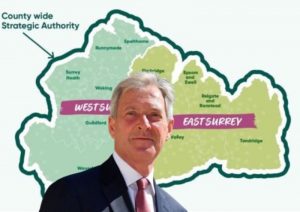
Under plans being considered, a directly elected mayor could manage strategic services such as policing, fire and rescue, health, and education. However, uncertainty remains over whether the new unitary system will feature a single authority covering all of Surrey’s 1.2 million residents or two to three smaller councils.

Who Pays the Price?

A key source of controversy is the issue of existing council debts, particularly in boroughs such as Woking, Spelthorne, and Runnymede, which have amassed a combined debt exceeding £3 billion. Woking has already declared effective bankruptcy, with Spelthorne and Runnymede under government scrutiny.

Local leaders across Surrey are voicing their objections to any attempt to spread the financial burden of these debts across councils that have maintained responsible fiscal management.

Councillor Richard Biggs, leader of Reigate and Banstead Borough Council, said: “Our view remains that plans should not support any restructuring of local government boundaries based on ‘redistributing’ the debt of other authorities.” His council, along with others, has worked to maintain financial stability while continuing to provide additional services beyond statutory requirements.

The Residents’ Association and Independents Group at Surrey County Council has strongly criticised the government’s approach, arguing that it is forcing through change with “zero funding” while suggesting that costs could be covered by selling off council-owned assets. Group leader Councillor Catherine Powell raised concerns that the government expects local authorities to fund reorganisation through “capital receipts,” which could mean selling buildings currently used to deliver essential services.

Opposition to Election Postponement

The Surrey Leaders Group, a forum representing the county’s borough and district councils, has already voiced opposition to the decision to delay elections. Chair of the group, Councillor Hannah Dalton, (RA Epsom and Ewell for Stoneleigh ward), warned that the proposed reorganisation could remove decision-making from local communities and lacks clarity on how existing debts will be handled.

“There is a real risk that new authorities will be set up to fail,” said Cllr Dalton, highlighting the potential for new unitary councils to inherit substantial financial liabilities without sufficient funding or support from the government.

A Distracted Local Government

Critics argue that the rapid timeline for reorganisation is an unwelcome distraction at a time when councils are struggling with increased demand for statutory services, including social care and housing. Concerns have also been raised about the practicalities of implementing a new financial IT system for the newly formed authorities, given that Surrey County Council’s recent system overhaul has been plagued with problems.

With just weeks to prepare draft proposals and a final deadline in early May, councils across Surrey are left scrambling to determine the best way forward. The government’s insistence on a rapid restructuring without clear funding commitments has left many questioning whether the changes will deliver better services—or simply create further financial and administrative chaos.

For now, Surrey residents must wait for further clarity on how their local government will be reshaped, and more crucially, who will bear the cost of these sweeping changes.

Related reports:

Political furies over Surrey election postponement

Surrey County Council election delay stirring up a storm

What might local government reorganisation mean for Epsom and Ewell?

All change! Epsom and Ewell Borough Council approaching its final stop?

Surrey’s Conservative leader wants to postpone May’s poll reckoning

Tiers to be shed if Epsom and Ewell loses its Borough Council?


Political furies over Surrey election postponement

Tim Oliver Surrey County Council leader - Surrey Live

Rival political parties are furious over the cancellation of Surrey’s 2025 county council elections, with groups claiming the ruling Conservatives are “running scared”. 

The government announced on Wednesday (February 5) that it has accepted Surrey’s request to postpone the county council elections for May 2025 to the following year. The county is now set to be part of the government’s ‘first wave’ of simplifying and streamlining local authorities. 

Specifics of how Surrey will be governed are still yet to be carved out but it could involve either a single mega authority with an elected mayor, or two to three smaller regions.

The news comes much to the despair of some political parties. Liberal Democrats and the Green Party saw a surging level of support in Surrey district and borough council elections last year and they were hoping to repeat the same success at a county-level. 

Surrey MPs have reacted to the cancellation, with newly-elected Liberal Democrats claiming the “Conservative-led Surrey Council has denied local residents their voice”.

A joint statement from the Lib Dem MPs in Surrey and the group leader read: “It is clear that the Conservatives are running scared and have succeeded in stopping these elections from happening in May, in a desperate attempt to cover up their own abysmal record.

“Meanwhile, the Labour Government has stood by and done nothing, knowing they can’t win in Surrey. 

“Voters are rightly fed up with this Conservative council and years of financial mismanagement. From endless potholes, to cutting local frontline services, to letting down thousands of children with special educational needs and much more, its record speaks for itself.”

Tim Oliver, Leader of Surrey County Council, welcomed the decision to postpone the elections to allow for “detailed work for reorganisation” to begin while supporting residents. The Conservative member asserted that devolution is in the “best interest” of residents and businesses.

Meanwhile, the Green Party reacted with anger to the news. Cllr Jonathan Essex (Redhill East) said: “Our fragile democracy can’t afford to ignore the people’s right to vote.” He said: “The local Conservatives have forfeited their right to represent the county as we face an uncertain future for local decision-making.”

The Greens said it would have stood more candidates than ever before at the Surrey County Council elections as the party has been growing in popularity. Cllr Essex said: “People should have a real choice between the failed Tory and Labour parties […] The real aim of so-called ‘devolution’ is quite the opposite: to move decision-making upwards to more unaccountable bodies.”

But Surrey’s two Labour county councillors said the delay was “good news for the people of Surrey”. The pair said the change will hand power from Westminster to local people with new powers and a better deal.

“Surrey County Council was formed in 1889 so the world is very different now,” Cllr Robert Evans (Spelthorne). The population of Surrey has more than doubled since Victorian times and much of what was Surrey then is now in London. The boroughs and districts were formed more than fifty years ago and don’t serve the same purpose as they might have done then.’

Cllr Robert King (Runnymede) added: “In Surrey we have a two tier system which means service delivery can be confusing. Add to that we have 12 headquarters, 12 chief executives, dozens of deputies and more than a thousand councillors. A top-heavy system of local government does not serve our communities as well as it should.”

Out of 16 local authorities which wrote to the government asking to postpone the May 2025 elections, only nine of the requests were accepted by Angela Raynor, Secretary of State for Housing, Communities and Local Government. Other councils that sought a delay included Warwickshire, Devon, Leicestershire, Gloucestershire, Kent and Worcestershire, and Oxfordshire.

“Any party calling for these elections to go ahead must explain how this waste would be justifiable,” Ms Raynor said in her announcement to the House of Commons. She added: “We’re not in the business of holding elections to bodies that won’t exist and where we don’t know what will replace them. This would be an expensive and irresponsible waste of taxpayer’s money.”

Describing the need for creating a sustainable unitary local government for Surrey as “urgent”, the Ministry for Housing, Communities and Local Government said postponing the elections will help “speed up” reorganising local government and its benefits.

Tim Oliver Surrey County Council leader – Surrey Live

Related reports:

Surrey County Council election delay stirring up a storm

What might local government reorganisation mean for Epsom and Ewell?

All change! Epsom and Ewell Borough Council approaching its final stop?

Surrey’s Conservative leader wants to postpone May’s poll reckoning

Tiers to be shed if Epsom and Ewell loses its Borough Council?


Surrey County Council election delay stirring up a storm

Cars driving under election delay sign

Surrey County Council Elections Postponed Until 2026 Amid Local Government Reforms

In a significant move reflecting the evolving landscape of local governance in England, the British government has decided to postpone the Surrey County Council elections, originally scheduled for May 2025, until May 2026. This decision aligns with the government’s broader devolution agenda, which seeks to streamline local government structures by transitioning from a two-tier system to single-tier unitary authorities.

The government’s devolution white paper, Power and Partnership: Foundations for Growth, published in December 2024, outlines an ambitious plan to decentralize power from Westminster to local regions. A key component of this strategy is the reorganization of existing two-tier local government areas into unitary authorities, each serving populations of at least 500,000 residents. The white paper states:

“Local government reorganisation: We will work with individual areas, inviting proposals from all remaining two-tier areas and those unitary councils where there is evidence of failure or their size or boundaries may be hindering their ability to deliver sustainable and high-quality services to their residents.”

This restructuring aims to enhance efficiency, improve service delivery, and provide clearer accountability by consolidating responsibilities previously divided between county and district councils. The government asserts that such a model will lead to: “Better outcomes for residents, save significant money which can be reinvested in public services, and improve accountability with fewer politicians who are more able to focus on delivering for residents.”

Surrey’s Inclusion in the Devolution Priority Programme: Surrey has been selected to participate in the first wave of the government’s Devolution Priority Programme. This inclusion necessitates a comprehensive review and potential reorganization of the county’s local government structure.

Tim Oliver, (Conservative) Leader of Surrey County Council, expressed his support for the initiative, stating: “Now we’ve received confirmation that Surrey is in the first wave of local government reorganisation and devolution priority programme, we will develop a business case for reorganisation and submit a draft to government in March.”

To facilitate this process, the government has decided to postpone the local elections scheduled for May 2025. This postponement allows the council to focus its resources on developing and implementing the reorganization plan without the immediate pressures of an electoral cycle. Oliver emphasized the practical benefits of this delay: “The resource and time that would have been spent on elections for a soon-to-be-abolished council can now be directed to working on the best possible outcome of reorganisation for Surrey.”

The decision to delay the elections has elicited mixed reactions across the political spectrum. Helen Maguire, Liberal Democrat MP for Epsom & Ewell, criticized the move: “The decision to allow this Conservative-led council to postpone the election and silence the voice of our community is scandalous.” She further contended that the postponement serves political interests. Maguire also highlighted concerns about the council’s performance, citing issues such as “endless potholes,” cuts to local frontline services, and shortcomings in supporting children with special educational needs. She concluded: “Democracy delayed is democracy denied, and the people of Epsom, Ewell, Ashtead and Leatherhead must be allowed to decide who they think is best to lead Surrey County Council through this time of significant change.”

The Labour Group of councillors in Epsom and Ewell, however, welcomed the postponement of the elections. Cllr Kate Chinn (Court Ward) stated: “Those who are calling for the elections to go ahead need to explain why we should vote again for an authority with just a year to go. It would be a costly and unnecessary exercise.”

Surrey County Labour Party also expressed support for the devolution plans. Cllr Robert Evans commented: “This is good news for the people of Surrey as it will open the doors for more local decision-making as the government has agreed to devolve additional powers to new unitary authorities and regional mayors.” Evans emphasized the need for modernisation: “Surrey County Council was formed in 1889 so the world is very different now. The population of Surrey has more than doubled since Victorian times and much of what was Surrey then is now in London. The boroughs and districts were formed more than fifty years ago and don’t serve the same purpose as they might have done then.”

Cllr Robert King added: “In Surrey, we have a two-tier system which means service delivery can be confusing. Add to that we have 12 headquarters, 12 chief executives, dozens of deputies and more than a thousand councillors. A top-heavy system of local government does not serve our communities as well as it should.”

Jonathan Carr-West, Chief Executive of the Local Government Information Unit (LGIU), acknowledged the mixed reception of the announcement within the sector: “Councils were given 16 working days to put their applications together… Countless hours were spent by council staff and elected members who worked incredibly hard over the Christmas period to meet this deadline.” Carr-West emphasized the need for transparency in the decision-making process: “It is essential that we understand more about the decision making process around this as there will undoubtedly be some places that feel they have been marched up the hill and then marched down again having spent considerable amounts of time and political capital getting to this point.”

Financial Implications and Debt Concerns: A significant aspect of the reorganization involves addressing the financial disparities among Surrey’s councils. Several boroughs, such as Woking and Spelthorne, are grappling with substantial debts due to ambitious investment strategies.

Woking Borough Council declared effective bankruptcy in 2023, burdened by debts exceeding £2 billion from failed large-scale projects. Spelthorne Borough Council faces over £1 billion in debt from investments in commercial properties. In contrast, Epsom and Ewell Borough Council has maintained prudent financial practices, consistently balancing its budgets and avoiding unsustainable debt levels. This disparity raises concerns about the equitable distribution of debt in the proposed unitary authority. Residents of fiscally responsible boroughs like Epsom and Ewell question the fairness of assuming responsibility for the substantial debts incurred by other councils.

Councillor Tim Oliver has advocated for central government intervention to address these financial challenges: “The Labour Government has set up their agenda in the white paper and that is to create Mayoral Strategic Authority (MSA) across England… If you don’t reach an agreement locally, then they will legislate. It’s going to happen. It’s better that we try to control or have some influence over what happens rather than have it imposed on us down the line.”

Future Steps and Considerations:

The postponement of the Surrey County Council elections provides a window for detailed planning and consultation regarding the proposed reorganization. The council is expected to submit a draft business case for reorganization to the government in March, with a full proposal to follow in May. The government will then evaluate these proposals, conduct consultations with affected bodies, and make decisions on the future structure of local government in Surrey.

Throughout this process, maintaining transparency and engaging with residents will be crucial. Tim Oliver sought to give assurances: “I can be absolutely clear that, throughout this process, our vital work supporting residents will continue—services will be delivered and we will still be here for those who need us most—until whatever new council is fully established to take on that delivery.”

The debate over the postponement underscores broader concerns about governance, fiscal responsibility, and democratic accountability. As the reorganization progresses, the challenge will be to ensure that reforms deliver tangible benefits for Surrey’s residents while preserving democratic integrity and local representation.

Related reports:

What might local government reorganisation mean for Epsom and Ewell?

All change! Epsom and Ewell Borough Council approaching its final stop?

Surrey’s Conservative leader wants to postpone May’s poll reckoning

Tiers to be shed if Epsom and Ewell loses its Borough Council?


Surrey County elections must go ahead clamour

Old man with walking stick leaving polling station

The May 2025 Surrey county elections must not be postponed, the 11 boroughs and district councils have said. That call has been amplified with the Surrey Liberal Democrat MPs writing to Government lending their support to the call – while a petition arguing the same has been signed by more than 3,000 people. The decision to call off this year’s poll will be down to Government ministers who said they would consider delaying local elections in areas going through the devolution process. Surrey has put itself at the front of that queue – which would get rid of existing councils and replace them with a new structure. What that would look like is anyone’s guess at the moment, but could range from a single mega council, or potentially two or three slightly smaller bodies. Any new system would have an overarching strategic mayor.

The county leadership argues that postponing the elections would give officers time to get on with the once in a lifetime reorganisation – which needs to have interim proposals submitted by March ahead of a more ironclad May deadline. They also question the value of holding elections, which would cost an estimated £2.48m, for a council that was effectively doomed to die within two years – the new devolved authority is expected to be up and running in 2027 with shadow elections held the year before.

The leaders of the 11 Surrey District and Borough Councils met with their Surrey County Council counterpart on January 7 to discuss the English Devolution White Paper and what this would mean for the residents of Surrey. There was acknowledgement that the central Government was determined to introduce sweeping changes through devolution with district and county councils merged into new unitary authorities. A statement released after the meeting read: “All the Leaders of the Surrey District and Borough Councils expressed their concerns around the pace of change being imposed by central government and that such widespread and significant change needs wider consultation with the residents, stakeholders, and businesses across the county. In addition there was concern that the change, as proposed, will decrease local representation for residents of Surrey. While the Leaders concluded that there needs to be a dialogue with Surrey County Council on the proposed changes, there was wide agreement that the county council’s plan to write to the Secretary of State, Jim McMahon MP on Friday January 10, requesting to postpone the county elections scheduled to take place on May 1 2025 was not supported by the District and Borough Leaders and would be opposed if submitted.”

Surrey Heath Borough Council leader Shaun Macdonald added that allowing the elections to go ahead would ensure that all those involved “in shaping the future of our communities” had the democratic mandate to represent residents. The six Liberal Democrat MPs for Surrey also co-signed a letter to Government calling on it to not pass legislation postponing this year’s elections, describing it as an affront to democracy. They also expressed concerns over the speed of devolution and local government reorganisation. They said: “A proposal of this scale requires careful consideration and broad support. Yet, just three weeks after the government’s announcement, no credible plan exists. There has been insufficient engagement with district and borough councils or MPs to justify this unprecedented step.”

Elections, they said, must go ahead to give those voted in the mandate for how to deliver those changes. They added: “This is a once-in-a-generation opportunity to reshape local government in Surrey, and it must not be derailed by unnecessary delays or a lack of transparency.”

Related reports:

Are Epsom and Ewell’s Interests Served by Postponing Democracy?

Surrey’s Conservative leader wants to postpone May’s poll reckoning

Local government reorganisation: What will it mean for Epsom and Ewell?

All change! Epsom and Ewell Borough Council approaching its final stop?


Surrey’s Conservative leader wants to postpone May’s poll reckoning

Tim Oliver Surrey County Council leader - Surrey Live

The leader of Surrey County Council is set to write to the Government calling for the 2025 elections to be postponed in order to allow authorities to focus on merging under devolution plans. In December last year the Government announced its vision to merge councils in Surrey and get rid of its 11 boroughs and districts. There would also be a directly elected mayor.

Councillor Tim Oliver plans to formally ask the government to postpone county elections until May 2026 to give the councils time to “put together proposals for local government reform necessary to unlock further devolution for Surrey.”

Not everyone has welcomed the delay with Surrey Heath Borough Council set to discuss a motion rejecting the county council leader’s proposals and allow the May 2025 poll to go ahead “in the interest of democracy and hearing the resident’s voice.”

Devolution plans are part of sweeping changes to how services are run as Downing Street looks to reshape local government.

Surrey currently operates under a two tier system with the county council overseeing things such as education, transport and fire with the boroughs and districts focused local planning matters, refuse collection and housing.

Devolution would do away with this system and instead create single unitary authorities, arguing it is more cost-effective.

In a draft letter set to be approved at an extraordinary meeting next week, Cllr Oliver writes that he shares the ambitions for boosting the country’s economic prospects and reforms to strengthen the efficiency and effectiveness of public services.

He said it was clear that reforming local government would unlock the full benefits of further devolution for the county.

The letter reads: “The current two-tier structure of local government in Surrey, comprising 12 sovereign local authorities, is fragmented and in a number of areas inefficient which inevitably diverts resources away from delivering the services that residents rightly expect.

“I believe reorganisation would provide more streamlined and cost-effective services for Surrey, enabling us to achieve further efficiencies and deliver better outcomes for our residents and communities.

“Local government reorganisation is a crucial stepping stone to further devolution for Surrey, to enable our communities to take more control of their own destinies.”

Cllr Oliver said the county already delivered more than £50 billion in gross value added every year, but further and deeper devolution could lead to even better returns.

It adds: “I am therefore writing to ask you to exercise your ministerial powers to lay the necessary legislation to postpone the county council elections in Surrey, which are due to take place in May 2025.

This will give us the time to work with the leaders of Surrey’s district and borough councils to put together proposals for local government reform that are necessary to unlock further devolution for Surrey.”

New unitary elections could then take place in 2026, and a mayoral election in 2027.

He argues that the delay would also allow time to determine how to deal with the “significant financial risk of the level of debt currently held across the Surrey local government footprint.”

Woking Borough Council is currently bankrupt with deficit of more than £1billion and debts of about £2billion, while Surrey County Council and Spelthorne Borough Council both have debts of more than £1billion.

Any proposals, Cllr Oliver adds, will need to adequately consider how to ensure the sustainable operation of any authority in the absence of exceptional financial support from the Government or a level of write-off.

Timetable for Devolution 

10 January 2025 Letter submitted to Minister of State requesting election postponement 
Before March 2025  Minister’s response to letter received 
March 2025  Interim Local Government Reorganisation (LGR) proposal submitted to government 
May 2025  Full LGR proposal submitted to government 
May – June 2025  Government evaluates proposal(s) received for LGR and makes a decision on whether to proceed on  single proposal, or to consult further on one or more proposals
July 2025  Government consultation with affected bodies on LGR proposal(s) 
Autumn 2025  Government decision on LGR anticipated, which begins statutory process to establish new council(s) 
January 2026  Parliamentary process begins to lay Statutory Instruments 
May 2026  Elections to shadow unitary authority/ies 
Spring 2027 New unitary/ies ‘go live’ 
Spring 2027 or 2028 Mayoral elections and mayoral strategic authority ‘go live’, with the preparations for the establishment of the Mayoral Strategic Authority (MSA) taking place throughout 2026/27, or Surrey joins MSA with neighbours

Related reports:

Tiers to be shed if Epsom and Ewell loses its Borough Council?

Image: Tim Oliver – Leader of Surrey County Council, Woodhatch Place, Cockshot Hill, Reigate. GL


A poll on polling – Epsom and Ewell consults

Old man with walking stick leaving polling station

Epsom & Ewell Borough Council will launch a six-week consultation into proposed changes to the polling district and polling places within the borough from 21 November 2024 to 2 January 2025.

In 2023, the Local Government Boundary Commission for England carried out a review of Surrey County Council’s electoral boundaries. The resulting Surrey (Electoral Changes) Order 2024 is anticipated to be passed by parliament and will make changes to the County Council’s electoral division boundaries.

This consultation will propose changes to Court and Horton wards in order to bring the areas in line with their new County Council electoral division and ensure ballots are placed in the correct ballot box.

There are no proposed changes for any other wards, as issues arising from the Police and Crime Commissioner elections in May were resolved for the Parliamentary elections in July.

Jackie King, Chief Executive of Epsom & Ewell Borough Council said,

“I would like to encourage all residents in the borough to have their say on the proposals in this consultation. It is important to review our polling district and places now to ensure the council is fully prepared for next year’s County Council election and the changes to the electoral divisions.”

The consultation can be accessed via the following link: https://www.epsom-ewell.gov.uk/council/elections-and-voting/electoral-boundaries


Surrey Tories bouncing back already?

Newly elected Elmbridge Borough Councillor Colin McFarlane and John O’Reilly (image John Cope)

The Conservative election turnaround in Surrey shows no sign of slowing after the party beat the Liberal Democrats, Labour and independents to take two more seats at the October 2024 by-elections.

Voters in Elmbridge backed the Tories in both seats contested on Thursday, October 10 – holding on to Weybridge and winning Hersham Village.

The polls were called following the death of former Conservative councillor and “community champion” Charu Sood, who died after a cancer battle in August, and the resignation of Chester Chandler.

The two victories build on other Tory wins in Surrey with the party winning in Waverley Borough Council following a huge 19 per cent swing and victory in Runnymede where they doubled Labour’s vote share.

The wins have left the Conservative group leader on Elmbridge Borough Council in buoyant mood and talking up the possibility of going into coalition with the residents groups to offer “a better approach”.

Councillor John Cop said: “We’re back, after a couple of difficult years it’s amazing to see the council group grow again.

“I think it was a combination of two factors.

“Firstly there was a very clear rejection on the door of what the Liberal Democrat council has done.

“The Hersham community has been treated really poorly.

“There’s been the closure of the community centres, still not fully reopen and there was a lot of concern around high rise buildings going up on the town centre  – and the council not getting a local plan in place leaving us open to development.

“Secondly.  there was a real anger at the new Labour government, winter fuel coming in, and talking down the economy,  I think that was why we saw such a dramatic turnaround.”

Elections in Elmbridge take place every year, with the fourth year left free for the county council ballot.

The Conservatives had not won in Hersham since 2021. Cllr Cope put the reversal in fortune down to the popularity of their candidate whom he dubbed “Mr Hersham” ‘

In Weybridge, the party held on to narrowly hold the seat, in what was their first victory there since 2022.

The new council now comprises 21 Liberal Democrats, easily the largest party, 13 Residents Associations Group members, 11 Conservatives, two Hinchley Wood RAG and one independent.

It leaves the door open for a change of control at the top should the residents associations go into coalition with the Conservatives, something Cllr Cope said he would look to do.

Cllr Cope said: “We would welcome going into coalition with the residents associations and change the council for the better.

“I would be more than happy to talk to the residents’ associations to see if they would prefer  a different  approach.”

 Weybridge St Georges Hill results in full

  • Colin McFarlane:  Conservative Party 608 votes, 46.0 per cent (Elected)
  • Andrew Kelly: Weybridge and St George’s Independents 598 votes,  45.2 per cent 
  • Brittany Johansson, Green Party, 116 votes 8.8 per cent

Turnout 19.7 per cent

Hersham Village

  • John O’Reilly. Conservative Party 1029 votes 55.4 per cent (Elected)
  • Vasha Khodiyar, Liberal Democrats 736 votes 39.6 per cent
  • Francis Eldergill. Labour Party 94 votes 5.1 per cent 

Turnout 27.1 per cent

Newly elected Elmbridge Borough Councillor Colin McFarlane and John O’Reilly (image John Cope)


Epsom and Ewell Parliament candidates interviewed

On Monday 17th June James Hains of the Epsom and Ewell Times conducted interviews with Gina Miller (True and Fair Party), Mhairi Fraser (Conservative), Helen Maguire (Liberal Democrat), Stephen McKenna (Green Party) and Mark Todd (Labour). The interviews were filmed by the Creative and Media Team at NESCOT in Ewell. Epsom and Ewell Times extends our immense gratitude to NESCOT for their professionalism and service especially Charlie McCarthy.

Mayuran Senthilnathan of the Reform Party was called away at short notice and could not make the schedule.

Here are the interviews:

Epsom and Ewell Times thanks all the candidates who took part.

They are all a credit to our democracy whether you agree with them or not.

Make sure you vote on 4th July and don’t forget your photo ID.


More opinions of opinion polls

Cartoon coloured persons with opinions

In the run-up to the 2024 general election, polling data for party support in Epsom and Ewell shows a fluctuating political landscape. Epsom and Ewell has returned a Conservative Party since the constituency was first created.

However, recent polling data indicates a potential upheaval.

In the 2019 general election, the Conservatives maintained a significant lead with 53% of the vote. The Liberal Democrats followed with 23%, while the Labour Party took a 17% share. However, recent polls now place the Liberal Democrats at the forefront as potential victors in the upcoming election 4th July.

This data comes emerges from the model of Electoral Calculus, which predicts that the Liberal Democrats have a 72% chance of winning the elections this term, with the Conservatives at 20%​. The model suggests a dramatic turnaround favouring the Liberal Democrats, with a swing of 26.09% of support from the Conservatives. In addition, the Electoral Calculus predicts that the Labour party will have a 5% chance of winning.

Even so, alternative polling sources, such as the UK Polling Report, suggest a more closely contesting race. The current support levels are predicted to be 29.76% for the Conservatives, 24.21% for the Liberal Democrats, and 24.03% for Labour. It indicates that there is a significant residual support for the Conservative Party, which challenges the prediction of a Liberal Democrat win, making the race far from
a foregone conclusion.

YouGov polls illustrate a more volatile landscape in comparison, with the winners emerging differently on a weekly basis, underscoring the volatility in voters’ intentions. According to the latest YouGov prediction, the support in Epsom and Ewell is 35.1% for the Conservatives, 25.9% for the Liberal Democrats, and 19.7% for Labour.

This general election highlights Epsom and Ewell as a key constituency, reflecting upon broader electoral trends across the United Kingdom.

Image: Creator: https://pixy.org/ | Credit: https://pixy.org/4155081/ Copyright: CC BY-NC-ND 4.0


Conservative who promises to serve “with integrity”

Mhairi Fraser and supporters

Epsom and Ewell Times is publishing the appeals of the Parliamentary Candidates standing in the General Election for the constituency of Epsom and Ewell. This is the appeal of Mhairi Fraser the Conservative Party candidate.


Epsom has been my family home for almost 20 years. All three of my younger siblings went to school here, at Glyn and Epsom College; my mum worked at Leatherhead Food Research; in university holidays I could be found working behind the bar at the Marquis of Granby, or volunteering at Epsom Hospital Radio; and as a young graduate, I commuted from Epsom into the City. I have a genuine drive to protect everything that makes Epsom, Ewell, Ashtead and Leatherhead special, and I also know where they need investment and attention.

I love this country and everything it stands for, and I believe traditional Conservative values – strong education, low taxes for workers and businesses, efficient use of public money, respect for law and order, and the personal freedom to allow you to aspire to great things – is the best way to build a Britain where that is possible for everyone.

I am running to be your MP because I believe it is time to bring integrity back to our politics. Having built a career as an anti-corruption lawyer at one of the top law firms in the world – whether advising the world’s most influential companies and governments on how to fight money laundering, or defending Nobel Peace Prize winners against persecution by foreign governments – integrity is, quite literally, my speciality.

That is why you will have seen me challenge other parties’ policies, which I believe would restrain the potential of us all, and of this country. But you have never heard me on the doorstep, or online, or in a leaflet, attack any of my opponents as individuals. Everyone is fed up with the division that is rife in our politics at the moment; it’s time that the British public was put before self-interest.

Having been lucky enough to call it my home, I know that’s how we do things in Epsom, Ewell, Ashtead and Leatherhead too. This is a really special place, with a rare community feel for somewhere so close to London. We put politics aside and work together – whether as neighbours or colleagues, in community groups or for charities – to make things better. I promise to do the same for you, here and in Westminster, starting with my key local priorities.

Protecting the Green Belt:

We are at a critical point, with only a few months left to have the Draft Local Plan amended to remove Green Belt sites. I have been visible at both of this year’s Green Belt protests, but I have also been quietly working behind the scenes, using my legal expertise to assist the Keep Epsom & Ewell Green Belt Group with legal strategy. I am in excellent company with my Conservative councillors Kieran Persand and Bernie Muir, who have consistently fought to remove the Green Belt from the Draft Local Plan.
 
Home ownership is one of the great aspirations of the younger generations in Surrey, and we all know that there is a need for new homes to be built for those who are currently finding it impossible to get on the housing ladder. But our housing needs can be met by building on brownfield sites, which have previously been developed, rather than forever destroying the Green Belt. If elected, I will continue to fight for a “brownfield first” strategy – including pushing the Council to consider the alternative plan for development at Kiln Lane and Longmead – which will be able to meet our actual housing needs as a borough.

The Green Belt is an essential home to hundreds of native species of flora and fauna. The minute the concrete is poured, the land is forever lost to nature. But there are also human consequences to building hundreds of new homes on inappropriate sites that do not have the infrastructure to support them. Schools and GP services running out of places. Traffic jams polluting our air. An increased risk of homes being flooded.

I am adamant: I will not let Epsom, Ewell, Ashtead and Leatherhead turn into carbon copies of Croydon and Woking. Our Green Belt and green spaces must be protected.

Tackling crime with a more visible police presence:

We deserve to feel safe at home, and when we head out. Under the Conservatives there are more police in Surrey than ever before, but I know that levels of vehicle theft, burglary, violent crime, drug dealing and shoplifting remain too high.

I have been relaying residents’ and business owners’ concerns straight to the top, to the Surrey Police and Crime Commissioner – and I will be a consistent voice for a more visible police presence on the streets of Epsom, Ewell, Ashtead and Leatherhead, because I firmly believe that more bobbies on the beat is the best deterrent to crime.

Improving commuter services:

Local residents using Ewell West, Stoneleigh and Worcester Park stations have been suffering unacceptable levels of overcrowding, delays and cancellations on South Western Railway trains at peak hours.

The supposed ease of the commute to and from London is one of the major reasons people have chosen to live in this area, and these issues are causing serious levels of disruption and stress. I know what it’s like – I’ve commuted to and from London on the same line on and off over a period of almost twenty years.

I have already spoken with representatives of South Western Railway to discuss train services in the constituency, and am pushing them to provide two extra trains during the morning peak and, in the interim, to reorganise their existing fleet to introduce additional ten-coach services for morning commuters.

Regenerating our high streets:

The high streets of Epsom and Leatherhead have long been in need of regeneration, and the best way to achieve that is to allow local businesses to thrive – by reducing taxes and abolishing unnecessary red tape.

I have kept my promise to you to run a clean campaign; it is the first of many promises to you that I will keep, continuing with my pledges above.


The other candidates:

Mark my words for Labour candidate

Lib Dems’ Helen Maguire – “Getting Things Done”

The Green promises

Reform candidate for Epsom and Ewell

A True and Fair view of the world


Surrey to have a new political colour 4th July?

Dog at a polling station. Chris Caulfield

Jeremy Hunt “faces a tight race” to be re-elected according to new polls that show Surrey could have as many as 12 new MPs after the July 4 general election.

Only East Surrey’s Conservative MP and Secretary of State for Energy Security and Net Zero, Claire Coutinho, are predicted to be safe.

Data published by Ipsos suggests the combination of big beast Conservative resignations and huge swings in voting intentions could drastically alter the political map.

The projections are based on Ipsos’ first MRP poll that uses a large-scale online survey of nearly 20,000 participants together with population data at a constituency level, to project which party will win individual seats at the upcoming General Election. 

Currently every single seat in the county is held by a Conservative but Ipsos polling has the Liberal Democrats poised to win in Esher and Walton, Dorking and Horley, Guildford, and Epsom and Ewell leaning that way too. 

The scale of the swings needed are huge with the Conservatives holding majorities as high as 29 per cent in constituencies predicted to go to the Lib Dems.

Three seats, with what would normally be considered safe Tory strongholds with majorities greater than 30 per cent, are also said to be in play.

Runnymede and Weybridge, Woking, Spelthorne,  Windsor, and Godalming and Ash are all toss ups, according to Ipsos.

Even among the seats Ipsos has staying blue, Ipsos says that Surrey Heath, Farnham and Bordon, and Reigate are only “leaning” Conservative with just East Surrey – which was last won by Claire Coutinho in 2019 with a 40 per cent majority “likely” to stay Tory.

Nationally the polls show:

Labour winning 453 – with ‘certainty’ range of 439 to 462 seats

Conservatives 115 – with a range of 99 to 123 seats

Liberal Democrats 38 – with a range of 35 to 48 seats

SNP 15 – with a range of 13 to 23 seats

Plaid Cymru four – with a range of two to five seats

Reform UK three – with range of three to 10 seats

Green Party three with a range of zero to four seats


According to Ipsos data the voting intentions in Surrey are: 

Liberal Democrat gains

Esher and Walton (Strong Liberal Democrat) overturning conservative majority of 5 per cent

Con 28%, Lib Dem 50%, Lab 11%, Ref 8%, Green 3%

Dorking (Likely Liberal Democrat) overturning  Conservative majority  of 19 per cent

Con 30%, Lab 17%, Lib Dem 41%, Ref 8%, Green 4%

Guildford (Likely Liberal Democrat – overturning Conservative majority of  6 per cent 

Con 25%, Lab 16%, Lib Dem 39%, Ref 15%, Green 4%

Epsom and Ewell (Lean Liberal Democrat – overturning  Conservative majority of 29 per cent

Con 30%, Lab 23%, Lib Dem 35%, Ref 7%, Green 4%


Conservative holds:

Surrey Heath (Lean Conservative) majority 30 per cent

Con 36%, Lab 18%, Lib Dem 30%, Ref 12%, Green 4%

Farnham and Bordon (Lean Conservative) majority 27%

Con 37%, Lab 17%, Lib Dem 31%, Ref 11%, Green 4%

Reigate (Lean Conservative) majority 36%

Con 34%, Lab 29%, Lib Dem 18%, Ref 9%, Green 10%

East Surrey (Likely Conservative)  majority 40%

Con 38%, Lab 26%, Lib Dem 16%, Ref 15%, Green 5%


Toss ups

Runnymede and Weybridge (Toss up) Conservative majority 31 per cent

Con 35%, Lab 31%, Lib Dem 18%, Ref 10%, Green 5%

Woking (Toss up) Conservative majority 17 per cent

Con 35%, Lab 30%, Lib Dem 25%, Ref 9%, Green 5%

Godalming and Ash (Toss up) Conservative majority 19 per cent

Con 34%, Lab 17%, Lib Dem 33%, Ref 11%, Green 5%

Spelthorne (Toss up) Conservative majority 37 per cent

Con 31%, Lab 31%, Lib Dem 17%, Ref 16%, Green 5%

Jeremy Hunt and Paul Follows were contacted for this story.

Related reports:

6 out of 11 Conservative MPs leaving Surrey


Taxing question for Surrey’s private schools

Epsom College

Labour’s proposal to add VAT to private school fees has ignited a fierce debate in Surrey, home to numerous prestigious independent schools. The policy, aimed at generating £1.5 billion to improve state education, has drawn both sharp criticism and staunch support from local residents, educators, and politicians

One Surrey grandmother explained that her grandchildren go to private school and says she thought it is a “ridiculous” policy on “hard-working people”.

Labour has said that if it wins the general election it plans to remove tax exemptions that private schools enjoy, generating around £1.5billion. The most significant of these is scrapping VAT exemptions on private school fees.

Critics say taxing private schools does not hit the super rich but hurts middle-income parents. Cllr Kate Fairhurst (Conservative/ Reigate) said: “I am very concerned that Labour’s plans will punish families striving and investing for a better future for their children.”

Private schools could make cuts to absorb the added VAT cost, Labour Shadow Chancellor of the Exchequer Rachel Reeves has said, so it is not passed on to parents.

Profoundly objecting, Roger Jones, a previous Conservative candidate for Dorking. said: “Private schools would have to axe a third of its [departments]”, causing the most affluent of pupils to move to other fee paying schools” or in the public sector. He added the suggestion of cuts as an option is rooted in the Labour’s envy of the privately educated.

With the money raised, Labour said it will improve standards in state schools by employing 6,500 teachers, improving schools and careers advice, as well as helping pay for mental health support staff in every secondary school.

Surrey has around 140 private schools: including primary, secondary and special schools. Fees vary between schools, but the cost of independent education in Surrey is above the national average.

They range from £18,975–£38,367 per year for day pupils and from £25,290–£47,535 per year for boarding. With an addition of 20% tax, this would hike the figures to £22,770- £46,040 annually for day pupils and £30,348- £57,042 for students at boarding schools. To those who can just about squeeze £18k for a year of schooling, the added VAT may make the private sector unaffordable.

“It would be a huge backward step for the county,” added Roger Jones He said: “Should Labour find themselves in government, then this policy will disadvantage every single child of school age and those yet to come.” He argued that taxing private schools would cost the state more than it is projected to generate as more children would move to the public school system.

One woman, who wished to remain anonymous, expressed concerns that the influx of previously private schooled children in the state sector could put strain on already struggling public schools. “Walloping private schools isn’t going to make the state schools better and the money raised will be a drop in the ocean compared to the financial needs of the sector,” she added.

Concerns were raised about the tax not affecting prestigious schools, like Eton, where the woman claimed the pupils are from very wealthy families. She said: “The imposition of 20% VAT won’t even begin to affect the attitude of [those] who are brought up by such schools to believe that they are superior to everyone else.”

Twenty-three-year-old Grace, who went to a comprehensive school in leafy Esher, said raising fees could increase elitism in private schools, making bullying and student dynamics worse. She said: “It’s no secret that private schools have a self-proclaimed elitist culture, and increasing VAT will mean the super rich will be more prolific in these schools.”

The vast majority of independent schools are classed as charities or non-profit making trusts. For-profit schools are not allowed in the UK so funds go towards running and improving schools.

Speaking to people on the doorstep, Guildford ’s Lib Dem candidate Zoe Franklin told the LDRS how a woman in Stoughton made “very careful and conscious spending decisions” to pay for a private school. She said the woman did not have foreign holidays and lived in a modest house to afford private schooling as they were unable to get into the local school of their choice that they felt would best support their child with special needs.

Labour’s policy would exempt private SEND schools Ms Franklin said: “It’s especially hard to hear people who say they feel they have to pay for private education for a child with SEND, because the right support just isn’t there in the state sector.”

Labour first announced this policy in its 2019 manifesto, under Jeremy Corbyn, but was brought back into the news limelight in 2023 by Keir Starmer. Worried parents started a Change.org petition against plans, attracting 145,446 signatures at the time of writing.

Starting in Berkshire, the petition argues parents who currently pay school fees on top of taxes used for school funding will be “adding to the state’s burden rather than opting to relieve it” by choosing an independent school. Critics have argued it is “reasonable” for a service provided by a business, like private schools, to be taxed in the same way as other goods and services. One person commented: “Both are voluntary choices when the state provides a free alternative.”

IPSOS polling, published November 2023, showed the majority of the public (57 per cent) support the Labour party’s proposal., with just under one in five (18 per cent) opposing the policy. Research found that even among 2019 Conservative voters, nearly half (47 per cent) support it, compared to a third (32 per cent) who oppose it.

Speaking on behalf of the party, Labour candidate for Reigate Stuart Brady said: “Introducing VAT on school fees is a tough choice being made against the backdrop of a very difficult economic and fiscal position Labour would inherit from the Tories. Labour wants to drive high and rising standards in all our schools, so that we can break down barriers to opportunity across our country.

“I’ve listened to stories from Reigate Constituents and am aware of the variety of economic and educational positions of those paying privately for education, including parents of children with additional needs. I know that most are not the super-rich. [But] Labour in government will spread opportunity to all parts of the country at every age and every stage.”