Epsom and Ewell Times

ISSN, LDRS and IMPRESS logos

Surrey’s affordable homes left unclaimed

CGI visualisation from Thames Street or the Elmsleigh Road Scheme. (Credit: Spelthorne Borough Council Planning documents/ Fairview New Homes)

Millions of pounds worth of affordable Surrey homes remain unbuilt because nobody is willing to take on the project. It has left Spelthorne Borough Council scrambling around trying to find a housing partner with negotiations set to take place over a potential rent to buy scheme.

It leaves families dangling in limbo on waiting lists with nowhere to go as there are almost 2,500 people are currently on Spelthorne’s housing list.

It comes as the developers behind a massive Staines Tower block withdrew all affordable housing from the scheme and instead only offered the council money to put towards low-cost homes elsewhere in the borough.

The Elmsleigh Road scheme was given the green light on appeal in 2022, after Spelthorne Borough Council had refused the application the previous year. The site, at the Old Telephone Exchange, is still under construction by the developer, Fairview New Homes.

Developers, Fairview, asked the council to remove affordable homes from its plans for 206 new units in two towers in Staines, and agreed a £3.85m contribution to go towards off-site affordable housing, instead of the 70 homes that were originally planned.

However, the council opted to delay accepting the money and approached a rent-to-buy provider, Rent Plus, to potentially take the affordable housing off its hands. Cllr Lawrence Nichols (Liberal Democrat/ Halliford and Sunbury West) told a planning committee on January 8: “If we take the [developer’s] money, Rent Plus walk away.”

Rent Plus buys affordable homes from developers at a discount, and then leases them to low-income families on the waiting list with the long-term plan of buying them.

The council had previously rejected using Rent Plus because the company did not provide housing to “the most needy” in line with the council’s legal requirements, the Housing Officer told the committee. Cllr Nichols said Spelthorne council has a meeting with the provider, Rent Plus, scheduled for January 14, next week.

“No interest”

The developer told the committee it had approached numerous registered providers for affordable housing but there was “no interest from any to take the residential units”. There were four separate tender processes and during the most recent, 81 parties were approached. Only 21 responses were received and all declined the opportunity to purchase the homes.

Speaking at the meeting, Director of Affordable Housing for Fairview New Homes Jonathan Millership, said: “The responses highlighted several issues that were specific to this development; these include the high rise nature of the building and the inclusion of a single staircase, a lack of appetite for flats in tall buildings outside London and a general lack of appetite for developer-led section 106 schemes.”

But councillors were not impressed. Cllr Katherine Rutherford (Independent Spelthorne Group/ Ashford Common) said the company “should have done their research”.

Cllr Darren Clarke (Conservative/Laleham and Shepperton Green) said: “Built the wrong thing in the wrong place to the wrong standard, but people don’t want them.” He added: “We all want affordable housing [and] we’ve got a real housing crisis.”

The council had also considered accepting the £3.8m and putting in its s106 pot for building community infrastructure. Officers explained the council could then use this to buy homes in the borough and then rent them out as affordable housing, generating a profit.

Councillors eventually decided to defer the decision on whether to accept the developer’s contribution until the next planning meeting in February 2025.

Image: CGI visualisation from Thames Street or the Elmsleigh Road Scheme. (Credit: Spelthorne Borough Council Planning documents/ Fairview New Homes)


Are Epsom and Ewell’s Interests Served by Postponing Democracy?

The Conservative-led Surrey County Council’s recent decision to seek a postponement of the May 2025 elections raises serious questions about the motivations behind this move. This decision, spearheaded by Councillor Tim Oliver, comes after the Conservative Party’s near-total defeat in the July 2024 General Election and appears to be as much about retaining control as it is about facilitating local government reorganisation.

The argument put forward by the council’s leadership—that elections would create a “zombie” authority that wastes public funds—is unconvincing. Elections are a cornerstone of democracy, not a bureaucratic inconvenience. By delaying them, the current leadership retains power at a time when its mandate to govern Surrey is at best questionable. Surrey’s residents, many of whom voiced their dissatisfaction with Conservative governance at the ballot box just months ago, now face the prospect of being governed by a council that is effectively prolonging its tenure without public consent.

One cannot ignore the context of this decision. Central government’s push for local government reform and devolution is not an altruistic initiative aimed at better serving communities. It is a cost-cutting exercise disguised as modernisation. The Government’s stipulation that new councils must serve a minimum of 500,000 residents almost guarantees the dissolution of smaller, locally focused boroughs like Epsom and Ewell.

For Epsom and Ewell, the smallest of Surrey’s 11 boroughs, this means the likely loss of a council that has served its residents with proximity and understanding for decades. What replaces it may be a sprawling mega-authority or a fractured, less accountable unitary structure. Either way, Epsom and Ewell risks losing its unique voice, with decisions about its future made by those unfamiliar with its needs and aspirations.

Equally troubling is the inclusion of Woking Borough Council’s extraordinary debt—reportedly the largest in UK local government history—in the negotiations surrounding devolution. This financial calamity, created under Conservative rule, should be a cautionary tale about the dangers of poor governance, not an issue swept under the rug in the rush to reform. Why should other Surrey residents shoulder the burden of Woking’s mismanagement? And why has Surrey’s Conservative leadership not been more transparent about its plans to address this issue?

The proposal to postpone elections also conveniently consolidates power for a party facing an uncertain future. By delaying the democratic process, Surrey’s Conservative leadership ensures it remains at the table during pivotal discussions about the future shape of local government, even as the electorate has made its dissatisfaction clear.

Epsom and Ewell Borough Council, like others across the county, is being swept into a centralised reorganisation process with little clarity about what it will mean for its residents. The likely outcome is the erosion of local democracy, with decisions affecting communities being made further away and by people with less understanding of local needs.

Surrey’s leadership has yet to explain convincingly why postponing the elections is necessary. If their proposals for reorganisation are sound, why not put them to the test of public approval? Democracy is not an obstacle to progress; it is the means by which progress is legitimised.

Epsom and Ewell’s residents deserve to have their voices heard in shaping the future of their local government. They deserve transparency about what reorganisation will mean for their services, their representation, and their community identity. Most importantly, they deserve the chance to vote on who should lead that process. Anything less is an affront to democracy and a betrayal of public trust.

The May 2025 elections must go ahead. It is time for Surrey’s leaders to trust the people they serve and stop hiding behind bureaucratic excuses.

Epsom and Ewell Times

Related reports:

Local government reorganisation: What will it mean for Epsom and Ewell?

All change! Epsom and Ewell Borough Council approaching its final stop?

Surrey’s Conservative leader wants to postpone May’s poll reckoning

Tiers to be shed if Epsom and Ewell loses its Borough Council?


Local government reorganisation: What will it mean for Epsom and Ewell?

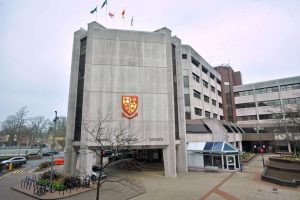
Surrey and Epsom Council buildings

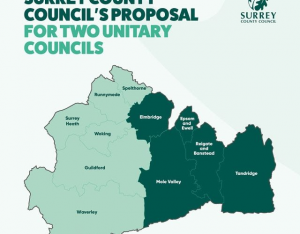
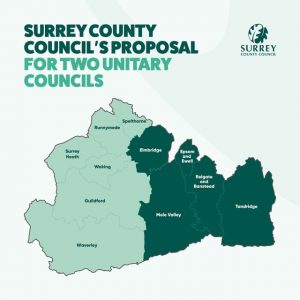
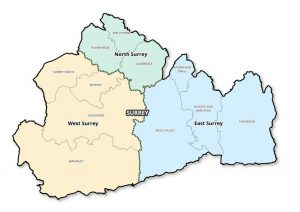
The leader of “doomed” Surrey County Council will write to the Government asking for the May 2025 elections to be postponed and Woking’s debt cancelled as part of devolution measures to merge the county’s councils. The moves are said to allow the council the time to draft proposals for how the county and its 11 boroughs and districts will be dissolved and reborn as potentially a single authority with a directly elected mayor. Other plans could see the county split in two or three smaller unitary authorities in one of the biggest shake-ups in a generation.

In December, the Government placed councils on short notice over devolution plans, giving those who want to get on board until March to submit interim merger proposals. Those who do not will have their devolution plans dictated to them by Downing Street. To give councils time to reorganise, the Government also said it would consider passing legislation postponing the May 2025 elections until next year. On Wednesday, January 8, Surrey County Council confirmed it would pursue the Government’s offer, with conditions.

The move to push back elections, however, was disputed in the chamber with councillors calling it undemocratic, while the leaders of the 11 boroughs and districts have also called for the May polls to go ahead. Councillor Paul Follows, leader of the opposition, told the meeting the boroughs and districts made it very clear local government reform was necessary – but that it could be done alongside the democratic process. He said: “We accept and broadly agree that some unitary council combination would make sense for a variety of reasons but we believe that the pace, the haste, and the lack of plans should not just be folly but a clear threat to services our residents need, and we do not accept that elections must be cancelled.

“The Government aren’t asking us or making us cancel elections. The deputy prime minister confirmed in an interview [on Wednesday morning] that councils are not being asked this way.” He added: “The timetable is going to remain as is and the work is going to happen and we can do everything that the leader is proposing to do while holding the scheduled elections. The leader has argued that leaping in here brings benefits but nobody has outlined what they are and honestly whatever they are, unless they include defined government interventions on debt and adult social care, nothing is worth taking that leap because then any successor authority will be immediately in serious troubles.”

He would also raise concerns that without clear guidelines and financial support, scenarios where playing fields in Godalming could be sold off to pay debts in Woking could emerge. The ruling Conservative group, however, dismissed demands to keep the election saying it would not only cost millions – estimated at about £2.48m – but also elect a “zombie” body that would be dissolved in just a year’s time.

Councillor John O’Reilly (Conservative; Surrey) said: “This council is doomed. This council will not survive and the 11 boroughs and districts will also not survive. So we are talking about a new structure and framework and for those saying the election to go ahead, it is quite clear, the minister’s letter has said that those authorities where elections do go ahead, they have still got to provide submissions by autumn, leaving only a few months. So what is going to happen if we have elections? It will essentially be a zombie council in the twilight, lurching through its own oblivion maybe only a year or so later when elections will take place for the new authorities.”

Councils have until March to submit interim devolution proposals with final drafts delivered by either May or the Autumn. The council has said it will work with “all stakeholders” over the next eight weeks in drawing up plans, including residents, as well as taking feedback from police, fire and rescue, and health services. The Government states it wants new councils to have a minimum of 500,000 residents meaning it is most likely Surrey would become either a single mega authority or split in two – with a directly elected mayor.

Some councillors raised a preference to create three bodies. Councillor Tim Oliver did not rule out expanding beyond the Surrey border to create a regional authority but hoped that all parties could come to an agreement. He said: “We propose to make it clear that the Government will be asked to deal with the debt partially, Woking that is publicly known and crystallised, but there are other levels of significant debt across the county.” He said it was better to get in early to create some leverage over the debt position rather than be handed down a Government dictate.

He said: “Work will start on Friday – officers are putting together the working groups needed. This will be exceptionally time consuming. Not only will it need collaboration between the boroughs and districts, but this council will need to have an input into the proposals. We may go with more than one proposal, one from this council and one from the boroughs and districts.”

The county council leader will now write to the Government setting out that Surrey wishes to be part of the accelerated devolution program and that it would support any new legislation postponing the May 2025 elections until next year.

Related reports:

All change! Epsom and Ewell Borough Council approaching its final stop?

Surrey’s Conservative leader wants to postpone May’s poll reckoning

Tiers to be shed if Epsom and Ewell loses its Borough Council?


Heritage at Risk: Epsom Town Centre Conservation Area Faces Challenges

Listed buildings map of Epsom Town Centre

The latest Heritage at Risk Register, published by Historic England in November 2024, has cast a shadow over the state of heritage conservation in Epsom and Ewell. Two conservation areas—Epsom Town Centre Conservation Area and the Horton Conservation Area—have been flagged as being in poor condition, with a concerning trend of deterioration. While both areas are deemed to have “low vulnerability,” this designation should not obscure the urgency of their plight.

The condition of these heritage assets is not only a reflection of their physical state but also an indicator of broader systemic issues. Without proactive measures, Epsom risks losing significant elements of its historical character.

Decoding the Heritage Assessment

Historic England evaluates heritage assets based on three criteria: Condition, Vulnerability, and Trend:

  • Condition: The physical state of the asset, ranging from “very good” to “very bad.” For both Epsom Town Centre and Horton Conservation Areas, the classification of “poor” signals pressing maintenance and repair needs.
  • Vulnerability: The extent to which external factors, such as funding shortages or development pressures, threaten the asset.
  • Trend: Whether the asset’s condition is improving, stable, or deteriorating. Both conservation areas are assessed as experiencing a deteriorating trend.

While “low vulnerability” suggests no immediate threats, the deteriorating condition of these areas calls for decisive intervention to reverse the decline.

Epsom Town Centre Conservation Area: A Historic Hub in Decline

Epsom Town Centre is more than a commercial centre; it is the beating heart of the borough’s identity. Its 39 listed buildings include the Spread Eagle Hotel and historic structures on Wheelers Lane. Each of these buildings tells a story of Epsom’s rich past, from its heyday as a 17th-century spa town to its enduring role as the home of the Epsom Derby.

The “poor” condition and “deteriorating” trend of the conservation area suggest neglect and insufficient maintenance. While some buildings remain privately owned, the broader conservation area’s status is a public concern that requires collective action.

Horton Conservation Area: A Legacy of Victorian Innovation

The Horton Conservation Area, part of Epsom’s celebrated “hospital cluster,” was established to protect the architectural and historical significance of the Victorian psychiatric asylum buildings. One notable structure, the Horton Chapel, was recently restored and reopened as the Horton Arts Centre. While this transformation is a success story, Historic England’s continued classification of the area as “poor” indicates unresolved challenges.

Epsom and Ewell Borough Council: Highlighting Achievements

Councillor Peter O’Donovan, (RA Ewell Court) Chair of Licensing & Planning Policy, defended the Council’s track record in heritage conservation. He highlighted the Council’s restoration of the Epsom Clocktower in 2019 and its role in transforming Horton Chapel.

Regarding the Town Centre Conservation Area, O’Donovan noted that the Council has implemented policies to guide development, enforce planning regulations, and enhance the appearance of shopfronts and buildings. The recently published Town Centre Masterplan prioritises a “context-led design approach,” aiming to balance new development with the conservation of historic features.

“Our local heritage is integral to our unique character,” said O’Donovan. “The Council works in a range of ways to protect the borough’s heritage and conservation areas.”

You can read Cllr O’Donovan’s full response HERE.

Councillor Kieran Persand: A Call for Stronger Action

Conservative Councillor Kieran Persand, representing Horton Ward, painted a more critical picture. He expressed concerns about the lack of a robust repair and maintenance programme for heritage sites, particularly in the Horton area.

Persand also raised alarm over the Council’s draft Local Plan, which proposes development on Horton Farm, a high-performing Green Belt site. “The vulnerability of these conservation areas is increasing significantly,” Persand warned. “Epsom is at risk of losing its identity as a beautiful and historic location through inappropriate development and poor maintenance.”

The Bigger Picture: Heritage and Development

Epsom’s heritage is inextricably linked to its future development. While the Council has emphasised its commitment to protecting conservation areas, critics argue that its actions often fall short of its rhetoric. The inclusion of Horton Farm in the draft Local Plan has drawn widespread opposition, with residents and conservation advocates fearing irreversible harm to the borough’s historic character.

Historic England’s findings underscore the importance of balancing development pressures with heritage conservation. The “poor” condition of Epsom’s conservation areas should serve as a wake-up call to prioritise long-term preservation efforts.

Community and Stakeholder Engagement

Preserving Epsom’s heritage requires a collaborative approach involving local authorities, property owners, and the community. Practical steps could include:

  • Increased Funding: Securing additional resources for maintenance and restoration.
  • Community Initiatives: Encouraging residents to take pride in and advocate for their local heritage.
  • Education and Awareness: Promoting understanding of the value of conservation areas.
  • Stronger Enforcement: Ensuring compliance with planning regulations and conservation policies.

The Path Forward

Historic England’s report is both a challenge and an opportunity. While the condition of Epsom’s conservation areas is concerning, it is not too late to act. Proactive measures, guided by a shared commitment to preserving the borough’s heritage, can reverse the trend of deterioration and secure Epsom’s identity for future generations.

As the debate continues, the question remains: will Epsom rise to the challenge, or will it allow its treasures to fade into obscurity?

Map of many of the listed buildings in Epsom Town Conservation Area: © Crown copyright [and database rights] 2025. OS AC0000815036. | © Historic England | © Crown Copyright 2024. Released under OGL. | © Crown Copyright 2024. Contains Ordnance Survey data © Crown copyright and database right 2024. Released under OGL.


Epsom and Ewell Borough Council response to Historic England’s Report on local heritage

Councillor Peter O’Donovan, (RA Ewell Court Ward) Chair of the Licensing & Planning Policy Committee

Epsom & Ewell first came to prominence as a destination town in the early seventeenth century with the discovery of Epsom Salts within the borough. Visitors came from London and further afield to ‘take the waters’. Epsom became known to merchants and royal visitors alike as a place of relaxation, sport and leisure, perhaps most famous even now as being the home of the Epsom Derby. The town was first granted Market Town status by Royal Charter in 1865, and Epsom market has been a defining focal point for the bustling town for hundreds of years, watched over by the historic landmark Epsom clocktower which is owned by Epsom & Ewell Borough Council and restored in 2019.

Our local heritage is integral to our unique local character. Across the borough there are around 300 buildings listed on the National Heritage List including Bourne Hall in Ewell, listed for its “striking design, …space-age flair and the generous, top-lit principal interior space”, Ewell Court House, a little altered Grade II late Victorian house built in the Jacobean style with wonderful period plasterwork and joinery, set in beautiful grounds with flowerbeds, walks and lake: and the Grade II* listed Assembly Rooms in Epsom which are the earliest known surviving building of this type in England.

There are 21 designated Conservation Areas in the borough. For each of these areas of special architectural or historic interest the council publishes an outline of the area’s special interest and proposals for its preservation and enhancement, which can be found here: Conservation Areas | Epsom and Ewell Borough Council.

Horton Conservation Area

Horton conservation area isone of a group of conservation areas put in place to protect the Victorian psychiatric asylum buildings in Epsom, which became redundant in the 1990s. Horton chapel is a grade II listed building which opened in 1901 as a place of worship for the patients and staff in the surrounding hospital buildings. It was empty and in a state of disrepair for many years, but was recently restored and reopened as the Horton Arts Centre, using funding from the National Lottery Heritage Fund and several other funds, including £1.46m (s106 developers’ funds) allocated by Epsom & Ewell Borough Council.

This is an example of heritage that was at risk of dilapidation, but for which a vibrant new use has been found. Historic England have been asked to remove the entry from their Heritage At Risk Register as the building and area are no longer at risk.

Epsom Town Centre Conservation Area

Epsom Town Centre Conservation Area extends from South Street and West Street, along the High Street, and along part of Upper High Street at the eastern end. The architecture of the area represents the history of the town centre and its development from a spa town in the 17th century to the present day with many interesting historic buildings, some of which are listed, and all of which are protected by their conservation area status.

Historic buildings are mainly owned by private owners, so controls are set by the government and the council to ensure that they are conserved in a manner that will ensure their survival and enjoyment for present and future generations.

  • To protect the conservation area, listed buildings in Epsom town centre must apply for Listed Building Consent for alterations (including internal alterations) and other buildings must apply for planning permission for external alterations.
  • To help owners and businesses understand the historic character of the conservation area, the council has also produced a conservation area appraisal, which sets out the important historic features and buildings that should be looked after to protect the character of the conservation area.
  • The council has recently published its Town Centre Masterplan which aims to compliment and protect the Town Centre conservation area. The first principle of the plan is to adopt “a context-led design approach to guide the development, regeneration and repair of the town centre. Having particular regard to the impact of building heights, building design, materials and land uses will ensure new development contributes to an improvement in the quality of the town centre.”  
  • The council is also working to improve the appearance of the area by controlling development and seeking to improve the appearance of the buildings and shopfronts, as well as taking enforcement action where unauthorised works have taken place. Those considering making changes to their buildings are advised to seek advice from the planning service before undertaking the works. The council runs a pre-application advice scheme that can be used to find out whether changes might or might not be acceptable prior to making an application.

As these measures demonstrate, the council works in range of ways that are within its control to protect the borough’s local heritage and conservation areas.

In 2023, Epsom & Ewell Borough Council participated in a Local Heritage List Project with Surrey County Council, funded by the government’s ‘Build Back Better’ initiative in association with Historic England. We are in the process of finalising the assets on our local heritage list in 2024/25 following consultation. The list will include those assets most valued by our local communities.

You can find out if a building is statutorily listed, locally listed or in a conservation area  by using our online mapping system.

Further information:

https://historicengland.org.uk/advice/heritage-at-risk

https://historicengland.org.uk/listing/the-list/list-entry/1232459?section=official-list-entry

https://www.epsom-ewell.gov.uk/conservation-areas (opens the Hospital Cluster Conservation Area Appraisal)

https://www.epsom-ewell.gov.uk/conservation-areas


All change! Epsom and Ewell Borough Council approaching its final stop?

Surrey and Epsom Council buildings

Surrey is changing “whether we like it” or not and county council leader Tim Oliver says it’s better to be at the forefront of that change.

The Government wants to introduce new mayoral authorities across the country in a bid to streamline councils and shift power away from Westminster.

For Surrey, that means scrapping the 11 boroughs and districts as well as the county council, and replacing them with either a single, or what seems more likely, two authorities with a Strategic Mayor.

The question is how will it be done? The answer; it will either be imposed on Surrey, or the councils can create their own plans to merge under devolved powers.

County Council leader, Councillor Tim Oliver, favours playing a central role, arguing that change is inevitable, and it’s best to be part of the conversation in order to shape the future, rather than sit on the sidelines waiting to be told what to do.

The Government wrote to the county council in December outlining how it planned to “transfer power out of Westminster through devolution and to fix the foundations of local government.” It wants a simpler structure that is “clearer for residents” and said it would even pass new laws to postpone the May 2025 elections “to help manage” the once in a lifetime opportunity to restructure.

Writing to Surrey, Jim McMahon, minister of state for local government and English devolution, said: “We are under no illusion about the scale of issues facing local government. It is in all our interests to make sure we are avoiding unnecessary spend at a time when budgets are already tight.”

He added: “I have heard from some areas that the timing of elections affects their planning for devolution, particularly alongside reorganisation. To help manage these demands, alongside our objectives on devolution, and subject to meeting the timetable outlined in this letter, I am minded-to lay secondary legislation to postpone local council elections from May 2025 to May 2026. However, I will only do this where this will help the area to deliver both reorganisation and devolution to the most ambitious timeframe – either through the Devolution Priority Programme or where reorganisation is necessary to unlock devolution or open up new devolution options.”

Cllr Tim Oliver is already minded to take up the offer of pushing back the elections for a year to get devolution done. Holding the elections this year would cost about £1million, he says, and would take time away from officers already working to a tight five-month deadline to get devolution over the line.

“The Labour Government has set up their agenda in the white paper and that is to create Mayoral Strategic Authority (MSA) across England. They have a strong majority and we can assume they will pass the legislation,” Cllr Oliver said. “If you don’t reach an agreement locally, then they will legislate. It’s going to happen. It’s better that we try to control or have some influence over what happens rather than have it imposed on us down the line.”

“The primary focus should be ‘what is in the best interests of the residents of Surrey?’ Whether we like the model or not it is going to happen in Surrey and the reason for getting in early as we are, is that we are slightly unique here in that there are councils in Surrey that have significant debt levels.”

This, he says, gives the Government a huge stick, to push councils to get on board. Councils such as Woking are bankrupt and need Government intervention. Merging the councils would pile its £2billion debt on to others.

Similarly, though not bankrupt, Spelthorne Borough Council has debts of more than a billion and Runnymede has debts of more than £600m. Surrey County Council, albeit with significantly larger spending power as a top tier authority, is also heavily indebted.

Cllr Oliver said: “The longer we leave it, the less likely we will get any support from the Government. That’s what’s driving me.”

Historically, Surrey councils have not benefited as greatly as other local authorities from Government funding reviews and have to raise more money locally. Areas that can raise taxes will continue to be required to. Removing tiers of local government will be an efficiency driver and help stave off service cuts, or lead to more investment.

He said: “We have to divide up the county to create a minimum of two strategic authorities, and then we get a mayor. If we don’t get on with that reorganisation, we will be years away from the benefits of a mayor, compounded with almost certainly reduced funding to Surrey councils.”

Papers published ahead of the January 10 deadline to respond suggest the council leader will take up the Government’s offer to hold off on this year’s elections “to give time to consult.”

Cllr Oliver said: “If we go ahead with elections in May, and I’m fine with that, I wasn’t going to run again. But, ignoring who wins, you end up with an election in May that will cost over a million pounds, which they do, and then you will have a bunch of new councillors who have to find their feet, only to be out in two years when the council disappears. The next five months should be about the negotiation with the Government about what the future looks like.”

“Every political party, and all the existing councillors who know the county better, will have the opportunity to input. I can’t see what the Liberals, if they got a majority, would do differently? This way, we will get a bit of goodwill from the Labour Government by engaging with them now.”

“Hampshire, Essex, and Hertfordshire are already getting on with their own plans for devolution, and if Surrey County Council just puts its head in the sand and gets on with the elections we will miss the opportunity to have the conversation with the Government about the debt levels.”

“We’ve got five months to consider it, the key thing is to do an intensive piece of work now. We’re not at the point where we’ve had the conversation about how it’s split, but we’ve got five months to do this either the Government’s way or our way. Yes, the timetable is much shorter than anybody would want particularly putting a letter in by January 10 but we have to respect the fact that this Government has an agenda and it can deliver because it has the mandate.”

Later this month the Government will set out which areas will be included in its Devolution Priority Programme with a view to inaugural mayoral elections in May 2026. They are looking at creating new unitary councils with populations of 500,000 or more. Surrey has a population of about 1.2 million. Exceptions will be made to ensure new structures make sense for an area.

An extraordinary meeting of Surrey County Council is set to go ahead on Wednesday January 8 where the council will be “asked to note” that the leader intends to express interest in pursuing devolution and local government reorganisation.

Related reports:

Surrey’s Conservative leader wants to postpone May’s poll reckoning

Tiers to be shed if Epsom and Ewell loses its Borough Council?

Tim Oliver Surrey County Council leader – Surrey Live


Epsom Green Belt Debate Intensifies

Horton Farm Epsom

The ongoing debate surrounding Epsom & Ewell Borough Council’s Proposed Submission Local Plan has escalated as the Epsom and Ewell Times publishes two sharply contrasting letters – one from the Epsom Green Belt Group (EGBG) and the other a formal response from the Council itself. At the heart of the dispute lies the proposed development of Green Belt land, the availability of affordable housing, and the transparency of the consultation process.

Epsom Green Belt Group: A Call for Change

The Epsom Green Belt Group’s letter criticises the Council for failing to heed public sentiment and expert advice during the Regulation 18 consultation earlier this year. Despite overwhelming opposition to the proposed release of over 175 hectares (around 12%) of the borough’s Green Belt, the Council has pressed ahead with plans that include development on high-performing sites such as Horton Farm and Hook Road Arena.

The EGBG highlights a key inconsistency: while the Council advised neighbouring Sutton Borough in September 2024 that they were under no obligation to review Green Belt boundaries, they have not followed this guidance themselves. Furthermore, the EGBG argues that prioritising brownfield and ‘grey belt’ land, as outlined in the updated National Planning Policy Framework (NPPF) of December 2024, has been neglected.

The group also casts doubt on the Council’s promises of ‘affordable housing,’ pointing out that discounts on market prices still place homes out of reach for many. Flats on brownfield sites, they argue, offer a more viable path to genuinely affordable housing.

A looming concern raised by the EGBG is the likelihood of the Local Plan being deemed unsound by the Planning Inspectorate. They warn that if the plan proceeds in its current form, it could pave the way for further Green Belt loss.

Read the full Epsom Green Belt Group letter here.

Council’s Response: Balancing Competing Priorities

In their formal response, Epsom & Ewell Borough Council defends the Proposed Submission Local Plan, arguing that it strikes a necessary balance between meeting housing needs and protecting the borough’s environment.

The Council acknowledges the high demand for affordable housing, with over 1,350 households on the housing register. They stress that their policies reflect both national guidelines and financial viability assessments.

Regarding the consultation process, the Council points out that Regulation 19 is a statutory stage primarily focused on assessing the plan’s legal compliance and soundness. They also address concerns over the timing of the consultation—spanning the Christmas and New Year period—explaining that it was essential to meet the submission deadline of 12 March 2025 under the current NPPF.

On the contentious Green Belt issue, the Council offers specific figures: 52.6 hectares of greenfield Green Belt land (3.36% of the total) and 85 hectares of previously developed Green Belt land (5.44%) are earmarked for development. They maintain that these changes are necessary to meet housing targets while acknowledging the flexibility offered by the NPPF.

The Council concludes by noting that while changes can still be proposed following the consultation, the Planning Inspectorate ultimately determines their validity.

Read the full Epsom & Ewell Borough Council letter here.

Diverging Priorities, Uncertain Outcomes

Both letters reveal deep divisions not only in policy direction but also in trust between the Council and sections of the local community. While the Council presents its plan as a pragmatic response to national housing targets and local affordability issues, the EGBG sees it as a short-sighted and flawed approach.

Key questions remain unanswered:

  • Why hasn’t brownfield land been prioritised more explicitly?
  • Will the Local Plan survive scrutiny by the Planning Inspectorate?
  • Are the proposed ‘affordable homes’ truly affordable for local residents?

The coming weeks will be crucial as the consultation progresses and residents have their final opportunity to submit their views. One thing is clear: the future of Epsom’s Green Belt hangs in the balance, and both sides are prepared to stand their ground.

Residents can participate in the consultation process until 5 February 2025 via the Council’s consultation portal.

Related reports:

Can the green light to Epsom’s Green Belt housing turn red?

Council minority vote Local Plan to next stage with Green Belt in

Conflict on Epsom’s Green Belt plans of another kind?

Epsom and Ewell Green Belt battle lines drawing near

and many more. Search “local plan” in search bar.


Surrey’s Conservative leader wants to postpone May’s poll reckoning

Tim Oliver Surrey County Council leader - Surrey Live

The leader of Surrey County Council is set to write to the Government calling for the 2025 elections to be postponed in order to allow authorities to focus on merging under devolution plans. In December last year the Government announced its vision to merge councils in Surrey and get rid of its 11 boroughs and districts. There would also be a directly elected mayor.

Councillor Tim Oliver plans to formally ask the government to postpone county elections until May 2026 to give the councils time to “put together proposals for local government reform necessary to unlock further devolution for Surrey.”

Not everyone has welcomed the delay with Surrey Heath Borough Council set to discuss a motion rejecting the county council leader’s proposals and allow the May 2025 poll to go ahead “in the interest of democracy and hearing the resident’s voice.”

Devolution plans are part of sweeping changes to how services are run as Downing Street looks to reshape local government.

Surrey currently operates under a two tier system with the county council overseeing things such as education, transport and fire with the boroughs and districts focused local planning matters, refuse collection and housing.

Devolution would do away with this system and instead create single unitary authorities, arguing it is more cost-effective.

In a draft letter set to be approved at an extraordinary meeting next week, Cllr Oliver writes that he shares the ambitions for boosting the country’s economic prospects and reforms to strengthen the efficiency and effectiveness of public services.

He said it was clear that reforming local government would unlock the full benefits of further devolution for the county.

The letter reads: “The current two-tier structure of local government in Surrey, comprising 12 sovereign local authorities, is fragmented and in a number of areas inefficient which inevitably diverts resources away from delivering the services that residents rightly expect.

“I believe reorganisation would provide more streamlined and cost-effective services for Surrey, enabling us to achieve further efficiencies and deliver better outcomes for our residents and communities.

“Local government reorganisation is a crucial stepping stone to further devolution for Surrey, to enable our communities to take more control of their own destinies.”

Cllr Oliver said the county already delivered more than £50 billion in gross value added every year, but further and deeper devolution could lead to even better returns.

It adds: “I am therefore writing to ask you to exercise your ministerial powers to lay the necessary legislation to postpone the county council elections in Surrey, which are due to take place in May 2025.

This will give us the time to work with the leaders of Surrey’s district and borough councils to put together proposals for local government reform that are necessary to unlock further devolution for Surrey.”

New unitary elections could then take place in 2026, and a mayoral election in 2027.

He argues that the delay would also allow time to determine how to deal with the “significant financial risk of the level of debt currently held across the Surrey local government footprint.”

Woking Borough Council is currently bankrupt with deficit of more than £1billion and debts of about £2billion, while Surrey County Council and Spelthorne Borough Council both have debts of more than £1billion.

Any proposals, Cllr Oliver adds, will need to adequately consider how to ensure the sustainable operation of any authority in the absence of exceptional financial support from the Government or a level of write-off.

Timetable for Devolution 

10 January 2025 Letter submitted to Minister of State requesting election postponement 
Before March 2025  Minister’s response to letter received 
March 2025  Interim Local Government Reorganisation (LGR) proposal submitted to government 
May 2025  Full LGR proposal submitted to government 
May – June 2025  Government evaluates proposal(s) received for LGR and makes a decision on whether to proceed on  single proposal, or to consult further on one or more proposals
July 2025  Government consultation with affected bodies on LGR proposal(s) 
Autumn 2025  Government decision on LGR anticipated, which begins statutory process to establish new council(s) 
January 2026  Parliamentary process begins to lay Statutory Instruments 
May 2026  Elections to shadow unitary authority/ies 
Spring 2027 New unitary/ies ‘go live’ 
Spring 2027 or 2028 Mayoral elections and mayoral strategic authority ‘go live’, with the preparations for the establishment of the Mayoral Strategic Authority (MSA) taking place throughout 2026/27, or Surrey joins MSA with neighbours

Related reports:

Tiers to be shed if Epsom and Ewell loses its Borough Council?

Image: Tim Oliver – Leader of Surrey County Council, Woodhatch Place, Cockshot Hill, Reigate. GL


Epsom & Ewell Faces Tight Constraints in 25/26 Government settlement

11 Surrey boroughs table of HMG funding

Epsom & Ewell Borough Council has received its provisional financial settlement for 2025/26, and while the figures align with expectations, they highlight ongoing financial pressures on local services. The settlement forms part of the UK Government’s wider local authority funding announcement, which has delivered mixed outcomes across Surrey’s district and borough councils.

Epsom & Ewell’s Settlement Overview

According to the latest figures, Epsom & Ewell’s Core Spending Power for 2025/26 is projected at £10.23 million, equating to £307 per dwelling. This places Epsom & Ewell below several neighbouring boroughs, including Woking (£378 per dwelling) and Elmbridge (£367 per dwelling), but slightly above Waverley (£300 per dwelling).

The Settlement Funding Assessment (SFA), which includes central government grants and retained business rates, stands at £1.63 million. This figure underscores the limited financial flexibility available to the council, particularly given rising costs and increasing service demands.

The Funding Context

The settlement includes a modest contribution from the New Homes Bonus, with Epsom & Ewell receiving only £6,160. This pales in comparison to Runnymede (£774,587) and Guildford (£614,903), reflecting the borough’s slower rate of housing growth.

A Challenging Year Ahead

The provisional settlement aligns with broader trends across Surrey, where councils have been advised to continue delivering “high levels of efficiency” to maintain balanced budgets. Surrey County Council, facing similar pressures, acknowledged the settlement as expected but warned of the continued uncertainty surrounding medium-term funding.

Councillor David Lewis, Surrey County Council’s cabinet member for finance and resources, noted: “Councils across the country continue to face a very challenging financial future. Uncertainty on funding into the medium term, coupled with high prices and increased demand, means high levels of efficiencies continue to be required in order to balance budgets.”

Limited Relief from Government

While councils such as Mole Valley have benefitted from additional Government grants targeting homelessness and recycling services, Epsom & Ewell has not been as fortunate. With no significant uplift in funding and reliance on reserves to bridge financial gaps, the council faces tough decisions in the coming financial year.

Furthermore, the funding floor mechanism has provided limited relief, ensuring that Epsom & Ewell does not see a drastic year-on-year funding drop. However, without long-term certainty or multi-year settlements, financial planning remains a significant challenge.

Looking Forward

As the Government promises to ‘fix the foundations of local government’ from 2026-27 onwards, Epsom & Ewell will need to rely on prudent financial management and creative revenue generation strategies to maintain essential services.

Residents can expect continued fiscal caution from the council as it navigates rising costs, growing demand for services, and ongoing funding uncertainty. The final settlement figures are expected to be confirmed early in the new year, and until then, the council’s budget planners remain in a holding pattern.

Related reports:

Tiers to be shed if Epsom and Ewell loses its Borough Council?

Examination of a Surrey Borough’s 2nd highest UK debt

What cuts to Surrey County Council services are you prepared for?


River Mole to attract visitors to Leatherhead?

Claire House and James House Watercolour (image McCarthy Stone)

Mole Valley District Council’s dream of “improving” and “enhancing” Leatherhead has taken a step forward after plans to regenerate Claire House and James House were submitted.

The site is part of the council’s vision for a new riverside area to attract visitors to spend time in the town centre.

The plans, submitted by McCarthy Stone the council’s preferred partner for regeneration, is for 37 one and two-bed retirement homes, a ground floor café and community space.

Developers McCarthy Stone said: “While the development is built around people in their later years this is not a development that offers care as you would find in extra care developments or care homes. 

“Retirement living creates safe and secure environments for homeowners to continue to live an active, independent life and caters for downsizers who are typically selling or vacating their former family home and moving to a smaller apartment. 

“Homeowners are generally the more active elderly rather than those who are in need of care or have more significant issues around mobility.”

McCarthy Stone also plans to improve the car park and landscaping the area to the front of the building. The work is part of the wider Transform Leatherhead project.

Councillor Keira Vyvyan-Robinson, Mole Valley District Council cabinet member for property and projects, said: “The Claire House and James House project aims to create a landmark mixed-use riverside development that will improve the western gateway to the town and enhance the area around the River Mole.

“The application marks the next step towards the regeneration of the area and enhancement of the riverside area, a key project of Transform Leatherhead.

 According to Mole Valley District Council, Leatherhead town centre is being re-invented, expanded and transformed.

It says the overall project, which also includes work on the retail and leisure quarter and Bull Hill, will “fully realise its potential as a distinctive, enterprising and highly regarded market town” adding that the “town’s character, history and environmental setting will be celebrated and complemented by new and revitalised uses.”

Not every aspect of the council’s vision has proven popular however. A petition calling on the authority to reconsider plans to build hundreds of homes in high rise blocks on the popular Bull Hill park gained 1500 signatures.

Some fear the plans will destroy the green gateway into the town, potentially turning it into another Croydon or Woking and causing people to leave.

Relared report:

Leatherhead town on the way up?