Epsom and Ewell Times

ISSN, LDRS and IMPRESS logos

Relative relief about Epsom and Ewell’s debt?

Town Hall

Epsom and Ewell Borough Council‘s debt is about average with all 381 United Kingdom local authorities. UK councils owe a combined £97.8bn to lenders, equivalent to £1,455 per resident, as of September 2023. Epsom and Ewell’s debt per person is £795. From highest debt per person to lowest Epsom and Ewell ranks 195 out of 381.

In the national league table of debt shame other Surrey Boroughs occupy the leading positions: Woking is first with debt of £18,756 per resident followed by Spelthorne in second place at £10,415. Guildford is 5th.

Taking into account all types of local authorities, such as police and crime commissioners and combined authorities, the debt pile rises to £122bn.

The 11 boroughs of Surrey are ranked in the table below. Highest debt per resident to lowest.

Dame Meg Hillier, the chair of the House of Commons Public Accounts Committee, said some examples of debt were “staggering”.

But council leaders say years of under-funding mean they have been forced to take out loans and invest in commercial properties just to keep services running.

In recent years, various commentators have warned that the debts held by councils – which must balance their budgets every year – are unsustainable. In 2020, chair of the Public Accounts Committee Dame Meg Hillier said the Government was “blind to the extreme risks” of  council borrowing levels.  

Since then, six more councils have had to issue section 114 notices declaring themselves effectively bankrupt: Croydon, Slough, Thurrock, Birmingham, Woking and Nottingham. 

In the case of Croydon, Slough, Thurrock, Woking and Nottingham – those effective bankruptcies could be directly linked to failed investments and spiralling debts. Thurrock’s  £469m funding black hole, for example, was caused by a series of failed investments in solar farms.

Dame Hillier added: “Small district councils have very little room for manoeuvre when finances are squeezed, relying on charges (such as parking fees) for a lot of their income. Unitary authorities are facing the demographic pressures on social services, social care and special educational needs.

“But beyond these day to day pressures, the PAC warned in 2020 that some councils had not only pursued strategies of commercial investment exposing them to high levels of risk, but normalised behaviour and optimistically believed that there was little downside to commercial activity. Add to this the delay in public sector audits and many councillors and taxpayers were blind to the risk.”

Cllr Julie Morris, (College Ward) Leader of the Liberal Democrat Group on Epsom and Ewell Borough Council said “There is no evidence that central government is likely to assist with the broader financial issues affecting local authorities, so we need to budget carefully and 2025/26 is likely to be crunch time.  We need a complete review of both mandatory services and those which are discretionary.  And central government needs to wake up to what is facing government at local level.”

Cllr Neil Dallen, (RA Town) Chair of Strategy & Resources Committee said: “As a council, Epsom & Ewell’s investments are performing as planned. The debts are considered sustainable, with sums set aside each year to ensure they can be repaid at maturity. Through taking a proactive approach to our finances, we have a strong track record of meeting the considerable financial challenges the past decade has brought for local government through reduced central government funding, and we are looking ahead to 2024/25 and beyond to ensure that we remain a financially sustainable council.”

The other parties have also been invited to comment.


Surrey’s £1/4 m fines for failing children

Surrey fines

The failings of Surrey County Council’s children services has meant the under-fire authority paid more than £250,000 in fines, compensation, and redress payments to families it let down last year. The settlements are published by the social care ombudsman and last week it upheld three more complaints.
The education watchdog found Surrey County Council continues to miss deadlines, and create needless delays for children waiting for psychological assessments and GP advice.

The latest rulings meant the authority had to payout a further £1,700 to families  with an ongoing £100 a month to one – as an acknowledgement of the “ongoing uncertainty and distress” until a final care plan is issued.

The total paid to families for 2023/24 will likely be published from April but the most recent full year figures showed the county council could have saved itself thousands of pounds  –  had it got things right.
The council sets itself a target of responding to 80 per cent of initial complaints within 10 working days – though this can be extended to 20 days with its children’s, families and lifelong learning department.
In children’s services only 59.4 per cent were within timescale. 

The figures are even worse for education and home-to-school transport at just 44 per cent and 56 per cent respectively.

The Annual Complaints Performance report read: “Where fault is found following a complaints investigation, financial redress can be recommended where appropriate. All financial awards are approved by the relevant head of service and, if greater than £1,000, in consultation with the relevant cabinet member.

“The Ombudsman can also recommend financial redress if they find fault following an investigation. 
“During 2022/23 there has been a significant increase in both the number of complaints attracting a financial remedy and the total amount paid of £258,730.53. This equates to an increase of £166,032.51 when compared to 2021/22.”

Of the payments, the council said, £87,445.65 was paid in symbolic financial remedies to recognise the impact of the fault identified, for example distress and anxiety and time and trouble taken in pursuing the complaint. The balance of £171,284.88 was primarily reimbursed costs to address missed provision which it says were “essentially funds that the council would have needed to spend to meet assessed needs irrespective of a complaint being made.”

Councillor Clare Curran, Surrey County Council cabinet member for children, families and lifelong Learning: “We are not able to comment on any individual children specifically, however we take the findings from the Ombudsman very seriously and apologise for the distress these families experienced. 
“I am aware that the Council has not always got things right and that the support and service that some children with additional needs and disabilities and their families receive is not always of the standard that we would expect, and I am sorry about that. We are working hard to improve services, and a recent Local Area SEND Inspection noted progress is underway.   

“Despite national pressures we regret all delays and are working hard to reduce any backlogs, and ultimately to reduce spend on fines, which we know is higher than it should be. We have taken several actions to address this including securing an additional £15m of funding to increase the capacity of key teams, extending the use of locum and associate educational psychologists, commissioning external providers for support, and increasing advertising to fill positions. 

“A multi-agency recovery plan is also in place with short-term and long-term goals, which Ofsted and Care Quality Commission (CQC) inspectors noted had identified areas that need improving and that actions by the local area partnership to address these are starting to make a difference. We know that communication with parents and carers is an area in need of focus and plans are being developed to address this as a standalone priority workstream within the refreshed Surrey inclusion and additional needs -partnership strategy.  

“We are constantly reviewing how we support young people who are unable to attend school, and are implementing our £180million capital programme that is increasing the availability of, and access to specialist provision.  We also recognise the significant issues that confront the SEND system nationally. We have seen a 64 per cent increase in education, health and care needs assessment requests across Surrey since 2020, at a time of a national shortage of Educational Psychologists (EPs).

“We are doing our utmost to recruit more to meet this demand, and we are filling this gap as best we can. We have already been able to halve the backlog of EP advices through the steps we’ve taken locally, but we hope to see the national shortage in trained EPs and other issues addressed soon through the government’s improvement plan.  

 “We remain committed to improving our services and outcomes for children and young people with additional needs and disabilities so that they are happy, healthy, safe and confident about their future.”


Surrey team addicted to changing futures

Surrey Count's bridge team

A former aircraft engineer has spoken out about how his alcohol addiction threatened to wreck his life.

Steve Saunders, 66, from Pyrford, Woking says that what started as social drinking turned into an all-consuming addiction, which saw both his marriage and career end.

Now he is using his experience to help others and to send out a clear message, that there is always support in Surrey for those with a drug or alcohol addiction.

Steve works with Surrey County Council’s Changing Futures programme on their Bridge the Gap scheme which supports people facing a range of issues including alcohol and drug addiction, domestic abuse and mental health challenges.

Like most other people I started drinking in my late teens and 20s socially but it was in my 50s when it started to become a big problem,” said Steve, who is a proud father of two grown-up sons.

I now know that I have an addictive personality and that affects how I see alcohol, and one drink is never enough. My behaviour changed and I was awful to those around me – it ended up ruining my second marriage and saw me retire from my job as an aircraft engineer aged just 53-years-old.

At my worst I was drinking a bottle of spirits a day, often in secret. You kid yourself that people don’t know what’s going on, but it was out of control. I kept losing my driving licence and I was lucky not to be in prison. When I left my job I nearly drank myself to death.”

The turning point for Steve was when he decided to be honest with his doctor about his drinking, and he went into rehabilitation.

Going through rehabilitation changed everything,” said Steve. “I decided I wanted to help others who are facing similar problems and so I became involved in Bridge the Gap to offer my insights into the systems that support people and also to run SMART recovery meetings which are both face-to-face and online.

A huge range of people access the service – business owners, housewives and professional people such as doctors and teachers. All of them have one thing in common – they are looking for help, and we make sure they receive it.

Until now Bridge the Gap has been run as a pilot scheme by Surrey County Council, funded by the Department of Levelling Up, Housing and Communities and the National Lottery – but now a fundraising drive is being launched to raise the £1.4 million which will be needed for it to continue supporting vulnerable people in Surrey.

Eleven local charities are backing Bridge the Gap and these are Catalyst, Guildford Action, The Hope Hub, Oakleaf, Richmond Fellowship, Rentstart, Your Sanctuary, North Surrey Domestic Abuse Service, South West Surrey Domestic Abuse Outreach Service, East Surrey Domestic Abuse Services and Surrey Domestic Abuse Partnership.

Steve said: “As well as helping others I also get something from the SMART meetings because it reminds me to be grateful for where I am. Anyone facing a drug or alcohol problem needs to know that there is help out there, and we will support them in turning their life around.”

Keely Glithero , service manager at Catalyst, said Steve’s input into the Bridge the Gap programme is invaluable.

Keely said: “Steve’s rich lived and learned experience in addiction brings a valuable perspective and contribution to how we deliver services. I am truly inspired by his relentless energy for supporting people, and I’m so glad to support and work alongside Steve as a volunteer for Catalyst in the Changing Futures programme.”

A conference is taking place in Surrey later this month when people, like Steve, will use their lived experience to support others, challenge prejudice and empower themselves. The Power of Lived Experience event takes place on Wednesday, January 31 from 10am to 4pm at Dorking Halls. For more information and to reserve your place contact colette.lane@sabp.nhs.uk

Further information:

Changing Futures Bridge the Gap programme Changing Futures – Bridge the Gap | Healthy Surrey

Drug and alcohol support in Surrey – Drugs and alcohol | Healthy Surrey


Councillors belted-up on Green Belt?

Horton Farm Epsom

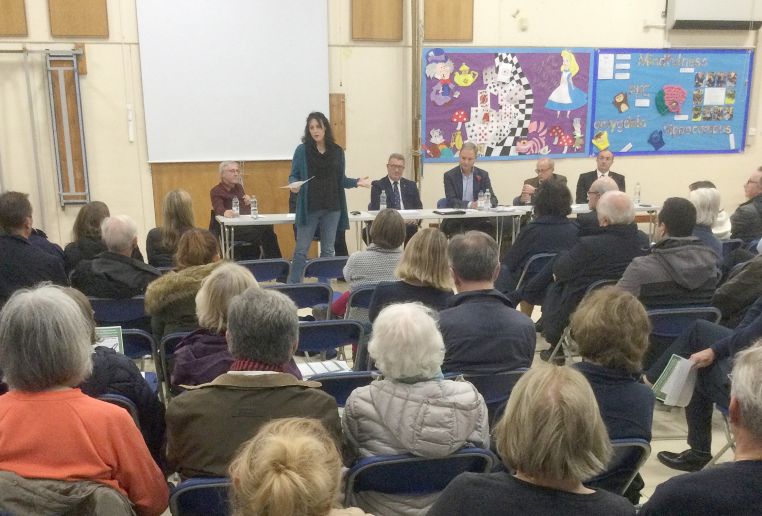
In a recent closed-door meeting held at the Town Hall, local councillors in the Borough of Epsom and Ewell,  convened to apparently deliberate on potential areas for housing development, with a particular focus on the contentious issue of Green Belt land. The meeting,  held on January 10, has stirred controversy and prompted reactions from concerned citizens, leading to a series of letters and press releases. Councillors were greeted at the entrance by a small and polite protest group.

Yufan Si, a prominent Green Belt campaigner, has expressed alarm over the secrecy shrouding the meeting. The council’s decision to discuss Green Belt development in a closed setting has raised questions about transparency and adherence to government policies.

Ms Si highlights the Council’s statistics, indicating that 84% of residents opposed development on Green Belt land during a prior consultation. The campaigner argues that the government’s planning policies offer a choice to protect Green Belt areas, questioning the need for a clandestine discussion.

She has raised concerns about the council’s sale of Green Belt land to a local business owner three years before the Local Plan’s development, potentially leading to significant financial gains. The campaigner emphasizes the availability of brownfield sites capable of accommodating over 3,700 new dwellings, surpassing the projected household growth from 2022 to 2040. In her letter Yufan Si has urged councillors to prioritize environmental preservation and fulfill residents’ wishes by excluding Green Belt land from the development plans.

Councillor Julie Morris (LibDem College) has stated that she challenged the decision to keep the meeting private. While acknowledging the legal standing of the private meeting, Councillor Morris called for greater transparency and public engagement. She emphasizes the need for progress reports on the Local Plan to address residents’ concerns and combat misinformation circulating in the public domain.

She said “The ruling Residents Association party would do well to engage directly with the public on this matter, or at the very least, to explain exactly why these meetings are being held, have to be in private, and why there is no public statement after each meeting to keep local residents informed as to how things are moving forward. Our residents deserve no less than this.”

Letters from concerned citizens to Councillors echoed the sentiment against Green Belt development. Stephen Neward, a voluntary warden at the Priest Hill nature reserve, expressed hope that the revised National Planning Policy Framework would prevent the inclusion of Green Belt sites in the Local Plan. Another resident, Lynn Munro, urged councillors to prioritize brownfield sites over Green Belt, emphasizing the irreversible impact on the borough’s open spaces.

Tim Murphy, representing the Council for the Protection of Rural England and the Epsom and Ewell Green Belt Group, shared the views of planning consultant Catriona Riddell. Riddell clarified that local authorities, including Epsom and Ewell, are not obligated to alter Green Belt boundaries to meet housing targets, challenging the notion that Green Belt sacrifice is necessary.

As controversy swirls around the closed meeting, residents, campaigners, and opposition councillors continue to press for transparency. The fate of Green Belt land in Epsom and Ewell remains a hot topic.

The meeting was not notified on the Council’s calendar of meetings and therefore the press do not know if it was a formal or informal meeting nor whether any order was made about publicity. No part of the meeting, including any section excluding the public, has been uploaded to the Epsom and Ewell Borough Council YouTube channel.

Cllr Steven McCormick (RA Woodcote and Langley) Chair of the Licensing, Planning and Policy Committee has responded to Epsom and Ewell Times:

“This was not a secret meeting; it just wasn’t a public meeting. I stated publicly at the September LPPC Committee and extraordinary full Council on 24 October 2023 that Member briefings regarding the Local Plan would be taking place during this time period assuming the local plan was unpaused by full council, which it was.

Further clarification was given at the special LPPC meeting held in November when the Local Development Scheme (LDS) was an agenda item.  I have given a statement at every council meeting allowing questions from all members.  All members have been encouraged to attend each LPPC meeting whether they’re a committee member or not.  All members have been fully involved and engaged in the development of our local plan. 

It is normal and expected practice when a Local Plan is being developed for Members to be able to discuss items of detail outside of the public Committee Meetings. The information briefing for councillors held on 10 January 2024 was not a meeting of the Council or a committee and had no decision-making powers, and there was no right for public access under the Local Government Act 1972 or any other legislation. 

There is currently a huge amount of work being done for our Local Plan, including considering the implications of the revised NPPF published in December 2023.   Work will continue over the coming months before the next stage of public consultation (Regulation 19), which is due to commence in January 2025, if supported by LPPC in November 2024 and full council in December 2024.”

Related reports:

Local Plan costs eat into Council reserves

Local Plan to move forward after passionate debate

Local Plan (2022-2040) Un-Pause Recommended

Cllr Persand intervenes ahead of Local Plan debate

and many many more. Search “local plan” in search function above.


Improving Surrey’s rights of way

newlandscorner-24c2a9jonhawkins_surrey-hills-photography-1

Surrey County Council is seeking the views of residents on the county’s Rights of Way to help drive improvements.

The county council is responsible for around 2,164 miles (3,482 km) of paths known as ‘public rights of way’ in both the countryside and urban areas. Accessing these paths is important for residents to enjoy and explore, travel to work or school and for health and wellbeing.

A public right of way is a path that anyone, by law, has the right to use. There are four types:

  • Footpaths for walking, mobility scooters or powered wheelchairs
  • Bridleways for walking, horse riding, cycling, mobility scooters or powered wheelchairs
  • Restricted byways for walking, horse riding, cycling, mobility scooters or powered wheelchairs and horse-drawn carriages
  • Byways for all modes including motorised vehicles.

Marisa Heath, Surrey County Council Cabinet Member for Environment said: “This is a fantastic opportunity for residents to share their views and really shape how we manage and improve our rights of way both in rural and urban areas. Exploring the countryside and being close to nature is so important for our health and wellbeing and also to understand the benefits of the natural environment we are doing our upmost to protect, so we want to support everyone by improving our networks.”

Residents are invited to feedback their views on Surrey’s Rights of Way network, sharing how they use them, their importance, what if anything may prevent residents from using them and how the council can support their needs. All views will help inform the new Rights of Way Improvement Plan which will be produced at the end of 2024.

The survey is open until 10 March 2024 and can be accessed on the Surrey Says website.

Image: newlandscorner jon hawkins surrey-hills-photography


East Street Development gets Green Light

79 - 81 East Street Epsom

At the Epsom and Ewell Planning Committee meeting of 14th December the proposed demolition of 79-81 East Street and the construction of a part 5, part 6 storey building containing 31 residential units faced intense scrutiny and debate.

After a heated discussion, Councillor Neil Dallen (RA Town Ward) proposed to refuse the application, citing concerns about over development, lack of parking provision, and harm to the conservation area. The proposal was seconded by Councillor Jan Mason. However, the committee ultimately voted against his motion (2 For, 6 Against).

Following further consideration, the Acting Chair put forward the Officer’s recommendation for approval, subject to conditions and a legal agreement. The committee resolved (6 For, 2 Against) to grant planning permission with conditions and informatives.

Conditions and Informatives: The approval is subject to a Section 106 Legal Agreement, including provisions for 16 affordable rented units, restrictions on parking permits, and a car-club agreement. Conditions include time limits for development commencement, approval of external materials, construction transport management plan, and various pre-occupation and post-development requirements.

The decision reflects the complex considerations surrounding the East Street Development. The approved conditions aim to address concerns raised during the meeting, particularly regarding parking, sustainable transport, and environmental impact. The development now moves forward, albeit with strict guidelines in place.


Ruxley Lane development on casting vote

site of Ruxley Lane development

Properties on Ruxley Lane in Ewell with sizeable gardens will be demolished and replaced by 14 dwellings in two blocks. A tied vote of Councillors, at the Epsom and Ewell Planning Committee meeting of 14th December, on granting permission was resolved by the casting vote in favour of acting Chair Cllr Steven McCormick (RA Woodcote and Langley).

The committee approved the application, contingent upon the execution of a Section 106 Legal Agreement. This agreement includes a viability review mechanism to be activated if the development fails to reach the first-floor slab level on both buildings within 20 months of the decision date.

A critical provision in the decision is the requirement for the Section 106 Agreement to be completed by March 18, 2024. Failure to meet this deadline empowers the Head of Place Development to refuse the application based on non-compliance with Policy CS9 of the Core Strategy 2007.

Several conditions were imposed, including a three-year time limit for the commencement of development to comply with the Town and Country Planning Act. The approved plans, covering aspects such as site location, construction details, and landscaping, must be strictly adhered to throughout the development process.

Pre-commencement conditions were also established, such as the submission and approval of a Construction Transport Management Plan, ensuring responsible construction practices and adherence to highway safety regulations.

Post-demolition and pre-above-ground conditions mandate the submission and approval of details related to external materials, access provisions, tracking details, sustainable drainage schemes, and more. These conditions aim to safeguard visual amenities, highway safety, and sustainable development principles.

Pre-occupation conditions cover various aspects, including access closure and remediation, parking and turning layouts, visibility splays, and the installation of electric vehicle charging points. These conditions align with the National Planning Policy Framework’s sustainable transport objectives and local development policies.

The committee emphasized sustainability measures, requiring the provision of solar panels, drainage verification reports, and adherence to ecological and sustainable design measures.

During and post-development conditions focus on groundwater remediation strategies, tree protection, ecological considerations, and sustainable design measures. The approved development must comply with strict regulations to control significant harm from land contamination and ensure the preservation of biodiversity.

The decision also outlines specific conditions regarding construction hours, limitations on additional windows or openings, and the installation of facilities such as refuse/recycling stores and cycle storage.


Ewell derelict site gets development go-ahead

Derelict site at 65 London Road Ewell

14th December 2023 Epsom and Ewell planning committee granted planning permission for a proposed development on the Ewell-By-Pass / London Road site. The application has come before the committee several times before and now has the go ahead. The plan involves construction of a three to five-storey building plus basement for use as a care home with up to 81 bedrooms and associated communal spaces and services, together with associated car and cycle parking, refuse storage and ancillary works.

Permission was granted subject to an extensive Section 106 Agreement. An agreement where the developer gives money to the Council for related development in the area. The agreement includes various Heads of Terms aimed at enhancing local infrastructure and ensuring compliance with planning policies.

Plan for 65 London Road Ewell

The agreement involve provisions for bus stop infrastructure improvements, push-button controlled pedestrian crossing facilities, and the establishment of a 3-meter wide footway along specified frontages. Additionally, a Travel Plan Auditing fee of £6,150 has been stipulated.

The agreement specifies that if the Section 106 Agreement is not completed by June 14, 2024, the Council can refuse the application, citing non-compliance with key planning policies.

Several conditions have been imposed to regulate the development, including a stipulation that construction must commence within three years of the permission date. Details of external materials, a Construction Transport Management Plan, and a Car Park Management Plan must be submitted and approved before the initiation of construction.

Other conditions address aspects such as the provision of EV charging, pedestrian visibility zones, cycle parking facilities, and a Surface Water Drainage Scheme complying with national standards.

Furthermore, the development must adhere to specific noise control measures, internal noise criteria, and contamination risk management schemes. The planning committee has also mandated the closure of existing accesses, the laying out of parking and turning spaces within the site, and the implementation of measures to safeguard against unexpected contamination during development.

The approved plan emphasizes sustainable development objectives, highway safety, and adherence to national planning policies. The local planning authority has taken a comprehensive approach to ensure the proposed development aligns with visual amenities, character, and safety standards outlined in the Core Strategy (2007) and Development Management Policies (2015).

The developer must comply with these conditions to ensure the project aligns with national planning policies and local community interests.

The councillors voted 5 in favour and 3 against.

Related reports:

Care home plan lacked the “wow” factor

“Blot on the landscape” – Ewell care home inked in


Dorking Halls to get refit

Dorking Halls Surrey

The “jewel in Mole Valley’s crown” is set to shut over the summer as it undergoes a £3.24million safety refit. Dorking Halls has been recommended for the “minimal” amount of work needed to fix its most immediate problems. A decision on an £8m modernisation of the venue with improved seating, bars, toilets, and sound proofing will be taken next year.

Councillor Nick Wright, cabinet member for leisure and tourism, told overview and select committee at Mole Valley District Council: “The halls are a very important part of Mole Valley’s cultural infrastructure, with over 114,000 tickets sold in 2023. They are used by residents from across the district and beyond.
“The halls are sorely in need of repair and refurbishment and the particular concern is over the state of the 90-year-old fibrous plaster ceiling in the great hall itself.

“This has to be dealt with urgently as a health-and-safety issue and it also costs us a lot in inspections and remedial patches. We absolutely have to avoid any chance of a forced unscheduled closure of the halls for safety reasons.”

Initial studies into the work began in 2022 with three ideas put forward. The first is the minimal safety work, the second an enhanced program to upgrade stages, access and bar areas. The final, which was ultimately not considered, was an aspirational complete remodelling.

The halls would need to close in summer 2025 as well; if the council agrees to go ahead with the second phase of works. The primary focus of the first phase will be to make the ceiling safe. Critical ceiling failure has been identified as a risk. If no work is done, there is the potential that the fibrous plaster in the Grand Hall becomes so unstable that the halls are forced to close at short or no notice.

Any collapse, regardless of whether the public were in attendance, would likely lead to a fine. The report read: “The priority is to address the ceiling at the earliest opportunity, to avoid the risk of being forced to close the Grand Halls to the public at short or no notice, with the associated reputational damage, and financial consequences of cancelling events, refunding ticket sales, and compensating for loss of profit.”
It has been about 30 years since the halls last underwent a large-scale refurbishment, when the building was extended and the current layout created.

The cinema was made digital in 2010 with other minor works also carried out. Cllr David Draper described the work as well deserved and necessary.

Officers told the meeting the site is compliant but that it “struggles to accommodate some shows” with adjustments and limitations enforced which often means performances are restricted, or not the full versions performed in other venues.

The meeting on Wednesday, January 3, heard: “We have to cut things to make it safe and workable so it’s not presenting a danger, it’s just a bit limiting and we’re only just managing.” Cllr Wright said: “Dorking Halls is the jewel in the crown of Mole Valley but its getting a bit tired, it needs a polish, and it needs to look much better than it does at the moment.”

The plans were then signed off later that night during a brief, 30 minute long, extraordinary cabinet meeting.


Homeless child will have his day in court

The High Court has granted a judicial review into Surrey County Council’s decision not to house a “child in need”. In 2019, a 17-year-old who was known to Surrey’s social services team was on the verge of being made homeless.

Surrey County Council caseworkers, who the judge praised, said the teen required the highest level of intervention together with a co-ordinated multi-agency approach. These are reserved for cases where children are in serious need. However, when he applied for emergency accommodation, the council’s housing team said they were forced into a “snap judgement”  – something the judge dismissed.

Mr Justice Calver rejected the county council’s claim that their decision was made against the clock and found they had a “duty to provide him with accommodation”. The judge said he was “well known to Surrey County Council with his history of children’s services involvement”, and that the council had already made considerable enquiries about his needs and welfare.

He added it was “clearly the case that… suitable emergency accommodation…was required, whilst his full needs, including his need for continuing accommodation and support, were further assessed.”
Following the county council’s decision the teenager, now 22, began to “sofa surf” between friends and family until he eventually ended up homeless and living on the streets.

Justice Calver’s judgement read: “Despite this, Surrey County Council inexplicably failed to provide (him) with any accommodation and indeed failed to take any steps to assess his case at all until September 18, 2019, being five days later, which is highly regrettable.” He wrote: “It is plain in my judgement that as at September, 18, 2019 it was or ought to have been clear to Surrey County Council on the facts as known to them that he could not return home, and did not otherwise have stable, suitable accommodation. Instead it merely recommended a referral to its targeted youth support.”

Justice Calver also said that, given the background of the young man’s situation, and how well known he was to Surrey County Council it was “extraordinary that on October 28, 2019, Surrey County Council nonetheless closed his case.”

The judge said that while there was “no doubt” he had a “caring and diligent social support worker” it was “clear that Surrey County Council as an organisation seriously failed” him. He said: “I do not accept the submission of Surrey County Council that no purpose would be served now in granting the relief sought by this claim,” adding “the support he receives from his supported accommodation key worker is being stepped down over time, and is accommodation-based.

“He still requires but cannot access support to return to college, access vocational training, plan his future and manage his social anxiety, all practical challenges which he struggles with owing to the lasting effects of his childhood.”

The judgement, handed-down on Friday December 15th granted the man permission to bring his claim forward for review.

A spokesperson for Surrey County Council said it does not comment on active court proceedings.