Epsom and Ewell Times

Current

ISSN, LDRS and IMPRESS logos

Epsom Symphony Orchestra: A Cornerstone of Local Musical Excellence

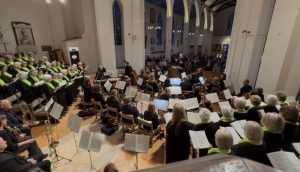
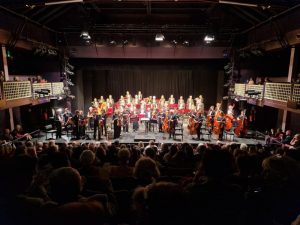
Epsom Symphony Orchestra May 4th concert

The Epsom Symphony Orchestra, a cherished fixture in the town’s cultural landscape, has been delighting audiences since its founding in 1951. Over its decades-long history, the orchestra has shared the stage with numerous esteemed soloists, including pianists Phyllis Sellick, Eileen Joyce, and Semprini, clarinettist Gervase de Peyer, and, more recently, the internationally acclaimed pianist Benjamin Grosvenor.

Currently under the direction of its long-serving musical director Darrell Davison, the orchestra performs four concerts annually at the Epsom Playhouse. Mr. Davison, who has led the orchestra since 1981, brings an impressive musical pedigree to the role. A scholar of both Charterhouse and St Catherine’s College, Cambridge, Davison began his career as the principal cellist of the Ulster Orchestra before transitioning to conducting. A winner of the Sir John Barbirolli Conducting Competition in 1979 and a prize winner at the inaugural Leeds Conducting Competition in 1984, Davison has conducted major ensembles across England, including all four London orchestras, and has appeared at venues such as the Royal Festival Hall.

The Epsom Symphony Orchestra comprises a blend of professional musicians and dedicated amateurs, creating a vibrant and inclusive musical community. Among its members is leader Julia Burkert, a German-born violinist who studied on scholarship in Canada and Scotland before establishing a successful freelance career in London. The orchestra’s ethos of collaboration and shared passion for music resonates strongly with its members, many of whom describe it as a “musical family.”

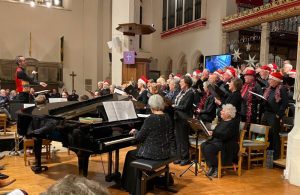
The orchestra recently performed its annual Christmas concert to a packed audience at the Playhouse. The festive program featured interactive elements that encouraged audience participation, adding to the warm and lively atmosphere. This year’s Christmas concert continued a tradition of welcoming celebrity narrators for musical pantomimes, with past guests including Johnny Morris, Wayne Sleep, and Lionel Blair.

Looking ahead, the orchestra’s next concert on 23rd March promises a compelling program of classical masterworks. Highlights include Tchaikovsky’s Romeo and Juliet Overture, Rachmaninov’s Rhapsody on a Theme of Paganini with Cypriot pianist Christos Fountos as the soloist, and Shostakovich’s emotionally charged Fifth Symphony. Mr. Fountos, born in Nicosia in 1997, began his piano studies at the age of five and made his orchestral debut at 17 with the Cyprus Symphony Orchestra.

The orchestra’s commitment to nurturing local talent and delivering high-quality performances continues to enrich Epsom’s cultural life. It is also actively seeking new players of a good standard to join its ranks, ensuring its legacy endures for years to come. For more information, prospective musicians and concertgoers are encouraged to visit the orchestra’s website. http://www.epsomsymphony.co.uk/

Related report:

Spanish fiesta came to Epsom


Lucy Porter Returns to Her Roots with “No Regrets” at Epsom Playhouse

Lucy Porter outside Epsom Playhouse

Epsom Playhouse is set to welcome one of comedy’s most beloved figures, Lucy Porter, on 18th January 2025, as part of her nationwide tour with the brand-new show No Regrets. For Lucy, this performance will be more than just a stop on her tour—it’s a nostalgic homecoming.

Lucy, who grew up in nearby Croydon and Wallington, has fond memories of Epsom. “Epsom was the place we went for a fancy day out—it seemed so much posher than anywhere else nearby,” she reminisces. “I used to hang out at the Ashley Centre, which is right next to the theatre. I’ll relive my youth by putting on some baggy jeans and Kickers, hanging around and terrorising the locals!”

Reflecting on her formative years, Lucy recalls special occasions at the Berni Inn at Tattenham Corner, where she developed her love of prawn cocktails, and visits to the Playhouse itself as a young fan. “I never dreamed that one day I’d get to perform there myself,” she says.

A Hilarious Exploration of Regret

In No Regrets, Lucy takes audiences on a journey through her most embarrassing mistakes and missteps, from disastrous dates and professional mishaps to parenting fails and ruined friendships. With her trademark wit, she examines the nature of regret, guilt, and shame—topics she knows all too well as a self-confessed middle-class, middle-aged ex-Catholic.

“It’s not all doom and gloom,” Lucy promises. “Regrets can also be inspiring. You can use them to change your ways. This show is about learning to laugh at the past and maybe using it to build a better future.”

Lucy’s comedic reflections are infused with sharp social commentary. In the show, she explores collective regrets, such as not maintaining the work-life balance we rediscovered during lockdown or failing to realise clapping for the NHS wasn’t enough to sustain it.

From Epsom to Stardom

Lucy Porter’s career spans acting, writing, and comedy. A familiar face on television, she has appeared on QI, Mock the Week, Have I Got News for You, and Would I Lie to You. Her stage credits include One Flew Over the Cuckoo’s Nest and even a stint on Eastenders. A passionate quizzer, Lucy co-hosts the hit podcast Fingers on Buzzers with Jenny Ryan (The Vixen from The Chase), and she’s a former Celebrity Mastermind Champion of Champions.

Her dulcet tones are regularly heard on BBC Radio 4, where she contributes to shows like The News Quiz and Just a Minute.

Don’t Miss Out

For those eager to catch Lucy’s laugh-out-loud performance and hear her candid confessions, tickets are available now at www.boundandgaggedcomedy.com.

Lucy’s final word on her return to Epsom? “I’m so excited to come back and share this show with a place that meant so much to me growing up. I hope everyone brings their prawn cocktails!”


Epsom Choral Society’s Verdi Requiem reviewed

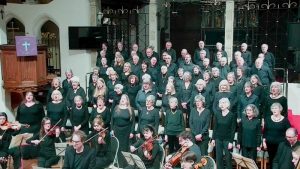
Epsom Choral Society singers

I will never forget the first time I heard Verdi’s Requiem.  That crashing wall of sound that was the Dies Irae filled me with fear and awe.  It seemed as if the mouth of hell had been opened and nothing could stop the all-consuming fire.  And here on offer from Epsom Choral Society is this mighty work, accompanied by only five instruments.  Would it work?  I couldn’t wait to find out.

The choir started off solemnly setting the scene.  Their warm-hearted singing incorporated a range of colours – from a luminous ‘et lux perpetua’ to a firmness of purpose in ‘te decet hymnus’.  The four soloists also made an impressive appearance with their fugal ‘Kyrie’.

Then came the ‘Dies Irae’.  Such was the spirit of the choir as they hurled their phrases at us that it was hard to believe there were not twice the number of singers on stage. This was fearless and exciting singing.  With alternating timpani and bass drum replicating the original scoring, we were wholly immersed in fire and brimstone. 

In addition to the high octane ‘Dies Irae’, the choir is given other saner but even more challenging fare, such as the fugue for 2 choirs in ‘Sanctus’.  Here, ECS was nimble and assured, keeping the texture light, transparent and a joy to listen to.  The concluding movement ‘Libera me’ is a balancing companion to the ‘Sanctus’, demanding equally tight control to prevent any section from charging off the rails.  Such hair raising moments showed the true mettle of ECS in their ability to conquer details, keep a clear head and ride the storm.

What a fabulous quartet of fine young soloists. All performed magnificently and immeasurably added to the enjoyment of the evening.  There were simply too many superlative moments, the following being a cruelly curtailed list.

Soprano Elisabeth Findon‘s impassioned singing during the concluding ‘Libera me’ was a highlight of the evening.  Her high Bb near the end – a true pianississimo (pppp) – floated above a muted chorus;  it was translucent and sublime and a moment to remember.   ‘Quid sum miser’ was exquisitely sung by mezzo Judy Louie Brown.  It was accompanied by the marimba – an unexpectedly successful substitute for solo bassoon in the original score, and especially notable this evening for both percussionists duetting on the one instrument!

John Findon is a commanding tenor. He was majestic in the opening of the ‘Kyrie’, and tenderly sensuous in ‘Qui Mariam’.  Mark Nathan‘s cantabile bass solo ‘Voca me’ showed off Verdi’s song-writing skill at its most natural and beautiful.  And whenever the four of them joined forces to sing as an ensemble, at times a cappella, they always added colour, sparkle and emotion to the drama.  I came out from the concert knowing that the haunting ‘Lacrymosa’ will be my Ohrwurm for weeks to come.

Verdi’s Requiem is universally adored.  That this wonderful work can be accessible to local choirs with smaller forces at their disposal is thanks to Berlin musician, Michael Betzner-Brandt, who has miraculously reduced the massed orchestral requirements to an ingenious chamber ensemble of piano, horn, double bass, marimba (plus big bass drum) and timpani.  Yes, there are moments that are hard to replicate, such as the antiphonal trumpets in the ‘Tuba mirum’, but they are a very small price to pay for what has been gained.

Lynda Chang

Related reporr:

Epsom born baritone to bring requiem to life


Epsom historian and the Frenchman who trained the British armies that defeated Napoleon

Royal Military Academy Sandhurst, Book cover and author.

The Royal Military Academy Sandhurst has seen a lot of famous faces over the years. Several members of the Royal Family have attended the Academy. Sir Winston Churchill graduated in 1894, Field Marshal Montgomery in 1908. The Academy is so respected that many countries send their military personnel there for training, making it one of the top military schools in the world.

But, how much do we really know about the origins of Sandhurst?

Local author and historian Paul Le Messurier has been a resident of Epsom for several years now. His latest book, Founder of Sandhurst, Maj-Gen John Le Marchant, tells the remarkable story of the British cavalry officer who started what has now become one of this country’s great institutions.

John Gaspard Le Marchant (1766-1812) was a French-born British cavalry officer who rose to prominence despite starting from humble beginnings. The son of a Guernsey father and a French mother, he joined the British Army at just 16. Through sheer skill and determination, he rose to become one of the most distinguished cavalry officers of his generation.

Le Marchant’s first taste of active service came during the French Revolutionary Wars, where he served as a captain in a cavalry unit during the ill-fated Flanders campaign. A skilled swordsman, it was here that he noticed that the British Army’s sword training was seriously lacking. Determined to make a difference, he designed a new cavalry sabre, wrote manuals on swordsmanship, and took it upon himself to train cavalrymen across the country.

Even then, he was still not satisfied and set his sights on an even grander and more ambitious attempt at reform: improving the overall standard and education of army officers.

Le Marchant’s idea for a military academy to professionally train army officers met with some initial resistance, but he eventually won royal and political backing. In 1801, Parliament approved his plans and allocated a budget of £30,000. The Royal Military College was established by Royal Warrant, initially based in High Wycombe and Marlow, with Le Marchant serving as its first Lieutenant-Governor. The college would later move to its prestigious location at Sandhurst.

In 1811, Le Marchant joined the Duke of Wellington’s army in the Peninsular War against Napoleon’s forces, taking command of a Heavy Cavalry brigade. He distinguished himself at the Battle of Salamanca, where he led one of the most successful cavalry charges of the campaign. Sadly, Le Marchant was killed in action during the battle at the age of 46. A memorial was erected in his honour at St. Paul’s Cathedral.

The Royal Military Academy’s motto today is ‘Serve to Lead,’ and that is exactly what Le Marchant did – both with the ground-breaking reforms he introduced and his bold leadership on the battlefield. Despite his many achievements, Le Marchant remains relatively unknown today. Paul Le Messurier’s engaging book seeks to change that, shedding light on the powerful and lasting impact Le Marchant had on the British Army.

Royal Military Academy photo: Antony McCallum – https://www.wyrdlight.com


Dorking Halls to reopen after upgrade

Dorking Halls (image Google)

The official reopening date for Dorking Halls is days away and a special ceremony has been announced to mark the occasion.

Mole Valley District Council was forced to close its veritable old venue in June so it could undergo a £11million facelift, to take place over two phases, to replace the 1930s plaster ceiling in the grand hall together with much needed mechanical and electrical work to its stage and internal workings.

Now, the first stage of that work, which has so far cost £4m, is done and Dorking Halls will reopen its doors on Monday, December 9 with screenings of Paddington in Peru, Wicked and Gladiator 2.

Then, from December 20 the big winter panto Sleeping Beauty takes to the stage, complete with 3D laser projections.

Ahead of the big day the council is also hosting a special reopening celebration the Friday before to show off the upgraded site, which will also feature newly enlarged toilet provision, and a draft lobby.

Speaking about the soon to be reopened Dorking Halls, leader of the council, Councillor Stephen Cooksey said: “I wanted to update you of an ‘early Christmas present’. 

“The work to replace the Grand Hall ceiling at Dorking Halls has gone brilliantly well and our entertainment venue will be re-opening as planned on Monday December 9, with the panto, ‘Sleeping Beauty’ beginning not long after on the 20 December and running until the end of the month.

“Whilst Dorking Halls has been closed, the opportunity has been taken to upgrade our film projectors meaning that they will not only present even better-quality visuals, but also run in a greener, more energy efficient, manner. 

“So, be prepared for an invigorated cinema experience when the Halls reopens with a comprehensive events screening and film listing.”

The second phase of the project’s £11m refurbishment will take place in 2025 and will focus on replacing “critical mechanical and electrical systems” – said to be its heating and cooling plant – that are near the end of their useful lives.

Related reports:

Dorking refurb: “it’s behind you”!

Dorking Halls to get refit


Music of mass creation in Epsom

Epsom Chamber Choir in action

Two mass settings in the same concert – too much of the same thing or the starting point for a creative programme of music?

During his time as music director of Epsom Chamber Choir, Jack Apperley has demonstrated a flair for devising intriguing programmes, whose themes emerge as you listen and learn about the music, revealing fascinating links that stitch the pieces together in interesting and often surprising ways.

In Saturday evening’s concert at St Martin’s Church in Epsom, we were invited to compare and contrast the mass settings of two composers, Stravinsky and Bruckner – the same liturgical texts but different musical language; the same instrumental forces but different ways of using timbres of woodwind and brass to accompany the choral textures. More on these pieces later but, linking them to the present, Peter Burton, a member of Epsom Chamber Choir, deliberately used the same forces in his setting of words from Psalm 19, “The heavens declare the glory of God”, which opened the concert. Peter captured the essence of the Psalmists’ words in music which expressed awe and wonder through a series of luminous chords before growing to a soaring climax.

The influence of Mozart then emerged as one of the programme’s themes in the next piece, Jonathan Dove’s Movements from Figures in the Garden. Commissioned by Glyndebourne for their 1991 Mozart bicentenary celebrations, this wind serenade was designed to be played outdoors before a performance of The Marriage of Figaro. Each movement subtly weaves snippets of arias, recitatives and musical phrases from the opera into more abstract musical textures, causing a ripple of amusement at moments of recognition amongst both the players (Chameleon Arts Wind Ensemble) and audience.

We then learned from Jack’s introduction that Stravinsky had spent much time listening to Mozart’s Missa Brevis during the period 1944 – 1948, when he was writing his mass setting. It is not easy to tell what effect this may have had on him but we can certainly hear the influence of Stravinsky’s Russian Orthodox faith in the syllabic setting of much of the text, especially in the Credo. The choir’s excellent clear diction made this particularly effective. The final a cappella ‘Amen’, sung with great beauty and stillness, brought a peaceful sense of calm to the close of the first half of the concert.

The second half took us from Stravinsky’s rather austere neo-classical style to the more lush, romantic sound world of Bruckner and the choir embraced this shift with delight. There was a good sense of ensemble and balance between the players and singers and a palpable sensitivity to the text. Particularly beautiful were the close harmony exchanges between a cappella female then male voices in the Qui tollis and Benedictus passages, where intonation and balance between the voices was flawless. Other highlights were the radiant beauty of the Crucifixus and the perfectly executed suspensions at ‘miserere’ in the Agnus Dei.

Two mass settings framing a varied musical menu and subtly woven themes: this was a creative programme that both challenged and delighted. I’m looking forward to the next one!

Carolyn Boulding


Epsom born baritone to bring requiem to life

Mark Nathan and Epsom Choral Society

Epsom-born baritone Mark Nathan will feature as one of the soloists in Verdi’s Requiem, performed by the Epsom Choral Society on Saturday, 23rd November at 7:30 pm at St Martin’s Church, Epsom. Known for his commanding stage presence and dynamic voice, Mark is delighted to perform this dramatic piece with his hometown choir.

Mark Nathan has earned acclaim for roles across opera stages in the UK and Europe. A former Emerging Artist with the Scottish Opera, he has captivated audiences as Joseph de Rocher in Dead Man Walking (Royal Conservatoire of Scotland), which garnered praise for his intense portrayal and powerful baritone. His notable performances also include Schaunard in La Bohème Maximilian in Candide, with Welsh National Opera, Giuseppi in Scottish Opera’s The Gondoliers which was televised for BBCTV, the title role of Don Giovanni with Opera Loki, and roles with Garsingto Opera, Waterperry Opera. Critics have celebrated his performances as “commanding” and “emotionally rich,” and he continues to expand his repertoire with roles for Scottish Opera and English Touring Opera this season.

In addition to his operatic work, Mark is an accomplished concert soloist, with oratorio performances that include Vaughan Williams’ Five Mystical Songs, Fauré’s Requiem, and Saint-Saëns’ Requiem. His versatility and vocal warmth make him an ideal choice for Verdi’s Requiem, a piece known for its dramatic intensity and sweeping emotional range.

“Performing Verdi’s Requiem with the Epsom Choral Society in my hometown is very special,” said Mark Nathan. “The power and emotional depth of this music are incomparable, and to share this experience with my community is a privilege.”

This special performance by the Epsom Choral Society uses an innovative arrangement by Michael Betzner-Brandt, making Verdi’s Requiem more accessible for local ensembles without sacrificing its grandeur. For Mark, who has returned to his roots in Epsom, the opportunity to perform this iconic piece with the Epsom Choral Society is especially
meaningful.

For tickets and more details on this powerful evening of music, please visit the Epsom Choral Society website

www.epsomchoral.org.uk .

Event Details:


Verdi’s Requiem adapted for Epsom Church

Concert flyer

Epsom Choral Society (ECS) will perform the Verdi Requiem on Saturday 23rd November at 7:30pm, at St Martin’s Church in Epsom. This concert promises to be a remarkable event, showcasing a special arrangement of Verdi’s grand work with chamber ensemble by Michael Betzner-Brandt.

Celebrating over a century of musical excellence, ECS has been delivering exceptional performances to its audiences to mark its centenary in 2022. The choir has programmed a series of exciting and diverse concerts over the past two years, including a gala performance of Handel’s Messiah and a spectacular rendition of Walton’s Belshazzar’s Feast at London’s Cadogan Hall.

There are four outstanding international soloists:
Elizabeth Findon – soprano
Judy Louie Brown – mezzo
John Findon – tenor
Mark Nathan – baritone

The concert will be conducted by ECS Music Director, Julian Collings.

This November, ECS invites its loyal followers to experience Verdi’s Requiem like never before. The arrangement by Michael Betzner-Brandt is designed specifically for a chamber ensemble, allowing the choir to bring the grandeur and emotional depth of Verdi’s masterpiece to a more intimate setting while still capturing the essence and intensity of the original composition.

“Our aim is to create an unforgettable musical experience for our audience,” said Nina Kaye, publicity manager. “The Verdi Requiem is one of the most powerful works in the choral repertoire, and this unique arrangement allows us to perform it in St Martin’s Church in Epsom.”

Tickets for this not-to-be-missed event are priced at £20, with a special half-price offer for under-25s and can be bought online www.epsomchoral.org.uk. Attendees are encouraged to book early to avoid disappointment, as this concert is expected to attract a large audience.

Join Epsom Choral Society on Saturday, 23rd November at 7:30pm at St Martin’s Church in Epsom for an evening of stirring music, passion, and community. Experience Verdi’s Requiem in a new light, and be a part of the rich musical heritage that ECS continues to build in Epsom and beyond.

For more information and to purchase tickets, please visit www.epsomchoral.org.uk.


Art, culture, and science collide in Surrey

Festival of Social Sciences flyer

This November, the University of Surrey will open its doors to the public as it hosts two prominent research festivals: the Being Human Festival and the ESRC Festival of Social Science. As part of the Being Human Festival, the UK’s only national festival dedicated to the humanities, Surrey will explore key themes related to identity, culture, and the human condition. This year’s festival features a number of intriguing events, including: 

  • Landmarking through Music: Early Recordings Revealed: Listen to early recordings as heard by your great-grandparents! Connect with early 20th century music through wax cylinders and develop an understanding of their role within society at the time. 

  • Poetry Play! Performances and Workshops: Think you might be a poet? Do you love poetry? Or maybe you just don’t get it. Are you puzzled or excited by the weird ways words work in poems? If you appreciate the power of language, we made this for you. 

  • Landmarking Surrey’s Musical Heritage: Dame Ethel Smyth: Dame Ethel Smyth was a pioneering composer of the late nineteenth and early twentieth centuries, a prolific author of biographical writing about herself and others, a leading suffragette, and for the majority of her life a resident of the county of Surrey. 

Running concurrently is the ESRC Festival of Social Science, which focuses on the real-world impact of social science research. This year’s festival at Surrey tackles a wide range of urgent societal issues, including: 

  • Green Means Go? Tackling Surrey’s climate emergency through deliberative democracy: Discover the latest sustainability-focused research and innovation initiatives being led by the University of Surrey. 

  • Bridging Digital Divides: Building dialogue on online safety between youth and parents: Discover what the evidence really says about young people’s digital lives and the challenges of online safety, parenting and digital citizenship. 

  • The Role of AI in Modern Policing: Key topics will include risk assessment, facial recognition, robotics, data mining, and cybercrime detection, offering a deep dive into the current applications of AI in policing. 

  • Eco-Logic: How Can We Make Green Living Easy? Discover surprisingly simple strategies that transform your daily routine into a sustainable one, without sacrificing comfort or convenience. 

Professor Annika Bautz, Pro-Vice-Chancellor and Executive Dean of the Faculty of Arts, Business and Social Sciences said: 

 “Both festivals are designed to be interactive, accessible, and thought-provoking. They offer attendees the chance to engage directly with cutting-edge research in ways that are relevant and relatable to all aspects of life. From workshops that let you create your own art or stories to expert panels exploring societal challenges, the festivals are an invitation to explore, question, and rethink the world around us. 

“Whether you’re passionate about the arts and humanities, curious about the social sciences, or simply looking to engage in meaningful conversations, these events offer something for everyone. The University of Surrey is proud to be a hub for these conversations, and we invite the public to participate in these exciting and enriching festivals.” 

Key dates: 

  • ESRC Festival of Social Science: 19 October – 9 November 2024 

  • Being Human Festival: 7–16 November 2024 

For more information, a full list of topics and events, and to book your free tickets for any of the events, please visit: https://buytickets.at/universityofsurrey3 


Learn to play music in Epsom

A guitar lesson

UK charity Music for All is thrilled to announce their annual flagship event Learn to Play is back for
2024 giving everyone in Epsom a chance to take part in ‘the biggest free music making weekend of
the year!’

The event will be held in Guitar, Guitar – 6 Capitol Square, Epsom on the 11th -13th October and is open to all; regardless of age, experience and background and provides opportunities for participants to
experience a free taster music making lesson from a musical instrument!

Learn to Play aims to inspire, encourage and enable both new and lapsed music makers to enjoy the
wide range of benefits of music making, as well as connecting and championing local UK music
providers through a shared celebration of music making.

Learn to Play arrives at a time where music making opportunities are difficult to access due to
current cuts to arts education, resulting in many primary schools failing to meet basic music
curriculum needs for young people 1 impacting the future of the UK arts, the creative potential of the
next generation and the people who deliver quality arts education in the UK.

Sonali Banerjee, Music for All’s General Manager explains: “The Learn to Play weekend is needed
now more than ever and through our regional music making events we aim to inspire as many people
as possible in experiencing the unique joys and benefits of music making. The arts enrich our lives,
our community and economy, as well as improving our mental health. We welcome all age-groups
and particularly encourage youngsters who may not have the opportunity to experience music
lessons at school, to come along and try out an instrument of their choice.”

Music for All believes everyone should have equal access to music making and supports
disadvantaged individuals, educators and community projects through cash and instrument award
rounds throughout each year.

The positive impact of using music to support and enhance mental and physical health throughout
people’s lives has long been documented in numerous academic and social research. Learning to
play music is a fantastic opportunity to:

 Challenge your mind and strengthen your memory
 Feel pride and a sense of achievement
 Connect with others and make new friends
 Take a break from stresses and worries
 Have fun whilst being creative
 Explore the joy of music-making!

Jamie Cullum, Musician and Music for All ambassador said: “Playing a musical instrument is an amazing thing to have in your life. Sadly, not everyone has the opportunity to have those experiences. I am proud to be a supporter of the Music for All charity and delighted to be involved in their work in changing lives through music. I encourage everyone to participate in a Learn to Play event near them.”

Joshua Franklin attended a Learn to Play event nearly a decade ago and has experienced the numerous opportunities and benefits since taking part. “At eight years old Joshua decided he wanted to play the Saxophone but was unfortunately turned down from taking lessons at school for being under the age threshold. Joshua was still determined to learn so attended a Learn to Play saxophone lesson at Dawkes Music’s in Maidenhead.

Through this experience, he managed to convince his school that he was ready and able to continue learning. Joshua excelled playing the saxophone, taking his first exam (Grade 3) aged nine, achieving a distinction at Grade 8 three years later, gaining a ABRSM Diploma and taking his music G.C.S.E exam two years early, achieving a Grade A.

Joshua’s love for music has continued through obtaining a Grade A in A-level music. He now plays lead alto in Cardiff University’s big band and attends local jazz jam nights where he frequently plays along with others at local venues.”

The Music for All YouTube channel will also have a series of online tutorials by professional musicians available, including some big names! In previous years these have included Music for All charity supporters and Ambassadors such as Jools Holland, Alison Balsolm, Anne Denholm, Rob Rolfe and Dave Tench – these tutorial lessons can be accessed by anyone at any time; subscribe for free here: Music for All UK charity – YouTube.

Those interested in getting involved in Learn to Play ‘24 events and accessing their free music lesson should simply visit the Learn to Play website, select their closest venue using the interactive map and register their interest directly with the venue.

For more information on Music for All visit: www.musicforall.org.uk

The Learn to Play ’24 event is generously supported by the NAMM Foundation. Other partners include Music Industries Association, Black Lives in Music, Make Music Day UK, Music Mark, Making Music and Take it Away.

To get the latest updates on Music for All and the Learn to Play ‘24 event follow us on our social channels