Old style 1980s rolling stock that had been taken out of service to much fanfare, including a huge ticket-only retirement party, are still being used to cover shortages across South Western Railways services.
The train operator made a big song and dance about the retirement of its old iconic Class 455 trains, even charging £45 a ticket for its supposed last ever journey – with the money going to charity.
The LDRS understands old rolling stock is still being used to cover shortfall when the new trains are unable to get off the blocks, notably on the Hampton Court to Waterloo route.
In December last year some 9,000 enthusiasts tried to buy tickets for the 400 spaces on the celebrated final service from Waterloo. Demand was so high a second train was put on. The day was supposed to mark the last rides of the Class 455 as they were finally phased out and replaced with modern Class 701 Arterio – the ones with the odd half table ledges.
Thousands gathered to say their goodbyes to the ‘iconic’ SWR trains that have, and continue, to serve Surrey for decades. The ceremony for the ‘red train’ involved a nine-hour round trip from Waterloo across the SWR network.
South Western Railways celebrated with a story titled ‘Train enthusiasts bid farewell to iconic red trains after almost 43 years of service’ – except they are still in service. Among the passengers was social media train fan Francis Bourgeois.
South Western trains said the December ‘farewell’ event was to celebrate the life of the Class 455, first introduced in the 1980s ahead of their removal from timetabled services and that it was always planned to keep some of them back as a contingency.
A spokesperson for SWR said: “The Class 455 fleet of trains was withdrawn from our timetable at the end of 2025. A small number were retained for resilience purposes, to cover any eventuality that may affect the trains we use on our suburban network.”
The 17.54 from Hampton Court to London Waterloo on Thursday January 29 was the old retired train brought back into service (LDRS)
Surrey Police precept rising
8 February 2026
The average household in Surrey could pay more than £350 a year towards policing after a £15 council tax hike was given the go-ahead. The police precept – the portion of council tax that funds Surrey Police – will rise from £338 to £352 a year for the average Band D home from April 2026, a 4.4 per cent increase from last year.
The rise was backed by the Surrey Police and Crime Panel on February 4, despite a sharp debate over whether residents can afford it. Police and Crime Commissioner (PCC) Lisa Townsend said the increase was needed to prevent services from deteriorating, warning that without the full rise people could face slower answers to 999 calls, longer waits for officers to attend incidents, and delays in forensic investigations.
“For every £1 on the precept, about £0.5 million goes into the Force,” she told the panel. “That equates to around 15 police staff or officers.” Ms Townsend said Surrey Police has become “one of the most improved forces in the country” in recent years, with more visible neighbourhood policing and better performance on crimes such as burglary and vehicle theft, but rising demand and increasing costs mean those improvements are at risk.
She said: “Improvements we are seeing today have only been possible because of previous decisions to increase the policing precept. Those decisions have allowed SP to invest in officers, staff, systems and technology that are now delivering results on the ground.” According to the PCC, on an average day the force handles almost 1,700 contacts from the public and sends vehicles to almost 250 incidents. Each day 216 crimes are recorded, 33 relate to violence against women and girls, 56 are assault, and armed response officers are called out 16 times a week.
She added: “The improvements achieved so far simply cannot be sustained” without further funding.
Some councillors challenged the move. Cllr Richard Wilson said many residents in his area are struggling to afford food, heating and rent, questioned whether it was the right time to increase bills, and asked whether Surrey, as a relatively low-crime county, could manage with a smaller force.
Kelvin Menon, chief finance officer for the PCC’s office, said Surrey receives one of the lowest levels of government grant in England, making it more reliant on council tax, and warned that cutting funding would mean difficult choices about which services to scale back. He argued that although Surrey may be a ‘low-crime’ area, it is the police keeping it that way, asking: “What level of crime are people willing to accept?” He added: “The level of poverty in the country is possibly not the fault of the police precept.”
The PCC repeatedly assured the panel that Surrey Police has already delivered about £90m in savings over the past decade. Even with the tax rise, the force still needs to find £5.5m in further savings this year and more in the years ahead, with an overspend of around £1m this year driven largely by overtime costs.
A public consultation found 57 per cent of respondents supported a £14 increase, the maximum allowed at the time. More than 2,400 people took part, although this was highlighted as a small proportion of Surrey’s 1.3m residents.
Surrey Police and Crime Officer, Lisa Townsend, at the Surrey Police and Crime panel. (Credit: Surrey County Council webcam)
When is attempted suicide anti-social? A Surrey police dilemma
8 February 2026
A woman has criticised Surrey Police for giving her an anti-social behaviour warning after officers intervened while she considered taking her own life. She has claimed the move left her feeling “ashamed” and too scared to call for help if she experiences the same struggles again.
The 40-year-old, who asked to remain anonymous, said she was issued with a Community Protection Warning (CPW) in October 2025 after officers intervened when she was at risk of suicide in Guildford town centre late at night. The supermarket worker said she later received a second warning in December, despite claiming she had not breached the first.
CPWs are normally used to tackle anti-social behaviour that harms or causes disturbance to the community. This could include harassment, vandalism or persistent nuisance. However, the Guildford resident said these anti-social behaviour powers are being wrongly used against vulnerable people rather than preventing crime.
A Surrey Police spokesperson said the warnings are to set “behavioural boundaries” and are “not about criminalising behaviour”. The Force uses a national framework ‘Right Care, Right Person’ to ensure health-related incidents are handled by specialists (NHS, social care) rather than the police.
The woman said the notice, which warns of potential consequences such as arrest or £100 fines if the behaviour continues, has had a chilling effect on her and has left her “too ashamed” to tell her close friends and family what happened. “It’s made me less safe,” she said. “If anyone had concerns about me they couldn’t call the emergency services because if I survived [there would be] consequences. And that puts my friends and me in a horrible position.”
The Guildford resident explained she did everything to avoid disrupting the public and was not being attention-seeking, as she fears some people may label her. “They are completely mis-using something designed to protect communities from things like youths carrying knives,” she said. “We are giving them money and power to tackle anti-social behaviour and that is not what they are doing.”
The woman described how officers initially spoke calmly with her, telling her she was not in any trouble and persuaded her to come to safety. However, she said the atmosphere “completely changed” as soon as she was safe. “When I say that I try to get help and say there isn’t any, the [police] sort of imply that I’m not trying hard enough.” The woman said she feels “failed” by mental health services and wants the police to recognise the pressure on this sector.
The 40-year-old said she was sent the first warning to her home address and the second warning was given in her workplace, in front of colleagues, which she said was humiliating. Although she made a complaint to Surrey Police, the woman said she was told no action would be taken. A police spokesperson has said they cannot comment on individual cases when a complaint is subject to review and an ongoing investigation.
The woman raised concerns about something called SIM (serenity integrated mentoring): a controversial model that once linked police with mental health services. In some areas around 2022, this was used against those who frequently sought emergency services help in a crisis. But Surrey Police said it is committed to delivering ‘Right Care, Right Person’ in making sure health-related incidents are dealt by specialists.
A Surrey Police spokesman said: “An initiative is underway in Surrey, based on similar models elsewhere in the UK, which is aimed at supporting the policing response to individuals who frequently present to police with suicidal behaviour which could put them at risk of danger. The response focuses on the core policing duties outlined under Right Care, Right Person to set boundaries and provide a consistent response from front line officers.
“The project involves working with partner agencies, such as health and social care colleagues, to signpost risk and vulnerability to the most suitable agency. Where necessary police interventions, such as community protection warnings, will be considered as part of the approach to reduce disproportionate demand and set behavioural boundaries. These would not be issued without the support of the relevant partner agencies.
“Setting these behavioural boundaries is not about criminalising suicidal behaviour – they are put in place to ensure that these individuals are accessing the right service to provide them with the support they need.”
Anyone can contact Samaritans FREE any time from any phone on 116 123, even a mobile without credit. This number won’t show up on your phone bill. Or you can jo@samaritans.org or visit www.samaritans.org.
Whatever you are going through, you don’t have to face it alone. Call Samaritans for free on 116 123, email jo@samaritans.org or visit www.samaritans.org for more information.
Epsom and Ewell Times does not normally report individual crime incidents. However, as a trial, we are publishing a monthly round-up of crime and community safety matters with a local connection, drawing on information released by Surrey Police and partner agencies.
Safer Epsom & Ewell partnership – early impact
Surrey Police and Epsom & Ewell Borough Council have continued to roll out the Safer Epsom & Ewell partnership during January, aimed at tackling persistent offending, organised crime, antisocial behaviour and theft across the borough.
According to the Office of the Police and Crime Commissioner, the initiative has already resulted in more than 150 arrests, targeting prolific offenders, shoplifting, drug supply and county-lines activity. Police report the disruption of multiple county-lines gangs, seizures of Class A drugs and cash, and the removal of knives from circulation.
The partnership builds on high-visibility policing activity over the Christmas and New Year period and is intended to provide a sustained, joined-up approach to community safety involving the police, the borough council, housing providers and other local partners.
(Source: Surrey Police / Office of the Police and Crime Commissioner)
Witness appeal after approach in Court Recreation Ground, Epsom
Surrey Police have issued an appeal for information following an incident reported on Monday 26 January in Court Recreation Ground, Epsom.
Police say a 13-year-old girl walking to school was approached by two men, one of whom reached out towards her. The girl was able to run away and was not injured.
One suspect is described as a tall white man of slim build with dark hair, wearing a dark jumper. Police have asked anyone who was in the area at the time, or who saw anything suspicious, to contact them.
Robbery in Ash Court, Epsom – police seek witnesses
Earlier in the month, Surrey Police appealed for witnesses following a robbery in Ash Court, Epsom, reported late on Friday 9 January.
The incident is believed to have taken place between approximately 11.50pm and 11.56pm. Officers have asked residents and motorists in the area at the time to check CCTV, doorbell or dash-cam footage and contact police if they have information that may assist enquiries.
Police have not released further public details about the victim or property taken.
Missing child appeal cancelled after positive outcome
Surrey Police also confirmed this month that a 13-year-old girl reported missing from Epsom was later found safe and well, and that an earlier public appeal was stood down.
Community engagement – ‘Meet the Beat’ sessions
Throughout January, Surrey Police neighbourhood teams held a series of “Meet the Beat” drop-in sessions across Epsom and Ewell.
The sessions allowed residents to speak directly with local officers about issues such as antisocial behaviour, shoplifting, speeding and general community safety concerns. Locations included areas such as Epsom town centre, Waterloo Road, Long Grove and local shopping parades.
Further sessions are scheduled into February.
Local policing priorities
Surrey Police have continued to highlight neighbourhood priorities for Epsom and Ewell, including action against antisocial use of motorbikes and e-bikes, and a zero-tolerance approach to retail crime in the town centre.
Police say this includes targeted patrols, enforcement activity and work with local businesses and CCTV operators.
How to contact Surrey Police
In an emergency (immediate danger or a crime in progress): call 999
Penchant for porn on Surrey police computer leads to ban
8 February 2026
A Surrey Police officer was dismissed for watching porn, taking pictures of his genitals and buying cocaine on a work device. Former Detective Constable (DC) Luke Turner has also been given a lifetime ban from the Force.
An accelerated misconduct hearing on December 19 found that Mr Turner had used his police-issued mobile data terminal (MDT), a work device used to access police systems, for explicit and unprofessional purposes.
The hearing concluded Mr Turner used it to help buy cocaine on four occasions between July and August 2025, searched and watched porn, took photos of his genitals and engaged in sexual messages with another individual.
Chair Sarah Grahame rules that his actions seriously damaged public trust and breached multiple police standards. Mr Turner was immediately dismissed without notice and placed in the national barred list.
The chair said: “I believe that the public of Surrey would be rightly appalled if they knew that this officer was engaging in this behaviour.” They said such behaviour would discredit the police service and damage its reputation.
Mr Turner denied and disputed the allegation that he used the work device to buy Class A drugs as well as sending or receiving sexual messages on it.
He did not contest allegations that he watched porn and took pictures of his genitals on his work device but argued they did not amount to gross misconduct.
But Assistant Chief Constable Grahame said she reviewed all the evidence and decided, on balance, that the behaviour had taken place. She said his actions broke two professional standards: discreditable conduct and failing to follow force policies and rules.
Under updated police conduct rules introduced in 2025, there is now a presumption that officers found guilty of gross misconduct will be dismissed unless there are exceptional circumstances.
The chair said there were not mitigating factors strong enough to justify a lesser punishment.
She said: “I do not believe that DC Turner could remain with Surrey Police given the seriousness of the behaviour found on duty.”
Surrey Police ethics print on wall at Mount Browne HQ. (Credit: Emily Dalton/LDRS)
Paradox of Protection policy for tenants: triggers Surrey police evictions
8 February 2026
A pregnant mum says families have been left facing a “very real prospect of being homeless” after being told to leave Surrey Police subsidised housing.
At least 15 households living in homes owned by the force have been served Section 21 ‘no fault’ eviction notices and told they must move out within 12 weeks.
The Surrey Police and Crime Commissioner’s (PCC) office owns a number of properties, which are rented to officers at subsidised rates to help ensure high housing costs are not a barrier to joining the force.
However, up to 15 families say they have now been told they must leave after building their lives in police-owned homes. Some of the officers affected have served with the force for several years, if not decades.
‘Very real prospect of being homeless’
One woman, who is due to give birth in five weeks and asked not to be named to protect her identity, said: “I don’t sleep at night. I wake up in the middle of the night and my brain is just ticking over. What are we gonna do?” She added: “We face a very real prospect of being homeless.”
She said families are being pushed into Surrey’s expensive private rental market with little time and no savings for upfront costs. She told the Local Democracy Reporting Service (LDRS) that families did not make a down payment when moving into the subsidised housing. The 34-year-old said: “What we’ve now got to do is go out into a private rented sector […] vastly more expensive than what we’re paying now […] and 12 weeks in which to gather enough money to find a deposit.”
She explained that if the force had given more notice of its intention to sell or repurpose the properties, families could have built up savings.
‘We have been totally abandoned’
Beyond the financial pressure, she said families feel unsupported. “There has been a total lack of support,” she said. “There’s no consideration for welfare, there’s no referrals or anything. They’re not keeping check on anybody.” She added: “We have been totally abandoned.”
‘Very tough decision’
Lisa Townsend, PCC, told the Local Democracy Reporting Service: “The imminent introduction of the Renters Rights Act has given us little choice but to take these steps now.” She said the “very tough decision” was motivated by a desire to do right by “the Surrey taxpayer and for the wider workforce at Surrey Police”.
The PCC added: “I appreciate the impact this will have on those current tenants and we have given them the longest notice period we were able to.”
Officers and their families have been told they must find alternative accommodation by May 1 — the same day the Renters’ Rights Act is due to come into force. The Act is designed to give greater protection to tenants, including banning no-fault evictions.
Plans change?
The 34-year-old mum questioned the explanation that legal changes forced the timing. “To say to somebody who’s got decades of service with this force, and you turn around and say to them, you need to leave because we want somebody who’s new in service […] there’s kind of an age discrimination there,” she said.
She explained that because of the eviction, her partner is considering quitting the force. “If this is how you treat people so badly, why on earth would [he] want to stay?” she said. She added that the force appeared to be casting out long-serving officers in favour of “newbies”.
Families say they were previously told there were no plans to change their housing situation, including during refurbishment works in 2024. The tenant said: “We were told any future eligibility changes wouldn’t affect current tenants.”
A Surrey Police spokesperson said that in December 2024 the PCC and Surrey Police advised all tenants they could be required “to give up possession of the property in the future for several reasons, including earnings exceeding the eligibility criteria”.
What Surrey Police say
Surrey Police said the move is part of a long-term plan to prioritise housing for newer staff. A force spokesperson said: “It is the ambition of the Police and Crime Commissioner and the Force to provide, and potentially grow, the temporary and subsidised housing stock available for employees who are early in their service and meet our eligibility criteria.”
The force said new rules mean applicants “must have been in Force less than three years” and must meet income limits, among other conditions. It confirmed: “Surrey Police has informed all serving police officers and their families currently residing in force-owned accommodation that they will be required to vacate their homes to make way for new recruits.”
It added: “This has been a very difficult decision to make, however, to meet the ambition of our future housing strategy, we must ensure we are utilising our housing stock in the fairest way possible for all colleagues within Surrey Police.”
Surrey Police said affected tenants have been offered meetings with senior leaders.
A recipe for success – Dame Prue Leith visits Ewell’s Nescot
8 February 2026
Dame Prue Leith DBE visited students at Nescot college in Epsom today, to share her experience, expertise and enthusiasm with students, including the next generation of culinary talent.
Prue, a chef, author and founder of Leiths Education, as well as a broadcaster and former judge on ‘The Great British Bake Off’, met students and staff and toured Nescot’s award-winning catering and cookery facilities. She also watched students in action, chatting to them as they prepared some of her own recipes in the college’s professional kitchens.
During the visit, Prue spoke about her incredible life, during an ‘in conversation’ session attended by around 250 students from business, catering, art and design, healthcare and media courses. The session, facilitated by Nescot’s CEO and Principal, Julie Kapsalis, included questions about setting up her cookery school, her writing career, including her new book due out in February, and how she moved into broadcasting. Prue also shared personal anecdotes from her time on TV and highlighted the importance of healthy eating and nutrition, an area she has previously advised the government on.
Julie Kapsalis, CEO and Principal at Nescot said “Although many of our students know her from the Bake Off, Prue is a powerhouse business leader, an amazing chef, an author and an educator. Her career is an incredible demonstration of how with determination, resilience and hard work, one person can achieve across several fields. Our Professional Cookery students loved showing her their skills and I know they appreciated her advice, which no doubt they’ll refer to when they’re running kitchens of their own. Prue has shown our students that the sky’s the limit – we’re so grateful for her time.”
Prue Leith said “Nescot is amazing! Truly professional, caring teachers and enthusiastic students.”
As well as Professional Cooking qualifications, Nescot offers a wide range of courses for school leavers and adults, including Animal Care, Hair & Beauty, Computing and IT, Construction, Performing Arts, Childcare and Health & Social Care. To find out more about studying at Nescot call 020 8394 3038, visit www.nescot.ac.uk or email adviceteam@nescot.ac.uk
Prue with Julie Kapsalis CEO and students in the Nescot professional kitchens.
Epsom & Ewell MP presses government on firearm licensing safeguards
8 February 2026
Epsom & Ewell’s MP Helen Maguire led a Westminster Hall debate on 28 January calling for tighter safeguards in the firearms licensing system, with a particular focus on making medical markers on GP records mandatory for gun licence holders.
Opening the debate, Ms Maguire set out the case for reform by referencing a series of fatal incidents where legally held firearms were used, including cases with direct relevance to Epsom & Ewell. She told MPs that the issue was not about restricting lawful gun ownership, but about closing gaps in safeguarding where warning signs were missed.
“This is a missed opportunity to save lives,” she said. “A missed opportunity to safeguard vulnerable adults with access to firearms and protect public safety.”
Local tragedy cited in Parliament
In a powerful and emotional passage, Ms Maguire referred to the double murder and suicide connected to Epsom College, a case that attracted national attention in 2023. She told the House:
“Gemma and her daughter Letty Patterson, who lived in my constituency, were shot and killed by Gemma’s husband almost three years ago, before he turned the gun on himself… If they had [been able to intervene], maybe Gemma would still be working at Epsom College and Letty might have celebrated her 10th birthday this year.”
Ms Maguire argued that the perpetrator’s use of online medical services meant that neither his GP nor the police were aware of changes in his mental health when his shotgun licence was renewed.
Case for mandatory medical markers
Medical markers are digital flags on GP systems indicating that a patient holds a firearm or shotgun licence. They are intended to prompt doctors to consider whether changes in a patient’s mental or physical health should be shared with police firearms units.
Although such markers are now available, their use by GPs remains voluntary. Ms Maguire said that this undermined their effectiveness:
“There is currently no obligation on GPs to use this marker. Their use is left to best endeavours… This cannot be allowed to happen again.”
She cited support for mandatory markers from a wide range of bodies, including the British Medical Association, the Royal College of GPs, shooting organisations and police representatives. Quoting survey evidence, she added that “87% of existing certificate holders believe GPs should inform the police if they become aware of a change of health which could impact a certificate holder’s ability to safely own a gun.”
Balancing safety and rural life
Anticipating concerns from rural MPs, Ms Maguire stressed that her proposals were not an attack on shooting sports or countryside livelihoods.
“Our country is home to proud rural communities and individuals who rely on gun ownership for their work,” she said. “This debate is in no way about firearm ownership… Today’s discussion is on how we can ensure medical professionals have the information required to best support the individuals they serve.”
She pointed to other licensing regimes, such as driving licences, where medical fitness is routinely monitored in the public interest.
Government response
Responding for the government, the Minister acknowledged the tragedy at Epsom College and confirmed that thousands of digital medical markers are already being applied each year. However, he stopped short of committing to make them mandatory, arguing that existing data suggested most GPs were using the system appropriately.
Ms Maguire challenged that position directly in the debate, asking: “If we’re saying there’s no additional cost to it, then I’m struggling to understand why it’s difficult to change the position.”
In her closing remarks, she expressed disappointment at the government’s stance and warned against complacency: “I do not want to be here again talking about another incident. And I truly hope the Minister will go away and really consider this.”
The debate concluded with broad cross-party support for the principle of stronger safeguards, even as ministers resisted calls for immediate legislative change.
On 28 January, HRH The Duchess of Edinburgh and the University of Surrey’s Chancellor, HRH The Duke of Kent, visited Surrey to celebrate the University’s innovation, research and hands on learning. During their visit, they met students and staff from across campus, gaining insight into Surrey’s multidisciplinary approach to education.
Medical students at the first and only medical school in Surrey met The Duchess of Edinburgh to demonstrate the collaborative training that will shape their careers in the NHS. The Duchess returned to the University of Surrey’s Kate Granger Building six years after she opened it as the home of its School of Health Sciences. Her Royal Highness met some of the University’s first cohort of UK government-funded medical students who began their studies in September 2025.
The Duchess also met medical, nursing, midwifery and paramedic students learning together in the collaborative training wards before joining a virtual reality anatomy teaching session.
The University’s Chancellor, The Duke of Kent, joined her Royal Highness at the Surrey Space Centre, where they visited labs to see a student-designed satellite deploy pod which will push a payload from a rocket into space.
At the Space Centre, The Duchess visited the satellite clean room toured by Her Late Majesty Queen Elizabeth II in 1998. In the clean room, Her Royal Highness helped to fit a panel engraved with Their Royal Highnesses’ Royal Cyphers to Jovian-1, a satellite which Surrey students helped develop.
Schoolchildren who took part in the University’s widening participation summer schools returned to campus to show off the hands-on STEM projects they enjoyed last year, with The Duke and Duchess joining in. Students from the University’s Engineering Design Centre also had the opportunity to show His Royal Highness a range of projects, including rocket designs and Formula E racing cars.
Professor Stephen Jarvis, President and Vice-Chancellor of the University of Surrey, said:
“Training medical students alongside nursing, midwifery and paramedic students reflects how the NHS operates in practice. Our students graduate already equipped to work effectively in multidisciplinary teams, rather than having to learn this solely once they enter the workplace. The Duchess saw this first-hand in our training wards, where students from different disciplines learn together in realistic clinical settings.
“Her Royal Highness also saw our engineering students working on satellites they have designed and built themselves – hardware that will ultimately be launched into orbit. That combination of world-class research and practical, employer-ready skills lies at the heart of what we do. For our students, whether still studying or already well into their careers, having two members of the Royal Family witness this work first-hand is an experience they will long remember. It was a truly memorable day for our entire community.”
The visit marked a return to sites with strong royal connections. Queen Elizabeth II visited the University’s Guildford campus three times during her 70-year reign: in 1992, where she inaugurated the University’s Centre for Satellite Engineering Research; 1998, when she once again paid a visit to the Surrey Space Centre; and in 2015, when she opened Surrey’s School of Veterinary Medicine.
Patrick Degg, Vice-President, Global at the University of Surrey, said:
“We thank both The Duchess of Edinburgh and The Duke of Kent for their continued support for Surrey. The Duke has served as our Chancellor since June 1976. To have him return in this 50th year of his Chancellorship alongside The Duchess, and for them both to see the breadth of the research and teaching Surrey delivers has been a moment of collective pride.
“A programme that took in our pioneering space engineering, our new medical school and other aspects of our multidisciplinary research and teaching, spoke to the transformation The Duke has witnessed and championed throughout his tenure. His presence continues to inspire our community and affirm the values at the heart of this institution.”
About Surrey Space Centre
Since its founding in 1979, the Surrey Space Centre has been a leading space engineering hub and is widely seen as the birthplace of the small satellite revolution. Professor Sir Martin Sweeting spun out Surrey Satellite Technologies Limited from his work at the Centre, and its recent missions have included RemoveDEBRIS, which demonstrated ways to capture debris in orbit.
The University recently announced the creation of the Surrey Space Institute, which brings together expertise across engineering, law, biosciences and artificial intelligence to build skills, partnerships and future space missions – with a particular focus on protecting Earth’s resources and critical orbital infrastructure.
HRH The Duchess of Edinburgh looking at a picture of Her Late Majesty Queen Elizabeth II at the University of Surrey. Credit Surrey University
Heathrow 3rd runway green-light by 2029?
8 February 2026
Heathrow Airport has begun working on its third runway planning application with the aim of getting the green light by 2029.
Last November, the Government indicated that the West London hub’s plan, which involves re-routing and tunnelling the M25, would be the preferred basis for expansion.
A second, less disruptive, option that featured a smaller runway put forward by Arora was rejected.
Now, Heathrow has announced it will begin getting its blueprints in order – in what it has called a significant step forward for the UK’s most important growth project.
The Government will still need to push through regulatory and policy decisions this year that will determine whether the £33billion 3,500m long runway project can proceed.
If built, it would increase the number of flights at Heathrow to 756,000 a year, with 150million people expected to use the airport. In 2024, the airport handled 83.9 million passengers while operating at 99 per cent of its annual flight capacity of 480,000.
Heathrow CEO Thomas Woldbye said: “Expansion is taking another significant step forward today as our board greenlights starting work on the planning application.
“This decision means we are on track to secure planning permission by 2029 and reflects Ministers’ renewed commitment to expansion and progress made to speed up delivery of the project to boost UK economic growth.
“Heathrow expansion is a critical national project and a central part of our journey to make Heathrow an extraordinary airport, fit for the future. Maintaining momentum will mean the CAA and Ministers remain focussed on securing the benefits of the project by meeting vital milestones in 2026 that are essential to enabling the next phase of delivery.”
Heathrow argues expansion would drive long-term economic growth and see billions invested into the UK while strengthening airline networks and enhancing the UK’s global trading links.
Critics slam the plans for the devastating impact it would have on the environment and challenge the financial benefits saying they are both overstated – and with many of extra passengers being transit, the benefits would be felt elsewhere.
Others believe the airport is already too close to London and Surrey and the added noise would blight millions of lives.
The Government believes the project can be delivered while meeting national environmental targets.
The timetable for the complex project has the runway coming into operation by 2039.
Key dates to look out for before then include Spring 2026 when the Civil Aviation Authority is expected to provide clarity on early stage project costs.
In the summer the Department for Transport is scheduled to publish its draft Airports National Policy Statement.
In the autumn, Parliament will decide on the project’s planning framework.
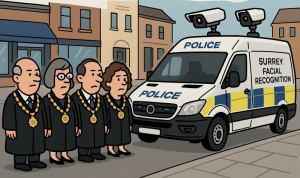
Surrey Police’s AI powered face recognition cameras in the spotlight
8 February 2026
Surrey Police will continue to use AI-powered surveillance vans to scan thousands of people’s faces in public locations despite fears over ethnic bias, said councillors calling for their use to be put on hold.
The Home Office is funding the use of new artificial intelligence powered cameras in Surrey to scan the faces of anybody who crosses their path.
On November 26 last year, the police brought the technology to Woking and recorded 7,686 people over a five-hour recording period – to cross reference them against known suspects.
The force has said the system was safe following a 2023 study that found previous bias in the system had been coded out – but more recent testing by the National Physical Laboratory suggests false positives are still happening too frequently among ethnic minorities.
The report read: “At the operational setting used by police, the testing identified that in a limited set of circumstances the algorithm is more likely to incorrectly include some demographic groups in its search results.”
The Home Office has said will act on the findings and that a “new algorithm has been procured and independently tested, which can be used at settings with no significant demographic variation in performance.
The new algorithm is due to be operationally tested early next year and will be subject to evaluation.”
It has led to calls from Woking Borough Councillors for the system to be mothballed until it has been thoroughly tested – something which Surrey Police has so far refused to do.
Speaking at a Tuesday, December 20, meeting of the borough’s communities and housing scrutiny committee, Surrey Police Chief Inspector Andy Hill described the system as having the support of the Home Office and said it was a valuable tool “to keep Surrey safe.”
He said: “It’s a safe place but if we’ve got the opportunity to use the latest technology then we want to make sure that we are doing that.” Early versions of the software created false alerts at a disproportionate rate among ethnic groups.
In London the Met Police is facing a High Court challenge after an anti-knife crime activist said he was misidentified and threatened with arrest. Surrey Police said it was confident in the system and that people are only arrested under suspicion, it does not mean guilt.
The technology is used in high footfall areas and is said to have a chilling effect on crime with notable falls in the following weeks after its deployment.
Any images that do not match those on its wanted list are instantly deleted. Matched faces are deleted at the end of the day. If the system thinks it has found a face on the police’s wanted database officers at the scene are notified and it is up to them how to proceed.
Committee chair Cllr Tom Bonsundy-O’Bryan said: “I have very serious concerns about the proportionality of this. Are the pros, which feels pretty limited in one of the safest town centres in the UK, worth the cost of 7,000 free citizens having their faces scanned by this technology?
“This doesn’t feel like targeted policing, it doesn’t feel like proportionate policing. It starts to feel like something more Orwellian in a kind of mass surveillance. With everything that you’ve said, all the facts about data not being stored, data not being used to train models
“It still feels like an overreach into people’s privacy, people’s rights fundamentally. Is there a point when it’s not proportionate, how many faces should we scan? To me it already feels vastly disproportionate.”
Chief Insp Hill said: “We are in the view that it is proportionate and it is appropriate and it is technology available to us. We don’t feel like we are reaching into a technology space. The van is funded by the Home Office, it’s why we want to continue using it but also keep it under review.”
Goldman sacks the Epsom and Ewell Residents Association
8 February 2026
A councillor representing Nonsuch ward has become the latest member of Epsom and Ewell Borough Council to change political alignment mid-term, with Shanice Goldman joining the Conservative group.
Cllr Goldman, first elected in May 2023, said her decision was based on where she believed she could be “most effective” in achieving practical outcomes for residents, rather than on ideology or internal party politics. She cited concerns about governance, the Local Plan and the council’s approach to parish councils as key factors influencing her move.
Her defection comes amid a period of visible political flux at Epsom and Ewell Borough Council, which is currently controlled by the Residents’ Associations (RAs). In recent months, College ward councillor Julie Morris left the Liberal Democrats to sit as an Independent, while Alex Coley departed the RA group, also choosing to continue as an Independent councillor.
In a statement explaining her decision, Cllr Goldman said she had found it increasingly difficult to support an administration she felt was not sufficiently focused on delivery or long-term outcomes. She said her priorities were better aligned with the Conservatives’ approach to accountability, governance and service delivery, adding that any local government reform should be “resident-focused, evidence-led, and driven by improved service delivery rather than structural change for its own sake”.
She also pointed to Conservative positions on safety, the Green Belt and scrutiny of council decision-making as factors in her decision, while stressing that her core priorities for residents had not changed.
The move was welcomed by local Conservative officers, who used the announcement to criticise the Residents’ Association-led administration’s record on council management, the Local Plan and parish council proposals. They said Cllr Goldman’s arrival strengthened their group’s capacity to challenge the council on behalf of residents.
Cllr Goldman said she would continue to focus on improving safety, quality of life and transparency in decision-making for residents of Nonsuch ward.
Her change of affiliation does not alter the overall control of the council, but it adds to a growing pattern of councillors stepping away from their original party groupings during the current term, raising wider questions about cohesion, governance and political direction at the borough council.
Though Conservative controlled Reigate and Banstead Borough Council has the lowest per capita debt of the 11 Surrey districts councils the three super-league mass indebted Councils were or are run by Conservatives at the relevant period of debt accumulation. See today’s Epsom and Ewell Times editorial: Process matters — but so does the balance sheet.