Epsom and Ewell Times

Current
ISSN 2753-2771

Young Surrey volunteers help shape new neuroinclusive travel app

Young people in Surrey have helped test a new travel-planning app designed to make public transport less stressful for neurodivergent passengers. Members of ATLAS, Surrey Youth Voice’s participation group for young people with additional needs and disabilities, spent three days trialling Aubin, a free app that takes a different approach to journey planning.

Unlike standard apps that prioritise the quickest route, Aubin focuses on reducing anxiety and supporting users who may find travel overwhelming. The app allows travellers to tailor their journey according to personal needs, rather than simply finding the fastest option. ATLAS members used it to plan and carry out trips across North, East and West Surrey, assessing how effectively it helped with independence and confidence.

Aubin functions as both a route planner and a “travel companion”. Alongside directions, it offers practical tools to support users in moments of uncertainty. These include grounding exercises to help regulate emotions during difficult points in a journey; a type-to-speech feature for anyone who may struggle to speak when stressed; and an editable Autism Card that allows travellers to explain needs quickly and discreetly to staff or fellow passengers. Users can also set preferences that shape the route suggested, such as avoiding busy interchanges or long waits.

ATLAS has long advocated for more accessible, neuroinclusive transport options, arguing that navigating public transport is essential for young people to reach education, work and social opportunities. Members described the trial as a chance to influence a product that could help reduce isolation and build independence for others with similar needs.

At the end of the pilot, ATLAS met with Aubin’s co-founder and product manager, Corinna Smiles, to give detailed feedback. Suggestions included adding journey-sharing options so a trusted contact can follow someone’s progress, communication prompts for stressful situations, and a checklist to help users prepare before leaving home. Aubin welcomed the recommendations and said they would incorporate them into future updates.

Ms Smiles said the pilot was a valuable example of user-led design and thanked the group for helping shape the app. ATLAS members have since given Aubin their “seal of approval”, encouraging other neurodivergent young people to try it.

ATLAS member Emily said taking part “felt empowering” and that knowing the group’s input would help autistic travellers made the experience worthwhile: “I feel honoured to have been part of shaping this app, which I’m sure will give many people the tools to travel with confidence.”

Councillor Helyn Clack, Deputy Cabinet Member for Children, Families and Lifelong Learning, said the collaboration showed the importance of designing tools with “the voices of the community they serve”, and that the app has real potential to improve accessibility.

Aubin is free to download from app stores.

Sam Jones – Reporter

Image – Surrey County Council news


Surrey fast to introduce slow speed limits?

20mph speed limits could soon be introduced across three Surrey neighbourhoods, with residents now invited to give their views.

Surrey County Council is consulting on new slower-speed zones in Barnsbury and Bonsey Lane in Woking, the Goodwyns estate in Dorking, and the Parsonage Road area of Cranleigh. The aim, the council says, is to make streets safer and more pleasant for people travelling on foot, bike and especially children heading to and from school.

Speed surveys carried out by the council show drivers in all three areas are already mostly respecting limits, meaning the new rules could be brought in without speed bumps or chicanes. In Woking, some “light-touch” measures such as vehicle-activated signs or painted roundels could be added on Bonsey Lane as an extra reminder to keep speeds down.

If approved, the schemes would each cost around £20,000 from a budget specifically set aside for 20mph zones. Details on the council’s website highlight that money cannot be spent on potholes or other road maintenance, which is funded separately.

Residents may spot a few extra road signs, though council officers say they will only install what’s needed and will make use of existing posts wherever possible to avoid cluttering pavements.

Currently, there are no plans for police to step up enforcement. Instead Surrey said the new limits must “self-enforce” and remain credible to drivers. Information online stressed that action should not wait for someone to be hurt: slower traffic means fewer crashes, and those that do happen are much less severe.

The consultation website read: “Research suggests 20 mph schemes do not increase air pollution. Slower vehicle speeds support a shift to more walking, scooting and cycling and then fewer polluting vehicles on the roads. 20 mph schemes can also encourage a smoother driving style with less acceleration and deceleration between junctions and pedestrian crossings.

“The amount of fuel a vehicle uses is mainly influenced by the way we drive – driving at a consistent speed is better than stopping and starting. Accelerating up to 30 mph can take twice as much energy as speeding up to 20 mph.

“Some people are concerned that 20 mph may lead to increased journey times. However, most of the delays that occur for motor vehicles in built up areas are at junctions, rather than the roads between junctions.”

Plans and maps for each scheme are now available online, and residents living in or near the affected roads are being encouraged to take part in the consultation and share their feedback.

Emily Dalton LDRS

Related reports:

Surrey examines a plea for a 20mph road

Mixed responses in Surrey to 20mph zones

I want to resist 20mph speed limits

Image: 20mph sign. Picture taken by LDR. Permission for use by all partners.


Surrey University balloon study of solar flares informs current air safety concerns

New balloon-mounted radiation probes developed by the Surrey Space Centre at the University of Surrey have captured their first readings of a major solar storm, confirming that levels of cosmic radiation at typical cruising altitude briefly surged to their highest point in almost two decades. The findings come as aviation authorities worldwide are responding to unrelated but highly publicised technical concerns affecting a small number of long-haul aircraft, prompting the UK Transport Secretary to offer public reassurance.

The powerful X5-class solar flare recorded on 11 November 2025 triggered a rare Ground Level Enhancement (GLE), in which solar energetic particles penetrated unusually deep into the atmosphere. Within an hour, the UK Met Office and the Dutch meteorological agency KNMI launched rapid-response weather balloons equipped with Surrey’s newly developed sensors, sending them through commercial-aircraft altitudes and far higher.

Early analysis shows that radiation at 40,000 feet briefly reached almost ten times normal background levels. Scientists stress that the spike posed no immediate health risk to passengers or crew, but they note the potential for temporary pressure on aircraft electronics. Surrey researchers estimate that during the storm’s peak, “single-event upsets” — tiny, unpredictable bit-flips in onboard computer memory caused by energetic particles — may have reached around 60 errors per hour per gigabyte.

Clive Dyer of the Surrey Space Centre said the November surge was the strongest event of its kind since December 2006, with new UK neutron monitors at Guildford, Lerwick and Camborne helping to map the storm’s radiation footprint across global airspace. Researchers emphasise that while far larger historical events are known — including the record 1956 radiation storm and the ancient “Miyake Events” revealed through tree rings — such extremes have never struck during the modern aviation era.

The renewed scientific focus on space weather arrives during a period of public sensitivity around flight safety. In recent days, several international carriers have reported technical issues affecting specific aircraft types, prompting precautionary inspections and, in some jurisdictions, temporary operational restrictions. Although no link has been made between these aircraft issues and solar activity, the incidents have heightened passenger concern.

Transport Secretary Heidi Alexander, responding to the situation, said: “I am aware of the technical issue impacting certain aircraft and concerns over how this will affect passengers and flights this evening. Passengers who are due to fly this weekend should check with their carriers for the latest information. The good news is it seems the impact on UK airlines seems limited with a smaller number of aircraft requiring more complex software and hardware changes. I would really like to thank the experts, staff and airlines who are working at pace to address this and reassure passengers that work is ongoing. It is heartening this issue has been identified and will be addressed so swiftly, demonstrating the high aviation safety standards globally.”

The Surrey sensors, engineered to withstand near-vacuum conditions and temperatures down to –70°C, stream real-time radiation data up to 100,000 feet. Their results will be used to refine models at the Met Office Space Weather Operations Centre, improving forecasting for sectors reliant on high-altitude electronics, including aviation.

Keith Ryden, Director of Surrey Space Centre, said the 11 November flare provided the team’s first opportunity to use the rapid-launch sensors in a live event, producing a “3D picture” of radiation patterns across UK airspace. Met Office Space Weather Manager Krista Hammond added that this is the first time radiation has been measured across such a broad range of altitudes during a solar storm, describing the new data as “a big leap forward” for forecasting capability.

Further launches are planned from Met Office sites in Lerwick and Camborne, and from KNMI in the Netherlands, as the current solar cycle moves into a more active phase. Aviation regulators say the Surrey results will help inform future operational guidance during solar storms, while the Transport Secretary emphasised that UK passenger safety remains “of the highest priority”.

Sam Jones – Reporter


Tunnel vision for Heathrow’s 3rd runway?

Heathrow Airport’s plan for a third runway – requiring a major re-routing and tunnelling of the M25 – has received Government backing as the preferred option for expansion. A competing proposal for a smaller runway put forward by Arora has been rejected. Heathrow welcomed the decision to proceed with the 3,500m runway, arguing it would deliver economic gains and improved passenger experience. Critics have long criticised the plan, saying it undermines climate targets and that the motorway works risk repeating the chaos seen with the delayed A3/M25 junction upgrade, potentially bringing parts of Surrey to regular standstills. Heathrow insists the M25 realignment would be built on adjacent land, allowing the switch to the new carriageway to take place “in a series of carefully planned overnight operations”.

A Heathrow spokesperson said the expansion would mean “more connectivity, increased trade, improved passenger experience and a huge economic boost for the British businesses that will help design and build it”, but added that “further clarity” is required on regulation of the next phase. “We need definitive decisions from the CAA and Government by mid-December so that delay to the project can be avoided and we can get on with delivering this vital project for our customers and for the UK.” The £33 billion scheme is expected to be entirely privately funded. Around £21bn would cover the runway works, including £1.5bn for the M25 realignment, with £12bn for new terminal infrastructure. Heathrow says it will also invest £15bn to modernise existing facilities, including a new terminal “T5X”, an expanded Terminal 2 and three new satellite buildings.

In 2024 the airport handled 83.9 million passengers, operating at 99% of its annual flight cap of 480,000 flights. The expansion would lift these to 756,000 flights and around 150 million passengers. Heathrow’s plan will now inform the review of the Airports National Policy Statement (ANPS), the framework on which the eventual planning decision will be based. The Government said Heathrow’s proposal is the most deliverable and most likely of the options to be approved before the next general election. The Department for Transport stressed this is not a final decision; any changes to the ANPS will be subject to consultation and parliamentary scrutiny next year, with details such as runway length, layout and infrastructure impacts considered throughout the review.

Transport Secretary Heidi Alexander said Heathrow is the UK’s only hub airport, supporting “trade, tourism and hundreds of thousands of jobs”, adding that the announcement is “another important step to enable a third runway and build on these benefits”. She said the Government is acting “swiftly and decisively” to realise the project’s potential for passengers, businesses and the wider economy. Ministers also said the scheme must comply with legally binding climate obligations, while balancing economic growth, as well as air quality and noise requirements. The independent Climate Change Committee will be consulted to ensure compatibility with the UK’s net-zero framework. A planning application is expected after the ANPS review is complete.

In a promotional video, Heathrow sought to reassure the public about the M25 works: “We understand people may be concerned this could cause congestion or delays. Following previous consultation with National Highways we have developed a smarter solution. We build the future right next to the present. The vast majority of construction happens off-line. A new realigned section of the M25 is built on adjacent land while the current motorway operates as normal and the tunnels and bridges for a new runway are constructed while minimising impact on the airport or the existing motorway. Then in a series of carefully planned overnight operations, we make the switch. Traffic is transferred on to the new alignment with minimal disruption. Our approach also ensures local traffic and access for surrounding communities are kept moving with minimal disruption. This frees up the old route of the M25, creating a safe, traffic-free zone to build the final parts of the runway. The result is an upgraded and expanded M25, with new link roads separating M4 traffic from M25 mainline journeys, easing congestion and improving safety.”

Chris Caulfield LDRS

Heathrow shown with a third runway over the M25 (image Heathrow)

Related reports:

Conditional nod to southern rail link to Heathrow

Environment News Transport

Heathrow expansion – what it may mean for Epsom

Heathrow expansion reaction


British Railways’ 200 year celebration train coming to Epsom

Free exhibition train to steam into Tattenham Corner

A free exhibition train celebrating 200 years of the modern railway will arrive at Tattenham Corner station next March as part of a 60-stop national tour.

More than 40,000 people have already visited the touring train, named Inspiration, which forms a centrepiece of Railway 200, the nationwide programme marking two centuries since the opening of the Stockton and Darlington Railway in 1825. Nine in ten visitors say they would recommend it to a friend.

What visitors can expect

Co-curated with the National Railway Museum, Inspiration explores how rail reshaped Britain and the wider world. Displays chart key “railway firsts”, interactive engineering challenges and a rapid tour of lesser-known railway careers. The exhibition has been praised as “brilliant”, “fascinating” and suitable for all ages.

One visitor reported: “I loved that it was interactive. I visited with people from age 18 to 85 and there was something for everyone.” Another said even their five-year-old “absolutely loved it”.

The train will be hosted by Southern at Tattenham Corner station from 9 to 11 March 2026. Tickets are free but limited.

Tattenham Corner’s royal railway history

Tattenham Corner station itself has a long connection with major public events. Opened in 1901, the station was built to provide easier rail access to the Epsom Downs racecourse, particularly for the Derby. According to local historical accounts, the new station offered an alternative to the original Epsom Downs station, which at the time had nine platforms and could be overwhelmed by Derby-day crowds.

It is widely understood that the creation of Tattenham Corner station was encouraged so that Queen Victoria, in the final months of her reign, could travel to the racecourse with greater ease and avoid the congestion associated with the older, much busier station. The new alignment brought passengers directly to the famous turn on the Downs from which the station takes its name.

In the decades that followed, Tattenham Corner became a focal arrival point for racegoers, and extra services still run on major racing days.

A milestone for Britain’s railways

Railway 200 marks two centuries since Stephenson’s Locomotion No. 1 steamed along the Stockton and Darlington line, an innovation that changed global travel, encouraged mass tourism, shaped timekeeping and sped up industrial development.

The anniversary year has already included a re-run of the original 1825 journey watched by around 100,000 people, commemorative stamps and coins, a global “whistle-up” of more than 200 locomotives, and what organisers describe as the world’s largest rail festival.

Angie Doll, Chief Executive of Govia Thameslink Railway, said: “Two hundred years ago the modern railway came into existence and utterly transformed our society. Working together, we hope to educate and inspire young people in rail’s past and future. The railway is great for the climate, and helps our local communities thrive.”

Emma Roberts, Programme Manager for Railway 200, added: “Inspiration is a fun, free and fascinating way to learn about the past, present and future of rail. There’s something for everyone.”

Rail Minister Lord Peter Hendy called Britain “the birthplace of the modern railway” and said the touring train aims to inspire a new generation of engineers, drivers, conductors and technicians.

The exhibition has been supported by a £250,000 National Lottery Heritage Fund grant, with Porterbrook providing the livery for the train.

Tickets

Tickets for the Tattenham Corner visit are free but must be booked in advance.

Sam Jones – Reporter


Nescot students’ artwork brightens Ewell East Station

Artwork by Nescot’s Level 3 Art and Digital Design students is now on display at Ewell East Station as part of Art@theStation, a national initiative bringing young artists’ work into public transport spaces.

Commissioned by The Arts Society Epsom and funded by Govia Thameslink Railway, this is the second collaboration with the college. Their first commission, exhibited in 2024, is still on show at Epsom Station.

“Sense of Place – Ewell”

Students were asked to create portrait-format designs themed around Sense of Place – Ewell, using bold silhouettes and bright colours to reflect local landmarks. Four students – Jess, Emma, Cate and Sarah – were selected for display and each received a certificate and a £25 prize.

Sarah’s design features Bourne Hall Museum. She said working collaboratively “just like in the art industry” had been one of the highlights, adding that the digital skills gained at college had been “invaluable”. Cate’s design, inspired by Bourne Hall Park and the Dog Gate entrance, left her “thrilled” when selected. She said researching the history behind her piece had been fascinating and that seeing her work displayed publicly was “a proud moment”.

Jess and Emma, whose pieces depict well-known Ewell Village landmarks, said the project strengthened their digital design skills and that they enjoyed working as a team.

Building skills and confidence

Tutor Demonstrator Miles Merritt said the project offered “a brilliant opportunity” for students to build confidence and professional experience. He praised the chance for learners to work to a live brief and deadline and to enhance their portfolios ahead of further study.

He added thanks to The Arts Society Epsom for providing a platform to showcase student creativity, saying the college looked forward to future collaborations.

Praise from The Arts Society Epsom

Angie Child, Project Lead for Art@theStation, said she was “delighted” with the students’ graphic designs, noting their use of vibrant colour to bring clarity and impact to familiar Ewell landmarks. She said each student showed a “mature approach to commercial design” and a clear passion for pursuing creative careers. She also commended Miles Merritt for supporting the students throughout the project.

Supporting young artists

Art@theStation is part of a wider national initiative developed by The Arts Society, giving young artists the rare chance to exhibit work in waiting rooms, ticket halls and on platforms across Britain. The scheme aims both to improve the station environment and to give travellers an unexpected cultural experience.

Photo: (left to right): Tudor Evans, Ewell East Station Manager; Alistair McGeachey, Chair of The Arts Society Epsom; Nescot Level 3 students Jess, Emma, Sarah and Cate; and project lead Angie Child.

Sam Jones – Reporter

Related reports:

Ewell’s Nescot student’s work selected for Origins Creatives 2025

Ewell East underpass transformed by new community mural

Young Artists Brighten Up Tattenham Corner Station


Conditional nod to southern rail link to Heathrow

Spelthorne Borough Council has agreed to support a new rail link between Staines-upon-Thames and Heathrow Airport, but only on strict environmental and local benefit conditions.

The proposed Heathrow Southern Rail (HSR) scheme would connect Heathrow Terminal 5 directly to the south-west rail network, using existing track between Staines and Windsor before running in a new tunnel under Staines Moor. Supporters say it could slash road congestion, help people reach work at the airport, and give the town’s economy a boost.

Councillors say they welcome the idea in principle but have made clear that their backing comes with safeguards. They want guarantees that trains will actually stop at Staines, that there will be no damage to the sensitive Staines Moor landscape, and that the council will get to sign off on final plans once detailed studies are complete.

Cllr Chris Bateson, who led the council’s review, told the BBC’s Local Democracy Reporting Service: “We’ve looked at both proposals in detail. A direct rail link from Staines to Heathrow could reduce congestion and support our local economy. But we must protect Staines Moor and make sure residents benefit.”

His colleague, Cllr Howard Williams, chair of the Business, Infrastructure and Growth Committee, added: “Our support relies on clear guarantees. The environment can’t pay the price for progress. We will keep working with HSR to make sure residents’ interests come first.”

The link would run mainly in tunnel to limit disruption, emerging to join the existing railway near Staines. The promoter, Heathrow Southern Railway Ltd, says the route could remove millions of car journeys to the airport every year and cut thousands of tonnes of carbon emissions.

If built, the line could open in the second half of this decade, though no firm construction timetable has yet been confirmed. Earlier proposals suggested the service could be running between 2026 and 2028, offering a six-minute journey from Staines to Heathrow Terminal 5.

An alternative “Southern Light Rail” idea — which would have involved a surface-level route — was rejected by councillors as too intrusive, with greater impact on privacy and the landscape.

While the majority of councillors supported the HSR plan with safeguards, some voiced concern that the benefits might not be evenly spread across the borough, particularly in Stanwell, where many residents already work at the airport.

The council says it will continue talks with HSR to ensure local voices are heard before any final decision. For now, the message from Spelthorne is clear: Heathrow’s southern rail link is welcome — but not at the expense of Staines Moor or local control.

Sam Jones – Reporter

Photo: Train sign (Credit: Spelthorne Borough Council)

Related reports:

Surrey’s new rail link to Heathrow?


Vital Surrey bus reduced from hourly to three mornings a week

People who wait for buses are often left disappointed and that only looks set to continue after the company behind an axed service said it was “not likely” to return. Residents in Horley gathered at what they have dubbed a ‘ghost’ stop in protest to the axing of the hourly 424 bus which served their estate and went between the town centre and Gatwick Airport. It has left them with just a single service – but that just runs three mornings a week.

Councillor Neha Boghani, Green Party member for Horley East and Salfords said: “For Surrey County Council, whose strapline is ‘we leave no-one behind’, to cut buses this savagely without even any public consultation is shameful, and a dereliction of their commitment to serve all residents. Our residents deserve better.” One resident at the bus stop protest said the loss of the route had taken away her social life with another adding the impact had been unbelievable. She said: “There are so many elderly people and people with disabilities living around here and we can’t afford to keep taking taxis.”

Metrobus’s commercial director Nick Hill said the two-way loop the 424 used to run along made it unreliable and the decision was made to simplify the route. The detour through Horley Riverside Gardens Estate was then dropped to make scheduling more reliable and because it was so poorly used – it would only pick up passengers on one in five journeys. He said: “It is not likely that a conventional bus service will return to the area on a frequent basis due to such low demand. Residents in the area do also have other alternatives: much of the area is a short walk to access more frequent bus services.”

The dial-a-ride type service Surrey Connect is to be made available in the area and for Gatwick Airport. A spokesperson for Surrey County Council said they understood the disruptions alterations to bus services can make but that no areas have been left unserved by the cuts. They said: “Residents in the Horley Gardens Estate were previously served by Metrobus service 424, however data showed less than one passenger per journey travelled on most of the 424 journeys, which was unsustainable. This area continues to be served by local bus service 26 three days a week, providing links with Horley Town Centre and Hookwood Tesco, as well as the Surrey Connect service, which operates between 7am to 7pm weekdays and 8am to 6pm on Saturdays, with alternative services available for most passengers within a five-minute walk.”

“These changes form part of a wider review, which has seen the off-peak service 100 rerouted from Park 25 in Redhill, where data showed a usage of less than one passenger per journey, to instead serve residents in Westvale Park, Horley. This has enabled in the region of 4,000 otherwise isolated residents to be served, and initial patronage figures from the bus operator indicate that the number of passengers now travelling in the area have since quadrupled. Residents in Park 25 continue to be served by service 100 in the peak hours and on Sundays, and off-peak service 424 provides an hourly service throughout the day. We will continue to work alongside bus operators to create travel opportunities which encourage greater bus use and will keep the prospect of rerouting an alternative service via Park 25 under review.”

Chris Caulfield LDRS

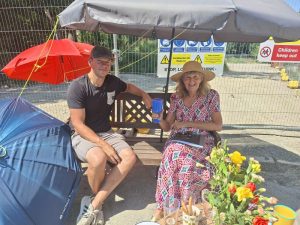
Image: Cllr Neha Boghani right), Green councillor for Horley East, with residents of the Gardens Estate, south Horley, at the ‘ghost bus stop’ where they used to get on the 424 Metrobus (image Cllr Boghani)


Surrey gets a sinking feeling over cost of its holes

Has Surrey become Britain’s sinkhole capital? Well, the figures certainly point in that direction.

Surrey County Council is on track to spend a staggering £1.6m fixing the collapsed 65ft hole in a section of Godstone High Street – a bill that dwarfs what most local authorities spend on sinkholes.

Figures obtained through Freedom of Information (FOI) requests show councils across the UK have spent more than £6.2m tackling over 7,000 sinkholes since 2020. But Surrey alone accounts for almost half of that total, shelling out over £3.1m making it by far the country’s biggest spender.

The Godstone collapse, which first appeared in February, has left the part of the High Street shut for months and businesses struggling.

Surrey County Council has already spent £850,000 on emergency responses, surveys, roadworks and consultancy fees, including £360,000 on just site establishment.

Another £800,000 is forecast for stabilisation work, filling in the mine tunnels, and further repairs – taking the final bill to £1.65m. This will amount to just over a quarter of the total UK bill on sinkholes for the last five years.

What is driving the cost?

The British Geological Society has stated that Surrey is particularly prone to sinkholes due to the underlying sands in the county, which are weakly cemented.

According to council documents, the ground beneath Godstone sits on the Folkestone Sandstone Formation – a weak, sandy foundation that made the area vulnerable to collapse. CCTV images provided under FOI request confirm the collapse was worsened by an old sand mine tunnel running beneath the High Street.

While the council insists the road should reopen by December 16, locals are not holding their breath. Residents have been struggling for months with the road closure, diversions, fall in trade and general feel of chaos. That being said, an official report shown to SurreyLive by the council does state that the project is tracking towards a final inspection date of December 16th.

A Surrey County Council spokesperson said: “This continues to be a highly complex incident involving a number of investigations led by our Highways Officers and other agencies, including specialist teams and utility companies.

“Work is underway to reconstruct the final footpath affected by the collapse and we’re now planning how we stabilise the collapsed area and fill in the tunnel network.

“We are updating local residents and businesses as we progress through each stage of the process and expect the final two residents to be back in their properties by the end of September.

“Once our stabilisation work and the SES works to reconnect and relay the mains through the collapse area are completed, the area will be refilled and repaired permanently. We are currently planning to complete our repairs and reopen the High Street during December.”

A nationwide problem

The Godstone collapse may be dramatic, but it’s part of a wider and growing problem. Since 2020, sinkholes have been recorded everywhere from Reading to Scotland, with councils spending millions to patch them up.

The top spenders after Surrey include Reading (£976,500), East Sussex (£767,238) and Transport Scotland (£602,000). If you take away the Godstone sinkhole expenditure, Surrey still comes up top with over £2.2m being put towards sinkholes.

Lloyd Allen, Infrastructure Team Manager for Surrey County Council, on Godstone high street. (Credit: Surrey County Council).

Emily Dalton LDRS

Additional reporting from Sam McEvans

Related reports:

Godstone’s gasworks fury while sinkhole not fixed

Godstone “Sink-hole” residents to return

Surrey sink-hole major incident


Half price Surrey bus journeys for under 20s soar to one million

19,000 young people aged 20 and under are now benefitting from 50% off bus journeys across Surrey.

The Surrey LINK card was developed by Surrey County Council in 2023 to give young people half price travel on all single and return bus journeys within the county.

Each month, 100,000 trips are now made using the card, with students travelling to higher education among the biggest users.

Matt Furniss, Cabinet Member for Transport, Infrastructure and Growth at Surrey County Council, said:

“I’m delighted that our scheme to offer half price bus travel to all our young people here in Surrey is proving so beneficial. We know that cost can be a barrier to people using public transport so we hope this significant discount will continue to make bus travel a more viable option, whilst also reducing car journeys across the county.

“This is part of our significant investment in bus travel and our efforts to encourage more people to use Surrey’s buses. We’re investing in making our buses greener including £32.3m for more ultra-low and zero emission buses and £6.3m for more ultra-low and zero emission community transport minibuses. A further £9m is being invested in bus priority measures to ensure buses turn up on time, and £1.4m in improving information for passengers at bus stops.”

Applications for the LINK card can be made at www.surreycc.gov.uk/surreylink.

Surrey County Council

.

Page 1
© 2021-2025. No content may be copied without the permission of Epsom and Ewell Times Ltd.
Registered office: Upper Chambers, 7 Waterloo Road, Epsom KT19 8AY