


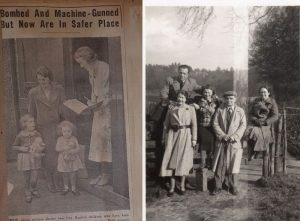
Rich historical records of how the small town of Dorking sheltered people fleeing Nazi persecution during World War Two are now fully searchable and publicly accessible online, thanks to a partnership between the University of Surrey and Dorking Museum.
Formally launched today (24 September), dorkingrefugeearchive.org digitises the papers of the Dorking and District Refugee Committee – a group of volunteers who were able to find housing, work and medical care for refugees arriving in the Surrey town between 1938 and 1949. Until now, the records, which are frequently requested by researchers, have only existed in paper form at the Dorking Museum.
The website organises the committee’s work into five themes – solidarity, caring for refugees, children, the post-war years and the people involved.
In collaboration with the history department at Dorking’s Ashcombe School, the project has also produced teaching resources, which are freely available to other schools, researchers and community groups.
Professor Constance Bantman, co-project lead and Head of Literature and Languages at the University of Surrey, said:
“Making this archive accessible means the stories held in these records, of both the refugees and the people of Dorking who supported them, can finally reach the audience they deserve. It is a resource for researchers, but just as importantly, it’s a resource for the town itself.”
Surrey first announced the project in May 2026, sharing individual stories held within the collection, including that of Sir Erich Reich, who arrived in Britain on a Kindertransport in 1939. Ralph Vaughan Williams (the composer) personally brought the four-year-old to safety in Dorking.
Dr Beth Palmer, co-project lead from the University of Surrey, said:
“These remarkable papers hold enormous detail, individual cases, letters, decisions that changed lives. Dorking’s history as a place of welcome and support is genuinely remarkable, and until now, only a small number of people knew about it. Putting the archive online, alongside resources for schools, means this chapter of Surrey’s history can be taught, studied and understood well beyond the archive’s four walls.”
Kathy Atherton, Chairman of the Dorking Museum, said:
“The Refugee Committee papers are among the archive’s most frequently requested resources. Digitisation not only opens them up to a far wider audience but also protects the physical fabric of the collection from over-handling by researchers.”
Related reports
- Dorking’s role as a refuge from Nazi oppression — the town’s organised support for people fleeing Nazi persecution from 1938. epsomandewelltimes.com
- Ugandan Asian refugees in Surrey 50 years on — recalls Surrey’s response to the 1972 expulsion from Uganda. epsomandewelltimes.com
- Flight of refugees: history repeating? — connects earlier refugee experiences with the work of the Epsom and Ewell Refugee Network. epsomandewelltimes.com
- Ukrainian refugees made welcome by King’s rep. — Surrey’s Vice Lord Lieutenant welcomes Ukrainians who found refuge in the county. epsomandewelltimes.com
- Epsom and Ewell Borough of Sanctuary — recognition of the borough’s continuing welcome to refugees of all nationalities. Epsom & Ewell Times