
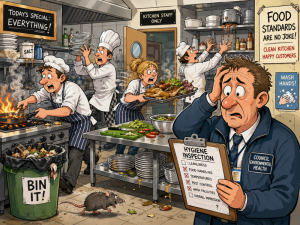
The borough’s environmental health team has told councillors it is running behind on lower-risk food hygiene inspections — deliberately prioritising higher-risk premises such as takeaways, schools and hospitals over sweet shops and home caterers — as the Environment Committee – Tuesday 30th June – adopted the council’s Food Hygiene Service Plan for 2026/27, in what officers confirmed will be the council’s last year running the service before Surrey-wide local government reorganisation.
Councils have a statutory duty, under a national Framework Agreement on Official Feed and Food Controls overseen by the Food Standards Agency (FSA), to inspect food businesses in their area at intervals set by risk category — broadly, the higher the risk, the more frequent the inspection. As of April 2026, the borough had 611 registered food premises, including 444 restaurants, cafés, canteens and other caterers and 139 retailers. Of these, 133 fall into the higher-risk categories A to C, requiring inspection every six, 12 or 18 months respectively; a further 120 businesses are newly registered and awaiting their first ever inspection.
Catching up, but not quite there
Public Protection Manager Oliver Nelson told the committee the service had actually exceeded its own targets in 2025/26, completing 237 inspections against a planned 161, largely by working through a backlog of overdue inspections and newly registered businesses that had not yet been visited. Even so, the plan for 2026/27 shows 207 scheduled inspections still due — including two Category A premises (the highest-risk tier, inspected every six months), 25 Category B, 77 Category C and 101 lower-risk Category D — plus a further 74 inspections reported as overdue from previous years.
Cllr Steve McCormick (Conservative Woodcote and Langley) pressed officers on why these 74 remained outstanding, and — more pointedly — “why is this statutory service unable to meet this demand, and how can we approve a plan that cannot deliver?” Mr Nelson said the situation was “not unusual” for a local authority environmental health team: the overdue premises are “mainly category E” — meaning very low-risk operations such as sweet shops and small-scale or domestic home caterers — which have been deliberately “deprioritised in favour of food production facilities, schools, hospitals, takeaways” and other higher-risk categories. He explained that his team juggles “four or five different” statutory service areas across several council committees competing for the same limited resources: “It’s a daily task to try and arrange yourself to cover all those bases,” he said, “and what happens is that the lower risk areas are deprioritised in favour of the higher risk every time.”
Staffing pressures and past scrutiny
The report notes that the service has struggled with staff retention, and that a newly created post remains vacant and covered by agency staff — leaving the small team vulnerable, officers said, since even a single experienced officer leaving risks non-compliance with statutory duties. Historically, 1.2 full-time-equivalent officers have been sufficient to meet the Food Law Code of Practice’s requirements for the borough, a level the service says it can currently sustain provided staffing and agency support remain stable.
Cllr McCormick also asked about a reference in the report to “the existing agreed action plan arising from previous Food Standards Agency intervention” — asking what that intervention had covered, and when the service was last formally audited. Mr Nelson could not recall the exact audit date on the night, estimating it was “probably in the last four years,” and agreed to circulate fuller details after the meeting. He said the earlier FSA intervention had flagged underperformance not just in the lowest-risk category but also in Categories B and C, at a time when staff resources had been diverted towards private sector housing casework.
The wider context: a service in its final year
In an unusually reflective note buried in the report’s final section, officers wrote that 2026/27 “will be the final year of delivery of this service by this authority following 90 years of work in the field by Inspectors of Nuisances, Sanitary Inspectors, Public Health Officers and finally Environmental Health Officers” — a reference to the borough council’s abolition under Surrey’s local government reorganisation, with food safety functions due to transfer to a new unitary authority from April 2027.
Elsewhere, Mr Nelson noted that several web links in the appended service plan had broken because the Food Standards Agency had migrated its guidance to the gov.uk website: “If any members of the committee would like those documents, I’m sure Google will be their friend,” he said.
Enforcement activity and the vote
During 2025/26 the service issued four hygiene improvement notices and 200 written warnings to food businesses. No food or environmental samples were taken during the year, officers said, as priority was given to the inspection programme; a separate allocation of around £2,800 a year from the UK Health Security Agency (UKHSA) funds routine microbiological sampling, alongside a local £450 budget for chemical sampling in 2026/27.
The committee voted to adopt the Food Hygiene Service Plan for 2026/27, with one councillor voting against.