


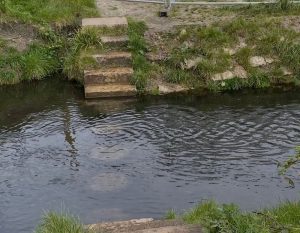
Epsom and Ewell Borough Council’s Environment Committee – Tuesday 30th June – has decided not to take on legal responsibility for the historic stepping stones across the Hogsmill River, after councillors concluded that accepting liability for a crossing already flagged as unsafe was too great a risk — instead backing a bid to build a new, fully accessible footbridge nearby.
The stepping stones, thought to have been installed in the early 1980s, sit within the Hogsmill Local Nature Reserve and are owned by the Environment Agency (EA), which — unusually — owns both the riverbed and the banks at this location. The EA has told the council it wants to remove the stones and the steps leading down to them on safety grounds, unless another organisation takes on responsibility for their ongoing inspection, maintenance and insurance.
Why now?
Countryside Manager Stuart Cocker told the committee two problems had brought matters to a head. First, the concrete steps on the northern bank have been undermined by dogs entering and leaving the water at that point, creating a risk of collapse — the first significant repair needed on the crossing “in over 40 years,” he said, with a repair cost of under £1,000. Second, a new wetland outflow channel built as part of nearby habitat restoration work has altered water levels, meaning the stones are now submerged, and therefore slippery, for much longer periods than in the past. The EA erected barriers preventing access to the stones in September 2025 following its own risk assessment.
Mr Cocker stressed that the EA remains an active partner in the wider Hogsmill Catchment Partnership, alongside the South East Rivers Trust, and pointed to what he called significant progress over 15 to 20 years, including “new meanders in the River Hogsmill,” removal of concrete weirs, “naturalising large sections of the river channel” and reintroducing fish.
He also had some encouraging news on the water-level problem: the South East Rivers Trust has secured the Environment Agency’s permission to move gravel that has built up at the confluence with the new wetland channel, work being paid for as a “public good” clause within a separate CIL-funded contract to restore a nearby footpath. “We’re fairly confident that that will cause the water levels to recede,” Mr Cocker said, though he cautioned it might need repeating. Asked directly whether this work would persuade the EA to keep responsibility for the crossing after all, he was clear: “From what they’ve said, they still wish the stepping stones to be removed. That’s their intention” — a decision he said rests with the EA’s asset management team, based purely on flood-risk grounds, and unaffected by the availability of funds for anything beyond flood mitigation.
Four options, and a difficult choice
Officers set out four options for the committee: take on liability for the stones with no bridge; take on liability and build a bridge; decline liability but still pursue a bridge; or decline liability and accept the stones’ removal with no bridge. A Community Infrastructure Levy (CIL) bid for a new pedestrian footbridge — of the kind already built nearby across the wetland outflow channel, at a cost of around £130,000 — has already been submitted, though the outcome is not yet known, and design and planning costs on top of any successful bid would still need to be found separately.
Councillors were, without exception, reluctant to see the stones disappear. Cllr Rob Geleit (Labour Court) told the committee: “I’m afraid I’m one of those people who used to play there as a child, and I think there’s always an element of risk in places where children play, especially when there’s water, but I would hate to see the stepping stones gone. So, I’d like to say, please don’t take the toys away.” Cllr Julie Morris (Independent College) said she had researched the issue and found that stepping-stone river crossings of this kind are now rare in the south of England outside Box Hill: “I haven’t really heard anybody speak in favour of getting rid of the stepping stones entirely,” she said, though she accepted that without identified funding for the fuller package of repairs, a more modest package of gravel-clearing, a handrail and a warning sign might be “a sort of halfway house at the moment.”
Cllr Steve McCormick (Conservative Woodcote and Langley) said he was “100% behind” retaining the stones and covering the modest repair cost, but was sharply critical of the bridge costings in the report, which he said “do not illustrate the full picture,” since design and planning funding was not specified and would in any case need approval from the Strategy and Resources Committee rather than this one. He also pressed officers on what work had been done, in the years since the Hogsmill Local Nature Reserve’s management plan (which runs from 2017 to 2117, with its first review due in 2027) identified bank erosion by the stepping stones as an issue needing the Environment Agency’s attention, to actually secure that work — a question Mr Cocker answered by pointing to the partnership’s broader achievements rather than action on this specific spot.
The liability question
It was Cllr Rachel King (RA Town) — sitting as a substitute, and drawing on her day job dealing with insurance claims — who made the most pointed intervention against the council accepting responsibility. “You cannot sign your way out of liability,” she told the committee, warning that no amount of warning signage removes an organisation’s underlying duty of care. “I don’t think we should be taking on that liability, because we know from the report currently that they are not safe, and until they are made safe, we wouldn’t want to burden ourselves with that kind of responsibility.” She later added that the committee risked “accepting liability” before the legal review, inspection regime and insurance implications flagged in the report had actually been worked through: “It feels a bit too, too big a risk to move forward in that direction without having done that work first.”
Cllr Steve Bridger (RA Stamford) raised a related, practical worry: that even if the stones were kept safely maintained, the steps leading down to the water would remain a magnet for children paddling regardless — and he warned that a single successful insurance claim could send premiums “up astronomically,” potentially forcing the council’s hand later anyway. Officers confirmed that if the council did not take on responsibility, the EA intends to remove both the steps and the stones.
Committee Chair Cllr Liz Frost (RA Woodcote and Langley) also noted a case for the bridge on its own merits, separate from the liability question: with the new wetland habitat drawing more visitors to the area, she said, a bridge would open up access “for a lot more people,” including those with prams, pushchairs or bikes who cannot manage the current steps and stones.
The vote
Put to a vote option by option, the committee settled on Option 3: the council will not take on liability for the stepping stones or the steps leading to them, acknowledging that the Environment Agency may proceed to remove them, but will pursue a new, fully accessible footbridge as an alternative crossing, subject to the outcome of the CIL funding bid and further funding being secured for design and planning. Councillors formally noted the CIL application, while the report’s third recommendation — covering ongoing inspection and maintenance costs for the stones — fell away as a consequence of the vote. Closing the item, Cllr Frost reflected: “I think it’s a very difficult one, because I think we all acknowledge how much we like the stepping stones, and I really hope that somebody else will be able to take on the responsibility, but that’s not really for this meeting.”

.
Photo: Stepping Stones – Hogsmill River. Credit Brigitte Jeffs