


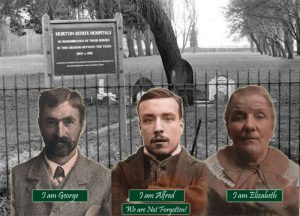
On the edge of Epsom lies Horton Cemetery — quiet, overgrown and easy to miss. More than 9,000 people are buried there. Most never had headstones. Many never had visitors. Almost all were patients of the former Epsom Cluster of psychiatric hospitals, men and women whose final resting place reflects how society once viewed mental illness: something to be hidden, managed and ultimately forgotten.
In 2026, on Time to Talk Day, [5th February] Horton Cemetery forces us to ask an uncomfortable question: how far have we really come?
Horton Cemetery was created to serve what was once the largest cluster of psychiatric hospitals in Europe. At its height, the Epsom hospitals housed thousands of people with severe mental illness, learning disabilities and complex needs. Those who died without family or money were buried together anonymously. This was not ancient history. Horton Hospital closed in 1997. Some of those buried there lived into the late twentieth century — into the era many of us think of as modern and progressive.
Sites like Horton Cemetery challenge us to ask not just whether we are talking more openly about mental health, but whether we have truly confronted the stigma that shaped places like this, and whether we are prepared to protect the dignity of those still buried there.
Today, the cemetery has been sold to a private owner, with hopes of future development. Like many historic pauper burial sites nationwide, it sits under pressure from land values and planning decisions. I have urged the government not to grant exhumation licences at Horton Cemetery and to properly safeguard similar sites as places of remembrance, not obstacles to development. These are not empty plots. They are graves. How we treat them matters, because how we remember the dead reflects how we value the living.
Friends of Horton Cemetery, families, and Professor Alana Harris of King’s College London have worked tirelessly through initiatives such as the Lost Souls Project, which seeks to recover the names and stories of those buried anonymously in former asylum cemeteries. Their work is a quiet act of justice — restoring identity where the system erased it, and dignity where stigma once prevailed.
But local efforts can only go so far. That is why there are growing calls for a national memorial to those who lived and died in Britain’s historic mental health institutions. Such a memorial would not rewrite history, but it would acknowledge it, signifying that now is the time to talk.
Time to Talk Day is often framed around everyday conversations — a coffee and a chat, a poster on a train reminding us to check in on loved ones. These things matter. They help chip away at silence and shame. Horton Cemetery asks us to go further.
Epsom tells the story of how this country has treated mental illness. It was once the centre of a system built on isolation and control. Today, it hosts the headquarters of the Samaritans — an organisation rooted in compassion and listening. That journey should give us hope. But it also gives Epsom, and Horton, a responsibility. If we are serious about confronting mental health stigma, this is one of the places where that conversation must begin.
Because today, people with severe mental illness still face some of the deepest inequalities in our society. Recent data paints a stark picture: those facing the longest waits for mental health care are now waiting nearly two years — an average of 658 days — more than twice as long as people waiting for elective physical health treatment. The consequences are devastating. Adults living with severe mental illness, including bipolar disorder and schizophrenia, have a life expectancy 15 to 20 years lower than the general population.
These are not abstract statistics. They reflect lives cut short, needs unmet, and a system that still too often talks about people with severe mental illness rather than listening to them.
The Government now has the opportunity — and the responsibility — to show that mental health reform means more than warm words. Safeguarding sites like Horton and recognising the historic mistreatment of people with mental illness would be a powerful signal that dignity is not conditional and remembrance matters. I look forward to discussions with ministers about how we protect Horton Cemetery and similar sites across the country — not as relics of an uncomfortable past, but as places of reflection and learning.
Time to Talk Day should not only ask whether we are speaking openly. It should ask who we are hearing, whose voices are still missing, and whether, finally, we are willing to restore dignity to those whose voices were never heard.
Horton Cemetery is a quiet reminder that stigma thrives in silence. In 2026, are we ready to listen to what it is telling us?

For further information about the work of the charity The Friends of Horton Cemetery visit their website HERE
Image: Horton Cemetery with former patients photos
Related reports:
Epsom’s Horton Cemetery gets attention of two kinds
Portraits of pauper patients in Epsom’s Horton Cemetery, inspires artist
Petition to reclaim Horton Cemetery from property speculator