


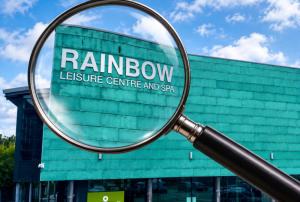
Epsom and Ewell Borough Council says it has addressed an audit finding on transparency. Yet a straightforward question about one of its largest public assets remains unanswered: how did the Rainbow Leisure Centre come to face apparent dilapidations costs of up to £500,000?
At the Council’s Audit and Scrutiny Committee on 29 September, Chief Executive Jackie King defended improvements to governance and communication with external auditors.
“This council does not have a governance issue,” she told members.
But for residents, transparency can be measured more simply than through meetings with auditors, constitutional amendments or changes to committee reporting. Can the public find out what happened to a building they own, why substantial expenditure became necessary, and whether anyone is being held responsible?
On the Rainbow Centre, those questions remain unresolved.
A public building, an unexplained liability
Epsom and Ewell Times has repeatedly sought an explanation of the circumstances behind a confidential urgent decision authorising access to Council reserves of up to £500,000 in connection with the leisure centre’s condition and disputed dilapidations.
That figure represents an authorised provision, rather than an established final bill. Nevertheless, the potential exposure is substantial.
The Council has previously acknowledged that it holds no records of routine landlord inspections over the former operator’s lengthy tenure. It has withheld condition papers, relying on claims of legal professional privilege and commercial sensitivity.
Neither position explains how the apparent liability arose.
Were defects identified before the change of operator? Were they reported and left unresolved? Did the Council adequately monitor the condition of its building? What obligations rested with the operator, and what steps did the Council take to enforce them?
Former operator GLL has said it returned the building in the condition required by its agreement and was unaware of any legal claim. EET’s recent requests for clarity on whether proceedings against the previous operator are contemplated have received no response.
The absence of an answer leaves residents unable to assess whether the Council is pursuing recovery, negotiating a settlement, or expecting public funds to meet the costs.
What the committee was told
The September meeting concerned an External Audit Transparency Report arising from Grant Thornton’s earlier finding of a significant governance weakness.
Officers said the problem concerned a failure to inform the auditors promptly about changes to governance arrangements. The report stated that subsequent improvements had satisfied the auditors and that the previous recommendation had been closed.
Cllr Chris Ames (Labour, Court) challenged that account. He argued that the auditors’ published findings covered wider concerns about openness, including changes to the constitution and scheme of delegation that had not been fully discussed publicly.
“This is a question of transparency, and we have a mismatch between what’s being said publicly and what was said privately, and that should concern us all,” he said.
Ms King rejected his interpretation and pointed to the more favourable subsequent audit assessment.
She also described improvements to urgent-decision reporting, including attaching decision forms to committee papers.
Cllr Steven McCormick (Conservative, Woodcote and Langley Vale), a former committee chair, said his written questions had been answered as fully as possible and that he had no supplementary questions.
The committee voted to note the report.
Publishing a decision is only the beginning
Better publication of urgent decisions is welcome. But publishing a form does not, by itself, explain the events that made the decision necessary.
The Rainbow controversy illustrates the difference.
On 16 July, the Audit and Scrutiny Committee concluded that the process followed for the Rainbow urgent decision had not complied with the Council’s stated procedure and was not justified by the information presented to members.
That finding concerned how the decision was taken. It did not establish how the building’s condition had been monitored, why the potential costs arose or who should bear them.
Those are questions about stewardship of a public asset, rather than simply the administration of committee business.
Claims of privilege or commercial sensitivity may protect particular documents or negotiating details. They do not give residents a substantive explanation of whether the Council fulfilled its responsibilities as landlord.
Who is protecting the public interest?
The unanswered questions also concern the role of elected councillors.
Their responsibility is to scrutinise the use of public money and the management of public property. Where possible failures of inspection or maintenance oversight arise, residents should be able to expect councillors to demand an explanation.
There is presently insufficient disclosed evidence to conclude that incompetence caused the Rainbow liability, or that officers are being deliberately protected from accountability. The continuing lack of information prevents those possibilities from being properly examined — and prevents the Council from demonstrating that they are unfounded.
That is why the unanswered requests matter.
A satisfactory audit assessment is relevant evidence of improved arrangements. It does not answer every outstanding question about a particular building or financial decision.
The Council says lessons have been learned. On the Rainbow Centre, the public still needs to know what happened, what the Council is doing about it, and whether taxpayers will ultimately pay.
Until those answers are provided, declarations of transparency remain difficult to reconcile with residents’ experience of trying to obtain information.

.
Related reports
- Epsom’s scrutiny committee slams Dallen’s urgent £500K Rainbow approval — 17 July 2026.
- Epsom Council Rainbow Centre secrecy row deepens over “pre-election silence” advice.
- Epsom and Ewell Council transparency row erupts as council backs publication of urgent decisions — 17 March 2026.
- “It’s my meeting”: Cllr Dallen stops questions about his role in alleged Rainbow “cover-up”.
- Epsom and Ewell Council CEO contests ‘culture of secrecy’ claim and outlines fixes — 1 October 2025.
- Epsom & Ewell Council not much in the red but too much in the pink! — 11 February 2025.