


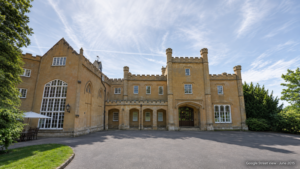
On Wednesday 29 September 1937 the Lord Lieutenant of Surrey presented Epsom and Ewell with its Charter of Incorporation, from a platform put up for the day in Epsom High Street. The same day, Nonsuch Park had its official opening.
The mansion in that park is one of six places in the borough licensed for civil ceremonies. Three of the six are at Epsom Downs Racecourse, Epsom College and the Royal Automobile Club’s Woodcote Park.
The other three, Nonsuch Mansion, Ewell Court House and Bourne Hall, are in public hands, and each got there by a different route.
Bought by four councils
Nonsuch is named after the palace Henry VIII began there in 1538. It was mostly pulled down in the 1680s.
The house in the park today took its shape between 1802 and 1806, when Jeffry Wyatt, later Sir Jeffry Wyatville, enlarged an older house for Samuel Farmer, MP for Huntingdon. Historic England’s listing calls it an early commission in the Tudor Gothic style that Wyatt later took to Windsor Castle. He modelled its entrance front on pictures of the lost palace.
Beside the front door is a terracotta tablet inscribed with the date 1543 and Henry VIII’s name in Latin, which the listing describes as a fragment of the palace.
The Farmers held the estate for more than a century. Between the wars new houses went up along its southern edge, and work began on an arterial road through the park.
Four councils bought the mansion and 263 acres of the Little Park as public open space: London County Council, Surrey County Council, Sutton and Cheam Borough Council, and Epsom and Ewell, then still an urban district.
The road was abandoned, though its embankment can still be traced. A joint committee has managed the park ever since.
Couples now marry in the mansion’s Orchid Room, which has stained glass and large bay windows.
Saved by its neighbours
Ewell Court House on Lakehurst Road was rebuilt for a marriage.
It began as Avenue House, named for the elms that lined its approach from Kingston Road. It was one of the gentlemen’s houses built after the fame of Epsom’s spa drew London merchants here in the late 1600s.
The house passed to the Bridges family, whose money came from gunpowder mills on the Hogsmill. The mills closed in 1875 because they could not meet new safety laws.
Four years later John Henry Bridges married Edith Tritton and set about making a new home for them both. J. Alick Thomas, a local architect then new to practice, rebuilt the house in the Old English style, keeping its old core, and the millpond became an ornamental lake.
Stonework and panelling were marked with a B and an anchor, for the family motto, “Heaven My Haven”.
The Stoddarts, who followed the Bridges, sold the house to the council in 1935.
In the autumn of 2003, the Epsom and Ewell History Explorer records, the council resolved to dispose of it for residential development. Local residents formed the Ewell Court House Organisation, ECHO, whose business plan for a mix of commercial and community uses persuaded the council to reverse its decision.
Ceremonies are held today in the Social Suite, with its polished maple floors and high moulded ceilings, which opens onto a terrace overlooking the lake. The grounds still have their cascades, rock pools and grotto.
Listed for its space-age flair
Bourne Hall in Spring Street takes its name from an older house. Garbrand Hall, a country house of about 1770, was praised in the gardening press of the 1870s for its chrysanthemums and orchids. It was renamed Bourne Hall when it was bought for a school in 1926.
The council later bought the estate on condition that the grounds were preserved. The old house, in poor repair, was demolished in 1962.
In its place A.G. Sheppard Fidler and Associates designed a round building under a copper dome, with twenty precast concrete ribs rising out of it and a glass-fibre rooflight at the centre. It opened in 1970.
Historic England, which listed it at Grade II on 30 April 2015, says the result resembles a flying saucer and was designed to sit low in the mature grounds. The café inside is the Flying Saucer Café.
The listing also cites its generous, top-lit interior and a ramp and lift that built in disabled access from the start. It notes a stainless steel plaque in the foyer recording the official opening by the Lord Lieutenant of Surrey.
Bourne Hall holds weddings and civil ceremonies, and some of Garbrand Hall’s trees can still be seen in its grounds, above the springs where the Hogsmill rises.
All six are on Surrey County Council’s list of approved venues. The Wedding Venue List, which covers every licensed wedding venue in England and Wales, has them on one page at weddingvenuelist.co.uk/venues-