Does Epsom and Ewell have the geo-thermal energy to solve our pothole problems?
14 August 2026
Could geothermal roads help prevent potholes before they form? Surrey trial aims to find out.
The UK’s pothole problem could one day be tackled from beneath the road surface, as researchers at the University of Surrey launch a pioneering trial that uses heat stored underground to keep roads cooler in summer, warmer in winter and less prone to damage.
The Thermo-active Roads for Heat Harvesting and Pavement Temperature Regulation project will test whether a ground-source heating and cooling system can regulate road temperatures throughout the year – helping roads better withstand increasingly extreme weather while reducing the carbon footprint of highway maintenance, improving safety and reducing the inconvenience of roadworks.
The system works by embedding a network of heat exchange pipes beneath the road surface, running through both the asphalt and the layers below. During summer, water circulating through the pipes absorbs heat from the asphalt and transfers it to a 100-metre-deep borehole, where it is stored underground. In winter, that heat is circulated back through the pipes to warm the road surface, helping to prevent ice from forming and reducing the freeze-thaw cycles that contribute to potholes.
Installation has already begun in the Senate House car park on the University’s Stag Hill campus, with the first phase of the trial underway and the second phase starting in mid-August 2026. Once operational, researchers will monitor the system over a number of years using underground sensors to assess how effectively it regulates road temperatures.
Project lead, Dr Benyi Cao, who is a Senior Lecturer in Geotechnical Engineering at the University of Surrey and Royal Academy of Engineering Research Fellow, said:
“Rather than reacting to potholes after they’ve formed, we’re asking how we can prevent them in the first place. Potholes are more than an inconvenience – they are a safety hazard; they disrupt journeys and are costly to repair. Our project will explore whether geothermal technology can help prevent that damage from happening at scale.”
Unlike many emerging infrastructure technologies, Surrey’s project uses mature, readily available materials, including standard plastic pipework and water circulation pumps, making future deployment both practical and affordable.
Previous studies in Europe and the United States have explored similar concepts, but Surrey’s project will provide detailed real-world evidence of how the technology performs in UK conditions.
As well as monitoring the road itself, the team will measure air temperatures above the test section to investigate whether cooler pavements could also reduce surrounding air temperatures during periods of extreme heat.
Dr Nikolas Makasis, Lecturer in Civil Engineering at the University of Surrey and project co-investigator, said:
“This trial will give us real-world evidence of how geothermal road systems perform outside the laboratory. If the results are promising, road authorities will have the evidence they need to deploy this technology to create longer-lasting roads, reduce maintenance costs and make transport infrastructure more resilient to a changing climate.”
The project is funded through Dr Benyi Cao’s Royal Academy of Engineering Research Fellowship, with additional support from Surrey County Council’s Lane Rental Scheme.
Image: Construction underway outside Senate House, University of Surrey. Image credit: University of Surrey.
.
.
.
.
Valerie Flanagan
14 August 2026
Valerie Flanagan passed away suddenly at home on Friday 17 July 2026.
She will be dearly missed by her Daughter Louise, Son in Law Paul, Grandchildren Abi & Oli, Grandson in Law Chris, Grandaughter in Law Danielle and Great Grandchildren Asher & Aurelia.
Also, extended family in the UK & New Zealand.
The funeral will take place at Randall’s Park Crematorium, Leatherhead on Tuesday 1 September 2026 at 11.45, followed by refreshments at The Cricketers Pub, Epsom.
Family flowers only please. In lieu of flowers Valerie’s friends may wish to make a small donation to a charity of their choice.
Dirty water double: sewage spills and blocked drains put Epsom and Ewell under pressure
14 August 2026
Epsom and Ewell recorded the longest duration of storm-overflow discharges among seven constituencies examined in a new study of sewage spills across parts of South London and Surrey.
Research undertaken by Purley-based Drainage & Plumbing Ltd using official Environment Agency data identified 55 spills lasting a combined 801 hours during 2025 — equivalent to more than 33 days of continuous discharge.
Almost all the constituency’s total came from the storm overflow at Leatherhead Wastewater Treatment Works, which discharged into the River Mole 49 times for a combined 787 hours. A further four spills, lasting 12 hours, were recorded at the Manor Drive storm tanks discharging into the Hogsmill.
The geographical label refers to the parliamentary constituency in which an overflow is located and should not be confused with the boundaries of Epsom and Ewell Borough Council.
Epsom and Ewell did not have the greatest number of spills in the study. Mitcham and Morden recorded 125 and Reigate and Redhill 61. However, their combined discharge durations were considerably shorter, at 204 and 556 hours respectively.
Across all seven constituencies covered by the research, 250 spills lasting 1,578 hours were recorded during 2025. Epsom and Ewell therefore accounted for just over half of the total discharge time in the study.
The figures came from the Environment Agency’s Event Duration Monitoring returns. These record how often a monitored storm overflow operates and for how long, but not the volume of sewage released.
Storm overflows are intended to act as safety valves when rainwater and wastewater threaten to overwhelm combined sewer systems. They discharge diluted untreated sewage into rivers and other waterways to reduce the risk of sewage backing up into homes. Their frequency and duration have, however, become the subject of growing public and regulatory concern.
Flooding reaches Epsom homes and gardens
The same Drainage & Plumbing Ltd investigation examined Thames Water’s sewer-flooding register for the three financial years from 2022/23 to 2024/25.
Across the Epsom postcode districts, it identified 24 recorded incidents: 12 in KT19, seven in KT18 and five in KT17. Of the 420 incidents identified across all the areas examined, about two-thirds involved external flooding in gardens or yards, while just under one in five reached inside a home or business.
The information was obtained by the company under the Environmental Information Regulations. Thames Water said it did not yet hold a completed register identifying properties formally considered to be at risk of sewer flooding.
The flooding register only covers incidents attributed to Thames Water’s sewer network. It does not include flooding from private drains, burst water mains or surface water which never entered a sewer.
553 highway drainage reports
A separate investigation by the company found that Surrey County Council received 553 reports concerning blocked gullies, blocked highway drains or drainage flooding in Epsom and Ewell during the same three-year period.
Reports increased from 156 in 2022/23 to 229 in 2023/24 before falling to 168 in 2024/25. The latest figure was therefore 7.7 per cent higher than in the first year, although substantially below the intervening peak.
The borough accounted for three per cent of the 18,463 reports recorded across Surrey. Epsom itself generated 288 reports: 70 in 2022/23, 116 the following year and 102 in 2024/25.
The countywide information was obtained from Surrey County Council through a Freedom of Information request submitted by Nima Fazlipour, director of Drainage & Plumbing Ltd. The company said it checked the 18,463 individual records against the Council’s annual and electoral-division summaries.
The figures count reports made by members of the public rather than confirmed blockages. They do not show how many reports concerned the same problem, how many resulted in repair work or how quickly the Council responded. Surrey’s released spreadsheets did not include gully-cleaning totals or dates on which cases were resolved.
A road gully is the grated opening beside a kerb which carries rainwater away from the highway. Its underground pot can become filled with silt, fallen leaves and road debris, leaving water standing on the carriageway after rain.
Highway gullies are generally maintained by the county council, while public sewers are the responsibility of Thames Water. Drains within private property boundaries ordinarily fall to the property owner.
MP says infrastructure is failing
Helen Maguire, Liberal Democrat MP for Epsom and Ewell, has accused Thames Water of failing to invest sufficiently in its ageing infrastructure.
Her intervention came as Thames Water customers remained subject to a hosepipe ban introduced following prolonged dry weather, heatwaves, low rainfall and unusually high demand.
Figures analysed by the House of Commons Library and the Liberal Democrats indicate that Thames Water lost an average of 569.1 million litres of treated water a day through leaks during 2024/25. That is equivalent to approximately 228 Olympic-sized swimming pools every day.
Those leakage figures apply across Thames Water’s network and should not be read as losses occurring within Epsom and Ewell alone. They nevertheless add to concerns about the resilience of the company’s infrastructure as it attempts to manage both periods of drought and the overloading of sewers during heavy rainfall.
Ms Maguire said she had written to Thames Water seeking a meeting about its preparations for increasingly extreme weather and how it intends to make the water network more resilient.
She said: “Thames Water needs to urgently get its house in order. They have got away with their negligent handling of our water infrastructure for far too long. It’s simply not good enough.
“Whilst residents in Epsom and Ewell have to face a hosepipe ban as well as continuing increasing bills, Thames Water continues to fail. Thames Water must stop rewarding their unaccountable bosses with bonuses and start investing in fixing their infrastructure so we can avoid this happening time after time.”
Ms Maguire also called for customer payments to be reinvested in stopping leaks and preventing sewage discharges, supporting her party’s proposal for water companies to be placed under a mutual ownership model.
The Government has already announced that Ofwat will be abolished and its functions combined with water-related responsibilities currently divided between the Environment Agency, Natural England and the Drinking Water Inspectorate. The existing regulators retain their legal powers until the new regulator is established.
Different drains, common concern
The highway gully, sewage overflow, sewer-flooding and clean-water leakage figures describe different parts of the water and drainage system and should not be treated as one dataset.
Taken together, however, they illustrate the competing pressures placed on local infrastructure: too little available water during prolonged dry weather, leakage from the supply network, road flooding when surface drainage becomes blocked and sewage discharges when combined sewers are overwhelmed.
Drainage & Plumbing Ltd brought its two investigations to the attention of the Epsom and Ewell Times. The company, based in Brighton Road, Purley, provides commercial drainage services across Surrey and South London.
EET acknowledges the public-interest work of Mr Fazlipour and the company in obtaining, checking and publishing the official information.
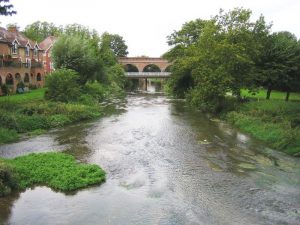
Image: River Mole in Leatherhead – geograph.org.uk Nigel Cox
Surrey help with school uniform costs
14 August 2026
Families experiencing financial hardship across Surrey will receive additional support with the cost of sending their children back to school this year, thanks to funding from Surrey County Council’s Crisis and Resilience Fund.
Surrey County Council has awarded over £100k to local children’s charity Stripey Stork to expand its already successful School Days scheme, helping more families access essential school items including non-branded uniform items, shoes, trainers, PE kits and school bags. This is additional funding to complement the many donations already made by local families, schools/PTAs and communities, that enable continued support throughout the school year by Stripey Stork.
The funding comes from the £7.1 million UK Government-funded Crisis and Resilience Fund, which is designed to help residents facing immediate financial difficulties and build longer-term resilience programmes. Families will be able to access this support via the Crisis Payments scheme and through existing trusted referral networks including schools, social workers, health visitors, Citizens Advice, domestic abuse services and local charities.
Back-to-school costs can place significant pressure on household budgets, particularly for families already struggling with the rising cost of living. The expanded scheme will ensure that more children can start the new school year with the clothing and equipment they need to learn and thrive.
In 2025, Stripey Stork supported 7,503 children from 4,116 Surrey families via it’s Schools Days programme.
This funding will help Stripey Stork fill the gaps in the good quality pre-loved school items donated by the community, ensuring every child receives a complete bundle of everything they need to start the school year. It also provides the infrastructure needed to collect, store, sort, pack and distribute these items efficiently, enabling the charity to support around 8,500 children across Surrey over the next 12 months.
Nicola Dawes Deputy Lieutenant, Chief Executive at Stripey Stork said: “Every child deserves to arrive at school feeling confident, included and ready to learn. Our School Days programme is one of the most valued services we provide because we see the difference it makes, not just to children but to whole families.
“We know from our partners that without this support many families would simply go without essential school items or be forced into debt to buy them. Three quarters told us the support has a significant impact on children’s wellbeing and sense of inclusion, while more than 80% said it improves school engagement and attendance. Perhaps most importantly, over 90% said it reduces the stress and worry parents are carrying.
“We’re grateful to Surrey County Council for this investment. Combined with the generosity of our local community, who donate good quality pre-loved items each year, this funding means we can make sure thousands more children across Surrey have the practical items they need to attend school with confidence.”
Councillor Mark Nuti, Surrey County Council Cabinet Member for Health and Communities said: “By investing over £100k through the Crisis and Resilience Fund, we’re helping Stripey Stork reach even more families across Surrey with practical support at a time when it is needed most. This partnership is making a tangible difference to children and young people, helping ensure they have the essentials they need to succeed at school while easing the burden on household budgets.
“The Crisis and Resilience Fund is about much more than responding to immediate need. This three-year funding allows us to work with our voluntary, community, faith and social enterprise partners to develop long-term support programmes that help residents become more financially resilient, reduce reliance on crisis services and achieve their full potential. Together, we are creating opportunities for people to regain stability, independence and to thrive in the future.”
About the Crisis and Resilience Fund
The Crisis and Resilience Fund is a 3 year funded programme funded by the UK Government and currently administered by Surrey County Council. It supports residents facing financial hardship by providing immediate crisis assistance while also helping individuals and families build longer-term resilience and independence. The fund works through partnerships with local voluntary, community and faith sector organisations to deliver targeted support, including food, household essentials, energy assistance, financial advice. Crisis and Resilience Fund – Surrey County Council
Free bus travel is a good idea; so why does it stop at 15?
14 August 2026
Dear Editor,
This August, children aged five to 15 can travel free on local buses across England. I think that’s genuinely good. It makes days out cheaper, helps children get to summer activities, and might persuade a few families to leave the car at home.
But I can’t quite work out why it stops at 15. And where I live, age isn’t really what decides the price of a bus seat anyway.
I’m 16. I live in Epsom and travel to school in Wallington, which is in the London Borough of Sutton. I have a 16+ Zip Oyster photocard. Going to school in London, it turns out, makes no difference at all; the rule follows where you sleep, not where you study.
So here is what the same card is worth to different people. If you’re 16 and live in a London borough, it gives you free bus travel. If you’re 16 and live outside London, as I do, it gives you half the adult fare – about 88p a journey. And if you’re 16 and have never applied for one, you tap a contactless card and pay the full £1.75.
Three 16-year-olds. Same bus, same stop. One pays nothing, one pays 88p, one pays £1.75.
Nothing in that reflects need, or distance, or what anyone’s family earns. It reflects which side of the Greater London boundary you sleep on, and whether somebody remembered to tell you the card exists.
That second part bothers me most, because it’s the easiest thing to fix. Some students will inevitably miss out simply because nobody has explained the system clearly enough. A benefit that depends on knowing it exists ends up helping the organised rather than the people who need it.
And the cost starts to matter more at 16 than it did at 15. At 15, most journeys are still with your family. At 16 you’re travelling on your own to sixth form, a Saturday job, or a work experience placement you were told to arrange yourself. Nobody tells you that you can’t apply for those things. On paper they’re open to everyone. But one student can afford the journey every week and another quietly decides they can’t, and from the outside that never looks like unfairness at all.
I should admit I’m arguing against my own convenience here. I have the card, and half fare is not a hardship. I’d still rather Epsom’s 16-year-olds got what Sutton’s get. The Greater London boundary was drawn to decide who administers what; it was never meant to decide which teenager can afford to get to an interview in Croydon. TfL buses cross it every twenty minutes.
Surrey does have its own scheme, the LINK card, which halves fares for under-20s. It’s useful, it’s badly advertised, and it doesn’t work on TfL services – which are the buses that actually serve this town.
Of course the government has to draw a line somewhere, and August’s offer was aimed at families with younger children. That’s fair. Public money isn’t unlimited. But 15 isn’t an obvious place to stop, and a postcode isn’t a principle at all.
Two things would help. Extend the August offer to everyone under 18; we’re legally required to be in education or training, and most of us earn very little. And make sure every pupil in Epsom and Ewell hears about both the 16+ Zip and the LINK card before their sixteenth birthday, with a plain list of what each one covers.
Free buses this August are a good idea. I just don’t think a birthday, a boundary and a form should decide who keeps them.
Yours faithfully,
Emad Rehman Aged 16, Epsom, student at Wilson’s School, Wallington
Reigate and Banstead goes a bit greener
14 August 2026
The Green Party has won a crucial by-election in Reigate and Banstead that could impact the balance of power on the council.
Nick Abear, who also serves on East Surrey Shadow Council, won the ward of Hooley, Merstham and Netherne following yesterday’s election.
This by-election was called following the death of Councillor Mus Tary, who sadly passed away in June.
Councillor Abear told the Local Democracy Reporting Service (LDRS): “I’m absolutely thrilled and delighted to have been elected in the Merstham, Hooley and Netherne by-election.
“Thank you to everyone who put their trust in me, and to the many volunteers who gave up their time to help us.
“I look forward to building on the excellent work that Shasha Khan and Joel Gabriel have been doing in the ward, and to working hard for all our residents over the coming months.”
The result represents a Green gain from the Conservative Party at a time when the Tories have held a slender balance of power in Reigate and Banstead.
The Greens will now have a total of 15 seats on the council against the Conservatives 16, while the Green and Redhill Independent group combined matches the Tories’ total.
In 2022, the full council election saw the Conservatives lose five seats, with the council remaining under no overall control.
However, this council will cease to exist in April, when the current district councils are abolished along with Surrey County Council to make way for the new West and East Surrey Councils.
Fellow Green ward councillor Shasha Khan told the LDRS: “I’m thrilled for Nick to be joining Joel and me to serve everyone in our ward.
“In 2023, I got 37.4 per cent. In 2024 Joel got 38.4 per cent, and in 2026 Nick has won with 41.8 per cent.
“This shows that where Greens get elected, they work hard for the community, resulting in voters wanting more.”
Nick With Partner And Green Councillors (Credit: Joel Gabriel)
Epsom Racecourse: Preview and Tips for Friday’s Six-Race Meeting
14 August 2026
Racing returns to Epsom Racecourse this Friday with a six-race meeting, consisting of five handicaps and a fillies’ novice race.
Read on for a preview of and tips for the Epsom card, brought to you by BOYLE Sports, who have all the horse racing odds.
We begin with a seven-furlong nursery handicap (14.48). Oliver Cole’s Greek Symphony and Andrew Balding’s Wise And Wonderful are the only runners to have previously won a race, but the former looks more competitive on this occasion having shown he can still step up at this mark. Sequel Star could be promising on her handicap debut, and might appreciate the step up in trip as well, but she is totally unproven on a testing track like Epsom.
Next is a seven-furlong two-year-old fillies’ novice (15.23). Tiora Time is the only previous winner in the field, having won nicely last time out at Doncaster, and she carries a four-pound penalty here. Tansy Lane has been going quite well in maidens so far and may stand a decent chance here, and she looks to be the only to throw Tiora Time a question.
Race three is a six-furlong handicap (16.00). Modern Times won last time out and has had a modest rise in the weights as a result. He could factor again, but others make appeal too. Ruby’s Profit is down to an attractive mark now and is well drawn, while Sir Garfield is a consistent sort who went well at Goodwood latterly and should run a big race here under Jason Hart.
A 10-furlong handicap follows (16.38). All About George went well last time at Bath on this mark, while Celtic Spirit has been consistently good this term and enjoyed the step back up in trip last time at Lingfield. Haveagobeau beat him that day but looks to be on too tough a mark to win this time.
Second to last is an extended mile handicap (17.13). Sir Mark Prescott’s Chantelle is shaping up as a consistently good filly who gets a result more often than not. She has won two of her four career starts and has shown to handle this track. She is lightly raced this season and ought to be able to win this now, if progressing from a second over course and distance last time. Trio was the one to beat her last time, though, and may throw another question.
Last of all is a seven-furlong handicap (17.48). Ice Cube and Eyes Front both won their latest starts, with both looking competitive once again. A La Noche makes his handicap debut and returns to the track for the first time in nearly three years, so he is worth watching but unlikely to win here. Freddie’s Star might go well in first-time blinkers. Red Mirage is more consistent, though, and coil prevail here.
Epsom selections – Friday:
14.48 – Greek Symphony
15.23 – Tansy Lane
16.00 – Sir Garfield
16.38 – Celtic Spirit
17.13 – Chantelle
17.48 – Red Mirage
Image: Horses racing Image: Credit Paul. CC BY 2.0
Record A level results open doors for Epsom and Ewell students
14 August 2026
Students at two Epsom and Ewell secondary schools are celebrating impressive A-level and vocational qualification results, with Rosebery School recording its best results to date and seven Glyn School students securing straight A* grades.
At Rosebery School in Epsom, 43% of all A-level entries received an A* or A grade, while 73% were graded A* to B and 88% A* to C. All three figures represent new records for the girls’ school.
Twenty-four Rosebery students achieved A* or A grades in every subject. Five secured straight As: Emma Glencross, with four A*s, and Emily Woodville, Grace Worley, Amy Box and Amy Helyar, each with three.
The school also highlighted students whose results demonstrated particularly strong progress since their GCSEs. Emily Gromova, Amelie Dale, Lara Sollewijn Gelpke and Jacqueline Tetteh were among the strongest members of the cohort when measured by the progress made from their earlier attainment.
Rosebery headteacher David Lach said: “These results are truly outstanding and reflect the talent, resilience and determination of an exceptional group of young women. We are enormously proud of what they have achieved and the way they have supported one another throughout their journey.
“At Rosebery, we believe there should be no limits to what girls can achieve, and this year’s results demonstrate exactly that.”
Members of the Class of 2026 will now progress to destinations including Oxford, Cambridge, Imperial College London, King’s College London and the universities of Warwick and Bath. Others have secured degree apprenticeships or will pursue specialist training, including pilot training and drama school.
Mr Lach thanked Rosebery’s teaching and support staff for helping the students to believe in themselves and fulfil their potential.
At Glyn School in Ewell, staff and students were meanwhile celebrating A-level and vocational qualification results in which more than 51% of students achieved A* to B grades.
Seven students obtained straight A*s. Vrushabh K achieved four, in chemistry, further mathematics, mathematics and physics, and will study mechanical and electrical engineering at the University of Bristol.
Oliver H gained three A*s in mathematics, further mathematics and physics and is heading to the University of Sheffield. Amri R achieved the same top grades in computer science, mathematics and further mathematics and will study at Imperial College London.
Amelie S secured As in biology, chemistry and mathematics, while Ilario Lok C achieved As in further mathematics, mathematics and physics and will attend the University of Hong Kong.
James D received three A*s in chemistry, mathematics and physics, while James Y achieved three in economics, mathematics and geography.
Glyn headteacher Jo Garrod said: “We are thrilled to see this year’s A-level and BTEC exam success. With over 51% of students achieving A* to B grades, they should all be extremely proud of their efforts, and we wish them the very best for their futures.”
She said the school was delighted that students had secured places at their chosen universities, apprenticeships and careers, while paying particular tribute to those who had overcome significant barriers before sitting their examinations.
“They should be incredibly proud of themselves and the results they have secured under difficult circumstances,” she added. “Thanks also go to the staff for their immense effort this year to ensure our students got the grades they deserved.”
Warwick Sharp, chief executive of GLF Schools, which includes both Rosebery and Glyn, congratulated the students and staff.
Describing Rosebery’s results as “record-breaking”, he said its students had been set on a path towards future success by the school’s committed team.
Addressing Glyn’s results, he added: “We are excited to see what these wonderful young people go on to do next as they shape their futures. A huge thanks and well done to the brilliant team at Glyn who should be proud of these impressive achievements.”
Epsom and Ewell FC 1 – 0 Chipstead. 8th August – Chalky Lane – The Emirates F.A. Cup Extra Preliminary Round
A much-changed Epsom & Ewell side showed grit, discipline and real defensive character to secure a hard-earned FA Cup victory, with Jason Bloor’s first-half strike proving decisive against ten-man Chipstead.
The Salts made several changes, including the return of Dylan Marchant-Simmonds for his first game of the season and a debut for goalkeeper William Davis, who impressed throughout and kept a clean sheet. Prince Aderogba also came into the back line.
Both sides looked to attack from the outset, with former Salts player Carl Oblitey booked in the 33rd minute as the game’s physical edge began to show. The Salts continued to press for the opener, playing positive, forward-thinking football, and the breakthrough arrived on 40 minutes. A superb free-kick delivery from skipper Brendan Murphy-McVey found Jason Bloor, who applied a composed finish to put the Salts 1–0 ahead.
Just before the interval, Chipstead were reduced to ten men. Oblitey, already on a yellow card, elbowed goalkeeper William Davis, earning a second booking and his marching orders.
The Salts went into half-time with a deserved lead.
The game tightened after the restart, with a flurry of cautions. Ayran Kugathas was booked in the 52nd minute, while Jason Vincent and Brendan Murphy-McVey both received yellow cards on 60 minutes.
Manager Max Johnson then used all five substitutions:
67 mins: LJ Walker and Blessing Hombessa replaced Jason Bloor and Luke Miller.
73 mins: Ryley Merrett and Callum O’Keeffe came on for Ayran Kugathas and Ore Allen.
78 mins: Oba Akinniranye replaced Jason Vincent.
Despite sustained pressure from Chipstead, the Salts defended with courage, organisation and determination. Davis remained assured in goal, while the back line held firm to protect their slender advantage.
A disciplined and resilient performance saw the Salts safely through to the next round, where they will host Crowborough Athletic in two weeks’ time.
Surrey leads first nuclear science experiment with world’s most advanced gamma-ray detector
14 August 2026
Nuclear physicists at the University of Surrey have become the first to carry out a scientific experiment using the world’s most advanced gamma-ray spectrometer – investigating a sudden change in the shape of the atomic nucleus that could challenge existing theories.
Nuclear physicists at the University of Surrey have become the first to carry out a scientific experiment using the world’s most advanced gamma-ray spectrometer – investigating a sudden change in the shape of the atomic nucleus that could challenge existing theories.
The experiment took place at the Facility for Rare Isotope Beams (FRIB) in Michigan, USA, using the newly delivered and characterised Gamma-Ray Energy Tracking Array (GRETA). Led by Lawrence Berkeley National Laboratory (LBNL) and delivered by a collaboration with Argonne National Laboratory, Oak Ridge National Laboratory and FRIB, GRETA is a $58 million detector designed to reveal the structure of atomic nuclei in unprecedented detail.
Working with collaborators from FRIB and Lawrence Berkeley National Laboratory, the Surrey team investigated a radioactive isotope of germanium to help answer a long-standing question about the shape of its atomic nucleus.
For many years, physicists predicted that the nucleus should resemble a rugby ball. However, more recent evidence has suggested it could instead be flattened like a disc – a result that would challenge current theories describing how protons and neutrons behave inside the nucleus.
Dr Jack Henderson, Co-Project Investigator, UKRI Future Leaders Fellow and Senior Lecturer at the University of Surrey’s School of Mathematics and Physics, said:
“Beam time at facilities like FRIB is exceptionally competitive, with proposals assessed by an international panel of experts. Being selected to lead the first scientific experiment using GRETA is an incredible achievement for us here at Surrey.
“Nuclear physicists deliberately study the most unusual atomic nuclei because they provide the toughest tests of our understanding. In this case, we wanted to investigate whether this isotope of germanium really does have an unexpected disc-like shape – a bit like chocolate Smarties.”
GRETA uses highly segmented high-purity germanium detectors to detect, localise and track gamma rays emitted by unstable atomic nuclei, allowing scientists to study their structure with unprecedented sensitivity and precision. Compared with the detector originally planned for the germanium experiment, GRETA is around five times more efficient, meaning measurements can be completed faster and with far greater precision.
Because access to rare isotope beam facilities is limited, GRETA’s efficiency enables scientists to study more exotic, short-lived isotopes within the available beam time.
Beyond Surrey’s experiment, GRETA opens up new opportunities to study how the elements are formed in explosive astrophysical events and deepen scientists’ understanding of how protons and neutrons interact within the atomic nucleus. Its exceptional sensitivity also allows researchers to detect tiny signals hidden within complex datasets and investigate increasingly rare isotopes that were previously beyond reach.
Paul Fallon, GRETA project director and interim director of Berkeley Lab’s Nuclear Science Division, said:
“The completion of GRETA and the first installation for physics experiments is a major milestone. This is the result of years of effort from a very big team.”
The experiment was led by Dr Jacob Heery, a postdoctoral research assistant at the University of Surrey, whose proposal secured the highly sought-after beam time after being selected by an international panel of experts.
Jacob Heery said: “Securing the first scientific experiment using GRETA is a huge achievement within the nuclear physics community. The detector gives us a level of sensitivity we’ve never had before, allowing us to investigate extremely rare isotopes that were previously beyond reach. We’re only just beginning to explore what’s possible, and I hope this will be the first of many collaborations between Surrey, FRIB and the GRETA team.”
Analysis of the experiment is now underway. The work formed part of the JANUS (Joint Arrays for Nuclear Structure) collaboration between FRIB, Lawrence Berkeley National Laboratory and the University of Surrey. It also builds on Surrey’s leadership of the £3.1 million FAUST project, which is developing a next-generation detector system that will operate alongside GRETA in future experiments.
Photo: Credit University of Surrey. Caption: From left to right: Chris Cousins (Surrey), Stephen Gillespie (FRIB), Jack Henderson (Surrey), Tom Parry (FRIB – Surrey PhD), Daniel Doherty (Surrey).
.
.
.
.
Drones may reduce delays on Waterloo line
14 August 2026
A drone is now operating at London Waterloo to tackle trespass, fix infrastructure faults and reduce disruption Operated remotely from Southampton, the drone provides live intelligence to South Western Railway and Network Rail Wessex for rapid response to incidents.
Trespass and fatalities account for almost 14 per cent of delays, making them a leading cause of disruption and costing taxpayers millions.
Automated drone technology is part of publicly owned South Western Railway and Network Rail Wessex’s plan to improve services for customers ahead of the establishment of Great British Railways RAILWAY customers at London Waterloo may have spotted a new presence overhead: a drone helping to prevent delays at Britain’s biggest station.
South Western Railway (SWR) and Network Rail Wessex (NR Wessex) are deploying automated drone technology to deter and tackle trespass, improve safety and reduce disruption on one of the country’s busiest rail corridors.
Trespassing on the railway is illegal and extremely dangerous. SWR and NR Wessex trains are powered by an ‘always on’ electric third rail carrying 750 volts of direct current, which can cause severe, lifechanging injuries or death.
When trespass is reported on the railway, SWR and NR Wessex must turn off the power, preventing trains from running until the incident has been resolved and power to the lines can be safely restored.
Most of South Western’s 1,600 daily services begin or end at London Waterloo. Even minor incidents can delay thousands of customers and cost taxpayers millions.
Between April 2025 and June 2026, trespass and fatalities caused almost 14 per cent of cancellations and over 200,000 minutes of delay to SWR and NR Wessex services, making it one of the leading causes of disruption.
Last September, a trespasser near Clapham Junction caused more than 57 hours of delays and was later imprisoned for eight weeks.
Another even more serious incident in the New Malden area in August 2024 saw the equivalent of nine days of delays, costing the taxpayer £1.2 million. The trespasser was sentenced to 18 months in prison.
The drone is operated remotely by British firm SkyBound from a high-tech control centre almost 80 miles away in Woolston, in the Southampton area.
When required, operators launch the drone from its trackside station to provide rapid intelligence for SWR and NR Wessex’s control centre, security and engineering teams, even before teams arrive on the ground.
Its high-resolution and thermal imaging cameras give enhanced visibility of trespass incidents, infrastructure concerns or any situation that requires inspection, with live footage streamed directly to the network’s operations centre in Basingstoke.
This allows the railway and emergency services to respond more quickly, reduces the need for ground teams to access the track, and limits the need to switch off the power and delays customer journeys.
The drone at Waterloo is just the first of a planned chain of SkyBound drones to help protect the busiest section of the SWR and NR Wessex network, with further drones to be based at Clapham Junction, New Malden and Walton-on-Thames.
South Western Railways
.
.
.
.
Epsom and Ewell Councillor allowances
14 August 2026
Councillor allowance bill rises £19,275 in a year
Epsom and Ewell Borough Council’s bill for councillor allowances rose by more than £19,000 last year, with 30 of the borough’s 35 councillors receiving more than in the previous financial year.
The Council paid a total of £285,011.33 in members’ allowances in 2025/26, compared with £265,736.49 in 2024/25 – an increase of £19,274.84, or 7.25%.
The newly published figures cover the financial year from 1 April 2025 to 31 March 2026. The previous return covers 1 April 2024 to 31 March 2025.
Much of the increase resulted from the basic allowance payable to every councillor rising from £5,779.86 to £6,202.68 – an increase of £422.82, or 7.3%.
Across all 35 councillors that added £14,798.70 to the bill. In other words, just over three-quarters of the £19,275 year-on-year increase arose from the increase in the basic allowance alone.
Special Responsibility Allowances – additional payments for councillors holding particular positions – increased collectively from £62,822.38 to £67,359.72, an increase of £4,537.34.
Travel and subsistence payments actually fell slightly, from £619.01 to £557.81. No dependants’ carers’ allowances were recorded in either year.
The Council states that Special Responsibility Allowances do not relate to actual attendance at meetings but to membership of committees and panels, and that allowance payments are subject to Income Tax and National Insurance.
McCormick remains highest-paid councillor
Cllr Steven McCormick topped the table for the second successive year. His total increased from £16,983.46 to £18,608.16, a rise of £1,624.70.
For clarity, McCormick was a Residents’ Association councillor throughout the 2025/26 financial year. Although EEBC’s present councillor page now records him as Conservative, the Council’s earlier listing recorded him as RA and he contested the new East Surrey Council election on 7 May 2026 as a Residents’ Association candidate for Epsom Town and Downs. His subsequent change of allegiance therefore falls outside the period covered by these allowance figures.
Second highest was Cllr Neil Dallen, whose payment increased from £15,645.76 to £17,057.52, a rise of £1,411.76.
Council Leader Cllr Hannah Dalton moved from second to third place and was one of only five councillors whose total payment fell. She received £16,266.40, £429.41 less than the £16,695.81 received in 2024/25. The difference largely reflects a reduction in her Special Responsibility Allowance and travel and subsistence payments.
The other councillors whose total payments fell were Humphrey Reynolds (£175.96 less), Steve Bridger (£75.76 less), Julian Freeman (£52.16 less) and Bernie Muir (£52.16 less).
Biggest rises
After McCormick’s £1,624.70 increase, the biggest cash increases went to:
John Beckett – up £1,474.94
Neil Dallen – up £1,411.76
Alan Williamson – up £1,395.42
Clive Woodbridge – up £1,214.94
The percentage comparison can sometimes exaggerate relatively small payments, but Cllr Beckett’s total nevertheless rose by almost a quarter, from £6,278.44 to £7,753.38.
At the other end of the scale, 12 councillors received no Special Responsibility Allowance in 2025/26 and were paid simply the basic £6,202.68 allowance.
The two published returns show all 35 councillors serving in both financial years, allowing a direct like-for-like comparison.
Councillor allowances compared
The table is ranked by the latest, 2025/26, total.
Councillor / ward / party during 2025/26
2024/25
2025/26
Change
Steven McCormick — Woodcote & Langley Vale — RA
£16,983.46
£18,608.16
+£1,624.70
Neil Dallen — Town — RA
£15,645.76
£17,057.52
+£1,411.76
Hannah Dalton — Stoneleigh — RA
£16,695.81
£16,266.40
−£429.41
Clive Woodbridge — Ewell Village — RA
£12,431.10
£13,646.04
+£1,214.94
Liz Frost — Woodcote & Langley Vale — RA
£9,790.14
£10,562.54
+£772.40
Peter O’Donovan — Ewell Court — RA
£9,648.02
£10,544.64
+£896.62
Phil Neale — Cuddington — RA
£8,131.92
£8,994.00
+£862.08
Alan Williamson — West Ewell — RA
£7,553.56
£8,948.98
+£1,395.42
Bernice Froud — Woodcote & Langley Vale — RA
£7,802.86
£8,373.72
+£570.86
Christine Cleveland — Ewell Village — RA
£7,727.52
£8,063.52
+£336.00
John Beckett — Auriol — RA
£6,278.44
£7,753.38
+£1,474.94
Shanice Goldman — Nonsuch — RA → Conservative
£7,300.16
£7,488.26
+£188.10
Kate Chinn — Court — Labour
£6,708.26
£7,173.00
+£464.74
Rachel King — Town — RA
£6,539.96
£7,133.04
+£593.08
Jan Mason — Ruxley — RA
£6,358.22
£6,822.96
+£464.74
Humphrey Reynolds — West Ewell — RA
£6,998.92
£6,822.96
−£175.96
Chris Watson — Ewell Court — RA → Labour
£6,286.66
£6,822.96
+£536.30
Alison Kelly — Stamford — Liberal Democrat
£5,779.86
£6,719.58
+£939.72
Kieran Persand — Horton — Conservative
£5,779.86
£6,719.58
+£939.72
Bernie Muir — Horton — Conservative
£6,658.22
£6,606.06
−£52.16
Alex Coley — Ruxley — Independent
£5,993.54
£6,593.09
+£599.55
James Lawrence — College — Lib Dem → Independent
£5,779.86
£6,552.72
+£772.86
Julian Freeman — College — Liberal Democrat
£6,358.22
£6,306.06
−£52.16
Arthur Abdulin — Town — RA
£5,779.86
£6,202.68
+£422.82
Chris Ames — Court — Labour
£5,779.86
£6,202.68
+£422.82
Steve Bridger — Stamford — RA
£6,278.44
£6,202.68
−£75.76
Tony Froud — Stoneleigh — RA
£5,779.86
£6,202.68
+£422.82
Rob Geleit — Court — Labour
£5,779.86
£6,202.68
+£422.82
Christine Howells — Nonsuch — RA → Independent
£5,779.86
£6,202.68
+£422.82
Graham Jones — Cuddington — RA
£5,779.86
£6,202.68
+£422.82
Robert Leach — Nonsuch — RA
£6,029.16
£6,202.68
+£173.52
Lucie McIntyre — West Ewell — RA
£5,779.86
£6,202.68
+£422.82
Julie Morris — College — Independent
£6,179.82
£6,202.68
+£22.86
Kim Spickett — Cuddington — RA
£5,779.86
£6,202.68
+£422.82
Darren Talbot — Auriol — RA
£5,779.86
£6,202.68
+£422.82
TOTAL
£265,736.49
£285,011.33
+£19,274.84
Political allegiances also shifted during the year covered by the figures. Shanice Goldman left the Residents’ Association for the Conservatives in January 2026, Chris Watson moved from the RA to Labour in February, and James Lawrence left the Liberal Democrats for the Independent Group in March. Christine Howells, who had been an RA councillor during part of the year, was also sitting as an Independent by its end. Steven McCormick remained an RA councillor throughout the 2025/26 financial year; his subsequent move to the Conservatives came after the May 2026 unitary council election, which he contested unsuccessfully for the Residents’ Association in Town and Downs.