
Epsom and Ewell Times
15th October 2026

ISSN, LDRS and IMPRESS logos

Virtual care to rise under ambulance plan

Call staff at South East Coast Ambulance NHS Foundation Trust. Credit SECAmb

Over a third of South East Coast Ambulance (SECAmb) service responses will be done remotely in a new five-year strategy. (Here “remotely” means by video call or telephone rather than sending out an ambulance.)

The NHS Trust said its care model is no longer “fit for purpose” as it prepares for a 15 per cent increase in patient demand over the next five years, at a board meeting last week (April 4). Increasing demands on the service included health care becoming more complex, the ageing population and changing areas of deprivation.

By 2029, the Trust aims that over a third of all its patients will be signposted to another service- leaving 65 per cent of patients with an ambulance response. The change will affect Surrey, Thames Valley, Kent and Medway as well as Sussex Integrated Care Systems (ICS).

Simon Weldon, CEO, reassured that SECAmb would still be there to protect and look after the sick who needed an ambulance. He added: “If patients don’t need an ambulance, we can help you get you to a place which can meet your healthcare needs.”

Urgent medical needs such as cardiac arrest, a stroke, heart attack, pneumonia, childbirth and newborn care would still be attended to by ambulances, the Trust said. 

Delivering this strategy, over the next three years, SECAmb expects it to meet emergency care needs within the national standards of 7 minutes for calls for immediate life-threatening and time-critical injuries and illnesses; and 18 minutes for emergency calls.

For non-emergency patients, virtual care will be provided via an assessment by a remote senior clinician. Meeting documents said this would enable patients to be “cared for directly or referred to the most appropriate care provider”.

Investing in a data and digital strategy was highlighted as a key part of the new direction. The board heard how new technology like AI would help the SECAmb make better decisions and lead virtual consultations. These could be used to respond to patient needs in a remote and professional setting rather than sending an ambulance. 

Meeting documents revealed that 88 per cent of patients received an ambulance response; but an SECAmb officer said the outcomes from the cases indicated only 30.5 per cent of patients needed clinical care. 

Only 12 per cent of patients are currently referred or signposted to another service rather than receiving ambulance care; but under the new strategy for 2029, this will increase to 35 per cent. 

Team Member for SEAmb, Matt Dechaine, said: “Sending a fully kitted ambulance is a very expensive way for the public purse to respond to patient needs, when other services may be able to address it in a cost-effective way.”

Covering five years, the new strategy will be carried out in three phases: designing new models of care, collaborating with partners and developing a digital strategy; implementing the change and finalising and improving the operational model. Digitalisation of the service will begin in phase 2, with electronic health records deployed by March 2025. 

SEAamb identified its model as “unsustainable when challenged” from an operational, workforce and financial perspective. The Trust found it would need to employ 600 more people over the next five years to respond to demand. 

Not all non-emergency patient consultations will be resolved solely over the telephone. Simon told the board that the strategy aims to “align patient needs with ambulance services”.

Over 2,000 staff, 400 volunteers and 350 members of the public have been consulted on the strategy, with the Trust saying it has been “clinically led”. System partners have also been invited to 20 sessions to share their views.

The full new SECAmb strategy is set to be published in May 2024.

Call staff at South East Coast Ambulance NHS Foundation Trust. Credit SECAmb


Floods with silver linings for Guildford’s housing targets?

Flooding Guildford feb 2020 1 gov (image Environment Agency)

Guildford has been given the “biggest opportunity” to transform itself in a century. The Environment Agency is looking into an expanded flood prevention scheme that would save homes and businesses from rising waters – and open up previously unusable town-centre land for new housing. Supporters say the upshot of this is huge.

Councils have to identify land for housing in order to meet Government set targets, but Guildford Borough Council had to recently disregard 50 sites because they were subject to flooding – 30 of which were in the town centre, the Local Democracy Reporting Service was told.

If the expanded flood alleviation scheme goes ahead it would instantly increase the amount of land in the town and in a swoop take pressure off green belt villages.

Former councillor John Rigg said that the town has been waiting affected by floods for almost 100 years and that it would only get worse if nothing was done. He said: “The Environment Agency’s  planning period anticipates a 72 per cent  increase in rainfall in the Guildford area. Not steady rain, big downpours.”

He said the problem was compounded as towns upstream – for example in Waverley – pressed on with their own developments.

Mr Rigg said: “When the Government said Guildford had to deliver 10,000 homes, they had to all go in the green belt and the villages, because nobody  got the flooding scheme underway and released the brownfield sites. When Guildford was looking at land for development as part of its local plan,  there were 50 sites that had to be disregarded because they were subject to flooding, 30 of them in the town centre.”

Among those are the Millmead and Millbrook car parks.

He said: “We have got to get the flood alleviation plan adopted. The EA has said there is £7bn allocated  to areas that  deliver economics and social benefits. This ticks all the boxes. It’s an important town, it’s a county town and it needs homes and businesses. The previous scheme was a minimum, just to stop a couple of streets flooding, but this does it properly, it frees up brownfield sites. It’s the biggest opportunity for Guildford since about 1900. Last week, by the cinema it flooded, it was up to people’s knees, as far as this town is concerned, they need to wake up.”

Guildford has a long history of flooding from the River Wey, and the Environment Agency, working with the borough council and Surrey County Council, are looking to reduce the high level of flood risk to the town centre.

The project is still in its appraisal stage, but the EA has confirmed it is looking to create a larger protection zone than initial plans from 2018. It expects to take up to three years to finalise the scheme as it undertakes  assessments, surveys and public engagement – the first of which takes place at the Yvonne Arnaud Theatre on Thursday April 18, from 2pm to 7pm.

Jon Mansbridge, Guildford Flood Alleviation Scheme project director at the Environment Agency, said: “The feedback we gather from communities during our engagement is really valuable in helping to inform the preferred option.” He added: “The flood defences will be visually integrated into existing and regenerated areas of the river corridor, reducing flood risk to even more of the town centre.”

Councillor Joss Bigmore, former co-leader of Guildford Borough Council said: “Finally the Environment Agency is supporting the council by backing a flood alleviation scheme. “We’ve been patient, nobody has the money to do these things, and its positive that we are at the top of the queue.

“Hopefully we can come up with a comprehensive solution and hopefully we can eradicate  the risk of flooding for the centre of Guildford for the next century.” He added: “For existing residents it very important – and if there is a solution it will unlock a lot of regeneration opportunities on former flood risk areas.”

Flooding in Guildford Feb 2020 (image Environment Agency)


Big employment hub coming to Leatherhead

Leatherhead Business Park (Image Mole Valley Planning Portal)

The future of a possibly major employment hub in Leatherhead has been given a huge “vote of confidence”.

Four new buildings and 13 industrial warehouse units will be built in the north of the town after decision-makers backed plans to modernise part of the Cleeve Road  Business Park Research Area.

Three “rather tired” buildings, Alpha, Beta, and Cetec, will be torn down to make way for modern facilities that meet the “expectations of employers and businesses today”.

The decision, backed unanimously at the Wednesday, April 3 meeting of Mole Valley’s Development Committee, had widespread support within the room given the area was already earmarked as a business park by the borough’s planners.

Councillor Keira Vyvyan-Robinson (LD, Leatherhead North) said: “I am broadly in favour of this. 

“I think it is a sort of vote of confidence in the industrial unit there, and the site, and the future of it, which is a really good thing.

“I’m pleased to see investment being put into that area.”

Cllr Chris Hunt (Ind, Ashtead Lanes & Common) said: “I really think this application is good. 

“I love the mix in the size of the units, I think that appeals to firms throughout.”

He said the noise, lighting and access were all positive and added: “ It’s the right site at the right time.”

Among the comments received during the planning process were concerns over the loss of existing pedestrian and cycle access.

Councillors did urge the developers Stefania Chancerygate (Leatherhead No. 1) Limited, to keep these throughways, particularly for those who work at the site as they would benefit from easy routes into town  – but were told it was not a planning matter.

The meeting heard the site had good access to the M25 and that “strategically” this was where the council would direct this type of development “as it would boost employment and promote growth”.

The new plans include 112 parking bays, of which at least 50 per cent must have fast-charge sockets before any of the units are allowed to open for trading.

Cllr Phil Hammond (LD,  Fetcham): “The employment land strategically for the district is really important and this is a big area but it’s got rather tired and it’s not really meeting the expectations of employers and businesses today.

“It needs upgrading, it’s important employment, we need that in north Leatherhead and we need that in the north of the district.”

Image: Leatherhead Business Park (Mole Valley Planning Portal)


Taking a ride on Epsom’s new S2 bus

Harrison Galliven on the S2

More than most in the capital, South Londoners notice when the bus timetables change. Whether this stems from a love of the iconic red fleet or an over-reliance on the service due to a lack of London Underground coverage is besides the point.

Therefore, news of Transport for London’s (TfL) latest bus rejig last month did not go unnoticed. The changes affecting the capital’s most southerly boroughs have seen routes withdrawn and re-drawn.

Perhaps the most exciting changes have come in the form of the entirely new 439 and S2 routes, that would take South Londoners across Sutton, Merton, and Croydon in a fleet of brand-new EV buses.

Last month I took a long and winding ride on the 439, which was comfortable but eerily quiet. Now I decided to jump on South London’s other newcomer, the S2. The S2, introduced on March 2, has replaced sections of the old 470 and S4 route that took passengers between Epsom town centre and St Helier station. The route is operated by Go Ahead.

Getting a measure of what a bus service is actually like is hard, as there are so many variables that can influence the length and enjoyment of the journey. That said, I thought it best to take a ride mid-afternoon to get a taste of the post-lunch slump and rush hour mania.

While waiting outside my local Ewell East bus stop on an overcast Monday afternoon, I felt a pang of nostalgia for the former 470 service. While slow and clunky, the old route served me well during my school days.

However, this nostalgia quickly evaporated as the souped-up S2 came into view. The bright LED numbering and hum that come with all-electric vehicles suggested TfL was taking bus travel seriously in South London.

Once onboard you are met with a range of features designed to keep passengers occupied during their journey. The charging points (currently working) and display telling you how far you are from your destination are mod cons we will soon come to expect from all buses in London.

As with all new services, teething problems are common. Despite some press and handy diagrams displaying the new changes, some passengers remained confused by the change. Elderly passenger Sharon, on her ‘potter round the shops’ in Sutton, told me: “It’s the first time I’ve been on it. They’ve messed it all up, I don’t know where it goes now.”

I saw this confusion unfold later on in my journey as several passengers stood by the doors of the bus, waiting for what they thought was their stop only to find out the new stop was a further 200m up the road. One disgruntled passenger mumbled: “I’ve got to go all the way back on myself now.”

However, she admitted that she had seen news of the changes online. Moreover, she welcomed the increased frequency of the new service. She said: “They’re more frequent than the 470 though, which is good. If you missed it you thought, ‘oh god I have to wait half an hour’.”

Fellow passenger David agreed, saying: “I’ve seen these new buses fly past much more often than the ones before. It makes a change.” The route is largely residential, choosing to link up Sutton and North East Surrey’s stations via a network of sleepy treeline avenues rather than on the more hectic dual carriageways.

The salubrious route, plus the relative quiet of the electric engine, can make for a pleasant journey. Whilst gliding through Cheam’s affluent Sandy Lane, Sharon turns and says: “I like this bit, nice houses round here.”

However, as the service passes through Sutton town centre it becomes apparent that this is not the service for those in a hurry. While temporary traffic lights and the mid-journey driver change did their best to obstruct the service, the S2 route is far from direct.

The bus slows to a snail’s pace as it passes the decaying white edifice of the St Helier Hospital. Being a popular stop for visitors and medical professionals, most passengers alight at this point.

The one remaining passenger then begins to loudly cite the entire phonetic alphabet during a phone call to what sounded like a party planner. While this did provide some entertainment, the stuttered progress of the S2 meant I started to tire of her recital by the time she got to echo.

The next stage in the journey provided no relief as the bus passed through a location feared by learner drivers across Sutton and Merton. The dreaded four-lane Rose Hill roundabout.

After nearly an hour on the S2, the bus rolls up St Helier station ending the first leg of my journey. By this time the bus is empty save for me and the driver, which seems apt for the equally deserted St Helier.

Before starting on the return leg to Epsom, I ask the bus driver for his thoughts on the new service. He said the service is based out of the Sutton bus garage and is pretty easy-going compared to other routes.

He added: “It’s not been busy in general, to be honest. The buses are nice and smooth.”

During the journey back towards Epsom, you realise the journey’s most odious section comes when you pass through The Wrythe and its network of hilly residential roads. Things get a bit more straightforward once the bus passes through Cheam.

After leaving the bus on Epsom High Street, you are immediately struck by how busy Epsom’s main thoroughfare can be during rush hour. Its main road is teeming with school children hanging outside vape shops and weary late-afternoon shoppers trying to get in before closing time.

While the S2 is a pretty comprehensive route, taking in useful stations and popular shopping locations, it seems amiss to not extend the route that little bit further up to Epsom Hospital.

Surely a route joining Epsom Hospital with St Helier, which are joint in an NHS trust, would make sense for staff and visitors. While other services serve Epsom Hospital, it wouldn’t take much effort to extend the route.

Despite this, the S2 delivers on the whole. It gets you from A to B in comfort, and the increased frequency benefits those who relied on the previous service. Just don’t be fooled by its spruced-up appearance, it’s not taking you anywhere fast.

Related reports:

New Bus Route for S2 through the Borough

Image : Harrison Galliven on the S2. Credit the author.


Tree felling foul of the law

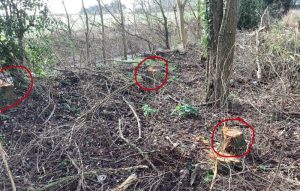
Tree stumps

The culprits who illegally chopped down more than 100 protected trees and damaged seven others have been fined nearly £20,000, Woking Borough Council said.

A landowner, together with its contractor were prosecuted and fined for the unauthorised felling of the trees  near Upshot Lane, Pyrford, after pleading guilty at Guildford Magistrates’ Court.

Burhill Development Ltd admitted it ignored a tree preservation order on its land and was made to pay £15,140, comprising fines of £11,000, a victim surcharge of £2,000 and costs of £2,140.

Their contractor, P&A Services, which carried out the work, also pleaded guilty to the unauthorised felling and causing damage to the protected trees and was ordered to pay a total of £2,900;  fines of £1,000; a victim surcharge of £400; and council costs of £1,500.

The action was taken against the two firms by Woking Borough Council. The original hearing took place in October 2023 with the judge issuing sentence in March 2024.

Speaking about the prosecution, Beverley Kuchar, Woking Borough Council’s strategic director for place, described it as an “important case” and welcomed the decision.

She said: “Whether you permit or cause wilful damage to our environment we will take legal action wherever necessary.

“It is important that landowners and their contractors take the necessary steps to understand what consent is required before commencing tree works.

“The status of the borough’s trees can be checked quickly and simply online. If in doubt, our arboricultural team can provide advice in advance of any works commencing.

“There is no excuse and, as in this case, failure to do so can lead to a criminal prosecution and significant fines.”

Tree Preservation Orders protect specific trees, groups of trees, or woodland that benefit the wider community


Psychiatric bed shortages in Surrey

HM Coroners Court Woking Surrey

A man tragically took his own life in Surrey after a mental health relapse, prompting a coroner to warn of a shortage of psychiatric beds in Surrey hospitals.

Jonathan Harris, 52, who suffered from paranoid schizophrenia, died by suicide  on June 27, 2022. 

If an inpatient psychiatric hospital bed had been available just days earlier, Jonathan would not have died, the coroner ruled. Coroner Anna Crawford judged that action should be taken to prevent future deaths. 

Bed shortages for mental health patients in Surrey, as well as nationwide, has been an ongoing issue for NHS Trusts. Many patients are forced to move up to 60 miles away from home to receive treatment because there are few beds in their area.  The court heard that this is in the context of a national shortage of suitably qualified psychiatrists.

Following a lengthy psychiatric inpatient stay in Camberley in November 2021, Jonathan was under the care of Surrey Heath Community Mental Health Recovery Service, which is part of Surrey and Borders Partnership NHS Foundation Trust.

Jonathan was prescribed anti-psychotic medication.  In February and May 2022, Jonathan requested for his medication to be reduced to fortnightly and then once every three weeks.

The reduction in medication in May 2022 was judged as “premature”  by the coroner. Jonathan had reportedly shown signs of appearing “suspicious” when he was seen by the Surrey Heath Mental Health Team (MHT) on May 4. However, these signs were not explored.

The mental health team were also aware Mr Harris was moving house, meaning and move to a new community mental health team, which may affect his wellbeing. 

Jonathan’s mental health continued to deteriorate and on June 24 it the MHT decided that he required an assessment under the Mental Health Act. 

No inpatient bed was available and therefore the assessment did not take place. If Jonathan had been assessed, he would have been detained under the Mental Health Act and admitted to hospital.

The coroner said: “Mr Harris would not have taken his own life had he remained well and the relapse of his paranoid schizophrenia materially contributed to his death.

“Mr Harris would not have died had an inpatient psychiatric hospital bed been available on either 24, 25 or 26 June 2022.

“The court also heard that there is an ongoing shortage of available inpatient psychiatric beds in Surrey and that this is in the context of a national shortage of inpatient psychiatric beds. The court is concerned that both of these matters present a risk of future deaths.”

The Prevention of Future Deaths report was issued to NHS England rather than to Surrey and Borders Partnership. NHS England was invited to comment; it said it is working to the coroner’s deadline of 56 days to respond with the action it will take or proposed to take, and such information is not yet available.

Related reports:

Coroner catalogues care failures in diabetic death

Better private – public health communications could prevent deaths


New Chief Executive for County

Terence Herbert new CEO for SCC

Surrey County Council has appointed Terence Herbert as its new Chief Executive.

Terence, currently Chief Executive at Wiltshire Council, was chosen after a robust recruitment process to find a replacement for Joanna Killian.

Subject to formal ratification at an extraordinary Full Council meeting on 9 April 2024, Terence is expected to take over as Chief Executive in the summer.

Leader of Surrey County Council Tim Oliver said:“Terence is an outstanding leader bringing over 25 years of local government experience to the role, and it is excellent news that he will be joining us.

“Under his leadership, Wiltshire is regarded as a strong local authority – one of the largest unitary authorities in the country – with sound finances and a high-performing workforce. 

“I am certain that he will be a tremendous asset to Surrey and is the right person to lead us as we face the challenges ahead.”

Terence said:“I am delighted to have been appointed as the Chief Executive of Surrey County Council. I’m looking forward to working with the leader, Members, staff and our partners to build on Surrey’s significant track record and lead the organisation through the next stage of its transformation in what continues to be a challenging time for local government.  

“Having spent much of my earlier career in children’s services and mental health, I am passionate about delivering quality services for the most vulnerable residents across our communities. I know the importance of retaining a motivated and ambitious workforce with a focus on celebrating the success of our staff, so this is an area that will be a key priority for me.”

Terence joined Wiltshire Council in 2011, where he was appointed Chief Executive in June 2020. Prior to this he held a number of senior leadership roles including Head of Service for Safeguarding, Associate Director for Children’s Services, Executive Director for Children & Families, Leisure & Communities, Corporate Services and HR & Organisational Development, and Chief Executive Officer for People.

Terence began his career as a Registered Mental Nurse (RMN) and then qualified as a social worker, taking up posts in children’s services at the London Borough of Lewisham, Royal Borough of Kensington and Chelsea, and North Somerset Council.

Related reports:

Surrey chief moves on after 6 years

County CEO’s pay rise triggering strikes?


Enforcing planning enforcement in Epsom and Ewell

Town Hall

In a comprehensive analysis of the Epsom & Ewell Borough Council‘s planning enforcement procedures, a recent audit report titled “EPSOM & EWELL BOROUGH COUNCIL INTERNAL AUDIT PROGRESS REPORT 2023-24,” conducted by the Southern Internal Audit Partnership in February 2024, has brought to light a litany of deficiencies and failures. These findings, detailed in a thorough examination of the council’s practices, underscore significant shortcomings in record-keeping, response times to complaints, and the enforcement of regulatory measures.

Central to the audit’s findings is the examination of the administration of planning enforcement, a critical function entrusted with ensuring the adherence of development activities to established regulatory frameworks. Despite assertions by the council regarding the existence of a comprehensive Local Enforcement Plan, purportedly designed to outline clear guidelines and timelines for enforcement actions, the reality paints a starkly contrasting picture upon closer scrutiny.

“Testing of a sample of cases revealed a disconcerting trend of non-compliance with stipulated timelines,” the report notes. Contrary to the Local Enforcement Plan’s mandate of acknowledging receipt of planning enforcement complaints within five working days, numerous instances were found where this requirement was not met, resulting in prolonged delays and a lack of clarity for complainants.

Moreover, deficiencies in the triage process, a critical step in determining the priority level of enforcement cases, were exposed. Despite the plan’s directive to assign priority levels ranging from one to three, the absence of mechanisms within the council’s system to accurately record these priorities severely hampered monitoring efforts. As a result, the council’s ability to effectively manage and expedite enforcement actions was compromised, leading to further delays and inefficiencies.

“Key documentation associated with enforcement actions was found to be missing altogether,” the audit report reveals, casting serious doubts on the thoroughness of investigations and the efficacy of enforcement measures. In several instances where enforcement notices were issued, no evidence of follow-up actions to ensure compliance was found, directly contravening statutory requirements under the Town and Country Planning Act 1990.

The repercussions of these systemic failures extend beyond procedural lapses to tangible impacts on the community and the council’s reputation. So heard a meeting of the Council’s Audit and Scrutiny Committee Thursday 28th March. Councillor Jan Mason (RA Ruxley), drawing from her extensive experience in planning, expressed profound dismay at the council’s failure to uphold its responsibilities in enforcing planning regulations. “I am totally surprised that we haven’t dealt with this in a more timely fashion,” she remarked. “This reflects poorly on our council, and I am deeply concerned about the potential consequences of unchecked development activities.”

Echoing these sentiments, Councillor James Lawrence (LibDem College) highlighted the significance of planning enforcement to residents, citing recurring issues and delays in addressing enforcement matters. “For many residents, planning enforcement is a top priority,” he emphasized. “The council’s failure to act swiftly in response to complaints undermines public confidence and raises serious questions about its commitment to upholding regulatory standards.”

In response to queries raised by councillors, council officers sought to clarify the circumstances surrounding the appointment of a permanent Enforcement Officer. While acknowledging the existence of temporary officers in the past, they emphasized the recent transition to a permanent role as a step towards addressing staffing concerns within the planning department.


Stoneleigh library flats for homeless

Stoneleigh Community Library (Credit Google Maps)

Two flats above a library are set to be used as temporary accommodation for homeless people, Epsom and Ewell Borough Council decided yesterday (March 26). 

Demand for temporary accommodation is “acute”, according to the council. It is currently predicting an overspend of £200,000 of its £1.5m temporary accommodation budget, according to the Local Democracy Reporting Service. 

Two self-contained, two bedroom maisonettes that sit above the Stoneleigh Community Library in Epsom that are accessed through the back of the building are earmarked for use. 

Surrey County Council, who commercially lease the empty flats, have reportedly refurbished the maisonettes to a “high standard” and will require “minimal preparation” to be used as temporary accommodation. 

Emergency and temporary accommodation is provided to housing register applicants whilst their claim is being investigated. Homeless people currently sit in Band A of the council’s housing allocations. 

Around 235 homeless ‘households’ (i.e individuals or families) were accommodated by the council in 2021, with 155 in temporary accommodation and 80 in nightly-paid accommodation, costing up to £140 a night.

Meeting documents state the decision will create a real cost saving of £30,920 pa for the two maisonettes combined to the council.

A budget of £15,000 was agreed to cover the development of the site, with £5,000 covering legal and/or surveyor costs to the council and contributing to SCC for landlord approval costs. An additional £10,000 is set aside for a maisonettes preparation contingency. 

Owned by a private landlord, the borough council will under lease from SCC who currently commercially lets the property. SCC and Epsom and Ewell Borough Council lease will co-expire in just under three years. The terms will then be renewed or re-negotiated.

Stoneleigh Community Library (Credit Google Maps)


Was County HQ sold for a song?

Surrey County Council faces scrutiny over its £25 million sale of a former headquarters site after it was revealed it could have a gross development value of £250 million once revedelopment is completed. The new owner of the former HQ has listed the site for sale with a gross development value of 10 times more than the council got when it sold the historic building in 2021.

The huge gap between the two figures led to the county council to be challenged on whether it got the best deal for residents although the lead member for property said it secured a “good deal” and would sell it again at the same price. The 5.2 acre site in Kingston is being marketed by Savills. It is described as a “landmark opportunity” with “stunning former County Hall buildings” and has planning permission for 254 private apartments, 16 shared ownership apartments, and 20 affordable rent apartments.

Rob Pollock, Savills director, London development, said in a statement promoting the sale: “With its scale and heritage, Surrey County Hall offers the opportunity to deliver a truly unique development in southwest London that might seem more at home in central London, and consequently appeal to buyers across the city. With world famous attractions like Hampton Court and Wimbledon Tennis Club in striking distance of the property, combined with the obvious curb-side appeal, we expect that the ultimate developer of the property will set new record for pricing in Kingston.”

The sale was discussed during the Tuesday March, 19 meeting of Surrey County Council. In March 2021 Surrey County Council sold the site for about £25m to RER Kingston Limited, according to officers although it was suggested the figure may have been “in excess” of that.

Councillor Robert Evans (Lab Stanwell and Stanwell Moor) asked: “When Surrey County Council was selling County Hall, its former Kingston headquarters, developers RER issued a release stating it had a guide price of £20m. This week Savills has issued a press release stating the site now has a Gross Development Value of £250m.

“Can the council tell us exactly how much it got for its former Grade 2 listed site, and whether it feels this was best value for residents seeing as it now has the potential to bring in hundreds of millions of pounds for its new owners?”

In a written response, he was told the council sold the site for £25million, on a subject to contract only basis, following “an extensive open marketing campaign for which best value was secured”. Since the sale, RER (Kingston) Ltd has been holding the 300,000 sq. ft site vacant, while pursuing a planning application through the Royal Borough of Kingston to convert much of the former complex into residential units.

The official council response read: “Costs would have been incurred for empty business rate liability, which would have been circa £700,000 per annum alongside security and other holding void costs. “Although planning consent is now expected, RER have placed the complex on the market through Savills.

“Whilst the agents suggest a potential value post development, it should be noted that when fully sold or let, this is not the value that a market bidder will pay for the asset today. A value bid would consider the cost, timing and risks of the development, the capital investment needed to complete any approved scheme (heritage build costs, consultant fees, ongoing security, void costs, finance costs at elevated rates since 2021) and the marketing period to sell or rent all units once converted.

“This could be a further three to five year project”. As part of the sale agreement the council negotiated a contractual position to secure any excess of value that might arise from any future development “if the quantum of development exceeded a certain level”.

When asked to elaborate on this, cabinet member for property, waste and infrastructure, Councillor Natalie Bramhall said the developers had spent £700,000 a year on empty rates, had to cover the cost of security, and that planning application costs would have been in excess of £1m.

She added that to get to the full £250m they would also need to spend ‘hundreds of millions” to bring it forward. She said: “Residual land value with planning persimmon is between £35m and £40m.

“Somebody is going to have to spend hundreds of millions of pounds bringing that forward and I would suggest that as the purchaser is trying to sell at this time in the market which is probably at the bottom they spent far more on this site then they probably expected already. I actually think we secured a good deal and would again sell at that price.”

Image – former SCC HQ County Hall in Kingston. Surrey Live


Unstable world, religious discrimination, the Local Plan and trains

Grayling in a snowy Epsom centre

We live, sadly, in an increasingly unstable world. The situation in Israel and Gaza has been and continues to be horrendous. There is a huge international diplomatic effort, involving the UK and other European countries, the US and countries across the Middle East, working to try to find a way of bringing both a short and long term resolution to the conflict. I really hope it succeeds.

At the same time the situation in Ukraine seems increasingly difficult, with Russia starting to make ground again in the conflict. In the short term at least there seems little prospect of peace – and my heart goes out to all of the Ukrainian families here in Epsom as they fear for their friends and relatives there.

But at Easter time I would also like to remember another group facing violence and persecution around the world. Every week I receive a newsletter from a member of one of our local Churches about what seems to be an endless stream of violence against Christian communities around the world. In Nigeria and Pakistan in particular attacks on Churches and Christian homes happen all too regularly, and in Nigeria thousands of Christians have been killed or kidnapped by extremists in recent years.

Christian communities are not alone. Ahmadiyya Muslims, a minority group in the Muslim faith, are another example of a group which faces persecution around the world.

In Epsom where different faiths live side by side, and where Church communities are strong and free to worship, we should never forget how fortunate we are compared to many in the world.

**

As I enter my last few months in Parliament, so the debate over the local plan in Epsom is beginning to heat up again. I will no longer be MP by the time it is finalised, but as a local resident as well I have a very strong interest in making sure it is done in the right way.

At the same time we can be in no doubt that we need new homes to be built. We cannot continue with a situation where so many people are struggling to get into a home of their own.

That’s why I have always argued that we need substantial smart development in this area, making best use of existing developed land, and mixing commercial and residential buildings in a way that is carefully and thoughtfully designed.

What this area does not need is more substantial family homes built on green belt land away from existing public transport. We need starter homes and affordable homes close to local centres.

I hope that even at this late stage the Residents Association councillors who control the Borough Council will change tack and look at the very real opportunities for smart brownfield development in the area. We can build substantial numbers of new homes without creating a new urban sprawl on the farm land to the East and West of Epsom.

With development, it is always much easier just to build on a green field. But the easy option is not always the best one. And in Epsom and Ewell it is certainly not.

**

If you travel by train into London, you have probably seen the new trains for our network lined up in sidings at Clapham Junction. They have been there for some time. And not in service.

There are a variety of reasons why our line is suffering from worsening overcrowding at the moment – and I am pushing South Western Railway very hard on this. Last year I got some extra semi-fast trains added to the evening peak timetable. Now I am working to do the same at other times of day.

But a lot of the problems would be solved if the new 10 coach trains were coming on stream. But it seems pretty clear that the main reason they are still parked in the sidings is because the unions are still dragging their feet on allowing them to be used. The reason – they are new, modern trains which work in a different way to the old ones. And the changes are still being resisted.

Perhaps one day the union leadership will put the passenger first. I am not optimistic.


Fast track your planning application at a premium

Application being considered

From 1 April 2024, applicants submitting certain planning applications in Epsom & Ewell will be able to choose to ‘fast track’ their application.

Developed to meet customer demands, the new optional service will be helpful to applicants who have a builder waiting to start work, or who need building work to start or finish by a certain date. Applicants will be able to pay to have their planning applications determined more quickly than the statutory eight-week period.

The types of applications that can be fast-tracked are:

  • Householder Applications – for instance, those required for extending homes e.g. building a single storey rear extension, or front porch.
  • Certificate of Lawful Development Proposed (Householder) – an application to show that the work you are proposing to do to a house is a ‘permitted development’ and therefore doesn’t need a formal application.  Sometimes you will need a certificate of this nature when you sell a house.

The fast-track fee is £350 for a Householder Application and £150 for a Lawful Development Certificate and is paid to the council, in addition to the usual cost of submitting a planning application.

Councillor Steve McCormick, (RA Woodcote and Langley) Chair of the Licensing and Planning Committee, said,

“We are incredibly proud of our Planning department who in the last year, have overcome significant challenges to go from being one of 10 UK council teams performing below an expected threshold of 70% for minor/other applications, to well exceeding national targets. It is brilliant that Epsom & Ewell Borough Council can now facilitate a service which will meet an obvious need for many residents wishing to progress building projects within the borough.

“I hope that this will ease stress for many people working to tight timelines for their builds.”

Applicants can learn more about the service and apply by visiting the council’s dedicated webpage: Fast Track Service | Epsom and Ewell Borough Council (epsom-ewell.gov.uk)