Epsom and Ewell Climate Action Network launches with community events and initiatives
20 November 2025
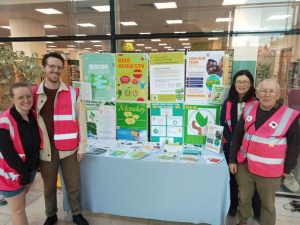
A new community movement is taking shape in the borough with the launch of the Epsom and Ewell Climate Action Network (eeCAN) – a local volunteer group working to empower residents through inclusive projects that build resilience to climate change.
EECAN’s mission is simple but ambitious: to help communities adapt and thrive in a changing world. Its projects focus on practical solutions, awareness-raising, and supporting climate-friendly policies. Everything the network offers at the moment is totally free and open to all, ensuring that everyone can take part in building a more sustainable, climate-resilient Epsom and Ewell. Users of the services will be given the opportunity to make any donations they feel they can afford if they want to help the charity do even more for their community.
“Epsom and Ewell Climate Action Network has grown so much in the last 12 months as a result of the energy and commitment of volunteers wanting to help their local communities reduce Climate risks while saving money” says William Ward the Chair and co-founder of the group.
Epsom and Ewell Library of Things
Launching to the public in spring next year, this innovative “Library of Things” will allow residents to borrow items instead of buying them, reducing waste and promoting sharing. From carpet cleaners and wallpaper steamers to pressure washers and gazebos, residents will be able to borrow tools and equipment for free, thanks to donated items. Donations of nearly new equipment are now being sought. Those able to help are asked to contact eeClimateActionNetwork@gmail.com or visit https://eecanlibraryofthings.myturn.com/library.
eeCAN is developing this initiative in partnership with Surrey County Council Library Services (for front of counter service) and with Epsom & Ewell Borough Council, in association with The Epsom Repair Café, who ensure that all electrical items are safe to use.
Bike Amnesty – Saturday 22 November 2025
Got a bike you no longer use? Donate it! Between 9am and 5pm at Epsom Methodist Church, Scout Hall, Ashley Road KT18 5AQ, residents can drop off unwanted bicycles to be refurbished and passed on to people who need them.
The scheme helps promote active, low-carbon travel while supporting those who might not otherwise afford a bike. Just turn up with your spare bikes. This free service is provided in partnership with Surrey County Council’s “Active Surrey” team.
Climate Conversations – every 2nd and 4th Monday of the month
eeCAN also runs regular Climate Conversations at Birchgrove Lower Mill, Kingston Road, Ewell KT17 2DQ, from 10:30am to 12:30pm. These informal gatherings give residents a friendly space to learn, share experiences, and explore all aspects of climate change together.
One participant said, “I often feel so motivated after one of our meetings!”
The upcoming session on Monday 24 November will feature Dr Kristine Damberg, online presenting “What can we eat for human and planetary health”, a talk exploring how our food choices affect both personal wellbeing and the planet.
Looking ahead, eeCAN will host a Living Rivers Art Exhibition at the Ebbisham Centre, Epsom KT19, in association with The Royal Marsden. Running from 22 April (Earth Day) to 22 May 2026, the free exhibition will celebrate the beauty and importance of rivers and waterways.
Inspired by writer Robert Macfarlane’s question “Is a river alive?”, the exhibition will showcase artwork from local schools, community groups, and individuals.
Submissions (A4 max-sized drawings or paintings) are invited by 27 March 2026, with eeCAN volunteers offering to collect (and return) artworks directly from schools and art groups. Groups will be invited to see their work on display and participate in nature-themed activities.
From swapping tools and donating bikes to sharing climate ideas and artistic expression, eeCAN’s initiatives reflect a spirit of cooperation, creativity, and care for the environment.
Its organisers believe that by taking small, collective steps, Epsom and Ewell can make a big difference — helping local people live more sustainably while building resilience for the future.
For more information, contact eeClimateActionNetwork@gmail.com or follow eeCAN’s activities through their upcoming community channels.
Late flash of composure seals Epsom & Ewell’s away win
20 November 2025
Sheerwater 3 – 4 Epsom and Ewell FC. Sunday 16th November – Combined Counties Premier League.
Epsom & Ewell finally claimed their first league away win of the season with a breathless 4–3 victory at Sheerwater, a contest that careened from controlled dominance to near-implosion and back again in a frantic final act.
Managerial tweaks paid early dividends as goalkeeper Sami Nabbad returned between the sticks, new signing Tyler Robinson led the line, and midfielders Shane Dunne & Brendan Murphy-McVey rejoined a refreshed starting XI. The Salts looked sharper, hungrier, and far more incisive than their recent travels had suggested.
They needed just six minutes to announce themselves. Robinson slipped a clever ball into Jason Bloor, whose effort was parried by Sheerwater keeper Antonios Nazareth. Tom Collins, alive to the rebound, arrived to head home from close range. It was a dream start for a side still searching for their first points on the road.
Brendan Murphy-McVey’s early pressure forced chances, and Robinson’s industry kept Sheerwater penned in, though the striker was shown a yellow card on 26 minutes for a late challenge on the keeper. Collins and Ali Fofahan both went close as Epsom continued to dictate, but Sheerwater finally stirred on 34 minutes when Rahman Ajibola broke free only to drag his shot wide.
Epsom doubled their lead on 40 minutes through a moment laced with both craft and confusion. Robinson earned a corner on the left edge of the penalty area, and Collins swung the set-piece directly towards the top corner. Nazareth rose to meet it along with defender Stefan Aiwone, but the ball appeared to curl straight in, possibly helped on its way by the goalkeeper. However it crossed the line, Epsom’s lead was thoroughly deserved.
A late scrambled scare in their own box and a booking for Connor McShane closed out the half, prompting the introduction of Ethan Brazier after the interval to guard against a second yellow.
But the restart brought chaos.
On 50 minutes, Nazareth conceded a needless free-kick on the left, and Sheerwater seized their lifeline. The delivery was artfully clipped into the centre, where Elliott York steered home a deft header past Nabbad to make it 2–1.
Three minutes later, Nazareth ventured out on one of his trademark mazy runs, lost possession, and from the resulting attack Harvey Valter levelled the match. A two-goal cushion was gone in a blink.
Tensions spiked on 56 minutes when Collins was pulled back unnoticed by the referee, prompting a tangle with Aiden Larkin. Both saw yellow once tempers cooled and the handbags had been packed away.
Further substitutions followed as Epsom sought to restore control.
The moment came on 65 minutes. Fofahan teed up Murphy-McVey 25 yards out, and the midfielder unleashed a looping strike that sailed over the Sheerwater keeper and into the net to restore Epsom’s advantage.
There were more changes on 78 minutes and a nervous moment on 83 when Callum O’Keefe was booked for a foul that may well have been triggered by Jason Vincent’s involvement—a potential second yellow avoided.
But Sheerwater refused to yield. On 85 minutes, with Epsom’s centre-halves caught in two minds by the charging Nabbad who was beaten by a deft lob from George Mackie from the through ball. At 3–3, The Salts’ season-long away frustrations threatened to resurface.
Yet there was one final twist.
Two minutes later, Andrew Herring threaded a ball forward that pinballed off bodies and broke fortuitously to O’Keefe, alone on the penalty spot and just kept onside by a retreating defender. With Sheerwater appealing for a flag that never came, he rounded the keeper and slotted into the empty net. Calmness personified, and a decisive blow.
After a frenetic, pulsating contest, Epsom & Ewell emerged with a hard-fought and fully deserved first away win of the campaign—one built on early dominance, character in adversity, and a late flash of composure when it mattered most.
Epsom and Ewell Borough Council to stay put awaiting its demise
20 November 2025
Epsom and Ewell Borough Council’s Strategy and Resources Committee has formally abandoned the plan to relocate the Town Hall to East Street, voting on 11 November to remain in the existing building until Local Government Reorganisation in 2027. The meeting also agreed to recommend a 3% staff pay award for 2026/27 and to support adoption of the Real Living Wage.
The decisions reverse the direction taken in earlier years which saw the Council identify 70 East Street as the future civic office site, a plan covered previously by the Epsom and Ewell Times. The East Street building will now instead be declared surplus and placed on the market.
Town Hall stays put
Members unanimously approved Option 1, an approach which keeps both the New and Old Town Hall buildings in use with only legally-required and essential health and safety works carried out. Officers advised that the council must now implement recommendations from the building’s fire risk assessment, previously deferred when a move to East Street was expected.
The work will cost £431,000, with a total capital provision of up to £517,200 once contingency is included. A further deferred-liabilities fund could be needed if ageing equipment fails during the next two to three years.
With Local Government Reorganisation due by April 2027, the report said investing more heavily in a short-term location would offer poor value. Options involving the Old Town Hall’s closure or bringing the decommissioned second floor of the New Town Hall back into service were judged significantly more expensive.
Sale of 70 East Street
Under a later agenda item, the Committee agreed that 70 East Street should be declared surplus to operational requirements and prepared for sale with a budget of up to £10,000 for marketing and upfront costs.
This effectively ends the former civic office relocation project. Surrey County Council’s departure from the second floor of the New Town Hall, the worsening condition of parts of the estate, and the uncertainties of a possible unitary-authority future all contributed to the reassessment.
Staff pay award: 3% recommended
The Committee unanimously backed recommending a 3% pay increase for 2026/27, alongside granting all staff an extra day of annual leave. Officers reminded councillors that the September CPI stood at 3.8% and that around 18% of staff at the top of their pay scales would not receive incremental rises.
Members also supported adopting the Real Living Wage from April 2026. The financial impact, estimated between £35,000 and £68,000 depending on next year’s National Living Wage, will be built into the Council’s Medium Term Financial Strategy.
Coley raises concerns over transparency and financial risk
During the public session, Cllr Alex Coley (Independent Ruxley) spoke to highlight his continuing concerns about the handling of major financial decisions, particularly those arising from Local Government Reorganisation. He noted that asset-transfer discussions risked obliging future parish-level bodies to take responsibility for community facilities without councillors being given the information they needed about long-term maintenance liabilities.
He told the Committee he had attempted several times to obtain estimated maintenance costs and values for potential transfer assets and warned of “blank cheques with unknown risks and liabilities” that could fall on residents through an uncapped parish precept.
Cllr Coley thanked the Section 151 Officer for constructive engagement on reserve reviews but cautioned colleagues not to proceed with decisions without full supporting data.
His remarks contributed to a wider discussion later in the meeting, after the press and public were excluded, on the Council’s strategic priorities and preparation for possible reorganisation.
Funding pressures still ahead
Officers confirmed that the 3% pay award would increase the projected 2026/27 budget deficit to around £2 million, with work continuing to close the gap before the February Full Council budget.
Councillors approved all recommendations put before them on the evening.
Epsom and Ewell Council transparency disputes revisited
20 November 2025
The Audit and Scrutiny Committee of Epsom and Ewell Borough Council met on 13th November, with long-running disputes about transparency once again overshadowing its agenda. Questions from the public and exchanges between councillors highlighted continuing disagreements over how openly the Council has handled its governance issues and its dealings with external auditors.
Public challenge over unrecorded meetings with auditors
Resident Previn Jagutpal opened the meeting by questioning the Council’s claim to have established “a very open dialogue” with its external auditors, Grant Thornton. He noted that a Freedom of Information response confirmed that no minutes were taken of the Chief Executive’s first meeting with the auditors. He suggested that unrecorded, closed-door discussions were difficult to square with recent criticisms of the Council’s transparency.
Committee Chair Cllr Steven McCormick (RA Woodcote and Langley) replied that not all internal meetings were minuted and that the quality of discussions with auditors did not depend on the existence of formal notes. He maintained that the sessions were appropriate and did not represent secrecy.
Jagutpal pressed further, but the Chair repeated that such meetings were professional exchanges and were not inconsistent with openness.
“Culture of secrecy” dispute resurfaces
Jagutpal’s second question revisited an earlier controversy over whether the Local Government Association peer review team had used the phrase “culture of secrecy” when assessing the Council’s decision-making. In September, Chief Executive Jackie King told the Committee she had an email from the peer-review lead saying they did not recall using that wording.
Jagutpal said that a fuller email chain disclosed under FOI showed that the LGA lead was “not present at every discussion”, leaving open whether the phrase had surfaced elsewhere. He accused the Council of selectively presenting the peer review comments. Cllr McCormick rejected any suggestion of misrepresentation and said the full email would be circulated to members and attached to the minutes of the meeting.
Clash over what may be discussed in public
Labour councillor Chris Ames (Court) then raised a formal point of order. He said councillors had been told they could not discuss certain matters in public that related to the 2023 changes to the Scheme of Delegation — the very subject that led auditors to conclude there was a “significant weakness” in governance. He argued that restricting discussion created the impression that matters were being “stitched up behind the scenes”.
The Chair and the Monitoring Officer both insisted that exempt-information rules applied and that certain details could only be taken in a private session. Ames protested that this prevented transparent scrutiny, but the Chair declined to widen public discussion further.
Disputed minutes and calls for further scrutiny
During approval of the September minutes, councillors and officers agreed to make a minor correction to a sentence summarising the Chief Executive’s comments. The amendment was adopted without dissent.
The meeting’s most heated exchange followed when Ames asked the Committee to add a future agenda item examining why the external auditors had not been informed earlier about changes to the Scheme of Delegation. Cllr McCormick initially resisted, saying the matter had already been covered by previous meetings.
Ames said that earlier discussions had been “stage-managed” and that the Committee had not been allowed to probe key issues. Liberal Democrat councillor James Lawrence (College) supported bringing the item back, saying members simply wanted clarity on when and how auditors were informed.
After a prolonged exchange, the Chair agreed that the subject could be added to a future agenda. Officers, not councillors, will prepare a report to support that discussion.
Wider business proceeds quietly
Following these debates, the Committee turned to counter-fraud matters, financial monitoring, and internal-audit progress reports. These items attracted few comments and passed without controversy — in contrast to the extended disputes over transparency that continue to dominate the Committee’s work.
Transparency remains the unresolved issue
Once again, the meeting demonstrated that the central challenge facing the Council is not simply the content of audit recommendations, but the competing interpretations of what “transparency” requires in practice. With further reports now expected, the question of how openly Epsom and Ewell Borough Council takes and explains its decisions seems set to return to the Committee table in the months ahead.
Image: Audit and Scrutiny Committee get ready for the meeting. Epsom and Ewell Borough Council YouTube.
Epsom and Ewell Times timeline on Council transparency tussle
How the Council’s transparency dispute unfolded
The debate over transparency at Epsom and Ewell Borough Council has stretched across several meetings of the Audit and Scrutiny Committee. What follows is a clear timeline of how concerns first surfaced, how councillors reacted, and how the Council’s leadership has responded.
March 2024 – Peer review flags concerns
An LGA Peer Review identifies weaknesses in decision-making processes, warning of confusion among councillors and raising concerns about the Council’s use of confidential sessions. It calls for clearer, more transparent explanations of how decisions are made under the committee system.
February 2025 – External auditors find a “significant weakness”
Grant Thornton reports a “significant weakness” in the Council’s governance arrangements, citing both the peer review and the lack of transparency over 2023 changes to the constitution and Scheme of Delegation. The Council disputes the auditors’ interpretation, arguing that it is already operating transparently.
March 2025 – Committee requests Chief Executive attendance
Audit and Scrutiny calls for Chief Executive Jackie King to attend its July meeting to explain management responses to the auditors’ findings. Concerns centre on whether officers properly informed auditors about the delegation changes.
May 2025 – Governance statement controversy
A draft Annual Governance Statement presented to the committee is criticised for downplaying the auditors’ “significant weakness” finding. Members send it back for redrafting, saying it fails to give an honest account of the issues raised.
17 July 2025 – CEO absence sparks anger
At the July meeting, members express frustration that the Chief Executive is absent despite earlier requests. Labour councillor Chris Ames repeatedly raises objections, accusing the Council of stalling accountability. The Chair says the CEO will instead attend the September meeting.
30 September 2025 – CEO gives evidence and defends actions
Chief Executive Jackie King attends and answers questions for the first time. She denies that the peer review described the Council as having a “culture of secrecy”, saying the LGA peer-review lead did not recall using the phrase. She outlines changes to reporting practices, including splitting public and confidential papers and providing plain-English explanations for exemptions.
Councillors, including Liberal Democrat James Lawrence, challenge the Council’s transparency record, citing confusing urgent-decision processes, late information at the May AGM, and the need for clearer oversight of how auditors are kept informed.
The Committee receives the officers’ report but signals that further scrutiny will be needed.
Early November 2025 – FOI reveals fuller peer-review email chain
A resident obtains an email chain via Freedom of Information showing that the LGA lead was “not present at every discussion” during the peer review, raising questions about whether the term “culture of secrecy” may have arisen elsewhere. This adds fuel to concerns about whether the Council has selectively interpreted criticism.
13 November 2025 – Transparency dispute dominates meeting
Two public questions challenge the lack of minutes for meetings between the CEO and auditors and question whether the Council has “fileted” peer-review comments. The Chair defends the Chief Executive’s position, saying not all professional meetings require minutes, and promises to append the full email to the minutes of the meeting.
A tense exchange follows when Cllr Chris Ames raises a point of order, arguing councillors are being prevented from openly discussing matters central to the auditors’ “significant weakness” finding. The Chair and Monitoring Officer insist some discussions must remain exempt.
Ames calls for a future agenda item explaining when and how auditors were told about the delegation changes. With support from Cllr James Lawrence, the Chair eventually agrees that officers will prepare a report for future consideration.
Routine business proceeds quietly, but the transparency issue clearly remains unresolved.
Looking ahead
With further reports pending and the Committee determined to revisit key questions, the transparency debate shows no sign of easing. How openly Epsom and Ewell Borough Council explains its actions, documents its decisions, and engages with auditors is likely to remain at the heart of future Audit and Scrutiny meetings.
Epsom and Ewell housing targets in the crosshairs
20 November 2025
The borough of Epsom and Ewell is currently engaged in a critical juncture of its planning future. The Council’s Regulation 19 draft Local Plan is under examination by the Planning Inspector, and at the same time the Government’s own statisticians, the Office for National Statistics (ONS), have published their new household projections. The juxtaposition of these two sets of figures highlights a growing tension between demographic trends, the Government’s national housing policy tool (the “standard method”), and local deliverability constraints.
Household growth projected by ONS
According to the ONS’s “2022-based” household projections for local authority areas, the number of households in Epsom & Ewell is forecast to rise from approximately 31,299 in 2022 to 35,493 in 2042 — an increase of about 4,194 households over 20 years, which corresponds to roughly 209 additional households per year.
It is important to emphasise that these are demographic projections (households forming under assumed migration, fertility, mortality etc). They do not translate directly into the number of homes that must be built: they make no allowance for planning constraints, land supply, local infrastructure, or policy decisions.
What the draft Local Plan proposes
The draft Local Plan for EEBC, covering the period 2022-2040, sets out the following key housing supply/requirement numbers:
A minimum housing requirement of 4,700 dwellings over the Plan period, which equates to approximately 261 dwellings per year.
An identified supply to deliver around 4,900-4,914 dwellings, providing a modest buffer above the minimum requirement. These numbers reflect the Council’s assessment of what is realistically deliverable given local constraints (Green Belt, flood risk, infrastructure, viability etc).
The “standard method” for housing need
Under national planning policy (the National Planning Policy Framework or NPPF) the “standard method” is the Government’s default tool for calculating housing need in local authorities. This is not a requirement automatically to be delivered by local authorities, but sets a starting point that local plans should address. In the case of EEBC:
In the Plan examination evidence the Council cites a standard method calculation of 10,242 dwellings over the plan period, which equates to about 569 dwellings per year — a figure more than double the Plan’s proposed annual rate.
Separately, analysts have calculated that under the more recent stock-based standard method (introduced in late 2024) which uplifts areas with higher affordability pressures, EEBC’s implied requirement would be around 871 dwellings per year, i.e. nearly 900 homes a year.
Why the “affordability uplift” matters
A key message that has emerged from CPRE Surrey and elected members is that the new standard method gives very heavy weight to the “affordability uplift” — the ratio of house prices to local earnings — and that this seriously disadvantages boroughs such as Epsom & Ewell.
As Tim Murphy (CPRE Surrey) put it: “The latest numbers from the Government’s own statisticians show that the housing target set by the Government for Epsom and Ewell is totally unrealistic. The target would mean that, over the next twenty years, the Borough would lose much of its existing open space – the character of the area would be changed for the worse for ever.”
Specifically:
The standard method compares local house prices with local earnings. In Epsom & Ewell many resident households earn London or Canary Wharf salaries (commuting to central London) which inflate local house prices but are not captured in the earnings base used for the formula.
There is no adjustment (in the national method) for such commuting-induced distortion of house prices. The result: the formula treats Epsom & Ewell as a high affordability-pressure area and drives a very large uplift in the ‘need’ figure. In short: the standard method may be overstating “need” in places where price inflation is driven by non-local earnings rather than purely local demand or local pay.
Contrasting the figures: ONS vs Local Plan vs Standard Method
Here are the headline comparisons:
ONS household formation projection: ~209 new households per year (2022–2042)
EEBC draft Local Plan requirement: ~261 homes per year (2022–2040)
Standard method (2023 NPPF basis): ~569 homes per year (10,242 over the period)
Updated stock-based standard method (2024 NPPF basis): ~871 homes per year (analyst estimate)
What this shows:
The Local Plan’s 261 homes per year is above the demographic projection of ~209 households per year, thus it can be argued that the Plan is planning for growth above simple demographic trend.
However, it remains far below the standard method starting points (569 or 871 per annum) — representing a significant gap between what the national policy tool implies and the local Plan provides.
The gap calls into question how far the Borough should be expected to “deliver” the full standard-method figure given local constraints, and whether a higher rate is justified (or deliverable) in practice.
Additional context from councillors
Councillor Kate Chinn (Labour Court) notes that: “Epsom and Ewell has a huge housing crisis now and can’t provide suitable homes for its current residents so the borough needs to build more than just enough to keep up with household growth. There are people in serious need of rehousing who are waiting years … the Residents Association … needs to stop looking for reasons to block new housing and start working with developers to build decent homes for residents.”
This underlines that local housing need is not only about future households but existing unmet need: social housing shortages, long waiting lists, temporary accommodation of poor quality, and the knock-on effects on children’s life chances, health, education and emotional well-being.
Councillor James Lawrence (LibDem College) adds further policy context, reminding us that the draft Local Plan is being prepared under the December 2023 NPPF (which uses the earlier standard method approach). He points out that the updated 2024 NPPF uses the stock-based standard method, raising further questions of whether the Plan needs to be reassessed in light of the new method. He also highlights the circularity argument: using future population projections to determine how many homes to build, when building more homes will itself change future population.
Councillor Peter O’Donovan (RA Ewell Court), Chair of Epsom and Ewell Borough Council’s Licensing Policy and PLanning Committee responded: “The Councils Local Plan was submitted to government in March 2025 and is now being examined by a government appointed Planning Inspector, this is known as the examination stage. The revised ONS household projections data do not impact the examination of the Local Plan. Keep up to date with the Local Plan Examination here: Local Plan Examination | Epsom and Ewell Borough Council”
Implications for Epsom & Ewell
The mismatch between demographic projections on the one hand and national policy-based housing “need” on the other has several implications:
Deliverability and infrastructure: The higher standard method numbers assume a very much higher rate of building than the Borough has historically achieved. If such rates were imposed, the supply of suitable land, infrastructure capacity (transport, schools, services), viability of development and environmental constraints (Green Belt, flood zones) would all come under significant pressure.
Green space and character: As Tim Murphy rightly flags, if nearly nine hundred homes per year were required over twenty years, the borough’s character, open spaces, suburban nature and amenity would face significant change. For many local residents preservation of character is a live concern.
Affordability link and commuting distortion: The standard method’s reliance on local earnings means that boroughs like Epsom & Ewell (with many commuters earning London wages) may be unfairly treated. The commuting effect inflates prices but is not compensated by the earnings measure. The formula may therefore over-inflate “need” in such areas.
Focus on genuine need: The local context shows that, beyond future household growth, there is an existing backlog of need (e.g., social housing, temporary accommodation, unsuitable homes). If the borough simply aimed to match new household formation it might still fail to meet the existing need. Councillors emphasise that making provision for those already housed in inadequate conditions must be part of the strategy.
Policy and timing: The draft Local Plan uses the earlier standard method (2023 NPPF) calculations; the switched methodology in the 2024 NPPF potentially changes the baseline “need” significantly. This raises questions as to whether the Plan remains future-proof and whether the examination will ask for an updated technical basis.
For the readership of the Epsom & Ewell Times and stakeholders across the local community, the following points merit emphasis:
Clarify that the ONS figure (~209 homes per year) shows what is likely in demographic terms, but that housing targets set by policy may differ significantly.
Highlight the role of the affordability uplift and how the standard method treats areas like Epsom & Ewell (with commuting wage influences) differently from truly local‐wage areas.
Encourage the Council and stakeholders to scrutinise whether the standard method’s assumptions are appropriate in the local context and whether the draft Plan provides sufficient evidence to justify deviation from higher figures.
Promote transparency on how the Plan addresses existing housing deprivation, not just future household formation: how many social or affordable homes, how many temporary accommodation units, how many conversions of unsuitable homes, etc.
Ask whether the local infrastructure, land supply and environmental constraints realistically allow delivery of very high build rates, and whether the Plan sufficiently tests viability at the higher levels implied by the standard method.
Encourage local residents to comment on the Plan and its housing provision strategy, especially in light of the gap between national “need” figures and local deliverability.
Recommend that the Council monitors any changes in Government policy or standard method revisions (e.g., if further changes to the affordability uplift or commuting adjustments are introduced) and updates the Plan accordingly.
Epsom & Ewell’s draft Local Plan appears modest but credible when viewed against demographic household growth alone. However, it falls far short of the housing “need” implied by the Government’s standard method calculations. The prominence of the affordability uplift in that method raises particular concerns for commuter-belt boroughs such as this, where local earnings do not fully capture the incomes of many resident households. The key challenge for the borough is to strike a balance between realistic deliverability, protection of local character and amenity, and the clear social housing need that exists today. The examination process offers an opportunity to test whether the Plan is positively prepared, justified and effective — but it will also require robust scrutiny of whether national formulae appropriately reflect local circumstances.
Surrey Police have begun using live facial recognition (LFR) technology after securing two mobile LFR vans in a joint bid with Sussex Police. The first deployment took place this week in Redhill following months of planning.
The vans use real-time facial recognition to compare faces captured on live camera feeds with a pre-determined police watchlist. Surrey Police say this list will include wanted persons such as sex offenders and perpetrators of domestic abuse. According to the force, images of everyone else are “instantly and permanently deleted”, and images of those on the watchlist are deleted within 24 hours.
Police acknowledge the historical concerns about gender and ethnic bias in commercial facial recognition systems but state that the national algorithm they will use “shows no statistical bias” and has been tested by the National Physical Laboratory. Officers will receive briefings on potential disparities relating to race, age and gender, and any computer-generated match will be checked by an officer before action is taken.
The force says deployments will only be authorised by a Superintendent and carried out “in a proportionate manner”, with clear signage on the vans and advance publication of deployment locations. The vans are funded by the Home Office for five years and may be made available to other forces for mutual aid.
Chief Inspector Andy Hill, Surrey Police’s lead for LFR, said the technology is “a vital tool to help us to investigate crime thoroughly and relentlessly pursue criminals”. He added that the rollout had been “meticulously planned” to ensure appropriate and transparent use. Police and Crime Commissioner Lisa Townsend described the vans as an important means of identifying violent criminals and sex offenders.
If the LFR vans come to Epsom and Ewell, Surrey Police say residents will be notified before deployments and that the vans will be signposted when in use.
National picture
The deployment in Surrey comes as the use of facial recognition technology accelerates across UK policing. Forces in England and Wales have increasingly turned to mobile LFR units, with millions of people scanned nationally each year and several hundred arrests made as a result. London’s Metropolitan Police and South Wales Police are among the heaviest users, reporting arrests of wanted individuals including violent offenders and registered sex offenders.
While these figures suggest a measurable benefit, LFR still represents a small proportion of overall policing activity, and questions remain about its accuracy, its effect on minority groups and the proportionality of scanning large numbers of passers-by for relatively small numbers of matches.
ICO guidance and safeguards
The Information Commissioner’s Office (ICO) has issued detailed guidance stating that facial recognition used by police must comply with strict requirements of data protection law. Forces must demonstrate that each deployment is lawful, fair, transparent and based on necessity and proportionality. Data Protection Impact Assessments are required, and forces must show clear justification for the locations chosen, the purpose of the watchlist, and the retention policy for images. The ICO stresses that facial recognition “does not operate in a legal vacuum” and will continue auditing police use.
Advance signage and practical concerns
One issue not fully addressed in the Surrey Police statement is how advance signage will work with mobile vans. In practice, UK police forces usually publish the location of an LFR deployment only shortly before the van becomes operational. Because the vans can be moved rapidly as part of an operation, advance publication generally refers to the place where the van parks, not its movements throughout the day. Some forces update information if the van relocates, though not always in real time.
Another question is whether advance notice undermines the policing purpose by alerting wanted suspects. Civil liberties groups argue it does, but police note that most arrests via LFR occur even when deployments are announced. Many wanted individuals do not monitor police websites, and the requirement for transparency stems from data protection law rather than operational convenience. The ICO has made clear that secrecy around deployments would be unlikely to meet legal standards of fairness.
Local implications
For residents, the potential arrival of LFR vans in Epsom and Ewell would bring a technology that is increasingly common across the UK. Surrey Police emphasise that law-abiding members of the public have “nothing to fear” and that images of those not on a watchlist are immediately deleted. However, questions remain about how watchlists are created, how effectiveness will be measured and whether Surrey Police will publish statistics on matches, false matches and resulting arrests.
As mobile facial recognition becomes a more familiar part of policing nationwide, the way Surrey Police implement and report on these deployments will be key to maintaining public confidence while pursuing the serious offenders the technology is designed to identify.
Photo: A live facial recognition van. Courtesy – Sussex Police.
Surrey to get a higher level of heart care
20 November 2025
Heart patients and the tiniest and most vulnerable babies across Surrey are set to benefit from major investment in local specialist services, following confirmation of a £3.2 million upgrade at Ashford & St Peter’s Hospitals NHS Foundation Trust in Chertsey. Although the improvements are centred at St Peter’s Hospital, the effects will be felt across the county, including by patients who would typically access services at Epsom.
The investment is being funded largely by Runnymede Borough Council’s Community Infrastructure Levy, and will see the cardiac catheter-lab at St Peter’s upgraded to deliver more complex and less invasive heart procedures at a faster rate. It will be complemented by a £296,000 refurbishment of the Neonatal Intensive Care Unit, which is the only Level 3 neonatal facility in Surrey. Councillor Robert King, co-leader of Runnymede Borough Council, stated to the BBC’s LDRS: “For families, the moments when a loved one needs specialist care are when the NHS matters most. That is why this investment we have championed at St Peter’s Hospital is so vital.”
Across Surrey, hospitals offer a range of cardiac services. Epsom provides extensive inpatient and outpatient cardiology care, including angiograms, non-complex stenting, pacemakers, complex device implants and heart-failure treatment. However, for confirmed heart attacks and the most complex interventional procedures, patients are transferred to the regional heart-attack centre at St George’s in London. Other Surrey hospitals, including East Surrey Hospital and the Royal Surrey in Guildford, also run catheter labs and offer broad specialist cardiology care, though not all services are identical between sites.
The enhancements at St Peter’s therefore represent a significant expansion of Surrey’s own capacity to deliver more advanced, less invasive heart procedures locally, reducing pressure on London hospitals and improving access for patients across the county. In neonatal care, the upgraded Level 3 unit will strengthen Surrey’s ability to care for the sickest and most premature babies, with facilities designed to improve comfort, privacy and support for families during long and emotionally demanding stays.
Ashford and St Peter’s Hospitals CEO, Louise Stead, stated to the BBC’s LDRS: “These improvements will strengthen our ability to deliver timely, life-saving care in modern, purpose-built environments.” The funding, described as one of the most significant local healthcare investments in recent years, is expected to deliver the improvements within the next two years.
From Ukraine to Epsom: How Music and Kindness Struck the Right Note
20 November 2025
When the Ukraine National Opera arrived in the UK on tour in early 2022, none of its musicians could have imagined how the world, and their lives, were about to change. Two weeks later, Russia invaded Ukraine. Many members of the orchestra, seeing the escalating conflict at home, made the painful decision to remain in the UK and claim asylum. Among them was clarinettist and saxophonist Vlad Voloshyn.
Now living in Epsom with local resident Nina Kaye, one of the founders of the Epsom & Ewell Refugee Network, Vlad has continued to rebuild his life through music. Together with five of his former orchestra colleagues, he formed a brass ensemble called Freedom Pulse, which performs Ukrainian and classical repertoire across Surrey and beyond.
Alongside his performing career, Vlad is in his final year at the British Institute of Modern Music (BIMM) in Fulham, where he studies music and sound production and hopes to work as a sound designer after he graduates.
Recently, an extraordinary act of local generosity brought his story full circle. Vlad had long hoped to buy a tenor saxophone, an instrument essential for his expanding repertoire but out of reach financially. By chance, his host Nina, who also volunteers for Nucleo, a London-based social action charity that helps children from disadvantaged backgrounds have access to music, received an email offering a donated tenor saxophone. Nina runs Nucleo’s National Instrument Bank, which matches donated instruments with musicians in need.
The offer came from a donor in the Lake District. Determined and hopeful, Vlad took the long train journey north to collect what he thought was a tenor saxophone. Only on the journey home did he discover it was actually an alto sax, an instrument he already owned. Disheartened, he returned to Epsom unsure how to continue his search.
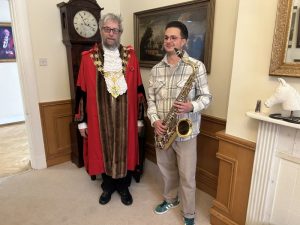
A few days later, Vlad was performing at a Ukrainian Music Evening in Epsom, attended by His Worshipful The Mayor of Epsom & Ewell, Councillor Robert Leach. Sitting beside the Mayor, Nina recounted Vlad’s misadventure with the saxophone. Without hesitation, Councillor Leach said, “I’ve got a tenor sax at home which I haven’t played for 30 years and he would be welcome to have it, if I can find it.”
True to his word, after the concert Vlad was welcomed to the Mayor’s home and given the instrument which left him both astonished and grateful.
What began as a story of loss and exile has become one of connection and kindness. From the national stage in Kyiv to community halls in Surrey, Vlad’s journey shows how music continues to build bridges where politics and geography divide.
When Vlad plays his tenor sax in Freedom Pulse’s performances, he will know that even in times of war and displacement, the power of human generosity, and of music itself, resonates far beyond borders.
Epsom & Ewell Borough Council is proud to launch its Green Your Home Guide to help residents take simple, everyday actions to contribute to a healthier environment and help combat climate change. The guide offers practical advice and tips for making small changes that collectively make a big difference.
The initiative empowers individuals and households to take ownership of their environmental impact through easy-to-follow steps. From reducing waste and conserving energy to choosing sustainable transport and supporting biodiversity, the guide highlights how everyone can play a part.
The Green Your Home Guide is being rolled out as part of Epsom & Ewell Borough Council’s Climate Change Action Plan 2025-2029, which has already helped reduce the council’s operational emissions by 16% since 2019/2020. This is part of the council’s commitment to becoming carbon neutral by 2035.
Councillor Liz Frost, Chair of the Environment Committee, said:
“This guide is about showing people they don’t need to make radical changes to their lives to make a difference. Simple, ongoing changes—whether building on existing efforts or starting something new – can have a meaningful, long-term impact. From making homes more energy efficient, to planning wildlife-friendly gardens, and investing in systems that reduce reliance on fossil fuels, every step counts. We want residents to feel confident and motivated to take action, and we hope the guide supports their decision-making along the way.”
About Epsom & Ewell Borough Council’s (EEBC) Green Your Home Guide The council’s Green Your Home Guide explains a number of ways residents can improve their property and garden, helping homes work with nature and reduce their household carbon footprint. Topics include: Insulate to end heat waste; generate green energy with renewable technology; let it drain with permeable driveways; go ahead, go electric; lights out to help nocturnal wildlife; mind the gap to save hedgehogs; give nature a home; save our streams with water butts; turn scraps to soil by composting; turf for earth; wild your garden with diverse, native landscaping; plants for bees; plants for butterflies; plants for birds; plant for the planet: plant new trees and keep existing ones. Green Your Home Guide | Epsom and Ewell Borough Council
About EEBC’s Climate Change Action Plan including progress so far
In 2020, the council’s first Climate Change Action Plan (2020-2024) was developed, setting an ambitious target of becoming carbon neutral by the year 2035. It set out plans to implement a range of measures to reduce the council’s own emissions as well as promoting good practice throughout the borough. The council has since adopted its second Climate Change Action Plan 2025-2029. The plan is a living document which will be reviewed and updated over time. Climate Change | Epsom and Ewell Borough Council
About EEBC Biodiversity Action Plan 2020-2030
The council’s local Biodiversity Action Plan is a long-term plan aimed at protecting, maintaining and, where possible, enhancing biodiversity at a local level, taking into account both local, regional, national and sometimes international priorities. Epsom and Ewell Borough Council – Biodiversity
Numerous safeguarding flaws over many years “cumulatively laid the foundations for the severe abuse” Sara Sharif experienced, a new independent report has revealed. The 10-year-old schoolgirl was found dead in her dad’s home in Byfleet, Surrey, in August 2023. After Sara’s dad, Urfan Sharif, and stepmum, Beinash Batool, were sentenced for murdering the girl in December 2024, Surrey Safeguarding Children Partnership (SSCP) launched an independent safeguarding review. The reviewers were tasked to investigate how professionals responded to concerns about Sara’s welfare throughout her life. The 62-page review, published on November 13, concluded that weaknesses in how professionals assessed risk, shared information and followed safeguarding procedures meant signs of harm were not acted on effectively. “Expected robust safeguarding processes were not followed,” the report found. “Information gathering and assessment at this stage did not adequately triangulate information and respond to the presence of bruising alongside inconsistent explanations. Sara’s ‘voice’ expressed through her change in demeanour was not heard.”
In March 2023, Sara’s school raised concerns with Surrey’s children services after she appeared with bruising on her face and teachers were given inconsistent explanations for how it had happened. Her normally positive demeanour had also changed, but the report found that this was not sufficiently recognised as a sign that she might be at risk. Instead, the service decided no further action was needed after speaking to her father and did not hold a formal strategy discussion with other agencies. The review also found that information was held across multiple agencies but not consistently shared, leading to an incomplete understanding of the family’s situation and therefore assessment of Sara’s safety. It read: “This serves to highlight the challenge for practitioners in coming to a holistic understanding of a child’s life both in the past and present and using this understanding to identify risk of harm.”
Sara was withdrawn from school to be home educated in April 2023, which the review said removed her from professional oversight. Surrey’s policy at the time required a home visit within ten working days when a child is withdrawn from school but this did not take place. The report added that management oversight failed to identify this gap in practice. The decision to home educate should have triggered further checks given the family’s history with children’s services. The review also identified long-standing domestic abuse concerns, finding that professionals underestimated the risks posed by Sara’s father and relied too heavily on his reported attendance at a perpetrator’s programme rather than assessing if his behaviour had changed. The authors recommended domestic abuse training and awareness should be strengthened across agencies locally and nationally.
Additionally Sara’s mum had limited access to Polish interpreters during key family court proceedings in 2019. The report said her views were not fully heard and that little consideration was given to Sara’s mixed Polish and Pakistani heritage in decision-making. The review also admits that sometimes agencies must “think the unthinkable” and consider the potential risk of harm in daily practice. It states: “Although the aim will always be to try and work alongside families and support them to care for their children, […] we must remain alert to the possibility that some parents will deliberately harm their children […] This is not the responsibility of any one agency.” The review made 15 recommendations, including ensuring multi-agency discussions in all cases of unexplained injuries, improving home education oversight, and embedding cultural and domestic abuse training for staff.
Terence Herbert, Chief Executive of Surrey County Council said: “We are deeply sorry for the findings in the report related to us as a local authority. We have already taken robust action to address those relating to Surrey County Council, and that work will continue with every recommendation implemented in full. We will also work with partners across the Surrey Safeguarding Children Partnership to ensure a joint action plan is implemented as quickly as possible.” In 2019 Surrey’s Children Services was given an ‘Inadequate’ rating from Ofsted. This was then upgraded to ‘Requires Improvement’ in 2022 and then ‘Good’ in 2025. Surrey County Council has said it has already made “significant change” to how it handles child safeguarding. These include the creation of a multi-agency safeguarding hub to improve information sharing between social care, the police, and health services and mandatory domestic abuse training for all children’s social workers. The council said it has also strengthened oversight of home education cases and requires additional checks and management reviews when a child is taken off the school roll.
However, the council has not clarified how it will acknowledge the importance of race and culture when considering child safeguarding, or how it will provide access to a translator if needed. Tim Oliver, Leader of Surrey County Council said: “I am certain that everyone involved with this family will have reflected on what more could have been done to protect Sara, and my thoughts and condolences are with anyone affected. The independent and detailed review makes a number of recommendations both for national government and local partners and it is now essential that every single person in every organisation involved in child safeguarding reads this report and understands the lessons learnt. I am deeply sorry for the findings in the report that relate to us as a local authority. We will now act on those findings and continue to review and strengthen our culture, systems and processes designed to support good practice in working with children and families, as per the recommendations. I call on the government to review the findings and, where appropriate, legislate for the changes in the national system that it calls for.”
Image: Surrey County Council headquarters. Credit: Emily Coady-Stemp
Surrey’s Satellite bio-diversity project promoted at COP30 Brazil
20 November 2025
Surrey’s Space4Nature project, which uses satellite data and community science to protect biodiversity across the county, is currently being showcased by the UK Government at the COP30 UK Pavilion in Belém, Brazil (10–21 November 2025). The display forms part of the UK’s official presentation of research and innovation tackling global climate and nature challenges.
Co-led by the University of Surrey’s Centre for Environment and Sustainability (CES) in collaboration with Surrey Wildlife Trust, Buglife, and the Painshill Park Trust, Space4Nature brings together scientists, local communities and conservation groups to map and monitor key habitats across Surrey – from chalk grasslands to heathlands and acid grasslands that support some of the nation’s rarest species.
Using advanced satellite imagery and artificial intelligence trained with data from local volunteers, the project can classify habitats to Level 4 of the UKHab system – producing one of the most detailed environmental maps of its kind. This allows conservation partners to pinpoint where biodiversity is under threat and focus restoration efforts, such as reconnecting fragmented chalk grasslands – often called the “rainforests of Europe” for their carbon storage and rich biodiversity.
Surrey Wildlife Trust plays a central role in Space4Nature, leading the project’s citizen science programme, training volunteers and coordinating the collection of field data that makes its satellite and AI mapping possible. The Trust’s on-the-ground expertise connects technology and conservation, turning local knowledge into invaluable data for protecting Surrey’s landscapes.
Dr Ana Andries, Lecturer in Remote Sensing and GIS at the University of Surrey, and project lead, said:
“We’re using satellite data and artificial intelligence in a way that directly supports conservation on the ground. Citizen scientists help train our machine learning models, thus turning local field data into high-resolution habitat maps that reveal where biodiversity is under threat. To see our work featured on a global stage at COP30 highlights how our region’s innovation and collaboration can help shape the future of biodiversity monitoring.”
Andrew Jamieson, Space4Nature Project Manager at Surrey Wildlife Trust, says:
“It’s time for conservation organisations like ours to step outside traditional boundaries and focus not just on land management and individual species recovery, but also on delivering the tools and partnerships that will drive change on a landscape level. This project exemplifies that approach.”
Space4Nature was among the first projects in the United Kingdom to receive Space for Climate Observatory (SCO) accreditation from the UK’s Space4Climate network, recognising its excellence in using Earth observation data to tackle environmental challenges. This year, it has been selected as one of just 19 organisations featured in the UK Government’s Pavilion at COP30, with a video and QR-linked display presented by government representatives throughout the conference.
Dr Zoe M Harris, Director of Surrey’s Centre for Environment and Sustainability and Co-Director of the Institute for Sustainability, said:
“The Centre for Environment and Sustainability was founded on the idea that solving environmental challenges means bringing disciplines and people together. Space4Nature embodies that vision – combining engineering, data science and community insight to create practical tools for nature recovery. Seeing this work recognised at COP30 highlights Surrey’s role as a global leader in sustainability research and innovation.”
Image: Centre for Environment and Sustainability, University of Surrey
Epsom and Ewell Times adds – the Surrey project is one of only twenty presented by the UK at the COP30 summit. See the full list HERE.
Conditional nod to southern rail link to Heathrow
20 November 2025
Spelthorne Borough Council has agreed to support a new rail link between Staines-upon-Thames and Heathrow Airport, but only on strict environmental and local benefit conditions.
The proposed Heathrow Southern Rail (HSR) scheme would connect Heathrow Terminal 5 directly to the south-west rail network, using existing track between Staines and Windsor before running in a new tunnel under Staines Moor. Supporters say it could slash road congestion, help people reach work at the airport, and give the town’s economy a boost.
Councillors say they welcome the idea in principle but have made clear that their backing comes with safeguards. They want guarantees that trains will actually stop at Staines, that there will be no damage to the sensitive Staines Moor landscape, and that the council will get to sign off on final plans once detailed studies are complete.
Cllr Chris Bateson, who led the council’s review, told the BBC’s Local Democracy Reporting Service: “We’ve looked at both proposals in detail. A direct rail link from Staines to Heathrow could reduce congestion and support our local economy. But we must protect Staines Moor and make sure residents benefit.”
His colleague, Cllr Howard Williams, chair of the Business, Infrastructure and Growth Committee, added: “Our support relies on clear guarantees. The environment can’t pay the price for progress. We will keep working with HSR to make sure residents’ interests come first.”
The link would run mainly in tunnel to limit disruption, emerging to join the existing railway near Staines. The promoter, Heathrow Southern Railway Ltd, says the route could remove millions of car journeys to the airport every year and cut thousands of tonnes of carbon emissions.
If built, the line could open in the second half of this decade, though no firm construction timetable has yet been confirmed. Earlier proposals suggested the service could be running between 2026 and 2028, offering a six-minute journey from Staines to Heathrow Terminal 5.
An alternative “Southern Light Rail” idea — which would have involved a surface-level route — was rejected by councillors as too intrusive, with greater impact on privacy and the landscape.
While the majority of councillors supported the HSR plan with safeguards, some voiced concern that the benefits might not be evenly spread across the borough, particularly in Stanwell, where many residents already work at the airport.
The council says it will continue talks with HSR to ensure local voices are heard before any final decision. For now, the message from Spelthorne is clear: Heathrow’s southern rail link is welcome — but not at the expense of Staines Moor or local control.