


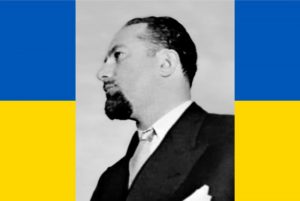
MICHAEL BIALOGUSKI (1917-84) Ukrainian born Doctor, musician, conductor and spy who spent the last 20 years of his life in Epsom
Mykolo Bialoguski was born in Kiev (then in Russia, now in Ukraine) on 19 March 1917. His parents, Gregorii and Paulina, were Polish professionals, being a veterinary surgeon and dentist respectively. Gregorii was a non-practising Jew and Paulina a Christian.
Apparently, the family fled Kiev in about 1920, having nearly been shot by Bolsheviks, and from 1927 to 1935 Mykolo attended a secondary school in Wilno, Poland – which is now Vilnius, Lithuania, a graphic illustration of the ever-shifting political sands of Eastern Europe. He studied the viola and began to study medicine.
The Nazis invaded Poland on 1 September 1939, thus triggering World War 2. The political goings-on in relation to Poland at that time were hideously complicated and we shan’t dwell on them here, but we do need to know where Mykolo was at the time and why he probably decided to leave. The following map will assist matters – Wilno is in the top right-hand portion and occupied by the Soviets.
In present-day terms Wilno/Vilnius is quite close to the Belarusian border, just over 200 km as the crow flies, and during WW2 Belarus (then the Byelorussian Soviet Socialist Republic) was initially under the control of the Soviets: however, in 1941 the Germans invaded and if, like Mykolo, you were both anti-communist and had a Jewish parent, then Wilno was not a place to be under either regime. (If you want to know more about Wilno during WW2 there is ample material on Wikipedia in the articles on Vilna Ghetto and Ponary Massacre.)
Mykolo had married an Irena Vandos in Poland at some point, but they were divorced in 1941. He had already been jailed briefly for protesting against some actions of the occupying Red Army and so, spinning a yarn about going to Cura?ao, he travelled across Russia to Japan, the latter not yet having joined in WW2, although it did so in December 1941. Fortunately, Mykolo had arrived in Sydney, Australia by then and became Michael.
So, we are now in Sydney and in 1942 Michael enlisted in the Australian Army Medical Corps as an orderly; he was then discharged with Government approval and assistance to study medicine at the University of Sydney, which he did successfully. In 1943 he married divorcee Agnes Patricia Humphry (known as Patricia – they were ultimately divorced in 1954). After a year in general practice at Thirroul, a seaside suburb south of Sydney, he set up on Macquarie Street, in central Sydney itself.
Spying
One would think perhaps that building up a practice as a doctor in a thriving city district would be more than enough for any young man, but there were other facets to Michael. He was certainly anti-communism but that in itself doesn’t turn you into a spy, especially if you’re safely ensconced in Australia. It looks more as if he wanted to ‘play spies’ because he was fascinated with it all. He offered his services to the Commonwealth Investigation Service (CIS) in 1945 and was engaged as an agent: the CIS was apparently as secure as a chocolate padlock in terms of leaks and had been infiltrated by Soviet spies, which led to the creation of the Australian Security Intelligence Organisation (ASIO). In 1949 Michael was engaged as an ASIO agent.
As is usually the case with that era of peculiar ‘peace’, spies, agents and double agents were everywhere and it was hard for them to know which side anyone was on, let alone any amateur researcher trying to make some sense of it 70 years or so later. Still, it must be done, as it was the man’s main claim to ‘fame’.
The Petrov Affair
Petrov had started out as Afanasy Shorokhov, born in 1907 to peasant parents in a Central Siberian village. In 1923 he joined an organisation for young communists and then the Soviet Navy, by which time his name had become Vladimir Proletarsky and later Vladimir Petrov. Having worked his way up, slowly, from cipher clerk in the Navy to the MGB (a predecessor of the KGB which dealt with myriad security and intelligence issues) he became third secretary at the Soviet Embassy in Canberra – or, to put it another way, a senior KGB officer and spy control in Australia. It was quite surprising that Petrov had survived Stalin’s vicious purges and executions of officials over the years, but he had mainly worked under a very nasty piece of work named Lavrentiy Beria and nobody had managed to get rid of this vile man to date. Beria will become significant in a moment, but, returning to Australia, Petrov met Bialoguski and, against a background of mutual friendship, copious alcohol and prostitutes, Petrov thought he had recruited Bialoguski as a Soviet spy, whereas the latter continued to work for ASIO and was spying on Petrov.
Matters came to a head in 1953 when Stalin died and a power struggle ensued. Beria was confident of working his way to the very top, but certain people, Nikita Khrushchev in particular, had other ideas, and Beria was executed. Bialoguski and his colleague, Ron Richards, used this as part of the argument that Petrov should defect, saying that when he was recalled to the Soviet Union under the new regime, he would be in mortal danger. Another part of the persuasion was a large sum of money.
Petrov did defect in 1954, but had neglected to forewarn his wife, Evdokia (also a spy), who, when recalled by the Soviets, was torn between her sister back home and her husband.
Evdokia decided to cooperate with the Australian authorities. Next came a ghastly episode: she was kidnapped by Soviet agents and dragged kicking and screaming to an aircraft.
A high-ranking Australian official witnessed this and fired off an urgent telegram requesting Prime Ministerial intervention, as it was certain that Evdokia would come to a horrible end if she was taken to Moscow. When the plane landed for refuelling at Darwin, Australian police boarded, extricated her from the kidnappers and asked whether she wanted to go to Moscow or stay in Australia. You can guess what her answer was.
There was subsequently a Royal Commission investigating Soviet espionage in Australia, but there is no need to go into that here, save to say that it generated enormous press coverage and political wrangling. The Petrovs remained in Australia as Australian citizens.
As mentioned earlier, Michael and Patricia were divorced in 1954 and it wasn’t an amicable parting. He wrote a book about the Petrov Affair, which was serialised in various newspapers and Patricia went to the papers with her own story. She said that he had a strange, almost weird, personality and that he was a clever, self-absorbed, manipulative and ambitious man who could also be charming and entertaining. This seemed to accord with others’ views of him.
Michael was apparently a minor press celebrity for the rest of the 1950s but didn’t seem to make significant headway with either his career or finances. In 1957 he applied for a reduction in Patricia’s alimony, claiming that he hadn’t made much money from the book and that his medical practice had suffered as a result of all the publicity. He got the reduction in alimony and in 1961 he won a libel case over Patricia’s published allegations and was awarded £1,000 in damages.
Meanwhile, in 1957 he had married Nonnie Frieda Peifer, then a secretary; she had had a brief career as a film actress in minor roles under the name of Nonnie Piper in the late 1940s/early 1950s. He was still determined to pursue a musical career of some kind, preferably as a conductor, and had actually played the violin in the Sydney Symphony Orchestra, but he wasn’t getting anywhere on that front.
In about 1964 the family moved to England, where Michael continued to work in medicine but pursued his musical ambitions too. They lived at 24 Shawley Way, Epsom, which by a boundary quirk came under Tattenhams Ward, Banstead for election purposes and is now designated as ‘Reigate and Banstead’.
Finally, Michael was able to study conducting and conducted the Royal Philharmonic Orchestra. In 1969 he conducted at the Royal Albert Hall, then he formed the Commonwealth Philharmonic Orchestra and also wielded the baton in Westminster Abbey. Perhaps at last he had found his true vocation.
Michael died of cancer on 29 July 1984 at Kingswood, Surrey. Nonnie remained in England and lived until 14 February 2020, aged 89. She was survived by three of her children and several grandchildren.
Linda Jackson 2023
This article is reproduced with the kind permission of Epsom and Ewell History Explorer (www.eehe.org.uk). The original article forms part of EEHE’s extensive and richly illustrated archive of local history. Epsom and Ewell Times readers are warmly encouraged to explore the many other fascinating histories available on the site.
Image source Australian Photographic Agency Collection, State Library of New South Wales CC BY-SA 3.0
Other histories from Epsom and Ewell History Explorer on Epsom and Ewell Times:
A surprise glimpse into 1883: Christ Church Epsom Common’s Parish Magazine