


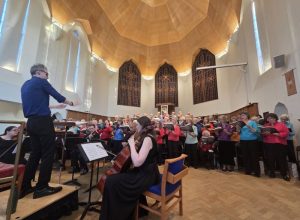
Epsom Choral Society concert – June 20th 2026
The Four Seasons is surely one of the world’s best loved and most widely played pieces of classical music. Written by the great eighteenth century Italian composer and violin virtuoso Antonio Vivaldi, this set of four violin concertos is a purely instrumental piece, so its appearance in Epsom Choral Society’s summer concert, performed to an attentive and enthusiastic audience, merits a little explanation.
What we heard on this warm summer’s evening in Cheam was a new choral re-imagining of Vivaldi’s masterpiece, published last year to coincide with the 300th anniversary of its publication in 1725. Entitled A Season to Sing, it is the work of composer and singer Joanna Forbes L’Estrange and has already been performed over seventy times.
Under the skilled leadership of their conductor, Julian Collings, and accompanied by a terrific quartet of professional string players, Epsom Choral Society sang the piece’s familiar melodies with confidence and spirit. And when required they brought the same confidence and spirit to whistling, whispering, clicking and stamping – which also requires a bit of explanation.
As the name suggests, each of the pieces that comprise The Four Seasons represents a different season and unusually Vivaldi provided for each one a short descriptive poem, possibly of his own creation. The poems are full of vivid imagery appropriate to each time year – buzzing flies, barking dogs, sudden downpours, chattering teeth and so on – which Vivaldi represents faithfully, and brilliantly, in his music. When you add to these instantly recognisable details a string of charming melodies and Vivaldi’s sparkling violin writing it’s easy to see why the piece retains its popularity.
To create A Season to Sing, Joanna Forbes L’Estrange had to graft voice parts on to Vivaldi’s original, along with appropriate texts, and unsurprisingly some sections of the work lend themselves more readily to this approach than others. But as a past Musical Director of the famous Swingle Singers, she knows something about how voices can be used to recreate instrumental music and clearly relished the challenge of translating Vivaldi’s special effects into vocal sounds. The choir certainly gave a committed and full-bodied performance of this interesting new addition to the choral repertoire.
This was all after the interval. The first half of the concert consisted of two works by the Norwegian-American composer Ola Gjeilo – Dark Night of The Soul and its companion piece Luminous Night of The Soul – along with Morten Lauridsen’s contemporary classic Sure on This Shining Night.
These three pieces suited the choir perfectly, highlighting its precise and powerful singing, and at the same time showcased the skills of their accomplished musical professionals. Julian Collings, a genial and energetic presence on the podium, had put together a programme which would challenge any choral society, but the clarity and sensitivity of his conducting brought out the very best in his singers. The sinuous melodic lines and shimmering harmoniesof Sure on This Shining Night glowed brightly and provided a welcome moment of calm after the driving rhythms of Dark Night.
At times in both Dark and Luminous NightGjeilo relegates the choir to an accompanying role and thrusts the piano onto centre stage. It needs a really good pianist to bring this off and in the choir’s regular pianist Peter Jaekel we had an outstanding one. His fluent, controlled playing made light work of Gjeilo’s tricky piano writing. Those members of the audience unfamiliar with Gjeilo’s music will certainly have had their interest sparked by Epsom Choral Society’s stirring, robust performances of these two works; one lady I spoke to told me she had never heard any of Gjeilo’s music before but intended to search out some recordings as soon as she got home. I’m sure she wasn’t the only audience member to be attracted to this increasingly popular composer’s sound-world.
Thanks are due to Epsom Choral Society for a concert of interesting repertoire and strong performances, with a beautifully designed, informative programme booklet and a free glass of wine in the interval. A delightful way to spend a fine summer evening.
Review by Ian Assersohn