

SES Water has reopened a grant fund to help Surrey farmers protect rivers and groundwater from agricultural pollution. The relaunch comes as Environment Agency figures show that leakage from the company’s drinking water network rose by more than 10 per cent in 2025–26, although SES still lost less water per household than the England average.
The Catchment Fund is open to farmers and landowners in priority areas where changes in land management could help protect water at source. Fertilisers and pesticides can reach rivers in runoff or seep into groundwater. Epsom & Ewell Borough Council’s infrastructure plan says around 85 per cent of the water supplied by SES comes from underground chalk and greensand sources.
What the grants have paid for
One grant paid for a bladed roller to loosen compacted soil, alongside soil tests and a subscription to an app to track changes. SES says loosening the soil can help roots grow deeper and rain soak in. Deeper roots could also help crops take up more nitrogen, leaving less nitrate to seep into groundwater.
The farmer told SES that roots were already growing into cracks made by the roller. There was a practical benefit too. Fence posts were easier to push into the ground. The company’s announcement gave no measurements showing whether less nitrate had reached groundwater.
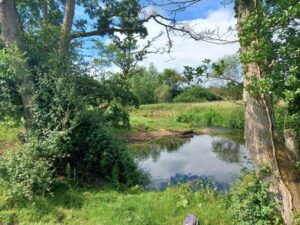
A second grant paid Surrey Wildlife Trust to assess a 2.2km stretch of the River Eden between two farms. The assessment identified possible measures including wider riverside buffer strips, tree planting, ponds and other wetland features. These could help intercept runoff and reduce bank erosion. The grant paid for the survey, and the assessment explored whether biodiversity net gain funding could pay for the restoration work. SES did not disclose the value of either grant or the budget for the reopened fund.
Less water lost than average, but leakage is rising
The Environment Agency says SES lost around 75 litres per property per day through leakage in 2025–26, against an England average of about 101 litres. Leakage accounted for 14.4 per cent of the water entering its distribution network, compared with 18.6 per cent nationally. Even with that better-than-average performance, the volume SES lost rose by more than 10 per cent in a year when leakage across England was broadly flat.
SES is part of Pennon Group, which reported £25.2 million of capital investment at SES in 2025–26. Pennon says that covered work on network resilience, leak detection and repairs, replacement of lead pipes and metering. Pennon also reported a group dividend of 29.29p per share for the year. That figure covers the whole group, which includes South West Water, and gives no breakdown of what shareholders received from SES’s operations.
Who is responsible for sewage in Epsom and Ewell?
Thames Water is responsible for public sewerage in Epsom and Ewell, including the storm tanks that discharge into the Hogsmill system. The Environment Agency recorded 22 serious pollution incidents from Thames Water’s sewerage assets across its operating area in 2025, including 11 from foul sewers. In a separate enforcement action, Ofwat imposed £122.7 million in penalties on Thames Water in May 2025, comprising £104.5 million for wastewater breaches and £18.2 million for breaches of dividend rules.
Across England, monitors recorded 291,492 storm overflow spills in 2025, down 35 per cent on 2024. The Environment Agency said unusually dry conditions accounted for much of the fall. Storm overflow counts record how often monitored outlets discharged. The agency separately records pollution incidents from sources such as foul sewers and treatment works.
Agricultural pollution is also a significant pressure. An Environment Agency report published this year cites national data identifying agriculture as adversely affecting 40 per cent of England’s water bodies. A parliamentary inquiry cited sewage and wastewater as a pressure affecting 36 per cent, based on the same generation of river basin evidence. The categories can overlap, and the balance varies from river to river.
For the River Eden, the next question is which of the proposed works will be funded and carried out. For the farm trial, it is whether the soil tests show a lasting improvement and whether monitoring can establish that less nitrate is reaching groundwater.