


Surrey countryside campaigners have joined a national call for residents to be given an independent right of appeal when changes are proposed to flight paths over their homes.
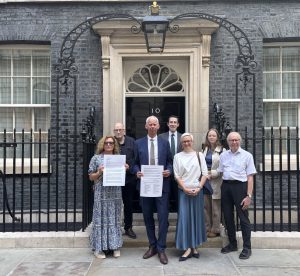
CPRE Surrey is among 22 community and environmental organisations that have signed a letter delivered to 10 Downing Street warning that the Government’s aviation reforms could leave the Civil Aviation Authority as both the regulator making decisions on airspace changes and the body answering complaints about those decisions.
The letter, addressed to Prime Minister Andy Burnham, calls for the Civil Aviation (Consumer Protection and Regulatory Reform) Bill to be amended to establish an independent airspace ombudsman.
Campaigners say this would give residents somewhere outside the CAA to seek a review of decisions capable of concentrating aircraft noise over homes, schools and previously quieter areas.
The proposed legislation arrives as the Government begins the most extensive redesign of British airspace for decades. Although the Bill does not itself draw new flight paths or change airport operating hours, it would strengthen the machinery through which approved airspace changes can be implemented.
Its significance for Surrey arises particularly from the planned redesign of the highly congested airspace over London and the South East, involving Heathrow, Gatwick and other airports.
What the Bill would change
The Civil Aviation (Consumer Protection and Regulatory Reform) Bill is a wider aviation measure covering passenger rights, enforcement of consumer law, airport slots, safety regulation and airspace modernisation.
It completed its stages in the House of Lords on 20th July and received its formal first reading in the House of Commons on 1st September. A date for its Commons second reading has yet to be announced.
Under existing legislation, the Transport Secretary can direct an airport, air navigation provider or another organisation involved in airspace change to prepare and progress a proposal. Clause 4 of the new Bill would extend that power so a direction could also require an airspace change already approved by the CAA to be implemented.
The Government’s explanatory notes say this would make the direction-making power available at every stage of the process, including putting an approved design into operation and implementing alterations identified by a subsequent review.
The Government argues that Britain’s underlying airspace design has changed little since the 1950s and is increasingly unsuitable for modern aircraft and present-day traffic levels. It says redesigning routes could permit more direct journeys and improved climb and descent profiles, cutting delays, fuel use and emissions.
The Bill would also allow the CAA to make detailed rules covering aviation safety and operations. However, these general rule-making provisions are distinct from the CAA’s function of deciding individual airspace change proposals. The measure does not expressly abolish consultation on individual proposals or create new flight paths by itself.
A new “guiding mind” for UK airspace
The broader reform centres on the new UK Airspace Design Service, known as UKADS. It is being provided by NATS En Route Ltd, the monopoly provider of en-route air traffic control services.
In its June 2025 announcement, the Government described UKADS as a single “guiding mind” capable of producing a coordinated design instead of relying upon airports to develop overlapping proposals separately.
The Government said UK airspace handled around 200,000 flights annually in the 1950s, compared with 2.47 million in 2024. Without modernisation, it estimated that one flight in five could experience disruption or delay by 2040.
The first priority for UKADS is the London airspace “cluster”. This includes the routes serving Gatwick and Heathrow and would also encompass airspace alterations needed for a third runway at Heathrow.
For Surrey residents, modernisation could therefore determine not merely how many aircraft use the region’s airports but where arriving and departing aircraft fly, at what heights and how noise is distributed.
Modern satellite navigation allows aircraft to follow routes much more accurately. That can reduce the total population affected by noise but may also concentrate flights over a narrower corridor, leaving households directly beneath it exposed more frequently.
How the public is consulted
Individual permanent flight-path changes must normally follow the CAA’s CAP 1616 airspace change process. A proposal is generally sponsored by an airport or air navigation service provider, although UKADS will now take a coordinating role in the London region.
Depending on the scale and likely effects of a proposal, the process includes development of design options, environmental assessment, engagement and public consultation. Consultation responses and other documents are published through the CAA’s Airspace Change Portal.
The portal allows residents to search by postcode or place name for proposals near them. The CAA says CAP 1616 is intended to provide a transparent, impartial and evidence-based assessment taking account of everyone affected.
When making a decision, the CAA must give priority to safety and then consider matters including efficient use of airspace, the needs of aircraft operators, environmental guidance and the interests of people on the ground.
The Government’s revised 2026 air-navigation guidance also sets expectations for engagement and consultation with affected communities and for the assessment of noise and other environmental consequences.
Consultation, however, is not the same as a right of appeal. It allows people to comment before a decision is made but does not necessarily provide an independent tribunal to reconsider the eventual decision.
Existing routes of challenge are limited
Anyone may ask the Transport Secretary to “call in” an airspace proposal and decide it in place of the CAA. But the request must normally be made during a four-week window and satisfy restricted criteria.
According to the CAA’s call-in guidance, a proposal must be of strategic national importance, have a potentially significant effect on UK economic growth, or meet a specified test involving both aircraft noise and its effects on health and quality of life.
The noise test requires a net increase of at least 10,000 people exposed to 54 decibels or more during the relevant 16-hour daytime period. Even if a proposal qualifies, the Secretary of State is not obliged to take it over.
Otherwise, a dissatisfied community may be left to pursue a complaint about whether the proper process was followed or consider judicial review. Judicial review is generally concerned with the lawfulness of a decision, rather than providing a complete reconsideration of whether a different route would have been fairer or less damaging. It can also be costly and procedurally demanding.
The Bill preserves an appeal against a ministerial direction for the person or organisation directed to carry out an airspace change. That is not an equivalent appeal for residents affected on the ground.
It is this gap that CPRE Surrey and the other signatories want an ombudsman to fill.
“Decisions made over their heads”
CPRE Surrey Chair Jennet Eyre said: “This Bill risks giving communities the worst of both worlds: more decisions made over their heads, with no independent way to review them.
“Residents deserve a process that is transparent, accountable and genuinely fair. If there can be independent oversight for passengers, consumers and proposed for the Clean Water Bill then there must also be independent oversight for the communities living under flight paths.”
The campaigners say they are not opposed to airspace modernisation or aviation but believe the interests of the industry should not override the health, sleep and quality of life of affected communities.
Ms Eyre added: “Families on the ground should not be left to live with increased noise, sleep disruption, health impacts or loss of amenity from concentrated flight paths without a clear, independent way to challenge how those decisions are made.”
The Government maintains that modernisation can produce “quicker, quieter and cleaner” flights and says future airspace designs will remain subject to environmental assessment and community engagement.
The central dispute is consequently not whether the public will be consulted at all. It is what residents can do after consultation if they believe their evidence has been disregarded, the effects have been underestimated or the burden of aircraft noise has been distributed unfairly.
CPRE Surrey is now urging MPs to amend the Bill during its Commons stages to provide an independent review mechanism outside the CAA. Whether ministers accept that argument may determine how much confidence communities place in the consultations that accompany the coming redesign of the skies above Surrey.

.
Related reports
Redesigning the Surrey skyways? – 2nd June 2025
Gatwick expansion update – 22nd September 2024
Gatwick Airport Expansion – 2nd March 2024
Gatwick 2nd runway sneaking in? – 20th December 2023