


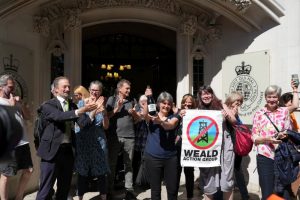
A Surrey-based grassroots campaign that reshaped national climate law has received one of the world’s most prestigious environmental honours, in a development that will resonate locally given the long-running controversy over oil drilling at Horse Hill.
Climate campaigner Sarah Finch, who led the legal challenge on behalf of the Weald Action Group, has been named one of six global winners of the Goldman Environmental Prize for 2026. The annual award recognises grassroots activists from each continent who have made significant contributions to environmental protection.
The recognition follows Finch’s landmark victory in the Supreme Court of the United Kingdom in June 2024, in a case brought against Surrey County Council over oil drilling at Horse Hill. As previously reported by Epsom and Ewell Times, the case became a focal point for national debate on fossil fuel extraction and planning law.
The court’s ruling—now widely referred to as the “Finch judgment”—established that planning authorities must take into account the downstream climate impact of burning extracted fossil fuels when considering applications. This marked a significant shift in legal interpretation, extending environmental assessment beyond the immediate site of extraction.
Campaigners say the implications have already been far-reaching. The judgment has influenced decisions affecting fossil fuel projects across the UK, including developments in Cumbria and the North Sea, and has been cited in wider planning and legal contexts such as aviation and intensive farming. Courts in other jurisdictions, including Norway, Guyana and Australia, have also drawn on similar reasoning.
Finch said she was “honoured” to accept the award on behalf of the Weald Action Group and communities campaigning against fossil fuel expansion. She described the ruling as evidence that “ordinary people organising together can win big victories,” adding that the scientific consensus leaves “no room for any more extraction and burning of coal, oil or gas” if climate targets are to be met.
The legal challenge was supported by Friends of the Earth, whose senior lawyer Katie de Kauwe described the ruling as “one of the most significant legal breakthroughs this century” in addressing the climate crisis. She said it had “fundamentally changed the rule book” by requiring developers to account for the full climate consequences of their projects.
Local campaigners involved in the Horse Hill dispute also welcomed the recognition. Lorraine Inglis of the Weald Action Group said the award reflected years of sustained community effort in Surrey and highlighted the role of grassroots activism in shaping national policy.
The Goldman Environmental Prize, established in 1989, has honoured 239 winners from 98 countries. This year’s cohort is notable as the first made up entirely of women, with other winners including climate activists from Colombia and South Korea who have led successful campaigns against fracking and for legally binding emissions targets.
For Surrey residents, the award brings renewed attention to a campaign that has already left a lasting imprint on the local landscape and on national law. As Epsom and Ewell Times has previously reported, the Horse Hill case demonstrated how a dispute rooted in a single planning decision can evolve into a defining legal precedent with international consequences.

Photo: Sarah Finch and Weald Action Group at London’s High Court
Related reports: