

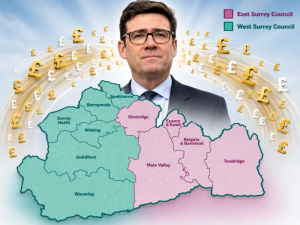
Surrey’s future strategic authority could retain a share of locally generated income tax and business rates under government plans to transfer more money and decision-making from Whitehall to England’s regions.
The Government’s “Rewiring the State” programme proposes replacing some central government grants with a share of the income tax generated within each mayoral area from April 2028.
Mayors would not, on the information published so far, be given the power to set income tax rates. Instead, part of the existing tax collected by the Treasury would be assigned to their regions.
The intention is that an area which expands its economy and tax base would benefit from the additional revenue. Councils and strategic authorities would also retain a greater proportion of locally raised business rates.
However, the Government has yet to disclose what percentage of either tax would be retained, how the system would operate during an economic downturn or how revenues would be redistributed between wealthier and less prosperous regions.
Those details are expected in a fiscal devolution roadmap accompanying the autumn Budget, followed by more precise income-tax arrangements in the next Spending Review.
The proposals could prove particularly significant for Surrey, with its comparatively strong economy, high employment and large number of higher-rate taxpayers. Whether that translates into substantially more money for local services will depend upon the formula eventually adopted and the grants which tax revenues replace.
Surrey County Council says a Foundation Strategic Authority is proposed for the county in 2027, providing a possible route to a Mayoral Strategic Authority from 2028.
That distinction matters. The Cabinet statement promises a share of income tax to “every mayor”, while saying that mayoral authorities will receive greater powers than non-mayoral bodies. It does not clearly promise non-mayoral Foundation Strategic Authorities the same income-tax entitlement.
The Government says it will not impose a mayor on an area which does not want one, although it regards directly elected mayors as offering the strongest form of accountability. It wants every part of England to have, or be establishing, a strategic authority by the end of 2027, with authorities operating everywhere by the end of 2028.
Councillor Steve Wotton, Leader of the East Surrey Shadow Authority, welcomed the direction of travel.
He said: “Surrey has a strong economy, a highly skilled workforce and an important role to play in supporting national growth. Giving strategic authorities a stronger link to locally generated revenues has the potential to provide greater certainty for long-term investment in transport, infrastructure, housing and skills.
“The ability to plan over a longer time horizon could help local leaders make better decisions, unlock investment and deliver improvements that residents and businesses want to see.”
Councillor Paul Follows, Leader of the West Surrey Shadow Authority, said the principle was positive but cautioned that the detail would be critical.
“Places like Surrey should have a stronger voice in the decisions that affect their residents, businesses and local economy,” he said.
“However, it will be important that government gets the detail right. Any new funding system must be fair, sustainable and recognise the different opportunities and challenges faced by communities across the country.”
Beyond taxation, the programme proposes giving mayors greater control over transport, housing, skills, employment support, innovation, energy and cultural investment.
Mayors would gain control of budgets for technical and vocational education for 16 to 19-year-olds and locally tailored employment support. They could also be given greater influence over commuter rail services, bus regulation, affordable housing and regional investment.
Police, fire and rescue services and Integrated Care Boards are eventually expected to align with strategic-authority boundaries. Deputy mayors could be appointed to oversee important public services.
All strategic authorities, including non-mayoral ones, would also be able to introduce an Overnight Visitor Levy. The charge, sometimes described as a tourist tax, could be imposed on overnight accommodation, with authorities expected to explain by March 2028 how the proceeds would be invested.
No proposed rate or charging mechanism has yet been announced.
The reforms could therefore give a future Surrey mayor considerable influence over services and investment currently controlled by Whitehall or separate public bodies. They would also create another directly elected political office above the two new Surrey unitary councils.
Epsom and Ewell is due to form part of the new East Surrey authority under the county’s local government reorganisation. The precise relationship between the two unitary councils and a county-wide strategic authority—including how powers, costs and accountability would be divided—has still to be settled.
Tax retention could reward economic growth and provide more predictable funding for long-term projects. It also raises difficult questions. Income-tax receipts fluctuate, affluent regions begin with much stronger tax bases, and replacing government grants with locally assigned revenues could expose authorities to greater financial risk.
The Cabinet statement acknowledges that different areas have unequal starting points and says growth incentives will have to be balanced against fairness. It also proposes stronger oversight, including making the chief executives of mayoral strategic authorities accountable for the use of public money as Local Accounting Officers.
Business-rate retention is scheduled to begin for mayors in April 2027, with locally retained income-tax receipts following in April 2028. A government white paper setting out the legislation, funding arrangements and timetable is promised for the autumn.
For Surrey, the headline prospect is an attractive one: keeping more of the wealth generated within the county. Whether it represents genuinely additional local spending power—or chiefly a new way of funding responsibilities transferred from Westminster—will only become clear when the figures and equalisation rules are published.