


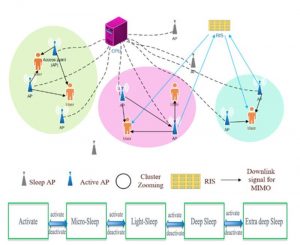
An optimal combination of energy-efficient 5G network features – including AI systems that let mobile mast and antenna base stations go into sleep mode when usage is low, and phones that avoid unnecessary background network checks – could help cut indirect carbon emissions across the UK economy by around 25 million tonnes of CO2, suggests new research from the University of Surrey.
The study, published in Resources, Conservation and Recycling, challenges the assumption that 5G will inevitably increase the UK’s energy demand. Instead, researchers show that next-generation network technologies have the potential to reduce emissions across many industries that rely on the digital infrastructure that keeps them online – from finance and IT to transport and construction.
Using UK economic and emissions data, the team established an environmentally extended input–output (EEIO) model tailored specifically to the Information and Communication Technology (ICT) sector. This allowed them to trace how cutting energy use in 5G can send knock-on effects across 33 industries of the UK economy.
Working in collaboration with Professor Ming Xu from Tsinghua University, researchers looked at 10 emerging technologies – six targeting how base stations operate and four designed to make user devices more energy-efficient. These included AI-driven multi-level sleep modes, which let mobile masts switch off when demand is low, reconfigurable intelligent surfaces (RIS) such as smart panels that redirect radio waves using little power, “cluster-zooming” in cell-free MIMO networks that allow groups of small antennas to expand or shrink coverage so energy is not wasted, and smarter handset signalling.
They found that AI-powered sleep control for base stations and improved control-channel signalling on user devices delivered the most impactful reductions.
Dr Lirong Liu, Associate Professor at Surrey’s Centre for Environment and Sustainability, said:
“Smarter base stations and devices don’t just cut electricity use in telecoms – they reduce indirect emissions in the whole supply chain. The modelling framework allowed us to quantify effects that are usually hidden, especially the indirect emissions linked to electricity use and wider supply chains. It also gave us a clear way to compare different 5G features side by side and identify which combinations deliver the strongest environmental benefits.”
The analysis shows that sectors such as financial services, IT services and computer programming gain some of the largest indirect benefits, reflecting just how much modern industries depend on digital connectivity.
Professor Pei Xiao, Professor of Wireless Communications at Surrey’s Institute for Communication Systems, said:
“Many of these energy-efficient features are already on the engineering roadmap. What this study provides is a clear system-level view of where the biggest carbon wins lie – and why regulators, operators and industry should prioritise them as part of the UK’s net zero transition.”
The research also suggests that to unlock these benefits, 5G policy must extend beyond coverage and speed targets and encourage the adoption of energy-efficient architectures. Measures could include building energy targets into spectrum licenses that mobile operators need to use 5G frequencies, incentives for low-power network design and making sure 5G research supports the UK’s broader net zero goals.

The full paper can be found here: https://www.sciencedirect.com/science/article/abs/pii/S0921344925005774?via%3Dihub
Image from Resources, Conservation and Recycling