


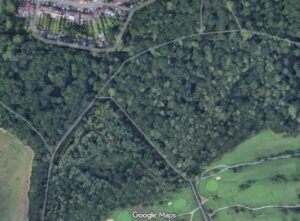
New BBC analysis shows Surrey is home to some of the densest concentrations of ancient woodland in England, as conservation groups warn that the drive to build 1.5 million homes and the new “grey belt” could weaken protection for habitats that have stood since at least 1600.
Surrey is one of the most important counties in England for ancient woodland, according to new figures from the BBC Shared Data Unit – and campaigners fear the national push for housing could put some of those woods under growing pressure.
Ancient woodland is land that has been continuously wooded since at least 1600. It covers only around 2.5% of England, yet it is regarded as one of the country’s most valuable wildlife habitats. Because these ecosystems take centuries to develop, conservation groups describe them as irreplaceable.
The BBC’s analysis of Natural England mapping shows that across England as a whole, ancient woodland covers 2.6% of council areas.
In Surrey, the picture varies sharply from borough to borough. Mole Valley, which borders Epsom & Ewell to the south, is among the most heavily wooded districts in the country, with ancient woodland covering 12.7% of its area – placing it eighth of roughly 290 council areas in the data. Waverley (11.4%) ranks tenth. Tandridge (7.1%) and Guildford (6.8%) are also well above the national figure.
By contrast, Epsom & Ewell has about 34 hectares of ancient woodland – roughly 340,000 square metres, or the equivalent of around 47 football pitches – covering 1.0% of the borough. That is below the national average, reflecting the borough’s small size and largely built-up character. Much of what survives lies within the borough’s countryside: the council describes much of the woodland at Horton Country Park as ancient coppice woodland, including Butcher’s Grove, where coppicing dates back to medieval times.
Taken together, Surrey’s eleven districts and boroughs contain around 12,150 hectares of ancient woodland – about 47 square miles.
“Wholly exceptional”
Under national planning policy, development that would cause the loss or deterioration of ancient woodland should be refused unless there are “wholly exceptional reasons” and a suitable compensation strategy exists. Natural England advises councils to keep a buffer of at least 15 metres between new development and ancient woodland.
But the BBC Shared Data Unit found dozens of housing schemes across England proposed or approved on land immediately beside ancient woods – including around 450 homes close to Hook Wood in Kent, 150 bordering Chaddesden Wood in Derby and about 130 beside Gelster Wood near Doncaster.
Campaigners say much of the controversy is not about felling trees but about building right up to the woodland edge. Ecologists warn that construction can damage root systems, change drainage, increase pollution and bring noise and light – while new residents’ pets can threaten ground-nesting birds and bats.
They also point to the government’s target of 1.5 million new homes by the end of 2029 and the creation of the “grey belt” – poorer-quality parts of the Green Belt that can be built on – as raising the pressure, particularly in the South East.
Lucy Graebe-Watson, chairwoman of Ancient Woodland UK, said: “We are already seeing cases where existing protections are struggling.” She said her organisation had seen a rise in concerns and alerts from local groups since recent planning reforms, especially around land allocations and buffer zones, and warned that because protection is based on policy rather than law, any increase in pressure raises the risk. Ancient Woodland UK wants statutory legal protection for ancient woodland.
Carl Bunnage, head of nature policy at the RSPB, described the “wholly exceptional” provision as a potential loophole for developers. He said that while the RSPB welcomed improvements to the definition of irreplaceable habitats in the new National Planning Policy Framework, protection should be strengthened – including a definitive list of irreplaceable habitats given the strongest safeguards, as historic buildings are. He added that housing and growth policies are generally given “substantial” weight in planning decisions while nature policies are not, meaning efforts to protect nature often start as an uphill battle.
A spokesperson for the Ministry of Housing, Communities and Local Government said ancient woodlands have “very clear and strong protections” and that proposals resulting in their loss or deterioration should be refused, with very limited exceptions such as nationally significant infrastructure – where measures to compensate for the impact would be required.
Local Plan
The figures come as Epsom & Ewell’s own Local Plan remains under examination. The plan was submitted to the government in March 2025, and earlier this year, at the inspector’s request, the council consulted on additional sites that could be allocated for housing through main modifications.
Surrey’s ancient woodland at a glance (share of each council area)
Mole Valley – 12.7% (about 3,287 hectares)
Waverley – 11.4% (3,942 ha)
Tandridge – 7.1% (1,770 ha)
Guildford – 6.8% (1,836 ha)
Reigate and Banstead – 4.5% (578 ha)
Runnymede – 4.0% (312 ha)
Elmbridge – 2.8% (268 ha)
Epsom and Ewell – 1.0% (34 ha)
Surrey Heath – 0.8% (76 ha)
Woking – 0.8% (51 ha)
Spelthorne – less than 0.1% (2 ha)
England average – 2.6%
How the figures were calculated: the BBC Shared Data Unit combined Natural England’s mapping of ancient woodland with Office for National Statistics council boundaries, and divided the area of ancient woodland in each council by that council’s total area. Hectare figures, the Surrey total and rankings have been calculated by Epsom and Ewell Times from the BBC data.
This story was produced with data from the BBC Shared Data Unit, part of the BBC Local News Partnerships.

.
Image: Butchers Grove Horton Country Park Epsom aerial from google maps