Epsom and Ewell Times
19th November 2026

ISSN, LDRS and IMPRESS logos

Epsom student wins badminton in Baku

Rathanan in action in Baku

An 18-year-old student at Epsom’s Nescot College has returned from Azerbaijan with two medals after representing Great Britain at the Special Olympics European Badminton Tournament.

Rathanan Pathmanathan, who lives in Tolworth and studies at Nescot in Ewell, won gold in the doubles competition and silver in the singles at the international tournament held in Baku.

The remarkable achievement marks another milestone in the sporting career of a young man who, just a few years ago, struggled even to hold a badminton racket.

Rathanan is now ranked number two in Great Britain in Special Olympics badminton and has ambitions to reach the number one spot.

From beginner to international champion

Rathanan first took up badminton shortly before the Covid pandemic. At the time, he spoke very little, often communicating in single words, and found it difficult to concentrate.

His father, Sutharsanan, initially took up badminton himself in an effort to find a coach who could help his son develop his sporting abilities.

Following a gold medal victory for his school, Rathanan was introduced to Special Olympics Surrey and professional coaches. His dedication soon began producing remarkable results.

He has since won silver medals in the top open category at three consecutive National Games and at the most recent Summer Games.

His training regime is demanding. For the past three years he has trained four times a week, sometimes beginning at 7am, at Wimbledon Racquets & Fitness Club.

He also benefited from two years of coaching by Toby Penty, the former England number one who represented Great Britain at the Tokyo Olympics.

More than sporting success

Rathanan attends Nescot’s Foundation Department, where he studies English, Maths and vocational skills. The college reports that he has made excellent progress in his studies alongside his sporting achievements.

His father believes that badminton has transformed much more than his son’s physical abilities.

Sutharsanan said: “I believe, purely because of badminton, he has improved an enormous amount, even in his communication. He can express himself and his needs better now, and his confidence is high. I know even the top mainstream players at Wimbledon really value him.”

The Special Olympics movement provides year-round sporting opportunities for people with intellectual disabilities, with competitions ranging from local events to international championships.

Rathanan’s success in Baku demonstrates how those opportunities can enable athletes to develop their talents and compete at the highest levels.

Principal beaten before departure

Before leaving for Azerbaijan on 18th November, Rathanan demonstrated his abilities in a badminton match against Nescot’s Principal and Chief Executive, Julie Kapsalis MBE, in front of students and staff.

The outcome was a decisive victory for the young international competitor.

Julie Kapsalis said: “Rathanan is an inspiration. His dedication and determination have taken him from struggling to hold a racket to representing Great Britain, and we couldn’t be prouder. It was a pleasure to take him on, although he definitely showed me who’s boss on court! Rathanan’s story shows what is possible when students get the right support and encouragement, and we’ll be cheering him on all the way to Baku.”

That encouragement has now been rewarded with a gold medal and a silver medal, bringing international sporting honours home to Nescot and the Epsom area.

With his sights already set on becoming Great Britain’s number one, Rathanan’s badminton journey may have many more victories ahead.

Lionel Blackman


Any one for polo? Buzz in to Ewhurst or trot over to Epsom

Cartoon polo match with helicopter landing in background

A huge polo club where neighbours complained helicopters arriving and leaving for events disrupted their peace, has been granted a new alcohol licence. It comes after residents objected to the plans following concerns over the summer.

The Hurtwood Polo Club in Horsham Road, Ewhurst, was acquired by its current owners earlier this year. During the summer, it hosted a number of events under temporary permission, and neighbours claimed the constant helicopters to and from the site was a real nuisance.

The owners said they have learned from past mistakes and would not want further disruption on their conscience, but claim a new licence is integral to making the club, which provides jobs for the community as well as a social hub, a financial success.

Failure to grant the licence, they warned, could result in the site being sold for potential housing – losing huge swathes of open space to development. To ensure the club becomes a better neighbour it was agreed to cut its licence to 11pm, down from the applied for 1am, and to install noise limiters that would either cut power if levels were breached – or automatically reduce the volume.

The applicant, Helene Webb said: “We do not dispute what residents experienced and we understand why it has shaped their response. Future bookings will be on new reduced hours with noise management plans in place.” The site’s period oak barn serves as a clubhouse and event venue. In summer, a marquee is erected and can be used by members.

There had been questions as to whether windows and doors should be kept closed in the summer months but the use of regulators meant this would not be necessary. Ms Webb said: “The reality is that this is not an economic model at the moment and we are asking for support from residents and the council to support what your economic strategy says.

“Organic development in sympathy with the community, that is what we want, which is why I’ve accepted their calls for reduced hours. We are in a very fortunate position to have bought 180 acres in Surrey and to have the opportunity to keep that in tact and to keep the developers away.

“We are in that position to do that, but we do need to make this business stand on its own two feet. The high street is closing, AI is taking jobs at the rate of knots. Who has the chance to do something?

“Its not to create a night club. We have a genuine opportunity to create a self-sustaining business, create some jobs, and do some good things in synergy with the community.

She said a nightclub in a marquee was not something she wanted to run adding: ”I live in this community, I live in Cranleigh, this is not something i want on my conscience.”

One objector said: “I moved to the area because I wanted peace and tranquillity, and that is exactly what I found. That will be decimated if this goes through.”

Councillor Jacquie Kean chaired the Waverley Borough Council meeting on November 23 and agreed to issue a new licence. She said the committee noted concerns raised by residents and the response to them, but agreed the concessions such as time limits and noise limiters, were significant enough to mitigate potential problems.

Chris Caulfield Local Democracy Reporter


Sutton & Epsom take top spot in 73-point thriller

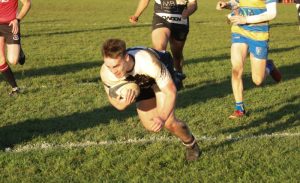
Epsom scoring a try against Beckenham

Sutton & Epsom 39 – Beckenham 34. Saturday 21st November. Rugby Lane

The latest meeting between Sutton & Epsom and Beckenham lived up to its billing as a clash between the top two sides in Regional 2 South East. A thrilling encounter at Rugby Lane saw the hosts withstand a remarkable Beckenham comeback to win 39-34 and leapfrog their Kent rivals into first place.

The previous three meetings had produced dramatic finishes, with the outcome settled by the last kick of the game. This encounter provided another gripping spectacle, although the attraction of the All Blacks at Twickenham reduced the attendance. Those who did make it to Rugby Lane generated an atmosphere worthy of the occasion.

Milestones and new faces

The return of Gareth O’Brien reunited the back division that had proved so devastating against Horsham on Sutton & Epsom’s previous home appearance.

There was another milestone for Munford, who became only the second Sutton & Epsom player, after Sam Frost, to reach 250 league appearances.

At the other end of the experience scale, New Zealand recruit “Big Red Ted” Northcott made his debut in the front row. His arrival was particularly timely, coinciding with Dan Johnson’s absence through concussion.

Beckenham also fielded a much-changed side from their victory over Ironsides. Ben Hatfield and Oliver Stapleton were new starters, the replacements bench was entirely reshuffled, and Tom Ward switched from flanker to wing.

Sutton & Epsom seize the initiative

On a chilly but bright and still afternoon, Freddy Bunting kicked off with Sutton & Epsom attacking the clubhouse end.

The hosts nearly opened the scoring within five minutes when scrum-half Euan Findlay raced down the wing, only to be bundled into touch close to the corner. Beckenham stole the resulting lineout, an early indication of an area in which Sutton & Epsom would struggle throughout the afternoon.

The visitors then suffered a setback when influential captain Richard Keefe departed injured.

Sutton & Epsom declined a kickable penalty in favour of a lineout, but once again lost possession. Their backs soon provided the breakthrough, however, when a long pass was skilfully gathered and transferred to Adam Bibby, who cantered over. Bunting converted superbly from the touchline for a 7-0 lead.

At the end of the first quarter, Euan Findlay scored the first of what would become a memorable hat-trick. A quickly taken penalty created the opportunity, and the lively scrum-half finished impressively despite defensive pressure. Bunting missed the conversion, leaving Sutton & Epsom 12-0 ahead.

Beckenham responded within five minutes, capitalising on a home error following a quickly taken lineout. Excellent continuity from the visitors ended with lock Pierce Cummins crossing beneath the posts. Liam Caddy converted to reduce the deficit to 12-7.

Sutton & Epsom dominated the remainder of the half, restricting Beckenham to just one further visit to their 22.

With five minutes of normal time remaining, the hosts scored their third try. A rare successful lineout in Beckenham territory produced a powerful catch and drive before the ball was released to Tom Lennard. His chip found Adam Bibby, who gathered despite the ball arriving behind him, turned and casually evaded the defender to score his second try.

Sutton & Epsom led 17-7.

The bonus-point fourth try arrived in first-half added time. A dazzling 40-metre break by Bibby laid the foundations before Bunting floated a long pass to Tipene Maxwell. The centre briefly juggled possession before racing over unopposed.

The conversion was unsuccessful, but Sutton & Epsom went into the interval with a commanding 22-7 advantage.

Findlay completes a stunning hat-trick

If Beckenham had hoped to strike first after the restart, those ambitions were dashed within five minutes.

An excellent clearance from Gareth O’Brien was chased enthusiastically by the home side. Euan Findlay seized on a loose pass, intercepted and raced 40 metres to score his second try. Bunting converted to extend the lead to 29-7.

The young scrum-half was soon celebrating his first senior league hat-trick in spectacular fashion.

Spotting an opportunity following a quickly taken Beckenham penalty, Findlay stole possession and accelerated into opposition territory. He chipped ahead, regathered and held off the covering defenders to complete a superb individual score.

Bunting added the conversion and Sutton & Epsom were seemingly out of sight at 36-7.

All six of the home side’s tries had come from their backs, with Findlay and Bibby accounting for five between them.

Beckenham launch remarkable recovery

Just as the home crowd began to contemplate a comfortable victory, Beckenham demonstrated why they had arrived as league leaders.

Liam Caddy’s intelligent kick ahead was collected by Tom Ward, who touched down for the visitors’ second try. Caddy converted from near the touchline to bring the score to 36-14.

The visitors began to dominate possession, with their forwards carrying powerfully and Caddy directing proceedings behind the pack.

With around 12 minutes remaining, sustained pressure finally produced another try as Juai Charles crossed. The difficult conversion was missed, but at 36-19 Beckenham were gathering momentum.

Sutton & Epsom briefly steadied themselves when Bunting landed a penalty from 45 metres, stretching the advantage to 39-19.

But the Kent side refused to surrender.

With five minutes remaining, another series of powerful forward drives created space out wide, where Charles was left unmarked to claim his second try and secure Beckenham’s four-try bonus point.

The score stood at 39-24, but the visitors now had their sights on a second bonus point for finishing within seven points of the winners.

Caddy kicked a penalty to narrow the gap to 12 points, and Beckenham continued to press.

In a frantic finish, Sutton & Epsom failed to find touch with a relieving kick. Beckenham returned to the home 22 and their pressure was rewarded with a fifth try.

Appropriately, it was outstanding Number 8 Ethan Benson, whose powerful contributions in attack and defence had been a feature of the afternoon, who crossed for the final score.

Caddy converted and referee Jon Rooke blew for full time.

Sutton & Epsom had survived 39-34, but not before Beckenham had transformed a seemingly one-sided contest into another Rugby Lane thriller.

Victory sends Sutton & Epsom to the summit

The result propelled Sutton & Epsom to the top of Regional 2 South East.

For much of the afternoon, the Black & Whites had produced an outstanding attacking display, with six tries from their back division.

Euan Findlay deservedly took the plaudits for his first senior league hat-trick, while Adam Bibby was in irresistible form throughout the opening hour.

Beckenham, however, demonstrated their own promotion credentials with a courageous recovery that saw them finish the stronger side.

Alongside the excellent contributions of Caddy and Benson, full-back Luke Bosch produced an outstanding performance, repeatedly launching dangerous counterattacks from deep.

The visitors departed with two bonus points, but Sutton & Epsom claimed the victory and, more importantly, first place in the league.

Cobham next at Rugby Lane

Sutton & Epsom return to Rugby Lane on Saturday 28th November to entertain Cobham RFC, who are back in Regional 2 South East after two seasons away.

Cobham secured automatic promotion as champions of Counties 1 Surrey/Sussex following an outstanding 2025-26 campaign.

They have recorded four wins and four defeats this season and currently occupy sixth place.

Their victories include an impressive 28-10 triumph at Balmoral Avenue, where they inflicted Beckenham’s first defeat of the campaign.

That result provides ample warning that Sutton & Epsom’s newly acquired position at the top of the table will face another serious examination.

Team selections

Sutton & Epsom: O’Brien, Bibby, Maxwell, Bunting, A Findlay, Lennard, E Findlay, Boaden, Lennie, Northcott, McTaggart, Duey, Glanville, Rea and Hegarty (captain). Replacements: Howes, Curwen and Munford.

Beckenham: Bosch, Charles, L Bunton, Curr, Ward, L Caddy, Hill, Baker, Jacobs, Hatfield, Keefe (captain), Cummins, Moran, Stapleton and Ethan Benson. Replacements: Willden, Brown and West.

John Croysdill

.

Image: archive action between the teams,


The Surrey Unitary Councils agree to go two-tier again

Elections Maps Surrey East And West

East and West Surrey Shadow Authorities have consented to the establishment of a Foundation Strategic Authority (FSA) for Surrey from 1 April 2027.

The decision marks an important step in Surrey’s devolution journey and will create a new strategic authority for the county, bringing more powers and decision-making closer to local communities and giving Surrey a stronger voice with government.

It follows a government-led consultation on establishing an FSA for Surrey. Following the consultation, government confirmed that Surrey had met the statutory tests and that it intended to proceed, subject to consent from East and West Surrey.

Both shadow authorities have now considered the proposal through their respective governance arrangements.

In East Surrey, the proposal was considered by the full Shadow Authority on 18 November, before formal consent was given by the Shadow Executive on 19 November.

In West Surrey, the Shadow Executive considered the proposal on 10 November, before formal consent was given by the full Shadow Authority on 19 November.

The Leaders of East and West Surrey will now jointly write to government confirming their consent, allowing government to lay the statutory instrument that establishes the FSA.

A Foundation Strategic Authority is the first level of the government’s devolution framework. It will provide strategic leadership across Surrey on areas expected to include transport, skills, economic development and strategic planning, while the new East and West Surrey councils remain responsible for delivering local services.

Councillor Steve Wotton, Leader of the East Surrey Shadow Authority, said: “We welcome this next step in bringing greater decision making closer to Surrey and giving our area a stronger voice with government.

“A Foundation Strategic Authority will give Surrey greater influence over areas such as transport and infrastructure, skills and economic growth.

“This is about making sure Surrey is well placed to take advantage of the opportunities that greater devolution can bring. We want to build an approach that works for Surrey, reflects the needs of our communities and delivers real benefits for residents and businesses.

“We will continue to work closely with government, West Surrey and our partners as the detailed arrangements are developed.”

Councillor Paul Follows, Leader of the West Surrey Shadow Authority, said: “I support the principle of devolution and bringing powers closer to our residents. Establishing a Foundation Strategic Authority is a sensible first step that gives us the opportunity to explore what greater devolution can offer Surrey.

“We want to take a pragmatic approach. The FSA should start as a relatively lean organisation, bringing democratically elected representatives from East and West Surrey together to make decisions on issues that are best considered at a Surrey-wide level.

“As these arrangements develop, it will be important that government provides the right funding to support the responsibilities being devolved and that local government has a meaningful role in shaping what devolution looks like for Surrey.

“Our priority remains making sure these arrangements deliver better outcomes for residents and businesses, stronger local accountability and sustainable public finances.”

The government’s current timetable would see the necessary legislation laid in early 2027, with the Foundation Strategic Authority established on 1 April 2027 alongside the new East Surrey and West Surrey councils.

East and West Surrey will continue discussions with government to develop the detailed governance and operating arrangements for the FSA.

Establishing the FSA will also provide the foundations for the next stage of Surrey’s devolution journey. The government has announced that it is in the final stages of agreeing a Mayoral Strategic Authority devolution deal for Surrey, which could bring further powers, funding and strategic opportunities to the county plus an elected mayor.

East and West Surrey will continue discussions with government to understand the detailed proposals for a Mayoral Strategic Authority, including the benefits, opportunities and practical implications for residents, businesses and communities.

Surrey County Council

.

Related reports:

Surrey Mayor? Not so fast, says East Surrey leader – 12 November 2026

What are the benefits of a Surrey Mayor? MP asks – 2 November 2026

East Surrey Council – Not Quite What We Were Promised? – October 2026

Epsom and Ewell to have three tiers of government when promised one? – 15 September 2026

Plans for East Surrey Council continue to progress – September 2026

Tourist tax to boost Surrey finances? – 7 September 2026

Burnham ‘commitment’ to Surrey devolution – 1 August 2026

Epsom Council leader’s delayed response to additional local government layer initiative – 7 July 2026

Cllr Coley on an attempt to create another layer of local government – 2026

County council set to propose two unitary councils for Surrey – 2025


Could you be Epsom and Ewell’s next citizen journalist?

Epsom & Ewell Times is inviting applications from local people interested in becoming volunteer citizen journalists, with a specially designed training course offering an introduction to reporting local news.

Do you take an interest in what happens in your neighbourhood? Are you curious about decisions made by local councils? Do you enjoy writing, meeting people or discovering stories that deserve a wider audience?

If so, Epsom & Ewell Times (EET) would like to hear from you.

The independent, not-for-profit local newspaper is looking to develop a team of volunteer citizen journalists who can help extend its coverage of the people, organisations, events and issues affecting Epsom, Ewell and surrounding communities.

No previous journalism experience is necessary. Enthusiasm, curiosity, fairness, reliability and an interest in local affairs matter more.

Learning the skills of local journalism

Successful applicants will be invited to attend a 90-minute introductory workshop designed specifically for EET. 3pm Monday 14th December in Epsom.

The course will introduce the principles of responsible journalism, including accuracy, impartiality, fairness, the importance of seeking comment from those affected by a story, and the ethical standards expected of a publisher regulated by IMPRESS, the independent press regulator.

Participants will also learn practical techniques for finding and researching local stories, interviewing contributors and preparing articles for publication.

The workshop will demonstrate how modern technology can make local journalism more accessible, including:

  • Finding stories in council agendas, reports and public meetings.
  • Extracting audio from recorded council meetings and producing transcripts.
  • Analysing lengthy council documents, identify newsworthy issues and prepare draft reports.
  • Checking facts, quotations and sources before publication.
  • Finding photographs and illustrations that can lawfully be published without infringing copyright.
  • Using AI-generated illustrations responsibly.
  • Preparing articles, headlines and images for EET’s website.

The course will include short practical exercises and examples drawn from local news reporting.

Helping local stories get told

Citizen journalism offers opportunities to report on subjects that might otherwise receive little attention.

These might include planning applications, environmental concerns, local businesses, voluntary organisations, schools, cultural events, sporting achievements, community campaigns or decisions by local authorities.

There is also a role for those interested in investigating matters of public concern and holding public bodies to account.

Volunteers will be able to suggest their own stories and develop particular interests, while receiving editorial guidance and support.

EET will retain editorial responsibility for all material published on its website.

Who should apply?

Applications are welcome from adults of all backgrounds, including students, retired people, those considering a career in journalism and anyone who would simply like to make a worthwhile contribution to their community.

Applicants do not need professional writing qualifications or specialist technical knowledge, although competence with computers and the internet is necessary.

Volunteering need not involve a substantial weekly commitment. Contributors may be able to undertake occasional assignments according to their availability and interests.

The opportunity is voluntary and unpaid.

How to apply

Places on the introductory course will be limited, and EET will operate a selection process to identify applicants who demonstrate a genuine interest in local journalism and the potential to contribute to the newspaper.

Applicants will be asked to complete a short online form explaining their interests, experience, availability and the kinds of stories they would particularly like to cover.

APPLICATION FORM LINK

Details of the course date, time and venue will be confirmed to successful applicants.

EET hopes that the initiative will help develop a new generation of community reporters and strengthen independent local journalism at a time when informed, trustworthy reporting of local affairs is more important than ever.

Could you help tell the stories of Epsom and Ewell? We would like to hear from you.


Reigate resignation signals end of LibDem East Surrey honeymoon?

Cllr Mark Johnston speaks at a council meeting (Credit: ESC)

An East Surrey councillor has quit the majority group on the council in protest at a contentious proposal to move the location of a Reigate primary school.

Councillor Mark Johnston (Liberal Democrats: Reigate) has resigned from the Liberal Democrat grouping on the East Surrey shadow authority after its cabinet green lit the relocation of Reigate Priory Junior School to Woodhatch Place last month.

In an email seen by the Local Democracy Reporting Service, Councillor Johnston told colleagues he believes East Surrey Council “acted hastily”, and that the school move is something the new authority “should have nothing to do with”.

The move of the highly-regarded primary school from its historic current location had been passionately debated by cabinet members, with two of them ultimately voting against it.

Some raised fears over the new site’s distance from the centre of Reigate and potential for greater buildup of traffic in the area. Councillor Ashley Tilling (Liberal Democrats: Walton South & Oatlands), who opposed the move, said in the meeting that moving the school would leave the old site as a “boarded up, looking rather ugly Grade I building”.

Conversely, finance lead Councillor Andy Burton (Liberal Democrats: Esher, Claygate & Oxshott North) argued the decision had been made by the outgoing county council “many years ago” and that the “financial binds tighten” around such moves over time.

After a spirited discussion, East Surrey’s cabinet would ultimately approve the school move by seven votes to two.

Councillor Johnston has now quit the majority Liberal Democrat grouping on East Surrey Council over this choice, and continues to urge for the decision to be reconsidered.

In his email, he wrote: “None of the existing Reigate ward councillors support the move. Nor do many county and borough councillors in neighbouring divisions and wards. 

“Alongside them thousands of local people, including hundreds of families – past and present users of local schools – are also in opposition.”

He said East Surrey had “squandered” the opportunity to “reverse this scandal” and was quitting the majority group as a result.

While he has left the Liberal Democrats on East Surrey Council, he remains a member of the national party and a part of the Lib Dem group on Reigate & Banstead Borough Council (RBBC).

“I intend to remain a member of the Council and to continue serving residents of Reigate and, to the extent possible, of the East Surrey area as a whole,” he wrote.

“As one should expect, I will consider carefully all matters before the Council on their merits including proposals brought by any member or group. I do not plan to leave my party or my RBBC council group.”

East Surrey Council will assume all responsibility for education across the five boroughs set to be brought under its banner from April 1 – a service area that is currently overseen by Surrey County Council.

Responding to Councillor Johnston’s resignation, East Surrey council leader Steve Wotton (Liberal Democrats: Horley West, Salfords & Sidlow) said: “We are, of course, disappointed that Mark has chosen to resign from the Liberal Democrat council group. 

“We understand his strength of feeling on this issue as a Reigate councillor and will value his local input based on the decision we have made to progress with the new school, including how we repurpose the existing site to benefit the town.”

However, Councillor Wotton stood by the “extremely difficult” decision to approve the school move, while acknowledging the strength of feeling on both sides of the argument.

He noted that, as East Surrey remains a shadow authority solely tasked with setting up the new council until April, cabinet members’ role was limited to deciding whether to approve Surrey County Council’s project.

“We were not in a position to progress alternatives through this process without exposing the council to material financial risk,” he said. “Planning permission for the new site and the underlying education decisions had already been agreed through Surrey County Council.”

“The existing site does not meet the children’s needs, as confirmed by the Department for Education. Not proceeding with the relocation to Woodhatch Place would risk significant further delay, leaving children in accommodation that falls short of the standards they deserve.

“Now that the decision has been made, our focus is on ensuring that the children who attend the new school have the best possible environment in which to learn.”

James Moules Local Democracy Reporter

Cllr Mark Johnston speaks at a council meeting (Credit: ESC)

Related Reports

The first two are particularly relevant: the first covers the original dispute over the school relocation, while the second is EET’s editorial examining the significance of open disagreement within the Liberal Democrat cabinet.


Surrey’s Olive joins the ranks of Britain’s canine heroes

The dog in field of bluebells

A Guildford search and rescue dog who helped save the life of a vulnerable missing person in the Surrey countryside has received a national bravery award, joining a distinguished tradition of animals recognised for extraordinary service to humans.

Olive, a five-year-old working cocker spaniel with Surrey Search and Rescue, received the Service Award at the inaugural Burns Bravery Awards, hosted by former Strictly Come Dancing professional Karen Hauer in London on 3rd November.

Her achievement was all the more remarkable because she had qualified as an operational search dog only five months before making the discovery that earned her the award.

A life saved in the dead of night

In July 2026, Olive and her handler Jonathan Cole were called upon to assist Surrey Police in locating a vulnerable missing person in a remote part of the county.

The search took them into a steep-sided valley in the middle of the night. Although conditions were clear, the still air made it particularly difficult for Olive to detect the scent of a human being.

Then Jonathan noticed a change in her behaviour. Olive raised her nose and quickened her pace, signalling that she had detected something.

Following her along a path towards the edge of the valley, Jonathan shone his torch into the woodland below and spotted the missing person.

The search team reached the individual and brought them safely into the care of the emergency services. Jonathan believes Olive’s discovery saved their life.

The achievement followed almost two years of preparation, including 286 hours of formal training and countless additional hours of practice.

Jonathan said: “Olive had no idea how extraordinary that find was.

“To her, it was simply the game we’d spent years playing together: find the person, get the reward. But that night, the person was in real danger and her getting to them quickly mattered more than ever.”

Surrey’s volunteer lifesavers

Olive is part of Surrey Search and Rescue, a voluntary specialist organisation that works alongside the police and other emergency services to locate missing and vulnerable people.

According to Surrey’s Police and Crime Commissioner’s Office, around 2,100 people are reported missing in the county each year. While not all require specialist searches, some cases involve serious risks to life, particularly where people are vulnerable through age, illness, mental health difficulties or other circumstances.

Surrey Search and Rescue has around 80 volunteers and is regarded as one of the country’s busiest lowland rescue organisations. Its members give their time to training and emergency call-outs, often working in darkness, difficult terrain and adverse weather conditions.

Specialist search dogs such as Olive can make an important contribution, using their highly developed sense of smell to locate people who might otherwise remain hidden from search teams.

The best known is the PDSA Dickin Medal, established in 1943 by Maria Dickin, founder of the People’s Dispensary for Sick Animals. Often described as the animals’ Victoria Cross, it recognises outstanding gallantry and devotion to duty by animals serving in military conflicts.

Its recipients have included military working dogs, messenger pigeons, horses and even a cat.

One celebrated recipient was Simon, the ship’s cat aboard HMS Amethyst during the 1949 Yangtze Incident in China. Despite being wounded when the vessel came under fire, Simon continued catching rats that threatened the crew’s food supplies. He remains the only cat to have received the Dickin Medal.

More recently, Kuno, a British military working dog, received the medal in 2020 after suffering severe injuries while confronting insurgents during an operation in Afghanistan. His actions helped protect British troops, but his injuries required the amputation of a rear paw.

Another military search dog, Theo, received the Dickin Medal posthumously in 2012 for his work detecting explosives in Afghanistan.

The civilian counterpart is the PDSA Gold Medal, often referred to as the animals’ George Cross. Introduced in 2002, it recognises life-saving acts of bravery and exceptional devotion to duty outside military conflict.

Its recipients include police dogs injured while confronting dangerous suspects and family pets whose extraordinary actions have saved lives.

In 2019, police dog Bacca received the Gold Medal after suffering eight knife wounds while protecting his handler from an armed attacker.

An earlier recipient, Endal, a golden Labrador assistance dog, was honoured in 2002 for his remarkable devotion to his disabled owner.

Lionel Blackman


Kissing goodbye to anti-social behaviour in Long Grove Park in Epsom?

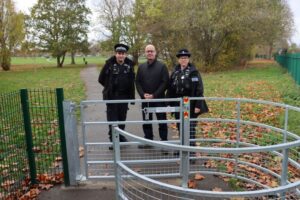
The Borough Commander and Cllr Alan Williamson at the kissing gate

Epsom & Ewell Borough Council has installed new kissing gates at Long Grove Park in Epsom as part of ongoing efforts to improve safety, tackle antisocial behaviour and create a more welcoming environment for residents and visitors.

Long Grove Park has been identified as an area affected by the misuse of motorcycles, mopeds, quad bikes and high-powered e-bikes, which can have a detrimental impact on the safety and enjoyment of other park users. The new gates have been carefully designed to deter unauthorised motorised vehicles while maintaining access for pedestrians, wheelchair users and cyclists.

The improvements form part of a coordinated approach with the council’s Safer Epsom & Ewell partners, including Surrey Police, to address concerns about illegal and antisocial vehicle use across the borough. Both organisations recognise the growing nuisance and danger caused by the reckless use of non-compliant e-bikes and e-scooters in public spaces.

Through Operation Scramble, Surrey Police have been targeting illegal and modified vehicles, seizing those that do not meet legal requirements and educating riders about the risks they pose to themselves and others.

Councillor Alan Williamson, Chair of the Crime and Disorder Committee, said:

“Everyone should be able to enjoy our parks and open spaces safely. These new kissing gates at Long Grove Park are a practical measure that will help deter unauthorised motorised vehicles, while ensuring the park remains accessible and safe for other users.

“Tackling antisocial behaviour is a priority for the council, which is why we launched the Safer Epsom & Ewell partnership earlier this year. By working closely with Surrey Police and our other partners, we have taken a coordinated approach to addressing the issues that matter most to residents.

“The installation of these gates, alongside enforcement activity such as Surrey Police’s Operation Scramble, demonstrates our shared commitment to making Epsom & Ewell a safer place for everyone. We will continue to listen to residents’ concerns and take action where it is needed.”

Inspector Tommy Pearson, Borough Commander for Epsom and Ewell, said:

“The illegal use of e-bikes and e-scooters is a growing problem in our borough, as it is across the country. We are committed to working with the borough council to tirelessly pursue riders who are causing fear and nuisance in our community.

“Last month saw two days of action targeting e-scooters in Epsom which delivered excellent results. I hope this activity, alongside deterrents such as the new kissing gates, provides direct reassurance that we are listening to your concerns around illegal and reckless riding and taking decisive action.”

Epsom and Ewell Borough Council

Epsom and Ewell herald

.

Photo: The Borough Commander and Cllr Alan Williamson at the kissing gate


Surrey carers charity at the final crossroads

Professional carer taking over from unpaid carer of elderly

A Surrey charity which has supported unpaid carers and vulnerable families for more than 40 years is closing at the end of November, following a bitter dispute with Surrey County Council over the withdrawal of funding for respite and emergency care services.

Crossroads Care Surrey, based in Leatherhead, will cease operations on 30 November 2026 after its trustees concluded that the organisation was no longer financially viable.

The closure follows the council’s decision to terminate contracts covering carers’ respite breaks, emergency care planning and end-of-life support. The charity says the loss of funding has made its position unsustainable despite efforts to reduce costs, attract private clients and secure alternative income.

Surrey County Council has defended its decisions, insisting that the previous contracts failed to deliver the expected results and that its replacement arrangements are supporting more carers.

The dispute raises fundamental questions about how the county supports thousands of unpaid carers who provide essential care for elderly, disabled and seriously ill relatives, often at considerable personal cost.

A charity’s final appeal goes unanswered

Crossroads chief executive Terry Hawkins described the closure as an “incredibly sad day” for staff, volunteers and the families who have depended on the charity.

He accused Surrey County Council of making decisions that had removed essential support from some of the county’s most vulnerable residents.

“It is also a damning reflection of what happens when vital support for unpaid carers is withdrawn. Surrey County Council has made decisions that have removed essential services from some of the most vulnerable people in our communities. Those decisions have had consequences, and the closure of the charity is now another.”

The charity says it had appealed to councillors, local MPs and council executives to reconsider the withdrawal of funding, including through a petition signed by more than 5,000 Surrey residents.

Mr Hawkins said those appeals had gone unanswered.

“We have done everything possible to keep this charity going and explored every realistic option to secure our future. It is heartbreaking that, despite those efforts, we have reached a point where we can no longer continue.”

He warned that the consequences of reduced support would not disappear but would instead fall on families, the NHS and already stretched social care services.

“The loss of Crossroads Care Surrey is not simply the closure of an organisation; it is the loss of a vital source of support for carers and families who still need help.”

The £3.5 million funding dispute

Central to the disagreement is the extent to which council-funded support has been reduced or replaced.

Crossroads says the remaining value of its three withdrawn contracts was approximately £3.7 million. These funded practical respite breaks, emergency care planning and assistance for people caring for relatives approaching the end of life.

The charity obtained figures through a Freedom of Information request showing that £204,600 had been issued under Surrey County Council’s replacement £300 Carers Wellbeing Break Payment scheme between 1 June 2025 and 1 September 2026.

It calculates the difference at approximately £3.5 million and argues that this represents a substantial reduction in practical support for unpaid carers.

However, the figures do not establish that overall council spending on carers has fallen by £3.5 million. The £3.7 million represents the remaining value of several contracts, while the £204,600 covers payments under one replacement scheme during a specified 15-month period. The council also funds other services.

The figures nevertheless raise questions about how much of the previous provision has been replaced, particularly for carers who need trained staff to take over care responsibilities rather than financial assistance to arrange a break themselves.

A £300 payment may provide welcome flexibility for some families, but it is not necessarily equivalent to several hours of professional replacement care, particularly where a person has complex medical or personal care needs.

Council says more carers are being helped

Surrey County Council’s Cabinet Member for Adult Social Care, Cllr Sinead Mooney, rejected the suggestion that the authority was abandoning carers.

“The council’s decision to end the carer services contracts we previously held with Crossroads Care Surrey wasn’t taken lightly. The contracts had failed to achieve the impact and take-up we expected, and we have a responsibility to make sure that public funding is used as effectively as possible for Surrey residents.”

She said the council continued to support other carers’ organisations and had invested in new respite facilities at Emily Lodge in Woking and The Squirrels in Banstead, providing breaks for carers while adults with complex needs received support.

She also defended the £300 wellbeing payment, saying the new scheme was reaching more carers than the previous arrangements.

“Our new flexible £300 wellbeing break payment to help carers with immediate needs is reaching more carers than ever before, with more carers supported under the new scheme than previously.”

Cllr Mooney said carers had welcomed the flexibility of the payments and that the council intended to expand the scheme further.

She added that funding transferring to East Surrey and West Surrey councils when local government reorganisation takes effect in April 2027 would allow thousands more carers to benefit.

According to the council, money not spent on the wellbeing payment scheme is reinvested in care packages for people with care needs, thereby providing additional support to their carers.

A dispute with a long history

The closure marks the culmination of a controversy previously reported by the Epsom and Ewell Times.

In August 2025, EET reported how Crossroads had stepped in to protect respite arrangements for 274 unpaid carers following the early termination of a council contract that had originally been due to continue until March 2027.

At the time, Crossroads accused the authority of withdrawing a commitment to honour carers’ remaining respite entitlements. The charity secured substantial donations to continue providing the promised breaks until November 2025.

Further controversy followed in March 2026, when Crossroads warned that the withdrawal of emergency care planning and end-of-life support could leave families without essential assistance during crises.

The charity said approximately 1,500 carers had existing emergency plans and questioned what would happen if they became ill or otherwise unable to look after someone dependent on them.

The council maintained that emergency arrangements would remain available through its existing adult social care services.

The latest announcement confirms that the charity has been unable to survive the loss of its council contracts, despite seeking alternative sources of income.

Who takes responsibility when a charity closes?

Cllr Mooney emphasised that Crossroads was an independent charity and that the decision to close had been made by its trustees, rather than the council.

“We recognise the important role that charities and voluntary organisations play in supporting Surrey communities, and acknowledge the impact that the closure of any local charity can have on its staff and the people who have drawn on its services.”

She added: “At the same time, we have a responsibility to make sure that public funds are directed towards services which deliver the greatest benefit for Surrey residents, rather than being used to sustain any individual organisation.”

The distinction is important. Although the trustees have made the final decision, the charity maintains that the withdrawal of council contracts was the decisive factor in its financial collapse.

The council, meanwhile, argues that its responsibility is to secure effective services for residents rather than guarantee the future of a particular provider.

The question for carers is whether the new arrangements offer support comparable to what has been lost.

There is also the issue of continuity. Specialist charities often build relationships with families over many years, acquiring detailed knowledge of individual needs and providing reassurance that familiar carers will be available when required.

Cllr Mooney said the council would work directly with the small number of people still receiving support from Crossroads to ensure a smooth transition.

“We will be working directly with the small number of clients who currently receive support through Crossroads to make sure they continue to receive the support they need and transition smoothly to a new provider as appropriate.”

What happens to Surrey’s carers now?

Crossroads says its remaining priority is to support service users during its final days and help identify alternative care arrangements wherever possible.

Mr Hawkins paid tribute to the staff, volunteers, supporters and families who had sustained the charity over four decades.

“Above all, I want to thank the unpaid carers and families who have trusted us. It has been a privilege to support you and we are deeply sorry that we cannot continue.”

The closure comes just over four months before Surrey County Council itself is due to cease operating, with responsibility for adult social care passing to the new East Surrey and West Surrey unitary authorities on 1 April 2027.

Those authorities will inherit not only the replacement wellbeing payment scheme but also the responsibility for ensuring that carers can obtain practical help when illness, exhaustion or family emergencies make it impossible for them to continue without assistance.

For families across Epsom, Ewell and the wider county, the critical test will not simply be how many people receive a £300 payment, but whether effective replacement care is available when they need it.

Crossroads Care Surrey can be contacted before its closure on 01372 869976. Carers requiring continuing support should also contact Surrey County Council’s adult social care services.

Sam Jones – Reporter

Related reports:


Blenheim boys of Epsom under the hood

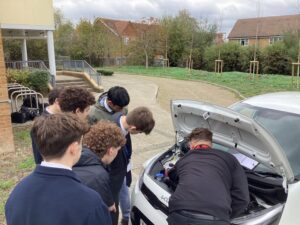
Blenheim boys looking at a car engine

Sixth form students at Blenheim High School in Epsom are getting a practical introduction to car maintenance thanks to a partnership with a motor dealership located just across the road.

Shelly Motors, the family-run Kia dealership on the Longmead Industrial Estate, opposite the school on Longmead Road, is putting its mechanical expertise to work in a six-week programme designed to give young people the confidence to look after their own vehicles.

Technicians from the dealership will guide Year 12 and 13 students through everyday motoring tasks, including checking tyre condition, changing a wheel, topping up essential fluids, replacing windscreen wipers and checking lights.

For many sixth formers, learning to drive is an important step towards independence. Yet while driving lessons prepare young people for the road, they do not necessarily equip them with the practical skills needed when something goes wrong with the car.

The programme is particularly timely as winter approaches, bringing shorter days, slippery roads and increased demands on vehicle maintenance.

But the initiative has another potential benefit: introducing young people to careers in an automotive industry facing a continuing shortage of skilled technicians.

A trade looking for the next generation

The Institute of the Motor Industry (IMI), the professional body for the sector, has warned that automotive apprenticeships remain around 20 to 25 per cent below pre-pandemic levels, despite the industry’s growing need for skilled workers.

Its 2026 research indicated that apprenticeship starts in the first part of the 2025/26 academic year had fallen by 6 per cent compared with the previous year. Nearly two-thirds of new starters were under 19, illustrating the importance of attracting school leavers into the trade.

The employment prospects remain significant. The IMI estimated that there were around 18,000 vacancies in the UK motor trades during the July to September 2026 period, with vehicle technicians accounting for the largest share of advertised positions.

The changing nature of motoring is also transforming the skills required. Modern technicians increasingly need expertise in electronics, computer diagnostics, hybrid technology and electric vehicles, alongside traditional mechanical knowledge.

Automotive apprenticeships offer an alternative to university, allowing young people to earn while gaining recognised technical qualifications and workplace experience.

While Shelly Motors’ programme is not itself an apprenticeship, meeting working technicians and learning what their jobs involve could encourage some students to consider this route after leaving school.

Learning beyond the classroom

Tony Scrivener at Blenheim High School welcomed the opportunity to offer students practical experience alongside their academic studies.

“It is wonderful to be able to run an enrichment like this at the Sixth Form. Enrichment encompasses many elements at Blenheim and giving the students an opportunity to take part in this six-week programme is very exciting for us. We believe in the whole student, not just the academic, so thank you to Shelly Motors for your help in delivering this!”

Kelson Gray, Operations Director at Shelly Motors, said the collaboration was about both road safety and opening students’ eyes to employment opportunities.

“It’s really important for all drivers to know the basics when it comes to vehicle maintenance, and this collaboration ensures students at Blenheim High School develop the right skills from an early stage. Talking to our technicians also makes students better aware of potential career options in the automotive industry as they progress through their education.”

The initiative builds on an existing relationship between the school and dealership. Since 2024, Shelly Motors has sponsored the Chelsea Blenheim FC female football team, helping to fund kit and equipment.

The latest collaboration brings that local support into the classroom and workshop, illustrating how businesses and schools situated only a short distance apart can make practical contributions to young people’s education.

For students who go on to become mechanics, it could be an early introduction to a future career. For everyone else, knowing how to change a wheel or spot a potentially dangerous tyre may prove just as valuable.

Lionel Blackman


Fly-tipping in Epsom and Ewell: footpaths bear the brunt

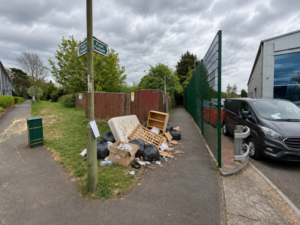
Fly tip in Epsom footpath

Six in ten fly-tips reported in Epsom and Ewell are dumped on footpaths and bridleways, official figures show, and the borough’s true total is higher than the statistics suggest. The Council has confirmed to the Epsom and Ewell Times that fly-tips its own street-cleaning crews clear are not counted.

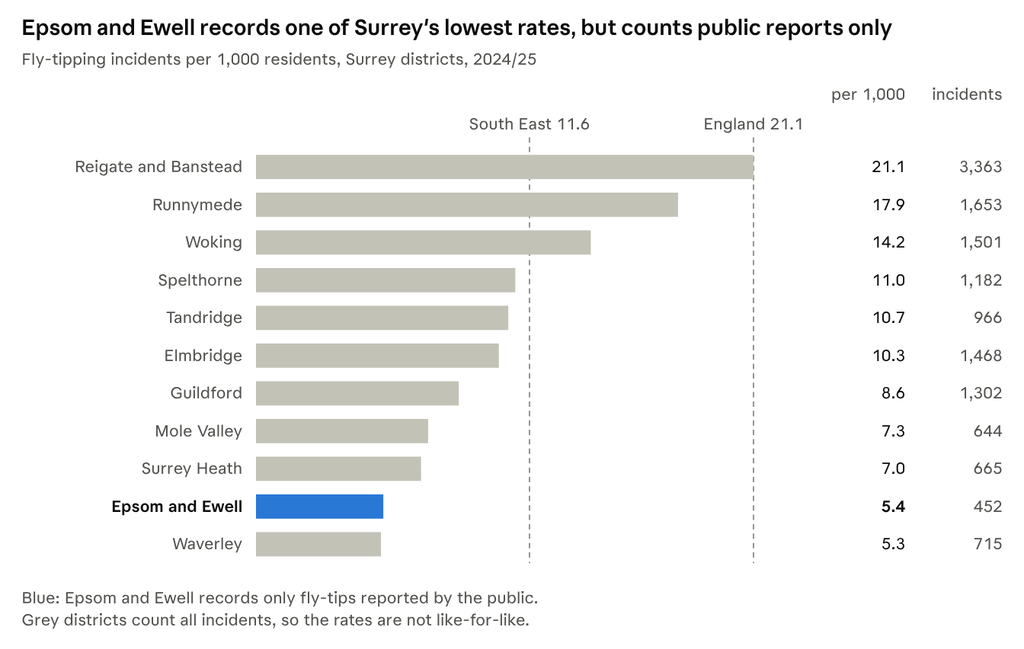
Epsom and Ewell Borough Council recorded 452 fly-tipping incidents in 2024/25, up 7% on 423 the year before, according to figures published by the Department for Environment, Food and Rural Affairs (Defra) in February 2026.

That works out at 5.4 incidents per 1,000 residents, a quarter of the England average of 21. But the low figure comes with a large caveat. Epsom and Ewell is one of only 25 councils in England that report to Defra only the fly-tips logged by members of the public.

Asked why, the Council told EET: “We currently report only cases logged through My Council Services (MCS). Fly-tipping is collected as part of routine street cleansing, but is not yet included in our data collection methods. We are working to develop a way to record all incidents.”

The Council gave no date for the change. Until it happens, waste that crews spot and clear on their rounds does not appear in the borough’s official count.

Across England, councils dealt with 1.26 million fly-tips in 2024/25, up 9% on the year before.

Footpaths bear the brunt

Of the 452 incidents, 280 (62%) were on footpaths and bridleways. Nationally, footpaths account for about one fly-tip in five. In Epsom and Ewell, only 16 incidents (3.5%) were recorded on roads and pavements, against about a third across England. Council land accounted for 93 (21%).

The footpath share has climbed steadily: 40% in 2022/23, 55% in 2023/24 and 62% in 2024/25.

EET asked which footpaths and bridleways were worst affected. The Council did not name any, saying only that the figure reflects “the locations recorded by the teams when collecting fly-tipping reported by the public, through the council’s website”. Nor did it say whether the surveillance cameras placed at hotspots in 2023, including Old London Road, Hook Road and Christ Church Road, are still in use.

What is being dumped

The loads are mostly substantial. 266 incidents (59%) were the size of a small van load, nearly double the national share of 31%, and a further 37 were transit-van sized. The largest dumps have disappeared, however: for the third year running, the borough recorded no fly-tips of tipper-lorry size, as EET has previously reported.

Household waste made up just over half of what was dumped. Unwanted fridges, washing machines and other “white goods” featured in 41 incidents (9%), almost twice the national rate. Other electrical items appeared in 22, and there were smaller numbers of tyres, building rubble and garden waste, plus one case of asbestos.

How the borough compares

On paper, Epsom and Ewell has one of the lowest fly-tipping rates in Surrey. Neighbouring Reigate and Banstead recorded 3,363 incidents, or 21.1 per 1,000 residents, the highest in the county. But every other Surrey district counts all fly-tips, including those found by council crews, so the comparison flatters Epsom and Ewell.

Source: Defra local authority fly-tipping data, 2024/25, published 25 February 2026

Few fines, and a prosecution missing from the figures

The Council took 438 enforcement actions in 2024/25. Almost all of them (416) were investigations. It issued four fixed penalty notices (three for fly-tipping and one to a householder who passed waste to an unlicensed carrier), sent eight warning letters and carried out ten duty of care inspections. Across England, fixed penalty notices make up about one in eight enforcement actions; in Epsom and Ewell it was fewer than one in a hundred.

Asked why so few investigations led to a fine, the Council said a fixed penalty is offered “as an alternative to prosecution where appropriate”, and that in some cases it goes straight to court. It added: “Any prosecution for fly-tipping must satisfy both the evidential and public interest tests. Criminal proceedings can only be pursued where sufficient admissible evidence exists to provide a realistic prospect of conviction. While the council investigates all reported fly-tipping incidents, this evidential threshold cannot always be met.”

The official return for the year shows no prosecutions. That is incomplete. In March 2025 the Council’s own magazine, Borough Insight, reported that a man who dumped waste in the World’s End area in February 2024, and ignored a fixed penalty notice, had pleaded guilty and been ordered to pay £2,330 in fines, costs and surcharge. The Council has confirmed to EET that the case, covering one fly-tipping offence and two of failing to cooperate, was heard on 10 February 2025, within the 2024/25 reporting year, and “was not included in the 2024/25 Defra return”.

The Council did not state the level of its fly-tipping fixed penalty, instead referring EET to a committee paper. Councils can set the penalty between £150 and £1,000.

Nor could the Council say what clearing fly-tips cost in 2024/25. It explained that dumped waste “is collected alongside other street-cleansing materials, so actual collection costs are combined with wider street-cleansing costs rather than recorded separately for each fly-tip”.

How to report fly-tipping

Because only public reports are counted, every report helps build an accurate picture of where fly-tipping happens in the borough.

  • Online: use the Council’s form at epsom-ewell.gov.uk/fly-tipping. The Council aims to clear fly-tips within three working days where practical.
  • By phone: 01372 732000.
  • Blocking a road: contact Surrey County Council Highways on 0300 200 1003.
  • On private land: clearing the waste is the landowner’s responsibility.

Householders can also avoid being fined themselves. If you pay someone to take your rubbish away, check they hold a waste carrier’s licence and ask for a waste transfer note, which you should keep for two years. If your waste is later found dumped, you can be held responsible.

About the figures: Incident and enforcement figures are from Defra’s Fly-tipping statistics for England (published 25 February 2026) and its local authority data, compiled from councils’ own returns. Surrey comparisons draw on the same data as republished by policestatistics.co.uk. Council comments were provided by Epsom and Ewell Borough Council in response to questions from EET on 18 November 2026.

Sources

Sam Jones – Reporter


Is Woking being woke?

Woking Borough Council flew the Palestine flag (image WBC/Facebook)

Flying the Palestinian flag outside civic buildings “does nothing to help those suffering in the Middle East and risks deepening divisions here at home” said the leader of the Conservative opposition group at West Surrey Council.

The flag has been displayed outside Woking Borough Council to mark Palestine National Day on November 15.

The authority said that this was done as an expression of solidarity, but Councillor Jane Austin said that residents expressed anger at the gesture and labelled it as virtue signalling.

She has called on the new West Surrey Council to keep its sites “free from political statements on divisive international issues.”

Cllr Austin said: “I head from many residents over the weekend who were deeply concerned about Woking Borough Council’s decision to fly the Palestine flag.”

She added: “We all feel enormous sympathy for innocent people caught up in war and conflict, wherever they are in the world.

“Council buildings belong to the whole community, and councillors have a responsibility to consider how decisions like this affect the people they represent.

“In my view, this decision does nothing to help those suffering in the Middle East and risks deepening divisions here at home at a time when antisemitism and anti-Muslim hatred are both serious concerns.”

“Woking Borough Council faces extraordinary financial challenges in its final few months.

“Residents rightly expect it to bring communities together and focus on the everyday business of local government, from collecting the bins to making timely planning decisions.”

Cllr Ann-Marie Barker, leader of Woking Borough Council is also a member of the West Surrey executive – which will take over services from April 2027.

Woking, she said, was a diverse borough, and the council was proud to support all members of its community, regardless of their faith, creed or background.

Cllr Barker said: “Throughout the year, we recognise and mark significant occasions, including Holocaust Memorial Day, Remembrance Sunday and other moments of remembrance, reflection and solidarity. We will continue to stand by those values and by our commitment to supporting and respecting all communities.

She added: “We stand by our decision to fly the Palestinian flag to mark Palestine National Day on November 15 as an expression of solidarity with those suffering, and we stand equally firmly by our commitment to a Woking in which all communities are treated with dignity and respect.”

The leader of West Surrey Council, Councillor Paul Follows has been approached for comment.

Chris Caulfield Local Democracy Reporter

.

Woking Borough Council flew the Palestine flag (image WBC/Facebook)


Leatherhead leisure pot diverted to nearby bridge

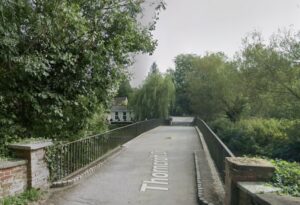
Throncroft Bridge in Leatherhead (image Google)

A “very popular and well used” bridge is set to undergo a quarter of a million worth of repairs after being damaged by heavy goods vehicles.

Serious defects have been found in the concrete beam and slab Thorncroft Bridge in Leatherhead.

They were discovered following a specialist inspection carried out when Mole Valley District Council received reports of larger and heavier vehicles using the river crossing.

Money for the project will come out of a pot earmarked to cover repairs in the nearby Leatherhead Leisure Centre.

The work was recommended by the council’s November scrutiny committee and still requires full cabinet approval.

Councillor Keira Vyvan-Robinson, cabinet member for property and project said: “It’s a very popular and well used bridge used by pedestrians and light vehicle traffic which supports local business and leisure in the area.

“A specialist non intrusive inspection  identified  a range of works needed to fix a range of defect and safety improvements.”

Among the work will be road resurfacing, new speed limit signs, new coping stones and new signage.

There will also be new measures put in place to make it more difficult for larger vehicles to use the River Mole crossing.

The £240,000 budget includes a 25 per cent contingency for any overspend, the meeting heard.

The exact age of the Thorncroft Bridge is unknown, but it is thought to have been built “post war” committee papers read.

The proposed project would also include traffic management, safety barriers, lifesaving equipment, with additional  work carried out to clear the riverbed and banks of any obstructions.

The report read: “The repairs would support continued access for tenants and landowners together with pedestrians and light vehicles. 

“The bridge also supports active travel and connections to the riverside and leisure centre.”

Officers have recommended carrying out the work at the first opportunity to avoid any risks of the project stalling once services are taken over by East Surrey Council in April.

The report said: “Taking no action, would increase health and safety risks, require additional inspections and could lead to closure.”

Chris Caulfield Local Democracy Reporter

.

Throncroft Bridge in Leatherhead (image Google)


Epsom Choral Society delivers an evening of choral masterpieces

The choir at St Martins - credit Clive Richardson

Epsom Choral Society ranks among the top cultural highlights of the town. The choir performs at a number of venues in the area; on this occasion, however, the concert was held in St Martin’s Parish Church.

On a chilly autumn evening, a large audience assembled in the church to hear three choral masterpieces, one very new and the others established repertoire, all expertly played by the English Sinfonietta and sung with huge enthusiasm by Epsom Choral Society (ECS). The conductor was ECS’s Musical Director, Julian Collings.

The evening’s concert came about as a result of a generous legacy from the late Vivian Brown (1926–2023), who had been a keen member of ECS for many years.

ECS was joined by five soloists. They had plenty to do, either as individuals, in pairs and even trios. Their names were Lisa Swayne (soprano), Ana Beard Fernandez (soprano), Henry Capper-Allen (counter-tenor), James Beddoe (tenor) and Mark Nathan (baritone).

Bach’s Mass in G Minor

It is probably anachronistic to claim it, but Bach recycled a lot of his music – after all, why let a good idea go to waste? The B Minor Mass is a famous example of this ‘recycling of music’.

Admittedly not on the same scale as the B Minor, Bach also wrote some Lutheran Masses during his Leipzig years. The Mass in G Minor, BWV 235, opened the concert. It is a Missa Brevis in so many words: just two movements, Kyrie eleison followed by the Gloria in excelsis Deo.

Both movements display all the typical Bachian characteristics: expressive solo numbers ranging from the delicate to the rumbustious; masterly instrumentation; and effortless counterpoint, i.e. the skill of combining two or more ‘themes’ or tunes in such a way that there is no clash.

In the Gloria, the choir alternates with the three soloists, culminating in Cum Sancto Spiritu Amen – ‘with the Holy Ghost, Amen’.

Clive Osgood’s Magnificat

The Magnificat by Clive Osgood followed. Clive is Director of Music and Organist at St Bartholomew’s Church, Haslemere.

The Magnificat dates from 2024 and was written as a companion piece to Bach’s Magnificat, which we heard later. Osgood retains Bach’s framework of choir intertwined with solo numbers, but his musical language is far more modern.

Inter alia, I heard allusions to Chilcott’s ‘Little Jazz Mass’ and echoes of ‘Oedipus Rex’; but the spine-chilling opening is surely Osgood’s own. The audience sat on tenterhooks of expectation throughout.

Bach’s Magnificat brings the evening to a close

After the interval, it was the turn of Bach’s own Magnificat, and this famous work brought the evening to a resounding conclusion.

Here, the effect was as a glass of clear water after the harmonic and orchestral riches of the Osgood.

The listener detects how Bach – recently appointed as Kantor at the prestigious Thomaskirche in Leipzig – wanted to impress his employers. Hence the five-part choir, five soloists and orchestra including trumpets.

All very succinct, as Bach shortens the work by dropping long arias in favour of dramatic momentum.

Timothy Tomkins

Photo credit – Clive Richardson


Popular Epsom and Ewell Councillor Jan Mason dies

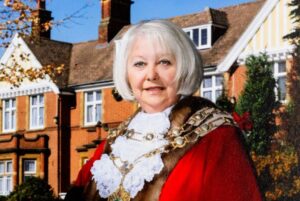
Jan Mason as Mayor outside Epsom and Ewell Town Hall

A veteran councillor who “tirelessly” represented her community for more than three decades has sadly died, it has been announced.

Residents Association Councillor Jan Mason, who served on both Surrey County Council and Epsom & Ewell Borough Council, passed away earlier this month.

The flag at Epsom Town Hall will be flown at half mast as a mark of respect to Councillor Mason.

Epsom & Ewell council leader Hannah Dalton (Residents Associations of Epsom and Ewell: Stoneleigh Ward) said: “It’s been an honour to work alongside Jan. 

“She worked tirelessly on behalf of residents in Ruxley Ward and was a passionate advocate for people across Epsom & Ewell. 

“Her commitment to public service was unwavering, earning her the respect and admiration of colleagues and residents alike. 

“I know that councillors and staff will miss her kindness and great sense of humour. Her contribution to our borough will be long remembered.”

Councillor Mason was first elected to Epsom & Ewell Borough Council in 1995, and would go on to be elected to Surrey County Council in 2001.

She also served as Mayor of Epsom from 2009 to 2010, and gave her backing to several charities during her tenure including Hearing Dogs for Deaf People, St John Ambulance and Riding for the Disabled.

In a statement, a Surrey County Council spokesperson said: “We are sad to share the news that Jan Mason, County Councillor for West Ewell, has passed away. 

“As a long-standing, highly respected member of the Residents Association, Jan was elected to Surrey County Council in 2001. 

“She dedicated many years of service to the Communities Select Committee, as well as her role as an Epsom & Ewell Borough Councillor.

“Jan was a determined advocate who worked tirelessly on behalf of her residents. She will be remembered for her kindness, integrity and dedication to the communities she represented. 

“Our thoughts are with Jan’s family and friends at this difficult time.”

James Moules Local Democracy Reporter


Jan Mason (Credit: EEBC)

.

.

.

.

.

.

.


Cllr Dallen’s “arrogance” complaint continues to consume Epsom and Ewell Council time

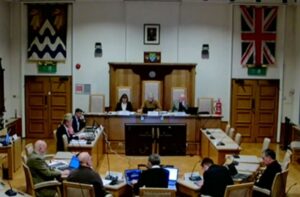
A&S Meet November 2026 EEBC YouTube channel

Questions have been raised about the impartiality of Epsom and Ewell Borough Council’s handling of complaints against councillors after it emerged that a committee chairman who withdrew from a controversial standards hearing is now involved in reviewing the procedures that brought it to a halt.

At the Council’s Audit and Scrutiny Committee meeting on Thursday 12th November, councillors challenged Chief Executive Jackie King over the aftermath of the September hearing concerning a complaint by Cllr Neil Dallen (RA Town) against Cllr Chris Ames (Labour Court).

The discussion raised wider questions about the Council’s governance, the role of its Monitoring Officer and whether external auditors had been informed of difficulties with the complaints procedure.

A chairman’s return raises questions

Cllr John Beckett (RA Auriol), chairman of the Standards and Constitution Committee, had originally been identified to chair the hearing into Cllr Dallen’s complaint against Cllr Ames. However, Beckett had himself participated in the January Strategy and Resources Committee meeting from which the complaint arose.

During that meeting, Ames challenged the decision to withhold information about an urgent authorisation involving up to £500,000 in potential liabilities at the Rainbow Leisure Centre. Beckett intervened to defend the confidentiality of commercially sensitive financial information. Cllr Dallen, who was chairing the meeting, expressly endorsed Beckett’s contribution.

The subsequent complaint alleged that Ames had failed to treat Dallen with respect during the heated exchange.

The proposed involvement of Beckett in determining that complaint had already attracted criticism. Epsom and Ewell Times previously questioned whether a councillor who had participated in the original dispute should sit in judgment upon the conduct of another participant. Beckett subsequently stood aside from the September hearing, which was chaired instead by Cllr Rachel King (RA Town), vice-chairman of the Standards and Constitution Committee.

That makes the latest development particularly significant.

At the November Audit and Scrutiny meeting, the Chief Executive disclosed that Beckett and Monitoring Officer Piero Ionta had met to review the complaints process following the September hearing’s adjournment.

The question now arises: if Beckett’s involvement in the original dispute was sufficient reason for him to withdraw from hearing the complaint, why is he participating in examining the procedures whose application is disputed in that same case?

There is an important distinction between deciding whether Ames breached the Code of Conduct and considering the Council’s general complaints arrangements. Withdrawing from one role does not automatically prevent involvement in the other. Nevertheless, the circumstances raise a legitimate question about the appearance of impartiality, particularly where a review of procedural shortcomings could have consequences for the complaint itself.

A hearing stopped by uncertainty over the rules

The hearing on 22nd September was intended to consider an investigator’s recommendation that Ames had breached the councillors’ Code of Conduct. Instead, it became embroiled in a dispute about which procedural arrangements the Council was entitled to use.

Ames and his legal representative questioned whether the Council had correctly identified the arrangements adopted under the Localism Act 2011 and whether the hearing panel had authority to establish its own procedure.

The Council’s external legal adviser maintained that the necessary arrangements existed across its Constitution, delegated powers and published guidance, but could not establish when the complaints guidance relied upon had been formally adopted. Earlier arrangements, dating from 2012 and used in a previous standards hearing in 2019, had not been clearly addressed in the September hearing papers.

The panel did not determine the dispute over the applicable rules. Instead, it unanimously adjourned the hearing and recommended that the Standards and Constitution Committee review the arrangements for complaints against councillors and sub-committee hearings. No finding was made about Ames’s conduct.

Who was authorised to conduct the review?

At the November Audit and Scrutiny Committee meeting, Cllr James Lawrence (Independent College) raised the failure of the September proceedings as a potential governance concern.

Jackie King (EEBC CEO) acknowledged the confusion surrounding the hearing and revealed that the Monitoring Officer and the chairman of Standards and Constitution had subsequently met to discuss the complaints process. “There was a lot of confusion at the pre-hearing,” she told the committee. However, she said that she had not yet received the conclusions of their review and could not say whether any procedural shortcomings had been identified. She undertook to communicate the outcome to members.

Cllr Ames challenged the arrangement. He pointed out that the September panel had recommended a review by the Standards and Constitution Committee itself, not by its chairman and the Monitoring Officer acting separately.

He questioned whether the people responsible for advising on and administering the disputed procedure should themselves determine whether it had been defective. He accused officers of attempting a “behind-the-scenes stitch-up”, an allegation rejected by the Chief Executive.

Ms King defended the Monitoring Officer and maintained that it was necessary to await the review’s conclusions before deciding whether there had been a failure.

Ames argued that the review should be conducted through the Council’s established committee system, with appropriate member oversight. His concern was not simply whether the eventual procedure might be corrected, but whether the Council was following the democratic decision made by the September panel.

The question of Beckett’s involvement adds another dimension. The original hearing was conducted without him, following concerns over his participation in the underlying dispute. Yet he has now returned to a role in examining the process by which that same dispute was to be adjudicated.

It remains unclear whether the review undertaken by Beckett and the Monitoring Officer will be presented to the full Standards and Constitution Committee for consideration and decision.

Auditors were not informed

The disagreement emerged during the committee’s consideration of the Council’s annual accounts and external audit findings.

Grant Thornton, the Council’s external auditors, had assessed its governance arrangements, including the systems intended to maintain standards of conduct and accountability. Cllr Lawrence questioned whether the difficulties surrounding the aborted hearing ought to have been identified as a weakness in the Council’s governance. Ames went further, asking whether officers had informed Grant Thornton that a standards hearing had been adjourned amid uncertainty about the applicable procedures.

The Chief Executive confirmed that the auditors had not been told. She explained that the Council could not know whether there was a governance failure until the review had been completed.

Ames disagreed, arguing that the inability to identify and agree the correct arrangements at the hearing was itself a governance concern, irrespective of any subsequent efforts to resolve the uncertainty. He reminded the committee that the September panel had itself recommended a review, rather than simply accepting the assurances of officers.

Grant Thornton indicated that the auditors could consider the matter and, if appropriate, amend their reporting once the outcome of the review was known.

The exchanges therefore brought the handling of a single councillor complaint into the wider question of how accurately the Council’s Annual Governance Statement reflects problems identified in its decision-making arrangements.

Cost of the unresolved complaint

Ames also raised the financial implications of the proceedings, reminding the meeting that more than £8,000 had already been spent on the complaint. The case has involved an external investigator, legal advice and the preparation of a hearing which was adjourned without reaching the merits of the complaint.

The original dispute concerned the manner in which Ames questioned Dallen over confidential treatment of information about the Rainbow Leisure Centre.

The external investigator recommended a finding that Ames had failed to show respect. The investigator did not, however, determine whether Ames’s underlying questions about the Council’s urgent decision and confidentiality arrangements were justified. Nor has the hearing panel yet determined whether Ames breached the Code.

Commenting after the meeting Labour Group leader on the Council, Cllr Kate Chinn (Court) said “One man can stop the disproportionate time being wasted on this petty complaint. Cllr Dallen’s refusal to withdraw appears to be demonstrating the very characteristic of “arrogance” he is complaining about.”

Standards for the standards committee?

The developments leave the Council facing several questions.

Why has a chairman who withdrew from adjudicating a complaint because of his earlier involvement returned to participate in a review connected with that complaint?

Why has a recommendation addressed to the full Standards and Constitution Committee apparently been pursued initially through discussions between its chairman and the Monitoring Officer?

And should the difficulties which prevented the September hearing from proceeding have been disclosed to external auditors without waiting for the Council’s own review to conclude?

These questions do not establish that Beckett or the Monitoring Officer acted improperly. Nor do they resolve the underlying complaint against Ames. They do, however, concern the independence, transparency and accountability of the procedures through which elected councillors are investigated and judged.

With Epsom and Ewell Borough Council due to disappear on 1st April 2027, the authority has only a few months remaining to demonstrate that its complaints arrangements are clear, properly authorised and capable of commanding public confidence.

The September panel asked for a review by the Standards and Constitution Committee.

Whether that is what the Council ultimately delivers remains to be seen.

Sam Jones – Reporter

Image: A&S Meet November 2026 EEBC YouTube channel

Related reports:

The cost so far to the Epsom taxpayer of Cllr Neil Dallen’s “arrogance” – 28 October 2026

Time for Cllr Dallen to drop his taxpayer funded complaint? – 23 September 2026

Epsom & Ewell Council refuses to explain complaints disparity – 21 August 2026

Epsom’s scrutiny committee slams Dallen’s urgent £500K Rainbow approval – 17 July 2026

“It’s my meeting”: Cllr Dallen stops questions about his role in alleged Rainbow “cover-up” – 23 February 2026

Cllr Dallen accused of £1/2 m Epsom & Ewell Council cover-up – 14 January 2026


Rising Energy Bills, Power Cuts and a VAT Deadline: Is It Time to Rethink Your Home’s Energy?

SPONSORED ARTICLE | Provided by Glow Homes

For homeowners in Epsom, Ewell and across Surrey, energy is back in the headlines.

Conflict in the Middle East has unsettled wholesale energy markets. Household bills have risen, with further increases forecast. The Government has also highlighted power outages as a risk worth preparing for.

Meanwhile, a significant change to the VAT treatment of home energy installations is approaching.

Against this backdrop, solar panels and battery storage are becoming about more than reducing electricity bills. They’re about giving homeowners greater control over how their properties generate, store and use energy.

More control over rising energy costs

The energy price cap increased in October 2026, and further rises are forecast for January.

Solar panels allow a household to generate some of its own electricity, reducing the amount purchased from the grid. A battery can store surplus generation for use later, including during expensive evening periods.

The financial benefit depends on the home’s electricity use, system design, tariffs and installation costs. It’s a long-term investment, not a guaranteed return.

Could your home keep the lights on during a power cut?

Government resilience planning has brought renewed attention to electricity disruption, although widespread blackouts remain unlikely.

Solar panels and batteries can contribute to household resilience, but there’s an important distinction: most conventional installations automatically disconnect during a power cut.

To maintain electricity to selected household circuits during an outage, a system needs specific backup capability and appropriate electrical design.

For homeowners concerned about keeping essential equipment running, that’s a question worth asking before installation.

Glow Homes