Epsom and Ewell Times
19th November 2026

ISSN, LDRS and IMPRESS logos

Six months of disruption ahead as major gas and traffic works set to hit central Epsom

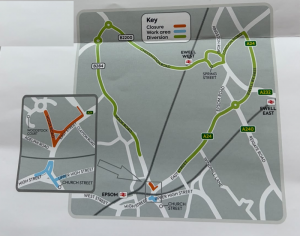
Roadworks and diversion plan SGN

Businesses and residents voice concerns over diversion routes as SGN and Surrey County Council prepare for large-scale works at the East Street/Hook Road/Upper High Street junction

Central Epsom is facing up to six months of roadworks and traffic disruption following the announcement of a major joint gas infrastructure and traffic signal project by Southern Gas Networks (SGN) and Surrey County Council (SCC) Highways.

What’s happening, and when

According to letters sent to residents and businesses this month, the works are being carried out to support new housing development in the area and to maintain the safety and reliability of the local gas network. SGN’s contractor, JDT Utilities, will lay new gas mains in East Street and Hook Road, while SCC replaces the traffic signal system on High Street, Upper High Street and Church Street.

A clarifying email from SGN, seen by this publication, sets out the works in more detail than the resident letters managed to convey. The project will run in two phases:

  • Phase One (planned duration: four weeks) will see SCC install a new urban traffic light system, with new light heads on Church Street, High Street and Upper High Street. Within this footprint, SGN will impose a lane closure — not a full closure — on East Street, to allow open-cut installation of two new mains running from outside The Big Yellow Storage on East Street through to Hook Road.
  • Phase Two will follow, with Hook Road closed between Woodstock Court and East Street while SGN continues its open-cut works down towards the multi-storey car park entrance and Woodstock Court.

The resident letters state that engineering work is scheduled to begin on 18 July, with SCC’s signal works starting on 23 July within the same traffic management setup. Go Epsom, the town’s Business Improvement District, gives a fuller picture of the timeline, stating that works will run from 23 July through to 24 December — a span of roughly five months, and notably longer than the “completed by the end of the year” assurance given in SGN’s own letter.

During the works, the multi-storey car park will remain open and accessible via Hook Road under traffic management, and a signed diversion route will be in place. SGN says access will be maintained for residents and businesses throughout.

Residents question the diversion plan

The announcement has prompted concern from residents about the adequacy of the traffic management plan. One resident, responding to the letter, said the accompanying diversion map was difficult to interpret and that the colour-coding “does not make a lot of sense,” while the flyer gave no indication of where traffic would be diverted to rejoin the A24 on the far side of Epsom, nor any information on bus route changes.

The resident warned that Epsom’s narrow residential streets are already prone to rat-running, and questioned whether roads such as Downs Hill Road and Worple Road — both narrow, and in the case of Worple Road affected by potholes — could safely absorb diverted traffic, including HGVs, without vehicles being forced onto pavements. They suggested a 20mph limit should be considered on any residential road used as part of the diversion, particularly given the number of children walking to and from school in the area.

The resident also raised concern about the six-month duration of the works and its potential impact on trade in Epsom High Street, and said they would be unable to attend either of SGN’s public drop-in sessions this week.

Businesses seek pause over Christmas trading period

Go Epsom has echoed concerns about the scale and length of the disruption. In a message to local businesses, it confirmed the works are expected to run from 23 July to 24 December, warning of “knock on effects with diversions, parking bay suspensions and road closures.” The BID says it is asking SGN and SCC to pause works over the November/December trading period, recognising the importance of the pre-Christmas period to town centre traders.

Businesses affected by the works may be eligible for support through SGN’s small business compensation scheme, details of which are available at sgn.co.uk.

Have your say

SGN is holding two public drop-in sessions this week for residents and businesses to raise questions directly with the engineering team, at the rear offices of 29 East Street:

  • Wednesday 1 July, 4pm–7pm
  • Thursday 2 July, 2pm–4pm

Project updates are expected to be published at sgn.co.uk/our-gas-works/major-planned-projects, and anyone with concerns about disabled access or specific needs during the closures is asked to contact SGN’s customer service team on 0800 912 1700.


Lionel Blackman


Epsom Racecourse: Preview and Tips for Tonight’s Seven-Race Meeting

Horses racing Image: Credit Paul. CC BY 2.0

Always a competitive track, there are seven races at Epsom this evening, with a maiden and six handicap races on the card.

Read on for a preview of and tips for the Epsom card, brought to you by BOYLE Sports, who have all the horse racing odds.

We kick off with an apprentice handicap run over 10 furlongs (17.20). Toby Moore, son of legendary jockey Ryan Moore, claims the most weight still, giving his ride – Oj Lifestyle – seven pounds. Imperial Cult, ridden by Jack Callan, seeks a hat-trick, which might be tricky on this higher new mark, while Bobacious looks likely to appreciate the better ground today. With Mason Paetel in the saddle, he looks a possibility here and has won at this track before.

Up next is a seven-furlong two-year-olds’ maiden (17.50). There are two newcomers here; Whiskey Galore and Bullrider, but this isn’t an easy track to debut at. It might, therefore, be more worthwhile to consider the chances of those with previous race experience. Shemiyla Star handled Pontefract first time out, which is promising for Epsom, while Foscarini might improve for the better ground here.

Race three is a six-furlong handicap (18.22). Four of the runners won their latest races, and have all gone up in the weights as a result. It could prove to be Goldwork’s time to shine here, on a workable mark and at a track he ought to handle. 

A mile and a half handicap follows (18.57). Central Command seeks a hat-trick on a new high mark, while Alma Latina steps into handicap company for the first time having won a maiden last month. Timber Twelve might sneak into the placings on a lower mark today, and Tabasko makes some appeal too, although this might be a tough ask for a three-year-old. 

The fifth race is a division of a mile and a half handicap (19.32). Pablo Prince is a consistent if rarely winning sort, who just might have an opportunity here. Lilykoy is untested on a track like this and makes her first handicap start, but her pedigree suggests propensity for these undulations. 

In the second division (20.07), both Gearing’s Point and Nymphaea won their latest starts. With the former probably the most likely of the two to oblige again. Naranka looks handy after placing last time out, while Ricardo Phillips enters calculations too, but might need the run here. 

Finally, racing concludes with a seven-furlong handicap (20.42). Bell Shot is on an attractive mark and has a further five pounds given by his claiming rider. Mission Command was a winner last time out but this new mark might prove to be beyond him. Musical Angel likes this track and looks more likely. 

Epsom selections – Wednesday:

17.20 – Bobacious

17.50 – Shemiyla Star, Foscarini to place

18.22 – Goldwork

18.57 – Tabasko e/w

19.32 – Lilykoy

20.07 – Naranka

20.42 – Bell Shot

Horses racing Image: Credit Paul. CC BY 2.0


Epsom and Ewell Council admit behind hygiene inspections

Cartoon busy restaurant kitchen and stressed council hygiene inspector

The borough’s environmental health team has told councillors it is running behind on lower-risk food hygiene inspections — deliberately prioritising higher-risk premises such as takeaways, schools and hospitals over sweet shops and home caterers — as the Environment Committee – Tuesday 30th June – adopted the council’s Food Hygiene Service Plan for 2026/27, in what officers confirmed will be the council’s last year running the service before Surrey-wide local government reorganisation.

Councils have a statutory duty, under a national Framework Agreement on Official Feed and Food Controls overseen by the Food Standards Agency (FSA), to inspect food businesses in their area at intervals set by risk category — broadly, the higher the risk, the more frequent the inspection. As of April 2026, the borough had 611 registered food premises, including 444 restaurants, cafés, canteens and other caterers and 139 retailers. Of these, 133 fall into the higher-risk categories A to C, requiring inspection every six, 12 or 18 months respectively; a further 120 businesses are newly registered and awaiting their first ever inspection.

Catching up, but not quite there

Public Protection Manager Oliver Nelson told the committee the service had actually exceeded its own targets in 2025/26, completing 237 inspections against a planned 161, largely by working through a backlog of overdue inspections and newly registered businesses that had not yet been visited. Even so, the plan for 2026/27 shows 207 scheduled inspections still due — including two Category A premises (the highest-risk tier, inspected every six months), 25 Category B, 77 Category C and 101 lower-risk Category D — plus a further 74 inspections reported as overdue from previous years.

Cllr Steve McCormick (Conservative Woodcote and Langley) pressed officers on why these 74 remained outstanding, and — more pointedly — “why is this statutory service unable to meet this demand, and how can we approve a plan that cannot deliver?” Mr Nelson said the situation was “not unusual” for a local authority environmental health team: the overdue premises are “mainly category E” — meaning very low-risk operations such as sweet shops and small-scale or domestic home caterers — which have been deliberately “deprioritised in favour of food production facilities, schools, hospitals, takeaways” and other higher-risk categories. He explained that his team juggles “four or five different” statutory service areas across several council committees competing for the same limited resources: “It’s a daily task to try and arrange yourself to cover all those bases,” he said, “and what happens is that the lower risk areas are deprioritised in favour of the higher risk every time.”

Staffing pressures and past scrutiny

The report notes that the service has struggled with staff retention, and that a newly created post remains vacant and covered by agency staff — leaving the small team vulnerable, officers said, since even a single experienced officer leaving risks non-compliance with statutory duties. Historically, 1.2 full-time-equivalent officers have been sufficient to meet the Food Law Code of Practice’s requirements for the borough, a level the service says it can currently sustain provided staffing and agency support remain stable.

Cllr McCormick also asked about a reference in the report to “the existing agreed action plan arising from previous Food Standards Agency intervention” — asking what that intervention had covered, and when the service was last formally audited. Mr Nelson could not recall the exact audit date on the night, estimating it was “probably in the last four years,” and agreed to circulate fuller details after the meeting. He said the earlier FSA intervention had flagged underperformance not just in the lowest-risk category but also in Categories B and C, at a time when staff resources had been diverted towards private sector housing casework.

The wider context: a service in its final year

In an unusually reflective note buried in the report’s final section, officers wrote that 2026/27 “will be the final year of delivery of this service by this authority following 90 years of work in the field by Inspectors of Nuisances, Sanitary Inspectors, Public Health Officers and finally Environmental Health Officers” — a reference to the borough council’s abolition under Surrey’s local government reorganisation, with food safety functions due to transfer to a new unitary authority from April 2027.

Elsewhere, Mr Nelson noted that several web links in the appended service plan had broken because the Food Standards Agency had migrated its guidance to the gov.uk website: “If any members of the committee would like those documents, I’m sure Google will be their friend,” he said.

Enforcement activity and the vote

During 2025/26 the service issued four hygiene improvement notices and 200 written warnings to food businesses. No food or environmental samples were taken during the year, officers said, as priority was given to the inspection programme; a separate allocation of around £2,800 a year from the UK Health Security Agency (UKHSA) funds routine microbiological sampling, alongside a local £450 budget for chemical sampling in 2026/27.

The committee voted to adopt the Food Hygiene Service Plan for 2026/27, with one councillor voting against.

Sam Jones – Reporter


“Come on” all tennis players in Epsom and Ewell

Mixed tennis doubles playing tennis

A borough scheme charging residents to play tennis on council courts has taken in almost double its budgeted income in its second full year, the Environment Committee – Tuesday 30th June – heard, as members confirmed that free morning tennis sessions will return across the borough’s courts this summer.

The Pay-to-Play Tennis Scheme was introduced in 2024 using a grant-funded electronic gate system from the Lawn Tennis Association (LTA), the sport’s national governing body, paired with an online booking platform called Clubspark. Under the scheme, households can buy an annual membership for £40 (£20 for low-income households) covering up to five people for unlimited play, or book a court on an ad-hoc basis for £6 an hour — prices fixed at their original, introductory level through to 2026/27.

The numbers

Interim Assistant Head of Service Samantha Whitehead told the committee the scheme’s growth had exceeded expectations. Household memberships rose from 268 in 2024/25 to 316 in 2025/26, while ad-hoc bookings climbed from 1,404 to 1,868 over the same period. Net income of £31,634.62 comfortably beat a budget of £17,500. “I don’t think any of us at the outset thought it would bring back the returns that it has in a relatively short period,” she said, adding that renovation works funded through the scheme’s income at Court Recreation Ground, Alexandra Park and Auriol Park courts had already paid off: “My team report that since the recent renovations at [Auriol] Park this weekend was the most amount of bookings they’ve ever seen on the courts.”

The scheme was not without unbudgeted costs, however — £21,140.11 was spent on repainting and line-marking at Court Recreation Ground and Alexandra Park, requiring a drawdown of £7,984.46 from the council’s Repairs and Renewals Reserve, which now stands at £8,426.54.

Free summer tennis returns

Free, bookable morning tennis sessions were run for the first time during the 2025 school summer holidays and proved highly popular, generating 566 bookings across the borough’s five sites: 203 at Alexandra Park, 164 at Court Recreation Ground, 88 at Poole Road, 75 at Auriol Park and 36 at Gibraltar Recreation Ground. Officers recommended repeating the offer, running free sessions up to noon each day from 22 July to 31 August 2026.

Before debating the substance of the report, the committee formally amended the recommendation, at Cllr Liz Frost‘s (RA Woodcote and Langley) proposal, to make clear the free sessions apply to “all EEBC owned and managed” tennis courts in the borough — a clarification agreed with one abstention.

Cllr Steve McCormick (Conservative Woodcote and Langley) asked whether residents needed to register with the Clubspark booking system to access the free sessions. Ms Whitehead confirmed they did: “They do have to register with the LTA Clubspark system, which means that they could be exposed to marketing in the future if we chose to do that, but in return they get free use of the tennis courts.” Cllr Frost noted a further benefit of requiring bookings even for free sessions — it stops courts being monopolised by a single group all day, since “now people have the confidence that… they booked play, so they can go and play.”

A push to extend the hours — defeated

Cllr McCormick, noting this would be the borough’s “last summer” before local government reorganisation replaces it with a new unitary authority, argued the free window should be extended well beyond midday. “It’s incredibly popular… why not extend it?” he asked, proposing the sessions run until 2pm instead of noon, covering the same 22 July to 31 August period. “It’s only an extra couple of hours per day across that very short time frame,” he said.

Ms Whitehead’s reservation was that extending free access too far could crowd out members who had already paid for the privilege of unlimited play: “My only reservation would be for those that have paid for a membership, if they couldn’t… get access to the facilities having paid, that would be my only caveat.” Cllr Frost confirmed the committee had considered making sessions free all day the previous year, but had held back for the same reason, adding that the scheme had run smoothly in practice: officers “didn’t receive any complaints from members” unable to book a paid slot, nor “any complaints that people couldn’t play who wanted to play.” Officers were unable to confirm on the night whether last year’s free sessions were regularly fully booked, or how much the current proposal — or Cllr McCormick’s extended version — would actually cost the committee’s budget, saying the figures would need to be worked out and circulated after the meeting.

Cllr McCormick’s amendment to extend the sessions to 2pm was put to a vote and defeated, with three councillors opposed. The committee then voted, unanimously, to note the progress of the Pay to Play Tennis Scheme and to approve free morning tennis sessions on all EEBC-owned and managed courts from 22 July to 31 August 2026, in line with last year’s arrangements.

Also noted: bids for court upgrades

The report also noted that two separate Neighbourhood CIL (Community Infrastructure Levy) bids — submitted by Cllrs Alex Coley (Independent Ruxley) and Clive Woodbridge (RA Ewell Village) for the regeneration of the tennis and basketball courts at Poole Road and Gibraltar Recreation Grounds — have been approved by the council’s CIL Panel and now go forward to the Strategy and Resources Committee for final sign-off. If successful, both sites would also gain pickleball facilities, a fast-growing paddle sport the report describes as offering “inclusive opportunities for participation across a wide range of ages and abilities.”

Sam Jones – Reporter

Related reports:

Anyone for tennis? If you pay.

LibDems call “Love All” for local tennis

Anyone for tennis?


Epsom and Ewell Council tiptoe around stepping stones “liability”.

Stepping Stones - Hogsmill River. Credit Brigitte Jeffs

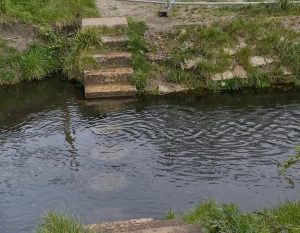
Epsom and Ewell Borough Council’s Environment Committee – Tuesday 30th June – has decided not to take on legal responsibility for the historic stepping stones across the Hogsmill River, after councillors concluded that accepting liability for a crossing already flagged as unsafe was too great a risk — instead backing a bid to build a new, fully accessible footbridge nearby.

The stepping stones, thought to have been installed in the early 1980s, sit within the Hogsmill Local Nature Reserve and are owned by the Environment Agency (EA), which — unusually — owns both the riverbed and the banks at this location. The EA has told the council it wants to remove the stones and the steps leading down to them on safety grounds, unless another organisation takes on responsibility for their ongoing inspection, maintenance and insurance.

Why now?

Countryside Manager Stuart Cocker told the committee two problems had brought matters to a head. First, the concrete steps on the northern bank have been undermined by dogs entering and leaving the water at that point, creating a risk of collapse — the first significant repair needed on the crossing “in over 40 years,” he said, with a repair cost of under £1,000. Second, a new wetland outflow channel built as part of nearby habitat restoration work has altered water levels, meaning the stones are now submerged, and therefore slippery, for much longer periods than in the past. The EA erected barriers preventing access to the stones in September 2025 following its own risk assessment.

Mr Cocker stressed that the EA remains an active partner in the wider Hogsmill Catchment Partnership, alongside the South East Rivers Trust, and pointed to what he called significant progress over 15 to 20 years, including “new meanders in the River Hogsmill,” removal of concrete weirs, “naturalising large sections of the river channel” and reintroducing fish.

He also had some encouraging news on the water-level problem: the South East Rivers Trust has secured the Environment Agency’s permission to move gravel that has built up at the confluence with the new wetland channel, work being paid for as a “public good” clause within a separate CIL-funded contract to restore a nearby footpath. “We’re fairly confident that that will cause the water levels to recede,” Mr Cocker said, though he cautioned it might need repeating. Asked directly whether this work would persuade the EA to keep responsibility for the crossing after all, he was clear: “From what they’ve said, they still wish the stepping stones to be removed. That’s their intention” — a decision he said rests with the EA’s asset management team, based purely on flood-risk grounds, and unaffected by the availability of funds for anything beyond flood mitigation.

Four options, and a difficult choice

Officers set out four options for the committee: take on liability for the stones with no bridge; take on liability and build a bridge; decline liability but still pursue a bridge; or decline liability and accept the stones’ removal with no bridge. A Community Infrastructure Levy (CIL) bid for a new pedestrian footbridge — of the kind already built nearby across the wetland outflow channel, at a cost of around £130,000 — has already been submitted, though the outcome is not yet known, and design and planning costs on top of any successful bid would still need to be found separately.

Councillors were, without exception, reluctant to see the stones disappear. Cllr Rob Geleit (Labour Court) told the committee: “I’m afraid I’m one of those people who used to play there as a child, and I think there’s always an element of risk in places where children play, especially when there’s water, but I would hate to see the stepping stones gone. So, I’d like to say, please don’t take the toys away.” Cllr Julie Morris (Independent College) said she had researched the issue and found that stepping-stone river crossings of this kind are now rare in the south of England outside Box Hill: “I haven’t really heard anybody speak in favour of getting rid of the stepping stones entirely,” she said, though she accepted that without identified funding for the fuller package of repairs, a more modest package of gravel-clearing, a handrail and a warning sign might be “a sort of halfway house at the moment.”

Cllr Steve McCormick (Conservative Woodcote and Langley) said he was “100% behind” retaining the stones and covering the modest repair cost, but was sharply critical of the bridge costings in the report, which he said “do not illustrate the full picture,” since design and planning funding was not specified and would in any case need approval from the Strategy and Resources Committee rather than this one. He also pressed officers on what work had been done, in the years since the Hogsmill Local Nature Reserve’s management plan (which runs from 2017 to 2117, with its first review due in 2027) identified bank erosion by the stepping stones as an issue needing the Environment Agency’s attention, to actually secure that work — a question Mr Cocker answered by pointing to the partnership’s broader achievements rather than action on this specific spot.

The liability question

It was Cllr Rachel King (RA Town) — sitting as a substitute, and drawing on her day job dealing with insurance claims — who made the most pointed intervention against the council accepting responsibility. “You cannot sign your way out of liability,” she told the committee, warning that no amount of warning signage removes an organisation’s underlying duty of care. “I don’t think we should be taking on that liability, because we know from the report currently that they are not safe, and until they are made safe, we wouldn’t want to burden ourselves with that kind of responsibility.” She later added that the committee risked “accepting liability” before the legal review, inspection regime and insurance implications flagged in the report had actually been worked through: “It feels a bit too, too big a risk to move forward in that direction without having done that work first.”

Cllr Steve Bridger (RA Stamford) raised a related, practical worry: that even if the stones were kept safely maintained, the steps leading down to the water would remain a magnet for children paddling regardless — and he warned that a single successful insurance claim could send premiums “up astronomically,” potentially forcing the council’s hand later anyway. Officers confirmed that if the council did not take on responsibility, the EA intends to remove both the steps and the stones.

Committee Chair Cllr Liz Frost (RA Woodcote and Langley) also noted a case for the bridge on its own merits, separate from the liability question: with the new wetland habitat drawing more visitors to the area, she said, a bridge would open up access “for a lot more people,” including those with prams, pushchairs or bikes who cannot manage the current steps and stones.

The vote

Put to a vote option by option, the committee settled on Option 3: the council will not take on liability for the stepping stones or the steps leading to them, acknowledging that the Environment Agency may proceed to remove them, but will pursue a new, fully accessible footbridge as an alternative crossing, subject to the outcome of the CIL funding bid and further funding being secured for design and planning. Councillors formally noted the CIL application, while the report’s third recommendation — covering ongoing inspection and maintenance costs for the stones — fell away as a consequence of the vote. Closing the item, Cllr Frost reflected: “I think it’s a very difficult one, because I think we all acknowledge how much we like the stepping stones, and I really hope that somebody else will be able to take on the responsibility, but that’s not really for this meeting.”

Sam Jones – Reporter

.

Photo: Stepping Stones – Hogsmill River. Credit Brigitte Jeffs


Ewell’s Library of Things finally to become a thing?

Bourne Hall Ewell

Epsom and Ewell Borough Council’s Environment Committee – Tuesday 30th June – has agreed to grant a police-approved outdoor storage unit in the grounds of Bourne Hall a five-year lease, with a two-year break clause, after councillors argued that officers’ original proposal of a two-year term was too short to give the volunteer group running the scheme any security.

The store is needed for the borough’s new “Library of Things” (LoT) — a scheme, similar to a book library, that lets residents borrow tools, camping equipment and household appliances rather than buying them outright. It is being set up by the volunteer group Epsom and Ewell Climate Action Network (EECAN) in partnership with Surrey Library Service, and will operate out of Ewell Library at Bourne Hall. Most items can be stored inside the library itself, but larger equipment needs a dedicated outdoor store — hence the need for a legal agreement over council-owned land.

A volunteer’s account

Before councillors debated the report, they heard a three-minute public statement from EECAN volunteer William Ward, describing himself as “a father and grandfather,” who joined the meeting online. Mr Ward told the committee: “I am working with 12 other volunteers to provide this free library of things at Bourne Hall, and I support the recommendations in the report.”

He used his statement to correct what he felt could be misunderstandings in the officers’ report. His original bid to the Community Infrastructure Levy (CIL) — a charge councils can levy on new development to fund local infrastructure — “was for one permanent shed, not multiple units,” he said, and had been approved at a meeting with six borough and county officers on 14 October, when the proposed site was shown to the volunteers present. He set out a lengthy timeline of pre-planning discussions, a planning application submitted on Christmas Eve, planning permission granted on 12 March, and confirmation from Building Control on 19 February that it did not need to be involved.

He also told the committee: “I’ve continued working with all partners, but only became aware last week from reading this report that the borough needed me to consult with the police. I want to reassure the committee that although I am [confident], the design addresses [many] of the risks [identified]. I’m happy to take further advice.” On safety, he noted that insurance was already in place, that Surrey County Council’s principal insurance officer had agreed to cover the store under its “Borrow a Bike” scheme, and that a planned green roof would carry a small solar installation providing only low-voltage lighting, with “no battery charging” to take place inside the unit.

Mr Ward ended with a warning about timing. If the lease “cannot be ready for signing well before April [20]27” — when local government reorganisation is due to sweep away the borough council in favour of a new East Surrey Unitary Authority — he said he might have to ask the incoming authority to reconsider storing the larger items inside Bourne Hall itself. He closed by asking the committee “to also consider the climate risk facing young people today,” saying his aim, with fellow volunteers, “has always been to help residents borrow instead of buy, save money and storage space, while lowering their carbon footprints.”

Officers’ concerns: wrong kind of shed

Introducing the report, Cllr Liz Frost (RA Woodcote and Langley) explained that the store was needed because Bourne Hall library “does not have sufficient storage space for the large items” the scheme requires, and that a two-year, rent-free legal agreement directly with EECAN was proposed, subject to planning permission and a series of health and safety mitigations.

Cllr Rob Geleit (Labour Court) asked officers directly: “Is there a concern that this is a wooden building when it was proposed to be a metal building?” Cllr Frost confirmed this was indeed a live issue. The CIL bid had originally referenced small, “police-approved” metal storage units no larger than 2.2m by 1m by 2m — the kind of secure steel shed used for bike storage. The planning permission that was in fact granted, however, was for a much larger timber outbuilding measuring 7.2m by 3.4m by 3.4m. “There has been… a history of unfortunate incidents with break-ins, vandalism, arson, etc. for buildings like [this],” Cllr Frost told the committee. “So the lease would stipulate a police-approved structure.”

A legal puzzle officers could not resolve on the night

Cllr Steve McCormick (Conservative Woodcote and Langley) raised what he called a contradiction in the report between sections referring to the committee “waiving” the council’s Contract Standing Orders in order to grant the lease directly to EECAN (rather than opening it to competitive tender), and a later section stating that the council would still need to establish the land’s market value to satisfy “best value” — the legal principle requiring councils to secure fair value for public assets. “Forgive me, which is it?” he asked.

No legal officer was present to answer. This was itself the subject of some frustration: Cllr McCormick had earlier asked in the meeting why nobody from the council’s legal team was in attendance, only to be told by an officer that “legal don’t attend committee meetings as standard… there was nothing that was foreseen tonight that would require their attendance.” On the specific question about best value, the officer present said: “I think I would have to take that away and go back to legal on it, because I don’t have the answer for you this evening, I’m afraid.”

The case for a longer lease

The most substantial debate concerned the length of the lease. Cllr McCormick argued strongly for extending it well beyond the two years proposed: “This library of things item is great. We should get it done… I would question the duration, actually, of two years. I think it’s incredibly short,” he said, pointing out that other local charities had recently had leases extended to 15 or 20 years, giving them far more flexibility when applying for grant funding. He initially proposed extending the term to 10 or 15 years.

Officers explained that the two-year figure had come from legal advice, given specifically because EECAN was “a new group” without a track record of running such a scheme; the original suggestion, before that advice, had been five years. Officers said they could see no reason why a review clause could not allow for extension after two years “if all was going well,” but that this would need to be confirmed with the council’s legal team.

Cllr Frost, while sympathetic to the case for grant funding, questioned how much external funding a volunteer-led scheme with no office overheads would actually need, but agreed the recommendation could be amended.

Cllr Julie Morris (Independent College) backed a middle way — five years, with a two-year break clause — and spoke warmly of Mr Ward’s track record: “I’ve known William Ward for some time… he’s not the new kid on the block… he has been involved in environmental and sustainability issues for some years.” She argued that a two-year offer, with an uncertain future council to renew it, sent the wrong message: “I don’t see that as commitment from us to a gentleman that’s actually done quite a lot for this borough that has a very good following, and will undoubtedly make a very good job of it. And I think it should be the role of this committee that we say [to] you’re not here, guys: this is what we want you to do. We want five years with the break clause at two years, because we really want to put our weight behind such a good initiative.”

Cllr McCormick accepted the compromise — “I’d like 10, but five, I’ll go for five” — and, with Cllr Morris seconding, the amendment was carried.

The decision

The committee unanimously agreed, as amended, to enter into a legal agreement at nil rent for five years, with a two-year break clause, for a police-approved outdoor store at Bourne Hall for the Library of Things — subject to the risk mitigations set out in the report — and to delegate the final legal drafting to the Head of Property and Regeneration, the Interim Assistant Head of Service for Venues and Community Commercial Services, and the Chief Legal and Monitoring Officer. Cllr Frost thanked Mr Ward “for coming along and making his presentation to us,” and thanked officers for their work on the report.

Sam Jones – Reporter

.

Related reports:

Epsom “Library of Things” Delayed by Council Stand-Off

Epsom and Ewell Climate Action Network launches with community events and initiatives

The Mayor of Epsom and Ewell meets local climate volunteers


Epsom company among Surrey businesses backed by £20m Start Up Loans funding

Phil Reed in his distillery

An Epsom-based craft distillery is among more than 1,500 Surrey businesses to have benefited from over £20 million in Start Up Loans funding since the national scheme began in 2012. The distillery is located in Capel.

Silhouette Stills, whose registered address is in Rosebery Road, Epsom, operates a craft distillery in Capel producing small-batch gin and moonshine. Companies House records list Phillip Anthony Reed as the company’s active director. (Companies House)

The business, established in 2025, received an initial Start Up Loan of £12,000 in April last year, followed by a further £5,000 loan to support its development.

According to the British Business Bank, Silhouette Stills has already received recognition in The Gin Guide, including two gold awards and a bronze award for its London Dry gin, as well as being named New Distillery of the Year 2026.

Phillip Reed said: “The financing from the Start Up Loans programme has been completely essential to helping get Silhouette Stills started. It’s because of the financing we’re in a position to produce our small batch moonshine, and to do so at the top quality we want for customers. We’re delighted to have won awards already as a young business and look forward to the future with confidence.”

Across Surrey, the highest number of loans has been made in Elmbridge, with 241. Guildford follows with 219, while Reigate and Banstead has received 203.

Epsom and Ewell businesses have received 106 loans in total, equivalent to 127 loans per 100,000 residents. That places the borough seventh in Surrey by the number of loans per head among the local authorities listed.

Blair McDougall, Minister for Small Business and Economic Transformation, said: “Surrey is home to a thriving community of entrepreneurs and through Start Up Loans, we are ensuring they have access to the finance they need to reach their full potential.

“This is an impressive milestone for the programme, which has supported entrepreneurs across the region, boosting local businesses, job opportunities and the economy.”

Almost four in ten Surrey Start Up Loans have gone to female business leaders, while 18 per cent were made to ethnic-minority business owners, the British Business Bank said.

Louise McCoy, Managing Director of Start Up Loans Products at the British Business Bank, said the £20 million milestone reflected the programme’s role in helping people establish or grow businesses.

She said: “We are delighted that Start Up Loans has been able to support Surrey business owners with £20m of financing, and are proud to support business owners with mentoring and other support as well.”

The Start Up Loans programme offers personal loans of up to £25,000 for business purposes, alongside mentoring and support. Eligibility for a first loan has recently been extended to businesses that have been trading for up to 60 months.

Start Up Loans Surrey lending data

Local authority Population Volume of loans Loans per 100,000 people
Elmbridge 141,926 241 170
Tandridge 90,586 142 157
Woking 105,679 159 150
Waverley 134,284 202 150
Guildford 151,359 219 145
Reigate and Banstead 159,134 203 128
Epsom and Ewell 83,288 106 127
Runnymede 92,118 116 126
Surrey Heath 94,492 116 123
Mole Valley 88,709 102 115
Spelthorne 107,074 110 103

For more information about the scheme, visit the Start Up Loans website.

British Business Bank plc is a public limited company incorporated and registered in England and Wales with registration number 08616013. It is a development bank wholly owned by HM Government.

Sam Jones – Reporter

Photo: Phil Reed in his distillery


Around 100 attend Epsom unity event after April far-right disorder

Revd Hutton

Around 100 people gathered in Rosebery Park for a community event intended to promote unity and reject racism following far-right disorder in Epsom earlier this year.

The free event, held on Saturday 27 June and organised by Stand Up to Racism Epsom & Ewell, brought together families, faith representatives, local campaigners and politicians for music, speeches, food, children’s activities and a community art project.

It followed events in April when Epsom attracted attention from far-right activists from outside the area after social-media discussion and misinformation surrounding an alleged rape. The subsequent disorder prompted concern among residents and community groups.

Saturday’s gathering included speeches by Epsom and Ewell MP Helen Maguire, Reverend Catherine Hutton of Epsom Methodist Church, Labour councillor Kate Chinn and Green councillor Jonathan Essex. Messages of support were also shared on behalf of Epsom Mosque and the local Sikh community.

Those attending heard live music from Canada Hill, with DJ Amalgamation also performing. Children’s face painting, food, stalls and a collaborative art activity were among the attractions.

A “Facts Not Fear” stall aimed to challenge misinformation and far-right narratives. The Epsom and Ewell Climate Network was represented, alongside members of Stand Up to Racism and local Green and Labour Party stalls. Organisers said the Conservative Party had been invited but had not responded.

Deborah Fish, of Stand Up to Racism Epsom & Ewell, said: “The response to our Unity Event showed that Epsom and Ewell rejects racism and division.

“There was a real sense of hope and solidarity in the crowd. People from many different backgrounds came together because they want to live in a welcoming, inclusive community and are determined to stand together against racism and the far right.”

Reverend Hutton said Epsom Methodist Church would continue to provide “a space of safety and sanctuary for all”.

Ms Maguire told the gathering: “We are here today because we choose to stand for something. We choose to say that racism has no home here. Disinformation has no home here and division has no home here.

“As your Member of Parliament, I will continue to stand up to racism.”

Event host and organiser Ammo Sandhawalia said the turnout showed “Epsom and Ewell’s true colours” were “warm, welcoming and united”.

He added: “To see around a hundred neighbours come together with their families, their faith communities, their councillors and their MP, sharing food, music and art in our park, was simply joyous.”

Stand Up to Racism Epsom & Ewell describes itself as a local group campaigning for inclusion, safety and unity across the borough.

Sam Jones – Reporter

Photo: Reverend Catherine Hutton of Epsom Methodist Church

Related reports:

Arrests from Epsom’s April disorder

Police confirm a female’s report of Epsom gang-rape was false

Surrey Police update on alleged sexual assault in Epsom

You Are Not Alone, Epsom Stands Against Rape

Church service following sex attack in Epsom


House extension fees relief coming to Surrey?

Ministry of Housing, Communities, and Local Government (image Google)

News that the Government could end the controversial house-extension taxes that slapped Waverley homeowners with huge fines or even the prospect of jail has been welcomed.

The Community Infrastructure Levy was first introduced in 2010 to enable councils to fund projects such as new schools, green spaces and health facilities. The idea was to balance the impact that new developments had on existing communities.

In 2014, exemptions for people building their own homes or smaller extensions were introduced. However, these had to be applied for in advance, creating a ticking time bomb for residents caught out in a labyrinth of paperwork.

It soon became clear that some householders were slipping through the cracks, creating inadvertent or unintentional charges despite qualifying for exemptions. This left them facing huge and unexpected bills, with many Waverley residents directly impacted.

The Government has now said it will look to change the system and launch a consultation in due course. This has been welcomed by action groups and politicians alike. However, until that becomes law, Waverley Borough Council remains bound by the existing system.

For example, liability notices, where a charge is placed against a property, still cannot be lifted. Any changes will have to wait until the Government adopts its new policy.

In a statement following the Government’s announcement, Waverley Borough Council recognised the difficulties some homeowners had faced and said it had written to Ministers highlighting concerns.

Councillor Liz Townsend, Waverley Borough Council’s portfolio holder for planning, said that while the announcement laid out a path forward, there were still limits on what the authority was able to do.

The law still prevents councils from repaying money collected in CIL charges from the so-called CIL pot. Any payment must instead come from general funds, at either the taxpayers’ expense or a cost to services. Equally, while the Government has said it will consult on reform, no dates have been set.

Cllr Townsend said: “We still cannot refund CIL from the CIL pot. We have always been clear that we couldn’t refund from the CIL pot; it will be from the general fund under discretionary review.

“That’s what we’ve already done and we’ve already made a payment, and that was where that was from. It hasn’t changed, as we could make ex-gratia payments under exceptional circumstances.

“Removal of liability notices still can’t be done, and that is so critical for our residents. It’s currently black and white at the moment and we can’t use our discretion. It’s desperately important for residents that this is resolved. That needs to be done through an Act of Parliament.

“The consultation is very welcome. Hopefully it will put things right. We’ve been lobbying the Government for this; it desperately needs to be changed. It’s too inflexible in its current state. We hope there are fundamental changes to housebuilder and self-builds.”

CIL is a set charge on most new developments of 100 square metres or more, as well as on new dwellings of any size. It applies only in areas where a local authority has consulted on and approved a charging schedule setting out its levy rates, and has published that on its website.

It was adopted by Waverley Borough Council on October 31, 2018, and implemented on March 1, 2019.

The Government is now looking to change the system “to ensure that these issues do not arise again in the future – recognising the need to improve the operation of the CIL regime going forwards”.

Its aim is to make CIL clearer and more proportionate for householders and self-builders.

Matthew Pennycook, Minister of State for Housing and Planning, said: “We are confident that these proposed changes will ensure that householders and self-builders who would otherwise be eligible for a CIL exemption are not faced with unexpected liability charges as a result of procedural errors in future.

“We are working to publish the consultation as soon as possible.”

Waverley’s Conservative opposition group has called for the council to go a step further and be proactive in making compensation payments from its general fund to those caught out by administrative errors.

Councillor Jane Austin, leader of the Waverley Conservative Group, said: “This is an important moment for residents hit by huge bills for self-builds and home extensions.

“Government has now confirmed councils are not powerless. Authorities retain discretion over enforcement and may consider ex-gratia compensation in exceptional cases. Let us get on with delivering justice for those hit – no more excuses.”

CIL campaigners described the process to get here as long, challenging and emotionally draining. They said they felt vindicated by the Government’s acknowledgement of the injustice and added: “What has seemed on many occasions impossible has today been made possible.”

A statement from the group said: “After a long, challenging and emotionally draining campaign, the victims of disproportionate Community Infrastructure Levy charges have finally been heard.

“The Government has now acknowledged the injustice faced by homeowners who have been subjected to substantial CIL liabilities as a result of procedural or administrative errors while simply seeking to improve their homes.”

Chris Caulfield Local Democracy Reporter

Related reports:

Waverley not waiving planning fees spark protests

Planning a house extension in Epsom and Ewell? A hard lesson from Waverley

Ministry of Housing, Communities, and Local Government (image Google)


Surrey walkers invited to tackle five peaks for young people

5 peaks flyer

Local charity Surrey Care Trust is calling on walkers, families, friends and businesses to take on a 13-mile – or even 26-mile – challenge across Surrey this year, helping young people overcome barriers, build confidence and create brighter futures.

Surrey Care Trust’s 5 Peaks Challenge will see participants take on either a half-marathon or full-marathon distance walk, tackling the “five peaks of Surrey”: St Martha’s Hill, Newlands Corner, Leith Hill, Holmbury Hill and Pitch Hill.

The event aims to raise funds for the charity’s work with young people across Surrey.

For many young people, the biggest obstacles are not physical. Low confidence, anxiety, a lack of skills or uncertainty about the future can make it difficult to remain connected to education, training and employment.

Surrey Care Trust provides alternative education, mentoring, confidence-building activities, skills development and practical support to help young people recognise their potential and move towards a positive future.

Through its Steps2Work programme, the charity says it has supported hundreds of young people into employment, education, training and volunteering.

“Everyone faces challenges in life, and sometimes young people need someone to help them find their way forward. The 5 Peaks Challenge is a fantastic opportunity for the Surrey community to come together, take on a personal challenge and help young people build confidence and achieve their goals,” said Rachel Perez-Lofty, Fundraising and Marketing Manager.

The bespoke orienteering route offers participants the chance to challenge themselves while enjoying Surrey’s countryside, whether walking alone, with friends or as part of a workplace team.

“The Surrey 5 Peaks Challenge really is an adventure not to be missed. I speak from experience. Expert organisation, stunning Surrey Hills countryside, the challenge of the five peaks, fresh air and the chance to meet other walkers all combine to make the day something very special.

“By taking part, you will be helping support vulnerable young people and families across Surrey. You really can make a difference,” said Teresa, a long-time Surrey 5 Peaks walker.

Surrey Care Trust is encouraging people of all abilities to take part, whether they are experienced walkers or simply looking for a new challenge.

The event takes place on Saturday 12 September 2026, following a route from Shamley Green to Wootton and back to Shamley Green.

To register, visit:

https://www.surreycaretrust.org.uk/event/charity-challenge-event-surrey-5-peaks-challenge-2026/

Surrey Care Trust supports people across Surrey to overcome barriers, build skills and create better futures through mentoring, education, training and community support.

Surrey Care Trust


Epsom Foodbank warns of summer holiday pressure as donations fall

A foodbank pantry

Families facing the school summer break are increasingly worried about affording extra meals and snacks for children, according to Good Company Surrey, which says donations to its foodbank operation are down by 20 per cent compared with the same period last year.

In its latest newsletter, the charity said that while many people look forward to the holidays, the approaching break can bring anxiety for families already struggling financially.

Dafne, Good Company’s Operations Manager, said the concern was not simply about the cost of food during the weeks away from school, but also the additional expense of preparing for a new school year.

She wrote: “For many of the families and individuals we support, however, the approaching summer holidays are not associated with a well-earned break or time away. Instead, they bring anxiety about providing extra meals and snacks during the long school holiday, guilt over what they cannot afford to give their children, and worry about the additional costs that come with preparing for a new school year.”

The charity, which incorporates Epsom and Ewell Foodbank, said foodbanks and partner organisations can only meet demand where essential supplies are available. It appealed for donations, saying that even small contributions could help ensure local people did not go without during the summer.

The newsletter also highlighted wider support offered through Good Company’s network. Epsom Pantry held its first peer-support meeting for parents of neurodiverse children on 10 June. Three members attended the initial session, which was intended to reduce isolation and allow parents to share information about services and activities. Another meeting is planned.

Good Company’s three Advice Cafés — at St Barnabas in Epsom, Merland Rise in Tadworth and Leatherhead Community Hub — recently met to develop their work. The service says it has supported nearly 2,200 clients in the past two years, with benefits and grants, debt, and the cost of living among the main reasons people seek help.

The newsletter also carried a personal account from Sharon, a member of the Banstead Pantry Steering Committee, who described the pantry as a place where people could obtain affordable food but also find advice, companionship and a non-judgemental environment.

She said: “Banstead Pantry is a community that works within the local community, it is a real life line, it is a place where you can be yourself regardless of background and situation.”

Good Company is also encouraging residents to support its work through fundraising challenges. Jonathan Lees, the charity’s founder and Managing Director, is due to cycle 100km in Ride Reigate on 12 July, while Run Reigate follows on 20 September, offering 5km, 10km and half-marathon routes.

The charity’s newsletter says donations, volunteering and community fundraising all remain important as it prepares for increased pressure over the school holidays.

Lionel Blackman


Former Epsom job centre worker hopes to question next PM in Parliament

he Burnhams with man in shadow behind them

A local marketing entrepreneur seeking Conservative parliamentary selection once went on television’s Blind Date with the woman who later became Andy Burnham’s wife — and was working at Epsom Jobcentre by the time the programme was screened.

The story was reported by The Sunday Times on 28 June 2026 in an article by chief news correspondent Rosamund Urwin.

Will Harris was chosen by Marie-France “Frankie” van Heel on Cilla Black’s ITV dating show in 1992. Van Heel was then studying at Cambridge University and was already in the early stages of a relationship with Burnham, the Mayor of Greater Manchester and former Labour Cabinet minister.

According to The Sunday Times, Burnham gave his blessing for van Heel to appear on the programme. She selected “Will from Surrey” from three unseen contestants.

Harris, then 21, was studying English at Nottingham University. He told the newspaper that he had spotted posters seeking Blind Date contestants and decided to audition on impulse.

“I had never watched Blind Date — I’m not a big TV guy — but I just thought it would be fun to go on a date and a holiday,” he recalled.

By the time his appearance was broadcast, however, Harris had apparently taken a job at a Jobcentre in Epsom. The article reports that he referred to himself as “signing John Major’s unemployment dole”.

The pair were sent to Gibraltar for their television date and spent about three days there, including visiting the Barbary macaques, dining together and filming sequences for a later programme.

Harris said there was no romantic spark. He described van Heel as “clever and cool” and said they got on well, but compared the atmosphere to being with a sister rather than on a conventional date.

The programme-makers later asked them to return for a follow-up, apparently believing the original encounter had not produced enough drama. Harris said that he found the idea uncomfortable, particularly when production staff urged him to say that van Heel was cold and lacking fashion sense.

He declined a further appearance. Harris said Cilla Black later told him: “Sorry, Will, it’s just good TV.”

Van Heel married Burnham in 2000 and the couple have three children.

Harris’s later career, as described in The Sunday Times, was separate from van Heel’s. He became marketing director of the Conservative Party in 2003 and later met van Heel and Burnham again in a House of Commons bar after both had been sent on the same training course.

The report says Harris now runs Bridge F61, an AI-powered business intended to help private-equity firms assess the marketing strategies of companies they may wish to acquire. He is also seeking selection as a Conservative parliamentary candidate.

Sam Jones – Reporter


Guildford clean air zone rejected

Park Street Guildford (Credit: Google Maps)

A clean air zone will not be coming to Guildford after councillors accepted a report saying the costs would outweigh the benefits of such a scheme.

Guildford Borough Council’s cabinet was presented with a report into measures to stem the level of harmful air pollution in the town.

The possibility of a clean air zone for Guildford was raised in a draft air quality action plan, although it sparked concerns over its potential economic impact on the town.

Councillor Merel Rehorst-Smith said: “A clean air zone scored highly as a measure capable of delivering air quality improvements within a relatively short timeframe. 

“However, it was recognised that introducing a clean air zone would have significant implications for residents, businesses, and visitors, and therefore a detailed economic feasibility assessment was commissioned before any decision could be made.” 

Clean air zones have become increasingly common in cities and towns across Britain over the past few years, many of which see high-polluting vehicles charged a small fee for entering the area.

However, some schemes opt for traffic control measures instead of charges on motorists.

The London Ultra Low Emission Zone is one of the best known examples, which sees vehicles that do not meet emission standards billed £12.50 to drive within its borders.

A feasibility study into a possible Guildford clean air zone found that such a measure could bring significant costs, and instead recommended targeted interventions in pollution hotspots and incentives for active travel.

It was considered by the council’s overview and scrutiny committee earlier this month, where report lead Dr Margarethe Theseira told councillors: “The reason a clean air zone or low emission zone is not proportionate to local need is that the air quality is very much concentrated on one site, at Park Street. 

“And so it made a broader scheme disproportionate in scale and cost. There are alternative measures you can do to improve air quality at Park Street.”

The research found that Park Street saw especially high levels of pollution as vehicles are forced to drive uphill before being held at traffic lights.

Better traffic management and engineering solutions were floated as options to alleviate nitrogen dioxide spikes in the area rather than a blanket clean air zone for the entire town.

Councillor Rehorst-Smith said: “The study concludes that a clean air zone would not be a proportionate or economically justified intervention for addressing the air quality issues identified. 

“Instead, the study implements a package of targeted measures focused on promoting active and sustainable travel, improving traffic management, and delivering local mitigation measures.”

Guildford Borough Council’s cabinet resolved to note the conclusions and recommendations of the feasibility report.

Councillors also agreed to report its findings to the Department for Environment, Food and Rural Affairs and report back on a revised draft Air Quality Action Plan within six months.

James Moules Local Democracy Reporter

Park Street Guildford (Credit: Google Maps)

.

.

.

.


Link road to Leatherhead recycling centre disruption

North Leatherhead Access Road (image Google)

The critical link road to Leatherhead Recycling Centre is likely to be subjected to weeks of “inevitable” disruption while “long awaited” repairs take place.

It comes as the costs more than double as the details of all the work needed to fix the pothole-filled road, that has seen a spike in the number of insurance claims and complaints, became clear.

The original budget had been just over £300,000, Mole Valley District Council’s June cabinet heard, but that has now leapt to £700,000. 

The road is owned by the district council with third party access rights to Surrey County Council and Thames Water – which Mole Valley expects will help with the costs. 

The county council has already agreed but Thames Water has yet to make its decision.

The project, will widen the road to allow for easier movement, a full resurface, and improved drainage to stop problems with standing water that plague the road.

Councillor Keira Vyvyan-Robinson (Liberal Democrat: Leatherhead North) said: “Everyone who uses the recycling centre will be fully aware of the condition of the road, largely caused by the heavy use by heavy vehicles, but the result is that there are significant potholes, often standing water and the result of that is an increased number of insurance claims and complaints.”

She added: “It’s an investment that I hope residents across Mole Valley will welcome.”

It is likely that any work carried out will be done by Surrey Highways before the end of the financial year. 

It is expected to last for six to eight weeks – with a traffic management plan, understood to be temporary traffic lights in place while it is carried out, once given full council approval.

Cllr Keira Vyvyan-Robinson: “Given the very poor state of the road, given the increasing complaints, the recommendations (which will still need to be approved by council) is to proceed.

“It is inevitable that there will probably be a certain level of disruption.”

Cllr Andrew Matthews (Liberal Democrat: Bookham East and Eastwick) Park said: “It’s been long awaited, it’s going to make the access road up and down to the tip but also for the other users of that road, much safer and easier. ”

Chris Caulfield Local Democracy Reporter

Related reports:

Leatherhead ruined recycling road repair

North Leatherhead Access Road (image Google)


Epsom’s Woodcote Stud homes plan approved despite transport and Green Belt concerns

Woodcote Stud entrance from Wilmerhatch Lane. EEBC planning documents

Epsom & Ewell Borough Council has approved plans to redevelop the former Woodcote Stud site in Wilmerhatch Lane with 14 homes — half of them affordable — and expanded supported-living accommodation.

The Planning Committee backed the scheme by seven votes to one at its meeting on 18 June. The Chair, Cllr Clive Woodbridge, (RA Ewell Village) did not vote.

The approved development involves demolition of the redundant former stud-farm buildings, while retaining Woodcote House. A new supported-living building will expand the existing care provision, alongside 14 new homes including seven affordable properties.

The legal agreement attached to the permission will require affordable housing, biodiversity-net-gain measures and public-transport works, including a new bus stop and pedestrian crossing on Wilmerhatch Lane.

The Planning officer told councillors the former stud farm had not been used for its original purpose for several years. He said the development would provide “an expansion to the existing operation on the site” and new housing, while retaining the historic Woodcote House.

Applicant’s agent Philip Dunphy of Causeway Planning said the family-owned stud farm had struggled to attract a replacement operator following the death of its owner in 2021.

He said: “There has been attempts to attract new operators, such as those in the racehorse training industry, but all have proved unsuccessful.”

Mr Dunphy said potential operators had cited distance from Epsom Racecourse, limited access to training gallops and wider accessibility difficulties.

He argued that the proposals would prevent the site falling into further vacancy and dilapidation, while delivering “much needed housing” and supported-living accommodation.

The scheme was considered under national Green Belt policy and the newer concept of “grey belt” land — previously developed land within the Green Belt that may be suitable for development where it makes only a limited contribution to Green Belt purposes.

Cllr Woodbridge said the officer report made the case that the land was previously developed and did not perform a particularly strong Green Belt function.

He added: “This provides useful housing to a council that’s very short of housing, and 50% is affordable housing, which I think this committee must welcome.”

But several councillors raised questions about whether the site was sufficiently sustainable, given its location between Epsom and Ashtead and limited public-transport links.

Cllr Kate Chinn (Labour Court) said the route through Woodcote Side could provide a more direct pedestrian and cycling connection to bus services, but questioned whether it would remain reliably available.

“The only thing I still don’t understand is it’s in the application that they can use the Woodcote Side entrance, but for pedestrians and cycles, but now I’ve been told that that could be withdrawn at any time,” she said.

Cllr Chinn added that both the Woodcote Stud area and Langley Vale suffered from “very poor public transport”, suggesting that wider discussions might be needed about improving bus links.

Cllr Kieran Persand (Conservative Horton) also expressed concern about the development’s distance from railway stations and the limited frequency of local buses.

He said: “My main concern” was that residents would be likely to depend on cars if sufficient infrastructure was not available. Cllr Persand also questioned the loss of the site’s equestrian use, pointing to Epsom’s racing and horse-related heritage. “I think it’s a highly weighted one in Epsom, because once we lose that, it’s a bit of a domino effect, and the industry itself will suffer from that,” he said.

Officers said no equestrian bodies had submitted objections during the consultation. They said the site had been unused for equestrian purposes for around five years and was poorly connected to the racecourse and training facilities.

The planning officer said the existing access from Wilmerhatch Lane would be widened to enable larger vehicles to enter and pass safely. Councillors had raised concerns about potholes and the condition of the approach road, particularly during construction.

Cllr Humphrey Reynolds (RA West Ewell) praised the quality of the officer report after the decision, telling officers: “It’s an excellent report, well done.”

Permission remains subject to completion of a Section 106 legal agreement (a developer investment in infrastructure). If that is not completed by 18 September, officers have been authorised to refuse the application. The permission also includes conditions covering construction traffic, drainage, tree protection, accessible homes, electric-vehicle charging, cycle storage and a 30-year habitat-management programme.

Sam Jones – Reporter

Woodcote Stud entrance from Wilmerhatch Lane. EEBC planning documents. Maydencroft


Epsom rail passengers urged to travel only if essential as extreme heat disrupts services

Epsom Railway station. Google

Rail passengers using Epsom station are being urged to avoid all but essential journeys on Wednesday and Thursday as extreme heat is expected to bring disruption across Surrey’s rail network.

Southern, which runs services through Epsom towards London Victoria, Sutton and Dorking, has warned that it will operate a reduced timetable as trains are required to run more slowly in the exceptional temperatures.

The warning also applies to South Western Railway services from Epsom towards Wimbledon and London Waterloo. SWR has told passengers to check before travelling on Tuesday and to make journeys on Wednesday and Thursday only where absolutely necessary, warning that services may be altered or cancelled at short notice.

The Met Office has issued a rare Red Extreme Heat Warning covering much of southern and central England. Conditions are expected to be most severe on Wednesday 24 June and Thursday 25 June, with very high daytime temperatures and little overnight relief.

Southern’s parent company Govia Thameslink Railway said fewer trains would operate across its Southern, Thameslink and Great Northern networks, with journeys taking longer and trains likely to be busier.

Passengers are being advised to consider postponing trips until later in the week, or to travel earlier or later in the day where possible.

South Western Railway has issued similar advice for its network, including routes serving Surrey. Its current travel notice says that hot weather may lead to short-notice timetable changes and cancellations between Tuesday and Thursday.

The disruption is linked to the effect of extreme heat on railway infrastructure. Steel rails expand in high temperatures and can buckle, while overhead wires, signalling equipment and train systems can also be affected.

Network Rail says rails in direct sunshine can be substantially hotter than the surrounding air temperature. It may therefore impose temporary speed restrictions during the hottest parts of the day to reduce the risk of track damage and keep services operating safely.

Jenny Saunders, Customer Service Director for Southern, Thameslink, Great Northern and Gatwick Express, said passengers should think carefully before travelling.

She said: “With such extreme temperatures forecast, we have to run fewer trains, more slowly to keep services safe.

“I’d really urge our customers to think about what’s best for them and to travel only if absolutely necessary on Wednesday and Thursday.”

Passengers who do need to use trains are advised to allow extra time, carry plenty of drinking water, use sunscreen and wear a hat. They should also have a backup plan in case their service is delayed or cancelled.

Southern has said that passengers with tickets dated Tuesday 23, Wednesday 24 or Thursday 25 June who decide not to travel may be eligible for a full refund from their point of purchase.

SWR also advises customers to carry water, avoid standing on exposed platforms in the middle of the day where possible, and leave the train at the next station if they feel unwell so that assistance can be arranged.

Epsom passengers should check the Southern and South Western Railway journey planners shortly before setting out, as the position may change during the day.

Southern, Thameslink and Gatwick Express passengers can check updates through the operator’s website or National Rail Enquiries. South Western Railway passengers can check its live journey planner and service updates online.

The advice is likely to affect commuters, visitors travelling into London, and passengers heading towards Surrey’s towns and leisure destinations during what is expected to be one of the hottest periods of the year.

Sam Jones – Reporter


Seasoned singing from Epsom Choral Society

Epsom Choral Society in full flow

Epsom Choral Society concert – June 20th 2026

The Four Seasons is surely one of the world’s best loved and most widely played pieces of classical music. Written by the great eighteenth century Italian composer and violin virtuoso Antonio Vivaldi, this set of four violin concertos is a purely instrumental piece, so its appearance in Epsom Choral Society’s summer concert, performed to an attentive and enthusiastic audience, merits a little explanation.

What we heard on this warm summer’s evening in Cheam was a new choral re-imagining of Vivaldi’s masterpiece, published last year to coincide with the 300th anniversary of its publication in 1725. Entitled A Season to Sing, it is the work of composer and singer Joanna Forbes L’Estrange and has already been performed over seventy times.

Under the skilled leadership of their conductor, Julian Collings, and accompanied by a terrific quartet of professional string players, Epsom Choral Society sang the piece’s familiar melodies with confidence and spirit. And when required they brought the same confidence and spirit to whistling, whispering, clicking and stamping – which also requires a bit of explanation.

As the name suggests, each of the pieces that comprise The Four Seasons represents a different season and unusually Vivaldi provided for each one a short descriptive poem, possibly of his own creation. The poems are full of vivid imagery appropriate to each time year – buzzing flies, barking dogs, sudden downpours, chattering teeth and so on – which Vivaldi represents faithfully, and brilliantly, in his music. When you add to these instantly recognisable details a string of charming melodies and Vivaldi’s sparkling violin writing it’s easy to see why the piece retains its popularity.

To create A Season to Sing, Joanna Forbes L’Estrange had to graft voice parts on to Vivaldi’s original, along with appropriate texts, and unsurprisingly some sections of the work lend themselves more readily to this approach than others. But as a past Musical Director of the famous Swingle Singers, she knows something about how voices can be used to recreate instrumental music and clearly relished the challenge of translating Vivaldi’s special effects into vocal sounds. The choir certainly gave a committed and full-bodied performance of this interesting new addition to the choral repertoire. 

This was all after the interval. The first half of the concert consisted of two works by the Norwegian-American composer Ola Gjeilo – Dark Night of The Soul and its companion piece Luminous Night of The Soul – along with Morten Lauridsen’s contemporary classic Sure on This Shining Night.

These three pieces suited the choir perfectly, highlighting its precise and powerful singing, and at the same time showcased the skills of their accomplished musical professionals. Julian Collings, a genial and energetic presence on the podium, had put together a programme which would challenge any choral society, but the clarity and sensitivity of his conducting brought out the very best in his singers. The sinuous melodic lines and shimmering harmoniesof Sure on This Shining Night glowed brightly and provided a welcome moment of calm after the driving rhythms of Dark Night.

At times in both Dark and Luminous NightGjeilo relegates the choir to an accompanying role and thrusts the piano onto centre stage. It needs a really good pianist to bring this off and in the choir’s regular pianist Peter Jaekel we had an outstanding one. His fluent, controlled playing made light work of Gjeilo’s tricky piano writing. Those members of the audience unfamiliar with Gjeilo’s music will certainly have had their interest sparked by Epsom Choral Society’s stirring, robust performances of these two works; one lady I spoke to told me she had never heard any of Gjeilo’s music before but intended to search out some recordings as soon as she got home. I’m sure she wasn’t the only audience member to be attracted to this increasingly popular composer’s sound-world.

Thanks are due to Epsom Choral Society for a concert of interesting repertoire and strong performances, with a beautifully designed, informative programme booklet and a free glass of wine in the interval. A delightful way to spend a fine summer evening.

Review by Ian Assersohn