
Epsom and Ewell Times
26th November 2026

ISSN, LDRS and IMPRESS logos

Horsham hound Epsom’s huddle

Sutton and Epsom Rugby team together

Sutton & Epsom were beaten 36–29 by Horsham Saturday 22nd November in a hard-fought and entertaining afternoon at Rugby Lane. The fixture brought together two clubs whose paths diverged at the end of the 2022–23 season, when Horsham were promoted and spent two seasons visiting such places as Bracknell and Bournemouth, while Sutton went into Regional 2 South East for rebuilding. This was their first league meeting, and Horsham’s mid-table position did not reflect their quality. Two draws and a narrow defeat to Sidcup suggested they might easily have been in the top three. The match lived up to expectations, with the sides sharing ten tries but the visitors finishing on top.

Despite forecasts of bleak conditions, rain proved only intermittent and the wind more nuisance than defining feature. Early exchanges showed how hard yards would be to earn, with both sides tackling fiercely in a high-tempo contest. The first score came after twelve minutes when Horsham failed to gather a ball on halfway. Tom Lennard broke towards the flank and linked with Archie Fitzgerald, who released captain Freddy Bunting to score from 30 metres. The conversion was narrowly missed but Sutton led 5–0.

By the end of the first quarter Horsham had turned the match. Scrum-half Aaron Linfield’s footwork took play into the Sutton half, and after several phases prop Luke Standing showed impressive pace to level the scores. Minutes later a Laurence Wise clearance was charged down and centre Tom Whittaker forced his way over. Joe Blake converted both for a 14–5 lead.

Sutton’s positive phases were repeatedly undermined by turnovers, lineout steals and determined Horsham defence. A rare scrum penalty for the hosts inside the 22 provided momentum and hooker Sam Lennie powered over from close range. The conversion drifted wide, leaving Sutton 10–14 behind.

A deep restart forced Sutton back and Horsham soon attacked again. A probing kick earned them a 5-metre lineout and a fumbled catch gave the visitors a scrum in prime position. Persistent defence was finally broken when prop Jack Osgood crashed over, with Blake converting for 21–10. Sutton pressed in the final minutes of the half but were repeatedly repelled. Referee Marc Fusil brought the half to a close with Horsham still 21–10 ahead.

Early in the second half Sutton’s task became harder. After five minutes Kyren Ghumra received a yellow card for a deliberate knock-on, reducing the home side to fourteen men. Horsham capitalised immediately, kicking to the corner and completing a bonus-point try through replacement prop Josh Earle. It gave all three Horsham front-row players a try, though Blake missed his only kick of the day as the lead extended to 26–10.

Sutton rallied despite their disadvantage. A scrum penalty and catch-and-drive produced Lennie’s second try, though the kick was missed. At 15–26, hopes of a comeback rose — only for those hopes to be dashed when Lennard’s clearance was charged down by Blake, who gathered to score and convert for 33–15.

Restored to full strength, Sutton chased points and quickly secured their own bonus point. A charge-down established field position and Lennie completed his hat-trick with a direct finish from ten metres, celebrating in Jason Robinson fashion. Bunting added the conversion for 22–33 with fifteen minutes left. Horsham responded with a calmly taken penalty for 36–22, leaving Sutton needing three scores for victory.

Sutton struck again in the closing stages with a powerful catch-and-drive that released the backs, allowing Ghumra to score in the corner. Bunting converted impressively and the margin narrowed to 29–36 as the match entered added time. A second bonus point was within reach and an equaliser not impossible, but Horsham closed out the remaining minutes to hand Sutton their first home defeat of the season.

Horsham were worthy winners, their disciplined defence denying Sutton’s backline and proving particularly resilient inside their own 22. Scrum-half Linfield was outstanding, dictating tempo with sharp distribution, jinking runs and intelligent kicking. Lock Jacob Denhart disrupted Sutton’s lineout, and Blake orchestrated play with a varied running and kicking game. Athletic and well organised, Horsham look set for a high finish.

For Sutton, Lennie’s hat-trick places him alongside Ghumra and Hegarty as players who have scored league trebles this season yet still finished on the losing side. The scrum was again a major strength, often pushing Horsham backwards. The loss of scrum-half Wise to a dislocated shoulder in the first half was a significant setback. Sutton showed character after the yellow card, but the sense persisted that they were chasing the match, and they may later reflect on missed opportunities inside the Horsham 22.

Next Saturday, 29 November, Sutton & Epsom face Canterbury II, “The Pilgrims”, whose recent run of three wins was halted by a 33–0 defeat to Sidcup. Both teams will be keen to return to winning ways at Merton Lane.

Sutton & Epsom: O’Brien, Fitzgerald, Bibby, Bunting (c), Ghumra, Lennard, Wise, Johnson, Lennie, Mount, McTaggart, Duey, Rea, Tame, Hegarty. Replacements: Boaden, Finney, Munford.
Horsham: Warwick, Sanders, Whittaker, Johnson, Nwachukwu, Blake, Linfield, Standing, Kilfeather, Osgood, Denhart, Howard, Thompson, Paku, Smith. Replacements: Earle, Murphy, Grogan.

John Croysdill

Photo credit – Robin Kennedy


Epsom’s Young Performers Light Up Picturehouse Showcase

Young performers on stage on film at Epsom Picture House

It was an unusually busy Sunday morning at Epsom’s Picturehouse, with the main cinema hall filled to the very last seat. It is rare to see it so full at that time of day. Jamie Bannerman, principal of PQA Epsom, moved around with calm efficiency, directing guests, helping young performers find their places and ensuring the event ran smoothly. The screening was completely sold out, and for good reason.

PQA – the Pauline Quirke Academy of Performing Arts – is a nationwide academy for children and teenagers aged 4 to 18. With more than 200 academies operating across the country on Fridays, Saturdays and Sundays, PQA offers young people a creative and supportive space to learn acting, singing, dancing, filmmaking and more. Around 200 students attend weekly classes in Epsom, developing not only performance skills but also confidence, imagination and teamwork.

The showcase at Picturehouse demonstrated just how transformative these experiences can be. The audience enjoyed an inspiring mix of short films, from musical tributes and Shakespeare recitations by remarkably young performers to socially aware pieces exploring video-game culture, comedy sketches and musical-inspired dance routines. Each film reflected the students’ creativity, commitment and growing self-belief.

The academy plans to stage a musical next season, so families whose children have ever shown an interest in performing may find this the perfect moment to get involved.

PQA’s motto, “Be Yourself, Be Amazing,” captured the atmosphere of the event. It is a safe and creative environment where every child is encouraged to shine at their own pace. As Jamie noted at the close of the showcase, the academy is not just about red carpets or a taste of fame, although students do have those opportunities. It is about belonging, making friends, gaining confidence and discovering one’s own voice through the arts.

The celebration concluded with medals and special achievement awards presented to students who had made notable progress in confidence, speaking, performing and directing. At PQA, every child can become a diamond; sometimes they simply need someone to believe in them.

Romana Sustar
Freelance Journalist


Is Epsom and Ewell ideal for remote working?

Remote worker at home desk

When remote work is supported well, it can raise job satisfaction, reduce commuting stress and give people meaningful control over their work life balance. However, the recent drive by some organisations to bring staff back into offices risks reversing these gains and widening the gap between regions, according to a new study that University of Surrey researchers contributed to as part of the R-Map project. 

A new study, published in Nature’s Scientific Data, details how access to reliable internet, local services, green space and community facilities can determine whether remote work improves quality of life or deepens inequalities. The research is based on a survey of more than 20,000 workers from across Europe and explores how remote work is influencing relocation patterns, wellbeing, job satisfaction, productivity, travel behaviour and the pull between urban and rural living. 

The study gathered responses from people living and working remotely in Europe through a large, structured survey. Participants were asked about their preferences, experiences and the practical realities of working away from a traditional office. The survey was distributed across multiple languages and included workers in both rural and urban environments. 

The study highlighted that remote work, either fully or partly i.e. hybrid work, is often associated with higher job satisfaction and a stronger sense of personal autonomy, particularly because people can choose where and when they work. This can support better work life balance, reduce commuting stress and create more space for family time or personal priorities. 

However, where remote work is discouraged or unsupported workers may lose these benefits. Returning to a daily commute or living far from their workplace can limit choice, increase strain and reduce the positive local impact remote work can bring to smaller towns and rural communities. 

Dr Nikolas Thomopoulos, Principal Investigator of the study from the University of Surrey, said:

“Remote work is changing how our towns and cities function and who gets access to good and rewarding jobs. When remote work is supported properly it can reconnect residents and tourists with their communities and boost local economies. When it is not, it risks deepening divides. We are hopeful that this research will provide policymakers with the clear evidence needed to shape a fairer and more sustainable future of work.”  

Dr Tracy Xu, Co-Director of the Future of Work Research Centre at the University of Surrey, said:

“Our research shows that remote work can genuinely improve quality of life by giving people more choice in where and how they live.  Without strong digital access and supportive environments, remote workers can feel isolated and overlooked. This study gives us the detail needed to understand where remote work thrives and where it needs to be improved.” 

The R-Map findings suggest that remote work can revitalise some rural or suburban areas, especially when people are able to move away from expensive city centres in search of more space, affordability or proximity to nature.  

However, the benefits are not shared equally. The study shows that access to everyday amenities such as green spaces, grocery shops, healthcare and public transport within a short walking distance plays a key role in whether remote work feels sustainable and supportive of wellbeing. Where these amenities are lacking, and where digital connectivity is weak, remote workers were more likely to report feelings of isolation and difficulty maintaining work life balance. In contrast, participants with reliable internet and access to local services reported greater satisfaction with remote work and stronger ties to their communities. 

Surrey University


Epsom Choral Society maintains its good standing

Epsom Choral Society with soloists

Epsom Choral Society’s performance of Dvořák’s Stabat Mater on 22 November 2025 at St Martin’s Church was an evening defined by emotional depth, musical discipline, and an unwavering sense of communal purpose. Under the assured direction of conductor Julian Collings, the choir and English Sinfonietta delivered a moving and meticulously shaped reading of one of the choral repertoire’s most profound sacred works.

The church’s warm acoustic proved especially well suited to Dvořák’s expansive, reverent writing; the opening lament, “Stabat mater dolorosa,” unfolded with a gentle solemnity that felt both intimate and monumental. The lower voices of the choir set a somber foundation, their tone grounded and resonant, while the sopranos floated above with clarity. Collings shaped the movement with confidence, never allowing the pacing to sag despite the movement’s extended emotional breadth.

The quartet of soloists—Lisa Swayne (soprano), Judy Louie Brown (mezzo-soprano), John Findon  (tenor), and Niall Anderson (bass)—brought a balanced and expressive presence to the performance. Swayne’s soprano was notable for its bright, ringing top notes, which soared effortlessly. Brown’s mezzo offered a warm, velvety counterpoint, particularly effective in the more introspective sections, where her phrasing carried a natural, speech-like flow.

Tenor John Findon delivered a compelling and lyrical performance, bringing both tenderness and urgency to his solos. His projection was clear, even in the church’s generous acoustic. Bass Niall Anderson provided a strong anchor, his tone rich and reassuring—especially striking in moments where Dvořák’s writing descends into darker, more meditative territory. Together, the four voices blended with admirable cohesion, never overshadowing the chorus but instead weaving in and out of the larger texture with sensitivity.

The English Sinfonietta supported the vocal forces with refinement and expressive nuance. The string section, in particular, brought a glowing warmth to the score, highlighting Dvořák’s gift for intertwining grief with deep spiritual hope. The woodwind solos were elegantly shaped. 

Collings maintained clear and communicative direction throughout, guiding transitions with fluid movement and drawing out the work’s emotional arc with thoughtful pacing. By the time the triumphant closing movement, “Quando corpus morietur,” arrived, the ensemble had built a compelling narrative of suffering transformed into hope, making the final “Amen” genuinely uplifting.

What stood out most across the performance, however, was the sense of collective commitment. Epsom Choral Society attracted a sizeable audience despite, the inclement weather, and there was a real sense of community between the choir and the audience. 

Jane Wilkinson


Epsom gets a bit of French polish

Epsom Chamber Choir at St Martins

Those who were fortunate enough to be in the audience for Epsom Chamber Choir’s concert at St Martin’s Church, Epsom, on Saturday 15 November were treated to a superb recital of French choral music. The first half comprised mainly unaccompanied short pieces by 20th-century French composers, with one work by American composer Eric Whitacre. From the outset the choir’s exceptional quality was evident as their exhilarating sound reverberated around the superb acoustic of St Martin’s. Maurice Duruflé’s Quatre motets, based on plainsong melodies, were beautifully sung, conveying every nuance of this intimate music. Whitacre’s Sainte-Chapelle, inspired by a visit to the medieval Parisian chapel, mirrored in vivid choral writing the stunning stained-glass windows for which the building is famous, its dissonant cluster-chords and wide dynamic range skilfully negotiated under the clear direction of conductor Jack Apperley.

The sopranos and altos were then given a chance to shine with three pieces for upper voices only. The ethereal purity of the sopranos’ tone was especially apparent in Lili Boulanger’s Pie Jesu, accompanied by string quartet, harp and organ. The first half concluded with Pierre Villette’s Attende Domine, composed in 1983 for Worcester Cathedral Choir. Villette’s highly chromatic writing, with hints of Poulenc, Messiaen, Gregorian chant and jazz, presents real challenges even for accomplished choirs, but the confident voices of Epsom Chamber Choir proved more than equal to the task, bringing the opening half to a thrilling close.

After the interval the choir gave a moving account of Fauré’s ever-popular Requiem, accompanied by an excellent ensemble of violin, cello, harp and organ. This reduced instrumentation lent a special intimacy to the performance, well suited to the reflective character of much of the work, though perhaps less so for its more dynamic sections. Jack Apperley directed sensitively throughout, and soloists Caroline Burgess, Roger Miller and Nic Ash all sang with assurance and musicality. It is impossible to be unmoved by the ethereal beauty of Fauré’s masterpiece, nowhere more so than in the transcendent In Paradisum, its soaring melody and murmuring harp bringing the evening to a sublime conclusion.

John Bawden


Sixty years of tea, chat and companionship in Epsom

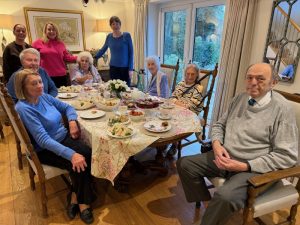
Tea Party for elderly

A charity supporting lonely and isolated older residents in Epsom and Ewell is marking its 60th anniversary.

Re-engage volunteers run monthly free tea parties for people aged 75 and over, alongside a call-befriending service for those who live alone.

“Almost part of my family”

Lesley Renwick, who has led the local group since 2005, said they had supported “hundreds of lonely older people who often don’t see or speak to anyone for long periods”. She added: “Our group is very friendly and they’ve almost become part of my family. It’s lovely seeing the older people enjoy themselves, simply having a chat and a cup of tea.”

Re-engage began in London in 1965 when a young lawyer, Trevor Lyttleton, and friends set out to support isolated older people. Epsom and Ewell was one of the earliest groups to follow. Today the charity has thousands of volunteers running hundreds of tea parties, activity groups and call-befriending sessions for around 6,500 older people nationwide.

‘It was worth the wait’

Phyllis, 91, has been attending the local tea parties since 2011. “I love them,” she said. “The volunteers make you so welcome. We all get to know each other and have a good old chat. I like the companionship. It’s nice to have someone to talk to. I had to wait two years to get into the group because it was so popular but it was well worth the wait.”

Pat, 86, whose husband died 14 years ago, said the gatherings helped lift the quiet moments at home. “There are times when I feel lonely but it helps going to the Re-engage tea parties. I’ve made some friends there and there’s always a lovely spread from the volunteers who are so kind. I get to hear everybody’s news and have a lovely time.”

Calls that make a difference

Jo Kearns, 48, lives in Epsom and volunteers as a Call Companion, making weekly calls to Irene, 79, who lives alone. “She gets very anxious about things. Her friends are dying so she can be a bit isolated but the phone calls seem to help. She’s happier by the time we’ve ended our chat,” she said. “I enjoy the volunteering because I like to help vulnerable people. It must be horrible to be alone and worried so I want to do whatever I can. In fact I’m thinking of taking on another older person after Christmas.”

‘Marvellous job’

Jenny Willott, CEO of Re-engage, said: “Our volunteers in Epsom and Ewell do a marvellous job, making sure some of our most vulnerable older people can find new friends and socialise. The fact they have been doing this for 60 years is astonishing.”

Interested in helping?

Volunteer opportunities supporting older people locally and remotely can be found on the Re-engage website.


Need to sell Council property spelt out for Spelthorne

Spelthorne Borough Council offices in Knowle Green, Staines. Credit: Emily Coady-Stemp

Spelthorne Borough Council has been warned it must sell off its commercial property empire fast or risk losing tens of millions of pounds and plunging even deeper into financial crisis. The financially-stricken authority agreed on November 17 to overhaul the way it repays its £1.1bn debt, adopt a new debt-repayment policy ordered by government commissioners, and start a rapid sell-off of its investment portfolio.

If the council delivers the plan on time, it could strengthen its budget by around £37m over the next decade, thanks largely to a £361m discount for repaying long-term Public Works Loan Board debt early. But the window to the cash in is narrow. Council officers say that slipping just six months behind schedule would slash the benefit to £12m, and a 25 per cent drop in sales prices could wipe out around 60 per cent of expected gains. The message from senior officials was blunt: delays are dangerous.

The warning triggered fierce rows in the chamber. Conservative councillors argued members still lacked key information and should not be rushed into decisions with such huge consequences. Cllr Margaret Attewell said the analysis so far was “all interpretation and it is not right”, calling for more advice before committing to the strategy.

But others insisted hesitation would be reckless. Cllr Howard Williams said rejecting the new repayment policy would be “the most irresponsible thing this council could do”, warning that commissioners could seize control and force a fire sale if Spelthorne failed to act.

Tory members remained unconvinced. “I don’t see how Spelthorne residents are going to be the winner in this,” said Cllr Sinead Mooney. “Why rush this through now?” Cllr Karen Howkins added that councillors had once believed their previous investment decisions were sound and could not be certain history wouldn’t repeat itself.

Behind the political clash lies a collapsing property empire. The council bought £1.077bn of commercial buildings over several years; they’re now valued at just £552m. Selling them is essential to meet government demands, but the council must still prove it is getting “best value” for every disposal.

The financial strain will be felt quickly. The amount Spelthorne must set aside for debt repayments, its Minimum Revenue Provision, will jump to £59m next year before slowly dropping to £9m over the next decade.

With stakes this high, the council plans to hire external property specialists to handle valuations, marketing and negotiations, admitting its in-house team is far too small to manage such a vast sale programme.

What this all means for residents is still unclear, but councillors warned cuts and higher council tax are almost inevitable. “We’ve looked purely at the financial side,” said Cllr Paul Woodward. “We have no idea what impact on our residents this is going to be.”

Emily Dalton LDRS

Image: Spelthorne Borough Council offices in Knowle Green, Staines. Credit: Emily Coady-Stemp

Related reports:

Spelthorne Borough Council commissioners

Who will be saddled with Spelthorne’s and Woking’s £3 billion debts?

Spelthorne in financial trouble


Nescot students’ artwork brightens Ewell East Station

(left to right): Tudor Evans, Ewell East Station Manager; Alistair McGeachey, The Arts Society Epsom Chairman; Nescot Art and Digital Design L3 students, Jess, Emma, Sarah, Cate, and Angie Child, Art@theStation Project Lead.

Artwork by Nescot’s Level 3 Art and Digital Design students is now on display at Ewell East Station as part of Art@theStation, a national initiative bringing young artists’ work into public transport spaces.

Commissioned by The Arts Society Epsom and funded by Govia Thameslink Railway, this is the second collaboration with the college. Their first commission, exhibited in 2024, is still on show at Epsom Station.

“Sense of Place – Ewell”

Students were asked to create portrait-format designs themed around Sense of Place – Ewell, using bold silhouettes and bright colours to reflect local landmarks. Four students – Jess, Emma, Cate and Sarah – were selected for display and each received a certificate and a £25 prize.

Sarah’s design features Bourne Hall Museum. She said working collaboratively “just like in the art industry” had been one of the highlights, adding that the digital skills gained at college had been “invaluable”. Cate’s design, inspired by Bourne Hall Park and the Dog Gate entrance, left her “thrilled” when selected. She said researching the history behind her piece had been fascinating and that seeing her work displayed publicly was “a proud moment”.

Jess and Emma, whose pieces depict well-known Ewell Village landmarks, said the project strengthened their digital design skills and that they enjoyed working as a team.

Building skills and confidence

Tutor Demonstrator Miles Merritt said the project offered “a brilliant opportunity” for students to build confidence and professional experience. He praised the chance for learners to work to a live brief and deadline and to enhance their portfolios ahead of further study.

He added thanks to The Arts Society Epsom for providing a platform to showcase student creativity, saying the college looked forward to future collaborations.

Praise from The Arts Society Epsom

Angie Child, Project Lead for Art@theStation, said she was “delighted” with the students’ graphic designs, noting their use of vibrant colour to bring clarity and impact to familiar Ewell landmarks. She said each student showed a “mature approach to commercial design” and a clear passion for pursuing creative careers. She also commended Miles Merritt for supporting the students throughout the project.

Supporting young artists

Art@theStation is part of a wider national initiative developed by The Arts Society, giving young artists the rare chance to exhibit work in waiting rooms, ticket halls and on platforms across Britain. The scheme aims both to improve the station environment and to give travellers an unexpected cultural experience.

Photo: (left to right): Tudor Evans, Ewell East Station Manager; Alistair McGeachey, Chair of The Arts Society Epsom; Nescot Level 3 students Jess, Emma, Sarah and Cate; and project lead Angie Child.

Sam Jones – Reporter

Related reports:

Ewell’s Nescot student’s work selected for Origins Creatives 2025

Ewell East underpass transformed by new community mural

Young Artists Brighten Up Tattenham Corner Station


QEF to Close After 90 Years as Epsom MP Seeks Answers

QEF street sign. Google street view

The Queen Elizabeth’s Foundation for Disabled People (QEF), the long-established disability charity based in Leatherhead, has announced it will enter administration after a 28-day wind-down period, bringing an end to more than nine decades of specialist support for people with disabilities in Surrey and across the country.

QEF said the decision follows “severe financial challenges” and comes after a year of exploring options to stabilise its position. The charity supports nearly 10,000 people annually through neuro-rehabilitation, mobility services and specialist residential care.

Founded in 1934 with the support of the then-Duchess of York (who became Queen Elizabeth The Queen Mother), QEF has been a significant presence in the local community for generations. Its closure raises immediate questions about the future care of residents and clients who rely on its services, and about the national pressures facing the disability-care sector.

Local Epsom and Ewell MP Helen Maguire said she was “deeply saddened” by the announcement, calling QEF “a cornerstone of our community in Leatherhead” and praising the “wonderful person-centred care” provided by its staff. She said she had seen the charity’s impact first-hand during a visit earlier this year.

According to QEF’s own statements, the organisation has faced rising staffing costs, recruitment pressures, and funding constraints from statutory bodies. The charity reported that despite efforts to improve its financial position, “there wasn’t a viable solution” to meet the scale of the challenge.

Mrs Maguire said she has been in “regular conversation” with QEF leadership in recent days to see whether a last-minute solution was possible. “It was conveyed to me that, sadly, the shutdown process is already fully in motion,” she said. She confirmed she has written to the Health Secretary, Wes Streeting, seeking an urgent meeting to discuss the circumstances of the closure and the wider lessons for the sector.

Her immediate focus, she said, is “ensuring continuity of care for both patients and staff”. QEF has said the 28-day wind-down period is intended to give time for residential clients to be found suitable alternative placements.

The charity’s closure will leave a notable gap in specialist provision in the region. QEF employed around 250 people and operated from modern facilities in Leatherhead after a major redevelopment earlier in the decade. Its departure will add pressure to already stretched NHS and social care services that rely on external specialist providers.

Sam Jones – Reporter

Image: QEF street sign. Google street view


Epsom and Ewell Climate Action Network launches with community events and initiatives

EECan team by stall

A new community movement is taking shape in the borough with the launch of the Epsom and Ewell Climate Action Network (eeCAN) – a local volunteer group working to empower residents through inclusive projects that build resilience to climate change.

EECAN’s mission is simple but ambitious: to help communities adapt and thrive in a changing world. Its projects focus on practical solutions, awareness-raising, and supporting climate-friendly policies. Everything the network offers at the moment is totally free and open to all, ensuring that everyone can take part in building a more sustainable, climate-resilient Epsom and Ewell. Users of the services will be given the opportunity to make any donations they feel they can afford if they want to help the charity do even more for their community.

 “Epsom and Ewell Climate Action Network has grown so much in the last 12 months as a result of the energy and commitment of volunteers wanting to help their  local communities reduce Climate risks while saving money” says William Ward the Chair and co-founder of the group.

Epsom and Ewell Library of Things

Launching to the public in spring next year, this innovative “Library of Things” will allow residents to borrow items instead of buying them, reducing waste and promoting sharing. From carpet cleaners and wallpaper steamers to pressure washers and gazebos, residents will be able to borrow tools and equipment for free, thanks to donated items. Donations of nearly new equipment are now being sought. Those able to help are asked to contact eeClimateActionNetwork@gmail.com or visit https://eecanlibraryofthings.myturn.com/library.

eeCAN is developing this initiative in partnership with Surrey County Council Library Services (for front of counter service) and with Epsom & Ewell Borough Council, in association with The Epsom Repair Café, who ensure that all electrical items are safe to use.

Bike Amnesty – Saturday 22 November 2025

Got a bike you no longer use? Donate it! Between 9am and 5pm at Epsom Methodist Church, Scout Hall, Ashley Road KT18 5AQ, residents can drop off unwanted bicycles to be refurbished and passed on to people who need them.

The scheme helps promote active, low-carbon travel while supporting those who might not otherwise afford a bike. Just turn up with your spare bikes. This free service is provided in partnership with Surrey County Council’s “Active Surrey” team.

Contact: eeClimateActionNetwork@gmail.com

Climate Conversations – every 2nd and 4th Monday of the month

eeCAN also runs regular Climate Conversations at Birchgrove Lower Mill, Kingston Road, Ewell KT17 2DQ, from 10:30am to 12:30pm. These informal gatherings give residents a friendly space to learn, share experiences, and explore all aspects of climate change together.

One participant said, “I often feel so motivated after one of our meetings!”

The upcoming session on Monday 24 November will feature Dr Kristine Damberg, online presenting “What can we eat for human and planetary health”, a talk exploring how our food choices affect both personal wellbeing and the planet.

Anyone can join in using this link: https://meet2.organise.earth/rooms/95o-iug-ems-2p6/join

Living Rivers Exhibition – April to May 2026

Looking ahead, eeCAN will host a Living Rivers Art Exhibition at the Ebbisham Centre, Epsom KT19, in association with The Royal Marsden. Running from 22 April (Earth Day) to 22 May 2026, the free exhibition will celebrate the beauty and importance of rivers and waterways.

Inspired by writer Robert Macfarlane’s question “Is a river alive?”, the exhibition will showcase artwork from local schools, community groups, and individuals.

Submissions (A4 max-sized drawings or paintings) are invited by 27 March 2026, with eeCAN volunteers offering to collect (and return) artworks directly from schools and art groups. Groups will be invited to see their work on display and participate in nature-themed activities.

Email eeClimateActionNetwork@gmail.com for participation details.

A community coming together

From swapping tools and donating bikes to sharing climate ideas and artistic expression, eeCAN’s initiatives reflect a spirit of cooperation, creativity, and care for the environment.

Its organisers believe that by taking small, collective steps, Epsom and Ewell can make a big difference — helping local people live more sustainably while building resilience for the future.

For more information, contact eeClimateActionNetwork@gmail.com or follow eeCAN’s activities through their upcoming community channels.

Sam Jones – Reporter


Late flash of composure seals Epsom & Ewell’s away win

Epsom and Ewell FC players celebrate an away win

Sheerwater 3 – 4 Epsom and Ewell FC. Sunday 16th November – Combined Counties Premier League.

Epsom & Ewell finally claimed their first league away win of the season with a breathless 4–3 victory at Sheerwater, a contest that careened from controlled dominance to near-implosion and back again in a frantic final act.

Managerial tweaks paid early dividends as goalkeeper Sami Nabbad returned between the sticks, new signing Tyler Robinson led the line, and midfielders Shane Dunne & Brendan Murphy-McVey rejoined a refreshed starting XI. The Salts looked sharper, hungrier, and far more incisive than their recent travels had suggested.

They needed just six minutes to announce themselves. Robinson slipped a clever ball into Jason Bloor, whose effort was parried by Sheerwater keeper Antonios Nazareth. Tom Collins, alive to the rebound, arrived to head home from close range. It was a dream start for a side still searching for their first points on the road.

Brendan Murphy-McVey’s early pressure forced chances, and Robinson’s industry kept Sheerwater penned in, though the striker was shown a yellow card on 26 minutes for a late challenge on the keeper. Collins and Ali Fofahan both went close as Epsom continued to dictate, but Sheerwater finally stirred on 34 minutes when Rahman Ajibola broke free only to drag his shot wide.

Epsom doubled their lead on 40 minutes through a moment laced with both craft and confusion. Robinson earned a corner on the left edge of the penalty area, and Collins swung the set-piece directly towards the top corner. Nazareth rose to meet it along with defender Stefan Aiwone, but the ball appeared to curl straight in, possibly helped on its way by the goalkeeper. However it crossed the line, Epsom’s lead was thoroughly deserved.

A late scrambled scare in their own box and a booking for Connor McShane closed out the half, prompting the introduction of Ethan Brazier after the interval to guard against a second yellow.

But the restart brought chaos.

On 50 minutes, Nazareth conceded a needless free-kick on the left, and Sheerwater seized their lifeline. The delivery was artfully clipped into the centre, where Elliott York steered home a deft header past Nabbad to make it 2–1. 

Three minutes later, Nazareth ventured out on one of his trademark mazy runs, lost possession, and from the resulting attack Harvey Valter levelled the match. A two-goal cushion was gone in a blink.

Tensions spiked on 56 minutes when Collins was pulled back unnoticed by the referee, prompting a tangle with Aiden Larkin. Both saw yellow once tempers cooled and the handbags had been packed away. 

Further substitutions followed as Epsom sought to restore control.

The moment came on 65 minutes. Fofahan teed up Murphy-McVey 25 yards out, and the midfielder unleashed a looping strike that sailed over the Sheerwater keeper and into the net to restore Epsom’s advantage.

There were more changes on 78 minutes and a nervous moment on 83 when Callum O’Keefe was booked for a foul that may well have been triggered by Jason Vincent’s involvement—a potential second yellow avoided.

But Sheerwater refused to yield. On 85 minutes, with Epsom’s centre-halves caught in two minds by the charging Nabbad who was beaten by a deft lob from George Mackie from the through ball. At 3–3, The Salts’ season-long away frustrations threatened to resurface.

Yet there was one final twist.

Two minutes later, Andrew Herring threaded a ball forward that pinballed off bodies and broke fortuitously to O’Keefe, alone on the penalty spot and just kept onside by a retreating defender. With Sheerwater appealing for a flag that never came, he rounded the keeper and slotted into the empty net. Calmness personified, and a decisive blow.

After a frenetic, pulsating contest, Epsom & Ewell emerged with a hard-fought and fully deserved first away win of the campaign—one built on early dominance, character in adversity, and a late flash of composure when it mattered most.

FT: Sheerwater 3 – 4 Epsom & Ewell

Epsom and Ewell FC Media


Epsom and Ewell Borough Council to stay put awaiting its demise

Old Town Hall and 70 East Street for sale.

Epsom and Ewell Borough Council’s Strategy and Resources Committee has formally abandoned the plan to relocate the Town Hall to East Street, voting on 11 November to remain in the existing building until Local Government Reorganisation in 2027. The meeting also agreed to recommend a 3% staff pay award for 2026/27 and to support adoption of the Real Living Wage.

The decisions reverse the direction taken in earlier years which saw the Council identify 70 East Street as the future civic office site, a plan covered previously by the Epsom and Ewell Times. The East Street building will now instead be declared surplus and placed on the market.

Town Hall stays put

Members unanimously approved Option 1, an approach which keeps both the New and Old Town Hall buildings in use with only legally-required and essential health and safety works carried out. Officers advised that the council must now implement recommendations from the building’s fire risk assessment, previously deferred when a move to East Street was expected.

The work will cost £431,000, with a total capital provision of up to £517,200 once contingency is included. A further deferred-liabilities fund could be needed if ageing equipment fails during the next two to three years.

With Local Government Reorganisation due by April 2027, the report said investing more heavily in a short-term location would offer poor value. Options involving the Old Town Hall’s closure or bringing the decommissioned second floor of the New Town Hall back into service were judged significantly more expensive.

Sale of 70 East Street

Under a later agenda item, the Committee agreed that 70 East Street should be declared surplus to operational requirements and prepared for sale with a budget of up to £10,000 for marketing and upfront costs.

This effectively ends the former civic office relocation project. Surrey County Council’s departure from the second floor of the New Town Hall, the worsening condition of parts of the estate, and the uncertainties of a possible unitary-authority future all contributed to the reassessment.

Staff pay award: 3% recommended

The Committee unanimously backed recommending a 3% pay increase for 2026/27, alongside granting all staff an extra day of annual leave. Officers reminded councillors that the September CPI stood at 3.8% and that around 18% of staff at the top of their pay scales would not receive incremental rises.

Members also supported adopting the Real Living Wage from April 2026. The financial impact, estimated between £35,000 and £68,000 depending on next year’s National Living Wage, will be built into the Council’s Medium Term Financial Strategy.

Coley raises concerns over transparency and financial risk

During the public session, Cllr Alex Coley (Independent Ruxley) spoke to highlight his continuing concerns about the handling of major financial decisions, particularly those arising from Local Government Reorganisation. He noted that asset-transfer discussions risked obliging future parish-level bodies to take responsibility for community facilities without councillors being given the information they needed about long-term maintenance liabilities.

He told the Committee he had attempted several times to obtain estimated maintenance costs and values for potential transfer assets and warned of “blank cheques with unknown risks and liabilities” that could fall on residents through an uncapped parish precept.

Cllr Coley thanked the Section 151 Officer for constructive engagement on reserve reviews but cautioned colleagues not to proceed with decisions without full supporting data.

His remarks contributed to a wider discussion later in the meeting, after the press and public were excluded, on the Council’s strategic priorities and preparation for possible reorganisation.

Funding pressures still ahead

Officers confirmed that the 3% pay award would increase the projected 2026/27 budget deficit to around £2 million, with work continuing to close the gap before the February Full Council budget.

Councillors approved all recommendations put before them on the evening.

Sam Jones – Reporter

Related reports

Epsom and Ewell Council goes East

A new Town Hall for Epsom and Ewell?


Epsom and Ewell Council transparency disputes revisited

Audit and Scrutiny Committee get ready for the meeting. Epsom and Ewell Borough Council YouTube.

The Audit and Scrutiny Committee of Epsom and Ewell Borough Council met on 13th November, with long-running disputes about transparency once again overshadowing its agenda. Questions from the public and exchanges between councillors highlighted continuing disagreements over how openly the Council has handled its governance issues and its dealings with external auditors.

Public challenge over unrecorded meetings with auditors

Resident Previn Jagutpal opened the meeting by questioning the Council’s claim to have established “a very open dialogue” with its external auditors, Grant Thornton. He noted that a Freedom of Information response confirmed that no minutes were taken of the Chief Executive’s first meeting with the auditors. He suggested that unrecorded, closed-door discussions were difficult to square with recent criticisms of the Council’s transparency.

Committee Chair Cllr Steven McCormick (RA Woodcote and Langley) replied that not all internal meetings were minuted and that the quality of discussions with auditors did not depend on the existence of formal notes. He maintained that the sessions were appropriate and did not represent secrecy.

Jagutpal pressed further, but the Chair repeated that such meetings were professional exchanges and were not inconsistent with openness.

“Culture of secrecy” dispute resurfaces

Jagutpal’s second question revisited an earlier controversy over whether the Local Government Association peer review team had used the phrase “culture of secrecy” when assessing the Council’s decision-making. In September, Chief Executive Jackie King told the Committee she had an email from the peer-review lead saying they did not recall using that wording.

Jagutpal said that a fuller email chain disclosed under FOI showed that the LGA lead was “not present at every discussion”, leaving open whether the phrase had surfaced elsewhere. He accused the Council of selectively presenting the peer review comments. Cllr McCormick rejected any suggestion of misrepresentation and said the full email would be circulated to members and attached to the minutes of the meeting.

Clash over what may be discussed in public

Labour councillor Chris Ames (Court) then raised a formal point of order. He said councillors had been told they could not discuss certain matters in public that related to the 2023 changes to the Scheme of Delegation — the very subject that led auditors to conclude there was a “significant weakness” in governance. He argued that restricting discussion created the impression that matters were being “stitched up behind the scenes”.

The Chair and the Monitoring Officer both insisted that exempt-information rules applied and that certain details could only be taken in a private session. Ames protested that this prevented transparent scrutiny, but the Chair declined to widen public discussion further.

Disputed minutes and calls for further scrutiny

During approval of the September minutes, councillors and officers agreed to make a minor correction to a sentence summarising the Chief Executive’s comments. The amendment was adopted without dissent.

The meeting’s most heated exchange followed when Ames asked the Committee to add a future agenda item examining why the external auditors had not been informed earlier about changes to the Scheme of Delegation. Cllr McCormick initially resisted, saying the matter had already been covered by previous meetings.

Ames said that earlier discussions had been “stage-managed” and that the Committee had not been allowed to probe key issues. Liberal Democrat councillor James Lawrence (College) supported bringing the item back, saying members simply wanted clarity on when and how auditors were informed.

After a prolonged exchange, the Chair agreed that the subject could be added to a future agenda. Officers, not councillors, will prepare a report to support that discussion.

Wider business proceeds quietly

Following these debates, the Committee turned to counter-fraud matters, financial monitoring, and internal-audit progress reports. These items attracted few comments and passed without controversy — in contrast to the extended disputes over transparency that continue to dominate the Committee’s work.

Transparency remains the unresolved issue

Once again, the meeting demonstrated that the central challenge facing the Council is not simply the content of audit recommendations, but the competing interpretations of what “transparency” requires in practice. With further reports now expected, the question of how openly Epsom and Ewell Borough Council takes and explains its decisions seems set to return to the Committee table in the months ahead.

Sam Jones – Reporter

Related reports:

Epsom and Ewell Council CEO contests ‘culture of secrecy’ claim and outlines fixes

RA councillor replaces Independent member as scrutiny row erupts at Epsom Town Hall

“Audit and Scrutiny” under scrutiny

Image: Audit and Scrutiny Committee get ready for the meeting. Epsom and Ewell Borough Council YouTube.


How the Council’s transparency dispute unfolded

The debate over transparency at Epsom and Ewell Borough Council has stretched across several meetings of the Audit and Scrutiny Committee. What follows is a clear timeline of how concerns first surfaced, how councillors reacted, and how the Council’s leadership has responded.

March 2024 – Peer review flags concerns

An LGA Peer Review identifies weaknesses in decision-making processes, warning of confusion among councillors and raising concerns about the Council’s use of confidential sessions. It calls for clearer, more transparent explanations of how decisions are made under the committee system.

February 2025 – External auditors find a “significant weakness”

Grant Thornton reports a “significant weakness” in the Council’s governance arrangements, citing both the peer review and the lack of transparency over 2023 changes to the constitution and Scheme of Delegation. The Council disputes the auditors’ interpretation, arguing that it is already operating transparently.

March 2025 – Committee requests Chief Executive attendance

Audit and Scrutiny calls for Chief Executive Jackie King to attend its July meeting to explain management responses to the auditors’ findings. Concerns centre on whether officers properly informed auditors about the delegation changes.

May 2025 – Governance statement controversy

A draft Annual Governance Statement presented to the committee is criticised for downplaying the auditors’ “significant weakness” finding. Members send it back for redrafting, saying it fails to give an honest account of the issues raised.

17 July 2025 – CEO absence sparks anger

At the July meeting, members express frustration that the Chief Executive is absent despite earlier requests. Labour councillor Chris Ames repeatedly raises objections, accusing the Council of stalling accountability. The Chair says the CEO will instead attend the September meeting.

30 September 2025 – CEO gives evidence and defends actions

Chief Executive Jackie King attends and answers questions for the first time. She denies that the peer review described the Council as having a “culture of secrecy”, saying the LGA peer-review lead did not recall using the phrase. She outlines changes to reporting practices, including splitting public and confidential papers and providing plain-English explanations for exemptions.

Councillors, including Liberal Democrat James Lawrence, challenge the Council’s transparency record, citing confusing urgent-decision processes, late information at the May AGM, and the need for clearer oversight of how auditors are kept informed.

The Committee receives the officers’ report but signals that further scrutiny will be needed.

Early November 2025 – FOI reveals fuller peer-review email chain

A resident obtains an email chain via Freedom of Information showing that the LGA lead was “not present at every discussion” during the peer review, raising questions about whether the term “culture of secrecy” may have arisen elsewhere. This adds fuel to concerns about whether the Council has selectively interpreted criticism.

13 November 2025 – Transparency dispute dominates meeting

Two public questions challenge the lack of minutes for meetings between the CEO and auditors and question whether the Council has “fileted” peer-review comments. The Chair defends the Chief Executive’s position, saying not all professional meetings require minutes, and promises to append the full email to the minutes of the meeting.

A tense exchange follows when Cllr Chris Ames raises a point of order, arguing councillors are being prevented from openly discussing matters central to the auditors’ “significant weakness” finding. The Chair and Monitoring Officer insist some discussions must remain exempt.

Ames calls for a future agenda item explaining when and how auditors were told about the delegation changes. With support from Cllr James Lawrence, the Chair eventually agrees that officers will prepare a report for future consideration.

Routine business proceeds quietly, but the transparency issue clearly remains unresolved.

Looking ahead

With further reports pending and the Committee determined to revisit key questions, the transparency debate shows no sign of easing. How openly Epsom and Ewell Borough Council explains its actions, documents its decisions, and engages with auditors is likely to remain at the heart of future Audit and Scrutiny meetings.


Epsom and Ewell housing targets in the crosshairs

New houses in green field under the cross hairs

The borough of Epsom and Ewell is currently engaged in a critical juncture of its planning future. The Council’s Regulation 19 draft Local Plan is under examination by the Planning Inspector, and at the same time the Government’s own statisticians, the Office for National Statistics (ONS), have published their new household projections. The juxtaposition of these two sets of figures highlights a growing tension between demographic trends, the Government’s national housing policy tool (the “standard method”), and local deliverability constraints.

Household growth projected by ONS

According to the ONS’s “2022-based” household projections for local authority areas, the number of households in Epsom & Ewell is forecast to rise from approximately 31,299 in 2022 to 35,493 in 2042 — an increase of about 4,194 households over 20 years, which corresponds to roughly 209 additional households per year.

It is important to emphasise that these are demographic projections (households forming under assumed migration, fertility, mortality etc). They do not translate directly into the number of homes that must be built: they make no allowance for planning constraints, land supply, local infrastructure, or policy decisions.

What the draft Local Plan proposes

The draft Local Plan for EEBC, covering the period 2022-2040, sets out the following key housing supply/requirement numbers:

  • A minimum housing requirement of 4,700 dwellings over the Plan period, which equates to approximately 261 dwellings per year.
  • An identified supply to deliver around 4,900-4,914 dwellings, providing a modest buffer above the minimum requirement.
    These numbers reflect the Council’s assessment of what is realistically deliverable given local constraints (Green Belt, flood risk, infrastructure, viability etc).
The “standard method” for housing need

Under national planning policy (the National Planning Policy Framework or NPPF) the “standard method” is the Government’s default tool for calculating housing need in local authorities. This is not a requirement automatically to be delivered by local authorities, but sets a starting point that local plans should address.
In the case of EEBC:

  • In the Plan examination evidence the Council cites a standard method calculation of 10,242 dwellings over the plan period, which equates to about 569 dwellings per year — a figure more than double the Plan’s proposed annual rate.
  • Separately, analysts have calculated that under the more recent stock-based standard method (introduced in late 2024) which uplifts areas with higher affordability pressures, EEBC’s implied requirement would be around 871 dwellings per year, i.e. nearly 900 homes a year.
Why the “affordability uplift” matters

A key message that has emerged from CPRE Surrey and elected members is that the new standard method gives very heavy weight to the “affordability uplift” — the ratio of house prices to local earnings — and that this seriously disadvantages boroughs such as Epsom & Ewell.

As Tim Murphy (CPRE Surrey) put it: “The latest numbers from the Government’s own statisticians show that the housing target set by the Government for Epsom and Ewell is totally unrealistic. The target would mean that, over the next twenty years, the Borough would lose much of its existing open space – the character of the area would be changed for the worse for ever.”

Specifically:

  • The standard method compares local house prices with local earnings. In Epsom & Ewell many resident households earn London or Canary Wharf salaries (commuting to central London) which inflate local house prices but are not captured in the earnings base used for the formula.
  • There is no adjustment (in the national method) for such commuting-induced distortion of house prices. The result: the formula treats Epsom & Ewell as a high affordability-pressure area and drives a very large uplift in the ‘need’ figure.
    In short: the standard method may be overstating “need” in places where price inflation is driven by non-local earnings rather than purely local demand or local pay.
Contrasting the figures: ONS vs Local Plan vs Standard Method

Here are the headline comparisons:

  • ONS household formation projection: ~209 new households per year (2022–2042)
  • EEBC draft Local Plan requirement: ~261 homes per year (2022–2040)
  • Standard method (2023 NPPF basis): ~569 homes per year (10,242 over the period)
  • Updated stock-based standard method (2024 NPPF basis): ~871 homes per year (analyst estimate)

What this shows:

  • The Local Plan’s 261 homes per year is above the demographic projection of ~209 households per year, thus it can be argued that the Plan is planning for growth above simple demographic trend.
  • However, it remains far below the standard method starting points (569 or 871 per annum) — representing a significant gap between what the national policy tool implies and the local Plan provides.
  • The gap calls into question how far the Borough should be expected to “deliver” the full standard-method figure given local constraints, and whether a higher rate is justified (or deliverable) in practice.
Additional context from councillors

Councillor Kate Chinn (Labour Court) notes that: “Epsom and Ewell has a huge housing crisis now and can’t provide suitable homes for its current residents so the borough needs to build more than just enough to keep up with household growth. There are people in serious need of rehousing who are waiting years … the Residents Association … needs to stop looking for reasons to block new housing and start working with developers to build decent homes for residents.”

This underlines that local housing need is not only about future households but existing unmet need: social housing shortages, long waiting lists, temporary accommodation of poor quality, and the knock-on effects on children’s life chances, health, education and emotional well-being.

Councillor James Lawrence (LibDem College) adds further policy context, reminding us that the draft Local Plan is being prepared under the December 2023 NPPF (which uses the earlier standard method approach). He points out that the updated 2024 NPPF uses the stock-based standard method, raising further questions of whether the Plan needs to be reassessed in light of the new method. He also highlights the circularity argument: using future population projections to determine how many homes to build, when building more homes will itself change future population.

Councillor Peter O’Donovan (RA Ewell Court), Chair of Epsom and Ewell Borough Council’s Licensing Policy and PLanning Committee responded: “The Councils Local Plan was submitted to government in March 2025 and is now being examined by a government appointed Planning Inspector, this is known as the examination stage. The revised ONS household projections data do not impact the examination of the Local Plan. Keep up to date with the Local Plan Examination here: Local Plan Examination | Epsom and Ewell Borough Council”

Implications for Epsom & Ewell

The mismatch between demographic projections on the one hand and national policy-based housing “need” on the other has several implications:

  • Deliverability and infrastructure: The higher standard method numbers assume a very much higher rate of building than the Borough has historically achieved. If such rates were imposed, the supply of suitable land, infrastructure capacity (transport, schools, services), viability of development and environmental constraints (Green Belt, flood zones) would all come under significant pressure.
  • Green space and character: As Tim Murphy rightly flags, if nearly nine hundred homes per year were required over twenty years, the borough’s character, open spaces, suburban nature and amenity would face significant change. For many local residents preservation of character is a live concern.
  • Affordability link and commuting distortion: The standard method’s reliance on local earnings means that boroughs like Epsom & Ewell (with many commuters earning London wages) may be unfairly treated. The commuting effect inflates prices but is not compensated by the earnings measure. The formula may therefore over-inflate “need” in such areas.
  • Focus on genuine need: The local context shows that, beyond future household growth, there is an existing backlog of need (e.g., social housing, temporary accommodation, unsuitable homes). If the borough simply aimed to match new household formation it might still fail to meet the existing need. Councillors emphasise that making provision for those already housed in inadequate conditions must be part of the strategy.
  • Policy and timing: The draft Local Plan uses the earlier standard method (2023 NPPF) calculations; the switched methodology in the 2024 NPPF potentially changes the baseline “need” significantly. This raises questions as to whether the Plan remains future-proof and whether the examination will ask for an updated technical basis.

For the readership of the Epsom & Ewell Times and stakeholders across the local community, the following points merit emphasis:

  • Clarify that the ONS figure (~209 homes per year) shows what is likely in demographic terms, but that housing targets set by policy may differ significantly.
  • Highlight the role of the affordability uplift and how the standard method treats areas like Epsom & Ewell (with commuting wage influences) differently from truly local‐wage areas.
  • Encourage the Council and stakeholders to scrutinise whether the standard method’s assumptions are appropriate in the local context and whether the draft Plan provides sufficient evidence to justify deviation from higher figures.
  • Promote transparency on how the Plan addresses existing housing deprivation, not just future household formation: how many social or affordable homes, how many temporary accommodation units, how many conversions of unsuitable homes, etc.
  • Ask whether the local infrastructure, land supply and environmental constraints realistically allow delivery of very high build rates, and whether the Plan sufficiently tests viability at the higher levels implied by the standard method.
  • Encourage local residents to comment on the Plan and its housing provision strategy, especially in light of the gap between national “need” figures and local deliverability.
  • Recommend that the Council monitors any changes in Government policy or standard method revisions (e.g., if further changes to the affordability uplift or commuting adjustments are introduced) and updates the Plan accordingly.

Epsom & Ewell’s draft Local Plan appears modest but credible when viewed against demographic household growth alone. However, it falls far short of the housing “need” implied by the Government’s standard method calculations. The prominence of the affordability uplift in that method raises particular concerns for commuter-belt boroughs such as this, where local earnings do not fully capture the incomes of many resident households. The key challenge for the borough is to strike a balance between realistic deliverability, protection of local character and amenity, and the clear social housing need that exists today. The examination process offers an opportunity to test whether the Plan is positively prepared, justified and effective — but it will also require robust scrutiny of whether national formulae appropriately reflect local circumstances.

Sam Jones – Reporter

Related reports:

Stage 2 Examination of Epsom & Ewell’s Local Plan opens Tuesday

Epsom & Ewell’s Local Plan under the Green microscope

The Local Plan plot thickens after revised NPPF

….. and many more. Search “local plan”.


Live facial recognition policing comes to Surrey

A live facial recognition van. Sussex Police.

Surrey Police have begun using live facial recognition (LFR) technology after securing two mobile LFR vans in a joint bid with Sussex Police. The first deployment took place this week in Redhill following months of planning.

The vans use real-time facial recognition to compare faces captured on live camera feeds with a pre-determined police watchlist. Surrey Police say this list will include wanted persons such as sex offenders and perpetrators of domestic abuse. According to the force, images of everyone else are “instantly and permanently deleted”, and images of those on the watchlist are deleted within 24 hours.

Police acknowledge the historical concerns about gender and ethnic bias in commercial facial recognition systems but state that the national algorithm they will use “shows no statistical bias” and has been tested by the National Physical Laboratory. Officers will receive briefings on potential disparities relating to race, age and gender, and any computer-generated match will be checked by an officer before action is taken.

The force says deployments will only be authorised by a Superintendent and carried out “in a proportionate manner”, with clear signage on the vans and advance publication of deployment locations. The vans are funded by the Home Office for five years and may be made available to other forces for mutual aid.

Chief Inspector Andy Hill, Surrey Police’s lead for LFR, said the technology is “a vital tool to help us to investigate crime thoroughly and relentlessly pursue criminals”. He added that the rollout had been “meticulously planned” to ensure appropriate and transparent use. Police and Crime Commissioner Lisa Townsend described the vans as an important means of identifying violent criminals and sex offenders.

If the LFR vans come to Epsom and Ewell, Surrey Police say residents will be notified before deployments and that the vans will be signposted when in use.

National picture

The deployment in Surrey comes as the use of facial recognition technology accelerates across UK policing. Forces in England and Wales have increasingly turned to mobile LFR units, with millions of people scanned nationally each year and several hundred arrests made as a result. London’s Metropolitan Police and South Wales Police are among the heaviest users, reporting arrests of wanted individuals including violent offenders and registered sex offenders.

While these figures suggest a measurable benefit, LFR still represents a small proportion of overall policing activity, and questions remain about its accuracy, its effect on minority groups and the proportionality of scanning large numbers of passers-by for relatively small numbers of matches.

ICO guidance and safeguards

The Information Commissioner’s Office (ICO) has issued detailed guidance stating that facial recognition used by police must comply with strict requirements of data protection law. Forces must demonstrate that each deployment is lawful, fair, transparent and based on necessity and proportionality. Data Protection Impact Assessments are required, and forces must show clear justification for the locations chosen, the purpose of the watchlist, and the retention policy for images. The ICO stresses that facial recognition “does not operate in a legal vacuum” and will continue auditing police use.

Advance signage and practical concerns

One issue not fully addressed in the Surrey Police statement is how advance signage will work with mobile vans. In practice, UK police forces usually publish the location of an LFR deployment only shortly before the van becomes operational. Because the vans can be moved rapidly as part of an operation, advance publication generally refers to the place where the van parks, not its movements throughout the day. Some forces update information if the van relocates, though not always in real time.

Another question is whether advance notice undermines the policing purpose by alerting wanted suspects. Civil liberties groups argue it does, but police note that most arrests via LFR occur even when deployments are announced. Many wanted individuals do not monitor police websites, and the requirement for transparency stems from data protection law rather than operational convenience. The ICO has made clear that secrecy around deployments would be unlikely to meet legal standards of fairness.

Local implications

For residents, the potential arrival of LFR vans in Epsom and Ewell would bring a technology that is increasingly common across the UK. Surrey Police emphasise that law-abiding members of the public have “nothing to fear” and that images of those not on a watchlist are immediately deleted. However, questions remain about how watchlists are created, how effectiveness will be measured and whether Surrey Police will publish statistics on matches, false matches and resulting arrests.

As mobile facial recognition becomes a more familiar part of policing nationwide, the way Surrey Police implement and report on these deployments will be key to maintaining public confidence while pursuing the serious offenders the technology is designed to identify.

Sam Jones – Reporter

Photo: A live facial recognition van. Courtesy – Sussex Police.