Epsom and Ewell Times
19th November 2026

ISSN, LDRS and IMPRESS logos

Dorking’s wartime refugee committee records go online for the first time

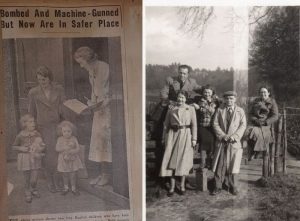
Compilation of exhibits in refugee exhibition.

Rich historical records of how the small town of Dorking sheltered people fleeing Nazi persecution during World War Two are now fully searchable and publicly accessible online, thanks to a partnership between the University of Surrey and Dorking Museum.  

Formally launched today (24 September), dorkingrefugeearchive.org digitises the papers of the Dorking and District Refugee Committee – a group of volunteers who were able to find housing, work and medical care for refugees arriving in the Surrey town between 1938 and 1949. Until now, the records, which are frequently requested by researchers, have only existed in paper form at the Dorking Museum. 

The website organises the committee’s work into five themes – solidarity, caring for refugees, children, the post-war years and the people involved.  

In collaboration with the history department at Dorking’s Ashcombe School, the project has also produced teaching resources, which are freely available to other schools, researchers and community groups.  

Professor Constance Bantman, co-project lead and Head of Literature and Languages at the University of Surrey, said:  

“Making this archive accessible means the stories held in these records, of both the refugees and the people of Dorking who supported them, can finally reach the audience they deserve. It is a resource for researchers, but just as importantly, it’s a resource for the town itself.” 

Surrey first announced the project in May 2026, sharing individual stories held within the collection, including that of Sir Erich Reich, who arrived in Britain on a Kindertransport in 1939. Ralph Vaughan Williams (the composer) personally brought the four-year-old to safety in Dorking. 

Dr Beth Palmer, co-project lead from the University of Surrey, said: 

“These remarkable papers hold enormous detail, individual cases, letters, decisions that changed lives. Dorking’s history as a place of welcome and support is genuinely remarkable, and until now, only a small number of people knew about it. Putting the archive online, alongside resources for schools, means this chapter of Surrey’s history can be taught, studied and understood well beyond the archive’s four walls.” 

Kathy Atherton, Chairman of the Dorking Museum, said: 

“The Refugee Committee papers are among the archive’s most frequently requested resources. Digitisation not only opens them up to a far wider audience but also protects the physical fabric of the collection from over-handling by researchers.” 

Surrey University

Related reports


Epsom and Ewell’s New Local Plan sites advance amid clash over scrutiny and cost

Town Hall and Local Plan

Epsom and Ewell’s Local Plan moved closer to public consultation on Tuesday 22 September, but cllrs clashed over proposed Green Belt development, decisions taken without committee debate and a government requirement to begin another plan before the borough council is abolished.

The Licensing and Planning Policy Committee voted six to three to recommend that Full Council approve a consultation lasting at least six weeks on modifications proposed by the Planning Inspector. Full Council has yet to make that decision; the council expects it to meet next month.

The modifications include 12 additional urban sites and four additional Green Belt sites. Proposals for the latter include at least 530 homes at Downs Farm and 275 at Priest Hill. Planning officers said land south of College Road at Downs Farm would remain in the Green Belt for open space, routes and playing pitches. They said the Sutton and Epsom Rugby Football Club playing fields were outside the proposed Priest Hill allocation.

Who chose the additional sites?

Head of Planning Policy and Economic Development Ian Mawer told the committee that many changes to the plan’s policies arose from examination hearings. Following a further hearing in July, he said, the Inspector’s programme officer asked the council to draft modifications for 12 urban sites and subsequently confirmed which Green Belt sites to include.

“The main modifications are those that the inspector considers are necessary to make the plan sound,” Mr Mawer said. “They must be consulted on as they are presented.”

Cllr Christine Howells (Independent Nonsuch) challenged the absence of a further decision by elected members on the sites. “At no time did elected councillors agree to these material changes, both to the evidence base and the proposals for the local plan,” she told the committee.

Cllr Bernie Muir (Conservative Horton) raised concerns about flooding assessments, school capacity and traffic. Cllr Steven McCormick (Conservative Woodcote and Langley Vale) criticised the opportunity members had been given to scrutinise the changes, calling them “an unprecedented sacrifice of our green belt”.

The dispute concerned both the proposed development and the process that brought it before the committee. Officers said the Inspector had requested the draft modifications as part of the examination. Members were told they could recommend whether the modifications went out to consultation, but could not rewrite the Inspector’s proposals beforehand.

The committee voted seven to two to note the modifications and six to three to recommend consultation. It then voted five to four on each of two delegations: allowing Mr Mawer, in consultation with the committee chair, to make further amendments required by the Inspector after consultation and to update the Local Plan timetable.

The Inspector will consider responses before issuing a final report. If the plan is found sound, Full Council will still have to decide whether to adopt it.

No affordable homes completed in 2025–26

The committee also agreed, by eight votes to one, to publish its Authority Monitoring Report. It records 37 homes completed in the borough during 2025–26, none of them affordable. The council cannot demonstrate a five-year supply of housing land.

Cllr McCormick described the report as “an annual health check on our borough’s planning performance” that showed a serious shortfall. Cllr Julian Freeman (LibDem College) focused on younger residents priced out of housing. “My own children can’t even imagine owning their own home,” he said.

Cllr Neil Dallen (RA Town) agreed that delivery was a problem but said the council could not force developers to build homes for which they had permission. Mr Mawer also pointed to building costs, market conditions and the limited number of large sites ready for development.

Urgent decisions challenged

Earlier in the meeting, members examined EEBC’s responses to Local Plan consultations by neighbouring Tandridge and Kingston. Both had already been submitted using urgent decision procedures. The committee was asked to note them afterwards and did so in each case by five votes to three, with one abstention.

Cllr McCormick called the Tandridge decision a “fait accompli”. He said its consultation had been open for weeks and asked why members had not been convened to consider a response. Cllr Kieran Persand (Conservative Horton) repeatedly questioned why a special committee meeting had not been arranged.

Committee chair Cllr Peter O’Donovan (RA Ewell Court) said he had been advised that the response needed to be submitted and had agreed to it. Asked why a meeting had not been called, he said: “Can’t give you an answer this evening.” He undertook to seek an explanation.

Cllr Phil Neale (RA Cuddington) acknowledged the frustration but argued that the summer holiday period and the unusual pressure created by reorganisation and the Local Plan made urgent decisions necessary in this instance.

The exchanges raised a question that extends beyond these two consultation responses: decisions made by councils shortly before they join East Surrey may affect the new authority, while members of the existing councils have limited time left to scrutinise them.

Government seeks work on another plan

The final item brought a further complication. Mr Mawer reported that new government rules placed EEBC among authorities expected to begin preparing another Local Plan, even though its 2022–2040 plan remains under examination and the borough council is due to be replaced by East Surrey Unitary Council on 1 April 2027.

He said the government recognised the resources involved in working on two plans at once but did not accept local government reorganisation as a reason to defer the new work. He estimated that taking a plan through to adoption under the new system could cost about £1 million, stressing that this was an estimate for a system no authority had yet completed.

Cllr McCormick criticised the absence of money in the budget for the work and called for a costed plan of action. Cllr Alex Coley (Independent Ruxley) asked why it had not been made a priority. Cllr O’Donovan said he would have to find out.

By seven votes to two, the committee agreed that officers should seek a meeting with the Shadow East Surrey authority’s chief executive and executive member for strategic planning and growth, then report back.

Surrey’s local government reorganisation is proceeding despite pauses announced elsewhere. That leaves EEBC facing the cost and staff demands of a new planning requirement during its final months, while East Surrey prepares to take over. The committee was given no assurance of additional government funding. How much work EEBC should commission before April, and who will pay for it, remain unanswered.

Sam Jones – Reporter

Related reports

  1. Plans for East Surrey Council continue to progress — 14 September 2026
  2. Bitter exchanges in Epsom and Ewell Council Chamber on Local Plan oversight — 22 July 2026
  3. Whose Local Plan is it anyway? — 2 July 2026
  4. Fresh Local Plan row as residents challenge legality of latest Epsom and Ewell consultation — June 2026
  5. Did Epsom and Ewell councillors approve more Green Belt release? — 22 May 2026

Salts hold Sutton for 72 minutes before cup defeat

Football action
Epsom & Ewell 0–2 Sutton United. Specsavers Senior County Cup, first round Chalky Lane, 22 September 2026

Epsom & Ewell held National League side Sutton United until the 72nd minute before two goals in quick succession ended their Senior County Cup run.

The Salts matched their full-time opponents through a goalless first half at Chalky Lane, with both teams creating chances but neither finding a breakthrough.

Epsom & Ewell came close to taking the lead after the interval. Oba escaped his marker and beat the Sutton goalkeeper, but his shot went narrowly wide.

Sutton broke the deadlock in the 72nd minute when Ogbonna poked the ball in at the near post. Two minutes later, Urpens struck from distance and a deflection wrong-footed Salts goalkeeper Grummitt to make it 2–0.

Epsom & Ewell made several changes as the game went on. Luke Miller replaced Oba, while Frankie Lynn, Jason Bloor and Niall Stillwell also came on. Joint player-manager Craig Dundas received a warm reception from both sets of supporters when he entered the match against his former club.

The Salts continued to press for a goal, but Sutton held on. Epsom & Ewell return to league action away to Abbey Rangers.

Epsom and Ewell FC Media


East Surrey is still going ahead – so what happens next?

David Buxton headshot

Readers may have seen the recent national news that the Government has stopped or paused Local Government Reorganisation in several parts of England. Understandably, some people have asked me: does this mean Surrey is stopping too?

The simple answer is no. Surrey is going ahead.

The Government has confirmed that its review of Local Government Reorganisation (LGR) does not affect the decision already taken for Surrey. We are further down the road: elections for the new East Surrey and West Surrey councils took place in May, and we are now working towards the new councils formally taking over on 1 April 2027.

For us locally, East Surrey Council will bring together Epsom & Ewell, Elmbridge, Mole Valley, Reigate & Banstead and Tandridge, alongside the relevant services currently provided by Surrey County Council.

Until 1 April, residents should continue to use their existing councils as normal. Behind the scenes, however, there is a huge amount of work taking place.

Since being elected in May, my fellow councillors and I have been serving on the Shadow Council. In plain English, our job is to build the new council before it takes over. This includes bringing together services, staff, budgets, buildings and systems, while making sure essential services continue without disruption.

As the Shadow Cabinet Executive Member responsible for Adult Social Care and Health, I am particularly focused on services supporting older and Disabled people, carers and some of our residents.

We also need to be open about the financial challenge ahead.

The Government is changing how councils are funded, with more emphasis on levels of need and deprivation. This will mean significant financial pressures for our area over the coming years. At the same time, demand and costs are rising, particularly in adult social care and children’s services.

Creating one council gives us opportunities to reduce duplication, work more efficiently and make better use of public money. But reorganisation will not magically solve every financial problem.

That is why I believe we must be completely open with residents. If difficult decisions have to be made, you deserve to know why, what choices we have, how much they cost and what they could mean for local services.

We must also listen. East Surrey will be a large council serving different communities. Epsom and Ewell must continue to have a strong local voice.

There is still a lot of work ahead between now and 1 April. I hope through these regular articles to explain what is happening in clear, plain English – the progress we are making, the challenges we face and, most importantly, what it all means for you, your family and our wider community.

David Buxton OBE

Shadow Councillor for Epsom West (East Surrey Council)

Shadow Cabinet Executive Member for Adult Social Care and Health


Time for Cllr Dallen to drop his taxpayer funded complaint?

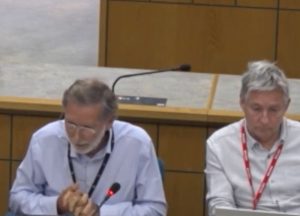
Cartoon showing Dallen at the committee with a humble pie to eat

A few minutes of video from an Epsom and Ewell Borough Council meeting have now generated an external investigation, a legal adviser’s attendance at the Town Hall and a standards hearing that could not get past a basic question: which rules is the Council using?

Councillor Neil Dallen (RA Town) complained that Councillor Chris Ames (Labour Court) had failed to treat him with respect during a heated exchange about the Rainbow Leisure Centre in January. An external investigator recommended a finding against Ames. But at a preliminary hearing on 22 September, the panel made no finding on his conduct. Instead, it heard a sustained challenge to the Council’s handling of the complaint and paused proceedings to consider it.

The question for Cllr Dallen is whether he still wants taxpayers to fund the pursuit of his complaint. He is entitled to make one. He is also free to withdraw it.

The rules the Council used in 2019

The Council’s own papers for its February 2019 standards hearing provide a striking point of comparison. This being the only other hearing of the committee on a complaint against a councillor since 2015. That hearing’s officer report said the Council had approved a process for investigating complaints in July 2012. It attached a document headed Arrangements for dealing with standards allegations under the Localism Act 2011 and identified it as the procedure for investigating and determining the complaint. The eventual decision recorded that the Independent Person’s views had been sought and taken into account.

The 2012 document remains in that publicly available hearing pack. It says the Independent Person’s views must be considered before a decision on whether a councillor breached the Code and on any action to follow. It also gives a councillor the right to require a further hearing sub-committee to review a sanction.

Yet the officer report prepared for the Ames hearing did not mention that document or explain whether it had ever been withdrawn or replaced. It instead pointed to provisions of the Constitution and guidance for people making complaints, while acknowledging that the arrangements it identified did not provide a standards hearing procedure. Officers asked the three-member panel to adopt a newly proposed procedure or amend it for fairness.

That omission is extraordinary. If the Council used the 2012 arrangements at its last publicly documented hearing in 2019, what changed, who approved the change and when? Those questions should have been answered in the report placed before the panel.

Safeguards missing from the proposed procedure

The differences matter. The proposed 2026 procedure does not expressly require the Independent Person’s views to be sought before the panel decides whether the Code was breached. It says there is no right of appeal, without preserving the sanction review set out in the 2012 arrangements. It also offers a wider list of actions, ending with “any other sanction” considered appropriate in consultation with the Independent Person.

A hearing panel appointed to determine one councillor’s complaint has not been shown to have power to replace the Council’s standing complaints arrangements or expand the sanctions it may impose. The 2012 arrangements were approved by the Council. If different standing arrangements have since been made under a valid delegation, the Council should identify the decision. Adopting new rules in the middle of Ames’s case cannot substitute for showing which rules lawfully applied when the complaint was handled.

At the hearing, Ames and his Labour Party legal representative, Matthew Burn, repeatedly asked for that answer. The external legal adviser to the panel argued that the Council’s arrangements need not be contained in one document: in his view, they could be found across the Constitution, delegations and published guidance. But he could not identify when the complaints leaflet on which Ames said the Monitoring Officer had relied was adopted. He accepted that a clear, consolidated document would help the Council. The adviser’s position was that the Council nevertheless had sufficient arrangements and powers to investigate the complaint. The panel did not resolve that disagreement.

Nor was this a question sprung on officers at the Town Hall. Ames and Burn said they had been seeking an explanation for months. Monitoring Officer Piero Ionta and his deputy did not attend to give one. The panel’s chair, Councillor Rachel King, eventually called a pause so members could consider what they had heard.

How much has this cost?

The Council’s hearing report confirms that it commissioned an external investigation and instructed an external adviser for the panel. It says the bills will be met from corporate reserves but gives no amount, stating that final invoices had not arrived. EET has also sought cost information from the Council without obtaining a figure. Officer preparation and attendance have not been costed publicly either.

CH&I Associates director Alex Oram declined to tell Epsom and Ewell Times his firm’s fees or hourly rate. He confirmed that the rate was no more than £100 an hour, but would not say whether it was below £50. A representative of the Norwich-based firm also travelled to attend the Epsom hearing in person.

Could the total already be as much as £5,000 once external fees, travel and officers’ time are counted? That is a question, not an established estimate: without invoices and a record of staff time, we cannot calculate the total. The Council should publish what it has spent so far and the anticipated cost of any further hearing, including additional external advice.

A complaint born of unanswered Rainbow questions

The underlying incident is recorded on the Council’s meeting video. Ames was asking who had decided to keep confidential an urgent decision concerning up to £500,000 of potential repairs at the Rainbow Leisure Centre. Dallen had supported that decision and was chairing the meeting when Ames questioned it. Dallen stopped further discussion, saying, “It is my meeting” and failed to stand aside for his vice-chair to rule on the matter. Ames called him “arrogant” and alleged a “cover-up”.

Ames has since said he regrets using “arrogant” and should instead have raised a formal point of order about Dallen continuing to chair that item. The investigator recommended a finding that Ames had failed to show respect, while recognising that he was pursuing a genuinely held argument about transparency. The investigator did not decide whether his questions about the Rainbow decision were right. The hearing panel has not determined the complaint.

Speaking after the preliminary hearing, Ames said he was grateful that the panel did not press ahead without clarity about the applicable arrangements. He accused the administration of spending taxpayers’ money pursuing a “low-level complaint” while his complaint about Dallen’s conduct at the same meeting had been rejected. Those are Ames’s criticisms, not findings by the panel.

The recorded exchange will still be there if a properly constituted panel is asked to judge it. First, the Council needs to explain why its 2019 hearing used arrangements absent from the 2026 report, what authority supports the proposed replacement and what this process has cost. Dallen, meanwhile, has a simpler decision: is continuing this complaint a proportionate use of public money?

Sam Jones – Reporter

Related reports

An East Side Story of Surrey’s new Parish Councils

Major and effectively permanent change that will increase people’s council tax bills at a time when many families are struggling to make ends meet.

Plans to create more new councils across Reigate and Banstead should be paused to stop residents being hit with higher tax bills and more red tape, the MP has said.

Local government in Surrey is changing. Last year it was announced that Surrey County Council and its 11 boroughs and districts would be dissolved and merged.

In their place would be two new mega authorities to deliver all services. One to cover the western half of the county, the other for the east.

It was argued at the time that it would make things easier for residents and be cheaper. Critics argued that by creating to huge councils to service around 600,000 residents each, would create too large a disconnect between people and those who represent them.

To combat this some of the out-going councils voted to create new lower-tier parishes that would look after small day-to-day issues such as allotments, or verges – but these would require hundreds of thousands of pounds to set-up, introduce higher tax bills.

Others, including MP for Reigate Rebecca Paul, feel the new councils should be given time to get their feet under the desk.

Three new councils will be created – Redhill Town Council, Reigate Town Council, and Banstead and The Villages Council – and minor changes made to Horley Town Council. There will be no changes to the existing Salfords and Sidlow Parish Council.

She said the new parish councils are now expected to add a further £15 to £30 to the annual council tax bill for a band d property, before election and administration costs are taken into account.

The estimated combined budget for the three new councils is just under £1 million for 2026-27, with approximately a quarter of this sum being spent on election costs alone.

Rebecca has written to East Surrey Leader, Councillor Steve Wotton over concerns the new authority should be concentrating on the safe transfer of major services including SEND and adult social care and allow the new unitary arrangements time to bed in.

She said: “Whatever people’s views on local government reorganisation, the whole point of moving to a unitary council was to simplify local government, remove duplication and save money.

Instead, before East Surrey has even opened its doors, its Lib Dem Executive has approved three new councils, dozens more councillors and another precept on residents’ council tax bills.

“There are of course good arguments for smaller and more local councils and I know of many parish councils that do an excellent job.

“But this is a major and effectively permanent change that will increase local people’s council tax bills at a time when many families are struggling to make ends meet.

“This decision should not be rushed or taken lightly – and it certainly shouldn’t be done without the support of residents.”

She said early surveys found only 21 people in favour of the new councils with 94 per cent of the 350 initial respondents rejecting the idea.

Cllr Wotton, leader of East Surrey Council, noted the questions raised about cost and public engagement but said it was important to be clear about how we got here.

He said: “Conservative-led Reigate and Banstead Borough Council initiated and ran the community governance review, held two rounds of consultation, and approved the final proposals in March.

“A majority of its Conservative councillors voted for each of the three new councils.

“Because of local government reorganisation, East Surrey inherited the decision on whether to implement those proposals. 

“Our executive could approve or reject the borough council’s recommendations; we could not change them.

“It voted to approve them last week. 

“These were not proposals developed by the Liberal Democrats.

“Rebecca encouraged residents to respond to the consultation, saying there were “upsides and downsides” and that their views should be taken into account, via her Facebook page.

“As far as I am aware, she did not publicly raise these objections while the borough council was considering the proposals. 

“She is entitled to raise them now, but it would be wrong to leave readers with the impression that this was a new decision dreamed up by a Liberal Democrat-led East Surrey Council.”

Chris Caulfield Local Democracy Reporter

Related reports:

A West Side Story of Surrey’s new Parish Councils

.

.

.

.

.


A West Side Story of Surrey’s new Parish Councils

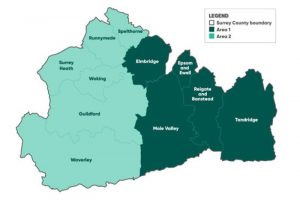
Surrey East West. (Credit: Elmbridge Borough Council) Permission for use.

New lower tier councils will be created in Runnymede, Surrey Heath, Woking, and most controversially Guildford, just months after elections were held to simplify local government in Surrey.

In May, residents went to the polls in what was described as a once in a generation vote that would see Surrey County Council and its 11 boroughs and districts dissolved and replaced with two new mega authorities covering West and East Surrey.

The argument was it would mean less complexity, better value for money, and improved services. 

However, some feared the huge new councils could leave too large a disconnect between residents and their representatives with some areas voting to create new hyperlocal bodies to oversee issues that might get overlooked by the larger bodies – at a cost.

The parish councils will require budgets of several hundred thousand pounds in start-up costs, and will have uncapped powers to charge more tax.

With some areas potentially facing increases in band d council tax bills of up to £100 for the privilege.

In three of the areas residents backed the plans and they were voted through by West Surrey’s executive committee with little issue. 

However, in Guildford, a public vote found 47 per cent of the people were against the plans compared with just 46  in favour  but they were pushed through regardless, leading to calls for West Surrey to reject the bid.

Councillor Jane Austin, leader of the Conservative opposition group, said: “Generally my position is a parish council should go ahead if there is a clear will for it and a clear benefit to residents. 

“I think this test has been met looking at the smaller parishes in Surrey Heath and Runnymede but I can’t see evidence of this anywhere in the report for the Guildford case

“Given its significant size and budget we need more detail.

“If we are asking for a major part of Guildford to pay an extra estimated £69 per year.

She added: “The tests of whether people want this, whether they are happy with the cost, and whether this represents value and benefits the residents of Guildford have not been met.”

Cllr Catherine Young (Horsleys: Residents for Guildford and Villages) said she believed the reason the vote was so close was that many people didn’t understand the benefits of being in a parish council.

The expectation is that there will be elections held for the newly created lower councils in May 2027.

It would then be the new parish councils decisions to determine their own budgets.

Leader of West Surrey Council, Paul Follows said: “Do you think that the Western cabinet will be sitting here discussing planters in Guildford Town Centre, or the Christmas lights, or the fireworks, or what we’re doing with certain elements of localised green spaces?

“It is ludicrous to think so and the problem is without making sure somebody else is responsible for it, we will be responsible for it, knowing that we don’t have the time or capacity to deal with it properly, or with any real local understanding.”

Chris Caulfield Local Democracy Reporter

Surrey East West. (Credit: Elmbridge Borough Council) Permission for use.

Related reports

Epsom’s Rainbow questions persist as £4.7m revamp advances

Rainbow leisure centre Epsom

Places Leisure has detailed improvements at Epsom’s Rainbow Leisure Centre but questions remain over the discovery of substantial dilapidations at the end of the previous operator’s tenure – and who will ultimately meet the cost.

Places Leisure took over the Council-owned centre from Greenwich Leisure Limited (GLL), which trades as Better, on 1 October 2025.

Shortly afterwards, Epsom and Ewell Borough Council authorised potential expenditure of up to £500,000 on works allegedly arising from the condition in which the centre was handed back. The decision was taken under the Council’s urgent-decision procedure and much of the supporting information, including a survey of the building, has remained confidential.

The controversy was intensified by confirmation that no formal condition surveys or inspection records could be found covering much of GLL’s approximately 20-year operation of the centre.

The Council has relied upon “legal professional privilege” and “commercial confidentiality” in declining to disclose the survey and related advice. It has not yet even acknowledged the Epsom and Ewell Times’ latest questions since 3rd September asking whether it has sent GLL a letter before action, begun legal proceedings or asserted any claim for failure to maintain the centre or breach of its contractual obligations.

GLL told the Times on 3 September that it had heard nothing further from the Council since its earlier correspondence and that its position had not changed: “the Council undertook, via specialist contractors, a full survey of the building prior to GLL exiting.  As is normal in all leisure transfers, items that were identified in that survey for GLL were all completed prior to handover and signed off by the specialist contractors on behalf of the Council.  GLL handed the building over to the standard required by the Council and under the contract.”

£4.7 million investment

Places Leisure has now told the Times that it is investing approximately £4.7 million in modernising the centre – £200,000 more than the approximately £4.5 million previously publicised.

Work completed so far includes a full refurbishment of the fitness suite, new equipment and EGYM technology, refurbished group-exercise studios and a new immersive spin studio.

A new health suite, with steam rooms and saunas, is expected to open by the end of November. Further plans include improvements to the café and teaching pool and a new Reformer Pilates studio due to open in the new year.

Places Leisure said the improvements would broaden community activities, encourage healthier lifestyles and generate more than £5 million of “social value” each year.

However, the operator did not provide a breakdown of expenditure on the different elements of the project. Nor did it answer questions about membership numbers, how the investment is being financed or whether any payments or other financial arrangements with the Council have been altered because of the centre’s condition or the closure of facilities.

On the separate dilapidation works, Places Leisure said these fell outside its planned investment programme and were being instructed by the Council.

It said: “Places Leisure is supporting and working with the Council to complete any necessary works quickly and with minimal impact on our customers.”

Membership changes

A centre member told the Times that his monthly payment had risen from £45.50 under GLL to £60 following the change of operator. He said another long-standing member, previously paying closer to £30, had experienced a similar increase.

Places Leisure said existing membership prices remained unchanged until February 2026, when members were transferred to the closest Places Leisure equivalent. For some customers, that change of membership category resulted in a price increase, of which they were informed beforehand.

The present headline monthly rates include:

  • Premium membership, covering the gym, swimming and classes: £60.
  • Swimming only: £29.
  • Premium membership for 16 to 18-year-olds: £30.
  • Premium membership for 19 to 25-year-olds: £40.

A £75 Premium+ option, which will include the health suite, is expected to be introduced when that facility reopens. Places Leisure said existing members would not be transferred automatically to the more expensive category.

The member who contacted the Times praised the refurbished gym and fitness studios, describing the work as fresh and modern. He said, however, that he was unaware of significant changes to the pool or sports halls and that the health suite had remained closed.

Complaint reaches standards process

The Rainbow controversy also forms part of the background to a pending preliminary hearing into a councillor conduct complaint made by Councillor Neil Dallen (RA Town Ward) against Councillor Chris Ames (Labour Court).

At a meeting of the Strategy and Resources Committee in January, Cllr Ames pressed Cllr Dallen about the secret urgent decision which Dallen had signed off. From the chair Cllr Dallen stopped his questioning declaring “It’s my meeting”. During a heated exchange, Cllr Ames used the words “cover-up” and “arrogant”.

Cllr Dallen subsequently complained that Cllr Ames had breached the councillors’ Code of Conduct. Cllr Ames maintains that his language arose from a legitimate attempt, as an elected councillor, to establish what had happened and why councillors and the public were being denied the relevant information.

The preliminary hearing will address procedural issues surrounding the determination of the complaint before any final hearing. This follows an expensive external investigation being authorised by the Council into Ames conduct. The controversial January meeting is available for all to see on the Council’s YouTube channel. The preliminary hearing will be in Committee troom 1 at the Town Hall and the agenda includes a resolution as to whether the press and public should be excluded. Epsom and Ewell Times has been told that the committee room is not sufficient for any public presence anyway.

A complaint made by Ames against Dallen for his conduct of the meeting was dismissed by the Council’s Monitoring Officer, who advised at the heated meeting, and without an independent investigation.

Residents still do not know precisely what defects were discovered, when they arose, why routine inspection records appear not to exist, whether GLL is considered legally responsible for any of the work or how much of the authorised £500,000 will ultimately be borne by local taxpayers.

Sam Jones – Reporter

.

Image: Creative Commons CC0 1.0 Universal Public Domain Dedication

Related reports


Young Legends offered free autumn activities in Epsom and Ewell

Group of children

Children aged nine to 11 living in Epsom and Ewell can take part in up to two free sports or creative activities through the return of the borough council’s Young Legends programme.

Bookings are now open, with places allocated on a first-come, first-served basis.

The programme is intended to help children develop skills and confidence, make friends and prepare for the transition to secondary school.

Activities running during November and December include basketball, coding, football, girls’ rugby, judo, musical theatre, scrapbooking, choir and tennis. A dedicated arts and crafts course is available for children with special educational needs.

Councillor Clive Woodbridge, Chair of Epsom and Ewell Borough Council’s Community and Wellbeing Committee, said positive feedback from the programme’s first year had demonstrated the value of providing such opportunities.

He said: “Through Young Legends, we’re helping children stay active, build confidence and connect with others, while working to make the programme accessible to as many young people as possible.

“Whether you want to continue with an activity you enjoyed last year or try something completely new, I encourage parents, carers and children to explore the activities on offer and give an activity a try.”

Activities and dates

Arts and crafts for children with SEN
Mondays: 9, 16, 23 and 30 November and 7 December, 4.15pm–5.15pm
Epsom Library
Delivered by Creative Minds

Basketball
Tuesdays: 3, 10, 17 and 24 November and 1 and 8 December, 7pm–8pm
Epsom and Ewell High School
Delivered by Cagers Basketball Club

Coding
Thursdays: 5, 12, 19 and 26 November and 3 and 10 December, 5pm–6pm
or Fridays: 6, 13, 20 and 27 November and 4 and 11 December, 5pm–6pm
Church House, St Martin’s Church
Delivered by Code Ninjas

Football
Thursdays: 5, 12, 19 and 26 November and 3 and 10 December, 5pm–6pm
Court Recreation Ground
Delivered by Young Ones United Football Foundation

Girls’ rugby
Wednesdays: 4, 11, 18 and 25 November and 2 and 9 December, 6.30pm–7.30pm
Sutton and Epsom Rugby Club
Delivered by Sutton and Epsom RFC

Judo
Tuesdays: 3, 10, 17 and 24 November and 1 and 8 December
Ages nine to 10: 4pm–5pm
Ages 10 to 11: 5pm–6pm
Rainbow Leisure Centre
Delivered by Westcroft Judo Nork

Musical theatre – song and dance
Mondays: 9, 16, 23 and 30 November and 7 December, 4.30pm–6pm
Laine Theatre Arts
Delivered by Laine Theatre Arts

Scrapbooking
Wednesdays: 4, 11, 18 and 25 November and 2 and 9 December, 5pm–6pm
Epsom Picturehouse
Delivered by Kate McBarron

Sing and Sign Choir
Fridays: 6, 13, 20 and 27 November and 4 and 11 December, 4.30pm–5.30pm
Council Chamber, Epsom Town Hall
Delivered by Include

Tennis
Sundays: 8, 15, 22 and 29 November and 6 and 13 December, 11.30am–12.30pm
Rainbow Leisure Centre
Delivered by Callum Macarty Tennis

Parents and carers can find further information and book through the council’s Young Legends webpage. Application forms can also be completed at Epsom Town Hall during its opening hours.

Up to two activities may be selected for each child.

Questions can be sent to the council’s Community Development team at cdevelopment@epsom-ewell.gov.uk.

The council also offers an Access to Activity Bursary for eligible 12 to 15-year-olds and community football sessions for children and young people aged 10 to 16. Details are available on its Getting Active webpage.

Epsom and Ewell Borough Council


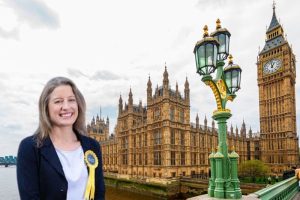
Back to Westminster with local priorities in focus

Maguire with Westminster background

Parliament recently returned after the summer recess, and the mood in Westminster has shifted considerably since we left in July. Labour now has its second Prime Minister since the General Election, with Andy Burnham entering No 10, alongside reshuffles on both the Government and Opposition front benches.

But the noise from No 10 does not change my focus: representing Epsom, Ewell, Ashtead and Leatherhead. My priority this autumn is making sure the Government is held to account on the issues that matter to my constituents – NHS access, train frequencies, e-scooters and the state of our water supply.

I am continuing my work as Liberal Democrat spokesperson for Primary Care and Cancer, pressing the Government on delays in securing GP appointments, cancer treatment waiting times and the need to improve access to dental care.

Alongside that, I am taking on a new responsibility after being selected by my party to sit on the Joint Committee on the National Security Strategy. I will be putting my experience of serving in the military abroad to good use in scrutinising our security at home.


This addition does not mean any of my other work as your MP is being put on the back burner. I will shortly be hosting a roundtable of police chiefs to press the Government for clearer guidance on e-scooters.

I will also be working with a research group to launch a report in Parliament on disinformation – a subject I take very personally following the unrest our constituency experienced earlier this year.

Party conference season is under way, and I will be in Brighton later this month for the Liberal Democrat conference, making the case for stronger action on primary care.

Once the conferences conclude, attention will turn to the Autumn Budget. My Liberal Democrat colleagues and I will be watching closely to see whether our new Chancellor, John Healey, will deliver on defence spending and hospital funding without placing a greater burden on taxpayers.

It is a tall order, but we Liberal Democrats have plenty of ideas about how to improve services without leaving taxpayers to foot the bill.

I also want to use this column to highlight something closer to home. Horton Cemetery in Epsom is the largest abandoned hospital cemetery in the UK. It is the resting place of more than 9,000 patients from the old Epsom Cluster asylums, most of whom lie in unmarked graves and have long been forgotten.

Earlier this year, I brought campaigners into Parliament to meet the Justice Minister, who confirmed that the site is protected from development under the Burial Act.

That was welcome news, but there is still work to do before this place receives the recognition and public access it deserves. I am thrilled that it was recently shortlisted in Findmypast’s Everyday History Heroes awards, and I know that meant a great deal to the families who remain connected to this history.

Finally, an update on a topic that dominated many of my conversations this summer: Thames Water.

The constituency has been consistently plagued by leaks and burst pipes, with interruptions to the water supply affecting homes and businesses across our area.

The irony is not lost on me that the worst of these failures peaked at the same time as Thames Water introduced a hosepipe ban during one of the driest summers on record.

I brought Sir Ed Davey to the constituency to see the effect on local businesses first-hand and have raised the issue directly with the company on several occasions.

Thames Water’s finances remain precarious and its infrastructure is ageing, but my constituents continue to pay more for a service that repeatedly lets them down.

I will keep pushing for a Westminster Hall debate this autumn to put that accountability on the record. I will not stop arguing that customers should not have to foot the bill for years of underinvestment.

Helen Maguire MP
Member of Parliament for Epsom and Ewell
Liberal Democrat spokesperson for Primary Care and Cancer


New East Surrey Council calls for current SEND plans

East Surrey shadow council meet Ashley Tilling and Epsom an dEwell LibDem Cllr Julian Freeman to his left

Leading East Surrey councillors are calling on Surrey County Council to publish its plans to reform special educational needs and disability (SEND) support across the county.

The Liberal Democrat-led shadow authority wants the county council to make public its three-year SEND Reform Plan to allow for “wider transparency” over education.

East Surrey Council will assume responsibility for education across the county’s eastern boroughs from next April, when Surrey County Council is abolished along with the 11 district councils.

However, until then, the county council remains responsible for school and SEND support across Surrey. 

Councils across England have been called on to produce SEND Reform Plans to the Department for Education (DfE) – a condition towards getting a 90 percent SEND deficit write-off.

While many councils have made these publicly available already, Surrey is among those keeping their draft plan under wraps until it receives government approval.

But at a meeting of East Surrey shadow authority’s cabinet this week, councillors called for this document to be made publicly available now.

The shadow authority’s children and youth services lead Councillor Ashley Tilling (Liberal Democrats: Walton South & Oatlands) said that while cabinet members have seen the plan, the lack of publication means “there’s no wider transparency of what that reform plan entails.”

He added: “We need to be engaging with schools, we need to be engaging with specialist support, we need to be showing parents that we are transparent in what we’re doing going forward as East Surrey.”

It came as cabinet members discussed Surrey County Council’s Experts at Hand grant – aimed at helping bolster the specialist workforce to further help SEND provision.

East Surrey council leader Councillor Steve Wotton (Liberal Democrats: Horley West, Salfords & Sidlow) agreed that his cabinet should request the plan’s publication by Surrey County Council.

“It would be in alignment with our commitment to be a transparent council from when we take this on,” he said.

These calls were echoed by Liberal Democrat MP for Dorking and Horley Chris Coghlan, who said: “It’s egregious that Surrey haven’t yet published their draft local SEND Reform Plan, despite around 40 other local authorities sharing theirs. 

“This is vital for transparency for countless worried parents and helping tackle the SEND crisis in Surrey.”

Education news outlet Schools Week has reported that 40 draft SEND Reform Plans have been published across England so far. 

However, there is no legal obligation on councils to do so at this stage, and many authorities have opted to wait for DfE approval before making them publicly available.

East Surrey opposition leader Councillor David Lewis (Conservative: Cobham & Oxshott South) told the Local Democracy Reporting Service: “The East Surrey Conservative Group understands that as with many other local authorities, Surrey County Council is currently awaiting feedback from the Department for Education on its SEND reform plans.

“The Conservatives are reassured that the council remains committed to transparency and welcome its commitment to publish the plans as soon as the necessary approval is received from the DfE.

“The East Surrey Conservatives understand that Surrey County Council looks forward to sharing further details with residents and stakeholders at the earliest opportunity.”

A Surrey County Council spokesperson said: “Like many other local authorities, we are currently awaiting feedback from the Department for Education on our SEND reform plans. 

“We remain committed to transparency and will publish our plans as soon as we receive the necessary approval from the DfE. 

“We look forward to sharing further details with residents and stakeholders at the earliest opportunity.” 

James Moules Local Democracy Reporter

Image: East Surrey shadow council meet Ashley Tilling and Epsom and Ewell LibDem Cllr Julian Freeman to his left. Credit Elmbridge Council


Former Epsom Glyn pupil not tyred of flipping in world-record bid

James Farmer flipping a tyre and inset when head Glyn boy

A former Glyn School head boy is preparing to flip a 100kg tractor tyre continuously for 24 hours in an attempt to break a Guinness World Record and raise £20,000 for his old school.

Professional trainer and fitness instructor James Farmer will begin the challenge at midday on Sunday 25 October, finishing at midday on Monday.

He will flip the tyre around a marked course within the Epsom school’s grounds, continuing throughout the night under the observation of independent witnesses.

The current Guinness World Record for the greatest distance covered by tyre flipping in 24 hours stands at 11.21km. James hopes to exceed 15km.

Money raised will contribute towards a new sports pavilion at Glyn School, which is part of the 43-school GLF Schools trust.

The proposed pavilion would provide improved facilities for physical education, competitive fixtures and after-school sport. It would also offer opportunities for use by the wider community.

James has worked in health and wellbeing for more than 20 years, training athletes and Olympians and appearing on ITV as a fitness expert. He credits Glyn with setting him on the path to his career.

He said: “I owe Glyn a debt of gratitude for providing the foundation upon which I built my entire career.

“Twenty-four hours of flipping a tyre is a hard way to say thank you. But if it puts a pavilion on those playing fields, it will have been worth every hour.”

Glyn headteacher Jo Garrod said: “James left here in 1999 and he has never really left us behind, which says something about Glyn, and James as a person.

“What he is taking on is extraordinary, and the pavilion he is raising money for will be used by our pupils every week for decades. We will be out there cheering him on through the night.”

The challenge comes as Glyn prepares to celebrate its centenary in 2027. James hopes the new pavilion will honour the school’s history while supporting its ambitions for the future.

Spectators are welcome to attend and encourage James during the challenge. Local businesses interested in sponsoring his attempt can contact the school.

Donations can be made through the James World Record for Glyn fundraising page.

Further information about the school is available from the Glyn School website.

Image: James Farmer flipping a tyre and inset when head Glyn boy


Criminal convictions follow Banstead construction site death

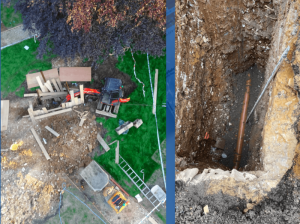
Construction site evidence

Two companies and a manager have been sentenced 9th September), after being found guilty of a health and safety charge of failing to discharge their duties following the death of a labourer who died on a construction site in Banstead in June 2020.

Gheorghita Arsene, 33, died when a 10ft (3m) trench collapsed on top of him, covering him in soil. He had been working on a site in Park Road where an old care home was being demolished to make way for a new purpose-built home.

Following a three-month trial at the Central Criminal Court in London, principal contractor Appledorn Developments Limited were found guilty of a health and safety charge of failing to discharge their duties. They were fined £500,000 with the judge, Her Honour Judy Khan KC, commenting that “their failure to ensure that a safe system of work was motivated by the desire to get the works done quickly and cheaply”.

T Vaughan Limited were also found guilty of a health and safety charge of failing to discharge their duties and were fined £650,000. They were also ordered to pay a further £40,000 in costs. The judge said she was” satisfied that systems were in place, but these were not sufficiently adhered to or implemented”.

Contracts manager Anthony O’Connor, 42, of Romford, Essex, pleaded guilty to failing to discharge his duty under the Health and Safety Act 1974, which was accepted by the prosecution. The judge sentenced him to 10 months in custody, suspended for 18 months, and ordered to carry out 150 hours of unpaid work, saying that “a number of workers were exposed to the risk of harm”.

The jury failed to reach a verdict in relation to a charge of manslaughter against O’Connor.

Site manager Peter Wraith, 54, from New Waltham in Lincolnshire, was found not guilty of manslaughter and assistant site manager Gregory Peake, 51, from Bromley in south-east London, was acquitted of failing to discharge his health and safety duty.

The court was told that a health and safety inspection found there were no supports to the trench and the excavated soil had been deposited unsafely close to it.

Mr Arsene, described in court as a “good man who worked hard and achieved everything through his
hard work”, had been working to replace a damaged pipe at the bottom of the trench and was clearing soil when one of the trench walls collapsed.

Despite desperate attempts by his colleagues, they could not pull him free.

Fire and ambulance crews were called to the scene but faced similar difficulties in digging Mr Arsene out, and he was confirmed deceased at the scene shortly after the incident took place.

Senior Investigating Officer, Detective Inspector Debbie Birch, said: “Gheorgita Arsene’s death could have been avoided if the appropriate health and safety measures had been followed. It can be easy to cut corners to save time and money but this tragic death highlights just how important health and safety legislation is on all building sites.  

“Sadly, this resulted in the death of a 33-year-old man who was simply trying to do his job, and our thoughts remain with his family and friends at this difficult time.”

A Health and Safety Executive spokesperson said:

“Gheorghita Arsene’s death was as horrifying as it was preventable. He lost his life because basic precautions were not in place to protect workers from the well-known risks that come with excavation work.

“Anthony O’Connor had observed workers in the trench without adequate protection and was aware of the measures required to prevent a collapse.

“This case is a stark reminder that when basic safety standards are ignored, the consequences can be fatal. Companies and individuals alike have legal duties to protect workers and where they fail to do so, and we will not hesitate to take enforcement action.

“Our thoughts today are with Mr Arsene’s loved ones, as they mourn their loss.”

Surrey Police


Epsom and Ewell to have three tiers of government when promised one?

Town Hall

Following Surrey County Council’s release reported here Plans for East Surrey Council continue to progress that the new East and West Unitary Councils will work toward adoption of an overarching Foundation Strategic Authority for all of Surrey and a local Charter Trustees body for Epsom and Ewell, Epsom and Ewell Times provides our readers with a summary guide to what Foundation Strategic Authorities are:

Surrey’s proposed new strategic authority: what would it do?

Surrey’s two new shadow unitary authorities have backed the creation of a county-wide Foundation Strategic Authority, adding another layer to the local government structures due to take effect in April 2027.

The proposed body would bring East Surrey Council and West Surrey Council together to make decisions on matters considered too large or interconnected to be handled effectively by either authority alone.

An analysis published by the Local Government Information Unit describes Foundation Strategic Authorities, or FSAs, as the entry level in the Government’s new system of devolved regional government.

Unlike a Mayoral Strategic Authority, an FSA would not have a directly elected mayor. It would instead be governed collectively by representatives of its constituent councils.

For Surrey, this would mean the two new unitary councils retaining responsibility for everyday services such as social care, waste collection, local planning, housing and environmental health, while working through the FSA on broader county-wide priorities.

What powers would it have?

According to the LGIU, Foundation Strategic Authorities are intended to provide a statutory framework for strategic functions including:

  • transport planning;
  • adult education and skills;
  • economic development;
  • infrastructure and investment;
  • housing strategy; and
  • the preparation of a Spatial Development Strategy.

The last of these could be particularly significant. A county-wide spatial strategy would establish the broad direction for development, housing and infrastructure across Surrey, above the more detailed local plans prepared by East and West Surrey councils.

An FSA could also act as Surrey’s Local Transport Authority, allowing decisions about buses, roads and other transport investment to be planned across the whole county rather than divided between the two new councils.

The Government argues that operating at this larger scale will make it easier for areas to negotiate with Whitehall, attract investment and coordinate services that cross council boundaries.

Not as powerful as a mayoral authority

The LGIU stresses, however, that an FSA occupies the lowest of the Government’s three strategic-authority tiers.

Above it sits a Mayoral Strategic Authority, led by a directly elected mayor, and then an Established Mayoral Strategic Authority. Authorities in the higher tiers can gain greater powers, more influence over government departments and access to broader, longer-term funding arrangements.

A Foundation Strategic Authority would therefore give Surrey a formal seat at the devolution table, but it would not initially receive all the powers or financial freedoms available to areas such as Greater Manchester.

This raises the question of whether an FSA is intended to be a lasting form of government in its own right or principally a “waiting room” on the way to an elected Surrey mayor.

The Government has said that areas may choose a non-mayoral arrangement, but its most substantial devolution offers have generally been attached to mayoral authorities.

A third level of decision-making

From April 2027, Epsom and Ewell Borough Council and Surrey County Council are due to disappear, with their responsibilities passing to East Surrey Council.

The FSA would sit above both East and West Surrey councils for specified strategic functions. Residents would therefore be governed locally by a unitary council and, on county-wide matters, by the strategic authority.

This would not reproduce the present county-and-borough division because the FSA would have a narrower and more strategic role. Nevertheless, its creation means the replacement of Surrey’s current two-tier system will not leave the county with a single level of local decision-making.

Questions remain about how the FSA would be constituted, how its decisions would be scrutinised, how costs and votes would be divided between East and West Surrey and how clearly residents would be able to identify which authority was responsible for a particular policy.

Why Surrey wants one

Surrey County Council has argued that establishing an FSA will unlock further devolution and allow more decisions and funding to be transferred from central government.

The two shadow councils would remain separate unitary authorities, but the strategic body would preserve a mechanism for county-wide coordination after Surrey County Council is abolished.

Its practical importance will depend on the powers and funding ultimately transferred by ministers. Without substantial resources, the FSA could amount mainly to another coordinating committee. With meaningful control over transport, skills, strategic planning and investment, it could become one of the most influential public bodies affecting Epsom and Ewell.

The central issue identified by the LGUI analysis is therefore not simply whether an FSA is created, but whether it is given sufficient authority, money and public accountability to make a noticeable difference.

Sam Jones – Reporter

.

Related reports


Plans for East Surrey Council continue to progress

Plans for the new East Surrey Council continue to move forward as Surrey’s local government reorganisation programme progresses with the full support of both central government and Surrey leaders. Key decisions are helping shape a modern, locally focused council that will deliver high-quality services for residents and communities.

The East Surrey Shadow Executive met on 14 September to continue preparations for the launch of the new authority on 1 April 2027. Councillors reviewed progress on the implementation of local government reorganisation and considered a number of important decisions that will help ensure services continue smoothly from Vesting Day.

A key decision at the meeting was to approve Woodhatch Place in Reigate as East Surrey Council’s main office from 1 April 2027. This short-term arrangement provides a practical and cost-effective base for the new authority, ensuring it can operate safely and lawfully from day one while longer-term property plans are developed.

Access to council services will remain local and convenient for residents. Existing council offices across East Surrey will continue to provide face-to-face support, alongside online and telephone services, giving residents a choice in how they access help and information.

Looking beyond council boundaries, councillors backed proposals for East Surrey and West Surrey to work together on strategic county-wide issues through a proposed Foundational Strategic Authority. Members recognised the potential benefits for transport, housing, economic growth and local funding, while also calling for further details from government on matters including any future visitor levy and Surrey’s devolution arrangements.

The meeting also explored how communities could play a greater role in shaping the future council. An early East Surrey Council Strategy was discussed, setting out a vision for an inclusive and sustainable East Surrey where people feel heard, supported and connected. Councillors also considered community-led neighbourhood governance arrangements that would give residents and local organisations more influence over local priorities and services.

Protecting local identity and civic traditions was another important area of discussion. Councillors supported the creation of Charter Trustees in Elmbridge and Epsom & Ewell from 1 April 2027, and in Reigate & Banstead if a proposed parish council is not established. These bodies help preserve historic traditions, ceremonial events and local heritage during the transition to the new council structure.

Preparations for Vesting Day also included consideration of the legal agreements needed to create the new councils. These agreements will set out how assets, contracts, responsibilities and financial obligations transfer from Surrey County Council and the district and borough councils to East Surrey and West Surrey, while also establishing how the two authorities will work together on shared services and other arrangements after 1 April 2027.
Councillor Steve Wotton, Leader of the East Surrey Shadow Council, said: “The pace of progress demonstrates our determination to make East Surrey Council a success. Each milestone is taking us closer to creating a council that is shaped by local priorities and focused on what matters most to residents.

“We have a real opportunity to create a stronger platform for long-term economic growth, investment and infrastructure improvements across Surrey, this will help us to rethink on how key services, such as SEND, are delivered for people across our communities.

“By combining services at a strategic level and empowering communities to shape local decisions, we can create better outcomes for residents and build a stronger future for East Surrey.”

In the months ahead, shadow councillors will use Section 24 powers to review and approve key financial decisions as Surrey prepares for the creation of East Surrey and West Surrey councils. This will help protect the finances of the new councils by ensuring major spending commitments made before 1 April 2027 are in the long-term interests of residents and support a strong start for the new authorities.

Surrey County Council


Surrey Hills National Landscape to expand?

Box Hill (Credit: Google Maps)

East Surrey’s MP has called on the government to approve the expansion of the county’s protected landscapes “as soon as possible”.

Claire Coutinho has written to Environment Secretary Dame Angela Eagle to voice her support for the recent review of the Surrey Hills National Landscapes’ boundaries.

Formerly known as the Surrey Hills Area of Outstanding Natural Beauty (AONB), the proposed expansion would see 129 square kilometres of stunning landscape brought under its umbrella.

Ms Coutinho wrote: “We are so lucky in East Surrey to be surrounded by such beautiful countryside – rolling hills, grazing fields, historic woodland. 

“I am proud to have helped to secure this long overdue boundary review over six years ago, and it is wonderful to see it has reached this major milestone.

“Countless individuals and groups have poured thousands of hours into this project to get it to where it is today. 

“Particular thanks must go to the team at Surrey Hills National Landscape, Tandridge District Council, our local farmers and landowners, and the many other organisations that have been intimately involved in this process from the very beginning.”

National Landscapes give designated stretches of countryside additional protections against development under planning laws.

While they receive similar safeguards, they differ from National Parks, which are overseen by separate National Park Authorities.

The new boundaries will see Surrey Hills stretch all the way from Hampshire to parts of Greater London, increasing its size by almost a third.

Areas poised to be brought into the National Landscape include Godstone Hills, Chipstead Valleys and Caterham Woods.

“Protecting our natural environment means cherishing the inheritance entrusted to the current generation by our forebears for the benefit of the next,” Ms Coutinho added in her letter. 

“This Burkean contract between the living and those yet to be born, through which the protection of our natural landscapes can be preserved, is a core principle many of my constituents hold dear and one that should never be abandoned.

“I therefore hope that, as the Secretary of State responsible, you will consider the proposal with a view to approving it as soon as possible.”

Department for Environment Food and Rural Affairs spokesperson said: “We know Surrey Hills is loved by its local community and volunteers for its natural beauty, and it is great that so many people care about its future.

“We have received an application from Natural England to extend the Area of Outstanding Natural Beauty, and, as with all applications, will be considering it in due course.”

Surrey Hills Board chair Kathy Atkinson previously said she would be writing to Dame Angela to invite her to visit the National Landscape.

She said: “The proposed extension represents a once-in-a-generation opportunity to recognise and protect more of the special landscapes that define Surrey Hills and the surrounding area.”

James Moules Local Democracy Reporter

.

Box Hill (Credit: Google Maps)

.

.

.

.


Surrey burglary figures spark row

Burglar being chased on foot cartoon

Helen Maguire MP has accused the Government of leaving Surrey families and businesses to “fend for themselves” after Liberal Democrat analysis suggested that fewer than one in 15 burglaries recorded by Surrey Police in 2025 resulted in somebody being charged or summoned.

However, Surrey Police and the county’s Police and Crime Commissioner have responded that burglary has been falling, detection rates are improving and officers attended almost 97% of reported residential burglaries during the latest financial year.

The Liberal Democrat MP for Epsom and Ewell said 3,045 burglaries were recorded across Surrey in 2025. According to figures supplied by her office, 6.4% resulted in a charge or summons, while 2,272 cases – 74.61% of the total – were closed without a suspect being identified.

Nationally, the party said 223,194 burglaries were recorded in England and Wales during the same calendar year. Of these, 13,936 – 6.24% – resulted in a charge or summons, while no suspect was identified in 160,396 cases, or 71.86%.

The figures were described as having been drawn from Home Office crime outcome statistics and analysed by the Liberal Democrats.

Mrs Maguire said: “It is unacceptable that families and businesses across Surrey are being left terrified as the vast majority of burglaries go unsolved. The Government has been asleep at the wheel; a persistent lack of support for community policing has left our streets vulnerable.

“In 93.6% of burglary cases in Surrey, the victims never see someone charged – this has to change. Surrey Police work tirelessly, but they require the proper resources and mandate from central government to ensure every single case is rigorously investigated.

“That’s why I’m demanding urgent action from the Prime Minister to restore neighbourhood policing and to back our calls for an investigation guarantee for all burglaries in Surrey.”

The Liberal Democrats are calling for what they describe as a “Burglary Response Guarantee”, backed by legislation requiring the police to attend and properly investigate every domestic burglary.

Police points to higher ‘solved’ rates

Surrey Police said the figures needed to be placed in context, particularly because the classification of burglary offences changed in April 2023. Burglaries are now divided into residential and business offences.

Detective Chief Inspector Jo Horner, the force lead for burglary, acknowledged that further improvement was required.

She said: “We know there is more to do to improve burglary detection rates, but it is also important to provide context to the data which has been used.”

Between April 2025 and March 2026, Surrey Police attended 96.9% of reported residential burglaries, according to the force.

Over the same period, it recorded a “solved rate” of 10.44% for residential burglary and 12.18% for business burglary.

A solved outcome is not necessarily the same as a charge or summons. It can include other recognised outcomes, so the police percentages cannot be compared directly with the 6.4% charge-or-summons figure quoted by the Liberal Democrats. The figures also cover different periods: calendar year 2025 in the MP’s release and the 2025/26 financial year in the police response.

DCI Horner said burglary remained “an area of continued focus and priority” for the force.

She highlighted an investigation that led to five offenders admitting a series of car-key burglaries, attempted burglaries and vehicle thefts across Surrey, Sussex and Kent. Investigators linked the group to more than 20 stolen vehicles with a combined value of £337,100.

A separate East Surrey operation resulted in six men being charged with nearly 80 offences, including burglary, motor vehicle theft and vehicle interference. Five of the men are now serving prison sentences.

Surrey Police said each of its two divisions has a proactive team monitoring burglary patterns, identifying hotspots and targeting prolific offenders and organised criminal networks.

PCC says burglary is falling

Surrey Police and Crime Commissioner Lisa Townsend said domestic burglary was “deeply invasive” and could have a profound effect on its victims, while acknowledging that improving detection remained a challenge for police forces nationally.

She said: “The good news is that Surrey Police is one of the fastest improving forces in the country and burglary rates across the county have been consistently falling.

“According to figures available on my Data Hub, the number of domestic burglaries fell by over 15% between 2023 and 2025. And more recent provisional data shows that in April and June this year, we saw the lowest monthly rates of domestic burglary in the latest three years.”

Mrs Townsend said the force’s burglary solved rate between April 2025 and March 2026 was more than 10%, which she described as considerably higher than the national average.

She added: “Surrey Police is already committed to deploying to every residential burglary reported in the county and each policing division has its own proactive team which identifies trends and ‘hotspot’ areas and targets offenders.

“The force has made great strides in tackling burglary over the last two years and this will be an area I will continue to scrutinise performance on to ensure they maintain that trajectory going forward.”

What the figures do – and do not – show

The competing statements measure several different things.

A 6.4% charge-or-summons rate does not necessarily mean that the offender “got away scot-free” in every other case. Cases may remain under investigation, be resolved through another recorded outcome or fail to proceed for evidential or other reasons. Nevertheless, the figures supplied by Mrs Maguire’s office indicate that no suspect was identified in almost three-quarters of Surrey’s recorded burglaries in 2025.

Conversely, attending a burglary does not mean that it will be solved. Surrey Police’s 96.9% attendance figure relates only to residential burglary and not to the business burglaries included in the MP’s overall total.

Neither side supplied Epsom and Ewell-specific figures, so the statistics in the exchange relate to the Surrey Police area as a whole.

Residents can report suspicious activity through Surrey Police’s website, by calling 101 or anonymously through Crimestoppers on 0800 555 111. A crime in progress or an immediate danger should be reported by calling 999.

Sam Jones – Reporter