


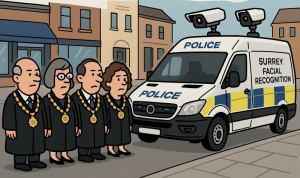
Formal protests have been lodged against Surrey Police’s use of facial recognition technology that scans the faces of every adult and child in a bid to identify known suspects. Surrey Police was given two live facial recognition vans from the Home Office in November and has since put them to use in Redhill and Woking. The surveillance cameras record the images of everyone who walks across their paths to see if they are a match for people on their watchlist. The force says it deletes anybody who does not match to “minimise the impact on their human rights”, with watchlist images deleted within 24 hours. The police said there were known issues in the past with facial recognition technology, including potential gender and ethnic bias, but that developments and new AI-driven algorithms have reduced this.
Now, a group of 25 cross-party Woking Borough Councillors have written to the force demanding the cameras are mothballed until meaningful consultation with residents and their elected representatives takes place over how, or whether, they are used. The letter says that fundamental questions of governance and human rights should have been resolved before any decision was made – including accountability for wrongful stops or arrests from misidentification, whether cameras record continuously or selectively, and how and when data is processed, shared, stored and deleted. A resolution has also been passed by Woking Borough Council’s Communities and Housing Scrutiny Committee calling on Surrey Police and the Crime Commissioner to join its January 20 meeting to answer questions about the use of live facial recognition cameras in Woking. In the meantime, councillors want the cameras’ usage suspended immediately, pending full consultation with residents, with a focus on young people and those from ethnic minority backgrounds and community groups, as well as a full independently led equality and human rights impact assessment.
Chairing the Tuesday, December 2 committee was Councillor Tom Bonsundy-O’Bryan. He said: “They were deployed in Woking on November 26 and in Redhill on November 13. They scanned the faces of more than 8,000 members of public; 99.9 per cent of those scanned were not arrested. Of the individuals explicitly flagged as alerts by the technology in Redhill, 60 per cent were ultimately not arrested; only two arrests were made. There are serious questions about the proportionality of this. Imagine the police standing down the road, and asking to see everyone’s passport, checking their ID, just in case they are a criminal. It would be a ludicrous thing, we wouldn’t stand for it, it would be outrageous, and that is effectively what this technology is doing. It scans the face of anyone, child or adult, walking down the street and compares it to a watch list. Everyone wants the police to stop criminals, to find and arrest the people responsible for crime, but is this technology really proportionate in being deployed here in Woking?”
A spokesperson for Surrey Police said: “The introduction of live facial recognition technology, which is already being used successfully by other forces in the UK, is a vital tool to help us investigate crime thoroughly and relentlessly pursue criminals. We meticulously planned the rollout of the technology to ensure our use is appropriate, proportionate, and that we are operating with transparency. As part of this, we appropriately engaged with a wide variety of stakeholders and have ensured all information, documentation and policies are publicly available on our website. Since the launch on November 13, we have successfully completed a deployment in Redhill where officers arrested a 69-year-old man for breaching his sexual risk order and conducted condition checks for a sexual harm prevention order and a stalking protection order. On a further deployment in Woking, a 29-year-old man was arrested on suspicion of rape and shoplifting and two women were issued community resolutions for shoplifting.”
Police added that the technology has been extensively tested by the National Physical Laboratory and that the algorithm used “shows no statistical bias towards gender or ethnicity (as tested nationally)”. They said officers are briefed before each deployment regarding any potential disparity relating to race, age and gender, and that “extra corroboration” is required before any action is taken. “It is our responsibility to use every tactic and innovation available to us to keep the public safe, deter criminal behaviour, protect people from harm, and locate the most serious of offenders – and the live facial recognition technology has helped us to do exactly that.”
Police and Crime Commissioner Lisa Townsend said: “I want to make sure our communities are as safe as possible for Surrey residents which is why our police officers must have every tool at their disposal to track down criminals operating in our midst. I do understand that people may have concerns which is why it is important that the debate on policing technology reflects the facts, the safeguards in place and the clear benefits to public safety. These vans will be used proportionately and it is important to stress that law-abiding members of the Surrey public going about their daily business have nothing to fear by their use. The cameras will help our policing teams identify and detain those on a pre-determined watchlist such as violent criminals and sex offenders.”
Related reports: