
Epsom and Ewell Times

2nd April 2026 weekly

ISSN, LDRS and IMPRESS logos

Classic growth versus environment dilemma

Farnborough airport

Just 20 miles from Epsom weekend flights at Farnborough Airport could more than double if expansion plans go ahead.

The airport’s owners are seeking to increase the annual number of flights from 50,000 to 70,000 a year – including a jump in weekend traffic from 8,900 to 18,900. They also hope to have aeroplanes taking off and landing from 7am to 9pm on weekends and public holidays, an hour earlier – and later – than currently permitted.

They say the increase in flights is needed to meet shifting needs of business travellers, opponents say the airport is trying to cash in on leisure and holiday travel. Airport bosses say the move will create thousands of new jobs in the area and are urging people to have their say on the proposals at a series of consultation events.

John Eriksson, chairperson of the Farnborough Noise action group said the people in the area already have no respite from the jet engines. He said his main concerns over the expansion were that it was yet another consultation before a review into the impact of airspace changes had concluded.

The claimed economic benefits, he said, were still being assessed by Rushmoor Borough Council’s oversight and scrutiny committee, and that the Government’s own climate change committee stated there should be no increase in aviation until the industry was able to reduce emissions.

He said that on average, planes from Farnborough carried 2.5 passengers per flight, with many not carrying any. Mr Eriksson said: “We’re going to have a continuous drone of aircraft noise. They already fly at a lower altitude to get under Heathrow and Gatwick airspace.”

Richard Nobbs, another Farnborough Noise member, said the growth of the airport had been “highly detrimental for the area”. He added: “We are going to end up with an increase in pollution, an increase in noise. Farnborough Airport will say this is needed because it will make a big contribution to the local area, but I don’t see that. Most of the flights are to holiday destinations.”

The airport, one of the  largest employment sites in the area, has said it would publish detailed information about its proposals from September 20. They claim the changes would enable it to be a “catalyst for long-term economic prosperity in the region” and support 4,100  jobs by 2040.

Opponents say it serves mostly private clients with jets averaging 2.5 passengers per trip. Campaigners said this makes it difficult to justify the airport expansion’s economic argument.

The airport argues it contributes £200m to the local economy each year, which in turn supports thousands of direct and indirect jobs in the process.

Simon Geere, Farnborough Airport chief executive, said: “By satisfying the growing demand for connectivity from Farnborough Airport, our proposals will create hundreds of new jobs within the local community and give a boost to the unique aerospace cluster that we are part of. This will be vitally important for the future economic prosperity of the region. At the same time, Farnborough Airport is leading the way on airport sustainability. 

“We recently achieved Level 4+ Carbon Neutrality which is the highest possible accolade, and last year we set ourselves one of the most ambitious targets in the industry, by committing to be Net Zero across our controllable emissions by 2030 or sooner. We are looking forward to sharing our proposals for the future of the Airport with the local community and receiving feedback on how we can continue to contribute to the ongoing economic prosperity of the communities we serve.

Further details are available at FarnboroughAirport2040.com.

The consultation will close on October 18 2023.

Following the consultation, the airport intends to submit its planning application in November 2023 after which a 16-week statutory consultation will follow.

It expects the first planning decision to be made in March 2024.

Image: MilborneOne CC BY-SA 3.0


Cycle hub in Dorking development

Pixham Lane Dorking development plan

A football academy, a 130-place children’s nursery, and a cycling hub, have all been approved in Dorking as the Pixham Lane masterplan steps up a gear.

The site had been seen as an opportunity for a new Dorking Wanderers FC stadium but that was kicked into the long grass when it became clear the club’s future was at Meadowbank.

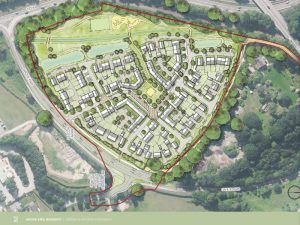
Now, developers Stonegate Homes have been granted planning permission by Mole Valley councillors for three new community buildings as part of a grander vision for the site that could also feature a senior living home for about 200 people and 300 new homes.

The largest of the buildings approved last week is a 414 square metre nursery, which will be built over two floors, and have space for up to 130 children across four classrooms.

A new youth academy will be used by Dorking Wanderers Football Club and features classrooms for up to 40 students at any time.

The final building will become a cycling hub after the plans sailed through the Wednesday, September 6 meeting with only minor objections from councillors.

The council said it expected the hub to be a hit with cyclists as “a place to meet and relax, as well as a place to repair and purchase cycling equipment and accessories”.

Speaking at the meeting was Councillor Simon Budd who questioned the need for a nursery after two had closed within the past year, suggesting a lack of demand and that “we would be much better building and SEN school rather than a nursery school”.

The site is surrounded by Dorking railway station as well as a train line running north to London and south to Horsham.


The application site (measuring 0.68ha) lies to the south of Pixham Lane, just east of the A24 and north of Dorking; within the Built up Area. The site, which lies at the south-western corner of the overall ‘AVIVA site’, comprises car parking which served the former office use. The ground level is generally flat. The site is bounded to the south west by Dorking Railway Station and rail line running north to London and south to Horsham and beyond. To the south east is a public footpath whilst to the north is the remaining part of the Aviva campus. The site itself is in the Built-up Area; adjoining to the east is land designated Metropolitan Green Belt. It is broadly level throughout. Access to the site can be obtained from the eastern end of Lincoln Road.


Cllr Rosemary Hobbs said: “If anyone has visited this site and walked in from Lincoln Road, they’ll know this is a particularly unpleasant looking, very messy looking, area of Dorking. It will greatly enhance the appearance of that part of the town and I think it is a good use of the land. The nursery will presumably get some business from the number of residents in the properties on the site.”

Cllr Chris Hunt said: “The cycling hub, who can speak against that as a principle?”

The football academy, he said was also for sports, and a nursery would be used by new families moving into the area. He added – given the use of the site “I think its a good proposal”.

Mole Valley Borough Council is currently preparing its new long-term planning bible, the Local Plan, which sets out the types and levels of permitted development in the area.

The council said it has been submitted to the Secretary of State for Levelling Up, Housing and Communities and is currently under examination by an Inspector. The draft earmarks the site for 276 dwellings and at least three Gypsy and traveller pitches.


Report against airport expansion

Flight over a town

Airport expansion benefits a “small and wealthy subset of the British population” leaving the rest to deal with its environmental impact, according to a new report.

The paper, Losing Altitude the economics of air transport in Great Britain, was published just weeks before plans to double capacity at Gatwick were made public for the first time.

It argues that the “significant” environmental downsides that come with the growth in flight numbers is not matched by its economic benefit – and that data arguing otherwise is out-dated.

However, while it says overall tourism in the UK is harmed by increased aviation, Surrey and the south east benefit.

Gatwick Airport says a second runway would bring an extra £1billion to the south east and that its “detailed economic analysis is robust and is based on UK-specific data”.

It has submitted proposals to the Planning Inspector to add a permanent second runway to allow an extra 100,000 flights a year. A six-month enquiry is set to start later this year to determine the matter.

The report, by New Economics Foundation, read: “The Government continues to provide conditional support to air capacity growth on the, often tacit, basis that the economic upsides outweigh the negative impacts and future risks. “But, the economic assumptions that underpin this position favouring growth are dated and have not been reviewed for some years.

“Given the urgent and sizeable nature of the climate risk, it is imperative that the evidence, and relative balance, of the economic and environmental impacts of air transport growth are kept up to date and under constant review.”

The last comprehensive Government review of the economic impacts of air travel was in 2012 and the industry has “changed dramatically” since then, the report argues.

Growth in business travellers has effectively ceased and new passengers are “exclusively from the leisure market” – in particular, “growth has been driven by wealthy British residents rather than foreign tourists or those on lower incomes”. The pandemic, it says, accelerated the trend.

Welfare, jobs and wages, tourism.

It said the social benefits that access to international travel brings to UK residents can be vast but is “typically captured by a small and wealthy subset of the British population while, each year, around half of British residents do not fly at all. Furthermore, the welfare benefit must now be offset against welfare losses resulting from greater environmental damage; these are substantial”.

On job creation, it said that aviation “supports a large number of British jobs, but the amount of employment created by growth has been diminishing over time” and has now become “one of the poorest job creators in the economy per pound of revenue” – due to automation and efficiency savings.

It also found productivity growth failed to translate into increased wages; after inflation.

On tourism it said there are now two decades of evidence showing air transport does not help the UK domestic tourism industry with cash instead flowing overseas.

The exception to this is in Surrey, London and the wider south east, where the majority of foreign tourists visit.

Dr Alex Chapman, senior researcher at the New Economics Foundation (NEF), said: “For years, this government has let the air travel industry balloon in size, based on dangerously outdated claims that it is boosting the UK’s economy. The reality is declining business air travel, declining wages for air travel workers, declining job numbers, and declining domestic tourism spending in the UK.

“And that’s before you consider the rise in noise, air pollution and dangerous emissions driven by UK airports. So who exactly is benefiting from ever more air travel? You needn’t look much further than the highly paid executives, the private shareholders, and the wealthy minority of ultra-frequent flyers.”

Cait Hewitt, policy director at the Aviation Environment Federation, said: “The question of whether or not airports should expand is often assumed to be about balancing environmental harms against economic benefits. This new analysis suggests we should think again; while flying definitely causes harm in terms of noise and emissions, it’s uncertain if it actually brings any economic benefits.

“Obviously people benefit from going on holiday, but policies that support British tourism and leisure – rather than increasing travel abroad – would be good for the UK economy as well as the climate.”

A London Gatwick spokesperson said: “We are aware of the… report and its claims, however our detailed economic analysis is robust and is based on UK-specific data. Our analysis shows that the Northern Runway plans would deliver 14,000 new UK-based jobs and inject £1 billion into the economy of the south east every year.

“Our plans would also benefit many communities across the south east by providing new economic and business opportunities as well as benefits for tourism and international trade.
“We recognise the climate emergency and the need for the whole aviation industry to act to reach net zero by 2050.

“To that end, we accelerated our plans to achieve net zero for airport emissions, Scope 1 and 2, by 2030 and will invest over £250 million so that we achieve this 10 years ahead of our previous target. The government is also committed to work with airlines to ensure they meet a trajectory of reducing carbon emissions to get to net zero, 2050, through measures including airspace modernisation; sustainable aviation fuel, electric, hydrogen and hybrid aircraft and setting carbon budgets for airlines.”

Related Reports:

Gatwick expansion plans revealed

Gatwick to get 2nd runway?

Chance for Epsom and Ewell’s say on Heathrow flights


Gatwick expansion plans revealed

Gatwick expansion plans

The first details of Gatwick’s multi-billion pound expansion plans – to double capacity and create a second Heathrow Airport in the south east – have emerged.

Gatwick originally submitted its bid to create a fully functioning two-runway airport to the planning inspector in July, as it pushes to increase annual capacity to 78 million passengers.

The plans have now been released to the public ahead of an expected six-month hearing due to begin at the end of the year.

The airport’s current annual capacity is 32.8million passengers. It wants to double that by building space for an extra 100,000 flights a year.

The project “would also include the development of supporting infrastructure and facilities to enable increased capacity at Gatwick airport to service 75 million passengers per year by 2038”.

The plans include:

Repositioning northern runway so both can be used together
Reconfigured taxiways
A new pier
Extensions to the north and south terminals
New hotel and office space
New car parks
Highways improvements

Opponents, including 10 neighbouring councils, and the Communities Against Gatwick Noise Emissions (CAGNE), said they were “disappointed” the application is moving forward as they had raised “significant concerns about Gatwick’s approach towards engagement and consultation”.

A spokesperson for CAGNE said: “Time and time again, airports that seek expansion and growth during the climate emergency use the same straplines to convince the government that it will be good for the country and that everything else can be mitigated. “Gatwick seems to have done the same.”

They added: “The planet cannot afford this expansion. We are horrified that a government Planning Inspector would agree to a second runway when it impacts the wellbeing and house value of so many residents, as well as the planet.”

The group said it was preparing a “strong legal team” to put forward a case against expansion. “The broken record keeps spinning as far as Gatwick’s management are concerned. The Development Consent Order is a cheap way to significantly increase capacity, without having to pay for the infrastructure needed to support such vast growth”, the spokesperson said.

Final sign off will be decided by the  Secretary of State .

Tandridge District Council is a member of a consortium of 10 local councils in Surrey, Kent, East Sussex and West Sussex, which have come together to ensure their interests are represented.

A joint statement read: “We are disappointed that the Planning Inspectorate has this week decided to “accept” Gatwick Airport Limited’s development consent order application for dual runway operations through the routine use of the existing northern runway for its detailed consideration and examination.

“We had raised significant concerns about Gatwick’s approach towards engagement and consultation with us and the wider local community and felt that further, more meaningful consultation should have taken place before the application was submitted.

“Now the application has been accepted, we will engage with the Planning Inspectorate with the many outstanding issues that are unresolved and without agreement across a wide range of issues. We believe this challenging situation will require significant resources from the local authorities to present its case on the many and varied environmental and economic impacts arising from the development and the associated growth of the airport.

“It is hoped that engagement and provision of information by( Gatwick) will improve as we approach examination to give confidence to all parties about the impacts of the proposals and enable the Secretary of State to make a robust decision.”

London Gatwick’s chief planning officer Tim Norwood, said: “In coming weeks, the airport will let residents and other stakeholders know how they can register their interest in taking part in the examination stage of the planning process, so they can submit comments and feedback on our important proposals.”

London Gatwick’s DCO application is available on the Planning Inspectorate’s website.

Those interested in finding out about CAGNE’ fundraising can visit www.cagne.org.

Crawley Borough Council, East Sussex County Council, Horsham District Council, Kent County Council, Mid Sussex District Council, Mole Valley District Council, Reigate and Banstead Borough Council, Surrey County Council, Tandridge District Council, West Sussex County Council form the coalition of councils.

Related reports:

Gatwick to get 2nd runway?


Surrey schools going solar

Solar panels on a school

Schools across the county are having their outdated end-of-life gas boilers replaced with new solar heating systems to help combat “skyrocketing” energy prices.

The £6million project is split between time-sensitive Government cash coupled with Surrey County Council’s “greener futures” fund which it says will be “effectively repaid’ via £1.6m in overall savings from cheaper fuel bills – or through reduced energy tariffs to schools.

The work will be carried out over the summer and is scheduled to be completed before the start of the new school year. This is not only to minimise disruption but also because the Government contracts are time-bound, meaning if it is not used, the cash is lost.

Surrey County Council’s greener futures strategy says evidence that climate change is real is beyond doubt and its effects are already being felt.

It says an increase in man-made greenhouse gases will impact on the “health, wellbeing and finances of Surrey’s residents, businesses, landscapes and biodiversity for many years to come” and as such, the county intends “to play its part by reducing its dependency on fossil fuels”.

The Tuesday, July 25, environment meeting heard from lead councillor Marisa Heath who said one of the chosen schools told her they were “absolutely thrilled because they’ve got skyrocketing energy prices and can’t even get the temperature right”. She said: “They’re really excited that we’re working with them on this. It’s a great program proposal. We need to move it on as we’ve been successful in getting government money.”

The first set of schools to benefit from the new heating panels are: Beauclerc Infant School, in Sunbury, Kingswood Primary School, in Lower Kingswood, St Peters Centre, in Englefield Green, Worplesdon Primary School, in Worplesdon, and Park Mead Primary School, in Cranleigh.

Image – example of school with solar panels cc ZSM


London Mayor confirms drive of ULEZ to Epsom border. ULEZ explainer.

Ulez sign

Sadiq Khan confirmed today the Ultra-Low Emission Zone (ULEZ) will cover almost all of Greater London, pushing it right up to the Surrey border.

The Mayor of London’s decision was made within minutes of the High Court decision to rule against Surrey County Council and four London boroughs’ joint bid to halt its controversial roll out.

The local authorities argued that the Labour mayor Sadiq Khan lacked the legal power to order the expansion. Mr Justice Swift, who heard the case, disagreed.

It means the new zone, where drivers of non-compliant vehicles will be charged £12.50 very time they cross the ULEZ border, comes up to Elmbridge, Epsom and Ewell, Reigate and Banstead, Spelthorne, and Tandridge.

How likely is it that ULEZ expansion will go ahead?

On July 28, Mr Justice Swift published his High Court ruling. He said the process to expand the ULEZ, including the public consultation, was thorough and the decision was completely legally sound.
The coalition of councils had been given leave to challenge the expansion on three grounds based on whether it was lawful for the mayor to extend ULEZ, the consultation process, and the scrappage scheme.

The Judge sided with the Mayor of London on all matters, prompting Sadiq Khan to say:  “This landmark decision is good news as it means we can proceed with cleaning up the air in outer London on August 29. 

“The decision to expand the ULEZ was very difficult and not something I took lightly and I continue to do everything possible to address any concerns Londoners may have. “The ULEZ has already reduced toxic nitrogen dioxide air pollution by nearly half in central London and a fifth in inner London. The coming expansion will see five million more Londoners being able to breathe cleaner air.

“I’ve been listening to Londoners throughout the ULEZ rollout, which is why from next week I am expanding the scrappage scheme to nearly a million families who receive child benefit and all small businesses with up to fifty employees. I will continue to look at new ideas to support Londoners.

“Nine out of 10 cars seen driving in outer London on an average day are already compliant so won’t pay a penny – yet will still see the benefits of cleaner air. Air pollution is an urgent public health crisis – our children are growing up with stunted lungs and it is linked to a host of serious conditions, from heart disease to cancer and dementia.

“This unambiguous decision today in the High Court allows us to press on with the difficult but vital task of cleaning up London’s air and tackling the climate crisis.”

What does it mean for people in Surrey?

The extended zone will directly bring in a further 5 million people under ULEZ, this is in addition to the four million Londoners within the existing clean air zone.

According to the Mayor’s office the decision to make ULEZ London-wide was “difficult and not something he takes lightly – and he continues to do everything possible to address concerns (people) may have.

Official figures say the “highly targeted scheme” will help take the the most polluting vehicles off the roads with estimates suggesting “nine out of ten cars seen driving regularly in outer London on an average day are already ULEZ compliant and will not pay a penny when the zone expands, while still benefiting from cleaner air”.

Freedom of Information figures for people living within Surrey postcodes suggest there will be far more people impacted by the changes with as many as a quarter of a million cars potentially falling short of emission standards.

Meanwhile, the mayor’s office estimates the £1million combined cost to councils for bringing the case  would paid for more than 350,000 free school meals.

It could also impact the parents, teachers, and staff at more than 50 schools on the Surrey-London border  from the next academic year.

 Why does the Mayor and TfL want to expand ULEZ ?

Air pollution is linked to asthma, cancer, heart disease and dementia among other conditions. Each year about 4,000 die in the capital  prematurely due to causes linked to air pollution – this, the Mayor’s office says – is even more prevalent in the outer boroughs.

At the same time every outer London borough exceeds the World Health Organisation’s recommended guidelines for nitrogen dioxide and particulates. Since the introduction of ULEZ, the number of children admitted to hospital with asthma and other respiratory diseases has failed by 30 per cent in central London.

The RAC meanwhile has suggested other factors such as lockdowns, the cost of living crisis, fuel shortages, fuel prices, and the weather have all contributed to these reductions.

Others have suggested ULEZ is being used as a means of bridging TfL’s  £1.2bn funding gap.

Will I have to pay?

Vehicles that meet required Euro emissions standards do not have to pay. This means that the majority of petrol vehicles from January 2006 onwards and diesel vehicles from September 2015 will be exempt from the charge.

The standards are:

Euro 3 for motorcycles, mopeds, motorised tricycles and quadricycles (L category)
Euro 4 (NOx) for petrol cars, vans, minibuses and other specialist vehicles
Euro 6 (NOx and PM) for diesel cars, vans and minibuses and other specialist vehicles

The majority of petrol vehicles that are less than 16 years old or diesel vehicles under six years old already meet standards. 

People who are clinically assessed as too ill to travel to medical  appointments on public transport may also be be eligible to claim back any ULEZ charge.

Not-for-profits that run community minibuses can register for exemptions until  October 26, 2025. Grace periods also exist for people whose vehicles are registered with the DVLA as having ‘disabled’ or ‘disabled passenger vehicle’.

Scrappage 

The Mayor of London launched a £110m scrappage scheme to help people dispose of the  highest polluting vehicles but this is currently only open to people living in London Boroughs.

What about if I decide to just not pay?

Transport for London will be using autonomic number plate recognition cameras to spot people entering the zones. People who fail to pay the £12.50 charge will be slapped with a fine of £160 – half if they pay it within 14 days.

Can I check if my vehicle is ULEZ compliant?

Transport for London has set up a website to allow people to check if their vehicles meet the emission and safety standards required to drive in London without having to pay a charge.
 https://tfl.gov.uk/modes/driving/check-your-vehicle/?intcmp=52335

Related reports:

High Court gives ULEZ the green light to Epsom’s borders

ULEZ court challenge begins

ULEZ driving old cars to Epsom market

Challenge to ULEZ gaining grounds

Many Surrey motorists will be paying the ULEZ charge.

ULEZ Court battle looming


High Court gives ULEZ the green light to Epsom’s borders

Map of proposed ULEZ area around Epsom

The controversial ULEZ scheme can now be expanded to the border of Surrey after a coalition of councils lost their High Court battle.

Surrey County Council, together with the outer London boroughs of Bexley, Bromley, Harrow and Hillingdon launched legal action in February over Sadiq Khan’s proposals to extend ULEZ beyond the North and South Circular roads.

The local authorities’ lawyers argued that the Labour mayor Sadiq Khan lacked the legal power to order the expansion.

Craig Howell Williams KC, for the councils, said there was an “unfair and unlawful” approach to collecting views on the plans and that “key information… was not disclosed” during previous consultation.

Today, July 28, the High Court ruled against them saying there was no legal impediment to the mayor’s expansion.

Councillor Tim Oliver, leader of Surrey County Council said: “Whilst we respect today’s court decision, it is incredibly disappointing. This has always been about protecting Surrey residents, many of whom will now be significantly socially and financially impacted by the Mayor’s decision as they go about essential, everyday journeys, without any mitigation in place to minimise this.   

“Our concerns, which have never been addressed by The Mayor despite our continued efforts, forced these legal proceedings to ensure we did all we possibly could to have the voice of our residents heard.

“We met with Transport for London on 14 July 2023 in the hope of agreeing mitigation for Surrey residents. Sadly, nothing was offered.” 

The councils said that, while the Mayor of London and Transport for London may now have the legal right to impose the scheme, questions remained over whether the public would agree that he had the moral right to do so – particularly in light of the Uxbridge by-election which they said was a “referendum on the expansion of ULEZ”.

They argue that this shows a lack of realisation on the part of the Mayor of London and TfL over the “damage the extension will have to the lives of residents and businesses in outer London as well as those outside of its borders”.

According to the the Mayor’s office,  air pollution causes thousands of Londoners to die prematurely each year and develop life-changing illnesses like cancer, lung disease, dementia and asthma.

Expanding the Ultra Low Emission Zone across all London boroughs will bring clean air to 5 million more people, it said.

The expansion of ULEZ is now expected to go ahead as planned on Tuesday August 29.

People driving non-compliant vehicles in the zone are expected to be charged £12.50 per day. 

Related reports:

ULEZ court challenge begins

ULEZ driving old cars to Epsom market

Challenge to ULEZ gaining grounds

Many Surrey motorists will be paying the ULEZ charge.

ULEZ Court battle looming


Sanity for the “mad mile”?

A217 mad mile Banstead

Lower speed limits along a notorious “high risk” danger road, dubbed the “mad mile”,  are to come into force from next year.

Surrey County Council has agreed to restrictions on the A217 between Sutton and Banstead in the new financial year after receiving a petition calling for greater safety measures.

The dual carriageway currently has a speed limit of 60mph which petition papers presented to the council said were “ often abused” with cars even “racing” with “no heed to other road users”.

This, it said, “led to severe accidents on that stretch, most of which could have been avoided if there was an imposed limit of 40 mph.”

In March this year a woman died in hospital three weeks after a crash happened involving two cars along the A217. Both vehicles were travelling south from Belmont Rise roundabout towards the traffic lights at Fir Tree road. 

Website crashmap shows the junctions at either end of the “mad mile” are particular hotspots.

The petition added: “There is no valid reason why this short stretch of road should allow a limit of 60 mph, when the rest of the A217 stretch has a limit of 40 mph.”

Ram Nandula who led the efforts, addressed the Tuesday, July 25, cabinet meeting. He said: “We’ve seen how dangerous the road is because of the change over from 40 to 60 and then back to 40 as people git the road they start racing with each other on both lanes. It’s a high risk road, and it’s not safe for pedestrians or cyclists.”

He added that the rest of the road was 40mph and changing this stretch would allow for “a smoother flow of traffic”.

The meeting was chaired by cabinet member for highways and community resilience, Councillor Kevin Deanus. He said: “Yes we agree and we will do it. We’ve looked at the number of collisions, there are collisions at either end. Partially due to people approaching too fast. There are crossing points and a 60 mph dual carriageway is not a nice place for a pedestrian to cross the road.” 

He said that long term the council was minded to introduce a signalled crossing on the road and that speed data collected along the road backed up the need for tighter controls there.

The council understands the road “a history of collisions including some resulting in serious injury”. As for time frames, Cllr Deanus said that highways money had been budgeted for so the new measures would be introduced and evaluated in the 2023/24 financial year.

According to the county council, its road safety engineering team has already allocated its central road safety budget on schemes across the county with a  history of collisions.

The official response to the petition read: “Therefore, we would be able to tackle this stretch with our central budget to implement a lower 40 mph speed limit in the following financial year starting in April 2024.

“Once implemented we will undertake similar speed surveys to check on the success of the scheme and compliance with the new speed limit. This will inform on the need for any additional measures to manage speeds successfully on this stretch.”

Mr Nandula said: “Thank you so much, I understand how important getting the budget is, and better late than never.”

Related report:

Time for us all to slow down?


Guildford Council to cut to the bone

Man cutting meat

The Epsom and Ewell Times has been reporting on the fate of Woking’s and Guildford’s Borough Councils. In contrast to Epsom and Ewell Borough Council, which recently proclaimed healthy solvency, Woking has been declared bankrupt and Guildford is close to bankruptcy. Valuable lessons are here for the role of our local Councillors, Council officers and the local media in reporting. Chris Caulfield reports:


Services will be cut back to the bone as Guildford Borough Council looks to carve out more than £18 million from its annual budget to avoid effective bankruptcy.

The level of cuts was agreed at the Thursday, July 25, full council meeting to address the authority’s £300m debt. Councillor Richard Lucas, lead member for finance and property said , the borough would have to make “structural changes” and dispose of its assets if it wanted to get its house in order ahead of a revised November budget.

He told the meeting: “Our officers are trying to deal with the reality of the situation. We won’t deal with this by pretending there is no problem. This is going to result in difficult decisions for the operational spending and capital disposal. This is not Section 114. We are taking action to avoid this. However, if we do nothing Section 114 comes into play which would pretty much make this council useless.”

A Section 114 notice is when a council declares itself effectively bankrupt and can no longer run a balanced budget. It stops all but essential spending to ensure a council can continue to provide its legally obligated services to its most vulnerable residents.

The approved measures, however, are not too dissimilar after the council said that new spending would need the explicit agreement of its chief finance officer (CFO) until further notice, and that breaches would be “considered a disciplinary matter”.

Recruitment and contract renewal has to be signed off by the corporate management board and the council’s investment programme has been suspended immediately, save for existing contracts that need to be fulfilled.

This applies to all council services, including statutory ones. The only exemptions are the council-owned housing company North Downs Housing Ltd and the Housing Revenue Account.

These controls will remain until at least the 2023-24 financial year.

Cllr Philip Brooker (Con, Worplesden) said “we as a council must take immediate action to solve this” but called on it to be done in a way that minimises the impact on services. Cllr Bob Hughes (Con, Shere) said “it was doubtless services would go” and that people “would get hurt”.

The authority will undergo radical change as it “reconfigures services so they can be managed within the financial resources available to the council”.

Every service and budget, the bleak report read, would undergo a review to establish minimum viable service levels and options for savings and income growth.

The report read: “The council will no longer be able to afford to deliver the current range of services or maintain some services at existing levels and significant rationalisation of the current service offer will be required to live within a reduced financial envelope.”

Services that protect the most vulnerable residents would be prioritised for protection with the remaining services transformed “to ensure they are as efficient and cost effective as possible”.

The authority announced it had to impose a series of strict cuts to its budgets to cover an £18m deficit by the end of the financial year if it was to avoid effectively declaring itself bankrupt this autumn.

The deficit, council papers said, equates to 145 per cent of its net budget and “will fundamentally change the services the council delivers and will require political will and a step change in activity to reconfigure services accordingly”.

Related reports:

Woking bankruptcy, far or near to us?

Guildford contemplates financial “Armageddon”.

The knives are out in Woking

Woking’s debt crisis explained

Council’s financial reservations (report on Epsom and Ewell Borough Council)


Surrey slips up on child’s GCSEs

An autistic child missed her GCSEs due to the failings of Surrey County Council, a watchdog has found. The girl missed about 40 weeks of education, the local government and social care ombudsman said, with only limited provision – much of which was online – during this time. 

The county council also failed to engage with medical professional involved with the girl, or provide any up-to-date notes to suggest what educational provision it considered suitable for the girl.

It led to the ombudsman to find fault with Surrey County Council for “failing to provide suitable alternative provision” and ordered the authority to apologise to the mother and child for the loss of education and support. 

After the ombudsman investigated the mother’s complaint, the council also agreed to pay £3,650 for the child’s missed education and £2,823.50 to for the cost of the private tutors.

The council also agreed to fund the child’s functional skills examinations to address her missed GCSEs.
In April 2021, the girl’s doctor asked for her to be signed off from school because of her sensory and communication difficulties.

The following month the school referred her to Surrey County Council because of her low attendance – having been out of education for more than 15 days.

The girl’s mother told the county council that her daughter had been signed off while doctors completed an Autism Spectrum Disorder assessment.

Work was being sent to the girl to complete but her mother expressed concerns over its suitability and had to search online to supplement this. That same month, her mother hired a private tutor for seven hours a week. By June ,she was attending half-days of school to see out the academic year. She began the new term after summer but stopped attending on September 13.

According to the ombudsman: “The law is clear that where a school does not make appropriate arrangements for a child who is missing education through illness or ‘otherwise’, the council must intervene and make such arrangements itself. The duty arises after a child has missed fifteen days of education either consecutively or cumulatively.”

From September 13, 2021 , to November 22, 2021, the child missed two further months of education during a key academic year, yet received no alternative provision during this time.

In total, during the period under review,  the girl received the equivalent of 20 per cent of a full-time education.

The lasting impact of all this, the ombudsman found, was that the girl “failed to take any of her year 11 GCSE examinations and has left mainstream secondary education without qualifications. This will have a lasting impact on (her) future. (Her mother) has advised she wants (her daughter)  to take functional skills examinations in maths and English.”

Surrey County Council has agreed to fund these. 

Councillor Clare Curran, cabinet member for education and learning apologised for the distress the family experienced. She said: “I am aware that the council has not always got things right and that the support and service that we give some children with additional needs and their families is not always of the standard that we would expect and I am sorry about that.  We are working hard to improve our services.

“We are not able to comment on any individual children specifically, however we are constantly reviewing how we support young people who are unable to attend school, and are implementing our £180million capital programme to increase the availability of, and access to specialist provision. We also recognise the significant issues that confront the SEND system nationally.

“We have seen a 64 per cent increase in education, health and care needs assessment requests across Surrey since 2020, at a time of a national shortage of Educational Psychologists (EPs). We are doing our utmost to recruit more to meet this demand, and we are filling this gap as best we can, but we hope to see the shortage in trained EPs and other issues addressed soon through the government’s improvement plan.

“We remain committed to improving our services and outcomes for children with additional needs so that they are happy, healthy, safe and confident about their future.”

The girl is said to be due to enrol in her sixth-form college in September 2023, and will be able to take her GCSE examinations there.

Related reports:

Council pays £3,900 to mother of SEND child

Surrey County failed SEND boy

Surrey to SEND £40m for special schools


RA and Green motion to improve Surrey’s “Green” motion

Cycle lane Christchurch road Epsom

It could soon be possible to take a “pleasant walk or cycle” along a Surrey road without being “slapped” in the face by “brambles or nettles”.

A motion calling on Surrey County Council to prioritise the maintenance of walking and cycling routes was passed with unanimous cross-party support – as long as the plans pass select committee.

Introducing the item at the Tuesday, July 11 full council meeting, was Residents’ Association and Independents Group leader Councillor Catherine Powell. She said: “The travel choices people make will be driven by how convenient, safe, easy, and enjoyable the options are. These choices will also impact on the individuals carbon footprint, and their health and wellbeing.”

Cllr Powell added: “We must make the most of the infrastructure we have already invested in, by proactively maintaining the surfaces, managing vegetation and prioritising the routes that people value most and use most. That will encourage others to use them too.”

The motion, she said, would “ensure our residents are not put off from walking, cycling, scooting because of overgrown paths, poorly repaired surfaces or just the plain absence of a map that shows the cut-throughs through an estate”.

The group hopes new and improved routes, in addition to the increased awareness from new maps – created with input from ramblers and cyclists – would reduce the dependence on driving as a default means of transport.

The motion was seconded by Cllr Jonathan Essex, leader of the Green Party group, who said it would ensure bus and cycle lanes, as well as pavements, were inspected more frequently.

He told the meeting it would “make it possible to do a pleasant walk or cycle without being slapped by brambles or nettles.”

The motion will go to the council’s highways select committee for approval following an amendment from Surrey County Council leader Tim Oliver who told the meeting decisions requiring policy and budget changes needed greater scrutiny and couldn’t be made on the hoof- but he supported it in principle.

The motion says that increasing cycling and walking is a key objective of the Council, and forms part of Surrey’s Community Vision for 2030 and Local Transport Plan.

All highways policies will be aligned with the council’s transport vision but, the motion said, more still needs to be done to develop plans to encourage walking and cycling.

As such the council has agreed, subject to agreement from the select committee, to update transport plans to support a higher priority grading on routes for local walking and cycling journeys, – particularly in areas of high employment, schools, hospitals, and leisure facilities.

It will also ensure walking and cycling routes are not blocked by overgrown plants and that highways inspection, for things such as potholes, are extended to left-behind signs, debris on pavements and cycleways and blocked drains.

Image: Cycle paths beside Christchurch Road Epsom (Google image).


Thames Water among worst in country

Hogsmill leak.

Standout levels of pollution and poor monitoring has left Thames Water languishing joint last among the country’s “very disappointing” water and sewerage companies.

The damning verdict was delivered in a report by the Environment Agency which measured the performance of the nine companies operating in England.

It found that there were 2,026 “pollution incidents” from sewerage and water supply – up from 1,883 in 2021 leading to the EA’s chair, Alan Lovell to describe the situation as “simply unacceptable”. Worse, he said, was that early unconfirmed data for 2023 suggests there has been no improvement this year either.

The report, published July 12, found that for serious pollution incidents four companies performed significantly below target – and none more so than Anglian Water and Thames water.

In total there were 44 of the serious incidents – and 38 per cent of those were from Thames Water alone – its worst performance since 2013. Of the six worst polluting incidents, half were from Thames Water.

The beleaguered company, which has faced calls to be renationalised in recent weeks, also led the way in the number of category 3 incidents that caused minor impacts to air, with four.

For planned environmental improvement schemes, 99.5 per cent were completed as part of the Water Industry National Environment Programme however three companies failed to meet all requirements and Thames Water, with its red rating, performed the worst.

In 2019,regulators Ofwat set the prices water companies could charge and developed environmental programmes for each firm to follow.. Thames Water was the only one to have performed “significantly below target” due to 12 water-quality schemes not meeting requirements within planned deadlines.

The EA also expects water companies to report pollution to the body first as “without a rapid response, the impact of pollution can escalate and the opportunity for mitigation measures can be lost.” The report said that Thames Water was one of four companies to fall below this target, the others being Anglian Water, South West Water, and Yorkshire.

According to the EA, water companies must also install monitoring devices on their storm overflows to capture how often and how long they are used. Thames Water again came last among the utility companies with 61.8 per cent coverage compared with market leader Severn Trent Water which had 99.6 per cent coverage.

Thames Water scored well for satisfactory sludge use and disposal, as well as for its compliance with permits to discharge treated wastewater.

Concluding, the report read: “The sector as a whole needs to improve in order to achieve and sustain expected levels of regulatory and environmental performance. The majority of water companies are not meeting basic environmental requirements. Although we have acknowledged some improvements, these results cannot be taken in isolation. They are set against the backdrop of poor and inconsistent results over recent years.

“We are concerned that some companies will not or cannot change. Anglian Water and Thames Water repeatedly dominate serious incident numbers.” It added: “These water companies in particular need to make radical changes now, but all water companies have areas to improve.”

A spokesperson for Thames Water said: “Protecting the environment is fundamental to what we do and we recognise our performance in preventing pollutions is still not good enough. We’re committed to turning this around and our shareholders have approved additional funding into the business so we can improve outcomes for customers, leakage and river health.

“Alongside implementing our pollution reduction plan to deliver these changes, we have plans to upgrade over 250 of our sewage treatment works and are striving every day to reduce the discharge of untreated sewage into our rivers. This is a key part of our River Health Action Plan to radically improve our position in order to protect and improve the environment, as we strive to eliminate all incidents in the future.”

The company has also announced that shareholders agreed to provide an additional £750m to “further improve operational performance and financial resilience”.

Related reports:

Local sewage uploaded

“Garden of Eden” coming to West Ewell as Wetlands Plan is approved. Will this stop pollution?

River “Bogsmill” blights Borough

An alternative view from Labour


Respite for carers in Surrey to increase?

Short Breaks - Visualisation for the Banstead site (Image Surrey County Council)

The chronic shortage of overnight respite places in Surrey could improve if plans to increase the number of available beds by almost 50 per cent are given the go-ahead.

Surrey County Council has submitted two sets of plans for short-stay centres – one in Woking and the other in Banstead.

This week, the county council launched its bids to the respective local authorities as part of the consultation process in order to address a care system that is “under significant strain and is facing long and sustained operational and financial challenges”.

The plans are to build two sets of eight en-suite bedrooms for short-break accommodation together sensory rooms, living rooms, dining rooms, kitchens, and supporting staff facilities.

Councillor Mark Nuti, Surrey County Council’s cabinet member for adults and health, said: “These two new centres will enable us to increase considerably the number of carers benefiting from short breaks, which help them recharge their batteries and get a bit of break. We value what carers do incredibly highly, so it’s really important we offer our residents these types of facilities. These will be modern places. They will be flexible, adaptable and able to accommodate people with many different disabilities and needs.

“They won’t be institutionalised places. They will be comfortable and fit for purpose, and able to accommodate more people than we can at the moment. This is a scheme we can be very proud of.”

The Woking site will be on the former Lakers youth centre in Goldsworth Park, Denton Way, with the Banstead site replacing The Squirrels, in the Horseshoe, Bolters Lane.

Currently there are seven registered bed-based short breaks services in Surrey but only five are operational, council documents show. At present they provide a maximum of 33 beds – but this can often be lower if needed by people with “increasingly complex needs”, the council said.

Those beds, which are clustered in the centre and east of the county, cover the 1,345 people in Surrey living with family carers.

Council figures show that fewer than 8 per cent of those eligible currently access provision. There is also the problem of increasing demand, with the council predicting a 10 per cent rise in users over the next decade as well as an increasingly “ageing” and “inappropriate service”. Combined, the new sites would offer 16 additional places, bringing the total overnight short-break places available to families from 33 up to 49.

Once they are both built, the council said, “the two centres will meet Surrey’s accommodation needs, Lakers meeting the needs within the west of Surrey, Squirrels continuing to serve the east”.

Image: Short Breaks – Visualisation for the Banstead site (Image Surrey County Council)


Gatwick to get 2nd runway?

Gatwick airport

Gatwick Airport’s bid to double its capacity to 78 million passengers and effectively create a second Heathrow will cause a “bigger impact locally than Horse Hill” oil drilling, a local councillor has claimed.

The international airport submitted plans to the Planning Inspectorate last week (July 6) for a second runway, in which its CEO Stewart Wingate said the proposal is vital to its the long-term future and economic prosperity.

Opponents in Surrey impacted by the plan say airports cannot be expanded at the same time as trying to hit net zero carbon emission targets – and campaigners have so far raised more than £5,000 to launch a fight against the airport through the courts.

Jonathan Essex, Surrey County Councillor (Redhill East, Green Party) urged inspectors to listen to the Government’s climate scientists and told the LDRS: “This is a big deal. This blows Horse Hill out of the ground and it will make a bigger impact locally. This expansion will mean 100,000 extra flights and a million tonnes of extra carbon. If you accept you need to deal with climate change and we need to do it now, you need to stop expanding airports.”

The existing northern runway is mostly used as a taxiway and the application proposes repositioning it 12 metres north to allow dual runway operations – like Heathrow.

According to Gatwick’s website, operating as a two-runway airport would “unlock new capacity and allow for a more efficient and resilient operation. If approved the £2.2 billion privately financed plan would be one of the largest capital investment projects in the region for decades. And it would help the airport meet future passenger demand by serving around 75 million passengers a year by the late 2030s.”

Gatwick Airport currently serves 32.8million passengers. Heathrow is used by between 70 and 78 million people.

Sally Pavey, chairperson of the Communities Against Gatwick Noise Emissions group said it is crowdfunding for a long legal battle as they didn’t believe planners would reject the application. “This benefits Gatwick, there are very few for the local communities. Gatwick is saying it will bring jobs and economic benefits but aviation and low-cost airlines are going towards automation. The jobs are decreasing.

“People really need to wake up to the fact that this is a second runway through the back door. It really slaps in the face of what we are all trying to do which is to cut our carbon footprints.”

According to the airport an expanded airport would ‘boost’ the region’s economy by £1billion and generate 14,000 new jobs.

The proposals also feature infrastructure work to improve the main access routes to the airport, but campaigners said the wider impact on the smaller roads would be huge.

Gatwick Airport chief Mr Wingate said: “The northern runway plan will help secure the long-term future of the airport and economic prosperity for thousands of families, businesses, and future generations across the region. If approved, our plan will also improve airport resilience, meet future passenger demand, and increase competition in the London airport market, by providing vital new international connections to support ‘Global Britain’.

“The consultation and engagement activity over the past two years has been hugely valuable in shaping our plans to ensure they best meet the needs and requirements of local people, as well as our airlines, passengers and other stakeholders. We are confident that our plans are both economically and environmentally robust.”

Applications of national importance are dealt with by planning inspectors and signed off by the relevant government departments. Construction could start in 2025 and be ready for operational use by the end of the decade, the airport said.

Image: Mike McBey – Gatwick Airport CC BY 2.0


Brawling Bowling Club reprieved

Old Dean Bowling Club

The “level of violence and hostility” during a mass brawl inside a Surrey bowling club was unlike anything a serving police officer had ever experienced before, they have claimed.

A fight involving about 30 people erupted at the Old Dean Bowls Club in Camberley last April with officers arriving to scenes of people having their eyes gouged, women knocked on conscious, men slumped in corners with life threatening head wounds and shattered glass all over bloodied carpets.

The officers were called out at 10.55pm and could hear “screams, shouts and smashing glasses coming from the building”. The details came from Surrey Police officer witness statements read as part of a Tuesday, July 5, Surrey Heath Borough Council licensing sub committee review into the club.

One said that as they got out of their cars they saw “around five people have been running from the building or sat down nearby crying or with injuries. A woman has been holding another female up partially as I have walked towards the door, she has shouted ‘you need to go in there now’.

“A male has said something similar next to another female in a vehicle shouting ‘don’t go, you’ll be lambs to the slaughter’.” The officer added: “The level of violence and hostility upon entry was something I have never experienced before.”

Another officer said they were warned by a female who “genuinely seemed concerned” they would be vastly outnumbered, that it was “f*g carnage in there”.

The sub-committee had already seen a lengthy clip of CCTV footage of what the police called an “utterly disgraceful scene”. The committee was hearing evidence brought by Surrey Police recommending the club lost its licence. Others argued it should be give a reprieve as it played an important role in the community – particularly as a bowls club but also in more wider terms.

Trefor Hogg, Surrey County Councillor for Camberley East said at the meeting revenue concerns pushed the club to host more events and that without the bar takings the club would find it difficult to remain open. He said the club, the town’s only secular meeting place, played a critical role in the community – which he described as an area of deprivation.

The venue, he said, is used for NHS sessions and job fairs as well as by Surrey Heath Borough Council for consultations.

Cllr Shaun Garrett Councillor, Conservative group leader at Surrey Heath, said, there was “no getting around the incident” – that the brawl failed the the four pillars of licensing; prevention of crime and disorder, public safety, prevention of public nuisance and protecting children. But he argued that the club was a “really important community space”. He said: “If the licence was revoked for even a short period of time the club would fold and once it’s shut it will never open again.”

The committee also heard that the club’s chairperson had since resigned and replaced with a new board that would put in strict rules to prevent any repetition of the night. The club also runs as a private members bar that hosts functions. The committee heard many functions were increasingly attended by non-members.

Licence hold Chris Turner, acknowledged the failings of the club and pledged to make changes to it’s rules, including appointing new officers to run the club, bar staff training and apply for personal licences for at least two of the committee members.

After a break to discuss the evidence committee chairperson, Councillor Valerie White, said the panel would: “Suspend the licence for a minimum of 28 days so that the mandatory steps can be taken and the club reopened with trained staff and new policies in place all proposals as per the club’s submissions…with the following amendments and additions.”

She said the club would need to have two members gain certification in order to carry out risk assessments for any functions held and to act as door supervisors if needed.

A signing-in book is to be used at all times to keep record of those attending functions, members and non-members, and that the club joins and becomes an active member of the pub–watch scheme.

Any children must be accompanied by an adult and no children under 12 after 9pm are allowed in the club. All staff who serve alcohol are to be trained every six months with written records kept.

A spokesperson for Surrey Police said they were called out to the Old Dean Bowling Club in Camberley on Friday, April 14 at around 10.50pm following reports of 30 people fighting.

A 32-year-old man, a 29-year-old woman, a 33-year-old man, a 45-year-old man and a 38-year-old man were all arrested on suspicion of violent disorder. All have been bailed while the investigation continues.


Accountants shortage blamed for Surrey’s rising debts

Spelthorne rising cost of debt

The scale of the financial problems unearthed by initial forensic exams of Woking Borough Council’s left many shocked. The council’s accounts had not been signed off by an independent auditor for more five years as part of a national shortage of qualified accountants that has left a high backlog across local government bodies.

Meanwhile, the borough’s chief financial officer warned things could get worse as they uncover more.
On June 23, the Public Accounts Committee said that delays to publishing audited accounts increases the risk of governance or financial issues being identified too late, and hinders accountability for £100billion in local government spending, with knock-on impacts for central government and the NHS.

It led to the committee’s deputy chairperson asking “how many more horror stories such as Croydon, Slough, Thurrock, and more recently the shocking case of Woking council are there remaining undetected?”

Following the report, the LDRS looked at three other Surrey councils with either high levels of borrowing, or that had experienced recent write-downs in the value of their assets and asked if residents can be confident their councils won’t go bust too.

Woking Borough Council – £1.7bn estimated debt in 2022, expected to rise to £2bn. There has also been an “absence of external audit opinions on the council’s accounts” since 2018/19. The majority of the council’s debt was built on complicated development deals. It borrowed hundreds of millions to pay companies it owned for town centre regeneration projects. It also funded its own loss-making businesses. Like many council’s Woking’s central funding fell significantly over the past decade.

According to the National Audit Office its Government-funded spending power dropped 69.2 per cent in the past decade. To counter this, it embarked on an investment strategy to cover the deficit, regenerate its town centres, and maintain non-statutory services.

In 2019/2020, the council received £6.7m from the Government, £9.9m from council tax and £28.7m from its investments.

The problem was that it spent £17.7m on services, £6m on minimum revenue provision, and £33.1m just on the interest on its debts.

The Public Audits Committee published the “Timeliness of local auditor reporting” on June 23, three weeks after Woking Borough Council issued its section 114 notice declaring it could no longer balance its books.

Chairperson, Dame Meg Hillier MP, said: “Our Committee warned in 2021 that the system of local government audit was close to breaking point. Disappointingly, since then the situation has only gotten worse. The cases of Croydon, Slough, Thurrock and Woking councils all should serve as flashing red signals for the Government, and our report finds that the rot risks spreading to central government finance and the NHS.

Deputy chairperson Sir Geoffrey Clifton-Brown MP,said: “How many more horror stories such as Croydon, Slough, Thurrock, and more recently the shocking case of Woking council are there remaining undetected, which ultimately always have to be bailed out at huge costs to the taxpayer? The fragility of the number of qualified people and firms tending to carry out these important audits means that the system will only get worse before it gets better.”

Spelthorne Borough Council – £1bn debt as of 2022, last set of audited accounts signed off: 2017/18. In 2022, there were nine local authorities with borrowing of more than £1bn.

They were either major population centres, Transport for London, Birmingham, Greater London Authority, Leeds, Warrington, Edinburgh, and South Lanarkshire, or bankrupt; Woking.

The other is Spelthorne Borough Council, with a debt of £1,084,655.00 and a capital programme under review from central government. Last week, it emerged that £50m development plans for Thameside House has now jumped to £80m – mirroring, albeit on a smaller scale, Woking’s Victoria Square development originally budgeted to cost £150m but now stands at £750m and a book value of around half that.

Since 2010, Spelthorne’s Government funded spending power has fallen 66.3 per cent creating the same environment of needing to find alternative funding or reduce services. The council borrowed £1bn over a three-year period from the Public Works Loans Board and income from its investments brought in £55.3m in 2019/20 – out of a total of £72.8m. That allows the council to spend £16m on services while paying off £24.2m in interest payments with £11.1m set aside to pay off the principle.

The sustainability of the strategy is less obvious with the council’s debt servicing as a proportion of spending power climbing to 328.1 per cent, higher than even Woking’s 295.2 per cent for the same 2019/20 year. A spokesperson for Spelthorne Borough Council said: “The financial situation is significantly different between Spelthorne and Woking Borough Council. Spelthorne has taken steps to ensure that the commercial property programme is sustainable, and our investment model is very different. We have always taken a cautious approach, paying down debt on a year-by-year basis (like a mortgage) and ensured that the council has fully complied with the CIPFA requirements for Minimum Revenue Provision. The council took a long-term strategic view to acquire key investment and regeneration properties in order to generate income to support and fund council services, affordable housing, and regenerations programmes.

“We save up funds over a long-term time frame and have set aside £37.8m sinking fund to cover potential dips in income.  Spelthorne Council has the highest ratio of usable reserves to net revenue budget of any district or borough council in the country.”

Runnymede Borough Council: £600m debt as of 2022, last set of audited accounts: 2018/19 
Runnymede Borough Council is awaiting the findings of a Department of Levelling Up, Housing and Committees report into its finances and its strategy to borrow heavily for town centre redevelopment projects.

It is another council that followed the investment/redevelopment route, in part to cover the 55.5 per cent decrease in its Government-funded spending power. High profile developments such as Addlestone One and the Egham Town Centre have changed their local areas with new shopping centres, hotels and cinemas. But they have also resulted in the council’s debt servicing costs climbing to 168.9 per cent, about half of the levels in Woking or Spelthorne but still way above the national average of 13.4 per cent for local authorities.

The investments brought in £28.1m in 2019/20, from a total of £40.8m in income, which covers the borough’s £13.4m spending on service as well as its £11.1m in interest repayments and £3.2 for the principal.

A spokesperson for Runnymede Borough Council said it “only undertakes borrowing where it is prudent and affordable. Our current capital programme, approved in February 2023, does not include any new major schemes that require additional borrowing. We have a robust policy covering the repayment of debt, which is reviewed annually as part of the budget process and is included in all the council’s financial plans. We continue to set a balanced budget and to hold sufficient reserves to manage known risks alongside contingency for unforeseen events. 

“The local government sector is suffering from the effects of the backlog in the audit profession. The Council is still awaiting final sign off for its 2019/20 accounts. “Since 2010 there have been significant cutbacks to local government funding. We calculate the loss of revenue support grant to be in excess of £5million, which equates to a third of our net budget. This has been partially offset by other grants, but only modestly. To protect services, we have had to raise our own sources of income whilst making efficiencies.”

Surrey Heath Borough Council: £51m debt at 2022, last set of audited accounts 2018/19. Debt levels in 2022 stood at £51m, putting Surrey Heath Borough Council in a different position compared with Woking, Spelthorne and Runnymede. However, it has since emerged in unaudited accounts that its debt grew to £160m and its biggest asset dropped by £79m. This prompted the council to announce it was updating its property acquisition strategy despite its government-supported funding dropping by 60 per cent in the last decade.

This change in approach is taking place even though its 2019/20 debt servicing levels were comparatively low among Surrey peers at 41.8 per cent – although its debt levels have since climbed. The council balanced its books in a more conventional manner with just £3.3m of its £15.5m income coming from its investments that year. This covered the £9.96m to run its services, with £2.3m paid in interest and £2.2m set aside to pay off the debt.

A spokesperson for Surrey Heath Borough Council it was considered to have a “sound strategy for debt management as per the annual Treasury Strategy agreed at Council in February.  We are not interlinked with Woking Council and therefore it is considered that no changes are required. The Medium Term Financial Strategy approved at February council contains a minimum revenue provision for future debt repayment.  This has been calculated in accordance with central government and CIPFA guidance.

They added: “The council no longer receives any revenue support grant from central Government.  The council retains business rate income, but also has to pay a tariff on this to central government.  It is difficult to put a £ and % figure on this as the real term reduction is a great deal higher than the actual cash reduction.”

The committee report concluded that the backlog of audit opinions for local government bodies remains unacceptably high, and that there is still no plan to reduce it. 

Only 12 per cent of local government bodies received their audit opinions in time to publish accounts for 2021–22 within the already extended local authority accounts publication deadline.