Epsom and Ewell Times
20th August 2026

ISSN, LDRS and IMPRESS logos

Surrey Police shows support for Muslim colleagues and communities during Ramadhan and wishes a blessed Eid Mubarak

Last week, 78 volunteers from Surrey Police and Sussex Police joined Muslim colleagues and communities to show their support and learn more about Islam and observe Ramadhan, as part of a ‘Fasting Collective’ organised by the Force’s Inclusion team.

Ramadhan lasts for 30 days, coming to a close around this Sunday, 1 May with the celebratory day of Eid ul-Fitr on Monday, 2 May. During Ramadhan, Muslims abstain from food and drink, including water, during daylight hours, as a means of strengthening and reflecting on their faith.

The Fasting Collective’s day began shortly after 4 am with a short virtual group meeting and an inspirational welcome from Imam Mansoor Clarke. 

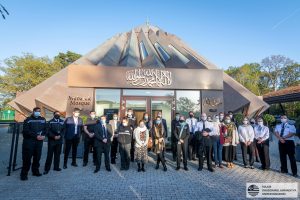
At the end of the experience, at the invitation of the Ahmadiyya Muslim community, 30 police officers and staff attended Mubarak Mosque in Farnham for Iftar, the breaking of the fast, a tour of the Mosque and an evening meal. 

For those who didn’t attend in person, food parcels were supplied by the Ahmadiyya Muslim Youth Organisation for participants to enjoy after sunset. 

This is the second year Inspector Chris Pike has fasted for the whole of Ramadhan to understand and support some Muslim friends.

Chris says: “I was intrigued by how it feels to fast and what my colleagues and friends experience when they fast. Fasting for Ramadhan last year made me appreciate the things in my life that I take for granted, not just people, but also things like having a roof over my head and the community I live in. I feel that I have been fortunate to learn through my experience of fasting. Ramadhan also helps me consider my lifestyle and re-centre, giving me an opportunity to be healthier.  Also, zakat, the making of donations to charity, is something which is central to the Muslim faith and has highlighted to me how we can make a difference in other people’s lives; not just giving  money, but giving people our time too, to give support and compassion to the people around us.”

Hibat ul Mohsin Abid, Director of Outreach for the Ahmadiyya Muslim Youth Association said:

“This is the second year that Ahmadiyya Muslim Youth Association (AMYA) UK has supported Surrey Police’s Fasting Collective. AMYA is an organisation with a passion to serve the community and being a driver for positive change at its heart. To support this initiative, we were graciously permitted by His Holiness, Mirza Masroor Ahmad, the current head of the Ahmadiyya Muslim Association, to hold the Iftar (breaking of fast) at the Mubarak Mosque. The Fasting Collective has been a great source of inspiration for our youth as well, as not only does it provide us with an opportunity to engage with the police, but also we are truly amazed by the positive experiences and warmth shared by the police. The positive feedback that we have received from those who took part in this initiative has been very encouraging and motivating. For this day, everything was done by volunteers, which included activities such as cooking and packing food, delivering food parcels to several police stations and hosting a physical and virtual Iftar. We really hope that the Fasting Collective will have allowed those who took part an opportunity to better understand the importance of Ramadhan and fasting. It has been an absolute pleasure to host Surrey Police and Sussex Police, and we sincerely hope that in the future we are able to continue with such initiatives and more.”

Having taken part herself, Surrey Police’s Temporary Assistant Chief Constable Ali Barlow reflected on her experience: 

“Being one of the 78 officers and staff involved in the Fasting Collective has given me a much better understanding of why there is a fast and what it means to Muslims – a time for reflection, self-restraint and thinking of others less fortunate. On a practical point whilst I was thirsty rather than hungry during the day it really did make me stop, reflect and focus and made me realise just how much time during the working day we spend grazing on food, drinking endless cups of tea or coffee and getting absorbed in the demands of the everyday.  Surrey Police has, through our commitments, promised to be kind, friendly, inclusive and supportive of our police families and to respect and reflect the differences in the communities we serve. We have also committed to valuing and learning from the different perspectives and experiences of others and this is exactly what being involved in the Fasting Collective has helped me to do. It has been an absolute privilege to be involved in the Fasting Collective, to show our support for our Muslim colleagues and communities during the Holy month of Ramadhan, and to experience the fast together. I would like to thank the community for welcoming us so warmly to the beautiful Mubarak Mosque – which has such a sense of peace – and for their generosity, kindness and support today. On behalf of us all, I wish everyone celebrating a wonderful Eid Mubarak.”

Farhan Hayat, Deputy Inclusion Lead and Chair of Surrey Police Association of Culture and Ethnicity (SPACE) said: “As a race and ethnicity staff network, we have been so touched and humbled by the support seen throughout Surrey Police for Muslim colleagues observing the holy month of Ramadhan. 

“For Muslims across the world, Ramadhan is without a doubt one of the most important and holiest months of the year and having the support of colleagues means so much.  By authentically living the experience of others we strengthen both our knowledge and our connection with them, and we’re so pleased that almost eighty colleagues chose to do that.”

Good Friday Music – The Hub

Regular contributor Baron Armah-Kwatreng lets us in on some delightful Easter tunes! Original article featured on thehubcast.co.uk

Three Recordings for Easter

Image: Salvador Dalí, Christ of Saint John of the Cross, c. 1951

Oil on canvas 204 x 115.9cm. Kelvingrove Art Gallery and Museum, Glasgow

/ Credit: © CSG CIC Glasgow Museums Collection

Easter is arguably the most important occasion in the Christian calendar as Christians everywhere celebrate the Resurrection of Jesus Christ. The Hub marks this most important occasion with three recordings that in their different ways reflect the spirit of Easter.

Duo Scott and Vince return with another selection of five seasonal songs. Charles A Holme reads his reflective poem and the folk choir from St Joseph’s Catholic Church, Epsom provides its own offering in song.

Scott and Vince’s Easter Special

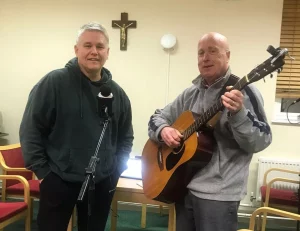
Picture: Scott Swift and Vince Yearly singing in harmony / Credit: The Hub

Epsom Catenian Circle‘s answer to Simon & Garfunkel – Scott & Vince – return after their successful Christmas Special with a selection of five songs at Easter time.

The songs reflect the duo’s differing tastes with Scott drawing on perennial favourite Stevie Wonder with Lately from the iconic 1980 album Hotter than July . Vince adds a floor-filler from his wedding band days, Van “the Man” Morrison’s Brown Eyed Girl from 1967 album Blowin’ Your Mind!. Among three other songs.

The songs were recorded in the Epsom Hospital Radio studio and were then edited to intersperse a Zoom interview with the duo on the inspiration behind each song choice. The interview concluded with a Q&A on what Easter means to each man.

You can listen to the interview and to the songs by clicking on the link below.


Christ of St John of the Cross: A Reflection

by Charles A Holme

Lifted high above an idyllic country view,

A lake, mountains, an empty fishing boat,

Against a menacing black sky. One man crucified.

Viewed from close overhead. A notice on the cross.

He is a carpenter who loved wood. Knew its grain

And strength. Chose it, shaped it, smoothed it

For village life. Seen here, ironically, hanging

From the rough beam of Roman justice

Below a notice.

No crowds passing by busy with their daily lives,

No jeering religious leaders, cowering disciples,

Distraught mother, gambling soldiers or penitent thief.

Alone. Raised against the engulfing black of this world

Below a notice.

Lit to show his Healing Hands, fractured, bleeding, torn,

By hand crafted, hand piercing, second-hand nails.

Shoulder muscles weakening, each shallow precious breath

Sighing blessings, forgiveness, love for Mary, a psalm

Below a notice.

That notice. Is it his name and crime?

A curse or a blessing? About victory or defeat?

Or, like on a parcel, delivery instructions

Sending him to some distant realm to be forgotten?

Or as an unwelcome, uninvited gift,

A ‘return to sender’ address?

It is all of these at the same time.

By his water and blood on that cross

Past and present linked for ever to my future.

Headley-based poet Charles A Holme offers a reflection on Salvador Dali’s arresting painting Christ of St John of the Cross. Piers Townley, a senior PR & Media Officer at The Brain Tumour Charity responded to this post, saying: “I’ve seen that St John of the Cross in real life in Glasgow. It’s an incredibly powerful piece of art up close. It’s huge and really intimidating. In a good way.”

Travel consultant and cricket fan Paul Movel, an interviewee in The Hub’s Test Match Special blog, agrees. “I am not into art, but when in Glasgow I went to see that ‘Christ of St John of the Cross’ picture. It’s quite impressive.” You can find out about the painting by listening to a Royal Academy of Art podcast of Dr Fiona Bradley, Director of The Fruitmarket Gallery, Edinburgh presenting on “A closer look at Salvador Dali’s ‘Christ of St John of the Cross’”.

You can listen to Charles A Holme reading his poem by clicking on the link below. Charles is a lay preacher and worshipper at St Mary the Virgin Church of England church in Headley, Surrey.


St Joseph’s Catholic Church, Epsom – Folk Choir

Picture: The St Joseph’s Catholic Church, Epsom Folk Choir in full voice

/ Credit: The Hub

On Palm Sunday The Hub was privileged to be given a private concert by the folk choir at St Joseph’s Catholic Church, Epsom.

Choir leader Emma Swan invited The Hub to the group’s rehearsal session before the Palm Sunday service. The choir – from left: Kathy Maskens, Emma Swan, Emma Smith, father and son Vince and Scott White – sang five hymns. Jonathan, the drummer, is in the background.

Kathy Maskens is a regular feature of this site and is the inspiration behind The Hub’s Friday 2-4pm show on Epsom Hospital Radio. The A Team is a patients and staff requests show for the Alexandra Frailty unit where Kathy is the Community Matron. Kathy and Emma Swan share the distinction of performing in the lead role in the musical Godspell.

The first hymn sung by the group, Prepare Ye The Way of The Lord, is from Godspell. After the service, Emma Swan talked to The Hub about the choir’s choice of hymns. You can listen to the conversation with Emma and hear the hymns by clicking on the link below.

After listening to the interview, singer and guitar player Emma White added: The folk group has been going for nearly 40 years! I was born in 1978 and have been in the parish all this time. The group was going since I can remember in the 80s! I have been involved with it since the late 80s, early 90s with a few breaks here and there. How scary is that?!!


Read more from Baron for Epsom & Ewell Times here!


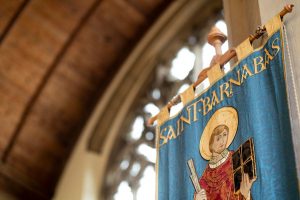
A Matter of Faith: St. Barnabas Church

The world’s largest religion, Christianity, is based on the life and teachings of Jesus. The origins of Christianity dates back to AD 30-33 in Jerusalem. The belief that God is one eternal and supreme being led billions of people to follow this religion. 53% of England’s population in 2018 were identified as followers of Christianity. There are thousands of churches around England that follow different principles with some of them being, Baptists, Methodists, Catholics, Church of England and the list goes on.

Epsom and Ewell alone accommodates 29 churches that observe worshippers on a regular basis. The diverse followers practice their religion wholeheartedly. St Barnabas Church in Epsom believes in one true God who lives eternally in three persons—the Father, the Son and the Holy Spirit. 

The hundred-year-old building welcomes people from any age, race, gender and religion for worship and in their innovative sessions such as Alpha and Barneys. Alpha course is more focused on young people with curious minds who want to explore the big questions of life, faith and meanings. This free session is open for all and helps people understand the Christian faith in a friendly, open, and relaxed environment. Barney’s session targets babies, toddlers and their parents and carers. The session involves lots of toys, songs, bible stories and refreshments for all which is an innovative way to connect little ones with church and God. 

According to Christians, Jesus Christ came in human form to teach people to love God and love their neighbour. Churches aim to spread this teaching through their Sunday prayers. Associating itself with Epsom primary schools, St Barnabas Church takes informal lessons either in schools or church itself where they educate young ones about the Christian faith and belief. Harry Lamaison, deacon of the church, says: “We’re currently exploring the ways we can engage with the local community and its evolving process. We have links with charity organisations such as Love Me Love My Mind and Sunny Bank Trust which helps people with their mental health issues and offer solutions for the same.” The church has linked itself to offer help and support from people who are dealing with mental health issues, breakdown of a relationship or a shock from death in a family. 

St Barnabas follows one of the greatest messages of Jesus Christ “Don’t forget to do good and to share what you have because God is pleased with these kinds of sacrifices.” Church extends its hands to people in the community who are going through financial hardships by providing advice on how they can plan their expenditure and savings. Advice is offered by a financial adviser and is often done by setting up a private meeting with the person. St Paul’s Howell Hill and St Barnabas are working in partnership towards making the local community better by offering support to families in need. The local community is encouraged to take part in church activities that help in bringing the neighbourhood closer and stronger.

To support each other is what God has taught us all. How do we support each other is the big question. The church helps anyone in need and is looking forward to collaborating with local artists who are often unnoticed. Combining prayers with artists is a great way to promote local talent and to draw the attention of locals towards the church. With musicians, dancers and other artists, prayers can be more fun for youngsters as well. Moreover, the church also gives out space for weddings, birth or death. A nominal fee is charged for decorations and upkeep of the church. Artists can also take part in these functions as per people’s choice. 

Sunday prayers are the heart of any church, where worshippers gather and worship for the betterment of their lives. Any religious establishment is incomplete without people and followers. Growing westernisation has kept many apart from the creator of the world. Remembering that god even once a day gives no harm and helping others is an act of God. Every culture or religion tells us how humans should live in harmony and respect each other’s decisions. Be it Jesus Christ, Allah or Bhagwan, all of them are with us, teaching the way of life and how to achieve peace in life.


A Visit to Stoneleigh’s Hindu Temple

Scintillating festivals and folk songs that are sung in Hindu culture bring nothing but life to Surrey. With the houses adorned like a bride, and temples flocked by those who follow the religion, Hinduism is a way of life. Our country is a multicultural state, where people from different beliefs, cultures and backgrounds have settled. Spreading its idea amongst people, Hindu belief is now popular all over the world because of its festivals and traditions. To be more precise, there is no month without a festival. 

Hindu belief has no specific founder, however, 95% of Hindus around the globe are known to live in India. Hinduism primarily has two symbols, one of which is OM and the other one is Swastika. Many recognise swastika used by the Nazis, however, in Hindu culture, it’s a symbol of divinity and spirituality in varied religions such as Hinduism, Buddhism and Jainism.

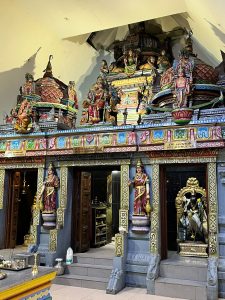
Established in 1994, the Sri Raja Rajeswari Amman temple lies in the heart of Stoneleigh, Epsom. The presiding goddess of the temple is Sri Raja Rajeswary Amman who is known as the mother of love and grace and showers her blessings upon all and develops the goodness within humans. The temple is hailed as an eternal place of devotion, purity and peace. Timeless statues of Hindu deities such as Sri Ganapathy, Sri Murgun, Sri Venktaeshwarar, Sri Pathmavati adorned with jewels and embroidered clothes are kept inside the temple. 

The architecture of the temple comprises two rooms one of which is the area where devotees pray and perform pooja and the other one is for functions such as marriages, festivals and childbirth. Vibrant and beautiful carvings are echoed in its art and architecture. The mandir (Temple) is a lively and peaceful place for worshippers who often come in for their evening prayers. The usual opening hours for the public are from 8:30 AM- 1:PM and 5:30 PM-10:30 PM. With just two Hindu temples in Surrey, this temple attracts devotees from across the county on Tuesdays and Fridays.

The temple witnesses thousands of devotees every day forming long queues outside the temple right from the early hours. “It’s very good to see people follow their culture even after coming abroad. Festivals are celebrated with full enthusiasm and exuberance. Many worshippers even offer donations to the temple for better functioning ” says the temple priest, Visvnathan Sarma, who has been working at the temple for 25 years now. He added, “I enjoy working for the god, it’s always peaceful and soothing for me to spend my time here at the temple and I wish to devote my rest of the time here only”. 

Worship is considered an important part of daily life. The majority of Hindu families have their own shrines where offerings are made and prayers are said to the deities. Worshipping involves all five senses:  touch, taste, smell, sight and hearing. Washing hands, bathing before the prayer, removing shoes before entering the shrine or temple are a few of common rules which must be followed. During the prayer, some offerings such as sweets, flowers and money are made to gods and goddesses. It is important for some men to wear a sacred thread over their left shoulder and hang it to the right hip. This thread is known as Janeu which means shouldering the burdens of life with patience.

There are various cultures in Hindu tradition and rules, marriage rituals, separation rituals might differ from each other. North Indian marriage rituals differ from what South Indian or Sri Lankan weddings perform. But you can expect that marriages traditionally involve a great number of guests, are bright, and colourful. A Hindu wedding is usually a week-long festival consisting of different functions every day which has deep philosophical and spiritual significance. During the wedding, the groom and bride take seven rounds around the fire (Agni) which binds both the couple to the seven promises of their married lives. Sindoor (Vermilion Powder) on their forehead and Mangalsutra worn by Hindu brides symbolises a woman’s marital status. 

The caste system is one of the main reasons which divides Hindus according to their karma (work) and Dharma (duty). It is believed by many scholars that this system dates back more than 3000 years. The four main castes in Hindu belief are Brahmin(the intellectual leaders), Kshatriya(the protectors of the public), Vaishyas (the skilful producers) and Shudras (the unskilled labourers).The system forces individuals to follow the rule and only marry within a specific caste. Even though there are mandatory laws that protect so-called low caste people from violation and discrimination, there are only a few who treat everyone as equal.

Hinduism is enriched with wonders and shocks, it is widely followed and practised by people around the globe. The beauty of festivals, the joy of celebration, the taste of sweets and the bitterness of ancient customs are what constitutes Hinduism. Every belief comes with its rules and traditions, what matters is how it is passed on from generation to generation.