Epsom and Ewell Times

Current Front Page

ISSN, LDRS and IMPRESS logos

Will Surrey’s Debts Force Us to Have a Unitary Authority?

Town Hall

Billions of pounds in crushing debt could force Surrey and its boroughs and districts to become a single mega council – potentially merged with a neighbour, following government feedback on its devolution and reorganisation plans.

Two plans were submitted in March over how to dissolve local government in the county and create a new streamlined system.

The county council and a handful of the boroughs favoured splitting Surrey into two authorities with Elmbridge worried about being ‘punished’ if it is grouped with debt-ridden neighbours – while the majority of the districts favoured three. Both would have an overarching and directly elected mayor.

Now, those plans could all be for nothing if they are unable to demonstrate how to deal with the more than £5 billion of debt owed  – and in particular £2.6billion from bankrupt Woking Borough Council and £1billion at Spelthorne where government commissioners have recently been appointed to take over.

The letter from the Ministry of Housing, Communities and Local Government was sent to all chief executives of Surrey’s boroughs, districts and county council, in reply to the councils’ plans.

It read: “The county and district co-authored plan shows that greater  efficiencies are available where there is less disaggregation, with the single  unitary enabling the greatest efficiency that could benefit the management of local debt. 

“Given the scale of the financial challenges facing Surrey, we would welcome further detail on how the ability to manage debt compares in each of the different options. 

“As the long-term financial sustainability of the three unitary option seems most challenging in this context, we will need more information on how you will manage the risks of disaggregation to meet the financial sustainability criteria as well as the approach to debt management.”

“We suggest meeting to discuss in more detail local proposals for managing debt.”

The ministry said that if Surrey was to shift towards a single unitary model, unlocking devolution would mean partnering up with neighbouring authorities or joining a neighbouring mayoral authority. “

To achieve this, the area will need to ensure the proposed devolution geography meets the criteria set out in the English Devolution White Paper.

A Surrey-only devolution would only work, it added, under the two or three unitary council proposals  “subject to achieving sensible population ratios between unitaries”.

The ministry also specifically asked for evidence on how any new merged authority  “would enable financially viable councils, including identifying which option best delivers value for money for council tax payers”.

It added; “We note the desire for clarity and further discussions around the area’s debt position and your preferred option for Government to write off the current estimated debt of £1.5bn.”

Woking  Borough Council is short £1.5billion  – once all its assets are accounted for.

It continues: “The default position is that assets and liabilities remain locally managed by councils, but we acknowledge that there are exceptional circumstances where there has been failure linked to capital practices. 

“Where that is the case, proposals should reflect the extent to which the implications of this can be managed locally, including as part of efficiencies possible through reorganisation. 

“Commissioners should be engaged in these discussions. 

“It would be helpful to see further detail in proposals on the projected financial sustainability of proposed unitaries and how they could manage debt locally.”

ENDS


Press statement from the Leaders of Surrey’s District and Borough Councils

Today, district and borough councils have published proposals for local government
reorganisation on their websites, to be debated at Council meetings across the county
in the coming days. Final proposals will be submitted to Government by 9 May 2025.

Eight of the eleven district and borough councils are proposing a three unitary council

model for Surrey. They believe that this is the best way to preserve local democracy and
accountability, and would ensure that new councils align with Surrey’s existing
economic and community identities – creating the foundation for more responsive
governance and stronger local economies. There is also a proposal for two unitary
councils being submitted by Surrey County Council. Those councils that have been
undecided so far will make a final decision between the 6 and 8 May.

The new structure for local government will replace the current two-tier system of
district, borough and county councils.

Councillor Hannah Dalton, Chair of the Surrey Leaders Group and Chair of the Epsom &
Ewell Borough Council Residents’ Association (Majority Group) said:

“This is a significant achievement and the culmination of much collaboration and hard
work by council leaders and officers across the county.
“There are still issues to be resolved, including how debt will be managed. Over the
coming weeks and months, we will continue to work at pace towards a vision for the
county that delivers for our residents and communities, that enables us to unlock the
wider benefits that devolution can ultimately bring.
“I’d also like to take this opportunity to thank everyone who took part in the recent
resident engagement which sought opinion on shaping Surrey’s future, the results of
which indicated clear public support for a three unitary model of local government.
“We also appreciate the time given to us by representatives from charities, parish and
town councils, residents forums, health services, community groups and others across
the county in our stakeholder engagement exercise and roundtable group sessions. It
was really important to make sure as many voices as possible were heard in this journey
about the risks and opportunities of changes that will impact local services and
Communities.”

Government is expected to decide on proposals by the end of the year. If approved,
legislation will be passed to allow the changes, and elections for new shadow unitary
councils will be held in May 2026, with a view to the new unitaries going live in May
2027.

Proposals are published on council websites:

  • Elmbridge Borough Council
  • Epsom and Ewell Borough Council
  • Guildford Borough Council
  • Mole Valley District Council
  • Reigate and Banstead Borough Council
  • Runnymede Borough Council
  • Spelthorne Borough Council
  • Surrey Heath Borough Council
  • Waverley Borough Council
  • Woking Borough Council

– Ends –


County council set to propose two unitary councils for Surrey

Subject to Cabinet approval, Surrey County Council plans to submit to government a proposal for two unitary councils for local government reorganisation in the county. These two councils, arranged by East and West, would replace the existing 12 councils and unlock further devolution in Surrey. 

In council papers published today, the county council outlines detailed analysis to evidence that two councils would be the most beneficial model for Surrey’s future. The proposal, which sets out a robust plan for local community engagement, also includes letters of support from key partners, business and community leaders, as well as Elmbridge Borough Council. 

Tim Oliver, Leader of Surrey County Council said: “Our analysis shows that two unitary councils would bring the greatest benefit to Surrey’s residents. Two councils, in partnership with a Mayor for Surrey, would save money, strengthen and simplify local government and with an East and West arrangement both councils would be in a strong position to continue to deliver high quality services to all Surrey residents. Of course, consideration must be given to the differing levels of debt that the authorities would potentially inherit, and we’re in talks with government about our request that the stranded debt be written off as well as providing financial support to those borough councils that need it.  

“Most importantly, this proposal strengthens local community engagement.We know that residents want high quality services that are easy to access, and they want a real say in services and decisions that affect them. That’s why we’re proposing the creation of community-level boards across Surrey. 

“These community boards will be locally determined but we would expect them to include representation from health partners, Surrey Police, voluntary groups, councillors, council staff, local Town and Parish Councils and Residents Associations. We plan to pilot these boards over the coming months, and residents will have a say in how they are set up and delivered.  

“We’re in a strong position as a county council, with good quality services and an excellent track record of stable finances after years of successful transformation. And working together with our residents and partners, we are well placed to deliver this important reorganisation. Ultimately, this work will unlock further devolution, meaning Surrey can elect a mayor which will bring more power, flexibility and funding closer to communities.” 

Cllr Mike Rollings, Leader of Elmbridge Borough Council said: While Elmbridge, like other districts and boroughs, is not overly enamoured with the government’s local government reorganisation, throughout this process, we have maintained an open-minded stance regarding the optimal number of new unitary authorities. Our primary goal is to ensure the best interests of Elmbridge, as well as Surrey as a whole. We have always said that our decision will be grounded in robust evidence and data and we will continue to analyse, research, and scrutinise all options until we are confident that the best solution for unitarisation in Surrey has been identified. 

“Based on the proposals we have seen, we think an East/West split could make the most sense for Elmbridge both in terms of financial stability, increased flexibility to meet housing needs and the potential to minimise the impact on the character and appearance of Elmbridge.

 “We will continue to work across the county to support the development of proposals that lead to the best results for our residents, and we will debate these at extraordinary meetings of our Council and Cabinet on 6 May.” 

The proposal includes a recommended geographical model for the two councils, by East and West, using current District Council geographies with Spelthorne, Surrey Heath, Runnymede, Woking, Guildford and Waverley residents in the West of Surrey, and Elmbridge, Mole Valley, Epsom & Ewell, Reigate & Banstead and Tandridge residents in the East. 

This model has similar levels of population, land area, total household numbers, homelessness, house building targets, waste collection, business activity, pupil distribution, number of birth and death registrations, and total miles of public highways. Demand and budget requirements would also be similar for Adult Social Care and Children Social Services across both councils and this geography makes use of the neighbouring economic benefits of London, Heathrow airport, and Gatwick airport, with a similar mix of the urban and rural landscape that makes Surrey a fantastic place to live and work. 

The overall populations of each new council would exceed the government’s minimum size of 500,000 residents. 

Notes:  

  • In February, government asked Surrey to submit plans for local government reorganisation. Once this proposal has been approved by Surrey County Council’s Cabinet on 7th May, it will be submitted to government by the 9th May deadline. A final decision is expected from government in the Autumn. The full council paper can be accessed here: https://mycouncil.surreycc.gov.uk/ieListDocuments.aspx?CId=121&MId=9715&Ver=4
  • District and borough councils in Surrey are also discussing options for reorganisation at respective council meetings.   
  • Details of an online resident engagement event, due to be held in May, will be shared soon 

Look to your own party’s dictatorship

Letter to the Editor

Sir,

I reply to Cllr Ames’ letter attacking Residents Association councillors in general and me in particular.

It is a pity that he chose to quote me selectively. I did say that the RA Group could put through anything it wished – that is a simple fact as we hold 25 of the 35 seats. However I went on to say that we value the contributions of members from other parties. .

A council may use either the cabinet or committee system of government. We use the committee system under which all councillors may partake in all decision making, as Cllr Ames has done. Unlike many other councils, all councillors are involved.

It is also a pity that Cllr Ames did not mention the subsequent meeting of the Standards and Constitution Committee on 16 April of which he is a member. This was a long but amicable meeting where much of the two and half hours was spent dealing with suggestions from Liberal Democrat leader Cllr James Lawrence. Some of his proposals were accepted. On all the motions, James was congratulated on the effort he had put in to serve the council and the constructive way he worked with RA members. This is hardly the attitude of a dictatorial ruling group.

In contrast, let us look at the Labour government of his party. Last year in the general election it got about a third of votes on a 60% turnout. This means that only one in five electors voted Labour. Another two voted for other parties, and the remaining two did not vote at all. Subsequent opinion polls suggest that Labour has lost support since the election.

On the basis of getting just 20% support from the electorate, the Labour government has dictatorially decreed that the borough should provide more than 800 new homes each year building on Green Belt, and that the borough council should be abolished in 2027. On neither of these issues has the government consulted anyone to ask if they want all this extra housing or if they want the council abolished. I have yet to meet any resident who supports either policy. The Labour government does not listen to any voices other than its own, and sometimes does not even listen to its own voices.

I like Cllr Ames as a person, and I respect his right to criticise me and RA councillors. However I believe that this should be done fairly, and not by selective quotation wrapped up in bluster. If Cllr Ames does not like dictatorial government, he would be better advised to direct such views to his own party.

Cllr Robert Leach
RA councillor

Nonsuch Ward


Labour decries Residents’ Associations’ unfettered power on Epsom & Ewell Council

Letter to the Editor

Dear Editor,

Thank you for your excellent reporting of last week’s meeting of Epsom and Ewell Council’s Standards and Constitution Committee, which highlighted some important and contentious issues about how councillors represent our residents.

Your analysis that public trust and democratic scrutiny hang in the balance is spot-on. In my two years so far as a councillor, I have frequently sought to highlight these issues, often in conjunction with other opposition councillors and sometimes with the support of more independent-minded Residents Association (RA) councillors.

In this light, I would like to highlight Cllr Robert Leach’s comment concerning the committees that decide the bulk of what the council does, that “The RA group can put through anything it likes”.

This shocking comment goes to the heart of issues of democratic scrutiny and appears to reflect the approach of the ruling party and many RA councillors to a situation where it has two-thirds of councillors. Despite its councillors purporting to represent residents at a very local level, the RA can often operate as a monolithic block.

One major change that the RA administration has attempted to implement is to neuter the Audit and Scrutiny Committee, of which I am also a member, which should play a key role in scrutinising what the council does in the name of residents.

Despite, or perhaps because of this, the administration has proposed to remove the committee’s scrutiny function, on the grounds that scrutiny should take place on the committees that make policy and spending decisions.

Cllr Leach’s blunt assessment that “The RA group can put through anything it likes” on such committees should represent the death knell for this proposal, which the administration has already had to “pause” in the face of fierce opposition.

While Cllr Leach’s words represent the numerical reality, they neglect the role that opposition councillors can play in raising questions and challenges and, on occasion, influencing how other committee members vote.

Last month, for the second year running, the Audit and Scrutiny Committee amended its own annual report, as drafted by the administration, to record that it had carried out “limited scrutiny” over the past year.

While this is an unfortunate situation, to say the least, it does show that some RA councillors have an appetite for a stronger scrutiny role and, despite what Cllr Leach says, can vote according to their own individual judgement.

Democratic scrutiny of what the council does in the name of residents is essential to maintain the public’s trust in it. We need more of it – and less of a ruling party that thinks it can put through anything it likes.

Councillor Chris Ames – Labour – Court Ward


Epsom and Ewell Borough Council Faces Scrutiny Over Constitutional Reforms

Hannah Dalton and John Beckett at Standards meeting

The Standards and Constitution Committee meeting of Epsom and Ewell Borough Council on 16th April was marked by heated exchanges and concerns over transparency, democratic participation, and officer-councillor relations.

The meeting, chaired by Councillor Hannah Dalton (RA Stoneleigh), dealt with contentious proposals affecting the structure of council committees, rules on public participation, and the delegation of powers to council officers. In the words of Councillor Chris Ames, (Labour Court) “There hasn’t been a meeting of the Constitution Working Group for seven months,” raising the stakes and intensity of the evening’s debate.


A Push for Plurality Rejected

A major flashpoint was the proposal to increase the number of councillors on the influential Strategy and Resources (S&R) Committee from eight to ten. Liberal Democrat Councillor James Lawrence (LibDem College) introduced the motion, arguing that the change would reflect “the plurality on the council” following the expansion to five political groups. “Strategy and Resources is, of course, our most important committee… and particularly so with unitarisation occurring and property decisions,” he said, asserting the need for broader representation.

Independent Councillor Alex Coley (Ruxley) added, “We should attempt to achieve the best plurality so that voices of smaller groups can also be heard and we can undertake proper, robust scrutiny.”

Despite the support, the motion fell. Councillor Robert Leach (RA Nonsuch)) dismissed it as a matter of “adiaphora — decisions that don’t really matter,” and declared, “The RA group can put through anything it likes… so I don’t think this would make much difference.”

Others expressed scepticism over inclusivity. Councillor John Beckett (RA Auriol) questioned the logic of the expansion: “We’re only going to give a voice to four [groups] if we go with this enlargement, so not everybody’s voice will be heard.”


Clashes Over Public Participation Rules

The committee also reviewed proposed changes to public participation rules, particularly Standing Order 3.1.3, which would allow officers to reword public questions for clarity. Councillor Bernie Muir (Conservative Horton) condemned the change as “seriously open to abuse,” warning it could “deny transparency, public accountability… and result in many issues and decisions being conducted without appropriate discussion.”

Councillor Lawrence suggested a compromise, proposing that officers “may suggest rewording” questions, rather than having an absolute right to do so. This amendment was accepted.

More fiercely contested was Standing Order 3.1.4, which sought to restrict questions relating to past legal cases or complaints. Councillor Ames described it as “having a chilling effect on public participation,” and stated bluntly, “We should not be trying to exclude members of the public… from participating at this meeting.”

In the end, the committee voted unanimously to refer the contentious clause back to the Constitution Working Group (CWG), along with concerns about the reduced five-to-three day notice period for residents’ questions.


Officer-Member Protocol Sparks Sharp Exchange

Perhaps the most contentious moment came with the debate on proposed additions to the officer-member protocol. Redrafted clauses sought to clarify officers’ expectations of councillors’ conduct.

Councillor Leach objected to the tone of the changes, declaring, “The council comprises councillors… not its officers… Officers are staff who are employed to do what we tell them to do.” This drew a stern rebuke from the Monitoring Officer, who warned that such language failed to acknowledge officers’ statutory duties: “If, in their professional opinion, something is unlawful or unconscionable, they have obligations.”

Councillor Lawrence defended the need for balance: “I don’t mind there being a look at the update of the officer-member protocol… but I would like it to be balanced.”

Ultimately, the committee agreed to refer the proposed changes to CWG, with a review of the Surrey County Council protocol as a potential model for achieving parity between officers’ and councillors’ expectations.


Delegated Powers Under the Microscope

Another area of concern was the list of proposed delegations to officers. Councillor Lawrence warned that not all proposals were “minor service changes,” pointing to one that would authorise officers to purchase properties for temporary accommodation.

“We should not delegate such significant capital decisions,” he argued. The committee eventually agreed to amend the wording, allowing officers to “identify and negotiate” but not to “purchase” without committee approval.


A Question of Process

Underlying the evening was a shared frustration with procedural breakdowns. Several members criticised the administration for sidelining the Constitution Working Group. “This administration, under your leadership, has twice postponed or cancelled the CWG,” Councillor Ames alleged, adding, “It would appear the CWG was not giving the answers that the administration wanted, so it’s been done away with.”

Chair Hannah Dalton acknowledged the delay, attributing it partly to the “devolution white paper” and pressures of local government reorganisation. However, she also committed to convening a new CWG to consider unresolved matters, stating, “You’ll probably need an extraordinary SNC and then bring it to the July meeting.”


As public trust and democratic scrutiny hang in the balance, the committee’s decisions to refer key changes back to the CWG suggest a desire to tread carefully. Whether this marks a course correction or a temporary pause in constitutional reform remains to be seen.

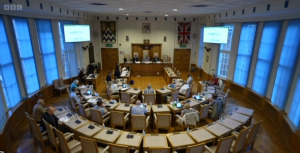
Image: The meeting from Epsom and Ewell Borough Council YouTube channel


The cost of saving the cost of local government

Surrey and Epsom Councils

As of April 2025, Epsom and Ewell is actively engaged in Surrey’s significant local government reorganisation, aiming to transition from the existing two-tier system to a unitary authority model.

The UK government initiated a directive for Surrey to be part of the first wave of local government reorganisation, inviting all 12 councils in the county to submit proposals for restructuring. The current two-tier system, comprising Surrey County Council and 11 district and borough councils, including Epsom and Ewell Borough Council, is set to be replaced by unitary authorities responsible for all local services.

Epsom and Ewell Borough Council, led by the Residents Associations of Epsom and Ewell, has expressed a preference for establishing three unitary councils within Surrey. This stance aims to balance efficiency with maintaining strong local connections. Councillor Hannah Dalton, Chair of the Surrey Leaders Group and leader of the Residents’ Association, has emphasized the importance of serving communities effectively and preserving local democracy.

Surrey County Council Leader Tim Oliver advocates for the creation of ‘community-level boards’ to ensure local voices are heard within the new governance structure. These boards would include representatives from various sectors, such as health, police, voluntary groups, and local councils, facilitating tailored public services and stronger community engagement.

While proponents of the reorganisation, such as Surrey County Council, argue that a streamlined unitary model will lead to long-term savings through the reduction of duplicated services and administrative overheads, there are also significant upfront costs involved. These include expenses related to restructuring staff, merging IT systems, rebranding, and establishing new governance frameworks. Early estimates suggest the transition could cost tens of millions of pounds, with potential savings only materialising over several years. Critics warn that these financial pressures could strain local services during the transition period and reduce the funds available for frontline delivery.

The Local Government Information Unit states: “A range of options for potential new unitaries were included from 27 to 67 different unitaries. And, across 18 regions (with the information publicly available), the average population size of options was 544,837. Across the 27 proposals analysed, £38.4m has been set aside for preparing LGR proposals. And, current financial analysis averages the estimated transition cost for each region’s reorganisation as £31.1m.”

A public consultation has been launched to gather feedback from residents and businesses on the proposed reorganisation. This initiative seeks to involve the community in shaping the future governance of Surrey, ensuring that the new structures reflect the needs and preferences of local populations.

  • Final Proposal Submission: The final proposals for the new unitary structures are to be submitted to the government by 9 May 2025.
  • Government Decision: A decision from the government is expected in the autumn of 2025.
  • Elections: Local elections, initially scheduled for May 2025, have been postponed to May 2026 to accommodate the reorganisation process.

Related reports:

Surrey Councils launch Local Government Reorganisation engagement

Surrey’s BIG debt question in local government reorganisation

Local Government Reorganisation in Surrey: Key Proposals

What might local government reorganisation mean for Epsom and Ewell?

Local government reorganisation: What will it mean for Epsom and Ewell?


RA councillor replaces Independent member as scrutiny row erupts at Epsom Town Hall

Audit and scruting committee 27th March 2025

A stormy Audit and Scrutiny Committee meeting at Epsom and Ewell Borough Council on Thursday 27 March has ignited a political row, as Councillor Robert Leach (RA Nonsuch) controversially replaced Councillor Alex Coley (Independent  Ruxley) on the committee. The change, made by the ruling Residents Association group, prompted accusations of “gerrymandering” and “Trumpian politics” from opposition members, particularly Labour Councillor Chris Ames (Labour).

The chair of the committee, Cllr Steven McCormick (RA Woodocte and Langley), presided over what quickly became a fractious meeting, with procedural disputes dominating its early minutes. The substitution of Cllr Coley – a former Residents Association member who resigned from the group and now sits as part of a two-member independent group – triggered a fierce exchange over the legality and transparency of the move.


“Nonsense on stilts”: Labour mounts strong objection

Rising on a point of order almost immediately, Cllr Chris Ames condemned the replacement as illegitimate:

“A member of the committee who was appointed by full council last year… has been excluded from attendance by diktat from the Residents Association… It’s a gross example of gerrymandering by the administration, by a Residents Association clique that will sink to any depths to gain revenge on the former member.”

Cllr Ames declared that no constitutional rule allowed for such a substitution, emphasising that committee membership was determined by full council, not party whips. He went on to challenge the very presence of Cllr Leach at the meeting, describing it as: “The worst kind of gerrymandering… resorting to Trumpian politics… shocking, absolutely shocking.”


Chair defends decision with constitutional reference

Cllr McCormick responded by reading from Appendix 5 of the Council Procedure Rules (CPR 15.4), arguing that: “A member of a committee… may designate as their substitute another councillor… The substitution happened by the leader of the RA group earlier today.” He added: “This is not to be debated… If you want to take it up with the monitoring officer, then please do.”

Despite Cllr Ames’s repeated interventions, the chair refused further discussion, insisting that proper constitutional advice had been followed.


Legal officer backs the administration

Cllr James Lawrence (Lib Dem College) attempted to elicit further legal clarity, but the deputy monitoring officer succinctly backed the chair: “I’ve got nothing further to add to what the monitoring officer has provided today.”

That led Cllr Ames to vent: “You have no explanation as to why a member of this committee who was appointed by council has been excluded from this committee.” He warned that the substitution would “nullify the whole proceedings”

Despite the protest, the meeting proceeded with Cllr Leach continuing in place.

Epsom and Ewell Times contacted Cllr Coley after the meeting and he said: “I did not request a substitute for either the meeting of S&R [strategy and resources committee] on the 25th March or A&S [Audit and Scrutiny committee] on the 27th March. Neither was I told that I would be substituted. I was however provided with a legal steer by the Council’s Monitoring Officer in which it was anticipated that the RA Group Leader might substitute me as the seat was allocated to that political group.”

“My reflection is that there seems to be a fear of robust scrutiny happening in committee meetings. Training on committee procedure is almost non-existent, with a lack of confidence and understanding creating a fait accompli when reports are brought to committee. It is my understanding that smaller opposition groups will be blocked from oversight of strategic financial decisions in the near future.” He added: “This bodes very poorly for the governance of the Council at such a critical time, with Local Government Reorganisation, a multi-million pound Town Hall move and an expected deficit in the Council’s finances in 2026.”

The relevant words of the rule are: “A member of a committee may……… designate as their substitute another councillor. …….. The nominating member, Leader / Chair of their Group, or Deputy Leader / Chair of their Group, shall inform the Democratic Services Manager of the substitute in writing prior to the meeting in question.”

There appears to be no rule allowing for any person other than the councillor himself or herself to designate a substitute.

Cllr Alex Coley and recently resigned group leader of the Liberal Democrats, Cllr Julie Morris (College), have formed a new 2 member Independent Group. The new Group pledges to allow its members freedom to vote and speak at Council independently from any “group position”.


Complaints report:

Following the dramatic opening, the committee did manage to turn to the rest of its business, including a review of council complaints between April and December 2024.

Members noted the learning from complaints data. Operational Services were responsible for 57% of complaints, mainly about refuse collection, although this was a 19.5% decrease compared to the previous year.


Treasury and transparency

The committee also received the Financial Strategy Advisory Group’s report on treasury management. There were no contentious issues here, and the recommendation to note the annual report passed unanimously.

But concerns over transparency re-emerged during discussion of previous minutes, particularly relating to responses to the external audit. Lib Dem Cllr James Lawrence criticised omissions in how verbal statements were recorded:

“If I’m looking at the minutes and I didn’t sit at the committee… that doesn’t tell me anything that adds to the debate.”

He also challenged the failure to record examples he had raised regarding “a failure to be transparent” in council decisions.

Cllr Ames returned to the theme, questioning why statements by officers in a previous meeting were vague or misrepresented. He called for: “An accurate description of what was said last time… because that is quite an important thing.”

Director of Corporate Services acknowledged this and promised to amend the minutes for accuracy.


RIPA and policy clarity

In the RIPA (Regulatory and Investigatory Powers Act) annual report the officer was candid:

“This is a report we’re obliged to bring to you every year to tell you about any covert surveillance… and we haven’t done any.”

The Council had nonetheless updated its surveillance policy after external inspection. The chair added that the report would be shared with community safety stakeholders to ensure open oversight.

Cllr Lawrence pointed out that a senior officer’s name in the report was “to be confirmed,” and officers clarified it was awaiting the arrival of a successor to Mr Sebastian.


Closing with caution

The meeting concluded with a subdued atmosphere after its turbulent beginning. No public questions had been submitted, and most agenda items passed without dissent.

But the confrontation over Cllr Coley’s removal – and the unresolved questions about process, transparency, and political fairness – are unlikely to fade quietly.


Commentary

The drama surrounding Cllr Coley’s substitution is more than a procedural quibble. It raises fundamental concerns about how power is exercised by the ruling RA group. When committee appointments, made by full council, are seemingly overridden without transparent explanation, the spectre of executive overreach looms.

Cllr McCormick’s constitutional cover seemed dubious at best and the tone and timing of the move – coming after Coley’s defection from the RA – understandably fuel suspicions of retaliation. The refusal to debate or justify the decision in open session further deepens the sense of opacity.

This episode may yet prompt a broader review of how Epsom and Ewell’s committees are constituted, and how scrutiny can be safeguarded from political manipulation.

Until then, the Audit and Scrutiny Committee risks becoming the subject of its own audit.

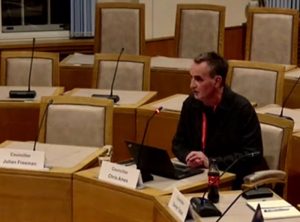
Image: Audit and Scrutiny Committee – Epsom and Ewell Borough Council YouTube channel.


Surrey Councils launch Local Government Reorganisation engagement

Surrey and Epsom Councils

Surrey residents can have their say on the future of local government in the county, in a new survey launched by eight of Surrey’s district and borough councils.

An initial proposal for Local Government Reorganisation, which would see the county divided into two or three unitary councils, was published by district and borough councils last week, and they are now asking for the initial views of residents and local businesses.

Given that the current system of local government has been in place for the last 50 years, this is a once-in-a-generation opportunity to change things for the better. Eight district and borough councils are therefore offering local people the opportunity to give their feedback on plans for the future governance of the county, to influence the next phase of the process.

Most district and borough leaders in Surrey support a move to three unitary authorities. They believe this would strike the best balance between efficiency and maintaining genuine local accountability, as well as maximising opportunities to support economic growth by ensuring that unitary authorities reflect the economic geography of the county. But regardless of any stated preferences, all district and borough leaders are keen that local people should have the opportunity to contribute to the debate.

The new unitary authorities would assume responsibility for the services currently delivered by Surrey County Council and the 11 district and boroughs. This transition would pave the way for the creation of a new strategic authority covering the county.

Councillor Hannah Dalton, Chair of the Epsom & Ewell Borough Council Residents’ Association (Majority Group) and co-chair of the Surrey Leaders Group, said:

“This is a pivotal moment for local government in Surrey. There are a number of compelling advantages to unitary councils – and cost savings is only one of them. We also need to ensure we create new organisations that can manage economic growth more effectively, and which recognise the importance of community, identity, and local democracy.

“Local Government Reorganisation provides us with an important opportunity to secure Surrey’s future prosperity, safeguard high-quality public services and ensure that decisions continue to be made close to the people they impact.

“The voice of our residents is what really matters. We want to hear what you think about the future of your local councils. Please get involved in the survey and give us your views.”

The survey is open for comments until Sunday 20 April.

Related reports:

Parliament motion to reinstate Surrey County May elections

Epsom and Ewell Borough Council has no choice but to vote for its own demise

Who will be saddled with Spelthorne’s and Woking’s £3 billion debts?

Local Government Reorganisation in Surrey: Key Proposals

An independent view on Epsom and Ewell Council’s future

Local Labour view on Epsom and Ewell Council’s future

Local LibDem view on Epsom and Ewell Council’s future


Surrey’s BIG debt question in local government reorganisation

Surrey county with big back hole debt.

Plans for what Surrey could look like in local government reorganisation have been agreed  but questions remain over looming debt. Councillors demanded to know how debt would be managed before the county is divided up.

The government outlined plans for a major reorganisation of local government in December. Two tier councils will be dissolved into unitary authorities which will carry out all local government functions like planning, bin collections as well as education and social care. 

Members of the County Council have agreed on March 18 two proposals for how Surrey could be carved up in the most dramatic reorganisation of local services in 50 years. Serving 1.2m people, Surrey’s current matrix – consisting of 12 borough and district councils and one county council – could be split into two or three new local authorities. 

Leader of Surrey County Council, Tim Oliver, said he believes reorganisation is the “opportunity to turbo charge localism”. He said: “Single councils are clearer for residents, have greater accountability, are more efficient and effective for delivery and strip out unnecessary bureaucracy and duplication.”

Option 1, and the Conservative-run cabinet’s preference, is to cut Surrey in half to create an east and west, or north and south. Exactly which councils will be included in the new authority are still yet to be determined, for instance whether Spelthorne borough is either on the east or west side.

Option 2, put forward by the majority of district and borough councils, consists of three new local authorities in the form of north-west, south-west and south-east Surrey. Again, full details of which councils would be included is still in the draft stages. 

The two outline plans will be submitted to the central government on Friday March 21, who will ultimately have the deciding power on the new face of Surrey. Meanwhile, the local authorities will keep working to produce a final proposal by May 9.

With over £5.5bn worth of crushing debt across the county, members publicly urged the government to solve Surrey’s financial issues before reorganisation. Cllr Catherine Powell said there needs to be “a clear path on the £5.5bn of debt” as it could create “significant imbalances” leading one council “more likely to fail”. The Residents’ Association and Independent Group Leader said she does not feel Surrey can propose new authorities without a solution.

Leader of the Liberal Democrat Group, Cllr Paul Follows, said the councils’ debt is “so toxic it will pollute the rest of this county”. He lamented that reorganisation will not be about what is best for residents but about how money will be spent. 

Speaking to the council, the leader said the government has “made it clear it does not intend to write off all of Woking’s debt”. Cllr Oliver said he will be having detailed conversations and Surrey will “have to come up with plan B”. 

Creating two councils in Surrey could save £27m after five years but three authorities could potentially make a loss of £8m, according to the county council’s report. But the district and borough councils argue three unitary authorities would only save slightly less money than two and not be in a deficit. 

However, Cllr Oliver said they have not taken into account the cost of reorganising services, such as adult social care, which could add substantial added costs. The leader claimed splitting into two is the best value for money for residents.

“There is no desire for Ashford to sink in with Godstone should the boundaries be cut [one] way,” said Cllr Robert Evans OBE. He explained slicing Surrey into two would only reveal some towns would have little in common with villages they may have not even heard of.

Creating two unitary councils with a population of around 600,000 each, opponents slammed the proposal as bad for local democracy and eroding distinctive community identities. Members also flagged there would be significantly less councillors looking after greater areas.

But those batting for a dual council-led Surrey said few residents even identify with the council and local identity would be strengthened by working with community groups and local healthcare networks.

Questions about services like adult social care as well as children and education services were raised as major issues. Cllr Sinead Mooney said splitting the adult social care beyond two units would complicate the service and people could “fall through the gaps”. Cllr Clare Curran highlighted the potential difficulties in retaining and splitting staff to more than two councils, meaning experienced teams could leave. 

Cllr Fiona Davidson called for a need to assess how many children homes, specialist school places and demand for foster children to ensure Surrey is covered with the right services. Members agreed it was not just about making services cheaper and simpler- they had to be run better than currently.

Related reports:

Who will be saddled with Spelthorne’s and Woking’s £3 billion debts?

Could Woking’s debt be shared by you after reorganisation?

What Epsom could do with Woking’s £75 million bail out?

Ex-Council Officers under investigation for Woking’s £2 billion debt

Will Epsom and Ewell be bailing out Woking?

No wonder Woking went bankrupt. Scandal of private school loans

PM confident of success in Woking

Woking’s whopping bail out and tax rise