
Epsom and Ewell Times
12th November 2026

ISSN, LDRS and IMPRESS logos

Education assessment delays making parents sick

Parents protesting outside Surrey County Council headquarters in Woodhatch Place, Reigate Credit: Emily Coady-Stemp

A mother claims Surrey County Council “makes her sick” as she says delays to assessing her son’s special educational needs are causing “a lot of stress”.

At a protest held outside the authority’s Reigate headquarters, the mother, along with others, called for change at the council in how Surrey’s children with additional needs are treated.

Image: Parents protesting outside Surrey County Council headquarters in Woodhatch Place, Reigate. Credit: Emily Coady-Stemp

Anna Sutherland, protesting for the fifth time outside the Woodhatch Place building, said parents being sent down the tribunal route, as they are if they want to appeal against a council’s assessment of their children, “put a lot on families”.

She claimed the education, health and care plan (EHCP) issued to her 11-year-old son by the county council was “unlawful” but that because she knew the law, and knew what he was entitled to, she would “get there in the end”. Ms Sutherland told the LDRS: “This makes me ill. Surrey council make me sick.”

With her 9-year-old daughter’s EHCP also up for an annual review soon, Ms Sutherland feared she may have two tribunals on her hands. On previous protests, cabinet members on Surrey County Council have come out to talk to the parents present, but did not on Tuesday (March 21).

When the group of parents decided to attend the council meeting taking place that morning, they were told they could only do so if they left their placards in the building’s reception downstairs.

Ms Sutherland said many families with children with additional needs had “a lot to deal with in the first place” and additional chasing of EHCPs, tribunals and school places was “a lot to put on families”. Saying many families also had to work, may also have neuro-diverse conditions themselves and the “huge impact” on a parent’s mental health of going through a child’s diagnoses she said the parents at the protest were representing a “much huger group”. She added: “On top of the stress they put on you, then having the additional strength or the additional drive to protest, a lot of families just can’t do that.”

Clare Powdrill said delays to the EHCP process for her son had led to her spending more than £30,000 in two tribunals, both conceded by the council the day before the hearing. She said: “I am protesting because Surrey County Council have seriously let my son down.” Another parent, Charlotte Lewis, also said EHCP processes had been delayed “at every step” and timelines not been met by Surrey County Council. She said: “Many parents are being forced into a lengthy and expensive appeals process which is usually won but can delay children’s access to an education by years in some cases. ”

A council spokesperson said: “We are not able to comment on the details of any individual children, but we can confirm that all current EHCPs were updated in line with statutory timescales to enable children’s transition to the next phase of their education. If a parent is unhappy with the content of their child’s updated plan, we would urge them to contact their case officer as soon as possible, so that any issues can be resolved.

“We always aim to resolve disagreements without families needing to go through a tribunal process, however, they do have the right to do so, and if it remains the view of the local authority that the latest education health and care plan accurately reflects a child’s needs and the provision required to meet their needs, then, in these rare cases the tribunal is the appropriate route to resolve the dispute.”



Surrey emotional and mental health crisis children’s home receives ‘Good’ Ofsted grading

A boy

Extended Hope, a respite home for children in Surrey who are having an emotional and mental health crisis has been graded as ‘Good’ in all areas by Ofsted following an inspection in November 2022.

Ofsted noted that “children have positive experiences in this home”, “staff support children to make progress in all areas of their lives” and “are skilled and knowledgeable in the care they provide children”. Inspectors found that, “despite the short-term nature of the home, staff help children to prepare for their future” and “safeguarding arrangements are in place to protect children”.

The home is operated by Surrey County Council in partnership with a wider Surrey and Borders Partnership NHS Foundation Trust service providing care for young people facing emotional and mental health crisis. It offers children a respite or crisis bed for up to seven days and is staffed by residential workers and community psychiatric nurses who can provide mental health assessments and support for young people out of hours as well as supporting families, carers and professionals.

Sinead Mooney, Cabinet Member for Children and Families at Surrey County Council said: “I am delighted that Ofsted recognises the positive experiences children have in this home. Extended Hope provides a safe and supportive environment for children to give them some respite, and also supports families with creating a plan of care. It is a crucial service because it offers children and young people support close to home and reduces the likelihood of them becoming an inpatient in hospital. Being close to home makes it easier for children to stay connected to their families, friends and their local communities, which is so important for their wellbeing, and ultimately their outcomes. This is why we are absolutely determined to ensure we have sufficient provision, in Surrey, and we will continue to provide the best possible support for the vulnerable children and young people we care for. I would like to congratulate and thank our staff and health partners for their determination and passion in ensuring these positive outcomes for our children and young people.”

Read the full report on Ofsted’s website here.

This home is one of ten county council-run children’s homes across Surrey. In 2020 and 2021, the Council agreed to invest £34m on improving sufficiency for Looked After Children and £2.4m in increasing management capacity and upskilling our workforce, so young people in care get the best environment to thrive, within Surrey. We are building up to three new purpose-built children’s homes in Surrey, the first of which is due to be completed in Spring 2023 and will provide a more accessible and homely setting to support children with the highest and most complex mental health needs. The design is at the forefront of green technology with modern building efficiency and its location will mean children and young people can stay better connected to the local community.

About Surrey and Borders Partnership NHS Foundation Trust

Providers of mental health, learning disability and drug and alcohol services for people of all ages. They provide a broad range of community and hospital services, mostly in Surrey and North East Hampshire but also extending across Hampshire, Croydon and Sussex. Their high-quality care focuses on enabling people and their carers to live well.

You can read about their New Hospitals Program on the website.

www.sabp.nhs.uk

From Surrey County Council news service.


Related reports:

1000 Surrey children wait for special needs plans

Epsom to help meet children’s homes bed shortage?

County children home challenges

Surrey County failed SEND boy


Surrey County failed SEND boy

Surrey fines

Surrey County Council has been ordered to apologise and pay a family £7,400 after failing a young boy with special educational needs. The local government and social care ombudsman published its finding today. It found Surrey County Council failed to provide the boy his full entitlement of education and therapy for 18 months and fined the local authority due the frustration, distress. and lost education it caused.

The boy’s mother raised the complaint in June 2021. As part of his education, health, and care plan, the boy should receive 15 hours of tutoring a week, along with speech, language and occupational therapy. Between September 2020 and January 2021 “he received just four hours a week. This rose to six hours a week in February 2021.”

In April 2021 a special educational needs and disabilities (SEND) tribunal ordered  the council to increase this to 25 hours a week, including weekly therapeutic provision, and animal therapy. Full speech and language therapy did not begin until September 2021. Animal therapy, despite the mother alerting the council that sessions had not started in May 2021, did not begin until March 2022 – as the council did not follow up her complaints, the ombudsman found.

In December 2021, the boy’s relationship with his occupational therapist was said to have broken down but Surrey County Council did not put in an alternative until March 2022.

Michael King, local government and social care ombudsman, said: “Councils cannot delegate their duties to ensure provision laid out in young people’s EHC Plans are delivered.  After councils issue these plans we expect them to ensure all the provision included is in place – and if it is not, it should act to secure it without delay. In this case the boy missed out on a significant amount of tuition and therapies for a prolonged period, despite a previous investigation by us which found the son did not get education between 2018 and 2020. It is disappointing that the council did not learn from the issues raised in my first investigation.”

Mr King said he had further concerns over the way Surrey County Council dealt with the mother’s complaints, which at one stage took 11 months to handle. The council’s own policy states it should have taken a maximum of 30 days.

Following the investigation Surrey County Council must now write to the mother and apologise for its faults and the injustice it caused.  It must also pay £5,400 for the boy’s his lost hours of education and therapy, £1,000 to the boy’s mother for the prolonged frustration and distress it caused which it compounded with poor complaint handling, and a further £1,000 to the boy in recognition of the distress caused to him. 

It must also carry out a review of how it arranges and monitors its provisions and complaint handling for its children and young people  services.

Mr King added: “The council has accepted my recommendations to improve its processes and I hope the better oversight this will bring will ensure other children and young people in Surrey do not miss out on the education and therapy they are entitled to in the same way.”

Surrey County Council now has three months to consider the report and confirm its actions. A spokesperson for the county council said: “The Local Government and Social Care Ombudsman has issued a report following its investigation of a complaint about Surrey County Council.  The complaint was about education and children’s services. The Ombudsman found that there had been fault on the part of the council, and this had caused injustice to the complainant. Surrey County Council takes the findings very seriously and apologises for any distress the family experienced, and has agreed to take action which the ombudsman regards as providing a satisfactory remedy for the complaint.”

The council must now consider the report and tell the ombudsman within three months (or such longer period as the ombudsman may agree) what it proposes to do. 


School transport failings lead to foodbanks…

Children and bus stop

Families were pushed to using food banks and suffered an impact on their mental health when Surrey County Council-funded school transport was not provided for their children.
Surrey County Council carried out a review into the school transport “failure” after nearly 150 families, many with children with additional needs, were left without a way to get their children to school at the start of term.
Alongside the authority’s internal review, Family Voice Surrey carried out its own, including a survey which heard from 290 families about the impacts of children not being provided with transport to and from school.
The survey showed that 71 per cent of those who responded had experienced challenges with home to school transport during the autumn term and that 19 per cent of children and young people were unable to attend school or college on the first day.
Leanne Henderson, the organisation’s participation manager, said they heard from “desperate” families every year about issues with school transport, often right at the end of August, when transport had not been confirmed for the start of the school term.
She also raised concerns about the communication that came from the authority, with many families waiting a long time for contact from the council.
The approach of the council had been “very inconsistent” she told a meeting of the authority’s children, families, lifelong learning and culture select committee on Thursday (December 15).
Ms Henderson said: “We had some families that told us they had to use food banks because they were so financially disadvantaged due to not being able to transport their child to school, and that was really quite worrying.”
She also told the meeting that the organisation was “shocked” that 86 per cent of respondents said the situation had adverse effects on their mental health and well being, and increased anxiety.
More than a third of respondents reported financial issues.
She said: “They were the two elements that really hit home and made us wonder: ‘Why has this happened? What is going on?’”
The meeting heard that at least six factors had led to a backlog of cases at the start of the school year, including an increase in applications, a policy change earlier in the year and a lack of resources.
Ms Henderson said she could see council staff were “totally overwhelmed”, saying she could see from both sides in talking to the families affected and those working at the council.
She said: “I could see the team and I really felt for them.
“They were doing the absolute best that they could do under really difficult circumstances.”
The council’s report listed 50 recommendations to ensure the issues would not be repeated next year, and there were recommendations in the Family Voice Surrey report.
Councillor Clare Curran (Conservative, Bookham and Fetcham West), the authority’s cabinet member for education and learning said she had also been “swamped” by emails on the matter.
She said the review that had been carried out was a “substantial piece of work” and not a “five-minute fix”.
The council spends more than £50m a year on helping children and families get to school, which Cllr Curran told the meeting is a fifth of the entire net budget for children and families.
Cllr Curran added: “I don’t underestimate the task at hand, I don’t underestimate the work that needs to be done.
“But I’m confident that we are going to get it done and next September families, children and young people won’t suffer the failure that there was in September this year.”
ENDS


1000 Surrey children wait for special needs plans

Surrey County chamber

A senior Surrey councillor admits it is “not good enough” that nearly 1,000 children with special educational needs in Surrey are waiting for an education plan. Nearly a third of those have been waiting more than the statutory 20-week limit for a Education Health and Care Plan (EHCP), with a shortage in educational psychologists among the reasons the council put forward for the backlog.

Surrey County Council’s cabinet member for education and learning said nationally for 60 per cent of children being assessed for an EHCP it was being done within the 20-week period. Clare Curran (Conservative, Bookham and Fetcham West) added: “Clearly it is not only a situation that prevails here in Surrey. Notwithstanding the national situation, I admit that it’s not good enough and not one that we would expect or want for our young people.”

An EHCP is put together by a council for children to outline what help they may need at school to support them with their special education needs and disabilities. There are 988 active EHCP requests at the council, of which 284 were known to be over the 20-week period, according to meeting documents.

Cllr Curran explained to a meeting of Surrey’s council on Tuesday (December 13) that a shortage of educational psychologists meant a mandatory part of the EHCPs could not be completed, which was contributing to delays. She said recruiting and training up caseworkers had been a focus, and the workforce was now around 80 per cent staffed across the county.

Her answers came in response to a question put forward by Lance Spencer (Liberal Democrat, Goldsworth East and Horsell Village) who said families were being “left behind” by the council and asked what was being done to reduce the “excessive delays”. Cllr Curran said that the council’s ambition was to achieve “better timeliness” by the end of the year in completing EHCP plans. She added: “I know the situation is not good. I know we are not achieving the level of service that we would want to for our children and young people. We are doing our very best to address that and make sure that things improve.”

In a written response, the council denied that parents threatening legal action sped up the time scales for getting an EHCP in place. Cllr Spencer’s written question read: “It would appear that where the parents threaten legal action that the EHCP timescales are reduced” and asked for the number of parents who had written threatening legal proceedings.

A written response said data was not collected at the council in that way, adding: “This process is not influenced by the threat of legal proceedings.”

The meeting heard that the issues impacting the outstanding EHCPs were also a factor in nearly a fifth of annual reviews not being carried out within six months of their due date.

A question put forward by Catherine Baart (Green, Earlswood and Reigate South) asked for an update on annual EHCP reviews at the authority. The response in meeting documents showed that at the start of term, 59 per cent of plans had an up-to-date annual review in place or were due within the next month, being 6,445 of the 10,963 plans in place. There were also 4,517 plans that were overdue a review, of which 1,849 were more than six months overdue.

Documents said the availability of staff over the summer had played a part in fewer annual reviews being completed on time, and that an improvement should be seen by the end of the autumn term. Cllr Curran said she did not know if there was a target within the department for completing reviews on time, but that the service was prioritising reviews for children who were vulnerable, including those looked after by the county council or on child protection plans.

Councillors also raised the issue of home to school transport in Surrey, described as “the biggest concern of many of our residents” by the Green Party Group leader on the council.

The council’s leader, Cllr Tim Oliver (Conservative, Weybridge) apologised in October for a backlog in sorting school transport for some of the county’s most vulnerable children, when more than 150 families were left in limbo at the start of term.

Jonathan Essex (Redhill East) called on the council to look in its review at the views put forward Family Voice Surrey which had spoken to 290 families as part of its own review.

Cllr Nick Darby (Dittons and Weston Green Residents, The Dittons) told the meeting the internal review listed more than 50 recommendations for the council, which he described as “a terrible indictment of the situation”. He said the school transport was “best described as a shambles” and questioned the creation of a new board to oversee progress being made up of officers and cabinet members, many of them previously involved in the process.

On Thursday (December 15) a meeting of the council’s children, families, lifelong learning and culture select committee will consider the council’s review of what happened at the start of the school year.


Surrey schools energy hikes

Radiator

Surrey schools are being advised to plan for increases in gas prices of more than 129 per cent.
Along with this, council finance teams are telling schools to plan for a 73 per cent increase in electricity prices, according to a cabinet member on Surrey County Council.
Councillor Claire Curran (Conservative, Bookham and Fetcham West), the county council’s cabinet member for education and learning, described the rises as “very significant increases”.
At a meeting of the authority’s cabinet on Tuesday (November 29), Cllr Curran said the school finance team had been working with schools on budget planning and sharing recommendations.
She said utilities generally accounted for around two per cent of a school’s budget, while the largest part of their budget goes on staffing costs, adding: “Even though there’s enormous pressure, it is for a relatively small amount of their budget.”
Many schools are on annual fixed contracts, meaning they were likely protected from the immediate pressure of increasing prices, which Cllr Curran called “a comfort for some”.
She told the meeting: “I don’t think anybody or any organisation is immune from the pressures of gas and electricity costs.”
She said the council was “comfortable” that schools were “not in immediate danger of runaway electricity or energy prices”.
Cllr Curran also highlighted the pressures faced by the county’s smaller schools, which had fewer pupils and were seeing falling birth rates in their areas.
She said schools in rural areas in particular, mostly concentrated in the south of Surrey, were under “very significant pressure” because of the way school funding is allocated on a per pupil basis.
There are 29 schools across the county with fewer than 90 pupils and 73 schools with less than one form of entry.
Cllr Curran said: “That just goes to show that when schools are funded on a per pupil basis we can understand why they’re under pressure.”
The Department for Education is increasing schools funding nationally by £1.5billion in 2023/24 with minimum (average) per pupil funding levels being increased from £4,265 per primary pupil to £4,405 and from £5,525 per secondary pupil to £5,715.
ENDS


Any more trees please?

Children and trees

The Woodland Trust is urging schools and community groups across the south east of England to get their free tree-pack applications in quickly with just over a month left until the spring delivery closes.

Applications for spring, for delivery in March 2023, are currently open, but only until 11 January.

The last round of the ever-popular free tree-packs scheme was the Woodland Trust’s biggest-ever single send-out, with 4,625 organisations across the UK taking advantage of the scheme.

A total of 643 schools and community groups in London, Greater London, Kent, Surrey and Sussex took delivery of their trees from the end of October to 11 November.

In the south east of England, 88,155 trees were sent out to 643 organisations:

  • 16,380 Trees to 168 organisations in London
  • 9,690 trees to 87 organisations in Greater London
  • 26,535 trees to 157 organisations Kent
  • 14,070 trees to 101 organisations in Surrey
  • 21,480 trees to 130 organisations in Sussex

The figures for the south east of England were part of a bumper autumn delivery which saw 740,970 saplings finding homes the length and breadth of the UK, bringing the annual total to a record-breaking 1.3m trees for 2022.

Woodland Trust senior project lead Vicki Baddeley said there is no time like the present to sign up and take advantage of the scheme.

“With Christmas looming and National Tree Week upon us, now really is a good time to get those applications in and ensure you don’t miss out,” she added.

“We still have lots of trees available but with schools breaking up before you know it, and the hectic holiday period around the corner, it makes sense to get organised nice and early and avoid a last-minute rush in early January.

“Planting trees is such a simple action, but the collective impact can make a huge difference. It’s a great way for schoolchildren and community groups to learn about nature and the environment and, at the same time, embrace a “Green Christmas”.

“Planting trees has so many benefits, from combatting the effects of climate change, helping support wildlife, to greening up local spaces and boosting well-being.

“The desire to plant trees is growing all the time and I fully expect demand to reflect that in the coming weeks, so I would advise any interested groups to apply sooner rather than later.

“The application process to secure your saplings is quite straightforward, just visit https://www.woodlandtrust.org.uk/plant-trees/schools-and-communities/ to get started.”

The Trust’s tree packs have been generously funded by lead partners: Sainsbury’s, Lloyds Bank, OVO Energy, Bank of Scotland and Sofology.

Baddeley added: “As ever, the support and generosity of our funders is invaluable and we simply couldn’t do this without them.

“The help each and every one of them provides is hugely appreciated and helps to ensure we can provide and deliver our saplings in such huge numbers.”

The Woodland Trust’s autumn delivery:

  • England: 615,720 trees to 3,982 schools and community groups
  • Scotland: 77,940 trees to 428 schools and community groups
  • Wales: 47,310 trees to 215 schools and community groups

NOTES TO EDITORS:

For more information please contact the Woodland Trust press office on 01476 602993, Owen Phillips on 07958 066 766, or email media@woodlandtrust.org.uk or owenphillips@woodlandtrust.org.uk

The Woodland Trust

The Woodland Trust is the largest woodland conservation charity in the UK with more than 500,000 supporters. It wants to see a UK rich in native woods and trees for people and wildlife.

The Trust has three key aims:

  1. protect ancient woodland, which is rare, unique and irreplaceable
  2. restoration of damaged ancient woodland, bringing precious pieces of our natural history back to life
  3. establish native trees and woods with the aim of creating resilient landscapes for people and wildlife

Established in 1972, the Woodland Trust now has over 1,000 sites in its care covering approximately 29,000 hectares. Access to its woods is free so everyone can benefit from woods and trees.

www.woodlandtrust.org.uk

Free trees for schools and communities

The Woodland Trust is giving away hundreds of thousands of trees to schools and communities to make sure everybody in the UK has the chance to plant a tree. To apply, or see terms and conditions, visit: www.woodlandtrust.org.uk/freetrees

National Tree Week

National Tree Week takes place from 26 November to December 2022. It is the UK’s largest annual tree celebration. Each year, the country’s conservation sector, volunteer groups and tree-lovers come together to plant thousands of trees to mark the start of the annual tree planting season.

Courtesy: The Woodland Trust

Images:  The Woodland Trust | Flickr & People Planting | Flickr


Timeo Danaos et dona ferentes..?*

Kingswood House School an Trojan Horse

Battle for school gets classical with fears of a Trojan Horse. Kingswood House School in Epsom is asking local people to join hundreds of residents in opposing plans to evict the School from its site and replace it with a small school and housing estate. With objections numbering over 400, local people have risen up in opposition to developer Steve Curwen’s plans to evict the 102 year old, 245 pupil school from its site in West Hill, Epsom. Curwen Group are working with the landowners, the Aczel brothers, with the scheme involving the construction of a small school of only 60 pupils with acute special needs.

It is anticipated that the school would be privately operated on a “for-profit” basis. In what has been described by MP Chris Grayling as: “an example of the worst form of business practice”, the Aczel brothers have confirmed that the planning application for the new school will be followed by a second application to build a housing estate on the current school’s playing field.

Amongst its 245 pupils, Kingswood House School is home to 172 local children with special needs and has the highest concentration of special needs pupils at any school in Surrey. The School has been made an Asset of Community Value by Epsom and Ewell BC in recognition of its contribution to the local community.

The School has now filed a detailed objection to the proposed development including reports by independent experts. These documents which are publicly available on the Council’s website include a report by educational expert Neil Roskilly, a former member of the General Teaching Council for England and adviser to the Department for Education. Roskilly notes that “…none of the pupils at Kingswood House School would qualify for a place at the proposed new school because their special needs would not be considered sufficiently severe: and the need in Surrey is for schools catering for milder special needs (such as Kingswood House) not acute special needs and therefore the new school would be marketed by its owners towards pupils from outside Epsom.”

 Roskilly says that Department of Education design guidelines for schools accommodating pupils with acute special needs have been ignored, resulting in classrooms and common areas being too small and that: “… as designed the proposed school would have to operate with a limited curriculum”. As such, Roskilly believes that: “…it is highly doubtful that the proposed school would receive permission to open from Ofsted at a post-registration inspection. This is because it would be potentially discriminatory and in breach of the: “Special Education Needs and Disability Code of Practice: 0 to 25Years (2015)”, which states that all SEND pupils should have access to a broad and balanced curriculum”.

Access for the proposed new school would be via West Hill Avenue, currently a quiet residential road to the rear of the Kingswood House School. Transport consultants Markides note that the proposed access and parking arrangements are inadequate given the width of West Hill Avenue, its use for residential parking and the presence of trees restricting visibility. When combined with the intended housing estate and inadequate staff and visitor parking for the proposed new school, Markides conclude that: “… the proposed access and internal layout are regarded as seriously deficient and unsupportable.”The problems identified don’t stop with those spotted by Markides and Roskilly.

Officers employed by Surrey County Council and Epsom and Ewell Borough Council have identified problems relating to both flood risk and ecology. The Surrey County Council Flood Risk, Planning and Consenting Team have reported that they are: “…not satisfied that the proposed drainage scheme meets the requirements…” of the relevant planning legislation and that development should not commence: “….until details of a surface water drainage scheme have been submitted to and approved in writing by the planning authority”.

Curwen’s own ecology reports recommended further reports, not yet done, to establish the presence or otherwise of protected species, Great Crested Newts and Bats. Surrey’s Ecology Officer notes that these reports are still not done and that: “These surveys are required and cannot now be done until spring/summer next year” .

A common concern amongst the hundreds of objections filed so far is that Curwen’s scheme is in reality a sham and a “Trojan horse” for the construction of a housing estate. This concern is only likely to have been intensified given the fundamental flaws in the scheme’s design exposed by experts for Kingswood House School’s and the shortcomings noted by Surrey County Council’s Flood Risk team and Epsom and Ewell Borough Council’s Ecology Officer.

A Spokesperson for The Curwen Group said to Epsom and Ewell Times:

“We are committed to providing a specialist SEND school at the Kingswood House site, and are currently working though technical responses to our application in consultation with the surrounding community. “.

Those wishing to support or object should do so via the Council’s website tinyurl.com/epsomewellplanning and entering the reference number 22/01653/FUL or by email to the case officer, Gemma Patterson at gpatterson@epsom-ewell.gov.uk (ref 22/01653/FUL)

*The Trojan priest Laocoön guessed the plot and warns the Trojans “I fear Greeks, even those bearing gifts“.


Campaign to save special Epsom school builds

Kingswood House Epsom

Kingswood House School is asking local people to join hundreds of residents in opposing the school’s landlord’s redevelopment plan. Around 100 local residents turned out at a community meeting on 10 th November in support of Kingswood House School. The School’s current landlords, the Aczel brothers who own extensive property in Epsom, have for many years made no secret of the fact, that they would like to replace the School with a housing estate.

The brothers have teamed up with local developer Steve Curwen and have confirmed that the plan is to get planning for a small school first and then apply to build houses on the remaining part of the site. With objections on the Council’s website already approaching 200, local people have made their views abundantly clear.

The application to replace Kingswood House School, a registered charity, which local residents regard as a trojan horse to facilitate the building of a housing estate, was described by MP Chris Grayling, in a message of support as: “an example of the worst form of business practice”. Grayling continued: “In reality this application is a sham. There is no known requirement for or plan to open a more limited facility like this on the site. Surrey County Council has said clearly that it has no intention of funding the development of such a school on the site, and there are no known private sector plans to do so.”

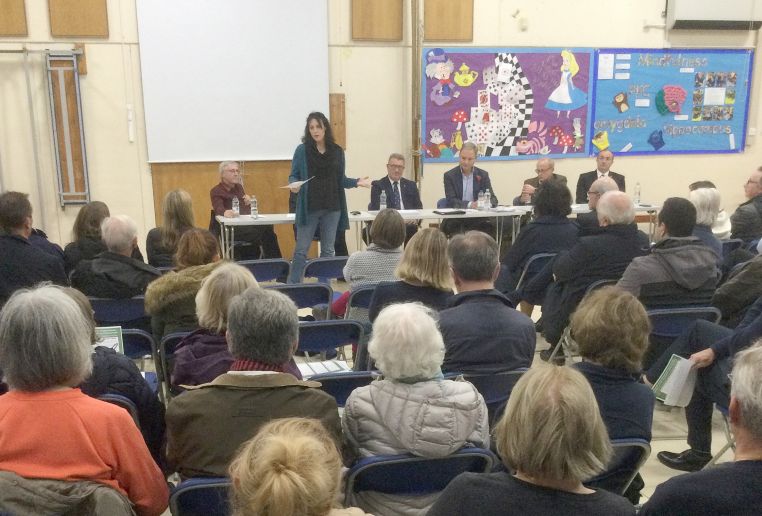
Objectors, public, parents and school governors meet 10th November

A very high percentage of Kingswood House’s 245 pupils have special needs and in recognition of its valuable work, the School has been made an Asset of Community Value by Epsom and Ewell Borough Council. Local residents heard first-hand about the difference the school makes as a former parent Helen Beckman, described in the most moving of terms, how the School supported her son who moved to it having suffered severe depression and mental anguish brought on by living through the tragic impact of Parkinsons on his father.

Headmaster Duncan Murphy explained that this was but one example of many similar cases within the School. If allowed, the new school would be a privately operated “for profit” venture aimed at 60 pupils with severe special needs for whom public transport would be out of the question, requiring travel to and from school to be by private transport. In order, to allow space for the housing estate on the current School’s playing field, access to the new school would be via a new road from West Hill Avenue, currently a quiet residential road.

The findings of the independent traffic experts were shown to the audience and demonstrated that given the level of traffic required, total gridlock in West Hill Avenue and surrounding roads would ensue at drop off and pick up times. Additionally, at least four trees would need to be felled to allow sufficient visibility for traffic exiting the new school. Experts explained that the gridlock effect would be exacerbated if the housing estate were to follow. The application would appear to have been made without proper ecology reports having been undertaken.

Curwen’s own ecology report submitted with his application, accepts that one of the buildings on the current site that is proposed to be demolished shows a high propensity as a bat habitat. As a protected species a bat survey should have been carried out over the summer months, but has not. It is understood that it is the Council’s practice to require full surveys before considering any planning application.

Given the lack of demand locally for the new school, the school would be looking to attract pupils from outside the borough with Curwen Group themselves admitting that pupils will be travelling at least 40 minutes to get to the new school. As regards Kingswood House’s pupils, none of them would qualify for the new school and all of them would need to find new homes. Given the special needs of many Kingswood House pupils and the scarcity of places locally, this is likely to pose a severe challenge.

Those wishing to object should endeavour to do so by 21 st November via the Council’s website tinyurl.com/epsomewellplanning

and entering the reference number 22/01653/FUL or by email to the case officer, Gemma Patterson at gpatterson@epsom-ewell.gov.uk (ref 22/01653/FUL)

See our earlier reports:

Battle for Epsom School continues….

Community Asset to be stripped?