
Epsom and Ewell Times

Current Front Page

ISSN, LDRS and IMPRESS logos

Another Surrey Borough with serious money problems

House of Fraser Camberley

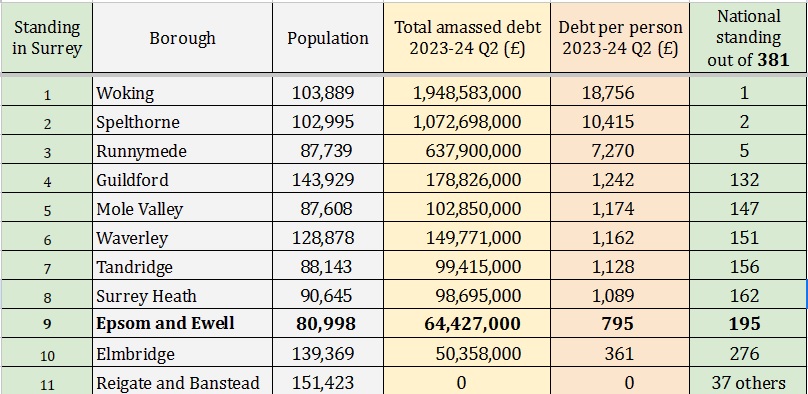
Epsom and Ewell Times has reported on the woes of Woking, the gaps in Guildford budgets and we have spelt out the thorny financial crisis of Spelthorne. Now Surrey Heath may move to asbestos lined offices to preserve its existence. These crises contrast with Epsom and Ewell Borough Council that consistently balances its books. Chris Caulfield reports:


Surrey Heath Borough Council could close its headquarters and move into the vacant, asbestos-lined House of Fraser site as it tries to get out from under its “existential crisis” of its “sheer levels of borrowing”.

It comes as the council’s leader Shaun Macdonald said the borough was as little as two years away from effective bankruptcy.

The council is seeking ways to cover its £176m debts and has launched a project to look into the relocation of civic offices – and papers published as part of its Thursday, September 14, performance and finance scrutiny committee suggest it is considering moving staff into the vacant House of Fraser building in Camberley.

Surrey Heath Borough Council bought the House of Fraser building in 2016 for £18m. The store closed its doors in May 2023  with the lease expiring in August 2023. 

Today the building is said to be worth just £2.9m and requires “multiple millions of pounds” to refurbish. House of Fraser closed the branch in Park Street in May.

The council says it has been working on alternative plans for the building, “including complete modernisation and refurbishment, improved retail and hospitality areas, offices and community facilities such as health and civic uses”. 

According to council documents, it has been negotiating with commercial tenants for the entirety of the third floor, as well as the entirety of the ground floor, and half of the first floor. 

“The second floor could be a potential location for Surrey Heath Borough Council’s relocated office and the remaining half of the first floor for a relocation of Surrey County Council’s library.” 

It could make the move as early as 2026. 

Commenting on the council’s treasury management activity report during the same meeting, Councillor Richard Wilson (LD, Bagshot) said: “It seems pretty obvious that the council has effectively an existential challenge because of just the sheer level of borrowing we’ve got. “This all stems back to 2016 when those failures in decision making on oversight and scrutiny but I wonder if there has also been a failure in treasury management in the period after 2016 while interest rates were still low?”

He also asked whether the loans could have been handled in a “different” way the council could have avoided the “existential crisis” it has now.

Details of the potential move were published as part of the council’s property and economic development service performance report.

A spokesperson for the council said: “In common with many buildings of this age, asbestos is contained in the fabric of the former House of Fraser building, which is safe if not disturbed. “This would need to be removed by specialist contractors as part of any future plans.”

House Of Fraser Camberley (Image: Google Street View)

Related reports:

The knives are out in Woking

Woking’s debt crisis explained

Guildford Council to cut to the bone

Guildford contemplates financial “Armageddon”.

Spelthorne’s neediest lose out on housing

Spelthorne’s thorny property problems spelt out


Guildford Council to cut to the bone

Man cutting meat

The Epsom and Ewell Times has been reporting on the fate of Woking’s and Guildford’s Borough Councils. In contrast to Epsom and Ewell Borough Council, which recently proclaimed healthy solvency, Woking has been declared bankrupt and Guildford is close to bankruptcy. Valuable lessons are here for the role of our local Councillors, Council officers and the local media in reporting. Chris Caulfield reports:


Services will be cut back to the bone as Guildford Borough Council looks to carve out more than £18 million from its annual budget to avoid effective bankruptcy.

The level of cuts was agreed at the Thursday, July 25, full council meeting to address the authority’s £300m debt. Councillor Richard Lucas, lead member for finance and property said , the borough would have to make “structural changes” and dispose of its assets if it wanted to get its house in order ahead of a revised November budget.

He told the meeting: “Our officers are trying to deal with the reality of the situation. We won’t deal with this by pretending there is no problem. This is going to result in difficult decisions for the operational spending and capital disposal. This is not Section 114. We are taking action to avoid this. However, if we do nothing Section 114 comes into play which would pretty much make this council useless.”

A Section 114 notice is when a council declares itself effectively bankrupt and can no longer run a balanced budget. It stops all but essential spending to ensure a council can continue to provide its legally obligated services to its most vulnerable residents.

The approved measures, however, are not too dissimilar after the council said that new spending would need the explicit agreement of its chief finance officer (CFO) until further notice, and that breaches would be “considered a disciplinary matter”.

Recruitment and contract renewal has to be signed off by the corporate management board and the council’s investment programme has been suspended immediately, save for existing contracts that need to be fulfilled.

This applies to all council services, including statutory ones. The only exemptions are the council-owned housing company North Downs Housing Ltd and the Housing Revenue Account.

These controls will remain until at least the 2023-24 financial year.

Cllr Philip Brooker (Con, Worplesden) said “we as a council must take immediate action to solve this” but called on it to be done in a way that minimises the impact on services. Cllr Bob Hughes (Con, Shere) said “it was doubtless services would go” and that people “would get hurt”.

The authority will undergo radical change as it “reconfigures services so they can be managed within the financial resources available to the council”.

Every service and budget, the bleak report read, would undergo a review to establish minimum viable service levels and options for savings and income growth.

The report read: “The council will no longer be able to afford to deliver the current range of services or maintain some services at existing levels and significant rationalisation of the current service offer will be required to live within a reduced financial envelope.”

Services that protect the most vulnerable residents would be prioritised for protection with the remaining services transformed “to ensure they are as efficient and cost effective as possible”.

The authority announced it had to impose a series of strict cuts to its budgets to cover an £18m deficit by the end of the financial year if it was to avoid effectively declaring itself bankrupt this autumn.

The deficit, council papers said, equates to 145 per cent of its net budget and “will fundamentally change the services the council delivers and will require political will and a step change in activity to reconfigure services accordingly”.

Related reports:

Woking bankruptcy, far or near to us?

Guildford contemplates financial “Armageddon”.

The knives are out in Woking

Woking’s debt crisis explained

Council’s financial reservations (report on Epsom and Ewell Borough Council)


Guildford contemplates financial “Armageddon”.

Weyside Urban Village

Guildford’s task to avoid issuing a bankruptcy notice requires “urgent” attention and councillors are branding the local council’s problems a “wake up call” – here’s everything we learned from a series of key meetings this week.

Guildford Borough Council is working to address its £300million of borrowing and an £18.3m projected deficit over three years.

Two crucial meetings this week have seen officers set out plans to combat rising costs of borrowing, in a situation compounded by an accounting error which made it look like the council had more in reserves than it did.

In March, the discovery of a £10m accounting error, along with other issues, led to a prediction that at the end of March 2024, the council would have £8.5m in its reserves. This was compared with a reported £32m in February 2023 when the budget for the year was signed off.

Below, the LDRS breaks down some of the key points from a meeting of the council’s corporate governance and standards committee on Tuesday (July 18) and its executive on Thursday (July 20).

Why are reserves so important?

Reserves are effectively a council’s savings, and may be used to balance a council’s budget when money coming in does not cover the money going out.

The drop in the expected reserves at Guildford is a large part of the problem, which could lead to the issuing of a section 114 notice at the borough council, effectively declaring itself bankrupt and stopping all non-essential spending.

Guildford’s executive head of finance told Tuesday’s meeting there is no legally required level of reserves that councils should maintain, but it came down to a “risk-based evaluation” of what he thought the council would need.

Peter Vickers said: “If an Armageddon happened and we got nothing in financially for a month or two, we still have to pay creditors etc. How much money do we really need? So it’s a risk assessment.”

The lead councillor for finance and property said in Tuesday’s meeting the problem for the council was not about cash flow but about servicing its debt, with borrowing costs “ballooning” and the council unable to afford them.

Councillor Richard Lucas (Lib Dem, Ash Vale) said the council was trying to avoid a section 114 notice, which could still come around in October when a new medium term financial strategy will be brought to the council. He said: “We will not deal with this by pretending there is no problem.”

What are the council’s options?

The council will look at all the assets it has available, and work out which could be sold off, with Cllr Lucas saying each asset would be reviewed in terms of how much net income they bring in and how much they could be sold for.

The council’s former leader, Cllr Joss Bigmore (Residents for Guildford and Villages, Merrow), raised concerns in Tuesday’s meeting that officers were painting “too negative a picture” in conflating issues linked to the authority’s council housing and general spending. He told officers: “If that’s because you want to focus our minds, it’s worked. But I don’t think it’s fair. I think this is slightly muddled.”

Cllr Bigmore said the council had strong options for capital assets it could sell off, that would not be done as a “fire sale” but would be about choosing to sell certain investments in favour of others that may be more profitable. He added: “We have a lot of options. It will be a colossal failure of this council if we have to issue a section 114 in October, because we have options.

“We’re not a Woking. There are a lot of things we can do between now and then. So I have every confidence, if we work together we can do it.”

Other plans laid out by officers include “strict controls” on new spending, and the creation of a dedicated financial task force at a cost of £2m.

Mr Vickers confirmed no council housing would be sold off as part of the measures.

Who could be affected?

Councillors raised concerns about the impact on residents if services were to be cut, and particularly in the event of a section 114 notice being issued.

Residents in Croydon have seen a 15 per cent increase in their council tax after the issuing of a section 114 notice there, and neighbouring Woking is currently consulting its residents on which services they would like to see prioritised amid warnings up to 350 staff could be made redundant.

Mr Vickers said on Tuesday the council had to “focus on the vulnerable”.

With a legal obligation to protect the essential services that the council delivers, he said: “It’s not as simple as saying we’re just not going to spend money. We don’t get that option to be frank.”

While he said he did not want to prejudge what may be coming down the line, Councillor Bob Hughes (Conservative, Tillingbourne) said: “This is something that’s going to affect everybody in this borough. People will lose services, there are going to be problems, there could even be, as has happened at some other councils, large increases in council tax.”

What happens next?

Though the increased costs of the Ash road bridge and the 1,500 home Weyside Urban Village were put forward by officers as contributing to the problems, for the bridge at least, the cost of stopping would be the same as to continue on.

Cllr Lucas said the same was true for a key part of the Weyside Urban Village project in relocating a Thames Water sewage works, but that the overall project was likely to see changes down the line.

He said borrowing costs on the project would “balloon” after the point the medium term financial plan is set to look at, but councillors will be looking at the longer-term implications for the plan in due course.

At a meeting on Tuesday July 25, all councillors will debate the officers’ action plan for turning things around.

Cllr George Potter (Lib Dem, Burpham) called the recommendations being made a “wake up call” on the “crisis” the council found itself in. He said: “I’m really pleased with the transparency we’re showing here, with the fact that we are putting as much as we possibly can in the public domain. We’re being very frank and honest about the seriousness of this situation and we are being very clear about the scale of a challenge, and very clear about the scale of what might need to be done in order to deal with it.”

Related Reports:

£10m Co-Vid grant pay-back put in wrong place

Council’s financial reservations

Another Surrey borough going under?

Accountants shortage blamed for Surrey’s rising debts

Image: Weyside Urban Village. GBC/JTP design and access statement.