Epsom and Ewell Times

Current Front Page

ISSN, LDRS and IMPRESS logos

County Councillor Community funding

County Councillors McCormick, Muir, Beckett and Kington

Surrey residents can now apply for cash grants to improve their local area through the Your Councillor Community Fund. Last year the Fund supported over 380 community projects via Surrey County Councillors, totalling £404,330.  

This community fund is flexibly designed to help with costs that can range from purchasing sports equipment for local clubs, to the creation of websites, providing financial support to community groups and projects that improve the quality of life in for residents in Surrey. 

Each year, Surrey County Council’s 81 councillors each allocate £5,000 of funding within their local communities. With their deep understanding of the needs and priorities of their communities they can ensure that the funding is targeted to areas where it is most needed and where it can make the biggest impact. It can be used across a variety of projects that help promote the social, economic and environmental wellbeing of their communities. 

Surrey County Council Deputy Leader and Cabinet Member for Customer and Communities Denise Turner-Stewart said: “As a council we are committed to working together with communities to improve the lives of people living or working in Surrey. The Your Councillor Community Fund is a great example of how even a small amount of funding can make a big difference in the communities we serve. These initiatives can help to deliver such things as sports for fitness, places to come together, providing facilities that help improve health and wellbeing and in other cases an improved pride in their local areas

It embodies our commitment to empowering local residents to have a say and make a real difference in their own communities. By supporting initiatives driven by the passion and dedication of our residents, we aim to create vibrant, inclusive communities where everyone thrives”. 

The Your Councillor Community Fund is open now and closes in January 2025. 


To apply for money from this year’s Your Councillor Community Fund you should contact your Epsom and Ewell Councillor. They are:

Epsom Town & Downs  Steven McCormick Epsom Town & Downs Residents Association Steven.McCormick@surreycc.gov.uk

Epsom West  Bernie Muir Epsom West Conservative  bernie.muir@surreycc.gov.uk

Ewell  John Beckett Ewell Residents Association  john.beckett@surreycc.gov.uk

Ewell Court, Auriol & Cuddington  Eber Kington Ewell Court, Auriol & Cuddington Residents Association  Eber.Kington@surreycc.gov.uk


More information can be found here Your Councillor Community Fund – Surrey County Council (surreycc.gov.uk)

Examples of projects funded last year include:  

£1,493 to help make Spelthorne cleaner and greener by providing group litter picking equipment which can be loaned out to encourage individuals, groups and schools to adopt an area for regular picking and to take a pride in their local environment. 

£2,000 towards equipment for the 2023 Shepperton Village Fair, including banners, sail flags, display board and cashless payment devices. 

£700 towards replacing a 25-year-old table tennis table used by Leatherhead U3A Table Tennis Group, helping to keep members physically and socially active. 

£1,000 towards new uniforms for Godalming Youth Band. The new polo shirts and hoodies are more suitable for events all year round and will be loaned out, much like the instruments, to help keep music-making as accessible as possible. 

As well as Your Councillor Community Funding, there is also funding available via Your Fund Surrey for small and large community projects. Visit www.surreycc.gov.uk/yourfund to find out more. 

Image: Left to right – County Councillors McCormick, Muir, Beckett and Kington 


Spelthorne in financial trouble

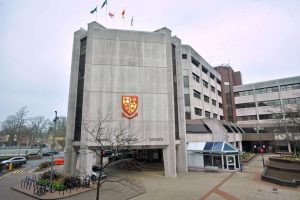
Leader of Spelthorne Borough Council, Ashford East councillor Joanne Sexton, at the council building in Knowle Green, Staines. Credit: Emily Coady-Stemp
Inspectors have been sent to Spelthorne Borough Council as concern grows over its ability to deal with its extreme debt and borrowing. The Department for Levelling Up, Housing and Communities (DLUHC)  has been working with the borough since May 2022 and now the Secretary of State has weighed in over the “authority’s extremely high levels of debt and borrowing”. 

A letter to Spelthorne Borough Council’s chief executive, confirming the department’s decision to appoint Lesley Seary to carry out a formal inspection of the council over its capital risk was published on Wednesday, May 8.

It read: “As of March 31 2023, Spelthorne’s debt was £1.096 billion, which was 87.1 times the council’s core spending power and 52.4 times its total service expenditure.”

The average borough council has a debt to spending ratio of 5.65.

A July review of the borough’s finances also found the council needed “expert independent support” to assist with its “immediate and ongoing financial challenges” and required help to mitigate its risk as well as improve its governance and decision-making culture.

It comes just four months after another Surrey authority, Runnymede Borough Council was served a notice over its finances, and a year after Woking Borough Council declared itself bankrupt.

Concerns over the council’s finances date back to a 2017/18 report from accountants KPMG  – published in November 2022. It highlighted concerns over the council’s investments and set out the auditor’s view that Spelthorne Borough Council had  acted unlawfully in borrowing and then purchasing three properties.

The Secretary of State has given certain directions to Lesley Seary’s inspection. First, she will examine concerns over the council’s governance and scrutiny, with particular attention to its financial arrangements and decision making. She is also looking into the council’s ability to carry out its new housing strategy, as well as the impact its investment portfolio has had on service delivery.

The inspector, who will have right-of-access to all council  premises and documents, will then report her findings to the Secretary of State by August 30. The council has also been told it cannot destroy any documentation or records.

The letter was sent as part of a best value directive from DLUHC. As part of the process the council must publish its response, together with the letters on its website.

The statement from Spelthorne Borough Council read: “Over a year ago, the Department for Levelling Up, Housing & Communities (DLUHC) asked the professional body for public sector finance, the Chartered Institute of Public Finance and Accountancy (CIPFA), to review Spelthorne Borough Council’s investment portfolio and borrowing position. 

“The authority has now received a letter from the department advising that they have appointed an independent inspector to undertake a review of Spelthorne Borough Council to seek assurance that the Council complying with its Best Value Duty.

“The Secretary of State decided to commission this inspection to provide him with direct, independent assurance that the council has ‘arrangements to secure continuous improvement in the way in which its functions are exercised, with regard to economy, efficiency and effectiveness.’ 

“The government letter outlines concerns around debt relative to size of the Council’s budget and governance whilst acknowledging that Spelthorne Borough Council has engaged constructively with the Department since 2022 and already taken action to mitigate risk.

“DLUHC has appointed Lesley Seary as Lead Inspector, who is independent of government, and has asked her to report her findings to the Secretary of State by 30 August 2024.”

Leader of Spelthorne Borough Council, Councillor Joanne Sexton welcomed the review and would work with the inspector and her team.

She said: “This administration has taken many decisive and positive steps since the May 2023 election including instigating a full external independent review of our commercial property portfolio. Additionally, we have reduced future borrowing requirements by nearly £200m and are pursuing alternative ways to deliver more affordable housing. We will continue to work with DLUHC in an open and transparent way and look forward to receiving the findings of the report.”

“The rental income received from our commercial property portfolio more than covers the financing costs and provides a significant contribution to support council services, additionally there is a reserve to cover possible income variation in future years.”

Spelthorne’s neediest lose out on housing

‘Crisis point’ in local government funding

Relative relief about Epsom and Ewell’s debt?

Leader of Spelthorne Borough Council, Ashford East councillor Joanne Sexton, at the council building in Knowle Green, Staines. Credit: Emily Coady-Stemp

Little solace for Guildford from fraud report

House in Guildford

Weak governance and poor scrutiny at Guildford Borough Council created a ‘quick fix culture’ that allowed potentially millions of pounds to be defrauded from the public purse while vulnerable housing tenants suffered, a new report has found.

The council has apologised unreservedly and pledged to adopt every recommendation – of which there are more than 70 –  after a Society of Local Authority Chief Executives (SOLACE) review found its practices posed a serious risk to residents.

The report, released on Tuesday May 7, covered how the culture at the council created an environment where housing budgets were able to skyrocket and pushed the authority towards bankruptcy.

It covers a general overview of the stages that lead to an arrest, two council staff members being suspended, and five agency workers having their contracts terminated.

In February 2022, the council agreed to invest a total of £24.5m to bring its housing stock up to standard and a three-year contract with a value of £5.4m was agreed for testing and inspection. In less than three years that ballooned to £18.9m spent –  a £13.5m overspend.

There was an increase in complaints concerning repairs and enhancements from tenants, the review found. This happened while the Housing Surveyor Team was vacant and had no permanent surveyors. 

The report read: “This lack of in-house expertise and capacity meant that the council often didn’t inspect and check work and were reliant upon agency staff. There was also incompleteness of data which compounded matters.” It added: “After making initial enquiries, it came to light that there was concern regarding risk to the council and the following matters were raised:

That work may have been ordered when it wasn’t necessary. *That work may have been ordered, invoiced and paid for when it was not completed at all or *Not to a satisfactory standard. *That duplicate invoices may have been submitted and paid for the same work. *That works may have been ordered and undertaken that were not the responsibility of the council.

This triggered a criminal investigation in August 2023 resulting in the suspension of two employees and five agency workers having their contracts terminated.

Whistleblowers first raised the alarm in September 2022 but it was not until 2023 that serious action into how housing budgets of about £5.4m a year had ballooned to more than £17m.

The initial investigation was conducted by Reigate and Banstead Borough Council’s anti-fraud unit before being handed over to the South East Regional Organised Crime Unit of the Police.

The council then ordered a series of reviews, with the results published late on Tuesday, May 7 – although the allegations of potential fraud were outside the review’s scope.

Despite that shortcoming, the review did find there was serious failure to follow due process in the procurement and management of housing maintenance contacts.

The council has now published an in-depth improvement plan, with more than 70 recommendations, to address every finding from the two reports, and, it says, to ensure it provides services that residents and businesses can be proud of.

Leader of the Council, Councillor Julia McShane, said: ‘The people of Guildford deserve better from their council and for that we give a heartfelt apology and a commitment to put right the long-standing issues which we have uncovered. We have invited scrutiny and embrace accountability and will not rest until we have a resilient, well managed council of which we can all be proud.’

Deputy leader, Cllr Tom Hunt, said: ‘We apologise unreservedly to the residents and taxpayers of Guildford. The SOLACE reports identify serious issues around the council’s governance, operations, and controls. This is unacceptable. We are utterly determined to root out every problem and to put matters right. The people of Guildford deserve nothing less.’

Pedro Wrobel, chief executive of Guildford and Waverley Borough Councils, said: “‘I recognise everything that the SOLACE reports identify, and accept all the findings in full. This is not okay, and I came here to deal with it. Over the past two and half months, we have been developing a comprehensive Improvement Plan to address the issues at Guildford Borough Council. It addresses every recommendation from these reports and goes further.

“I am delighted with the appointment of the Independent Assurance Panel. It is critical that we make everything open and transparent. We are here to do the right thing, not the easy thing. I am determined to ensure the council is sustainable, delivers excellent value for money, and provides services that our residents and businesses can be proud of.

“We will not do this alone. I look forward to working with partners and our communities and businesses to make Guildford a brilliant place to live, work and do business.”

A police investigation and an employment investigation carried out by an external law firm are continuing, the council said.

The Local Democracy Reporting Service has read through the  documents with this being the first of several stories to be written about the findings.

Further stories will look in greater detail at the steps the council is taking, the impact of the merger with Waverley Borough Council and the views of the community and residents.

Related reports:

Police probe abuse of public funds

Good money goes after bad


Surrey County Council staff strike poll

Staff at Surrey County Council are voting on whether to go on strike after receiving a revised pay offer which union bosses say is not good enough.

Union chiefs representing workers, including teachers and firefighters, have described the ballot as one of the most important in the branch’s history and that it was time to make a stand against low pay.

The ballot papers were sent out to staff on May 7 and run until June 4 – when staff will decide whether to accept the council’s revised offer or support the walk out.

Surrey County Council leader, Councillor Tim Oliver (Conservative) said it was important the authority “lived within its means” and that the offer was final. He said the council remained committed to getting the matter resolved so staff could receive pay increases as soon as possible. 

Surrey Pay comprises pay bands PS1/2 to PS14 and pay bands for senior managers PS15 to Chief Executive. The council’s original offer of between £1,124 to £1,682 for grades PS3-PS9, was overwhelmingly rejected. Unions had been asking for a £3,500 increase across the board.

In March, workers warned the local authority of a potential walkout after a “record number” of people backed strike action – unless there was a significantly improved pay offer. The council came back and is now offering a £1,800 increase to all staff on PS6 and below, unions have said. Those on between PS7 and PS10 are still on the old deals. Sick pay will return to six months full pay and six months half pay, double its current levels.

Lead negotiator Paul Couchman has said this shows the council can be moved. He said: “This is going to be one of the most important votes in our UNISON branch history. The council has already shown that we can move them. We believe we can get a better, fairer, offer if we get a result in this ballot. 

“Last year we were just 40 votes short of reaching the legal minimum of 50 per cent of members voting. This is the year we make a stand.”

Earlier this year a consultative online ballot was held with 53 per cent  of members responding, 87 per cent of whom voted to reject the offer and 91 per cent saying they would support strike action if there wasn’t a significantly improved offer.

The Strike Committee felt the council has not moved far enough and has moved to a full postal legal strike ballot. The two general trade unions representing employees said members were being left behind – both national pay awards as well as most other local councils. 

According to the unions about a thirds of Surrey staff are paid below a ‘minimum standard of income’, based on research provided by the Joseph Rowntree Foundation.

The revised offer would see the lowest hourly rate of pay would be £12.04, higher than both the Real Living Wage and Statutory National Living Wage.

Unison is asking its members to reject the offer.

It comes as, last February, there was a “catastrophic” Surrey payroll glitch that left workers unable to pay mortgages or afford food for their children “We really do deserve better,” a statement from Unison read.

Tim Oliver, Leader of Surrey County Council: “We have made a revised improved final offer and remain committed to getting the matter resolved so that our staff can receive their pay increase as soon as possible. However it’s imperative that the offer is within our means.

“The council is not immune to the challenges of the current economic landscape, rising costs and inflation pressures, and we must ensure we remain in a position to deliver vital public services and protect our most vulnerable in our communities throughout.”

Related reports:

Surrey County Council workers to strike?

County CEO’s pay rise triggering strikes?


Community fund open for bids

Rosebery Park - children's recreation area

Epsom & Ewell Borough Council is inviting community groups and organisations to bid for neighbourhood funds raised by the Community Infrastructure Levy (CIL), to deliver projects that will support new development and benefit Epsom & Ewell residents across the borough. Bidding opens on 7 May for six weeks, closing on 18 June.

The CIL raises funds from developers in recognition that new development creates pressure on local infrastructure. It is spent on the provision, improvement, replacement, operation, or maintenance of local infrastructure. Epsom & Ewell Borough Council has invested more than £210,000 from the 2022/23 Neighbourhood CIL Fund in community infrastructure projects including:

  • Replacing playground equipment in Rosebery Park and Alexandra Recreation Ground
  • Repairing pathways in Nonsuch Park to ensure they are safe and accessible
  • Upcoming works to support biodiversity and improve visitor experience, including an additional new bench, at Stamford Green Pond.

Councillor Steven McCormick, (RA Woodcote and Langley) Chair of the Licensing and Planning Policy Committee, said “I strongly urge local community groups and organisations to take this opportunity to bid for funds for community projects and initiatives that can improve quality of life for residents in Epsom & Ewell.

The Neighbourhood Community Infrastructure Levy Fund offers us the chance to deliver projects that have a real impact on our communities, for example enhancing access to the countryside, improving accessibility and facilities in our parks and open spaces, improving health and safety for example by installing public water fountains, and more.”

The bidding process is designed to be as clear as possible. Information on the process can be found in section 6 of the CIL Spending Protocol.

Bids will be shortlisted using the criteria set out in section 7 of the CIL Spending Protocol.  Shortlisted bids will be presented to the Licensing and Planning Policy Committee for approval and, for any spend over £50,000, then to the Strategy and Resources Committee.

Image: Rosebery Park – children’s recreation area. Google


Clash Over Funding and Priorities in Surrey PCC Race

4 PCC candidates montage

On the eve of the Surrey Police and Crime Commissioner election, candidates are locked in a battle of ideas over funding allocations and the strategic direction of law enforcement in the county.

Independent candidate Alex Coley, former barrister Paul Kennedy of the Liberal Democrat Party, and Kate Chinn representing the Labour Party have all weighed in on the key issues facing Surrey’s police force and incumbent Commissioner Lisa Townsend for the Conservative Party responds.

Alex Coley, (Residents Association Councillor on Epsom and Ewell Borough Council for Ruxley Ward) a vocal critic of current spending practices, has campaigned on the issue of financial management within the force. “Over the past six weeks Surrey has been my treadmill, six weeks of walking and talking to residents all over this county,” Mr Coley stated. He emphasized concerns raised by residents about the allocation of resources, particularly in light of a significant underspend by the Police and Crime Commissioner (PCC) office. “The number one question from residents has been: ‘how are you going to pay for more police?’” Coley highlighted, pointing to unutilized funds that he argues should be directed towards bolstering the police force.

Furthermore, Mr Coley raised eyebrows with his critique of what he termed “casino politics in policing,” alluding to financial dealings between the PCC and Surrey County Council. “I don’t think residents want a PCC acting like an investment bank that dabbles in the gilt markets, backed by your council tax,” he asserted, painting a picture of fiscal irresponsibility that he vows to rectify if elected. Full statement HERE.

In contrast, Paul Kennedy of the Liberal Democrat Party takes a different approach, drawing on his legal and financial background to advocate for prudent fiscal management. “The challenge of funding more community policing requires professional discipline, not simplistic solutions,” Kennedy remarked. With experience as a barrister and an accountant, Kennedy positioned himself as a candidate with the expertise necessary to navigate the complex financial landscape of law enforcement.

Mr Kennedy defended the current funding structure of Surrey Police, stressing the importance of maintaining a buffer to address cash flow fluctuations. “Temporary surpluses can’t just be run down as some have suggested,” he cautioned, echoing sentiments of fiscal conservatism that have resonated with some voters. Full statement HERE.

Meanwhile, Kate Chinn (Epsom and Ewell Borough Councillor for Court Ward) of the Labour Party emphasized the human aspect of policing, focusing on recruitment and retention as key priorities. “Of course the budget needs scrutiny and increasing, but as Alex Coley identifies it is ensuring enough officers are recruited and retained that is the real priority,” Ms Chinn argued. She outlined a series of measures aimed at bolstering recruitment and supporting existing officers, including streamlining the recruitment process and providing adequate mental health resources.

Ms Chinn’s vision for policing centred on valuing and supporting front-line officers, with a pledge to advocate for fair pay and long-term investment in law enforcement. “A Labour government would ensure police pay recognizes the value of the work our officers do and commit to long-term investment,” she asserted, positioning herself as a champion of the men and women who serve on the front-lines of policing. Full statement HERE.

As the candidates make their final pitches to voters, the future direction of policing in Surrey hangs in the balance. With each candidate offering a distinct vision for the role of the Police and Crime Commissioner, residents face a critical decision that will shape the county’s law enforcement priorities for years to come.

A response from Conservative candidate and current Police and Crime Commissioner, Lisa Townsend, was awaited at the time of going to press and just came in minutes after…….

Lisa Townsend refutes Mr Coley’s claims: “There is no loan to Surrey County Council. The £43m is the amount of cash held at the 31/8/23. This represents reserves of about £30m as well as cash held due to the timing of council tax receipts, grants, payments out, etc. Rather than holding all our cash in a single bank we pool it on an overnight basis with SCC who add it to their spare cash and invest it in overnight money market deposits with many banks. This reduces the risk as this pooled money is spread over a larger number of institutions than if we were to do this alone, and it also reduces the cost of management.”

In respect of underspending the Commissioner points out the small underspend in proportion to the total budget and how it arose from a higher staff vacancy rate than expected. Full statement HERE.


Surrey County Council’s new CEO defends “unlawful” email

Terence Herbert new CEO for SCC

Surrey County Council’s soon to be in post Chief Executive and current Wiltshire Council’s CEO has insisted that an email he sent to staff in November 2022, which was recently judged unlawful, was to correct a GMB (General, Municipal and Boilermakers) Union lie.

Terrence Herbert, who is preparing to leave his Chief Executive role to transfer to Surrey County Council, has gone on the record to speak about the events surrounding the case.

GMB, the union for Wiltshire Council staff, claims the email intended to deter its traffic wardens from voting for industrial action. The vote was part of a long-running dispute in which Wiltshire Council is seeking to remove contractual out-of-hours pay enhancement.

Written by Mr Herbert, the email claimed that GMB’s representation of the proposals as a “10% pay cut” was “really misleading”, and urged staff to “consider carefully” whether further strikes would support a resolution.

Bristol Employment Tribunal ruled that the correspondence broke industrial relations law.

The leader of the council, Richard Clewer, has reported that £21,395 was spent on defending the case.

Wiltshire Council is currently seeking legal advice as to whether there are grounds to appeal the decision.

Mr Herbert said: “We entered into all of our negotiations in good faith and professionally, with all three of our recognised unions – UNISON, Unite and the GMB. Unfortunately, from the outset, GMB’s behaviour and actions were in sharp contrast to that of UNISON and Unite, and they seemed to have set their course not to agree.”

He described the pay policies which Wiltshire Council is seeking to change as “historical” and “no longer fit for purpose.” Mr Herbert said it was “very hard to justify” – to residents and staff who do not receive the same entitlement – policies that amounts to “£800,000 per year in extra payments.”

He noted: “The only other way that you can make those savings are through redundancies and the position that I took from the outset, and it’s one that I stand by now and do not regret, is that I didn’t want to make people redundant.” He added: “There are considerably more requirements on local government than there were before, but there isn’t the money. Therefore, we have to make savings.”

Following negotiations, the council offered a four-year pay protection for concerned staff, which was accepted by UNISON and Unite the Union, but rejected by GMB.

Regarding his email, Mr Terence said: “There had been a number of announcements or media statements made by GMB in the run up to another ballot. In those statements, they had said that we had reneged on a promise to offer lifetime pay protection. We were very clear that that was a lie, that we had never offered lifetime pay protection.”

Referencing his staff, he also said: “I didn’t intend for them to feel threatened, I intended for them to be informed. I genuinely believed that what I was doing was informing my staff.

“Whenever you see an organisation like GMB openly misrepresenting what has happened, you think that there is a duty for you to correct the record, and that’s what I was doing.”

Reflecting on the impact of the case, Mr Herbert concluded: “It is stressful, it takes a personal toll, but at the end of the day, I go home and try to switch off. But the personal attacks, which then lead to offensive comments, as a direct result of inflammatory, incorrect statements that have been made by supposedly professional organisations, that takes a toll.”

When approached for comment, a spokesperson for GMB said: “The findings of the tribunal are clear that his arguments are unconvincing. For him to attack the findings of the tribunal is disingenuous and I’m sure residents of Wiltshire will find it equally concerning.”

Jessica Moriarty

Related reports:

New Chief Executive for County

County CEO’s pay rise triggering strikes?

Image credit: Wiltshire Council


Surrey Councils holding unclaimed tax refunds

Table of unpaid refunds from Surrey councils.

Councils in Surrey are holding nearly £1.5million in overpaid tax that can be claimed back. People who moved to a different borough after paying their tax are supposed to be sent a closing bill. If an account is in credit, overpayments are refunded.

When this is not possible, for example if the council does not have a resident’s forwarding address, the overpaid cash can sit in a pot until a claim is made – or the residents return to the borough.

In Surrey, that figure is a combined £1,493,722.12 for eight of the 11 councils. As for the others (Elmbridge, Tandridge and Epsom and Ewell) their figures remain unclear.

The three most common reasons for overpayments are when someone moves out of their house and has already paid, changes to a property’s tax band, or when residents forget to cancel standing orders when they move.

The two biggest stockpiles are held by Guildford and Spelthorne Borough Councils, and account for more than £600,000. This is according to data released under Freedom on Information to Money Saving Expert.

Tax not claimed back can be written off by a council – to balance the cost of bad debts – however Guildford Borough Council said it reinstates the money if a resident comes forward to claim the credit.

Guildford Borough Council told the Local Reporting Democracy Service it has refunded 12,793 people on both closed and open accounts with a total value of £4.4 million, since April 2021. It says nearly a third of these were refunded through MyGuildford online accounts.

A spokesperson for Guildford Borough Council said: “It’s important that we are provided with a forwarding address so we can send closing bills or retrospective bill changes.

“If a refund is not claimed, the money will remain on the account until the resident claims it or becomes liable for council tax in our borough again.” They added: “To be transparent, we roll over overpaid council tax every year. If other councils have already written off credits, their credit value will be reduced.”

Guildford council added that they don’t have a specific deadline for claiming overpaid council tax. But to avoid fraudulent claims, they ask residents to provide proof of the overpayment. The older the claim, the more proof is needed.

A spokesperson for Spelthorne Borough Council said: “Tax refunds occur for a number of reasons, for example if a resident has moved from the borough or they have paid a bill in advance and Spelthorne Borough Council proactively issues any council tax refunds which are due.

“Where accounts are in credits, statements are sent with refund application to the last known address, if we hold bank details refunds are refunded directly back to the bank account that they were paid from. Where accounts are constantly paying in credit, copy bills are sent to prompt a response from the payer to claim the overpayment back.

“Residents can keep track of their council tax bill by registering for the self-service customer portal online or call the team on 01784 451499.”

Elmbridge Borough Council, which did not respond to the FOI, said it refunds overpaid council tax if a resident’s account is in credit and does not owe any other amounts of tax.

People who move within the borough will usually have credits from their previous address transferred across, while those leaving the area can arrange a refund.

[Nationwide the London Borough of Newham holds the highest of £9,539,750 and Surrey’s Runnymede fourth lowest of £5,777.]

Contact your local authority for specific advice on claiming it back, as this is likely to differ.


Was County HQ sold for a song?

Surrey County Council faces scrutiny over its £25 million sale of a former headquarters site after it was revealed it could have a gross development value of £250 million once revedelopment is completed. The new owner of the former HQ has listed the site for sale with a gross development value of 10 times more than the council got when it sold the historic building in 2021.

The huge gap between the two figures led to the county council to be challenged on whether it got the best deal for residents although the lead member for property said it secured a “good deal” and would sell it again at the same price. The 5.2 acre site in Kingston is being marketed by Savills. It is described as a “landmark opportunity” with “stunning former County Hall buildings” and has planning permission for 254 private apartments, 16 shared ownership apartments, and 20 affordable rent apartments.

Rob Pollock, Savills director, London development, said in a statement promoting the sale: “With its scale and heritage, Surrey County Hall offers the opportunity to deliver a truly unique development in southwest London that might seem more at home in central London, and consequently appeal to buyers across the city. With world famous attractions like Hampton Court and Wimbledon Tennis Club in striking distance of the property, combined with the obvious curb-side appeal, we expect that the ultimate developer of the property will set new record for pricing in Kingston.”

The sale was discussed during the Tuesday March, 19 meeting of Surrey County Council. In March 2021 Surrey County Council sold the site for about £25m to RER Kingston Limited, according to officers although it was suggested the figure may have been “in excess” of that.

Councillor Robert Evans (Lab Stanwell and Stanwell Moor) asked: “When Surrey County Council was selling County Hall, its former Kingston headquarters, developers RER issued a release stating it had a guide price of £20m. This week Savills has issued a press release stating the site now has a Gross Development Value of £250m.

“Can the council tell us exactly how much it got for its former Grade 2 listed site, and whether it feels this was best value for residents seeing as it now has the potential to bring in hundreds of millions of pounds for its new owners?”

In a written response, he was told the council sold the site for £25million, on a subject to contract only basis, following “an extensive open marketing campaign for which best value was secured”. Since the sale, RER (Kingston) Ltd has been holding the 300,000 sq. ft site vacant, while pursuing a planning application through the Royal Borough of Kingston to convert much of the former complex into residential units.

The official council response read: “Costs would have been incurred for empty business rate liability, which would have been circa £700,000 per annum alongside security and other holding void costs. “Although planning consent is now expected, RER have placed the complex on the market through Savills.

“Whilst the agents suggest a potential value post development, it should be noted that when fully sold or let, this is not the value that a market bidder will pay for the asset today. A value bid would consider the cost, timing and risks of the development, the capital investment needed to complete any approved scheme (heritage build costs, consultant fees, ongoing security, void costs, finance costs at elevated rates since 2021) and the marketing period to sell or rent all units once converted.

“This could be a further three to five year project”. As part of the sale agreement the council negotiated a contractual position to secure any excess of value that might arise from any future development “if the quantum of development exceeded a certain level”.

When asked to elaborate on this, cabinet member for property, waste and infrastructure, Councillor Natalie Bramhall said the developers had spent £700,000 a year on empty rates, had to cover the cost of security, and that planning application costs would have been in excess of £1m.

She added that to get to the full £250m they would also need to spend ‘hundreds of millions” to bring it forward. She said: “Residual land value with planning persimmon is between £35m and £40m.

“Somebody is going to have to spend hundreds of millions of pounds bringing that forward and I would suggest that as the purchaser is trying to sell at this time in the market which is probably at the bottom they spent far more on this site then they probably expected already. I actually think we secured a good deal and would again sell at that price.”

Image – former SCC HQ County Hall in Kingston. Surrey Live


How many £s does it take to change a Council light bulb?

Bourne Hall Ewell Surrey inside

The cost of changing Council light bulbs was the subject of some concern at Tuesday 26th March’s meeting of the Strategy and Resources Committee of Epsom and Ewell Borough Council. The committee was considering the annual maintenance programme for Council run properties.

Cllr. Robert Leach (RA Nonsuch) enquired: “I thank the officers for a very thorough report, but when I look at the planned maintenance, it does seem to me that this is an area where a stricter financial control is perhaps needed. I look at some of these figures with amazement. £56,000 to change the light bulbs in Bourne Hall. £70,000 to paint the woodwork in Ewell Court House. What controls do we have that we are getting value for money from these contractors?” 

The Council Officer replied: “With Bourne Hall, to change a light bulb in this building is not a simple case of getting a step ladder out. It needs scaffolding to get up to these lights here. The costs of replacing the lighting also includes all the equipment to enable those lights to be replaced where they’re in very hard to reach positions. So it’s not just simply changing light bulbs.”

Cllr Leach’s question on financial controls was left unanswered.

Cllr. Alison Kelly (LibDem College) wanted to know about the environmental cost of the main entrance doors to the Epsom Playhouse that open directly onto the lobby. It was observed that the construction of an second inner set of doors was resisted by the theatre as it would take away vital foyer space.

Cllr. Graham Jones MBE (RA Cuddington) had earlier that day taken a stroll over to the Epsom Playhouse and had a “light bulb” moment. He suggested: “I’ve seen quite a lot of places where instead of taking away from the lobby you go outwards. There’s lots of space there, and it would  make a really nice feature and I would recommend that you consider that option.” His idea was warmly received with the officer responding: “That would be exactly the solution. Hence why it would need to be a future capital bid. Because that’s clearly a larger project than creating it within the building itself. But you’re absolutely spot on. Thank you.”