Ex-local LibDem leader explains part of her departure
11 May 2026
Dear Editor
It is indeed regrettable that our (otherwise rather good) MP, Helen Maguire, wished to control what each and every new Liberal Democrat councillor has to say, and presumably fears they are not competent to string a few words together and celebrate their victory.
Not every Liberal Democrat victory in Surrey belongs to Ms Maguire, much as she wishes it does.
It seems to be a problem for Ms Maguire to be a team player, to delegate and trust — and one of the reasons I left the Liberal Democrats after 25 years, the majority of those years leading the Opposition on Epsom and Ewell Borough Council.
It was also partly the reason Cllr James Lawrence left the Liberal Democrats more recently and similarly became an Independent councillor for the final year of Epsom and Ewell Borough Council.
She would do well to concentrate on giving the new team in Surrey the respect and degree of autonomy they have earned — and will cherish — in local government, and which will be necessary for them to run East Surrey Council and fulfil the promises made in their election literature and on the doorstep.
Cllr Julie Morris
Independent Councillor for College Ward – Epsom and Ewell Borough Council
Redhill data hub plugs into AI boom
11 May 2026
A major expansion of a Redhill data centre campus worth an estimated £500 million has been approved by Reigate and Banstead Borough Council.
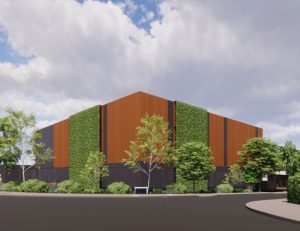
The development at Foxboro Business Park, Holmethorpe, will see older industrial buildings demolished and replaced with a large new data centre building containing four server halls, offices, electrical infrastructure and cooling equipment.
The scheme was approved by councillors at RBBC’s Planning Committee subject to conditions, including controls over construction activity and further work into the possible reuse of waste heat from the site.
The project is being brought forward by property investor Castleforge in partnership with Galaxy Data Centers, which operates data centre facilities.
Data centres are effectively the industrial warehouses of the digital age. Instead of storing goods, they house vast numbers of computers and data storage systems that support cloud computing, artificial intelligence, online banking, business systems, streaming services and internet communications.
The Redhill expansion is intended to strengthen the area’s role as part of London’s growing digital infrastructure network, with the developers saying demand for computing capacity continues to rise rapidly because of AI and other data-heavy technologies.
Planning papers show the new building will provide around 15 megawatts of computing power capacity — enough electricity usage to rival that of a small town.
The council report describes a highly serviced technical building featuring secure server rooms, cooling systems, rooftop plant equipment, backup diesel generators and new electricity substations to ensure uninterrupted operation during power outages.
The development will also include roof-mounted solar panels and has been designed to achieve a BREEAM “Very Good” environmental rating.
One feature highlighted by both the developers and council planners is the potential reuse of heat generated by the computers inside the building.
Data centres produce very large amounts of heat, normally removed by industrial cooling systems. In this case, the planning permission requires further investigation into whether excess heat from the site could eventually be exported to nearby homes through a district heating network.
The approved site lies within the Holmethorpe Industrial Estate, about a mile north-east of Redhill town centre.
Planning documents indicate the wider Redhill Data Centres campus already occupies around 11,800 square metres across three buildings and serves clients in sectors including finance and artificial intelligence.
The site was already authorised for data centre use under earlier planning permissions dating back to 2007 and 2009, meaning the latest approval represents an intensification and modernisation of an existing technology campus rather than an entirely new industrial use.
Residents raised concerns during the planning process over issues including traffic, construction disruption, noise, flood risk, visual appearance and possible health impacts.
However, specialist consultees including Surrey County Council officers, Surrey Fire and Rescue Service, Surrey Police and London Gatwick Airport did not object, subject to planning conditions.
The development also reflects a much wider national trend as Britain competes to expand the infrastructure needed for AI and cloud computing.
The UK Government designated data centres as Critical National Infrastructure in 2024, recognising their growing importance to the economy and public services.
Industry analysts CBRE describe London as Europe’s largest data centre market and one of the most important globally, although growth has increasingly been constrained by electricity supply and the difficulty of finding suitable sites close to major urban areas.
Castleforge says it has already invested more than £100 million into the existing Redhill campus since 2024 and now intends to proceed with a further major phase of development following the council’s approval.
For local residents, the project represents another sign of the gradual transformation of industrial estates into high-value digital infrastructure hubs serving the modern economy — largely unseen by the public, but increasingly essential to everyday life.
Epsom “Library of Things” Delayed by Council Stand-Off
11 May 2026
A volunteer-led scheme to open a “Library of Things” in Ewell has been delayed for months amid a stand-off between Surrey County Council (SCC) and Epsom and Ewell Borough Council (EEBC) over who has the authority to approve a key lease.
The project, led by the Epsom and Ewell Climate Action Network (eeCAN), aims to allow residents to borrow household tools and equipment rather than buy them—an initiative already operating successfully in other parts of Surrey. However, despite securing planning permission for an external storage unit at Bourne Hall in early April, the scheme remains unable to open to the public.
At the heart of the delay is confusion between the roles of the county and borough councils. SCC operates the library service within Bourne Hall and has entered into a memorandum of understanding (MoU) with eeCAN covering the delivery of the service. But the land and building are owned by EEBC, meaning any lease for the external storage facility must be agreed with the borough.
In correspondence seen by the Epsom and Ewell Times, a senior SCC officer states that the county council “would not be a contracting party nor is there a requirement for a formal approach from us,” adding that any lease should be agreed directly with EEBC.
However, EEBC’s Head of Property and Regeneration takes a different view. He explains that under his delegated authority he can only progress matters involving Surrey County Council, which he describes as the legal occupier of the Bourne Hall library space. He also cites legal obligations requiring any new lease to be openly marketed to ensure “Best Value,” rather than agreed directly with a single organisation.
The result is an impasse: SCC says it is not required to initiate the lease, while EEBC says it cannot proceed in the way requested. Meanwhile, the community group finds itself unable to move forward.
William Ward, Chair and Co-founder of eeCAN, describes mounting frustration. Writing to both councils, he points to months of correspondence since December and says the group now has “many local residents who have already signed up… asking why the opening has been delayed and when they can borrow the donated items they need.”
The delays have already forced the postponement of the scheme’s planned launch around Earth Day, with construction of the storage unit also on hold pending agreement of the lease.
The situation also raises questions about consistency across Surrey. Ward notes that similar “Library of Things” schemes elsewhere in the county do not appear to have encountered the same requirement for formal inter-council processes, suggesting potential differences in how local authorities interpret their responsibilities.
For observers, the episode offers a practical illustration of the challenges inherent in Surrey’s two-tier system of local government. Responsibilities for a single site are split between county and borough, with separate legal, operational and property roles. While each authority’s position may be individually justifiable, the combined effect can be delay, duplication and uncertainty for community groups trying to deliver local services.
The issue comes at a time when Surrey is preparing to replace its current structure with unitary authorities. Proponents of reform argue that merging responsibilities into a single tier could reduce exactly this kind of confusion. Critics, however, warn that large new authorities risk becoming more remote from local needs.
In the case of the Bourne Hall Library of Things, the immediate concern is more practical. Without resolution between the two councils, a project intended to promote sustainability, reduce household costs and strengthen community engagement remains on hold, it has been claimed.
Surrey County Council and Epsom and Ewell Borough Council joined forces in issuing a response to these claims. A spokesperson said:
“Surrey County Council (SCC) Libraries enables external providers to operate a “Library of Things” service across the county. Under the agreed arrangements, all “Library of Things” providers are responsible for organising off-site storage for larger items, while smaller items may be stored within library buildings where space allows.
“Ewell Library is located at Bourne Hall, which Surrey County Council leases from Epsom & Ewell Borough Council (EEBC). As both the planning authority and freeholder of Bourne Hall, EEBC is responsible for approving any external storage within the grounds.
“Epsom and Ewell Climate Action Network was advised at an early stage that planning permission and landowner agreement would be required for an external store to house larger items. Planning permission was granted earlier this year, and the proposal will be presented to the next meeting of Epsom & Ewell Borough Council’s Environment Committee which is scheduled to take place on 23 June. Committee agreement is required before volunteers can manage the store.
“Both councils look forward to welcoming a new “Library of Things” to Ewell, building on the success already seen at Dorking, Godalming, Guildford and Haslemere Libraries, supporting residents to share resources and reduce waste.”
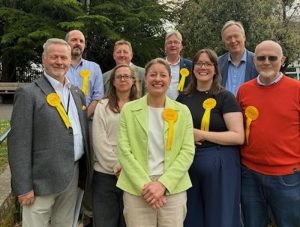
The Liberal Democrats have won the first ever election for East Surrey Council winning a huge majority on the newly formed authority. The party surged to an early lead as the votes began to trickle in during the Friday, May 8 count and never looked back as seat after seat turned yellow.
When the votes were all counted they won 40 of the 72 seats up for grabs, giving them a huge lead over the second placed Conservatives who managed 10. What had been expected to be a close race with no single party being able to command an outright win soon turned into a landslide with the Lib Dems saying the result offers people a “fresh start” after years of Conservative rule.
The old county council had previously always been under Tory control but in borough elections over the past five years the Liberal Democrats have made significant gains. Today, they said, that the decades-long journey was complete.
Liberal Democrat spokesperson for East Surrey Bridget Kendrick said: “I personally thought we had a very strong chance of taking control and a lot of people underestimated the power of Epsom and Ewell Liberal Democrats but we saw it on the ground day in and day out on the door. We’ve been very clear that this is an incredible opportunity for a fresh start in East Surrey. This is really about a cultural change of transparency.
“Our priority is adult social care and special education, and across Surrey we have been delivering good services and being financially competent. It’s a fresh start for culture and transparency. I’d like to thank everyone who campaigned for so long, for everyone who stood, regardless of parties -for the democratic process. For everyone voting for hope.
“We are going to have our own significant challenges (early estimates suggest the new authority faces an immediate £35m budget shortfall). We need to put people at the forefront of decisions. Turnout was high, it was a good moment for democracy. It’s a good moment for Liberal democrats. We have worked for this moment for decades.”
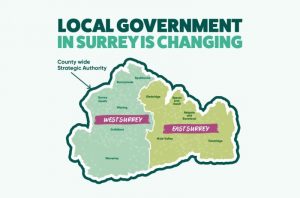
The new East Surrey Council will sit in shadow for its first year as the old two tier system of Surrey County Council and its 11 boroughs and districts is wound up. East Surrey is the merger of Elmbridge, Reigate and Banstead, Epsom and Ewell, Mole Valley, and Tandridge – and the eastern half of the county council.
West Surrey, which was also won by the Liberal Democrats comprises Runnymede, Spelthorne, Waverley, Guildford, Surrey Heath and the eastern half of the county council.
East Surrey results in full:
Liberal Democrats, 40 seats Conservative, 10 The Green Party, 8 Reform UK , 5 Residents Associations of Epsom and Ewell, 2 Independent, 2 Ashtead Independent, working with Ashtead Residents, 2 Tattenhams Residents’ Associations , 2 The Molesey Residents Association, 1
Epsom’s LibDem MP gags her Party’s new councillors in their moment of triumph
11 May 2026
Bourne Hall, Ewell, Friday 8th May – the Count of the five local divisions in the East Surrey Unitary Council elections.
As reported elsewhere, local Liberal Democrats took eight out of ten seats in the Epsom and Ewell Area on Thursday’s local elections.
Our reporter, in the room reserved for media interviews at the Count, was talking to soon to be elected Liberal Democrat candidate Roy Deadman. Entered the room Helen Maguire’s communication (sic) officer who stated her party’s candidates were not to talk to the press! The press were only to talk to her boss.
What hare-brained politics studies undergraduate idea this was of a communications strategy is any body’s idea. Neither “liberal” nor “democratic”. Ms Maguire, you can do better than this.
Somewhat handicapped by this injunction your reporter had more time to gauge feelings and responses from the other parties.
Clearly a very poor showing from Labour who had a proud record of consistent representation in Court Ward and a succession of highly respected Labour Mayors.
Reform posted substantial votes in most of the five divisions but failed to get even a second place.
The Conservatives appear to be saying goodbye to Epsom and Ewell as a safe Conservative parliamentary seat, that it had been for ever, up to Helen Maguire’s Liberal Democrat victory in July 2024.
The Greens polled admirably but failed to make the breakthrough that they were hoping for.
The Residents Associations’ faces were saved by the personal appeal and integrity of Eber Kington and Peter O’Donovan who won their seats by substantial margins. Elsewhere, the RA leaders Hannah Dalton and Neil Dallen fell woefully behind both Liberal Democrats and Reform by hundreds of votes.
It would seem that the direction, motivation and relevance of the long-ruling Residents Association has been lost and a new era has dawned.
The full EAST SURREY election results will be published HERE in due course.
On a lighter note. Council issued coloured rubber thimbles sparked controversy. Handed out to the dedicated and hard-working counters, they were brightly coloured green, red and yellow. Were they for counting particular party votes? No, just a co-incidence but that did not stop one Reform candidate asking why there were no purple ones.
Lib Dems sweep up in East Surrey Unitary Council election for Epsom and Ewell
11 May 2026
The results are in.
Of the 10 seats in Epsom and Ewell the Liberal Democrats dominate with the election of 8 of their candidates. The Residents Association took 2. None of the other parties gained any seats. See full results below.
Announced from the count by deputy returning officer and EEBC CEO Jackie King at Bourne Hall in Ewell on Friday 8th May.
You may need to refresh your browser during the results period for the updating to appear.
The top two in each division are elected.
Epsom Town & Downs
Epsom West
Ewell Court, Auriol & Cuddington
Ewell Village, Stoneleigh & Nonsuch
West Ewell
According to the Council the full results for the East Surrey Council will be published on the Future Surrey website.
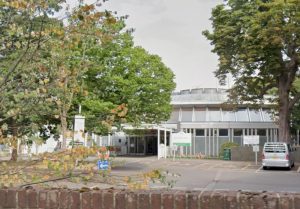
View of Bourne Hall and Museum, Spring Street, Ewell. (Credit: Google Street View)
You can now watch online the Epsom & Ewell Times Election Hustings
11 May 2026
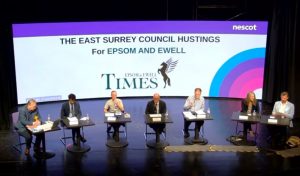
Residents from across the borough gathered at NESCOT on Wednesday (29th April) evening for a wide-ranging East Surrey unitary council election hustings, hosted by Epsom and Ewell Times and chaired by local solicitor Lionel Blackman.
Six candidates representing the main political groups contesting the forthcoming elections addressed the audience, setting out their priorities and responding to questions on key local issues. Those taking part were Eber Kington (Residents’ Association), David Buxton (Liberal Democrats), Robert Geleit (Labour), Kieran Persand (Conservative), Yvonne Grunwald (Green Party) and Ben Cronin (Reform UK).
Opening statements revealed both shared concerns and sharply differing approaches to local governance. Conservative candidate Kieran Persand emphasised his party’s campaigning record on issues such as Green Belt protection and crime, arguing that “track record” was the key distinction between parties.
Labour’s Robert Geleit drew on his long experience as a borough councillor, highlighting community engagement and investment in disadvantaged areas, while also reflecting on his own personal journey overcoming adversity.
Liberal Democrat David Buxton focused on what he described as the need for “practical, joined-up solutions”, particularly in road maintenance, special educational needs provision and infrastructure planning, arguing that current systems were not delivering for residents.
Green Party candidate Yvonne Grunwald highlighted cost-of-living pressures, environmental protection and the need for more community and youth spaces, pointing to her party’s growing representation locally.
Reform UK’s Ben Cronin centred his remarks on transparency and accountability, calling for a “full review” of council decisions and criticising what he described as wasteful spending, including issues surrounding the Rainbow Leisure Centre.
Residents’ Association representative Eber Kington positioned his group as a non-party alternative focused purely on local issues, stressing a positive campaigning approach and independence from national politics.
A lively question-and-answer session followed, with residents pressing candidates on practical concerns.
Road maintenance and potholes dominated the opening exchanges. Candidates broadly agreed the current system is too reactive, though solutions varied. Conservatives pointed to increased funding and a need for more strategic planning, Liberal Democrats argued for improved management and more in-house delivery, while others called for a return to long-term resurfacing programmes rather than repeated short-term repairs.
Youth provision emerged as another major concern, with audience members highlighting the decline of youth clubs and accessible spaces. Candidates across the political spectrum acknowledged the gap, suggesting a mix of direct council investment, partnerships with charities and sports organisations, and better use of existing community facilities.
Questions on the future structure of local government prompted discussion on how communities would be represented under the proposed East Surrey unitary authority. Candidates spoke of the need for stronger consultation, local committees and improved transparency, though some warned that new structures must avoid becoming ineffective “talking shops”.
Throughout the evening, a common theme was the challenge of translating broad promises—on roads, youth services and local accountability—into deliverable policy within a new council structure.
The hustings provided voters with a rare opportunity to hear directly from candidates across the political spectrum ahead of polling day. While there was broad agreement on the issues facing residents, the event highlighted clear divisions over how they should be addressed—and who is best placed to deliver change.
Photo: Hustings platform – L to R: Buxton, Persand, Kington, Blackman, Geliet, Grunwald, Cronin
Solar Panels green-light in Mole Valley a grey area?
11 May 2026
Solar panels powering up to 5,500 homes have been approved for prime Surrey agricultural land that could have been used to put the “wheat in our Weetabix”. Mole Valley District Council’s April development committee green lit the renewable energy plant for Little Flanchford Farm in Flanchford Road, Leigh.
The former green belt site was considered to be some of Surrey’s best and most versatile agricultural land, but the plans were recommended because the council sees renewable energy as central to achieving a sustainable, low-carbon future. The panels will convert light into electricity and contribute enough renewable electricity and low carbon energy to cut 4,052 tonnes of CO2 per year from the atmosphere, with the development standing for up to 40 years before being decommissioned and the site returned to agricultural use.
Residents objecting said special circumstances of the solar farm were not enough to outweigh the harm it would cause to green belt land, with one saying it would significantly affect the area for up to 10 years as planting would be ineffective for the first quarter of its lifespan and, even when fully in place, would not provide screening for several months a year, adding: “A decade of admitted damage is a serious policy conflict.”
Councillor Joanne Willoughby of Leigh Parish said the council was not against the principle of solar development but was concerned that open undeveloped agricultural countryside within the wider rural green belt was being classed as grey belt. The solar farm’s agent said the plant would improve local energy resilience and support businesses and homes through lower network charges, and would also curb the need for pylons crisscrossing the country.
Councillor Simon Budd (Conservative: Brockham, Betchworth, Buckland, Box Hill and Headley) said: “Saying that it is a grey belt, that is an absolute nonsense. That is green belt all day long. Nothing is out there. I’m told that green belt is only to protect Dorking and Reigate merging, well I don’t think it is. I think the green belt is there to protect the villages. I’m in favour of solar panels on top of buildings, on top of car parks, but not now on ‘best and most versatile land. And that is what it is, that is the land that feeds us, that puts the wheat in your Weetabix.”
The plans were approved by eight votes to four with three abstentions.
A “beautiful” and “fantastic” high-end luxury hotel, spa and fine dining restaurant set in the Surrey countryside has been approved.
Gatton Manor and Country Club will be transformed as part of a £41 million project to demolish the closed hotel and failing golf course and replace them with 81 guest rooms, two restaurants, and a spa featuring indoor and wild swimming pools, a gym, and treatment and relaxation areas.
The 22-hectare site near Ockley is expected to generate around 290 construction jobs during the two-year build, followed by 145 permanent roles once the development is operational.
Planning officers told Mole Valley District Council’s April development committee that the proposal would create a destination venue in the borough and bring significant investment into the rural economy. They added: “It is such a beautiful site, it is such a large site, it has got woodland, open areas, it is really a lovely, lovely, rural area and because of its size and the amount of landscape it is more than capable of absorbing this amount of development.”
In addition to the hotel, new facilities will be open to the public, including a fine dining restaurant and gym. The scheme also includes two tennis courts and three padel courts, with up to 100 gym memberships offered at preferential rates to residents living within 3km of the site.
Access to the hotel and spa will be via Standon Lane, linking the A29 Stane Street with Horsham Road. The existing hotel closed in 2022, and its adjoining 18-hole golf course had already been earmarked for closure regardless of the planning outcome.
Officers noted the development would also support businesses further along the supply chain. However, some residents objected, raising concerns about the impact on the openness of the countryside and increased pressure on local roads.
Developers acknowledged the loss of the golf course was regrettable but said it had been operating at a loss for several years and was no longer viable.
Councillor Roger Adams (Liberal Democrat, Bookham West) said: “With global warming and rising temperatures I suspect a lot of people seeking a holiday will no longer be heading to the Mediterranean but may well seek to have staycations, and where better to stay for a holiday than Surrey. We’ve got beautiful country here and we do need developments such as this. It will provide employment and enhance the visitor offer.”
Councillor Monica Weller (Liberal Democrat, Bookham West) added: “It really is quite fantastic as far as I’m concerned. A business like this has got to bring something really quite fantastic to our area and that is really to be welcomed.”
Plans for new hotel and spa in Ockley (MVDC)
Saturday 9 May is Surrey Day – and this year, we’re digging deeper
11 May 2026
Now in its eighth year, Surrey Day is about bringing communities together to celebrate everything that makes this county so special. In 2026, the theme is Going Underground, and it’s an invitation to see Surrey as you’ve never seen it before. Forget what you think you know about this beautiful county. Beneath the rolling hills and the familiar high streets of its market towns lies a world of hidden treasures just waiting to be unearthed.
Whether you fancy venturing into the literal underground or uncovering something altogether more unexpected, Surrey Day 2026 has something to spark the curiosity of all the family. Enjoy hands-on activities, torchlit tours, guided walks, unseen histories, a disco in a tunnel and stories in caves, re-enactments in shelters, castles to explore, fossils galore – and so much more!
While there will be events and activities countywide, this year, Epsom is taking centre stage as a key host town for the very first time. BBC Radio Surrey will be broadcasting live from Epsom from 12-3pm so keep your ears open – or better still, get down there and join in! The headline act is the extraordinary Ashley Road Deep Level Air Raid Shelter – a grid of brick-lined tunnels constructed 50 feet underground to shelter 1,500 people from the Blitz. Now hidden in woodland on the edge of town, there will be torchlit guided tours, but book early as these will sell out.
Many Surrey museums will also have Going Underground events such as Bourne Hall Museum in Ewell with an exciting full day of discovery, including an archaeological walk-and-talk, coin identification drop-ins and the remarkable story of the Epsom Aurochs which was a 3,500-year-old giant prehistoric animal unearthed locally in 2023. Or nearby in Dorking, there are castle and cave tours, guided history walks, and a chance to get hands-on with fascinating old inventions at Dorking Museum & Heritage Centre. A particular highlight is an impressively large-scale reconstruction of the very first Baronyx fossil discovery. On the other side of the county, Guildford Museum has fun hands-on fossil handling sessions, while Surrey History Centre presents a day of talks celebrating some of Surrey’s lesser-known artists. At Brookwood, you can be taken on a guided tour of the American Military Cemetery or if you head out further towards Tilford, you can get involved in 2 thrilling days of re-enactments at the open-air Rural Life Living Museum, finding out what daily life was like amid rationing and air-raids. If you’ve never visited, this is an experience you won’t forget in a hurry!
Find out more and plan your Surrey Day at visitsurrey.com/surrey-day and if you like a podcast, the BBC Secret Surrey series is a great companion to the day’s events.
A call to vote at the new East Surrey Council election 7th May
11 May 2026
Voters Urged to Have Their Say in First East and West Surrey Council Elections
With just one week to go until polling day on Thursday 7 May, voters across Surrey are being urged to take part in the first elections for the new East Surrey and West Surrey unitary councils.
The vote marks a major step in the reorganisation of local government across the county. From 1 April 2027, the new councils will assume responsibility for all key local services currently split between county and district/borough councils. These include education, waste collection, highways, housing, planning, children’s services, adult social care and more.
Those elected next week will initially sit on Shadow Authorities for East and West Surrey. These bodies will oversee the transition to the new system, including setting budgets and council tax levels, agreeing staffing structures and governance arrangements, adopting codes of conduct, and preparing for the transfer of services ahead of vesting day.
Mari Roberts-Wood, Returning Officer for the East Surrey elections, said: “These elections are your opportunity to choose who represents you on your new council and makes decisions on important local matters, including how the council is set up, so be sure to use your vote.”
Andrew Pritchard, Returning Officer for the West Surrey elections, added: “Electors will be able to vote for up to two different candidates to represent their ward. Remember, your vote is your decision and yours alone. You do not need to tell anyone how you voted.”
Polling stations open 7am–10pm
Polling stations will be open from 7am to 10pm on Thursday 7 May. Voters attending in person must bring an accepted form of photo ID. Without it, you will not be able to vote and will be asked to return with valid identification.
Accepted forms of ID include a UK, EEA or Commonwealth passport, a UK or EEA driving licence, biometric immigration documents, and certain concessionary travel passes such as an older person’s bus pass or an Oyster 60+ card. A free Voter Authority Certificate is also valid. Expired ID can still be used if the photograph remains a good likeness, but the name must match the electoral register.
Voters are advised to check their poll card carefully before attending, as polling station locations may have changed. You do not need your poll card to vote, but it provides useful details including your polling station.
You can find your polling station, ward, and a list of candidates by entering your postcode here:
If you have lost your poll card, you can still vote.
Those voting as a proxy must attend the polling station allocated to the person they are voting on behalf of, not their own.
Postal voting guidance
If you are voting by post, it is important to follow the instructions carefully to ensure your vote is counted. You may vote for up to two candidates where applicable.
Make sure you: complete your ballot paper in secret fill in the postal voting statement correctly place all documents in the correct envelopes seal the envelope yourself
Postal votes should be returned as soon as possible. If you are unable to post it in time, you can hand it in at a polling station up to 10pm on polling day.
Emergency proxy voting
If you are unable to vote in person due to illness, an emergency, or because your photo ID has been lost or damaged, you can apply for an emergency proxy vote until 5pm on polling day.
Polling stations are equipped to support voters with additional needs. This includes accessible entrances, low-level polling booths and assistance from trained staff. Voters are encouraged to ask for help if required.
Further information
You can find more details about the elections, including wards and candidates, at: surreylgrhub.gov.uk/elections
For broader information about the local government reorganisation in Surrey, visit: surreylgrhub.gov.uk
For residents without internet access, local electoral services teams at district and borough councils can provide assistance by phone.
The 7 May elections represent the first stage in establishing the new unitary councils, which will replace Surrey’s current two-tier system in April 2027.
East Surrey Council, an election that calls for distinction?
11 May 2026
As voters in Epsom and Ewell prepare to elect representatives to the new East Surrey Unitary Council on 7th May, two unfolding controversies raise a broader question: how should voters judge those seeking office when key decisions remain unexplained?
At the centre of both issues is a bizarre but all the same political deployment of Section 2 of the Local Government Act 1986 to justify a refusal to answer questions. As previously reported, this provision is aimed at preventing political publicity, not at preventing factual explanation. Yet it has been relied upon in two separate cases to decline engagement with legitimate enquiries.
One concerns the Rainbow Leisure Centre, where a confidential council decision identified potential dilapidations of up to £500,000 shortly after a change of operator. The public is still waiting for clarity on how such a liability arose. The other concerns the signing of a submission in the name of Epsom and Ewell Borough Council relating to a proposed second tier of governance above unitary councils, where questions remain about authority and process.
In both cases, the refusal to answer questions has come at a moment when accountability matters most — immediately before an election.
This matters because local elections are not simply about party labels. They are about judgement, competence and accountability. For nearly a century, the Residents’ Association has governed Epsom and Ewell, attracting many capable and committed councillors who have avoided the severe financial problems seen in a number of Councils in West Surrey. That record carries weight.
But continuity also brings its own challenges. Some councillors, including among the four who have left the ruling group of Residents Association councillors since the last Borough elections, have raised concerns about the “undemocratic” style of leadership in recent years. Others, still within the group, have expressed to Epsom and Ewell Times unease but privately. Many councillors are not political operators by instinct and appear reluctant to challenge leadership decisions publicly or otherwise “rock the boat”. Though the former main opposition LibDems on EEBC have not been without their own divisions; they lost two of their four councillors to independent benches.
For voters, that creates a need to distinguish between individuals as well as affiliations. A candidate’s independence of judgement, willingness to question, and approach to transparency may matter as much as their political alignment.
At the same time, the forthcoming election is not for the existing borough council but for a new authority covering a much wider area. The East Surrey Council will bring together multiple districts into a single body responsible for all local services. That change introduces a second consideration for voters: influence.
Available projections and polling suggest that no single grouping is guaranteed dominance, but that larger national parties — including the Liberal Democrats and others with broader geographic bases — may be well placed to secure significant representation across the new authority. A recent JLP Partners opinion poll has placed the Liberal Democrats a nose ahead at 29% over a split right vote between Conservatives (25%) and Reform (27%). At a national level, the political landscape itself appears increasingly fragmented, with gains forecast for smaller and emerging parties alongside shifts in traditional support.
In that context, voters may find themselves weighing two different questions. One is who best represents Epsom and Ewell locally. The other is which candidates are most likely to have influence within the Unitary Council that will take decisions affecting the area for years to come.
Neither question has a simple answer. Voting for independent or Residents’ Association candidates may prioritise local identity and continuity. Voting for candidates aligned with larger parties may offer a greater chance of being part of the administration of the new authority.
What the current controversies underline is that accountability, transparency and willingness to engage with scrutiny are central to that judgement. When questions about significant public decisions remain unanswered, voters are entitled to take that into account.
The ballot on 7th May is therefore not only about the future structure of local government. It is also an opportunity for voters to decide what standards they expect from those who seek to represent them.