Epsom and Ewell Times

ISSN, LDRS and IMPRESS logos

Epsom & Ewell Full Council Meeting: Budget Approved Amid Debate

Town Hall

Epsom & Ewell Borough Council held a full council meeting on 11 February 2025, where key issues, including the approval of the council’s budget, the mayor’s upcoming engagements, and urgent council business, were discussed.

Mayor’s Address

The meeting opened with prayers led by Reverend Esther Holly Hunt, followed by an address from the Mayor, Cllr Steve Bridger (RA Stamford) who reflected on recent civic events, including the 50th anniversary of the Epsom and Ewell Talking Newspaper, the 100th anniversary of the Epsom Rotary Club, and the forthcoming 80th anniversary of VE Day. The Mayor also highlighted the upcoming Mayor’s Ball at Epsom College and the opening of the newly step-free Stoneleigh Station.

Budget Debate and Approval

A crucial part of the meeting was the discussion of the council’s budget for 2025-26. Councillor Neil Dallen (RA Town), Chair of the Strategy and Resources Committee, presented the budget, outlining the financial challenges faced by the borough, including homelessness, climate change policies, and government funding uncertainties.

The opposition groups, including the Liberal Democrats, Labour, and the Conservatives, expressed concerns over housing shortages, procurement processes, and local plan delays. Councillor Alison Kelly of the Liberal Democrat group (Stamford) criticised the council’s lack of action in addressing social housing and discretionary housing payments. Labour Councillor Kate Chinn (Court) challenged the proposed council tax increase, arguing that it would place an undue burden on residents. Meanwhile, the Conservatives called for greater scrutiny of council spending and planning decisions.

Many councillors who voted against the budget voiced concerns over the council’s financial priorities. Labour representatives particularly highlighted the continued reliance on temporary accommodation for those facing homelessness, arguing that the budget did not allocate enough funding to long-term housing solutions. The Liberal Democrats criticised the slow progress on infrastructure projects and the perceived lack of transparency in procurement decisions. The Conservative group, on the other hand, raised issues regarding planning enforcement and the handling of the local plan, arguing that the administration was failing to provide long-term economic sustainability for the borough.

Some opposition members also questioned the feasibility of the proposed budget adjustments, warning that future financial strains could lead to service reductions or higher tax burdens in the coming years. They argued that without a more robust financial plan, the council risked further instability, particularly in areas such as waste management, policing support, and community welfare.

Following the debate, the budget was put to a recorded vote and was approved, despite opposition from some eleven councillors including several Residents Association members against 23 who voted to pass the budget.

Withdrawal of Motion

A motion initially set for discussion was withdrawn at the request of Councillor Dallen. The motion pertained to potential by-election arrangements and was removed following guidance from Surrey County Council, which advised that any by-elections held before May 2026 would need to be conducted under existing boundaries.

Confidential Discussions

Towards the end of the meeting, the council entered a closed session to discuss an urgent item containing exempt information, leading to the exclusion of the press and public.

The meeting highlighted the ongoing challenges faced by Epsom & Ewell Borough Council as it works to balance financial constraints with the needs of local residents. The approval of the budget ensures continued funding for essential services, though the opposition has signalled that they will continue to scrutinise council decisions closely.


Funding for new apprenticeships now available to Surrey businesses

Businesses can grow their workforce and boost productivity in just a few clicks by getting an apprenticeship funded by Surrey County Council.

As part of the Apprenticeship Levy Transfer Scheme, small and medium enterprises across the county can get fully funded support to train local talent.

Apprenticeships are widely recognised as a cost-effective way to recruit, improving diversity and filling skills gaps. In time, they can also help businesses grow, improve employee retention and support the wider economy.

Funding is available to pay for the training of dozens of new apprenticeships across the county. It is open to all businesses in Surrey and allocated on a first come, first served basis – meaning those interested should apply swiftly via the Surrey County Council website.

For those unsure of the process, a free 45-minute webinar will be hosted by the Council’s Business Surrey service on February 26. Reserve your space today to discover more about modern-day apprenticeships and how businesses can access funding.

One Surrey organisation that has benefited already from the scheme is Sight for Surrey, a charity that provides specialist support for people in Surrey with sensory loss. Diane Smith, Head of Adult Services says:

“We have used the levy to support internal succession for those wanting to pursue a career in Social Work from the Deaf Community. More recently we used the levy to support three new apprentices in roles that are recognised to be under resourced across the sector nationally as well as in Surrey.

“The process of completing the Levy Transfer scheme was simple and smooth due to the responsive support from the Council. Our Deaf Services Social Worker has recently graduated from Kingston University and our three new apprentices are settled and progressing well in their new careers! All making an impact for residents of the Surrey community.”

The call comes in National Apprenticeship Week (February 10 to 16), which is a national celebration of the opportunities presented by the training schemes.

According to government figures, benefits of apprenticeships include:

96% of employers report benefits to their business
employers make a net gain of between £2,500 and £18,000 per apprentice during their training period
80% of businesses see a significant increase in employee retention
Almost two-thirds of all UK apprenticeships in the last year have been funded by the apprenticeship levy.

This is a pool of funding made available by large employers, such as the Council, to make apprenticeships more accessible to SMEs. The Council wants as many local residents and businesses to benefit from the scheme as possible – which is why the online process can be completed in a matter of minutes.

Matt Furniss, the Council’s Cabinet Member for Highways, Transport, and Economic Growth, emphasised the council’s commitment to providing opportunities for all. He said: “Apprenticeships are a proven cost-effective way to recruit which benefit businesses and employees, as well as the broader economy. As an organisation we are committed to providing opportunities to all of our residents, which includes creating a skilled workforce for the future. “The levy transfer scheme is a fantastic way for SMEs to access funding to develop and grow their workforce – which is why I encourage them to discover more about this fantastic opportunity.”

For more information on how to apply for the Apprenticeship Levy and to start the process of recruiting talented apprentices, visit https://www.businesssurrey.co.uk/workforce/apprenticeship_levy/


 Mega Surrey council ruled out as leader says it would ‘lack accountability’

Proposed Surrey County boundaries (Credit contains Ordnance Survey data Crown copyright and database rights 2024)

Council leaders across Surrey have ruled out making the county a single mega authority. The agreement was reached during a meeting on February 7, attended by leaders from all eleven district and borough councils. 

The government confirmed last week that Surrey is among the first areas to take part in devolution to simplify and streamline local government. Elections have also been postponed until at least 2026 as part of the process. 

Catherine Sayer, Leader of Tandridge District Council, said: “I am delighted we have been able to rule out proposing a single unitary which I believe would have been too large and so lack accountability to residents.”

Two-tier systems of borough and county councils could be thrown away with single unitary authorities created instead. The government argues this would not only be more cost effective but also shift power away from Westminster and towards local people. 

Tim Oliver, Leader of Surrey County Council, who was unable to attend last week’s meeting, said: “The government’s White Paper sets out their ambition to create strategic combined authorities under mayoral devolution, and within Surrey’s geography a single unitary wouldn’t meet that criteria.”

A statement from the Surrey Leaders LGR Steering Group said it “remain[s] committed to working together towards submitting one bid for the County”.

Options still on the table include Surrey being made up of two or three smaller council regions, with possibly an elected mayor overseeing the whole county. Last week Spelthorne councillors voted on their preferred make-up of councils depending on whether Surrey would be split into two or three. 

But leaders across the political divide have warned shrewd councils should not be flattened by neighbouring council’s crushing debts. Leader of Reigate and Banstead Borough Council, Richard Biggs, and Leader of Elmbridge Borough Council, Mike Rollings, as well as Cllr Sayer (Tandridge) have raised alarm at being forced to pick up the tab of other councils. 

Council leaders are aiming to meet weekly to develop an interim proposal, in line with government criteria, to be submitted by 21 March with a full proposal to follow by 9 May.


Epsom & Ewell Council not much in the red but too much in the pink!

Epsom Town Hall in a pink hue

Governance Failing Exposed by External Audit Findings

The Audit and Scrutiny Committee of Epsom and Ewell Borough Council convened on 6th February 2025, where the External Audit Report by Grant Thornton ignited a heated debate over transparency, governance, and the Council’s use of confidential “pink papers”. Against the background of relative positive news on the accounts and budgets the meeting focussed on the culture of secrecy over decision-making.

The external auditors highlighted a culture of secrecy, citing too many decisions being taken in private and a lack of openness in decision-making. Opposition Councillors Kate Chinn, Chris Ames and James Lawrence strongly criticised the Council’s handling of transparency, while the Council’s leadership attempted to downplay the concerns, insisting that governance processes were robust.


The External Audit Report: A Damning Verdict on Transparency

The Grant Thornton audit report drew heavily on a Local Government Association (LGA) Peer Review, which criticised the Council’s decision-making culture. The report highlighted that:

  • “Too many decisions are being made under part two as a media management strategy.”
  • There is a “lack of transparency” in governance structures.
  • The Council needed to demonstrate clearer and more open decision-making.

These findings were met with stark reactions from opposition councillors, who argued that the Council was withholding information from elected members and the public.


Councillor Kate Chinn: “Stop the Navel-Gazing”

Before the committee formally discussed Item 4: External Audit, Councillor Kate Chinn (Labour, Court Ward) made a strong opening statement, focusing on the governance failures exposed by the auditors. She highlighted:

“Throughout their report, Grant Thornton noted the LGA report stating a culture of secrecy, noting a lack of transparency, stating a culture of secrecy described by members and that too many decisions are being held behind closed doors.”

Chinn criticised the ruling administration for focusing on internal restructuring, particularly the proposal to separate audit and scrutiny functions, rather than addressing substantive transparency issues. She stated:

“The ruling group has chosen to focus as a priority on the LGA recommendation to decouple audit and scrutiny. This is a decision that was already planted in council by the political leadership as a direction of travel, and I’m quite sure this is not a priority for the residents of Epsom and Ewell facing so many cost-of-living challenges.”

She urged the Council to move beyond constitutional tinkering and focus on supporting frontline services:

“In view of the move to a unitary authority, the Council should stop spending so much time on internal matters—no more tweaking the constitution or fiddling about with the functions of a soon-to-be different committee. It’s just become navel-gazing.”


Councillor Chris Ames Challenges “Pink Paper” Secrecy

The overuse of confidential “pink papers” (private reports) became a central point of contention, with Councillor Chris Ames (Labour Court) raising concerns over the council’s reliance on closed-door discussions.

He directly challenged the administration on whether they were deliberately using “part two” rules to restrict public access:

“Are you using part two to be a euphemism for going into a closed session? Because that’s not my understanding of what part two means….. There is a withheld report here. It’s Appendix Two. It’s quite clear. It says on both the public pack and in item 13.”

Chair Steve McCormick Chair of the Committee (RA Woodcote and Langley) defended the Council’s approach, arguing that some reports contained sensitive financial details:

“If you start to ask questions on that, then we will have to go into part two. We will have to basically stop the feed. And once we go into part two, we can’t come out.”

However, Ames remained sceptical, pressing for clear definitions of what was truly confidential and what was being unnecessarily withheld. He questioned whether decisions should be debated in secret unless absolutely necessary: “My question is, are we using the word Part Two consistently and accurately? Because it says item 13 and it says it’s on the public pack.”

Adding to this transparency row, Councillor Alex Coley (RA Ruxley) reported that he was unable to access the part two documents on the Council’s internal system, ModGov:

“I’m not actually able to access the part two items in ModGov. So that’s perhaps why there’s been some confusion. I can’t get to them.”


Councillor James Lawrence: “A Transparency Crisis”

In one of the most scathing criticisms of the evening, Councillor James Lawrence (LibDem  College Ward) said that his own experiences confirmed that the Council had a serious transparency problem. He declared:

“Quite frankly, my own experience of transparency at the Council is not great.”

He pointed to several key examples where he felt information was deliberately restricted:

  1. The Local Plan Process:  “I’ve struggled to be involved at all in the local plan process. The entire time I’ve been elected as a councillor, it has not come to a public committee until right before it went to full council……..If I’m struggling as a councillor, my goodness, what do we think residents are struggling to see?”
  2. The Town Hall Move (£7m Project):  “Still don’t really know why that was in part two……Then of course we had the well-prepared, very slick PR statement to go out after, to give the impression to residents that there were no problems, that it’s all clean sailing.”
  3. The Hook Road Arena Plan:  “I remember I saw that appear in the Local Plan documents, and I emailed in questions about that. Nothing. Nothing back.”
  4. Access to Audit Reports: “Having my own struggles to get hold of an audit report as a member of audit and scrutiny—it’s not a very good sign……Of all the people to be struggling to get hold of an audit report, it shouldn’t be someone on the Audit and Scrutiny Committee.”

Council’s Response: A Dismissive Attitude?

The Council’s official response to the audit findings did not acknowledge any fundamental governance failures. Instead, the Senior Leadership Team (SLT) issued a brief statement, saying: “SLT believes the Council is transparent in its reporting and through Committees.”

Lawrence ridiculed the response, stating: “My impression of the management response is essentially: Don’t care. It’s already transparent enough.”

A pragmatic attitude from Councillor Alan Williamson

Cllr Alan Williamson (RA West Ewell) struck a pragmatic tone, questioning whether the Council should devote energy to internal reforms when local government reorganisation was imminent. He remarked:

“Obviously, the one area where there is an element of concern from the external auditors is governance and transparency. Now, this is, in my mind, an issue of culture rather than performance…….. The whole focus of this Council is going to be the impending local government reorganisation, and to expect it to change its culture in the next year or two is somewhat implausible.”

He suggested that the Council’s priorities should shift towards ensuring stability during the transition rather than engaging in lengthy internal governance debates.


A Governance Crisis?

The Audit and Scrutiny Committee meeting exposed deep divisions within the Council. While external auditors and opposition councillors raised legitimate concerns about secrecy and accountability, the administration remained largely dismissive of these criticisms.

As Councillor Lawrence bluntly put it: “If I’m struggling as a councillor to access this information, what hope do our residents have?”

With local government reorganisation looming, the Council faces mounting pressure to reform its decision-making processes—but the meeting made clear that no immediate action is planned.

Whether transparency will improve or whether secrecy will remain embedded in the Council’s culture remains to be seen.

Related reports:

Seeing through transparency in Council Chamber

“Audit and Scrutiny” under scrutiny

Annual audit of Epsom and Ewell Borough Council


Guildford Borough Council keeps its lights on

Outside Guildford Borough Council\'s HQ, Millmead House. (Credit: Guildford Borough Council)

A Surrey council may have “kept the lights on” and balanced the budget this year but trouble could be looming. The pessimistic warning came during the budget meeting as councillors were told they will have to make tough decisions in the future. 

Members of Guildford Borough Council signed off a balanced 2025/26 budget this week despite an ‘unkind’ settlement from the government leaving levels of funding largely unchanged from the previous year. Councillors from all parties praised officers and finance bosses for turning Guildford’s accounts around in the last two years. The Surrey borough was nearing bankruptcy in 2023 with the strain from rising historical debts.

But all is not as rosy as it seems. Each year Guildford Borough Council must find £2m worth of savings just to keep afloat and cover borrowing costs for its “ambitious” capital programme. The projected budget gap is expected to grow from 0 in 2025 to potentially £5.9 million in four years (2028/29) with at least an £1.6 million increase every year. Service costs from the council are projected to rise from £16.4 million in 2025/26 to potentially £20.3m in 2028/29.

Over the next five years, Cllr Richard Lucas (Lead for Finance and Property) explained the requirement for Guildford to pay back its escalating debt represents a “major financial challenge”. He said: “Each year we will have to find another £2m worth of savings just to stay still and cover our borrowing costs increasing.”

However, the council’s plan for paying back debts for building projects does not include the Weyside Urban Village scheme. A hugely ambitious undertaking, the Weyside Urban Village project is the council’s regeneration scheme aiming to build 1,500 homes. The borrowing costs, or interest, for the project are due after 2029 and so are not incorporated into the medium term financial plan. 

Despite work being underway, the council still has not quite figured out how it’s going to foot the bill. Although it may seem a ‘future problem’, councillors will decide how they are going to finance the project in March.  

“If anything is going to put the council back in the financial mire it is that,” said Cllr Patrick Oven. He said although he was very “committed” to the scheme, he “wondered whether we can afford it”. 

Cllr Richard Lucas told the council the budget was balanced by “finding some savings within the services, increasing some fees and charges”. The Lead Councillor for Finance and Property added the main source of potential savings going forwards is from opportunities of collaboration with Waverley. The councils had recently claimed £600k has been saved in the local authority partnership between Guildford and Waverley. 

National insurance increases took the biggest chunk of the council’s finances, hitting Guildford with around £1,000 per full time employee. Wage rises and inflation is also squeezing the council’s budget, demanding the increase in council tax by the maximum 2.99 per cent. Charges for council services are projected to increase by at least 3.75 per cent. 

Non-ringfenced reserves for a rainy day sit at around £17.7m, well above the minimum 5% of general fund expenditure recommended. 

Cllr Patrick Oven described the accounts as “an austerity budget”. Expenditure is reduced in 2025/26 but for the next four years spending “effectively falls off a cliff” with money dropping to about a third of the £111k promised this year. “But we can’t spend money we haven’t got,” he added. 

Opponents still criticised the Liberal Democrat administration for a “lack of ambition” with the budget as no ‘rabbit out of the hat’ or exciting projects were revealed. Cllr Joss Bigmore said: “It’s really sad that we’re at this stage now where we’re going budget to budget trying to keep the lights on and that leaves so little discretion for any political ambition or choices.”

Guildford council has also agreed to undergo a ‘zero budgeting basis’ by looking at everything it does, covering its statutory duties and long-term priorities. Cllr Lucas said: “It inevitably means we will stop doing some things. There will be pain involved but we have £2m a year, each year, to find extra savings.”

Outside Guildford Borough Council\’s HQ, Millmead House. (Credit: Guildford Borough Council)


Surrey’s flood defences and energy efficiency funding

View from Little Misley, one of the fields set to have solar panels. (Credit: Guildford Borough Council planning documents)

Funding for Surrey’s climate change programme has been reinstated after the county council received £1.5m more in government grants than it was expecting. 

Surrey’s Greener Future’s programme is a climate change strategy that aims to reduce carbon emissions and make the county net-zero by 2050. Budget details had initially proposed to slash £0.5m from the Greener Future’s spreadsheet, as part of Surrey County Council’s identified £66.4m cuts it needs to make in 2025/26. 

But the cuts will now be reversed after an amendment put forward by the Residents’ Association/Independents and the Green Party. Members unanimously agreed to the proposed changes to the budget at a full council meeting on February 4. 

Cllr Catherine Powell said in the meeting: “Younger residents want a long-term focus which I don’t believe this budget fully supports.” The Independent member for Farnham Residents said the funds will safeguard the “vital work on developing and embedding climate adaptation”.

Money reinvested back into the Greener Futures team can be used to develop and integrate climate adaptation policies such as flood defences, heat avoidance, and programmes to improve household energy efficiency. It also includes developing finance opportunities like natural capital and organising health initiatives.

Cllr Jonathan Essex (Green Party/ Redhill East), who initiated the amendment, said: “Now is the time to strengthen and extend, not water down, climate action across Surrey, so I am delighted that we have taken this step to continue tackling the climate emergency. 

“Leadership by local councils, including here in Surrey, is vital to ensure that the health of the economy is defined by community well-being and sustainable living, not by growth at all costs.”

Cllr Powell added: “I firmly believe that climate change is not only real, but impacting Surrey and our residents and our businesses today.” She cited the multiple instances of flooding across Surrey last year which the Environmental Agency said would only happen once every 30 years in normal condition. 

The agreed change was just one of five amendments the Green Party put forward to change the council’s budget, the rest were rejected. The others included creating a voluntary contribution fund for early intervention children services, closing the Your Fund Surrey programme, putting a transport scheme on hold and committing to a cross-party working group for SEND needs. 

View from Little Misley, one of the fields set to have solar panels. (Credit: Guildford Borough Council planning documents)


Mole Valley setting a green belt development trend?

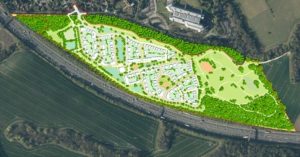
Plans for 200 homes in Little Bookham (image Thakeham)

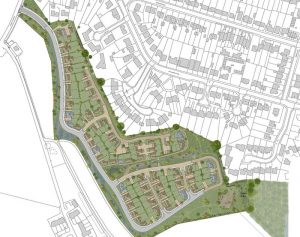
Up to 200 new homes will be built on former green belt land despite fears they could overwhelm the already strained sewage system. Mole Valley District Council’s planning committee approved developer Thakeham’s vision for the 27-hectare site off Little Bookham Street on Wednesday, February 5. As well as the 200 homes, the plans will feature a community building, Gypsy and Traveller pitches, and public open space that the developers said would also open access to nearby ponds. Forty per cent of the homes would be affordable.

The site has been identified for development by the council’s local plan, but the application had drawn more than 300 objections. Residents speaking at the meeting raised concerns about raw sewage, as well as the impact on local children being pushed out of their school’s catchment area. Thames Water, however, raised no objections. Christine Milstead said: “Our green belt is definitely not Angela Rayner’s gray belt. We think this development will cause harm to the green belt and protected habitats. All residents have objected to surface water flooding, and there are springs all over this site. For years, residents have been pumping water off their patios to prevent their houses from flooding. When you get a lot of rain, water does not drain through permeable surfaces. Will the proposed infrastructure capture water from the rear of new properties, or will it just run down to Little Bookham Street?”

Speaking on behalf of the plans, Tristan Robinson, Thakeham’s director of external affairs, said Mole Valley was the fourth least affordable place to live in the country. He highlighted young couples struggling to afford housing and the 680 households on the waiting list. Despite the plans being voted through—by eight in favour, three against, and one abstention—Councillor Joanna Slater (Conservative; Leatherhead South) cautioned against setting a precedent for developing beyond what was laid out in the council’s local plan for green belt. Cllr Paul Kennedy (Liberal Democrats: Bookham East and Eastwick Park) also urged the committee to heed residents and environmental groups calling for the protection of the “precious unspoiled countryside.”

The new homes will be net carbon zero and feature a mix of one to four-bedroom properties. The developers aim to create 45 acres of open space and a new country park accessible to the wider community. Mr Robinson said: “After undertaking a comprehensive public consultation process for Land North West of Preston Farm, we are pleased to receive backing from Mole Valley District Council. The scheme includes 40 per cent affordable housing—something urgently needed locally—and significant new public open spaces for everyone to enjoy.”

Plans for 200 homes in Little Bookham (image Thakeham)


Elections Delayed as Surrey Faces Uncertain Future of Local Government Shake-Up

Surrey and Epsom Councils

Surrey residents will have to wait an extra year to vote in the county elections following the government’s decision to postpone the polls from May 2025 to May 2026. The delay comes as part of a sweeping local government reorganisation that will see the biggest structural shake-up in fifty years. However, concerns are mounting over the rushed timetable, the fate of council debts, and the financial burden that could fall on responsible local authorities.

Reorganisation at Speed

The government’s drive for local government reform is progressing at an accelerated pace, with councils required to submit interim proposals by 21 March 2025 and finalised plans by 9 May 2025. The reform aims to replace Surrey’s current two-tier system – where Surrey County Council oversees borough and district councils – with unitary authorities that will consolidate power at a higher level.

Under plans being considered, a directly elected mayor could manage strategic services such as policing, fire and rescue, health, and education. However, uncertainty remains over whether the new unitary system will feature a single authority covering all of Surrey’s 1.2 million residents or two to three smaller councils.

Who Pays the Price?

A key source of controversy is the issue of existing council debts, particularly in boroughs such as Woking, Spelthorne, and Runnymede, which have amassed a combined debt exceeding £3 billion. Woking has already declared effective bankruptcy, with Spelthorne and Runnymede under government scrutiny.

Local leaders across Surrey are voicing their objections to any attempt to spread the financial burden of these debts across councils that have maintained responsible fiscal management.

Councillor Richard Biggs, leader of Reigate and Banstead Borough Council, said: “Our view remains that plans should not support any restructuring of local government boundaries based on ‘redistributing’ the debt of other authorities.” His council, along with others, has worked to maintain financial stability while continuing to provide additional services beyond statutory requirements.

The Residents’ Association and Independents Group at Surrey County Council has strongly criticised the government’s approach, arguing that it is forcing through change with “zero funding” while suggesting that costs could be covered by selling off council-owned assets. Group leader Councillor Catherine Powell raised concerns that the government expects local authorities to fund reorganisation through “capital receipts,” which could mean selling buildings currently used to deliver essential services.

Opposition to Election Postponement

The Surrey Leaders Group, a forum representing the county’s borough and district councils, has already voiced opposition to the decision to delay elections. Chair of the group, Councillor Hannah Dalton, (RA Epsom and Ewell for Stoneleigh ward), warned that the proposed reorganisation could remove decision-making from local communities and lacks clarity on how existing debts will be handled.

“There is a real risk that new authorities will be set up to fail,” said Cllr Dalton, highlighting the potential for new unitary councils to inherit substantial financial liabilities without sufficient funding or support from the government.

A Distracted Local Government

Critics argue that the rapid timeline for reorganisation is an unwelcome distraction at a time when councils are struggling with increased demand for statutory services, including social care and housing. Concerns have also been raised about the practicalities of implementing a new financial IT system for the newly formed authorities, given that Surrey County Council’s recent system overhaul has been plagued with problems.

With just weeks to prepare draft proposals and a final deadline in early May, councils across Surrey are left scrambling to determine the best way forward. The government’s insistence on a rapid restructuring without clear funding commitments has left many questioning whether the changes will deliver better services—or simply create further financial and administrative chaos.

For now, Surrey residents must wait for further clarity on how their local government will be reshaped, and more crucially, who will bear the cost of these sweeping changes.

Related reports:

Political furies over Surrey election postponement

Surrey County Council election delay stirring up a storm

What might local government reorganisation mean for Epsom and Ewell?

All change! Epsom and Ewell Borough Council approaching its final stop?

Surrey’s Conservative leader wants to postpone May’s poll reckoning

Tiers to be shed if Epsom and Ewell loses its Borough Council?


Surrey mansion tax debated at County Council

Paul Follows speaking at full council meeting 4/02. (Credit: Surrey County Council live stream)

Plans for ‘those with the broadest shoulders’ to voluntarily pay more council tax to help those in need have been labelled ‘morally corrupt’ in a heated debate. The idea is based on a scheme introduced by Westminster Council in 2018, dubbed a “mansion tax”.

Council Tax is based on the property value of a house if it was sold in April 1991 in England. For instance, Band H is for properties valued at over £320,000. But with the average house price in Surrey today at just over £600k, according to Rightmove, councillors agreed the council tax system needs reform.

Paul Follows, Liberal Democrat group leader, put forward an idea to ask residents in Band H if they would be willing to pay more money to support essential services and those in need. He asked the county council to “explore the creation of a voluntary contribution scheme” for those in the highest bracket of council tax.

But the Lib Dem’s amendment to the budget was lambasted by councillors at a full council meeting on February 4. Members voted against proposal 43 against, 25 in favour and six abstentions.

Brandishing the proposal as “morally corrupt”, Cllr Ernest Mallett MBE (Residents’ Association and Independents/ West Molesey) argued many people, like himself, support charities which try to combat poverty. He said that for Cllr Follows to suggest a council with a £2bn turnover should attempt to “levy funds from residents” is “totally immoral” and “unjustified”.

The suggestion was tabled as an amendment to Surrey’s budget for 2025/26 at a full council meeting on February 4. Residents living in a Band H property will be facing a council tax bill of over £3,690 this year as the council’s budget was approved.

Not a concrete plan, Cllr Follows proposed a cross-party working group would be created to flesh out the scheme’s scope and structure. Then the designs would be brought back to council for consideration for the next financial year. He said: “It does not cost us a lot of money to try, and we may help a lot of people if we do.”

Cllr Mark Nuti (Conservative/ Chertsey) said it was “an affront” to the people of Surrey who are generous with their time and money in the voluntary sector and philanthropic investors in the community.

Council leader Tim Oliver agreed and said Surrey “already has one of the highest council tax bills in the country”. Cllr Oliver said members should focus more on local government reform rather than getting residents to pay extra.

Worried about the “unintended consequences” of the scheme, Cllr Denise Turner Steward (Conservative/ Staines South and Ashford West) said putting “moral pressure” on residents to pay more council tax to help others could “divert” funds away from much-needed charities in Surrey.

But not everyone shared the same view. “There is nothing iniquitous of asking those with more to consider voluntarily giving a little extra,” said Cllr George Potter (Lib Dem/Burpham). “If that bastion of socialism in Westminster can manage it, then surely middle of the road Surrey can certainly manage it.”

Other members took a more hard-line approach. “If you can afford a £3m or £4m house, you ain’t poor,” said Cllr Jan Mason (Residents’ Association/ West Ewell). “They know they are buying housing in an affluent area, they are able to pay.” She told the council many of the residents in her ward and it would be an “insult to my residents who are on really low income” if bigger council tax bands were not brought in.

Cllr Lance Spencer (Goldsworth East and Horsell Village), seconding the motion, said he understood not everyone in a Band H property would be able to contribute. However, the voluntary contribution could provide “an opportunity to make a significant impact to the county’s future” with the “further degradation of services realistically inevitable”.

Waverley Borough Council, where Cllr Follows is leader, has also sent a letter to residents asking for their thoughts on a proposal to introduce voluntary tax contributions to support projects and vulnerable residents across the borough.

Paul Follows speaking at full council meeting 4/02. (Credit: Surrey County Council live stream)


Political furies over Surrey election postponement

Tim Oliver Surrey County Council leader - Surrey Live

Rival political parties are furious over the cancellation of Surrey’s 2025 county council elections, with groups claiming the ruling Conservatives are “running scared”. 

The government announced on Wednesday (February 5) that it has accepted Surrey’s request to postpone the county council elections for May 2025 to the following year. The county is now set to be part of the government’s ‘first wave’ of simplifying and streamlining local authorities. 

Specifics of how Surrey will be governed are still yet to be carved out but it could involve either a single mega authority with an elected mayor, or two to three smaller regions.

The news comes much to the despair of some political parties. Liberal Democrats and the Green Party saw a surging level of support in Surrey district and borough council elections last year and they were hoping to repeat the same success at a county-level. 

Surrey MPs have reacted to the cancellation, with newly-elected Liberal Democrats claiming the “Conservative-led Surrey Council has denied local residents their voice”.

A joint statement from the Lib Dem MPs in Surrey and the group leader read: “It is clear that the Conservatives are running scared and have succeeded in stopping these elections from happening in May, in a desperate attempt to cover up their own abysmal record.

“Meanwhile, the Labour Government has stood by and done nothing, knowing they can’t win in Surrey. 

“Voters are rightly fed up with this Conservative council and years of financial mismanagement. From endless potholes, to cutting local frontline services, to letting down thousands of children with special educational needs and much more, its record speaks for itself.”

Tim Oliver, Leader of Surrey County Council, welcomed the decision to postpone the elections to allow for “detailed work for reorganisation” to begin while supporting residents. The Conservative member asserted that devolution is in the “best interest” of residents and businesses.

Meanwhile, the Green Party reacted with anger to the news. Cllr Jonathan Essex (Redhill East) said: “Our fragile democracy can’t afford to ignore the people’s right to vote.” He said: “The local Conservatives have forfeited their right to represent the county as we face an uncertain future for local decision-making.”

The Greens said it would have stood more candidates than ever before at the Surrey County Council elections as the party has been growing in popularity. Cllr Essex said: “People should have a real choice between the failed Tory and Labour parties […] The real aim of so-called ‘devolution’ is quite the opposite: to move decision-making upwards to more unaccountable bodies.”

But Surrey’s two Labour county councillors said the delay was “good news for the people of Surrey”. The pair said the change will hand power from Westminster to local people with new powers and a better deal.

“Surrey County Council was formed in 1889 so the world is very different now,” Cllr Robert Evans (Spelthorne). The population of Surrey has more than doubled since Victorian times and much of what was Surrey then is now in London. The boroughs and districts were formed more than fifty years ago and don’t serve the same purpose as they might have done then.’

Cllr Robert King (Runnymede) added: “In Surrey we have a two tier system which means service delivery can be confusing. Add to that we have 12 headquarters, 12 chief executives, dozens of deputies and more than a thousand councillors. A top-heavy system of local government does not serve our communities as well as it should.”

Out of 16 local authorities which wrote to the government asking to postpone the May 2025 elections, only nine of the requests were accepted by Angela Raynor, Secretary of State for Housing, Communities and Local Government. Other councils that sought a delay included Warwickshire, Devon, Leicestershire, Gloucestershire, Kent and Worcestershire, and Oxfordshire.

“Any party calling for these elections to go ahead must explain how this waste would be justifiable,” Ms Raynor said in her announcement to the House of Commons. She added: “We’re not in the business of holding elections to bodies that won’t exist and where we don’t know what will replace them. This would be an expensive and irresponsible waste of taxpayer’s money.”

Describing the need for creating a sustainable unitary local government for Surrey as “urgent”, the Ministry for Housing, Communities and Local Government said postponing the elections will help “speed up” reorganising local government and its benefits.

Tim Oliver Surrey County Council leader – Surrey Live

Related reports:

Surrey County Council election delay stirring up a storm

What might local government reorganisation mean for Epsom and Ewell?

All change! Epsom and Ewell Borough Council approaching its final stop?

Surrey’s Conservative leader wants to postpone May’s poll reckoning

Tiers to be shed if Epsom and Ewell loses its Borough Council?