Surrey eyes a share of its own taxes under devolution plans
7 August 2026
Surrey’s future strategic authority could retain a share of locally generated income tax and business rates under government plans to transfer more money and decision-making from Whitehall to England’s regions.
The Government’s “Rewiring the State” programme proposes replacing some central government grants with a share of the income tax generated within each mayoral area from April 2028.
Mayors would not, on the information published so far, be given the power to set income tax rates. Instead, part of the existing tax collected by the Treasury would be assigned to their regions.
The intention is that an area which expands its economy and tax base would benefit from the additional revenue. Councils and strategic authorities would also retain a greater proportion of locally raised business rates.
However, the Government has yet to disclose what percentage of either tax would be retained, how the system would operate during an economic downturn or how revenues would be redistributed between wealthier and less prosperous regions.
Those details are expected in a fiscal devolution roadmap accompanying the autumn Budget, followed by more precise income-tax arrangements in the next Spending Review.
The proposals could prove particularly significant for Surrey, with its comparatively strong economy, high employment and large number of higher-rate taxpayers. Whether that translates into substantially more money for local services will depend upon the formula eventually adopted and the grants which tax revenues replace.
Surrey County Council says a Foundation Strategic Authority is proposed for the county in 2027, providing a possible route to a Mayoral Strategic Authority from 2028.
That distinction matters. The Cabinet statement promises a share of income tax to “every mayor”, while saying that mayoral authorities will receive greater powers than non-mayoral bodies. It does not clearly promise non-mayoral Foundation Strategic Authorities the same income-tax entitlement.
The Government says it will not impose a mayor on an area which does not want one, although it regards directly elected mayors as offering the strongest form of accountability. It wants every part of England to have, or be establishing, a strategic authority by the end of 2027, with authorities operating everywhere by the end of 2028.
Councillor Steve Wotton, Leader of the East Surrey Shadow Authority, welcomed the direction of travel.
He said: “Surrey has a strong economy, a highly skilled workforce and an important role to play in supporting national growth. Giving strategic authorities a stronger link to locally generated revenues has the potential to provide greater certainty for long-term investment in transport, infrastructure, housing and skills.
“The ability to plan over a longer time horizon could help local leaders make better decisions, unlock investment and deliver improvements that residents and businesses want to see.”
Councillor Paul Follows, Leader of the West Surrey Shadow Authority, said the principle was positive but cautioned that the detail would be critical.
“Places like Surrey should have a stronger voice in the decisions that affect their residents, businesses and local economy,” he said.
“However, it will be important that government gets the detail right. Any new funding system must be fair, sustainable and recognise the different opportunities and challenges faced by communities across the country.”
Beyond taxation, the programme proposes giving mayors greater control over transport, housing, skills, employment support, innovation, energy and cultural investment.
Mayors would gain control of budgets for technical and vocational education for 16 to 19-year-olds and locally tailored employment support. They could also be given greater influence over commuter rail services, bus regulation, affordable housing and regional investment.
Police, fire and rescue services and Integrated Care Boards are eventually expected to align with strategic-authority boundaries. Deputy mayors could be appointed to oversee important public services.
All strategic authorities, including non-mayoral ones, would also be able to introduce an Overnight Visitor Levy. The charge, sometimes described as a tourist tax, could be imposed on overnight accommodation, with authorities expected to explain by March 2028 how the proceeds would be invested.
No proposed rate or charging mechanism has yet been announced.
The reforms could therefore give a future Surrey mayor considerable influence over services and investment currently controlled by Whitehall or separate public bodies. They would also create another directly elected political office above the two new Surrey unitary councils.
Epsom and Ewell is due to form part of the new East Surrey authority under the county’s local government reorganisation. The precise relationship between the two unitary councils and a county-wide strategic authority—including how powers, costs and accountability would be divided—has still to be settled.
Tax retention could reward economic growth and provide more predictable funding for long-term projects. It also raises difficult questions. Income-tax receipts fluctuate, affluent regions begin with much stronger tax bases, and replacing government grants with locally assigned revenues could expose authorities to greater financial risk.
The Cabinet statement acknowledges that different areas have unequal starting points and says growth incentives will have to be balanced against fairness. It also proposes stronger oversight, including making the chief executives of mayoral strategic authorities accountable for the use of public money as Local Accounting Officers.
Business-rate retention is scheduled to begin for mayors in April 2027, with locally retained income-tax receipts following in April 2028. A government white paper setting out the legislation, funding arrangements and timetable is promised for the autumn.
For Surrey, the headline prospect is an attractive one: keeping more of the wealth generated within the county. Whether it represents genuinely additional local spending power—or chiefly a new way of funding responsibilities transferred from Westminster—will only become clear when the figures and equalisation rules are published.
Water shortage risk drives Surrey farm plan for irrigation pond
7 August 2026
An east Surrey farm is seeking permission to build a new irrigation pond, as climate change has made water supply a “major operational risk”.
Reid Manor Farm Limited has put forward a prior notification application to Tandridge District Council for excavation works to install the pond in a field to the west of Lingfield.
The applicant noted that “mixed farming activities” are currently undertaken in the area, with hay production being the largest operation.
“There are a number of other farming activities the business is currently exploring and in the process of setting up to support the farming business,” the planning documents say.
Blackberry harvesting and jam making are expected to be included among these activities, the applicant states.
But they added that the proposals for a new irrigation pond represent a “critical business asset” in the cultivation of aquatic plants.
“While south east England is historically the driest part of the UK, climate change has worsened summer droughts and unpredictable rainfall patterns, making reliable water access a major operational risk,” the documents say.
They add: “A farm irrigation pond allows a farm to capture and store abundant winter rainfall, securing an independent, year-round water supply that protects the crop from summer water restrictions and heat stress.”
The applicant also pointed to a government statement published in its ‘Farming Roadmap 2050’, which states: “The scientific consensus is clear that the UK should expect wilder, stormier weather with significantly increased flooding as well as summer droughts.
“With 70 per cent of our land currently used for agricultural purposes, it will become increasingly important to hold more water on farmlands to help reduce the impact of flooding downriver and support farmers during drought periods.”
Access to the farm via Brickhouse Lane would not be changed as a result of this development, the documents claim.
They add: “The site currently has no mains water connection, and no water bore holes exist on site meaning the only current water source option is harvesting rainwater.”
Bedsit bedlam in Reigate and Banstead getting under control
7 August 2026
Strict controls on new HMOs in Reigate and Banstead could be brought in next year.
It comes as new bedsits have sprung up and clustered in Redhill and Horley at an enormous rate in recent years, driven by a demand for low-cost housing, with the council having no say on where they are.
The borough council is looking to bring in new powers to ban the automatic right to convert homes into bedsits for between three to six residents in order to control where they are built.
Making small HMOs go through the planning process, the council says, would relieve pressure on waste collection and parking – as well as ensure quaintly of design.
Currently landlords can convert their homes into small HMOs – properties rented by at least three people from more than one household with shared kitchen or bathrooms – under permitted development rights.
The council is looking to remove this and, if everything goes according to plan, would come into effect in 12 months to limit the council’s financial liability against any conversions already under way.
HMOs of seven people or more already require planning permission.
Speaking at the July meeting of Reigate and Banstead Borough Council’s planning committee was its chairperson, Councillor Simon Parnall.
He said: “It doesn’t remove existing HMOs nor would it prevent new HMOs from being created; however it would give the council greater control over location of, and the design of, the HMOs.”
Currently there are 101 licensed houseshares on the council’s registers with about three quarters occupied by up to six people.
There are at least 109 non-licensed HMOs with occupancy of three to four people. This, the meeting heard, was only an estimated number, and that, in reality, it may well be considerably higher.
The majority of the HMOs within the borough are in Redhill and Horley and in recent years the number of small HMOs on the register has increased by 400 per cent with a notable rise in complaints to planning enforcements following.
He added: “There can be issues about parking pressure, waste management, poorly maintained buildings, the general standard of accommodation, noise disturbance, anti-social behaviour, especially when there is an area where there is a larger number of HMOs.”
The chair recognised the important role HMOs play in low cost accommodation but stressed the powers would give greater control over location, design and quality which in turn would better renters.
It would also, he said, help reduce the clustering of HMOs, reduce parking pressures and overflowing bins.
Cllr Rich Michalowski said: “I am hugely supportive of the recommendation…and good news for those who will be dwelling in HMOs. Great news for communities.”
The deadline for responses to thehttps://www.reigate-banstead.gov.uk/article4directionHMOs consultation is Thursday 24 September 2026.
The procedural controversy at Epsom and Ewell Borough Council did not end when 11 councillors walked out of the Council Chamber on 21 July in protest at the Mayor’s ruling in favour of her father participating in a debate on the development of Council owned Hook Road arena, where his annual fireworks display is held.
Since Epsom and Ewell Times’s (EET) report, “Fireworks at Epsom Council spark walk-out”, further exchanges with Councillor Neil Dallen (RA, Town) and the Mayor, Councillor Lucie McIntyre (RA, West Ewell), have raised questions about accountability, consistency and the proper boundary between robust scrutiny and personal abuse.
An interview made a condition of answering
Before the earlier publication, EET sent Cllr Dallen straightforward written questions about his position as a director of Epsom Fireworks Display Limited, the company’s agreement to hire the Council-owned Hook Road Arena, and whether he has ever received remuneration, expenses or another financial benefit through the company. After five days Cllr Dallen did not reply before publication.
After the publication he made an interview a condition of responding: “I do not intend to answer them (the questions) in isolation but if you wish to meet and discuss the firework display, how it is organised, who benefits etc. I would be very happy to meet you either face to face or online.”
EET explained that its settled news-gathering policy is to conduct enquiries by email. This creates an exact, contemporaneous record of the questions asked and answers given and protects reporters, contributors and those being interviewed against later disagreement about what was said. This policy has been expressly approved by EET’s regulator IMPRESS. Furthermore, as volunteers we do not have the time to give and Cllr Dallen is no exception to our method. EET would welcome for publication an article about the history of the Epsom fireworks, an annual event that has been a staple of community life in the Borough since 1971.
Cllr Dallen replied: “I can see no point in responding. Perhaps you need to consider taking out insurance or getting agreement to record meetings.”
For clarity, Cllr Dallen did not decline an interview. He required one before he would answer. EET declined that condition and renewed its invitation to answer in writing. No substantive response has followed.
Cllr Dallen is under no general legal obligation to answer questions from a newspaper. His decision not to answer proves neither payment nor wrongdoing. EET nevertheless considers the questions proper and relevant to the public controversy.
In particular, the question remains unanswered:
As a director, does Cllr Dallen receive, or has he ever received, fees, expenses or any other financial benefit from Epsom Fireworks Display Limited?
Gain is not the only possible interest
At the 21st July Council meeting, Cllr Dallen declared that he was a director and trustee connected with the fireworks display, but said he did not have a pecuniary interest in the Hook Road proposal.
It is possible that he reached that conclusion in good faith because the motion sought to advance development which might ultimately bring the annual firework display to an end rather than produce a gain for him.
A pecuniary interest, however, is not confined to the prospect of making money from the decision. An existing financial interest may also be adversely affected and that would constitute a “pecuniary interest“
Moreover, EEBC’s Members’ Code of Conduct includes among disclosable pecuniary interests a contract between the Council and an incorporated body of which the councillor is a director, where goods or services are to be provided and the contract has not been fully discharged. Epsom Fireworks Display Limited had an agreement to hire Hook Road Arena for the November 2026 display.
The Code says that, where a matter “directly relates” to such an interest, the councillor must disclose it, take no part in the discussion or vote and leave the room unless granted a dispensation.
That leaves an important question of application. Did a motion merely making development of the Arena a strategic priority “directly relate” to the existing fireworks-hire contract? The motion did not itself cancel that agreement or approve a particular development. There is consequently room for legal argument.
But the existence of a company contract is relevant independently of whether Cllr Dallen receives directors’ fees. An answer about remuneration would still help establish whether his directorship also falls within the separate category of an office carried on for “profit or gain” and would allow the public to understand the full nature of his interest.
It remains a question Cllr Dallen has chosen not to answer.
The Mayor’s full statement
EET also asked Cllr McIntyre why she did not formally disclose that Cllr Dallen is her father and why she did not invite the Deputy Mayor to chair the dispute over his participation.
The Council supplied the following statement on her behalf: “I was elected Mayor this year and, as you will read in my biography on the Council website, the commitment my father, Councillor Dallen, demonstrates in helping others is one of the things that inspired me to serve my community by becoming a councillor, and now Mayor. I am perfectly able to chair a meeting in my capacity as Mayor when my father is in attendance. At the Full Council meeting on 21 July, Councillor Dallen declared that he did not have a pecuniary interest in the item concerning Hook Road Arena, which was his right.”
The original report summarised the first part and reproduced the final two sentences verbatim, these being the part directly addressing the question. The Council subsequently insisted that the entire statement should appear, saying that editing it had altered its meaning.
EET therefore publishes it above in full.
The additional passage undoubtedly supplies context. It also expressly records Cllr McIntyre’s admiration for her father and the influence he has had upon her own public life. Readers may consider that this reinforces, rather than dispels, the appearance of a conflict when she chaired rulings determining whether he could remain, speak and move the motion.
The issue is not whether a mayor can ordinarily chair a meeting attended by a parent. It is whether she should have continued to chair the particular dispute over that parent’s interests, without formally disclosing the relationship and when the Deputy Mayor was available.
Cllr McIntyre’s statement does not answer that question.
In requesting publication of the full quotation, the Council’s communications team added: “We value our working relationship with local media and always respond to enquiries in good faith, with the expectation that comments will be represented accurately.”
This was not an express threat to end cooperation with EET. In its context, however, the reference to the working relationship could be read as placing institutional weight behind the request. A constructive relationship between a council and the local press must permit fair editing, difficult questions and disagreement over what is relevant. It cannot depend upon every supplied statement being published in full.
Was there “hate” in the chamber?
At the conclusion of the Hook Road debate, Cllr Dallen said: “We, as a council, made a motion about Debate Not Hate, and I think we need to remind ourselves about that.”
EEBC unanimously adopted its Debate Not Hate motion in July 2023. It committed the Council to challenging abuse and intimidation while encouraging healthy political debate.
The campaign was never intended to make councillors immune from criticism. When the East Surrey Shadow Authority recently supported the same Local Government Association campaign, councillors emphasised that they expected their decisions to be questioned and that there was a fundamental difference between robust disagreement and personal abuse. As one councillor put it: “We should challenge each other’s policies, question decisions, and hold one another to account.” Read EET’s report.
EET has reviewed the transcript of the Hook Road exchange. It records repeated procedural objections, interruptions, an adjournment and the walk-out. Cllr Kieran Persand (Conservative Horton) called the Council “a joke”. Cllr Clive Woodbridge (RA Ewell Village) praised those opposition councillors who remained for showing a “mature side”, prompting Cllr Chris Watson (Labour Ewell Court) to defend the walk-out as a valid democratic act. Cllr Hannah Dalton (RA Stoneleigh) referred more generally to “cheap pop shots and remarks” and councillors feeling “mauled”.
Some of that language was sharp and the atmosphere was plainly heated. EET found no threat, discriminatory abuse, harassment or personal attack upon Cllr Dallen in the recorded Hook Road exchange of the kind at which Debate Not Hate is principally directed. The objections concerned whether he was entitled to participate and whether the correct procedure had been followed.
It is therefore fair to ask what Cllr Dallen intended by invoking Debate Not Hate. If it was directed at those procedural objections, it risked treating scrutiny as abuse and turning a campaign designed to protect democratic participation into a means of discouraging it.
“Debate Not Hate” cannot sensibly mean “debate, but no uncomfortable questions”. The campaign protects councillors against intimidation; it does not release them from accountability.
Cllr Dallen may maintain that he had no pecuniary interest and was entitled to participate. Cllr McIntyre may maintain that she was capable of chairing impartially. Both are entitled to state those positions.
But accountability involves more than asserting that one is right. It includes answering reasonable questions, disclosing relationships relevant to public perception and permitting established rules to be tested without characterising the challenge itself as hate.
Whether the approaches taken here demonstrate consistency—or something closer to selective accountability—is a judgment readers can now make with the exchanges before them.
Staines Ali G fans hope for Massiv support for statue
7 August 2026
A petition has been launched calling for a statue celebrating Ali G to be installed in Staines – tying in with the release of his new film.
The petitioners want Spelthorne Borough Council to explore a “temporary” Ali G attraction in the town linked to the upcoming release of ‘Ali G: Who Iz I?’, while also looking at options to fund a permanent landmark.
Nearly 15 years have now passed since Staines voted to change its name to Staines-upon-Thames – partially in response to negative associations with the character.
But the new petition wants the town to “embrace the attention with humour and pride” – and even asks the council to reach out to actor Sacha Baron Cohen himself to get involved.
It reads: “Ali G and the Staines Massiv have given Staines a distinctive place in British popular culture.
“The release of a new film provides an opportunity to celebrate that connection, promote the town centre and create a lasting community benefit.”
While the petitioners want the council to invest in a permanent statue or landmark to celebrate Ali G, it adds that this should only happen “if external funding is secured for its design, installation and maintenance”.
The petitioners explicitly state they do not want a statue to be bought and upkept using council tax receipts, and want the project to “include a secure donation facility supporting affordable sport, arts, leisure and community activities for children and young people in Staines”.
They add: “We believe Staines should embrace the attention with humour and pride, while using it to support the next generation of the Staines Massiv.”
Just ten people have signed the petition at time of writing, which will run on Spelthorne Borough Council’s website until August 24.
Played by Sacha Baron Cohen, Ali G rocketed to global notoriety following the release of ‘Ali G Indahouse’ in 2002.
While the film was broadly well received with critics and audiences, many people felt the spoof character left viewers with an undeservedly bad impression of Staines.
Staines’ name was officially changed to Staines-upon-Thames in 2012, in a move that was widely seen as being a reaction to Ali G’s depiction of the town.
However, then Spelthorne Borough Councillor Colin Davis told the BBC at the time: “Ali G may have had a role, but I think it goes back further than that.
“I regard Ali G as someone who put Staines on the map, we’re just telling people where it is.”
The character’s new film ‘Ali G: Who Iz I?’ is due to be released on October 23, 2026.
One of the first orders of business for the newly formed Liberal Democrat-run, £4billion indebted West Surrey Council – will be to seek to change its name.
A motion is being put forward by Spelthorne-based councillors to rebrand West Surrey Council into the catchily named West Surrey and South Middlesex Council (WSASMC).
Proposed by Councillor Harry Boparai the motion to the Thursday, July 30, West Surrey Shadow Authority calls on the council to ask the government to rebadge the new body before it formally comes into being.
Posting to Facebook he described it as the most important motion for Spelthorne in 50 years.
He said: “Yes this is about identity that has been brushed under the carpet since 1965 which is shameful.”
His motion reads: “It is important that the name of the new unitary authority accurately reflects the history and identity of the communities it serves.
“Unlike the rest of the new authority Spelthorne lies north of the River Thames and has been historically a part of Middlesex, not Surrey, for centuries.
“Indeed, the postal address of properties in Spelthorne remains Middlesex.
“This council resolves to ask the government to rename the West Surrey Authority as West Surrey and South Middlesex as this would more accurately reflect and respect the history and identity of all the communities it serves.
“It would also remind councillors, officers, and others on a daily basis of the existence of a part of the new authority on the other side of the River Thames.”
The timing comes just two days after West Surrey Council leader Cllr Paul Follows issued his vision for the future of West Surrey. It mentions West Surrey 18 times. It never once says South Middlesex.
Cllr Follows said: “It is our collective understanding that this motion has broad opposition support.”
Had the council waited until it formally took over, in April 2027, it would require a two-thirds majority of members to change its name.
Leader of the opposition, Cllr Jane Austin criticised the decision to push forward with the name change during the summer holidays, when many residents would be away.
She said: “It is extraordinary that the Liberal Democrats’ first major signal of intent for West Surrey Council is to debate changing its name rather than tackling the enormous challenges facing the new authority.
“They are attempting to push through a significant change without consulting the nearly 700,000 residents we have been elected to serve.
“Meanwhile, the real issues – integrating six councils, managing around £4.5 billion of inherited debt and ensuring the new authority is ready for Vesting Day – remain unaddressed, and councillors are still largely in the dark about the administration’s intentions.
“I understand why many people in Spelthorne feel strongly about their Middlesex heritage, but Spelthorne is one of six council areas that will form the new authority, and its name must represent everyone.
“West Surrey does exactly what it says on the tin.
“By contrast, the proposed alternative is cumbersome and is being advanced without first seeking the consent of the residents it would represent. Rather than bringing people together, it risks creating division from day one.”
“In my view, it is outrageous that the Liberal Democrats are prioritising rebranding over building a council that is financially secure, well run and focused on delivering for residents.”
East Surrey Council has no plans to change its name.
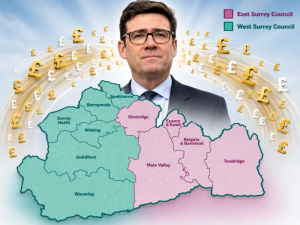
Image: Surrey East West. (Credit: Elmbridge Borough Council) Permission for use.
Debate not hate says East Surrey shadow authority
7 August 2026
East Surrey councillors shared their experience of facing intimidation and harassment from voters as they debated a motion calling for civility in political discourse.
At a meeting of the full shadow authority, several members recalled facing extreme vitriol from members of the public and implored councillors and voters to engage respectfully.
It came as councillors debated a motion supporting the Local Government Association’s (LGA) ‘Debate Not Hate’ campaign, which aims to tackle growing abuse against local politicians.
Introducing the motion, Councillor Kirsty Hewens (Liberal Democrats: Walton South & Oatlands) said: “This motion is not about stifling or sanitising debate. We all know there is a fundamental difference between robust political disagreement and personal abuse.
“What matters is how we conduct those debates.”
She added: “As councillors, we expect to be challenged. And we should be. Residents have every right to question our decisions, disagree with us and hold us to account.”
However, she said there is a line between this and growing volumes of abuse directed towards councillors and officers from the public.
“This behaviour discourages good people from standing for public office,” Councillor Hewens said.
Other shadow authority councillors shared their own first hand accounts of receiving intimidation and harassment from voters.
Councillor Shelly Newton (Conservative: Tadworth, Walton & Kingswood) told councillors the authority’s Conservative group would support the motion, saying: “Politics is about ideas. We should challenge each other’s policies, question decisions, and hold one another to account.
“That’s what our residents expect us to do. That’s why they elected us. But there is a clear line between challenging someone’s views and attacking the person behind them.”
She added that in her two years as a councillor, she had received inappropriate messages and experienced harassment that resulted in police involvement.
“While canvassing I was grabbed, pulled into a resident’s home, and had my way blocked out by the resident who then shouted at me about national politics,” she added.
An LGA survey found that seven in 10 councillors across the country have reported experiencing abuse or intimidation in the past year.
The East Surrey motion threw the shadow council’s support behind the LGA’s campaign and called for the authority to commit to “fostering a culture where political debate is encouraged, but personal abuse, intimidation, discrimination and harassment are never tolerated”.
Councillor Andrew Matthews (Liberal Democrats: Bookham & Fetcham West) added: “As I’m sure many of us have experienced, we’ve had threats of violence. I’ve been threatened with being punched in the face. I’ve had people stalk me. I’m not alone.”
Seconding the motion, Councillor Elly Heaton (Green Party: Redhill West & Meadvale) thanked the councillors for sharing their stories, calling them a “disappointingly relatable experience”.
The LGA’s campaign also noted that more than half of councillors have reported being victims of misinformation.
The organisation’s website says: “The increasing level of abuse and intimidation aimed at local politicians is preventing elected members from representing the communities they serve, deterring individuals from standing for election and undermining local democracy.”
Image: Councillors debate the motion (Credit: East Surrey Shadow Authority)
Burnham ‘commitment’ to Surrey devolution
7 August 2026
East Surrey’s shadow council leader has welcomed Andy Burnham’s “strong commitment” to devolution as Surrey continues to take steps that could see the county get its own elected mayor.
Speaking at a meeting of the full shadow council, Councillor Steve Wotton (Liberal Democrats: Horley West, Salfords & Sidlow) congratulated the new Prime Minister and wished him “every success”.
“I plan to write to him in due course to set out our plans for East Surrey Council, and update him on the progress we’re making,” he added.
Councillor Wotton told councillors the government has confirmed its intention to bring forward a Foundation Strategic Authority (FSA) for Surrey from April 2027 – pending local consultations and ministerial approval.
This would mean that the new West Surrey and East Surrey councils could pool resources and work together on certain key strategic issues, such as transport and economic development.
“We continue to see a strong commitment from government for the devolution agenda,” Councillor Wotton said.
“Following the recent appointment of Andy Burnham as prime minister, the government has reiterated its ambition to transfer more power and responsibilities and funding away from Whitehall and into local areas.”
An FSA would also serve as a stepping stone towards the potential creation of a mayoral authority – which would create a directly elected mayor for all of Surrey.
Councillor Wotton said an FSA would give Surrey a “clear route” into that next phase of devolution, adding that failure to embrace it would “risk leaving Surrey outside the main direction of travel”.
East Surrey and West Surrey shadow authorities are currently tasked with setting up their respective councils ahead of assuming full responsibility of local government services in April 2027.
At that point, Surrey County Council and the county’s 11 district councils will all be abolished. Elections to the shadow authorities took place in May 2026.
Councillor David Lewis (Conservative: Cobham & Oxshott South) welcomed the move towards an FSA and said the shadow authority’s Conservative group supports its foundation.
“We believe that the additional devolved powers and funding that would come with a mayoral strategic authority would be beneficial for the residents of Surrey,” he said.
“Directly elected mayors have brought an additional focus to their areas, which has resulted in higher levels of economic growth.”
Councillor Jonathan Essex (Green Party: Redhill East & North Earlswood) said the authority’s Green group supported the FSA creation “in principle”, but questioned why mayoral devolution had not been fast-tracked to Surrey.
“We were told by Surrey County Council in very early 2025 we would be fast-tracked to be new unitaries in Surrey on the basis this would enable a mayoral authority to be created,” he said.
Addressing these concerns, Councillor Wotton said he is “more confident now” of the government’s commitment to Surrey’s devolution under Andy Burnham’s premiership.
“But fundamentally this is about moving us forward on a journey towards devolution”, he added. “It does not guarantee a mayor, but it the first step necessary to achieve a mayor.”
Eleven councillors walked out of Epsom and Ewell Borough Council after the Mayor ruled that her father could remain in the chamber and lead a debate on the future of land hired by a company of which he is a director.
Despite the upheaval, the Council agreed on Tuesday 21st July to give strategic priority to the potential development of sports facilities and housing at Hook Road Arena.
The decision does not approve development. It elevates the Council-owned, 14-hectare site between Chessington Road and Horton Lane to one of EEBC’s strategic priorities for its final months before abolition in April 2027.
A feasibility study will examine whether housing on part of the Arena could finance playing pitches and other sports and recreation facilities. Up to £250,000 has already been allocated from the Council’s Corporate Projects Reserve.
Consultants are expected to be appointed by the end of August, with the study intended to be completed before EEBC’s functions transfer to the new East Surrey Council on 1st April 2027.
However, the merits of the proposal were overshadowed by a bitter dispute over the participation of Councillor Neil Dallen (RA, Town), chair of the Council’s Strategy and Resources Committee.
Fireworks company hires Council land
Cllr Dallen is a director of Epsom Fireworks Display Ltd and a trustee of the associated Epsom Fireworks Display Charitable Trust.
The company contracts with EEBC to hire Hook Road Arena for its annual fireworks display. It has done so since between 2019 to 2021 after taking over from the local scouts that had organised the annual event since 1971. The company has a further agreement with the Council for the November 2026 event.
The company has just three directors. Two of those directors are two of the four trustees of the charity that distributes its income to scouting groups and other worthy charitable causes.
Development of the Arena could eventually bring the fireworks display at that location to an end.
At the beginning of the ordinary Council meeting, Cllr Dallen declared that he was a director and trustee of the fireworks organisations and that the Arena was used for the display.
He also disclosed that he had met representatives of Epsom and Ewell Football Club and the borough’s netball club concerning their proposals for the site.
Cllr Dallen told the meeting that he had never expressed a view for or against their plans and was “confident that I have an unbiased and open mind”.
When the Hook Road item was reached, he proposed that development of the Arena be made a strategic priority.
Cllr Alex Coley (Independent, Ruxley) immediately raised a point of order. He said Cllr Dallen had treated the same connection as a conflict on two previous occasions when Hook Road Arena was discussed by the Strategy and Resources Committee.
Cllr Dallen disputed Cllr Coley’s account. He said he had not left the room at the earlier meetings, although on one occasion he had not voted.
Cllr Bernie Muir (Conservative, Horton) supported Cllr Coley’s objection. She said the conflict had caused controversy at both previous meetings and asked for a ruling from the Council’s Monitoring Officer.
The legal officer advising the meeting said Cllr Dallen had declared his connection and had self-declared that it was not a pecuniary interest. The officer said that where a member decided that an interest was not pecuniary, participation was a matter for that member’s discretion.
Cllr Coley tried to point out that Companies House registered Cllr Dallen as a director of Epsom Fireworks Display Ltd and that the company had a financial relationship with the Council.
Mayor Cllr Lucie McIntyre (RA, West Ewell) repeatedly instructed him to stop speaking and sit down.
She ruled that it was for Cllr Dallen to decide whether his interest was pecuniary and said councillors who disagreed could pursue the relevant complaints procedures after the meeting.
After further objections, the Mayor adjourned proceedings. When councillors returned, she announced that Cllr Dallen had confirmed that he did not consider his interest pecuniary and would continue to participate.
Eleven councillors then walked out of the chamber.
Cllr Kieran Persand (Conservative, Horton) put on record his view that “this council is a joke”.
Cllr Chris Watson (Labour, Ewell Court) remained but later defended the absent councillors, saying their walkout was “a perfectly valid democratic process”.
Mayor was ruling on her father
It was not disclosed to the meeting or to members of the public that Mayor Cllr Lucie McIntyre is Cllr Dallen’s daughter.
It does not follow that being Cllr Dallen’s daughter automatically gave the Mayor a disclosable pecuniary interest of her own under the Localism Act. The statutory definition generally extends to a councillor and their spouse, civil partner or person with whom they live as a partner—not to an adult parent or child.
Nevertheless, Cllr McIntyre was making contested procedural rulings about whether her father could remain, speak, propose the recommendation and vote.
No suggestion is made that the family relationship necessarily disqualified her from chairing the whole meeting. However, declaring it would have enabled councillors and the public to assess openly whether the Deputy Mayor (Cllr Julie Morris Independent College) should have ruled upon this particular dispute.
EET asked the Mayor why she did not disclose that Cllr Dallen is her father or invite the Deputy Mayor to chair the objection to his participation and the item. After referring to her reference in her Council website biography to the inspiration her father gave her to be a Councillor she responded: “I am perfectly able to chair a meeting in my capacity as Mayor when my father is in attendance. At the Full Council meeting on 21 July, Councillor Dallen declared that he did not have a pecuniary interest in the item concerning Hook Road Arena, which was his right.”
EET asked the Council’s legal adviser if his legal advice took account of the live company-council contract and the statutory contracts category in the 2012 Regulations? And whether any formal dispensation was granted to Dallen to participate, and whether an external Monitoring Officer will be asked to review the matter?
A Council spokesperson responded: “At the meeting of the Full Council on 21 July, Councillor Dallen declared that he did not have a pecuniary interest in the item concerning Hook Road Arena. There are no plans to review this.”
Five sources allege history of obstruction
Cllr Dallen’s public advocacy of the Hook Road project also contrasts with accounts given privately to Epsom and Ewell Times (EET) about his earlier approach.
Three councillors belonging to Cllr Dallen’s own Residents’ Association group and two sources closely connected with Epsom and Ewell Football Club have independently told EET that he repeatedly impeded progress on proposals for the Arena.
The sources allege that proposals were pushed “from pillar to post” and from one committee or process to another, causing avoidable delay.
Cllr Dallen has also been quoted by more than one source as saying, while discussing the future of the Arena: “I want the fireworks four more years.”
The sources asked not to be named because of their continuing political or organisational relationships. EET knows their identities and considers each to be in a position to have direct knowledge of the events described.
Their accounts do not, by themselves, prove that every delay resulted from Cllr Dallen’s intervention or that any intervention was motivated by the interests of the fireworks company. Large developments involving Green Belt, restrictive covenants, sports bodies, housing and Council land inevitably pass through several stages.
Nevertheless, the consistency of the accounts raises a legitimate question about why a councillor alleged to have resisted or delayed the proposals behind the scenes emerged at Full Council as their proposer and public champion. Was he seeking to publicly erase perceptions that he had been the cause of previous delays?
Cllr Dallen told the meeting that he wanted the work concluded quickly and, ideally, before EEBC ceased to exist, although he acknowledged that this might not be possible.
EET has asked Cllr Dallen to respond to the allegations that he previously delayed the project, to confirm whether he said he wanted the fireworks to continue for four more years, and to explain what caused his apparent change of approach.
At the time of publication, Cllr Dallen had not responded.
What do the fireworks accounts reveal?
Epsom Fireworks Display Ltd’s latest micro-entity accounts show turnover of £109,324 for the year ending 30th April 2025.
Almost the entire amount—£108,890—is placed under the single expenditure heading “cost of materials”, leaving a profit of £434.
The company accounts state that it had no employees, but do not break down the £108,890. They do not separately identify the cost of fireworks, Arena hire, insurance, event services, charitable donations, directors’ remuneration or directors’ expenses.
Accounts filed by the associated charitable trust show total income of £48,623 during the same year, including a £41,250 donation from Epsom Fireworks Display Ltd.
The Charity Commission register states that the charity’s trustees receive no remuneration, payments or benefits from the charity. That does not answer the separate question of whether anyone receives payment or expenses from the limited company.
The company’s accounts neither establish that its directors were paid nor prove that they were not. The donation to the charity must form part of the £108,890 wrongly described as all being “cost of materials”.
Companies House identifies Cllr Dallen as one of four directors. It names another director, Anthony Williams FCCA (Fellow of the Association of Chartered Certified Accountants), as the company’s only registered person with significant control. Cllr Dallen’s directorship therefore does not, without further information, establish that he owns or controls the company. It is a company limited by guarantee with no share capital.
EET has asked Cllr Dallen whether he receives any remuneration, expenses or other financial benefit from Epsom Fireworks Display Ltd.
At the time of publication, no response had been received.
The legal question
The Localism Act 2011 prevents a councillor with a disclosable pecuniary interest from participating in a discussion or vote unless a dispensation has been granted. A beach is a criminal offence.
The prescribed interests include an “employment, office, trade, profession or vocation carried on for profit or gain”, together with specified contractual, property and ownership interests.
Whether Cllr Dallen’s directorship falls within that statutory definition may therefore depend upon facts not revealed by the micro-entity accounts—including whether his office as director is carried on for profit or gain and whether he has a beneficial interest in the company.
The existence of a statutory interest is not ultimately determined by whether a councillor personally “feels” that an interest exists. Members must initially assess and declare their own position, but whether the legal test is satisfied is an objective question of fact and law.
The legislation is preventive. If a disclosable pecuniary interest exists, the prohibition applies regardless of whether the councillor supports or opposes the proposal and regardless of whether the councillor believes that he has an open mind. An ongoing contractual relationship is a disclosable interest regardless of any personal benefit.
There is a paradox in this case. Development could ultimately end the fireworks display at Hook Road Arena. Cllr Dallen was therefore advocating a process which may operate against, rather than in favour of, the future interests of the fireworks company and the charitable causes it supports..
That may be relevant when assessing his motivation and the seriousness of any alleged breach. It does not, by itself, determine whether the statutory definition of an interest was satisfied.
The Council’s wider code of conduct and the appearance of bias are separate issues from the narrower statutory offence concerning disclosable pecuniary interests.
Rainbow row preceded ordinary meeting
The ordinary Council meeting followed an extraordinary meeting convened earlier that evening to debate the governance of the emerging Local Plan.
During that earlier meeting, Cllr Chris Ames (Labour, Court) expressly referred to the controversy surrounding the Rainbow Leisure Centre.
Cllr Dallen had authorised an urgent and confidential Council decision making up to £500,000 available to address an unexpected dilapidations liability following the change of leisure-centre operator.
Cllr Ames told the extraordinary meeting that problems with the Rainbow contract had become apparent early and argued that an officer and urgent-decision process had been used to bypass democratic scrutiny.
Mayor Cllr McIntyre interrupted him twice and instructed him to return to the Local Plan motion.
Cllr Ames replied: “I really don’t think it’s for you to tell me what my speech is to be about, Madam Mayor. Absolutely not. If I think this is relevant, I will make this point. I will not be silenced.”
He said the Rainbow affair formed part of a pattern in which procedural rules had been used to prevent councillors discussing matters for which they were responsible.
Cllr Clive Woodbridge (RA, Ewell Village) subsequently described criticism of officers as “unconscionable” and said the opposition did not like the answers it received.
Sports shortage wins support
After the walkout from the later ordinary meeting, the councillors who remained overwhelmingly supported making Hook Road Arena a strategic priority.
Cllr Peter O’Donovan (RA, Ewell Court) said the borough had a severe shortage of sports pitches. He referred to 84 junior football teams and said the netball club lacked a permanent base and was forced to hire facilities which could be withdrawn at short notice.
Cllr Alison Kelly (Lib Dem, Stamford) said residents frequently raised the shortage of accessible local sports facilities. She described the feasibility study as the first step towards evaluating the available options.
Cllr Clive Woodbridge said the site had “tremendous potential” as a sporting hub but stressed that the Council was not approving the details of development.
Cllr Jan Mason (RA, Ruxley) supported further investigation but warned against simply stamping through a large scheme without careful consideration of the surrounding homes and existing open land.
Council papers acknowledge substantial obstacles. The Arena is in the Green Belt and a 1975 deed restricts its use largely to open space and recreation unless Surrey County Council consents.
Any housing would also depend upon the emerging Local Plan. Development beyond the feasibility stage would require a separate business case and further decisions, some of which would require the consent of the new East Surrey authority.
The recommendation was carried without a recorded numerical vote.
Cllr Dallen ended the debate by reminding councillors that EEBC had adopted a “debate, not hate” motion.
The Council’s decision means the future of Hook Road Arena will now advance as a formal strategic priority. Whether the dispute over Cllr Dallen’s participation also advances through the Council’s standards process—or to the police under the Localism Act—remains to be seen.
After the meeting Cllr Steven McCormick (Conservative and former prominent RA – Woodcote and Langley) said
“To put this forward now is too little, too late. This council had a prime opportunity over many years to clear the path for enhanced sports facilities at Hook Road Arena, yet proposals were repeatedly shuffled from committee to committee while time ran out.”
He added “Instead of proactive leadership when it could have made a real difference, we are left with a last-minute scramble just months before council abolition. Residents and sports clubs were forced to wait years for progress; they deserve to know why momentum was continually blocked until the eleven-hour mark.”
Why procedure matters, even in little old Epsom and Ewell
7 August 2026
Nobody seriously disputes that developing Hook Road Arena as a centre for community sport, supported where necessary by housing, deserves proper investigation.
The proposal enjoyed overwhelming support. Had almost any councillor moved it at the meeting of Epsom and Ewell Borough Council on 21st July, it would have passed comfortably and probably without drama.
Yet the debate produced an adjournment, angry exchanges and the walkout of 11 councillors—including, it appears, at least one member of the ruling Residents’ Association group.
Why?
The answer cannot lie in opposition to the proposal itself. Most, if not all, of those who walked out supported giving Hook Road Arena strategic priority. Their protest concerned the process by which the decision was being made and, more particularly, the identity of the councillor who was permitted to present himself as its principal champion.
That distinction matters.
Procedure is not an inconvenience
There is a temptation, particularly where the desired outcome appears uncontroversial, to dismiss procedural objections as political gamesmanship.
Why worry about who proposed the motion if it was going to pass anyway? Why interrupt an important debate about desperately needed sports facilities with arguments about interests, declarations and who should occupy the chair?
The answer is that procedural rules are not decorative. They exist to preserve confidence in the decisions reached under them.
Substantive rules determine what a council may decide. Procedural rules determine how it must decide it, who may participate and whether the process can command public confidence.
A good outcome reached through a questionable process does not retrospectively cure that process. Nor can councillors embrace constitutional rules when those rules assist them, only to minimise or reinterpret them when their application becomes personally inconvenient.
Rules which operate only when the powerful find them useful are not rules at all. They become instruments of discretion—and discretion exercised in one’s own cause is precisely what rules governing conflicts of interest are intended to restrain.
The interest question
Cllr Neil Dallen is a director of Epsom Fireworks Display Ltd, which contracts with EEBC to hire Hook Road Arena for its annual display. He is also a trustee of the associated charitable trust.
Development could eventually end the fireworks at the Arena. The company’s precise financial arrangements remain unclear, as do any payments or expenses received by its directors.
This does not establish that Cllr Dallen possessed a disclosable pecuniary interest within the strict definition of the Localism Act. That depends upon facts which the company’s abbreviated accounts do not reveal. Though there is undoubtedly a related current contract with the Coucil and his company – which in itself – regardless of personal gain – is disclosable and prevents the councillor participating, absent a clear dispensation, on pain of a criminal penalty.
It is also true that Cllr Dallen was supporting a proposal which may ultimately operate against the continued use of the Arena by the fireworks company. That apparent paradox may weigh significantly against any suggestion of corrupt motivation at the meeting itself.
But the law on interests is preventive. If an interest falls within the statutory definition, a councillor cannot participate merely because he believes he is acting impartially, because his preferred outcome is publicly beneficial or because he is voting against the immediate interests of the connected organisation.
The test is not whether the councillor “feels” conflicted. It is whether the relevant facts satisfy the applicable rules.
The Mayor’s position
There was a second and arguably more obvious procedural issue which received surprisingly little attention.
The Mayor, Cllr Lucie McIntyre, is Cllr Dallen’s daughter. This is an undisputed and widely known fact, almost certainly familiar to every councillor in the chamber.
Yet the relationship was not formally disclosed at the meeting.
Being Cllr Dallen’s daughter did not automatically give the Mayor a disclosable pecuniary interest. However, she was being asked to rule on whether her father could remain in the chamber, speak, move the recommendation and participate in the vote.
Her father plainly had, at the very least, a reputational interest in that ruling. His conduct, consistency and integrity were being challenged publicly.
The question was therefore not whether the Mayor was capable of chairing impartially. It was whether public confidence would have been better protected by disclosing the relationship and allowing the Deputy Mayor to rule upon that discrete controversy.
Justice must not only be done but be seen to be done. That principle applies to modest local proceedings as surely as it applies to a courtroom.
The opposition focused its objections almost entirely on Cllr Dallen. It did not press the equally apparent question of whether his daughter should continue to chair the dispute about him.
Why?
Perhaps the relationship was so universally known that councillors did not consider a formal declaration necessary. Perhaps tempers and confusion prevented the point from being articulated. Perhaps they accepted that the Mayor was relying upon legal advice and did not wish to personalise their protest further.
But the omission also invites a less comfortable question: was the walkout motivated solely by concern for constitutional principle, or partly by anger at the spectacle of Cllr Dallen receiving public credit for a project which others believe he had previously frustrated?
From obstruction to championship?
EET has received consistent accounts from three councillors within Cllr Dallen’s own Residents’ Association group and two people closely connected with Epsom and Ewell Football Club.
They allege that proposals for Hook Road Arena were repeatedly pushed “from pillar to post” and between processes, contributing to delay. Cllr Dallen has also been quoted as saying: “I want the fireworks four more years.”
These remain allegations to which Cllr Dallen is entitled to respond and since Sunday when he was asked to EET has received no comment from him.
Was the walkout driven not merely by the disputed legal interest, but by a sense of hypocrisy? Did councillors object to seeing someone whom they believed had privately impeded progress now appearing publicly as the development’s leading promoter?
If so, the protest was about political ownership and credibility as well as legal compliance.
That would explain why councillors who supported the motion nevertheless refused to remain for it. They were not rejecting Hook Road Arena. They were rejecting the presentation of Cllr Dallen as its champion.
But that interpretation also carries a warning for the protesters. If their objection was truly one of principle, they should have applied that principle consistently—including to the Mayor’s position in the chair. Selective indignation is no more attractive from the opposition than selective compliance is from the administration.
The small scale is no excuse
It would be easy to regard this as a parochial quarrel in a council which will cease to exist in eight months.
That would be a mistake.
Respect for the rule of law is built from the bottom upwards. It begins with small decisions, modest offices and local institutions. It depends upon people following rules even when the consequences are inconvenient and even when ignoring them might produce the same substantive result more quickly.
The erosion usually starts harmlessly: a procedure is treated as unnecessary because everybody supports the outcome; an interest is dismissed because the individual believes himself honest; a relationship is left undeclared because everybody already knows about it; an awkward question is silenced because it is said to be outside the scope of the debate.
Each departure can be rationalised. Together, they create a culture in which rules become optional for those exercising power.
At national and international level, the same habit has graver consequences. Selective obedience breeds cynicism; cynicism produces contempt for institutions; and contempt for institutions opens the way to disorder, violence and, ultimately, conflict.
Epsom and Ewell is not on the verge of anarchy because of a disagreement over a fireworks display. But the principle is indivisible. We cannot demand fidelity to constitutional rules in Westminster, respect for courts nationally or adherence to international law abroad while treating procedural safeguards as dispensable in our own council chamber.
Rules matter most when they are inconvenient.
Hook Road Arena deserved to be made a strategic priority. It did not need Cllr Dallen to move the recommendation, and the proposal would have passed without his participation.
The Council could therefore have avoided the entire controversy at virtually no cost. Cllr Dallen could have withdrawn; another councillor could have proposed the recommendation; the Mayor could have disclosed the family relationship and allowed her deputy to determine the procedural objections.
The same substantive decision would have been reached, but through a process carrying far greater public confidence.
That is the point of procedure. It is not there to frustrate good decisions. It is there to ensure that good decisions are reached in a way that deserves respect.
East Surrey appointing its Chief Executive
7 August 2026
The new East Surrey council is poised to confirm its first permanent chief executive in the latest step towards the authority’s creation next spring.
East Surrey Shadow Authority, the body overseeing the new council’s setup, has selected Interim Head of Paid Service Adam Chalmers as its preferred candidate for the role.
Mr Chalmers currently serves as Elmbridge Borough Council’s chief executive, the council’s most senior salaried officer. He is also recommended for appointment as Returning Officer for East Surrey Council.
He comes with more than 20 years of experience in local government, having previously held senior roles at Horsham District Council and Tunbridge Wells Borough Council.
East Surrey Shadow Authority leader Steve Wotton said: “I am pleased to announce that Adam Chalmers is being recommended as our preferred candidate for chief executive of East Surrey Council, subject to formal agreement by full council.
“He combines a strong track record of delivering results with a genuine commitment to public service, and I believe he is the right person to lead East Surrey Council as we prepare for this exciting new chapter and beyond.”
Councillor David Lewis, Conservative group leader on the Shadow Authority, said: “The creation of East Surrey Council is one of the most significant changes to local government in a generation, and it is important that we have experienced leadership in place.
“Adam brings a wealth of knowledge and a strong understanding of local government, and I am pleased to support his appointment as we work together to deliver the best outcomes for residents and communities.”
Mr Chalmers’ appointment will be subject to approval by East Surrey’s full council at a meeting on July 29.
East Surrey Shadow Authority is tasked with forming the new East Surrey Council before it takes over management of the area’s local government services in April 2027.
Surrey County Council and the county’s 11 district councils will all be abolished at that point, with services transferred to the new West and East Surrey councils.
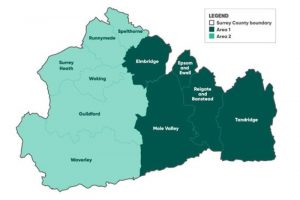
East Surrey Council will cover the areas that currently fall under Elmbridge, Epsom & Ewell, Mole Valley, Reigate & Banstead, and Tandridge district councils.
Adam Chalmers (Credit: East Surrey Shadow Authority)
.
.
.
Epsom Council delivers shock rejection to defibrillator kiosk
7 August 2026
Plans to install a communications kiosk including an advertising screen and defibrillator on Epsom High Street have been refused over concerns it would harm the character of the area.
The proposals would have seen the 2.63 metre tall structure placed on the high street pavement, for which the applicant was seeking both planning permission and advertising consent.
As well as holding a publicly available defibrillator in case of emergencies, the unit also would have offered free calls to landlines, free Wi-Fi and interactive wayfinding.
One side of the unit would have featured an LED advertising display, which planning documents describe as “equivalent to the size of display found on bus shelters”.
But the design was met with pushback from a number of residents, with several complaining about its potential impact on the high street conservation area.
One “frequent visitor” to the town wrote an objection to the advertising consent, calling it “ugly, obstructive and unnecessary advertisement hoarding with several cursory additions”.
In their refusal, Epsom and Ewell Borough Council planning officers wrote that kiosk “would create additional street clutter” and “would be excessive and out of character within the street scene”.
They also noted in their report that the council has received 14 similar applications in the past 18 months.
“If each proposal were to be granted approval, the council would have an excess of public payphones and defibrillators, notwithstanding facilities already in existence in the surrounding area,” officers wrote.
“These applications have been submitted over time by different companies, some of which are in very similar locations, which if all were to be granted would result in several similar structures being built within proximity of each other; resulting in over dominance and harm to the street character and visual amenity.”
They added: “As a result of its unsatisfactory siting, design, scale and appearance, the proposed communication hub structure would create significant clutter on the street causing unacceptable visual harm to the wider character of the area.”
“The Planning Inspectorate has dismissed appeals at Epsom Gateway and Capital Square, agreeing with the council that the harm from the advertising screens outweighs the public benefits of including a defibrillator.
“The health and wellbeing of residents is central to the council’s work.”
Defibrillators are currently placed at the following sites across Epsom & Ewell:
Market Place, Epsom.
Ebbisham Centre, Epsom Square, Epsom.
Town Hall (rear entrance).
Harold Bell Solicitors, 174 Kingston Road, Ewell.
St John’s Parish Centre, Station Approach, Stoneleigh.
Auriol Park Café, Salisbury Road, Worcester Park.
The Parade Dental Practice, 177 Kingston Road, Ewell.