Epsom and Ewell Times

ISSN, LDRS and IMPRESS logos

Kids takeover Bourne Hall digitally

On Friday 7 July Bourne Hall in Ewell handed over its social media channels to young people from St Clement’s Catholic Primary School in Ewell, as part of a national Kids in Museums Digital Takeover Day event. 

Supported by Arts Council England, the Kids in Museums charity aims to empower young people and help them learn digital marketing skills, as well as support museums to engage younger audiences.

The charity has held an annual digital takeover since 2014, where young people take over the social accounts of museums, galleries, historic homes, archives and heritage sites across the UK. Last year, over 50 museums were taken over and the hashtag #TakeoverDay has even trended on Twitter.

Bourne Hall welcomed a group of year 2 students to its Museum to become cultural detectives for the morning. Focusing on five specific themes: Space, Nature, Local History, Holidays and Textiles, children highlighted their favourite items, which were then photographed and placed alongside their own caption, to go out on Bourne Hall’s social media.

As well as the digital takeover, the children also created some brilliant visual responses to their visit, these artworks will be turned into an exhibition at Bourne Hall – watch this space for the launch date!

The children had some insightful comments to make about the objects in the museum. One commented about some 1950s card games:

“Amazing, incredible, really fun! The cards were colourful and rainbowy and reminded us of holidays.”

Thinking about working in the role of a Curator, another child added: “I’m thinking about the security in our museum – and how we keep everything safe. I’m also thinking about how I would make sure that everyone had a great time when they come to visit our museum.”

Speaking of the recent event, Councillor Clive Woodbridge, Chair of Epsom & Ewell Borough Council’s Community and Wellbeing Committee, said “This was a great event that brought our fantastic museum to life for some of our borough’s young people. It was a highly engaging experience for the children and they also gave us valuable feedback on what they loved in the museum and what they’d like to see more of. I am really looking forward to seeing the children’s artwork when it is displayed in Bourne Hall’s foyer.”

You can follow the conversation on social media by looking at the hashtag #TakeoverDay and following @KidsInMuseums.


Little plots of Council land for housing?

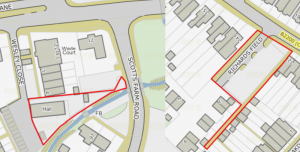
Graphics of Scott Farm and Richard Field Council owned land

Epsom and Ewell Borough Council’s Strategy and Resources Committee decided Thursday 13th July to submit two Council owned sites for housing. The Draft Local Plan sets out the framework for local development including meeting housing targets. Proposals to release green belt land for development were met with strong local opposition and a brake on the Plan’s adoption.

Council officers were tasked with seeking additional brownfield sites suitable for housing, including land owned by the Council itself.

The Council owns 37% of the Longmead and 35% of the Kiln Lane industrial estates. However, the grant of long leases to various businesses means that none of its land can be made available in the Local Plan timescale within 2040.

Consideration was given to the Council owned Cox Lane Community building and car park but a doctor’s surgery and nursery need medium term certainty for their future with the surgery’s lease expiring just before the plan period ending 2040..

Two small plots of Council owned land were stated to be suitable to be submitted to the Local Planning Authority, (the Council itself) for consideration for inclusion in the Local Plan. They are a small 0.08 ha site (a former Scout’s Hut) on Wesley Close / Scotts Farm Road and Richard’s Field Car Park accessed off Chessington Road, offering approximately 35 parking spaces of which about 14 are reserved as resident permit spaces.

Cllr Graham Jones MBE (RA Cuddington Ward) noted the Wesley Close site had not been submitted before as it was too small. “What had changed?” An officer explained the proposal was “directly on the back of members request to find more brownfield sites to meet housing targets. The site had been looked at again and it could achieve 5 dwellings which is the threshold for a call for sites”.

Cllr Jones asked the same question in relation to the Richards Field car park and Cllr Dallen suggested that there maybe a way of building residences while keeping parking provision.

The meeting agreed to the submission of the two sites for consideration to be included in a revised draft Local Plan.

In a lengthy explanation officers reported that the legal and cost obstacles to pursuing compulsory purchase orders to acquire land for housing development are too high. Thus, exercising such powers was not recommended.

Related Reports:

Motion to pause Local Plan process

Public meeting on Local Plan dominated by greenbelters.

Planning or pantomime? Councillors press pause on Plan.


Council’s financial reservations

Town Hall

Epsom and Ewell Borough Council’s finances came under the spotlight at a meeting 13th July of the Strategy and Resources Committee. Chair Neil Dallen MBE (RA Town Ward) opened the item stating “from history we are very good at keeping our books and the auditor often praises us for a good job done.” Later he reassured Cllr Alison Kelly (LibDem Stamford) that “We are no where near Woking or other councils that are in trouble. We have been very prudent. We have had some hiccups and the reserves have been used as they are supposed to be to resolve those hiccups. We are in very good shape.”

Cllr Chris Ames (Labour Court Ward) asked about buying properties for housing the homeless. Cllr Dallen advised that the Borough was currently supporting 70 to 80 families in temporary accommodation, a situation that the Council needs to resolve. An officer stated that there was no risk in the Council purchasing ordinary residential accommodation as that could be sold when no longer needed, but “homelessness specific accommodation” had risks and the demand outstripped supply. No definition of this term was asked for or provided.

Officers reported the Council receives significant income from the car parks in the Borough it operates. The financial year 2022/2023 saw a reduction in income from the Ashley Centre car park on account of the loss of the House of Fraser department store. Income was also reduced from the Hook Road car park. The introduction of charges for parking in the Stoneleigh Parade offset those reductions a little.

While acknowledging that “reserves should not be used to fund day to-day services on an ongoing basis, as reserves would eventually become depleted without a plan for replenishing them”, a Report to the meeting confirmed: “The 2023/24 budget plans to use about £2.4m from the Council’s reserves to balance, which was considered a reasonable approach in the short term, as this use of reserves has enabled the Council to assess the financial environment post pandemic and cost of living crisis, before taking major decisions around the future of service delivery.”

However, in a note of caution it was reported: “The Council’s external auditors, Grant Thornton, whose 2021/22 Annual Auditor’s Report (dated May 2023) recommends that the Council needs to set a timeline for how it will develop longer term saving plans that will ensure reserves are not further depleted”.

At 31 March 2023, the Council holds £2.2m (subject to audit) of uncommitted un-ringfenced revenue reserves.

The Government is promising a Fair Funding Review, not before 2025/2026, to re-assess the distribution of government and business rates funding between Councils. When complete, it is expected to favour unitary and upper tier councils, ahead of districts such as Epsom & Ewell Borough Council.

Officers reported to Councillors that in 2016, central government introduced Negative Revenue Support Grant as part of EEBC’s four-year settlement. The settlement identified that in 2019/20 the Council would have to make an on-going payment back to central government of £624,000, known as Negative RSG. However, after significant lobbying from affected councils including EEBC, government decided to remove Negative RSG from annual settlements.

The delay of the Fair Funding Review means that Negative RSG continues to be excluded from EEBC’s settlement, however, the risk still remains that Negative RSG will feature as part of the future Fair Funding Review calculation when this is eventually introduced.

It was stated that the highest service financial risks are considered to be the impact of increased inflation on the Council’s costs and income streams, and the potential for increased demands for housing and homelessness prevention next year. In particular, the cost-of-living crisis is expected to impact on any new Pay Policy. The current forecast includes an estimate of 3% for the staff pay annual cost of living increase, however, recent public sector pay settlements for 2023/24 have been significantly higher than 3%.

With the projected shortfalls in the coming years Officers are to be tasked with identifying further efficiencies, although these are becoming harder to achieve after over a decade of austerity.

Epsom and Ewell Times reported on the proposal in The Draft Local Plan (now paused) to sell off the Town Hall in the Parade and move into offices in East Street that the Council owns. The meeting noted that should the move go ahead the Council would need to generate a net annual income/cost savings in the region of £600,000 from the remaining Town Hall site if it wishes to replace foregone commercial income from its East Street owned offices.

Also on the agenda was a proposal to spend £150,000 on consultants to advise on how the Town Hall site should be developed. Cllr Robert Leach (RA Nonsuch) commented “We are bringing in consultants every time we need to know the time of day”. He believed that there was sufficient expertise within the Council. The officer explained he was part of a two man team that did not have the time or expertise. Cllr Jones supported the proposal as the Council could not afford to get this wrong. The motion was carried with Cllr Leach supporting it in the end.

Related Reports:

The Epsom and Ewell Town Hall plan

A new Town Hall for Epsom and Ewell?

Anyone for tennis? If you pay.


Respite for carers in Surrey to increase?

Short Breaks - Visualisation for the Banstead site (Image Surrey County Council)

The chronic shortage of overnight respite places in Surrey could improve if plans to increase the number of available beds by almost 50 per cent are given the go-ahead.

Surrey County Council has submitted two sets of plans for short-stay centres – one in Woking and the other in Banstead.

This week, the county council launched its bids to the respective local authorities as part of the consultation process in order to address a care system that is “under significant strain and is facing long and sustained operational and financial challenges”.

The plans are to build two sets of eight en-suite bedrooms for short-break accommodation together sensory rooms, living rooms, dining rooms, kitchens, and supporting staff facilities.

Councillor Mark Nuti, Surrey County Council’s cabinet member for adults and health, said: “These two new centres will enable us to increase considerably the number of carers benefiting from short breaks, which help them recharge their batteries and get a bit of break. We value what carers do incredibly highly, so it’s really important we offer our residents these types of facilities. These will be modern places. They will be flexible, adaptable and able to accommodate people with many different disabilities and needs.

“They won’t be institutionalised places. They will be comfortable and fit for purpose, and able to accommodate more people than we can at the moment. This is a scheme we can be very proud of.”

The Woking site will be on the former Lakers youth centre in Goldsworth Park, Denton Way, with the Banstead site replacing The Squirrels, in the Horseshoe, Bolters Lane.

Currently there are seven registered bed-based short breaks services in Surrey but only five are operational, council documents show. At present they provide a maximum of 33 beds – but this can often be lower if needed by people with “increasingly complex needs”, the council said.

Those beds, which are clustered in the centre and east of the county, cover the 1,345 people in Surrey living with family carers.

Council figures show that fewer than 8 per cent of those eligible currently access provision. There is also the problem of increasing demand, with the council predicting a 10 per cent rise in users over the next decade as well as an increasingly “ageing” and “inappropriate service”. Combined, the new sites would offer 16 additional places, bringing the total overnight short-break places available to families from 33 up to 49.

Once they are both built, the council said, “the two centres will meet Surrey’s accommodation needs, Lakers meeting the needs within the west of Surrey, Squirrels continuing to serve the east”.

Image: Short Breaks – Visualisation for the Banstead site (Image Surrey County Council)


Another Surrey borough going under?

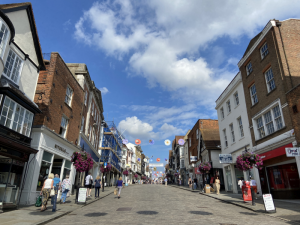
Guildford high street. Credit: Emily Coady-Stemp

Guildford Borough Council will bring in “strict controls” on new spending and aim to get its finances in order with a special budget to be set this month.

The authority has admitted it may need to consider the issuing of a section 114 notice, effectively declaring itself bankrupt, ahead of a full council meeting in October.

But relying on its reserves should in the meantime avoid having to issue the notice – a move which nearby Woking pursued last month due to a forecasted £2.6billion debt and a £1.2bn deficit.

A dedicated financial task force will be established as Guildford Borough Council admitted it finds itself in a “very difficult financial position”.

The Guildford Lib Dems, which won control of the council in May’s elections, said rising interest rates and accounting issues unearthed by a review of council finances had contributed to the situation.

A special meeting of the authority’s corporate governance and standards committee will outline the plans on Tuesday, July 18. The special budget, which should be brought to full council on July 25, will aim to get the council’s finances in order and will include “strict controls on all new spending, and in-year reductions in spending”.

‘Our residents will always be our highest priority’. The Guildford Lib Dems said the highest priority would be to protect public services. They added: “Above all, we will not shy away from making the tough decisions to make sure residents are protected from cuts to core services. Our residents will always be our highest priority, and we will be honest and realistic about the choices that need to be made to keep the council financially stable.”

The council’s leader, Cllr Julia McShane (Lib Dem, Westborough) said though she knew the report was “a difficult read” she said the council wanted to be open and transparent about the challenges ahead. She said: “We have issued a report today related to our finances. I am aware our residents may find this worrying. I want to reassure you that we are taking this situation very seriously. I take comfort in the fact that officers and councillors are working hard to tackle the situation head on.”

Guildford’s former leader, Cllr Joss Bigmore (Residents for Guildford and Villages, Merrow) said the budget was delivering on what the previous administration had started at the end of the last financial year. He said the council was “nowhere near” the situation of nearby Woking, which in June issued a section 114 notice. But he said a full review of the finances had shown some errors in the accounts. Cllr Bigmore added: “That’s made the situation even more urgent.”

With overall debt of around £300 million, expected to rise further, council documents show the authority can balance its 2023/24 general fund budget, using reserves if necessary, which should avoid the issuing of a section 114 notice in the current financial year.

The former leader, who was in charge for two years as part of an arrangement with the then residents and Lib Dem coalition, said: “Our balance sheet is very solvent. t’s just a matter of managing cash flow, to manage the interest payments. With strong leadership and decisive decision making, it should be no problem.”

He said he “hoped” the current administration could show the leadership and decision making needed. Cllr Bigmore told the LDRS: “I hope they do, for the sake of every resident in Guildford. I think across the chamber, all the group leaders met with the chief executive, the leader and the lead officers for finance and everyone is behind helping.”

He agreed the administration would have to make some “difficult decisions” about services, which could be unpopular with residents. “But they need to make them, otherwise they will be issuing a section 114,” he said.

The Lib Dems pointed to previous Conservative administrations carrying out “high levels of borrowing”, as well as central government issues including rapid rises in interest rates after the budget put out by former Prime Minister Liz Truss and Kwasi Kwarteng, and a delay to council account auditing.

The council said spending controls would be brought in, immediately limiting all new spending, a review of major projects and borrowing would be carried out and the council would look at selling council assets.
Plans also include “expanding and strengthening” the council’s finances team and continuing the collaboration with Waverley Borough Council to reduce costs.

The Conservative group leader on the council, Cllr Philip Brooker (Worplesdon) said he had not yet seen the papers for Tuesday’s meeting, but said he thought one area the council could look at tackling was the “significant amount” spent on consultancy fees. Of the budget situation as a whole he said: “It’s extremely concerning at the moment.”

The corporate governance and standards committee will take place at 7pm on Tuesday, July 18, at the council’s Millmead offices.


Surrey’s 999 services under one operator?

A review into Surrey’s Police and Crime Commissioner taking control of the county’s fire and rescue service has been branded “a waste of time” and “unwarranted” by councillors.

The proposals could mean the Surrey Fire and Rescue Service would no longer be under the control of the county council, but councillors questioned the possible move at a time of “considerable change” in the service.

Councillors raised concerns at a meeting of the authority’s communities, environment and highways select committee on Wednesday (July 5) that such a change had previously been ruled out, and that the review was a waste of money.

Lisa Townsend told the LDRS she was responding to central government proposals to reform fire and rescue services, and has commissioned an independent review to see if there would be any benefits of a change.

The Conservative PCC said this was not something she had “dreamt up overnight”, but claimed the county council had made clear they wanted “no active part” in the work to look into the change.

Councillor Denise Turner-Stewart, deputy leader at Surrey County Council and cabinet member for communities and community safety, told the July 5 meeting a previous proposal put forward by former PCC David Munro showed there was “no significant benefit” to a change in governance. She said: ”As far as I’m concerned, nothing has really changed since. There are no direct benefits that could be generated by a potential change. There is no mandate for a potential change.”

She said the service had been through “considerable change” since an inspection by His Majesty’s Inspectorate of Constabulary and Fire & Rescue Services in 2018/19 found it required improvement, and was now in a “steady state”.

Cllr Turner-Stewart said it would not be “beneficial or advantageous” to look at further changes for the service, and called the PCC’s review “unwarranted and not legitimate”.

Mrs Townsend said she had written to all MPs and to the county council’s leader outlining the work she planned to undertake and the reasons behind it. She added: “This is government policy which I have been encouraged to consider. So I believe establishing an up-to-date understanding of the picture of fire and rescue governance in Surrey is an entirely prudent and legitimate exercise for me to carry out in the circumstances.

“I want to be clear that at this stage, this is purely a review. Any proposal to take on responsibility for the governance of Surrey Fire and Rescue Service would require the preparation of a full business case. This would be subject to extensive consultation prior to being submitted to the Home Office for any approval.”

Cllr Keith Witham (Conservative, Worplesdon) told the meeting he had already made his views on the proposals known to the PCC. Saying he knew how much hard work had gone into improving the service in the past five years, Cllr Witham said a change would be “an entirely inappropriate, unnecessary distraction at this time”.

He said: “It is a waste of time, a waste of her funds, for she is financing this investigation, and will be a distraction, unnecessarily.”

Mrs Townsend said she had “no desire” to distract from progress made in the service but that a government white paper on future legislation was “imminent”.

She told the LDRS: “[Government] have been clear they want to simplify and strengthen governance for fire services and if that process is to involve Police and Crime Commissioners, this review will ensure I am properly placed to make an informed decision for the Surrey public.”


Esher monument cleaners risk arrest….

White Lady monument Esher

An Esher monument so “grubby” that people want to clean with toothbrushes is an “enigma” as to who owns and is responsible for it.

The White Lady Milestone road marker, outside the former Cafe Rouge building on the approach to Esher, has been there since 1767. But the Grade II listed milestone is now looking “very grubby” according to one Elmbridge cabinet member, leading to “regular” emails from people who want to clean it up.

Elmbridge Councillor Alex Batchelor told a cabinet meeting on Wednesday (July 5) “it would be great” if anyone could help work out who was supposed to be responsible for the monument. Having had conversations with conservation officers at both Elmbridge Borough Council and Surrey County Council, Cllr Batchelor said as far as he could tell, no one was claiming responsibility for the Portsmouth Road landmark.

The borough council’s leader, Cllr Bruce McDonald (Liberal Democrat, Claygate) described it as an “enigma” for the council to ponder. Cllr Batchelor told the meeting: “It is a listed, National Heritage monument and it’s looking very, very grubby indeed. I constantly get [emails from] regular people who would like to show up with their toothbrushes, give it a good go. The only thing I have to promise them is that’s certainly likely to get them arrested.”

The cabinet were discussing the monument as they made the decision to add the former Cafe Rouge building, previously known as the Orleans Arms, to the council’s list of local heritage assets.

The former public house, dating back to 1856, was originally named after the  Duke of Orleans, King Louis Philippe of France, who lived at nearby Claremont House.

Council documents show it provides evidence for development of Victorian Esher, and point to its prominent location on the historic route between London and Portsmouth.

As a “good example of Regency style building with continental influences” the building was added to the local list, which can be taken into account during planning applications.

Council documents describe assets on the local list as reinforcing “a sense of place and local distinctiveness” and providing a “tangible connection with our past lives, events, and industries”.

A previous planning application for 28 flats on the site was described by residents as “more suitable for the centre of Basingstoke” and “the ugliest residential housing scheme” that one had ever seen.


Accountants shortage blamed for Surrey’s rising debts

Spelthorne rising cost of debt

The scale of the financial problems unearthed by initial forensic exams of Woking Borough Council’s left many shocked. The council’s accounts had not been signed off by an independent auditor for more five years as part of a national shortage of qualified accountants that has left a high backlog across local government bodies.

Meanwhile, the borough’s chief financial officer warned things could get worse as they uncover more.
On June 23, the Public Accounts Committee said that delays to publishing audited accounts increases the risk of governance or financial issues being identified too late, and hinders accountability for £100billion in local government spending, with knock-on impacts for central government and the NHS.

It led to the committee’s deputy chairperson asking “how many more horror stories such as Croydon, Slough, Thurrock, and more recently the shocking case of Woking council are there remaining undetected?”

Following the report, the LDRS looked at three other Surrey councils with either high levels of borrowing, or that had experienced recent write-downs in the value of their assets and asked if residents can be confident their councils won’t go bust too.

Woking Borough Council – £1.7bn estimated debt in 2022, expected to rise to £2bn. There has also been an “absence of external audit opinions on the council’s accounts” since 2018/19. The majority of the council’s debt was built on complicated development deals. It borrowed hundreds of millions to pay companies it owned for town centre regeneration projects. It also funded its own loss-making businesses. Like many council’s Woking’s central funding fell significantly over the past decade.

According to the National Audit Office its Government-funded spending power dropped 69.2 per cent in the past decade. To counter this, it embarked on an investment strategy to cover the deficit, regenerate its town centres, and maintain non-statutory services.

In 2019/2020, the council received £6.7m from the Government, £9.9m from council tax and £28.7m from its investments.

The problem was that it spent £17.7m on services, £6m on minimum revenue provision, and £33.1m just on the interest on its debts.

The Public Audits Committee published the “Timeliness of local auditor reporting” on June 23, three weeks after Woking Borough Council issued its section 114 notice declaring it could no longer balance its books.

Chairperson, Dame Meg Hillier MP, said: “Our Committee warned in 2021 that the system of local government audit was close to breaking point. Disappointingly, since then the situation has only gotten worse. The cases of Croydon, Slough, Thurrock and Woking councils all should serve as flashing red signals for the Government, and our report finds that the rot risks spreading to central government finance and the NHS.

Deputy chairperson Sir Geoffrey Clifton-Brown MP,said: “How many more horror stories such as Croydon, Slough, Thurrock, and more recently the shocking case of Woking council are there remaining undetected, which ultimately always have to be bailed out at huge costs to the taxpayer? The fragility of the number of qualified people and firms tending to carry out these important audits means that the system will only get worse before it gets better.”

Spelthorne Borough Council – £1bn debt as of 2022, last set of audited accounts signed off: 2017/18. In 2022, there were nine local authorities with borrowing of more than £1bn.

They were either major population centres, Transport for London, Birmingham, Greater London Authority, Leeds, Warrington, Edinburgh, and South Lanarkshire, or bankrupt; Woking.

The other is Spelthorne Borough Council, with a debt of £1,084,655.00 and a capital programme under review from central government. Last week, it emerged that £50m development plans for Thameside House has now jumped to £80m – mirroring, albeit on a smaller scale, Woking’s Victoria Square development originally budgeted to cost £150m but now stands at £750m and a book value of around half that.

Since 2010, Spelthorne’s Government funded spending power has fallen 66.3 per cent creating the same environment of needing to find alternative funding or reduce services. The council borrowed £1bn over a three-year period from the Public Works Loans Board and income from its investments brought in £55.3m in 2019/20 – out of a total of £72.8m. That allows the council to spend £16m on services while paying off £24.2m in interest payments with £11.1m set aside to pay off the principle.

The sustainability of the strategy is less obvious with the council’s debt servicing as a proportion of spending power climbing to 328.1 per cent, higher than even Woking’s 295.2 per cent for the same 2019/20 year. A spokesperson for Spelthorne Borough Council said: “The financial situation is significantly different between Spelthorne and Woking Borough Council. Spelthorne has taken steps to ensure that the commercial property programme is sustainable, and our investment model is very different. We have always taken a cautious approach, paying down debt on a year-by-year basis (like a mortgage) and ensured that the council has fully complied with the CIPFA requirements for Minimum Revenue Provision. The council took a long-term strategic view to acquire key investment and regeneration properties in order to generate income to support and fund council services, affordable housing, and regenerations programmes.

“We save up funds over a long-term time frame and have set aside £37.8m sinking fund to cover potential dips in income.  Spelthorne Council has the highest ratio of usable reserves to net revenue budget of any district or borough council in the country.”

Runnymede Borough Council: £600m debt as of 2022, last set of audited accounts: 2018/19 
Runnymede Borough Council is awaiting the findings of a Department of Levelling Up, Housing and Committees report into its finances and its strategy to borrow heavily for town centre redevelopment projects.

It is another council that followed the investment/redevelopment route, in part to cover the 55.5 per cent decrease in its Government-funded spending power. High profile developments such as Addlestone One and the Egham Town Centre have changed their local areas with new shopping centres, hotels and cinemas. But they have also resulted in the council’s debt servicing costs climbing to 168.9 per cent, about half of the levels in Woking or Spelthorne but still way above the national average of 13.4 per cent for local authorities.

The investments brought in £28.1m in 2019/20, from a total of £40.8m in income, which covers the borough’s £13.4m spending on service as well as its £11.1m in interest repayments and £3.2 for the principal.

A spokesperson for Runnymede Borough Council said it “only undertakes borrowing where it is prudent and affordable. Our current capital programme, approved in February 2023, does not include any new major schemes that require additional borrowing. We have a robust policy covering the repayment of debt, which is reviewed annually as part of the budget process and is included in all the council’s financial plans. We continue to set a balanced budget and to hold sufficient reserves to manage known risks alongside contingency for unforeseen events. 

“The local government sector is suffering from the effects of the backlog in the audit profession. The Council is still awaiting final sign off for its 2019/20 accounts. “Since 2010 there have been significant cutbacks to local government funding. We calculate the loss of revenue support grant to be in excess of £5million, which equates to a third of our net budget. This has been partially offset by other grants, but only modestly. To protect services, we have had to raise our own sources of income whilst making efficiencies.”

Surrey Heath Borough Council: £51m debt at 2022, last set of audited accounts 2018/19. Debt levels in 2022 stood at £51m, putting Surrey Heath Borough Council in a different position compared with Woking, Spelthorne and Runnymede. However, it has since emerged in unaudited accounts that its debt grew to £160m and its biggest asset dropped by £79m. This prompted the council to announce it was updating its property acquisition strategy despite its government-supported funding dropping by 60 per cent in the last decade.

This change in approach is taking place even though its 2019/20 debt servicing levels were comparatively low among Surrey peers at 41.8 per cent – although its debt levels have since climbed. The council balanced its books in a more conventional manner with just £3.3m of its £15.5m income coming from its investments that year. This covered the £9.96m to run its services, with £2.3m paid in interest and £2.2m set aside to pay off the debt.

A spokesperson for Surrey Heath Borough Council it was considered to have a “sound strategy for debt management as per the annual Treasury Strategy agreed at Council in February.  We are not interlinked with Woking Council and therefore it is considered that no changes are required. The Medium Term Financial Strategy approved at February council contains a minimum revenue provision for future debt repayment.  This has been calculated in accordance with central government and CIPFA guidance.

They added: “The council no longer receives any revenue support grant from central Government.  The council retains business rate income, but also has to pay a tariff on this to central government.  It is difficult to put a £ and % figure on this as the real term reduction is a great deal higher than the actual cash reduction.”

The committee report concluded that the backlog of audit opinions for local government bodies remains unacceptably high, and that there is still no plan to reduce it. 

Only 12 per cent of local government bodies received their audit opinions in time to publish accounts for 2021–22 within the already extended local authority accounts publication deadline. 


Green complaints not black and white

Epsom and Ewell Borough Council disagrees with the claims made by Green Belt campaigners reported 1st July. Yufan Si of Epsom and Ewell Green Belt and Alexander Duval stated that their clear objections to Green Belt development were not so classified in the consultation analysis by EEBC.

Steven McCormick (RA Woodcote and Langley) Chair of the Licensing and Planning Policy Committee has hit back and said: “I would like to reassure all residents in the borough that, contrary to the assertations in this article, no responses to the consultation have been excluded, or ‘not counted’. Every single response we have received has been logged and published on our online platform, Inovem.

“We received a significant number of responses during the Local Plan consultation. Most respondents chose to complete the online questionnaire on Inovem. We also received copies of the questionnaire by email and by post, which have since been uploaded onto Inovem. On the questionnaire, respondents were invited to tick a multiple choice box for each policy area (this shows as the ‘Option’ column in the published responses), and whether they want to add comments (this shows as the ‘Comment’ column in the published responses).

“Alongside responders that used the questionnaire, we also received a significant number of more general responses by email and post, which have also been uploaded onto Inovem. Whilst some of these responses made it clear which policy or policies they were referring to, in the majority of cases officers have used their judgement to assign the responses received to the relevant section of the Local Plan. As part of this process, officers have not completed the multiple choice ‘option’ questions and have left these blank, unless a response clearly stated the question number or policy reference and directly quoted one of the multiple-choice question response options.

“There is an important reason for this. Our officers cannot presume to know which option each respondent would want to use, if they want to use one at all – this would be a subjective decision by officers, and it may not be correct, particularly where responses do not state they are specifically for or against a policy, but are providing general feedback, which is common. All comments are still clearly displayed, and the comments are a vital element used by officers to ascertain what the views of respondents are regarding the different policies.

“All the comments received during the consultation period will help to inform the preparation of the next version of the plan for consultation, which will be the version of the Local Plan that the council intends to submit to the government for examination.  

“We will publish a Consultation Statement alongside the next version of the Local Plan that will provide a summary of the main issues that have been raised and how they have been taken into account. Once again, we would like to assure residents that all responses have been published and are viewable on the consultation platform.” 


The Green Belt campaigners did not complain that their objections had not been published. How else could they have known how their responses were classified or not? Their complaint was that their stated objections were not classified correctly. As the reader will see from Cllr McCormick’s response the business is not straightforward. The Green complaint is not black and white.


Under 21s Surrey bus travel at 50%

Surrey under 21 bus discount LINK card

Young people aged 20 and under are now entitled to 50% off all bus journeys across Surrey.

A new ‘LINK’ card has been developed by Surrey County Council which can be shown on any bus in Surrey to qualify for the discount on all single and return journeys. Applications can be made at www.surreycc.gov.uk/surreylink.

Journeys should start and/or end in Surrey and people in the qualifying age group must live in the county.

[Epsom and Ewell Times adds: the Surrey link discount card cannot be used on London Transport buses that many young Epsom and Ewell residents use, even for journeys entirely within Surrey. So, the 293 and the 406 and 418 etc are excluded. However, those who are 16 and 17 years old can apply for London Transport’s own Transport for London’s 16 plus Oyster photocard. The Oyster card will allow Surrey students to pay-as-you-go at half the adult single fare. For further details, contact 0845 300 7000 or visit the Transport for London website. And for young student train commuters you can apply for the National Railcard 16 to 17 Saver, it allows students 50% off single, return and season tickets.]

Matt Furniss, Cabinet Member for Transport, Infrastructure and Growth at Surrey County Council said, “I’m delighted that we can now offer half price bus travel to all our young people here in Surrey.

We know that cost can be a barrier to people using public transport so we hope this significant discount will make bus travel a more viable option, whilst also reducing car journeys across the county.

This new scheme is part of our significant investment in bus travel and our efforts to encourage more people to use Surrey’s buses. We’re investing in making our buses greener including £32.3m for more ultra-low and zero emission buses and £6.3m for more ultra-low and zero emission community transport minibuses. A further £9m is being invested in bus priority measures to ensure buses turn up on time, and £1.4m in improving information for passengers at bus stops.”

Simon RowlandChief Executive Officer for White Bus said, I am very pleased that Surrey County Council, supported by the Enhanced Partnership Board, is launching this fantastic initiative to promote bus usage amongst the under 20s.   This is a scheme that all operators and stakeholders will embrace as a key driver of passenger growth.   

It is the under 20s that are the next generation of bus users, and with the new LINK passes providing heavily discounted travel, we hope that travelling by bus will be the first choice of transport for this cohort.”

More information is available at www.surreycc.gov.uk/surreylink